i
How
does
Digital
Piracy
influence
the
subscription of online video bundling services?
Bernardo Filipe Geadas Joaquim
ii
How
does
Digital
Piracy
influence
the
subscription of online video bundling services?
Bernardo Filipe Geadas Joaquim
i Title:
Subtitle:
Student
full name
MEGI
201
6
201
6
Title: Subtitle:
Student
ii
NOVA Information Management School
Instituto Superior de Estatística e Gestão de Informação
Universidade Nova de Lisboa
HOW DOES DIGITAL PIRACY INFLUENCE THE SUBSCRIPTION OF
ONLINE VIDEO BUNDLING SERVICES?
By
Bernardo Filipe Geadas Joaquim
Dissertation presented as partial requirement for obtaining the Double degree Master in Information Systems Management
iii
October 2016
SUBMISSION RESULTING FROM THIS MASTER THESIS
iv
ACKNOWLEDGEMENTS
I would like to thanks my parents for providing me the opportunity to be a part of this Master’s, my mentors: Professor Aleš Popovič and Professor Vitor Santos for all the help and advices given during the progression of the thesis and the country of Slovenia for hosting me during the execution of this
v
ABSTRACT
The availability of digital channels that allow the distribution of copyrighted material has raised several questions over the last few years. With several different media and entertainment companies claiming lost profits due to digital piracy, this master thesis was created to deliberate whether companies have a right to feel damaged by illegal activities related with their content, more specifically TV-shows, the motives leading to this behavior, and if this influences the subscription of online video bundling services such as Netflix for people who access this content illegally via for example Torrent communities. We address these questions by gathering information from various legitimate sources regarding current TV-show business models (Mirrlees 2013) (Masouras 2015), the way pirates’ access and visualize copyrighted content and by inquiring said pirates about their purchase intentions regarding services like Netflix.
In order to do this, an online survey was created and shared on social media as well as in popular torrent websites, targeting people that incur or had incurred in illegal downloading of video content. We use a variation of the popular Technology Acceptance Model (TAM) to gather the data regarding pirates’ intentions of subscribing an online video bundling service.
While some of the chosen variables revealed themselves to be non-significant contrary to what was firstly believed, we were able to identify Perceived Convenience, Price, Perceived Value and Morals and Ethics as the most influential factors that users contemplate when considering adopting an online video bundling service.
This master thesis is therefore an addition to the current academic literature that depicts media consumption when users have an illegal free option to choose from. Adding the fact that this research focus specifically in the TV-Show industry ( something that has been majorly overlooked so far), we hope that the studios and related media personnel will understand what is actually valued by these type of consumers so that in the future they can offer higher value in order to capture these potential customers.
KEYWORDS
vi
INDEX
1.
Introduction ... 1
2.
Theoretical background ... 3
2.1.
The Known Effects and Related Research on Piracy and Entertainment Business3
2.2.
Practical Evidence and Related Reports ... 5
3.
Market, Business and tools ... 9
3.1.
Market and Business ... 9
3.2.
Bundled Internet Services ... 10
3.3.
Tools and Technologies for Onlne Content Sharing ... 14
4.
Methodology ... 18
4.1.
Theoretical Background on the TAM Model ... 18
4.2.
Formulation of Hypothesis and Constructs ... 20
4.3.
Data Collection ... 27
4.4.
Data Analysis Methods ... 29
5.
Results... 30
5.1.
Measurement Model: Validity and Reliability ... 30
5.2.
Structural Model ... 33
5.3.
Results ... 34
6.
Discussion ... 35
7.
Conclusions ... 37
7.1.
Resume of The Work and Contributions ... 37
7.2.
Limitations and recommendations for future works ... 38
References ... 39
Glossary ... 44
vii
LIST OF FIGURES
Figure 1: Trend in the Number of Scripted Original Series (2002-2015)
... 5
Figure 2: Category of Downloads per million
... 8
Figure 3: Number of Premium Spotify Users
... 11
Figure 4: Number of Netflix Customers (2011-2016)
... 12
Figure 5: Example of the size of one of the most popular games ever released
... 13
Figure 6: How does the BitTorrent protocol works
... 14
Figure 7: An extended version of the TAM model
... 19
viii
LIST OF TABLES
Table 1: AMC’s Gross Ad Sales and Growth
... 9
Table 2 : Content construct variables
... 21
Table 3: Perceived Usefulness construct variables
... 21
Table 4: Perceived Convenience construct variables
... 22
Table 5: Price/Perceived fee construct variables
... 23
Table 6: Perceived Ease of Use construct variables
... 24
Table 7: Perceived Value construct variables
... 25
Table 8: Morals and Ethics construct variables
... 26
Table 9: Purchase Intentions construct variables
... 26
Table 10: Survey Range
... 27
Table 11: Demographic characteristics of the sample
... 28
Table 12: Validity and Reliability Indicators
... 30
Table 13: Correlations and AVEs
... 31
Table 14: PLS Loadings
... 32
1
1.
INTRODUCTION
Entertainment: “a form of activity that holds the attention and interest of an audience, or gives pleasure and delight”. This Oxford English Dictionary definition is quite broad but at the same time perfectly synthetizes the concept of what entertainment really is. Historically speaking, the forms of technological entertainment known to Humans today are incredibly recent. Humans always had sources of entertainment throughout History but never so many options were available. Anywhere. At the same time.
Since the appearance of television for the masses in the 1950’s, society changed forever. And it kept changing under the influence of the “little” black box. After the World War II it became increasingly popular in the USA and in Britain, rapidly spreading across the world, being the primary source of political influence at the time. 60 years later the whole concept of the television has suffered a whole paradigm shift: from terrestrial to internet television, from state controlled TV to private TV-networks, from a 20 inch black and white screen to a 65 inch 4K ultra HD screen with a 3D, virtual reality prospection in the near future.
Over the last decade a large number of entertainment related companies have filed legal prosecution against both consumers as well as distributors that make available (even if just the platform for exchanging files) for free, copyrighted materials (TV-shows, movies, software ,among others). Several past academic literature, has tried to address this problem but most of the available literature focus either in music or movie sales displacement and the conclusions are not homogenous across the available literature (Smith, Telang 2012). The problematic with TV-show piracy is that the television status has evolved from a public to a private good: the users don’t have to be at a specific time or location to watch their favorite programs because you can now set your TV box to record the show. The rules of the game have changed and studios and networks will have to adapt in order to compete in this newly globalized market (Newman 2012) .
Most of the shared content is American but due to globalization, the rise of Internet broadband speed and the growing investment in the entertainment industry, torrent users as well as users of online video streaming websites across the world find it easy to visualize their favorite content at considerable high speeds, even more so they are doing it just few days and even hours of the show being officially aired in the US (Leaver 2008) .This shows a highly motivated group of individuals that does not want to stay behind on their favorite TV-shows and are not discouraged to engage in illicit activities. Several motives for this behavior have been numbered down to monetary reasons and lagging in the release of content for different countries among others less notorious motives. In order to fight this tendency and increase profits paid online streaming services have been launched such as Netflix, Hulu or Amazon Prime but, even so, illegal file sharing does not show signs of slowing down: in fact, it is still growing (Steele 2015) (see Appendix A1).
2
It is important to mention that unlike music or movies, television was always a public free good. The fact that you can record a TV-show for later viewing but (accordingly to the copyright infringement laws) cannot download the same video file constitutes quite a conundrum. The business model used by TV-shows is quite dissimilar when compared with music or movies. The television studios present a number of pilots to a given network that posteriorly decides which ones they want to invest in. If the show proves its value and remains on air, licensing fees for third countries start being paid. There is very little information about these deals and the way they are managed but one fact remains transparent: artistic creation does not show signs of slowing down. In fact, it is increasing.
3
2.
THEORETICAL BACKGROUND
2.1.
T
HEK
NOWNE
FFECTS ANDR
ELATEDR
ESEARCH ONP
IRACY ANDE
NTERTAINMENTB
USINESSBeing piracy an ever changing concept that it’s constantly adapting and finding new ways to continue the distribution of copyrighted material, and the increasing buzz in recent years with companies claiming lost profits due to said illegal activities, there have been an increasing number of academic literature released in the last decade related to these issues.
Theory is not unanimous but there is definitely a large tendency in the research that advocates that Bit Torrent and other file sharing activities make companies incur in lost profits. Studies regarding piracy, have mainly chosen one of the following methodological approaches: product-level analysis using natural experiments, product-level analysis using instrumental variables, city or country- level data and finally individual-level (survey) data (Smith, Telang 2012).
Danaher, Dhanasobhon, Smith and Telang (2010), on their paper “Converting Pirates without Cannibalizing Purchasers: The Impact of Digital Distribution on Physical Sales and Internet Piracy” use a product-level analysis with a natural experiment. They use NBC’s decision to remove its media content from the iTunes store as a natural experiment and compare piracy levels and sales for NBC content (the treatment group), to Fox, ABC and CBS content (the control group). They found that the removal of NBC’s primary digital sales channel caused an increase of 11.4% in piracy of that same content above any change experienced by the competitor networks. They also found that piracy levels for the competitors contents’ also increased, suggesting that NBC’s decision actually harmed the whole industry (Danaher et al. 2010).
On product-level analysis, with instrumental variables, we find one of the few papers that find no evidence of harm done by piracy to sales. Oberholzer-Gee and Strumpf (2007) analyze how German holidays affect the ease of piracy in the US. In order to do so, they use the number of German secondary school students who are on holidays in a particular week as an instrument to measure piracy among US citizens: since piracy is a global activity, this study tried to understand if when German high scholars were on holidays and weren’t seeding downloads, if that meant that piracy would slow down in the US. Regarding this paper specifically, there a few authors that disagree with the chosen instrumental variable. Liebowitz (2010) argues that the instrument had to be correlated with the ease of piracy in the US and uncorrelated with US sales of music, which according to Liebowitz (2010) fails in both (Oberholzer‐Gee, Strumpf 2007, Liebowitz 2010) .
The third main approach is city or country-level data, used usually to compare sales levels in different geographical markets. And the fourth main approach, individual-level (survey) data, uses surveys of small homogenous samples of consumers, and examines the demographic and psychographic characteristics to control for unobserved correlation with the dependent variable.
4
In Danaher’s & Waldfogel (2012) research on the effects of online film piracy in international box office revenues, they estimate that pre-release piracy causes foreign box office sales returns to decrease 1,3% for each week of lag between its official USA premiere ant the foreign releases of the same movie. Although their study was focused on movies and not in TV-shows, it is believed that usage of the same strategy (officially air it in the US and only after in other locations) also carries financial consequences to the studios.
But since no one creates content just for the fun of it, the economics of TV also needed to evolve in order to keep maximizing revenues. More specifically, how to aggregate the largest number of viewers to a specific TV channel at a specific time? Or how to appeal to a segmented group of customers? And more recently with the adoption of Tivo, how to guarantee that viewers will see the ads if a “fast-forward” as well as a “record to see later” options are available? With this constant evolving environment and the explosion of the Internet in early 00’s it was only a matter of time until Television and Computer sets collide, the so called Convergence Era . Media once viewed as a threat to intellectual culture, childhood development, and social cohesion, with the introduction of television into P2P networks bespeaks the high value that some forms of TV are now recognized by the masses (Newman 2012). So how can TV producers invest millions per episode on scripted material when its access for free is at a few clicks away? While this is true, it is not such a simple premise as TV-studios want to make the public believe. Several other factors come into place when talking about downloading contents from the internet such as quality, convenience and even the expertise to access this content illegally (Tang 2009) . The fact is, if there really were an enormous amount of people accessing this content illegally, TV-studios would be incurring in loss. And, as we can see in the next sections (based on practical evidence and reports) that is not what is happening. Television shows are not often sold directly to the customers in exchange for money, unlike movies and music. The place of TV in scientific research has been minimal when compared with both music and films. The fact is that file-sharing regarding television, is in a space of transition from a public to a private good, and the old notion of local, national TV is being replaced by a new global form of television (Newman 2012) .
The ability of users to program their own viewing, replacing the paradigm of being “slaves to the schedule” of the broadcasters and the possibility of watching ad-free television functions to legitimize television. This “power” taken by force, by the consumers, shows the evolution of the costumer from passive viewers into active users (Newman, Levine 2012) .
5
2.2.
P
RACTICALE
VIDENCE ANDR
ELATEDR
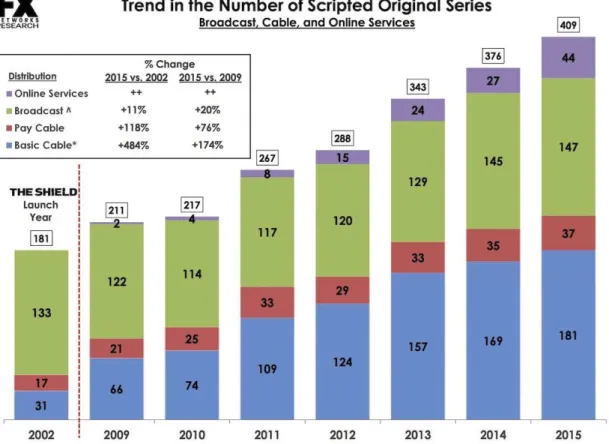
EPORTSIn spite of the rise of infringing bandwidth use in recent years, the investment in scripted TV-shows and original content does not seem to be slowing down. FX Networks, a famous American basic cable channel owned by the Fox Entertainment Group, released in the end of 2015 a research that shows a tremendous increase in original TV-shows (including broadcast, basic cable, pay cable and online services) from 2002 until 2015. (See Figure 1 below).
Figure 1: Trend in the Number of Scripted Original Series (2002-2015)
Source: FX Networks Research
As seen in the figure above, there was an explosion on the production of TV-shows that doubled in a 13 year period, which means than even considering the lost profits claimed by the production studios, it is still a highly profitable market to be in otherwise such a substantial increase would not be noticeable. Therefore this figure supports the idea that (so far) piracy has not undermined artistic creation and development in terms of scripted television material.
6
In 2008, Swedish prosecutors filed charges against the owners of the famous torrent tracking website The Pirate Bay. They were accused of administering, hosting and developing the website that facilitated the access to copyrighted materials. Among the harmed companies that demanded compensation, were 20th Century Fox, Colombia Pictures and Warner Bros. A documentary released
on YouTube by the same people being legally charged, overlooked how the whole process was treated by the Swedish authorities. Although the defendants alleged that they merely operated a platform that allowed people to share whatever they want between them and that no copyrighted material was found hosted on their servers, the defendants were found guilty of “accessory to crime against copyright law, strengthened by the commercial and organized nature of the activity”, and sentenced to one year of jail and a fine of approximately 3.5 million dollars. Even after appeals from The Pirate Bay members on the next legal stances available, they were still found guilty on one of the most famous piracy trials.
A little further ahead in 2012, in what was probably the most mainstreamed piracy lawsuit, the popular file hosting website Megaupload, that, at the time, had 150 million registered users, was seized due to allegations of violation of piracy laws. His iconic founder, Kim Dotcom, and other 3 executives were arrested in Auckland and all their assets seized. Following Megaupload’s shut down, several other big players at the time either shut down as well in fear of ending up like Megaupload or limited their operations to avoid illegal file sharing through their servers such as only allowing the user who upload the file to posteriorly download it, ceasing the sharing feature.
In recent statistics is found that most people current embracing file sharing activities in the last 12 months are sharing up to 50% of television and movie content from different regions of the world. A great example of this is the huge television success Game of Thrones that leads the underground world for the fourth year in a row as the most downloaded TV show of the year (Ernesto 2016). This is an ambiguous claim due to the launch and growing buzz around paid online video streaming services that have been proven successful, so why doesn’t online piracy show signs of slowing down?
7
The above statistics regard the total amount of infringing bandwidth usage not just TV-shows, but if we take a look at the percentage of Television files , in the 12,500 most popular torrents of January 2013, we find that 15,3% of said torrents are TV-shows, only surpassed by Pornography (30,3%) and Movies (33,4%). Although through this analysis, it was not divided the quota between movies and TV shows on the video streaming website analysis, these two are the only options since you obviously can’t use a video streaming website to download for example, software. But even without these detail, the amount of users who used these kind of websites in January 2013 ascended to 112 million users. (See Appendix for graph B1, B2 and B3 and for chart B4)
Also another important aspect that should be taken into account, is the so called Release Window business model that is more clear in movie releases but that still accounts for TV-show releases, where the distribution from its original airing (usually) in the USA to airing in different countries around the world can take up to a year (although the broadcasters have been trying to reduce this time).
The fact that we live in a globalized world cannot simply be ignored as it was for many years. The internet came to make the world smaller and enthusiasts of television simply do not want to wait more than a certain period of time to watch their favorite TV-show after they know that its already aired in their home country and therefore is available for (illegal) download just a few hours later. One of the reasons pointed out for this is the presence of the so called spoilersthat do exactly what they mean: they inform viewers of what happened in a certain episode before they were able to see it. The presence of these spoilers are everywhere: from social media such as Facebook to online platforms like 9gag.com. And the majority of users in this websites correlate with population usually associated with illegal download: teenagers and young adults. This effect influences even more the audience to watch the content before they have the chance to be “spoiled”. (Leaver 2008)
But not all unpaid consumption displaces paid consumption. If an individual values a film or a TV-show below its price (this being a movie ticket or an extra fee to pay for the specific channel), and proceeds to download it, his download does not displace a legal viewing of that content. This unpaid viewing merely creates consumer surplus, but on the other hand, if the individual valuates the content over the price, then his download creates sales displacement. (Danaher, Waldfogel 2012) A 2015 report from Tru Optik regarding 2014 illegal file sharing activities suggests a new approach that disregards tracker averaging and network bandwidth percentage and focuses on IP-verified media consumption aggregation and segmentation. More importantly than the results of this report (in more detail bellow), is the concept that its analysts promote: unmonetized demand. Quoting its definition: “The monetary quantification of consumer demand and audience engagement for which revenue is not currently captured”. It is important to mention once again, that a user that download something but does not consider worth buying should not be counted in this kind of research because in the absence of piracy the user would still not pay to consume such media. Although this being a valid premise, it is a too complex matter and virtually impossible to prove or disprove.
8
unmonetized demand we can find two that are originally distributed via Internet – Netflix – which proves that users using P2P networks have in consideration content quality (see figure C1 in annex).
Figure 2: Category of Downloads per million
Source: Tru Optik
9
3.
MARKET, BUSINESS AND TOOLS
The TV industry works differently from the other entertainment businesses because most of the content is distributed for “free” through a broadcast network. It is not actually free because in exchange for their shows, we, the consumers, are (or were) made to watch commercial breaks bombarded with advertisements. Even through paid cable, we are still exposed to advertisement and on contrary of for example new released movies , when you pay a fee to watch it, the crushing majority of TV content is not based on a pay-per-view scheme ( unless we speaking of the old classic Video on Demand).
3.1.
M
ARKET ANDB
USINESS3.1.1.
TV Show Business Model
It is, then, important to understand how producers of television actually earn revenue and therefore stimulate content creation. Although it is not an equal process for all studios and producers, the relationship between TV-shows and advertising is clear: a TV-show only stays on air if it has enough audience to screen ads during commercial breaks. Data from the AMC’s record breaking Breaking Bad, states that in the last two episodes, advertising rates were raised to 400.000$ per 30-second spot. While it was a tremendous investment to advertise during Breaking Bad’s intervals, each episode in 2010 was being shot for 3.000.000$ and 3.500.000$ for the last season. And even after the show ended in 2013, in 2015 AMC released a spin-off of the (in)famous lawyer Saul, Better Call Saul. AMC is a good example to portrait the importance of scripted TV-shows because it is one of the most recent success cases in the United States. In their 2012 financial report, AMC networks earned 1.25 billion dollars in revenues with 41.7% coming from advertising and 58.3% coming from distribution and affiliate fees.
Table 1:
AMC’s Gross Ad Sales and Growth
2010
2011
2012
Ad Sales
(Gross)
397.619.000$ 447.449.000$ 522.449.000$
Growth
N/A
13%
17%
Source: AMC Sales Source: AMC Networks, Inc. Annual Reports 2012
We can notice from the above table that in the years that converged in Breaking Bad’s mainstreaming (also adding the popular TV-Shows Mad Men and The Walking Dead) , that the ad revenues grew quite substantially. The popularity of these shows lifted a once small cable network channel, into the channel with most expensive ad air time in America (for those specific days). (See Appendix D1).
10
executives, joined by major advertisers and the press. This event allows marketers to buy television commercial air time “up front”, which means that schedule for TV ads is done several months in advance.
At this point it is important to notice that, the studio and the network broadcaster are often not the same, which means that their revenues are obtained differently. While the broadcasters, as seen above, have a huge percentage of their yearly revenues correlated with ad sales, the studios that produce the episodes have most of their returns divided between U.S broadcasting licenses and licensing fees from foreign distribution markets. Even more in recent years, foreign broadcasters play a more important role than ever in studio funding (Sharma 2014). With a decent group of scripted TV-shows going up to 3.000.000$ per episode, not even the huge American market has the economic power to support it all by themselves, which emphasizes the concept of globalization on the entertainment business.
The most recent breakthrough though, regards the paid online streaming services such as Netflix or amazon Prime. TV studios collect licensing fees by making available to these services all season of an already finished show, for a space of 1, 3 or 5 years (according to the contract).
3.2.
B
UNDLEDI
NTERNETS
ERVICESA wide variety of entertainment related online services has become available in the last few years. The trend now is not pay for a single song or movie, but rather to pay a subscription fee to access a bundled (yet limited) catalogue of media options. This includes almost every digital entertainment or information goods available: music, TV-shows and movies, videogames and even books.
The advantages of bundling have long been identified in previous research (Kenney, Klein 1983) such as: efficiency due to transaction costs, evasion of price control or reducing search and sorting costs. Of course, since we are talking about information goods, the plot thickens.
11
3.2.1.
Online Bundling Music Services
Being music the form of entertainment that requires both, less space in a hard drive and less amount of broadband to download or transfer, it was music files that firstly conquered the masses and led illegal consumers to the legal market.
Online Music Bundling Services consist of a set of companies that make available (almost) all the songs from every artist you can imagine into a single program or application for a monthly or yearly fee. These companies provide digital rights management-protected content from record labels and media companies and without a doubt the most successful one so far is Spotify (although there are several major players in the market like Deezer, Google Play or Rdio, none of these actually matches Spotify’s numbers) with almost 35 million paying users by March 2016 (as you can see in figure 3 below). In order to capture clientele, Spotify made the computer version of its software free of charge and it’s available almost everywhere in the world ( most of the features require an internet connection both the free version and the premium one)..
Although revenues keep growing, so does the royalty costs of the enormous amount of artists that receive royalties every time someone listens to their tunes. In order to combat this, Spotify started combining deals with major telecommunication companies with the objective of boasting even more the number of premium users (since internet data connection is needed for most of the Premium features).
Figure 3: Number of Premium Spotify Users
12
3.2.2.
Online video Bundling Services
When companies started to understand the influence that the internet was having on the daily habits of people across the world, first movers created the so called online video bundling services. At this point in time, around the beginning of the 2010’s, VoD services were not a novelty: they had already existed for quite some time and customers were already familiarized with its concept.
Although different demographic groups presented different results, the amount of time that is now spent looking at a television has decreased substantially in recent years. Young individuals have no problems looking for entertainment online making them the group with the largest decrease in viewing hours when compared with middle aged and older individuals (Liebowitz, Zentner 2012) . The fact that now content was being accessed through a different device ( personal computer) than a television set, was seen as a business opportunity for some, hence the creation of these services. Up to the date of this dissertation, a wide variety of services is now available although a grand majority is highly targeted for the US market making it unavailable for clients in other countries. The most successful of these services so far is clearly Netflix and like with Spotify, Netflix started combining forces with ISP ( which nowadays are also cable TV providers) in order to maximize its potential customers (Ball 2015).
Figure 4: Number of Netflix Customers (2011-2016)
Source: Statista.com
13
3.2.3.
Online Gaming and e-book Bundling Services
Although the videogame industry is as or more developed than other parts of the entertainment business (mostly because of the massive amount of gamers that started playing games while being connected to the Internet) (Hsu, Lu 2004), there is still no company offering the same concept as Netflix for audiovisual content. Steam from Valve Corporation offers a platform where the user can buy individual games or small bundles of games for cheaper prices (digital rights management), also offering multiplayer gaming as well as social networking services among others but there is not an option to pay a monthly fee in order to access the whole gaming database. It is estimated that 75% of games bought online were downloaded via Steam. Contrarily to music and movies, games are substantially more expensive when they are released (usually around 60€-70€). Another reason that might explain this phenomena is the fact that the size of a game today can go up to 35 GB (see figure 5 below) which implies a much longer waiting period to download it via Torrent and more importantly, the fact that the latest gaming software is starting to imply that the game has to be connected online via (for example) the Steam platform, making it much harder for hackers to release the so called “cracks” if they are even released at all. But being games an interactive activity, and nowadays with high speed connection basically everywhere even when confronted with the possibility of playing the game, but because it’s a pirate version, the player can’t access the online community, and this works as a deterrent for illegal downloading.
Figure 5: Example of the size of one of the most popular games ever released
Source: www.extratorrent.date
14
3.3.
T
OOLS ANDT
ECHNOLOGIES FORO
NLNEC
ONTENTS
HARING3.3.1.
BitTorrent
–
Features and Advantages
BitTorrent is by far the most used peer-to-peer file sharing communications protocol in the world
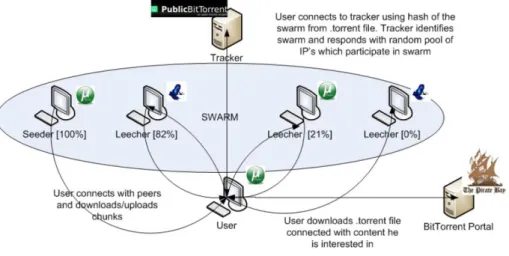
and can be used to download and share every kind of file (music, video files, software, eBooks, etc.). Its creation dates back to 2001 and it was originally designed by Programmer Bram Cohen, initially intended to share large non-infringing files such as distributions of the popular open source software Linux. BitTorrent came to revolutionize the way large files were distributed across the internet. Instead of downloading a file from a single source server, this protocol allows users to join a “swarm” that upload to/download from each other simultaneously and with this protocol, home computers can replace large servers while proficiently distributing files to several receptors.
Figure 6: How does the BitTorrent protocol works
Source: (Cuevas et al. 2011)
15
downloaded non sequentially and are protected by a cryptographic hash that safeguards that any modification to that piece can be detected, ensuring the authenticity of the original file.
So if the user does not have a problem in incurring in illegal file sharing, the fact is that there are several clear advantages for using BitTorrent. Among them we find:
Single Search – there is no current legal streaming video service that makes available all popular television show, in contrast with BitTorrent. With BitTorrent the user just needs to visit one single pirate website to find all the content that he’s looking for. In contrast, using the legal options, the user would most likely have to subscribe to provider X and pay for other content from provider X1 and X2.
Simple Indexing – with BitTorrent it’s much easier to find which new episodes were made available recently (due to the popularity in which they are being shared) than with the different available legal services.
Uniform Software and Interface – while the user of BitTorrent just needs to learn to interact with the same Graphical User Interface and have one media player that plays the downloaded files, the user of legal downloading and streaming websites must learn to interact with various GUI’s because it differs from service to service.
File Portability – While an illegal downloader may transport the files as they like ( nowadays a Pen Drive can carry more than one season of any TV-show), in order to watch it with friends or simply in another device ( from the PC screen to a bigger screen such as the TV set), it gets complicated with the legal services. The best example would be the Apple TV where, if you don’t own the actual Apple device you simply cannot watch it elsewhere other than the place where the file was downloaded.
Also a user who plays the video files from an external devices does not need an internet connection at the time, which cannot be said for most of the services available.
Access to Global TV – the pirate is not bound by American TV (which makes up most of the offer from legal suppliers). One best example of this is the recent spike in interest of Japanese content (Anime). The offer is only now beginning to expand to outside USA markets.
Low-Cost and Commercial Free – Almost every TV-show found on a torrent website will have commercials already taken out from the file.
16
3.3.2.
Other Methods for Accessing Content
Right now, there are 3 relatively easy ways to access (illegally) copyrighted materials (for the sake of this research we are focusing on video files): BitTorrent, online video streaming websites and Cyberlockers. There are other illicit forms to access said material, but compared with these three main players, their share of the underground market is insignificant in most regions of the world.
3.3.2.1.
Direct Download Cyberlockers
Cyberlockers (or a file hosting service) make available online storage space for users, giving a link to each file that can be shared with other users to facilitate downloads across a broader community. Like Video Streaming Websites, it operates in a two-stage process. First, the user tries to locate a file through a metasearch website or a dedicated forum. Then, after the URL is located, the user proceeds to download it through one of the many available file hosting services. Although its original use, was to make documents such as PDF files more available and easy to share, its use was quickly corrupted by people wanting to share infringing copyrighted material.
In the specific case of DDCs, usually the user gets privileges if he subscribes for the premium account. Depending on the size of the file ( the reader needs to keep in mind that, in the specific case of TV-shows, the quality of the video files, is increasing with time therefore so is the size of the file), the user may have to acess more than one hyperlink in order to download all the pieces that form the file. And, in this eventuality, if he doesn’t possess a premium account, he will have to wait an hour before downloading the second link and so on. This happens because there is a limit to how much a free user can download per hour. There a few major players with this business model such as BitShare, 4shared or MediaFire. It is also important to notice that the business model of said companies is supposed to be legal which means that in case of report of said links for infringing content, they will be taken down immediately. The company is not responsible for what is stored in their servers, the responsibility lays on its users.
3.3.2.2.
Online Video Streaming Websites
Streaming video has had a major role in distributing illegal content in recent years. This way of accessing infringing video files, consists of two types of websites that combined, allow users to watch their favorite movies or TV-shows. The first kind of website offers links to the searched content and are commonly known as video streaming link sites while the second type of website hosts the streaming video to the user using an HTML5 or Flash-based video player. These hosts, are commonly called “streaming cyberlockers” as they depict some of the features of direct download Cyberlockers: the user can upload content himself but most of the times the websites do not have a search bar, as an alternative, the user is given a link that can be shared online.
17
18
4.
METHODOLOGY
Traditionally, research made on technology acceptance has been focused on workplace software, in other words, software people would use to increase their productivity at the workplace. Since this master’s thesis has its focus on the adoption of leisure platforms (the online video bundling services), several external variables were added. The differences between utilitarian (workplace) and hedonic (leisure) have gradually drawn significant attention from Information Systems researchers (Marina Abad et al. 2010). The existing research on technology acceptance tends to emphasize the utilitarian aspect of information systems, focusing too much on Perceive Usefulness and Perceived Ease of Use alienating, for example, Perceived Enjoyment which in a leisure based platform is a significant variable. Having this in mind, we tried to reduce the focus on these two factors while still using them in the model.
Several other scientific research, emphasize the importance of adding other variables that measure the enjoyment the user has when interacting with the system or if the user finds it convenient enough to adopt it (Moon, Kim 2001; van der Heijden 2004). Hedonic information systems aim to provide self-fulfilling value rather than instrumental value for the user.
The choosing of this model was not only made because it is the most widely accepted model in academic literature but also because it permits for the addition of external variables that we considered crucial when researching about hedonic systems. In conclusion, it allows for the exploitation of the original model strengths while (hopefully) mitigating its weaknesses.
4.1.
T
HEORETICALB
ACKGROUND ON THETAM
M
ODEL19
users’ intentions. Perceived ease of use is understood as the level to which a person believes that using a particular system/interface will be without effort while perceived usefulness is the degree to which a specific system will enhance his job performance. Because these determinants are also easy to understand for system developers, they can and are considered during the system requirement analysis and posterior system development stages. TAM posits then that perceived usefulness will be influenced by perceived ease of use because, other thing being equal, the easier a technology is to use, the more useful it can be (Venkatesh 2000). While the original theory is based on inquiring systems that are primarily used in job/work like situations, the model used for this dissertation is slightly different: the system being analyzed is a leisure type kind of system. Its main purpose is for people to enjoy viewing their favorite TV-shows and movies in a VoD type of platform. This individual’s subjective enjoyment of the interaction has been empirically confirmed to be a significant predictor of important outcomes related to technology use, such as attitudes and extent of use (Webster & Trevino, 1992).Therefore other variables that captured the enjoyment captured by the interaction with the technology had to be included in the model. Many studies explained and predicted users’ information technology acceptance based on TAM with external variables, like self-efficacy when predicting consumer intention to use mobile services(Wang et al. 2006) ;perceived quality when investigating e-learning continuance intention (Roca et al. 2006); perceived value on user acceptance of wireless short messing services (Turel et al. 2007); or perceived convenience in an ubiquitous computing environment (Yoon, Kim 2007). Original TAM believed that external variables would affect perceived usefulness and perceived ease of use and that they would mediate technology acceptance, but more recent studies found that external variables not only affected technology acceptance indirectly by these two variables but also affected technology acceptance directly. (Moon, Kim 2001) (Yoon, Kim 2007).
20
4.2.
F
ORMULATION OFH
YPOTHESIS ANDC
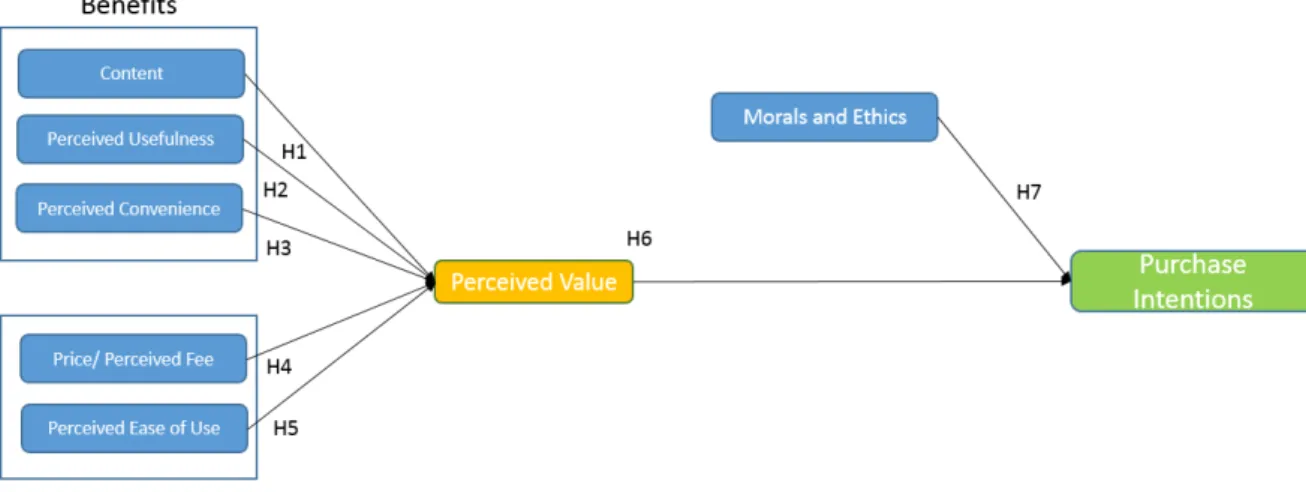
ONSTRUCTSWhen designing the model, for maximum understanding and simplicity, the variables were divided into two groups which we thought respondents would understand as beneficial as Benefits (positive impact), and the variables that we thought would be understood as prejudicial (negative impact), as Hindrances. The last two hypothesis though, concern how (1) Perceived value and (2) Morals and Ethics, influence purchase intentions.
4.2.1.
Benefits
4.2.1.1.
Content
This master thesis examines content as an external variable for perceived value. Content is usually defined as a construct which has dimensions of exactness, relevance, and sufficiency (Doll, Torkzadeh 1991) . A more recent synthesis of previous concepts of content define it as an individual’s assessment of credibility, timeliness, sufficiency and relevance of information provided by a content provider. (Wulf et al. 2006). In this master thesis though, the previous definition is accepted with the exception of credibility. In the case of an entertainment-oriented problematic such as online video bundling services, credibility is not easily applied in an individual’s cognitive understanding of content. Hence, we accept the concept of content as a consumer’s assessment that program are relevant, up-to-date and sufficient.
Previous research emphasizes that content is a significant predictor of positive responses in website satisfaction (Wulf et al. 2006) , end-user computer satisfaction (Doll, Torkzadeh 1991) and perceived success of websites (Palmer 2002) . Jung, Perez-Mira and Wiley-Patton (2009) found that content had a crucial influence on user’s beliefs driving behavioral intention on adopting mobile TV.
Content is therefore one of the most important variables in the model: the fact that people need to pay a subscription fee in order to access said content and that not all online video bundling services provide the exact same content symbolizes a choice between providers or even the adoption (or not) of said platform for visualizing audiovisual content. It takes an even bigger importance now that online video providers decided to invest in the production of their own TV-shows and documentaries (Netflix’s “House of Cards”, Hulu’s “11.22.63” or Amazon Prime’s “The Man in the High Castle” among many other examples) and make most of them only accessible through their own individual platforms.
So, having in mind that we’re researching an online video platform which is basically an entertainment service, content should have a direct influence on consumers’ perception of value for using this platform. While boring, repeated or unoriginal similar content may make consumers perceive a low level of utility for the service, an exciting and unique content may provide greater satisfaction and consequently induce a higher perception of value.
21
Table 2 : Content construct variables
Construct Variables Code
Content
Online video bundling services provide up-to-date content C1 Online video bundling services provide sufficient content C2 Online video bundling services provide content pertaining to my concerns C3 Online video bundling services provide content that I need C4
Source: an adaptation from (Jung et al. 2009)
When setting up variables that determine the Content construct, it was used a basis from Jung, Mira and Wiley-Patton from 2009, from their research on consumer adoption of mobile TV. The statements were then tailored to fit the research at hand.
4.2.1.2.
Perceived Usefulness
Previous research suggests that people tend to use or not to use an application to the extent they believe it will help them perform better their job. (Davis 1989) Perceived usefulness is defined here as “the degree to which a person believes that using a particular system would enhance his job performance”. This variable is one of the two most important when using the original TAM model. Pikkarainen et al. (2004) when applying the TAM model in Finland, found that perceived usefulness is a determinant of actual behavior which encouraged users of the banking system to use more user-friendly self-service technologies that give the user a greater autonomy. There are several other scientific evidence proving the significance of perceived usefulness on adoption intention (Chen, Barnes 2007) (Venkatesh 2000) .A system possessing high perceived usefulness is one for which the user believes in the existence of a positive use-performance relationship. Perceived usefulness, according to Davis et al. (1992), is connected with the extrinsic motivations for adoption: “extrinsic motivations refers to the performance of an activity because it is perceived to be instrumental in achieving valued outcomes that are distinct from the activity itself”.
H2
–
Perceived Usefulness is positively related to perceived value in the context of online
video bundling services.
Table 3: Perceived Usefulness construct variables
Construct Variables Code
Perceived Usefulness
Online video bundling services enable me to fulfill the purpose of visualizing content more quickly PU1 Online video bundling services enable me to fulfill the purpose of visualizing content effectively PU2 Online video bundling services enable me to satisfy the purpose of visualizing content easily PU3
Source: an adaptation of (Hsu, Lu 2004)
22
4.2.1.3.
Perceived Convenience
With the developments achieved in the last decade when taking mobile technologies into consideration, and the increasing ubiquity in the surrounding environment, it was evident that the existing online video bundling services would start making available their content for online platforms such as smartphones and tablets pending an online connection.
A product or service is considered to be convenient when it saves time for a user or more specifically when it lowers the cognitive, emotional and physical burdens for a user (Berry et al. 2002). In one of the first academic literature about the significance of convenience of a product or service, five dimensions were used: time, place, acquisition, execution and use (Brown 1990). More recent literature, found that convenience in accessing technology is not definitely related to intention to use the technology and that convenience in use is too similar to the ease of use variable. So Yoon and Kim (2007) defined perceived convenience as a level of convenience toward time, place and execution that one perceives when using wireless networks to complete a task. Perceived convenience was also added with the same definition as Yoon and Kim’s (2007)to TAM when researching about m-learning of the English Language for college students (Chang et al. 2012) . Therefore, based on the perspective mentioned above, perceived convenience is understood in this dissertation as the level of convenience towards time, place and execution that one feels when interacting with online video bundling services.
H3
–
Perceived Convenience is positively related to perceived value in the context of
online video bundling services.
Table 4: Perceived Convenience construct variables
Construct Variables Code
Perceived Convenience
I can visualize TV-shows/movies at any time via online video bundling services PC1 I can visualize TV-shows/movies at any place via online video bundling services PC2 Online video bundling services are convenient for me to engage in visualizing TV-shows/movies PC3 I feel that online video bundling services are convenient for me watch TV-shows/movies PC4
Source: an adaptation from (Chang et al. 2012)
23
4.2.2.
Hindrances
4.2.2.1.
Price/Perceived Fee
The price or perceived fee (since all the online video bundling services sell their services through a monthly or annual subscription package) refers to the monetary sacrifice also known as the consumer’s financial payment for the online video service. From the consumer’s cognitive perception, price is something that must be given up or sacrificed in order to obtain kinds of products and services (Bei, Chiao 2001). Zeithaml (1982) posited that customers usually do not remember the objective price of a product. Instead, customers encode price in ways that are meaningful to them (Zeithaml 1982).
The concept of perceived price is based on the nature of the competitive-oriented pricing approach. This approach focuses on costumers’ concerns about whether they are being charged more than or about the same as charged by competitors (Ryu, Han 2010). This perceived price would include both monetary and nonmonetary prices such as time and effort to the consumer (Zeithaml 1988) but in this dissertation the nonmonetary costs are took into account with the perceived ease of use variable.
The direct effect of variables with similar meaning in other research papers suggests that a perceived fee could be a potential barrier to decrease the likelihood of the user’s behavioral intentions to adopt and use an IS (Kim et al. 2009) , in this case, an online video bundling service. Also, previous research suggests that not only perceived fee/perceived price has a direct influence on perceived value but also, that perceived fee/perceived price is negatively related to perceived value (Zeithaml 1988) (Kim et al. 2007) (Chu, Lu 2007) . So in this dissertation, perceived fee is defined as the extent to which a customer believes that using an online video bundling service is expensive.
H4 - Price/Perceived Fee is negatively related to perceived value in the context of online
video bundling services.
Table 5: Price/Perceived fee construct variables
Construct Variables Code
Price/Perceived fee
The fee that I have to pay for the use of online video bundling services is too high MF1 The fee that I have to pay for the use of online video bundling services is not reasonable MF2 I am not pleased with the fee that I have to pay for the use of online video bundling services MF3
Source: an adapation of (Wang et al. 2013)
To estimate the perceived fee, an adaptation of Wang’s research on what drives purchase intention in online services was used. In his research, online music services were the main target so the statements were tailored from “online music services” to “online video bundling services”.
4.2.2.2.
Perceived Ease of Use
24
they can, at the same time believe that the platform is too hard to use and that the performance benefits of usage are outweighed by the effort of using the application (Davis 1989) . It refers to “the degree to which a person believes that using a particular platform would be free of effort”: all else remaining the same, an application perceived to be easier to use than another is more likely to be accepted by users. Perceived Ease of Use deals with user motivation that is based on the assessment of the intrinsic aspect of using an IT system like the interface and the process involved in using it (Gefen, Straub 2000). According to Davis et al (1992), “intrinsic motivation refers to the performance of an activity for no apparent reinforcement other than the process of performing the activity per se”.
H5
–
Perceived Ease of Use is negatively related to perceived value in the context of online
video bundling services.
Table 6: Perceived Ease of Use construct variables
Construct Variables Code
Perceived Ease of Use
It is easy for me to become skillful at visualizing content through an online video bundling service PEU1 Learning to visualize content through an online video bundling service is easy for me PEU2 It is easy to watch online video content PEU3
Source: an adaptation from (Hsu, Lu 2004)
Like in the Perceived Usefulness construct variables, also regarding Perceived Ease of Use the work of Hsu and Lu on online gaming was used. The statements were chosen in order to try to understand if the respondents found it easy to interact with the online video bundling services, or if in the other hand they would recognize it as troublesome to use.
4.2.3.
Perceived Value
The consumer’s perceived value believed to be the most important prerequisite of purchase intentions. Perceived value is conceptualized as a trade-off between perceived benefits and perceived sacrifices (Monroe 1979) . The features that constitute value are highly personal and idiosyncratic meaning that the definition of value varies extensively from individual to individual (A.Zethaml, 1988). Perceived value is posited to be higly associated with service quality and customer satisfaction (Tarn 1999). A.Zethaml (1988) synthetized during her research, the concept of Perceived Value into four different definitions that together conceptualize what can be understood what value is and what drives consumers into purchase: Value is low price,Value is whatever I want in a product, Value is the quality I get for the price I pay, Value is what I get for what I give. By summing up these four expressions of consumer value we get that perceived value is the consumer’s overall assessment of the utility of a product based on perceptions of what is given and received.
25
since the user will have to consider the cost of learning how to use it. (Kim, Chan, & Gupta, 2005) (Chen & J.Dubinsky, 2003).
The perceived value is then related with the overall benefits and sacrifices that the costumer deliberates when considering acquiring a subscription in an online video bundling service such as Netflix or Hulu.
H6 - Perceived value is positively related to purchase intentions in the context of online
video bundling services.
Table 7: Perceived Value construct variables
Construct Variables Code
Perceived Value
Compared to the fee I need to pay, the use of online video bundling services offers value for money PV1 Compared to the effort I need to put in, the use of online video bundling services is beneficial to me PV2 Compared to the time I need to spend to access content illegally, the use of online video bundling services is
worthwhile to me PV3
Overall, the use of online video bundling services delivers me good value PV4
Source: an adaptation from (Wang et al. 2013)
The groundwork for the Perceived Value construct was also the research of Wang et al., where the statements were drawn from. Since their research on online music services is similar to what we are trying to accomplish, it was logical to use their variables that explore the Perceived Value construct.
4.2.4.
Morals and Ethics
26
H7
–
Morals and Ethics are positively related to purchase intentions in the context of
online video bundling providers.
Table 8: Morals and Ethics construct variables
Construct Variables Code
Morals and Ethics
I would feel guilty if I pirated video content ME1 To pirate video content goes against my principles ME2 It would be morally wrong of me to pirate video content ME3
Source: an adaptation of (Yoon 2011)
In order to develop the variables for the Morals and Ethics variables, insight from Yoon’s 2011 research on the Ethics Theory in digital piracy was taken into consideration. Although in the original research this construct was insightfully denominated “Moral Obligation”, this paper is not focused exclusively in the moral perceptions of the respondents. It is still expected though, that this construct will be one of the most influential when it comes to purchase intentions.
4.2.5.
Purchase Intentions
Purchase Intentions has been a recurrent researched topic in a wide variety of fields, also including information goods. It is a subject of higher value to companies since it can determine the reasons why consumers adopt and consume different products, therefore providing valuable information to corporations that want to better understand and serve their customers. Consumer’s intentions to purchase online at electronic commerce websites (van der Heijden et al. 2003); the impact of brands social media presence on purchase intentions (Naylor et al. 2012) ; or how online word of mouth influences purchase intentions (Prendergast et al. 2010).
The final question of the survey, questioned respondents about their future intentions of subscribing to an online video bundling service. This question will serve the purpose of measuring just how many people are considering the adoption of such services knowing they can do it via an illegal option.
Table 9: Purchase Intentions construct variables
Construct Variables Code
Purchase Intentions
I plan to pay for online video bundling services in the future PI1 I intend to purchase online video bundling services in the future PI2 I predict I would buy online video bundling services in the future PI3
Source: (Wang et al. 2013)
27
4.3.
D
ATAC
OLLECTIONEmpirical data was collected by conducting an online survey through the www.1ka.si platform. Dissemination of the survey was made via e-mail, posted and shared on social media (www.facebook.com ; www.linkedin.com ) and posted on diverse Torrent communities both public and private (www.kat.cr ; www.scene-rush.com ). The message stated the purpose of this study, providing a hyperlink to the survey form. No specific range of demographics was targeted although answers were expected to be given mostly by young adults ranging from 18-30 since that is the significant age of the population that incurs in illegal downloading. The data was collected from 20th
May to 8th June, which totals for 15 days online.
A likert scale with a range from (1) Strongly Disagree to (7) Strongly Agree was used to analyze the respondents’ opinions’. It was believed that when using a variation of the TAM model, the best option to relate with the model would be a likert scale.
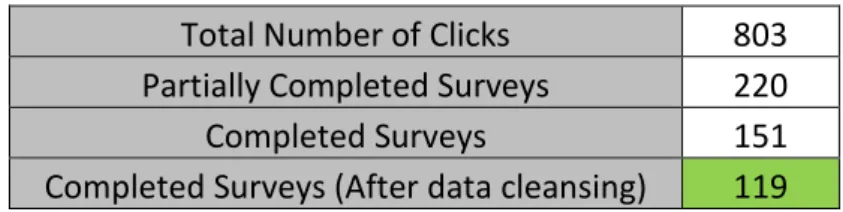
As the reader can verify in the table below (table 9), although the online survey got through a big number of people, only around 10% of them completed the survey from beginning to end. The total number of considered surveys (the sample) for this research is 119 questionnaires after data cleansing.
Data cleansing was performed manually through a Microsoft Excel data sheet (CSV file import). When analyzing the data, there were found some inconsistencies in some completed surveys: there were several people that answered some of the questions and then pushed the forward button until the end of the questionnaire without answering all the required questions. This happened through the mobile app of the survey website, since this exact situation was previously tested in the computer platform. From the 151 completed surveys, 32 were considered unfit to be a part of this sample.
Table 10: Survey Range
Total Number of Clicks
803
Partially Completed Surveys
220
Completed Surveys
151
Completed Surveys (After data cleansing)
119
The usage of online research has already been accepted by IS researchers in previous literature (Bhattacherjee 2001;Wright 2005; van Selm, Jankowski 2006). Tan and Teo (2000) were among the first to suggest that online field surveys have several advantages over traditional paper-based mail-in-surveys: cheaper to make, faster response rate and geographical barriers are non-existent.
28
channel. The main purpose of this research is to try to understand why people that can and are accessing content through illegal channels do or do not contemplate paying for a legal service. The profile of the sample is presented below in Table 10, where we can see that out of the 119 valid responses analyzed, two age groups presented the majority of all responses (from 18 to 34 years old). It was predictable that it would be so, since students and recently graduated youngsters are the majority of people that knows how to access illegal content (Oberholzer‐Gee, Strumpf 2007) , between the two having a staggering 84,03% of the population of the sample. While gender wise, the sample is pretty much equally divided, regarding the occupation of the respondents the majority was either studying (55,46%) or already employed (42,86%) therefore presenting a group where the majority of the population had superior education (69,75%).
Table 11: Demographic characteristics of the sample
Sample Characteristics (%)
Age Group
<18 0%
18-24 54,62%
25-34 29,41%
35-44 10,92%
45-54 5,04%
>55 0%
Gender
Male 50,42%
Female 49,58%
Job Description
Employed 42,86%
Unemployed 1,68%
Student 55,46%
Retired 0%
Highest Degree Received
No schooling completed 0,84%
High School 29,41%
Bachelor's Degree 37,82%
Master's Degree 29,41%
Doctorate's Degree 2,52%
Watches TV-Shows regularly
Yes 78,15%
29
4.4.
D
ATAA
NALYSISM
ETHODSTo analyze the collected data of the 119 valid questionnaire responses and to empirically assess the relationships defined by the extended TAM model that was designed, descriptive statistics were utilized and the structural equation model (SEM) applied due to its ability to assess unobservable “latent” constructs. The chosen method to proceed with the research was the Partial Least Squares (PLS) since it is the best method for empirical testing of structural models, through the SmartPLS software (Ringle, C. M., Wende, S., and Becker, J.-M. 2015).
30
5.
RESULTS
The evaluation of the research model was conducted in two stages: firstly, the measurement model was analyzed, where the reliability and validity of the model constructs was evaluated. Secondly, the structural model with hypotheses was tested.
5.1.
M
EASUREMENTM
ODEL:
V
ALIDITY ANDR
ELIABILITYIn order to determine construct validity, two elements of factorial validity were examined: convergent validity and discriminant validity. By taking into consideration these two validities, it is possible to figure out just how well the measurement items relate to the constructs. Convergent validity is shown when each measurement item is highly correlated with its theoretical construct while discriminant validity stands out when each measurement item correlates dimly with all other constructs except for the one to which it is theoretically associated (Gefen, Straub 2005).
Convergent validity was studied using the Average Variance Extracted (AVE). Keeping in mind that in order to ensure a sufficient degree of convergent validity the value of AVE should be greater than 0.50, and by looking at Table 12 we can verify that all the values are bigger than 0.6 therefore demonstrating convergent validity.
Table 12: Validity and Reliability Indicators
Constructs Cronbach's Alpha Composite
Reliability AVE
Content 0,885 0,920 0,742
Morals and Ethics 0,939 0,961 0,892
Perceived Convenience 0,828 0,883 0,656
Perceived Usefulness 0,851 0,910 0,771
Perceived Value 0,882 0,918 0,739
Perceived Ease of Use 0,850 0,906 0,763
Price/Fee 0,882 0,926 0,808
Purchase Intentions 0,980 0,987 0,961