online | memorias.ioc.fiocruz.br
Detection of tuberculosis drug resistance: a comparison by
Mycobacterium tuberculosis
MLPA assay versus Genotype
®MTBDR
plus
Paula Fernanda Gonçalves dos Santos1, Elis Regina Dalla Costa2,7/+, Daniela M Ramalho1,
Maria Lucia Rossetti2,3, Regina Bones Barcellos1,2,7, Luciana de Souza Nunes4,
Leonardo Souza Esteves2, Rodrigo Rodenbusch2, Richard M Anthony5, Indra Bergval5,
Sarah Sengstake5, Miguel Viveiros6, Afrânio Kritski1,7, Martha M Oliveira1,7
1Universidade Federal do Rio de Janeiro, Faculdade de Medicina, Programa Acadêmico de Tuberculose, Programa de Pós-Graduação em Clínica Médica, Rio de Janeiro, RJ, Brasil
2Fundação Estadual de Produção e Pesquisa em Saúde, Centro de Desenvolvimento Científico e Tecnológico, Porto Alegre, RS, Brasil 3Universidade Luterana do Brasil, Porto Alegre, RS, Brasil
4Universidade Federal do Rio Grande do Sul, Centro de Biotecnologia,
Programa de Pós-Graduação em Biologia Celular e Molecular, Porto Alegre, RS, Brasil 5Royal Tropical Institute, KIT Biomedical Research, Amsterdam, The Netherlands 6Universidade Nova de Lisboa, Instituto de Higiene e Medicina Tropical,
Unidade de Microbiologia Médica, Global Health and Tropical Medicine, Lisboa, Portugal 7Rede Brasileira de Pesquisa em Tuberculose, Rio de Janeiro, RJ, Brasil
BACKGROUND To cope with the emergence of multidrug-resistant tuberculosis (MDR-TB), new molecular methods that can routinely be used to screen for a wide range of drug resistance related genetic markers in the Mycobacterium tuberculosis genome are urgently needed.
OBJECTIVE To evaluate the performance of multiplex ligaton-dependent probe amplification (MLPA) against Genotype® MTBDRplus to detect resistance to isoniazid (INHr) and rifampicin (RIFr).
METHOD 96 culture isolates characterised for identification, drug susceptibility testing (DST) and sequencing of rpoB, katG, and inhA genes were evaluated by the MLPA and Genotype®MTBDRplus assays.
RESULTS With sequencing as a reference standard, sensitivity (SE) to detect INHr was 92.8% and 85.7%, and specificity (SP) was 100% and 97.5%, for MLPA and Genotype®MTBDRplus, respectively. In relation to RIFr, SE was 87.5% and 100%, and SP was 100% and 98.8%, respectively. Kappa value was identical between Genotype®MTBDRplus and MLPA compared with the standard DST and sequencing for detection of INHr [0.83 (0.75-0.91)] and RIFr [0.93 (0.88-0.98)].
CONCLUSION Compared to Genotype®MTBDRplus, MLPA showed similar sensitivity to detect INH and RIF resistance. The results obtained by the MLPA and Genotype®MTBDRplus assays indicate that both molecular tests can be used for the rapid detection of drug-resistant TB with high accuracy. MLPA has the added value of providing information on the circulating M. tuberculosis lineages.
Key words: tuberculosis - MLPA - GenoTypeMTBDR®plus - isoniazid resistance - rifampicin resistance - multidrug resistance
doi: 10.1590/0074-02760160376
Financial support: CNPq/MCT (Process CNPq/INCT-TB 573548/2008-0, 478033/2009-5), FAPERJ (E: 26/110974/2011).
MV was supported by project “Ciência sem Fronteiras/Professor Visitante Especial” (CAPES/MEC/Brazil - Nº 88881.064961/2014-01).
+ Corresponding author: [email protected] Received 19 August 2016
Accepted 21 February 2017
Tuberculosis (TB), despite being a curable infectious disease, persists as a global health problem that affects millions of people each year (WHO 2015). Drug-resist-ant and multidrug-resistDrug-resist-ant tuberculosis (DR/MDR-TB) have increased worldwide, demanding the development of new drug resistance detection assays. The early de-tection of mycobacterial clades can also support timely patient management, as some spoligofamilies have been associated with outbreaks, multidrug resistance or more aggressive forms of TB disease (Narvskaya et al. 2002, Gomes et al. 2012, Dalla Costa et al. 2015).
al. 2002, Simons et al. 2015). However, no epidemiologi-cal information on the M. tuberculosis lineage is pro-vided by this test. Thus, assays able to test for genome dispersed molecular characteristics in a single step are appealing and the multiplex ligation-dependent probe amplification (MLPA) technique is able to achieve the above-mentioned objective (Bergval et al. 2008). MLPA is a molecular method that allows simultaneous multi-plex detection of a large number of SNPs and/or genetic markers by amplification of sequence-specific MLPA probes rather than the target DNA, without loss of am-plification efficiency, as observed in a regular multiplex polymerase chain reaction (PCR) with too many ampli-fication targets (Schouten et al. 2002). The presence of an MLPA product indicates the presence of the corre-sponding targeted SNP or genetic marker.
This study evaluates the ability of a highly-multiplexed MLPA assay designed to detect an extended number of mutations in different M. tuberculosis lineages iso-lated from Brazilian patients (Bergval et al. 2008). This MLPA assay was compared with the WHO-endorsed Genotype®MTBDRplus assay, using DNA sequencing and conventional drug susceptibility testing (DST) as reference gold-standard methods for the genotypic and phenotypic characterisation of drug resistance in these strains.
MATERIALS AND METHODS
Setting and routine laboratory procedures - In a retro-spective study carried out at a reference TB hospital and secondary Health Unit in the Rio de Janeiro city, Brazil, between January 2004 and July 2006, 96 M. tuberculo-sis isolates were obtained (one sample per patient) on the basis of routine testing. The isolates were confirmed as containing acid-fast bacilli by microscopy detection on Ziehl-Neelsen stained slides prepared from the cultures in Lowenstein-Jensen medium. Standard bacteriological and biochemical tests were performed for differentiation of species within the M. tuberculosis complex (MTBC) and mycobacteria other than tuberculosis (MOTT), includ-ing biochemical testinclud-ing for niacin, paranitrobenoic acid (PNB) and tiofeno-2-carboxylic acid hydrazine (TCH) (MS 2010). Subsequently, the isolates were submitted to DST using the proportion method on Lowenstein-Jensen solid media (Canetti et al. 1969), following the Brazilian Ministry of Health recommended breakpoints for M. tu-berculosis DST on solid media [isoniazid 0,2 µg/mL; eth-ambutol (EMB) 2 µg/mL; streptomycin 4 µg/mL; pyra-zinamide (PZA) 25 µg/mL] (MS 2010).
MLPA design of probes - The probes used were as pre-viously published and described by Bergval et al (2008), with exception the IS6110 probe. In summary: seventeen discriminatory markers were selected, and MLPA probes were designed accordingly, to provide information about drug resistance, principal genotypic group (PGG), and (mycobacterial) species (Table I) (Bergval et al. 2008). (i) Drug resistance markers (targeted by probes rpoB-522, rpoB-526G, rpoB- 526T, rpoB-531, rpoB-176, inhA-15, katG-3inhA-15, and embB-306). Probe embB-306 targets the wild-type sequence, since many different base pair changes can occur in this codon. (ii) Genotypic
mark-ers (gyrA codon 95, katG codon 463) to discriminate be-tween the three PGGs. (iii) The mutT2 codon 58, mutT4 codon 48, ogt -12, ogt-37 and ogt-15 to identify putative virulent strains, such as the various Beijing and Haar-lem lineages, respectively (Table I). (iv) Discriminatory region (specific to members of the MTBC): 16S rRNA gene. (v) Probe targeting TbD1: a region that is absent in the genome of “modern” M. tuberculosis strains but pres-ent in all other members of the MTBC.
Genotypic characterisation - Genomic bacterial DNA was extracted from M. tuberculosis cultures ac-cording to a standard protocol described by van Soolin-gen et al. (1994). Spoligotyping was performed according to Gomgnimbou et al. (2013), using a microbead-based DNA chip read on a MagPix system (Luminex, Austin, TX). The online database SITVIT WEB (Demay et al. 2012) was used to compare the results with the interna-tional shared spoligotypes.
DNA sequencing procedures - The key genomic re-gions involved in the INH resistant phenotype (katG and
inhA genes) and RIF resistant phenotype (rpoB gene) were amplified and sequenced according to protocols previously published (Dalla Costa et al. 2009), respec-tively. Briefly the sequencing amplifications were car-ried out in an Applied Biosystems® Veriti® 96-Well thermo cycler (Thermo Fischer Scientific, California, EUA) as follows: 94ºC for 2 min, 55ºC for 1 min, and 72ºC for 2 min, for 30 cycles. Amplification products were analysed by electrophoresis in 1.5% agarose gels, purified PCR products were purified with the polyethyl-ene glycol method and sequenced by using the Big Dye Terminator Cycle Sequencing v 3.1 Kit (Applied Biosys-tems, Foster City, CA, USA) in the ABI Prism 3130xl
DNA Sequencer (Applied Biosystems).
GenoType® MTBDRplus assay - The Genotype®
MTBDRplus assay was carried out according to the manufacturer’s instructions [Hain Lifescience, Nehren, Germany, (Crudu et al. 2012)].
MLPA analysis - All MLPA reagents were manufac-tured and supplied by MRC-Holland (Amsterdam, The Netherlands). The fragments were analysed using an ABI 3130xl Genetic Analyzer (Applied Biosystem, Fos-ter City, CA, USA) capillary electrophoresis instrument. The evaluation of these fragments was performed using GeneMapper, software version 3.2 (Applied Biosystem, Foster City, CA, USA).
Statistical analyses - Statistical analysis was per-formed using the SPSS v.21 statistical program (SPSS Ins. Chicago, IL, USA). Agreement between the meth-ods was evaluated using the kappa score.
RESULTS
Mem Inst Oswaldo Cruz
, Rio de Janeiro, V
ol.
112
(6), June 2017
TABLE I
Summary of the multiplex ligaton-dependent probe amplification (MLPA) probes used in this study as published by Bergval et al. (2008)
Probe Target-specific sequence Length (bp) Target or information provided
embB-306 GTCGGACGACGGCTACATCCTGGGCATggcccgagtcgc cgaccacgccggctac 142 EMB resistance marker
katG-315 caccggaaccggtaaggacgcgatcaccaCCGGCATCGAGGTCGT ATGGACGAACACCCC 160 INH resistance marker
inhA-15 CGATTTCGGCCCGGCCGCGGCGAGATgataggttgtcggg gtgactgccacagcc 178 INH resistance marker
16S rRNA CACGGGATGCATGTCTTGTGGTGGAAAgcgctttagcggt gtgggatgagcccgcggc 202 16S rRNA gene, MTBC specific
rpoB-176 cacgttcatcatcaacgggaccgagcgtgtggtgTTCAGCCAGCTGGT GCGGTCGCCC 229 RIF resistance marker
rpoB-531 GTTGACCCACAAGCGCCGACTGTTggcgctggggcccggcg gtctgtcacgt 256 RIF resistance marker
rpoB-526G caacccgctgtcggggttgaccGACAAGCGCCGACTGTCGGCG CTGGGGCC 265 RIF resistance marker
rpoB-526T caacccgctgtcggggttgaccTACAAGCGCCGACTGTCGGCG CTGGGGCC 274 RIF resistance marker
rpoB-522 agccaattcatggaccagaacaacccgctgtTGGGGTTGACCCACA AGCGCCGAC 283 RIF resistance marker
katG-463 GATTGCCAGCCTTAAGAGCCAGATCCGggcatcgggatt gactgtctcacagctagtttcgacc 319 Genotype marker, specific for PGG two and three
gyrA-95 GCACGGCGACGCGTCGATCTACGACACcctggtgcgcat ggcccagccctgg 328 Genotype marker, specific for PGG one and two
mutT2-58 CCCGAGAGCTCGCCGAAGAACTGCgactcgaggtcgccga cctcgcggtggg 355 Genotype marker, specific for Beijing two
mutT4-48 CGACCCCGGCAACGGCGAAGGggtcccggtcccgctcacctcg tcgcgggt 364 Genotype marker, specific for Beijing one, two and three
ogt-12 CGCACCATCGATAGCCCCATCGGAccattaaccctggccggg catggctcggtgttga 373 Genotype marker, specific for Beijing two
ogt-15 taccgcaccatcgatagccccatcgggccattaaGCCTGGCCGGGCAT GGCTCGGTGTTGA 382 Genotype marker, specific for Haarlem
ogt-37 cctgcggatgctcgagcagacgtatgagccaagccTCACACACTGGAC ACCCGACCCC 391 Genotype marker, specific for Beijing three and four
TbD1 GCGGTCGCGGGATTCAGCGTCTATcggttgcacggcatcttc ggctcgcacgaca 418 Absent in modern Mycobacterium tuberculosis strains
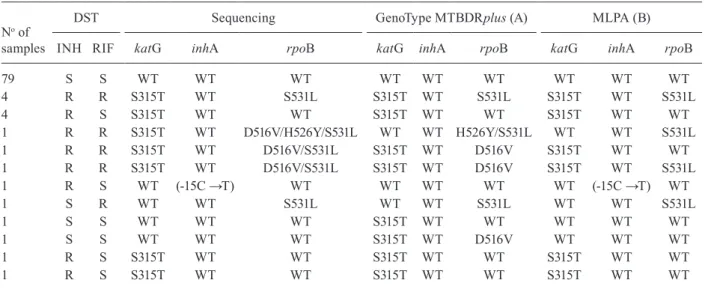
Relation between phenotypic resistance and mutations in drug-resistance targets for INH and RIF - From the 14 INH resistant strains characterised by the standard DST test, 13 carried a S315T (AGC-ACC) mutation; one carried an inhA -15C →T mutation (Table II). Mutation S531L in
the rpoB gene was identified in all of phenotypic RIF-resis-tant samples. From these, three had also a second mutation in the codon D516V (GAC-GTC) and one had the aggrega-tion of a third mutaaggrega-tion in codon H526Y (CAC-TAC). All the samples classified as MDR-TB by the phenotypic DST test were confirmed by sequencing (Table II).
Spoligotyping - Spoligotyping using the Luminex microbead-based allowed identification of M. tuber-culosis lineages for 93 of the 96 isolates studied: 58% were Latin American Mediterranean (LAM), 22% Euro American, 15.5% Haarlem, and 2% X lineage. Three of them had indeterminate results. Beijing clade was absent in this collection of samples.
MLPA - The identification probe 16SrRNA gave a signal in all samples. The genotype markers probe katG-463 and gyrA-95 also gave a signal in all samples. The TbD1 probe was ligated in most of the samples, indicat-ing that the TbD1 fragment was absent and most strains were “modern” genotypes, as this probe targets the flanking regions of the deleted TbD1 fragment. The ogt -15 identified all the Haarlem strains that were classified as Haarlem by spoligotyping. No Beijing family strains were identified in this collection of M. tuberculosis by MLPA or spoligotyping. Therefore, the sensitivity of probes ogt-12, ogt-37, mutT2-58 and mutT4-48 could not be determined. The MLPA embB-306 probe worked in one of the two EMB resistant isolates; previously it was determined that this probe is able to detect only a pro-portion of the mutations that can arise in the 306 codon
of embB. As the embB gene was not sequenced, these results could not be confirmed. Results for INH and RIF related probes are shown below in comparison to the Genotype®MTBDRplus assay.
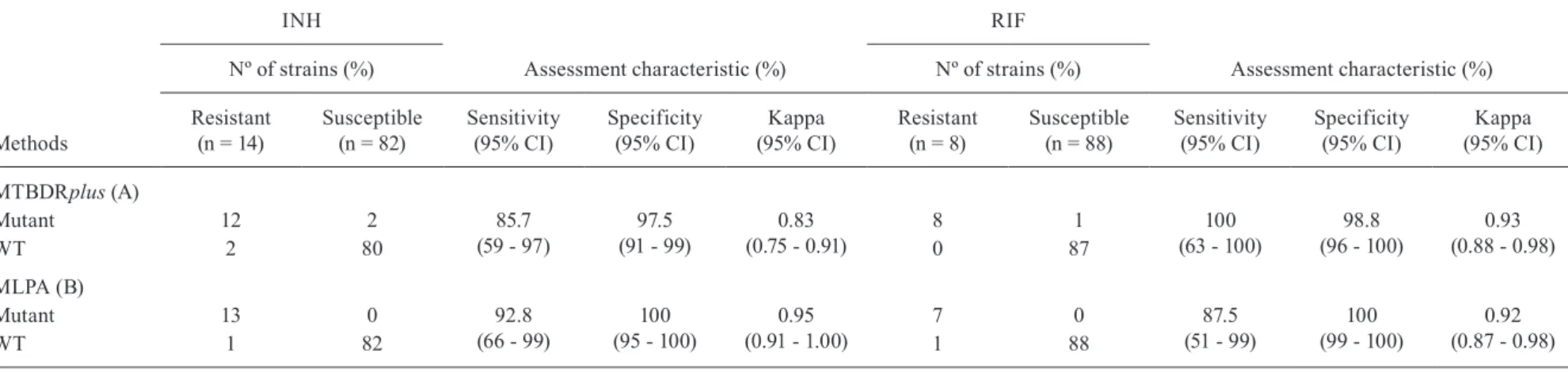
MLPA x MTB-DR plus - Both, the MLPA and the Genotype®MTBDRplus assay identified MTBC in all samples using the designed MTBC specific probes. Using DST as the reference standard, the specificity of MLPA and Genotype®MTBDRplus for detection of INH resistance was 100% [95% confidence interval (CI): 95-100] and 97.5% (95% CI: 91-99), respectively; for detection of RIF resistance was 100.0% (95% CI: 99-100) and 98.8% (96-99-100), respectively. The MLPA and Genotype®MTBDRplus sensitivity was 92.8% (95% CI: 66-99) and 85.7% (95% CI: 59-97), respectively, to detect INH resistance; and 87.5% (95% CI: 51-99) and 100%, (95% CI: 63-100) to detect RIF resistance (Ta-ble III). Assuming sequencing as reference standard for the genotypic characterisations by the MLPA and Genotype®MTBDRplus methods, the sensitivity to INH resistance detection was 92.8%, (CI 95% 66-99) and 85.7% (CI 95% 59-97) respectively, and the specificity was 100% (CI 95% 95-100) and 97.5% (CI 95% 91-99), respectively. In relation to RIF resistance, the sensitiv-ity was 85.7% (CI 95% 51-99) and 100% (CI 95% 63-100), respectively, and the specificity was 100% (CI 95% 99-100) and 98.8% (CI 95% 96-100), respectively (Table IV). The agreement, measured by kappa (k) be-tween MLPA and sequencing was the same to MLPA and DST: 0.95 (95% CI: 0.90 - 99) for INH and 0.92 (95% CI: 0.86 - 0.97) for RIF, respectively. As well as, Genotype®MTBDRplus showed the same kappa results when it was compared to sequencing and to DST: K = 0.83 (95% CI: 0.74 - 0.91) to INH and 0.93 (95% CI: 0.87 - 0.98) to RIF (Tables III, IV).
TABLE II
Drug susceptibility testing (DST), sequencing, multiplex ligaton-dependent probe amplification (MLPA) and GenoType MTBDRplus results for the 96 isolates studied
No of samples
DST Sequencing GenoType MTBDRplus (A) MLPA (B)
INH RIF katG inhA rpoB katG inhA rpoB katG inhA rpoB
79 S S WT WT WT WT WT WT WT WT WT
4 R R S315T WT S531L S315T WT S531L S315T WT S531L
4 R S S315T WT WT S315T WT WT S315T WT WT
1 R R S315T WT D516V/H526Y/S531L WT WT H526Y/S531L WT WT S531L
1 R R S315T WT D516V/S531L S315T WT D516V S315T WT WT
1 R R S315T WT D516V/S531L S315T WT D516V S315T WT S531L
1 R S WT (-15C →T) WT WT WT WT WT (-15C →T) WT
1 S R WT WT S531L WT WT S531L WT WT S531L
1 S S WT WT WT S315T WT WT WT WT WT
1 S S WT WT WT S315T WT D516V WT WT WT
1 R S S315T WT WT S315T WT WT S315T WT WT
1 R S S315T WT WT S315T WT WT S315T WT WT
Mem Inst Oswaldo Cruz
, Rio de Janeiro, V
ol.
112
(6), June 2017
TABLE IV
Multiplex ligaton-dependent probe amplification (MLPA) vs MTBDRplus in comparison to sequencing for assessment sensitivity, specificity and agreement of both methods
Methods
INH
Assessment characteristic (%)
RIF
Assessment characteristic (%)
Nº of strains (%) Nº of strains (%)
Resistant (n = 14)
Susceptible (n = 82)
Sensitivity (95% CI)
Specificity (95% CI)
Kappa (95% CI)
Resistant (n = 8)
Susceptible (n = 88)
Sensitivity (95% CI)
Specificity (95% CI)
Kappa (95% CI)
MTBDRplus (A)
Mutant 12 2 85.7
(59 - 97)
97.5 (91 - 99)
0.83 (0.75 - 0.91)
8 1 100
(63 - 100)
98.8 (96 - 100)
0.93 (0.88 - 0.98)
WT 2 80 0 87
MLPA (B)
Mutant 13 0 92.8
(66 - 99)
100 (95 - 100)
0.95 (0.91 - 1.00)
7 0 87.5
(51 - 99)
100 (99 - 100)
0.92 (0.87 - 0.98)
WT 1 82 1 88
INH: isoniazid; RIF: rifampicin; WT: wild-type.
TABLE III
Multiplex ligaton-dependent probe amplification (MLPA) x GenoType MTBDRplus in comparison to drug susceptibility testing (DST) and sequencing for the 96 isolates of Mycobacterium tuberculosis included in the study
Methods
INH
Assessment characteristic (%)
RIF
Assessment characteristic (%)
Nº of strains (%) Nº of strains (%)
Resistant (n = 14)
Susceptible
(n = 82) Sensitivity Specificity
Kappa (95% CI )
Resistant (n = 8)
Susceptible
(n = 88) Sensitivity Specificity
Kappa (95% CI)
MTBDRplus (A)
Mutant 12 2 85.7
(59 - 97)
97.5 (91 - 99)
0.83 (0.75 - 0.91)
8 1 100
(63 - 100)
98.8 (96 - 100)
0.93 (0.88 - 0.98)
WT 2 80 0 87
MLPA (B)
Mutant 13 0 92.8
(66 - 99)
100 (95 - 100)
0.95 (0.91 - 0.100)
7 0 85.7
(51 - 99)
100 (99 - 100)
0.92 (0.87 - 0.98)
WT 1 82 1 88
DISCUSSION
The currently available methods to identify M. tu-berculosis and mutations related to drug resistance are mainly based on the PCR amplification of target genes or mutations and subsequent analysis of the amplified product by reverse or direct hybridisation with comple-mentary probes, sequencing or melting point analysis. As a limitation, these methods do not allow multiplexing of many targets (the exact number depends on the thermo-dynamic and structural characteristics of the sequences to be amplified) without a significant loss of specificity and overall accuracy (Bergval et al. 2008). An efficient and high-multiplex assay, able to detect several widely dispersed point of mutations and gene sequences involved in tuberculosis drug resistance and molecular typing, es-pecially for complicated cases of TB recurrence, could benefit patient treatment and would be a very useful tool for the management of efficient TB control programs. Ge-notyping allows distinguishing between recurrent cases of reinfection or reactivation (Unis et al. 2014), enabling molecular epidemiological studies to monitor the geno-typic diversity of TB, as some particular genotypes are correlated with disease dynamics, outbreak detection and increased virulence (Narvskaya et al. 2002, Gomes et al. 2012, Perizzolo et al. 2012, Dalla Costa et al. 2015).
Unless isolates are routinely typed it will not be pos-sible to further explore these associations. Moreover, clinically severe cases of TB are more prevalent among presumed extensively drug-resistant TB (XDR-TB) cases, treatment dropout, and/or TB and M/XDR-TB outbreaks.
The MLPA genotype marker probes katG-463 and gyrA-95, specific for principal genetic group (PGG) one, two and three families, allow the discrimination be-tween the different bacterial subspecies (Bergval et al. 2008) (Table I). These results highlight the potential use of MLPA, as it appears ligated in all samples; however there were some interpretation concerns. Further stud-ies focusing on phylogenic view should be conducted to better understand these results. TbD1 probe was ligated in most of the samples, this probe targets the TbD1 dele-tion site and thus the presence of its product indicates the presence of the TbD1 deletion. As the TbD1 probe region is absent in modern M. tuberculosis strains (Baker et al. 2004), it was possible to infer that most of the tested samples are so called “modern” strains. Additionally, the inclusion of only two M. tuberculosis isolates resistant to EMB precluded the evaluation of the EMB drug resis-tance performance of MLPA. However, as the embB-306 probe has previously been shown to be specific for only two out of the three possible mutations in this codon, absence of a mutation cannot be concluded from absence of an MLPA product (Sreevatsan et al. 1997).
Genotype®MTBDRplus has been compared to phe-notypic and other molecular assays with very impressive performance and was endorsed by WHO for MDR-TB molecular detection in 2008 (Nikolayevsky et al. 2009, Ferreira Jr et al. 2014, Asante-Poku et al. 2015). Since the first report using MLPA as a promising alternative for TB genetic characterisation (Bergval et al. 2008), few studies evaluating MLPA in comparison to other assays
have been described (Bergval et al. 2012, Sengstake et al. 2014, Chaidir et al. 2016). In this scenario, as EMB and PZA susceptibility testing show no reliable results, and having small sample size of drug-resistant M. tuber-culosis strains, in our study we relied on the evaluation of MLPA performance on RIF and INH resistance.
The concordance between results of MLPA and sequencing (gold-standard) was slightly higher than Genotype®MTBDRplus versus sequencing for the assess-ment of INH resistance. Asante-Poku et al. (2015) reported misdiagnosis by Genotype®MTBDRplus in approximate-ly 16% of INH-monoresistant isolates that were wrongapproximate-ly identified as susceptible, reinforcing the possibility that Genotype®MTBDRplus may have limitations in the detec-tion of INH resistance, depending on the local prevalence of unusual mutations. Simons et al. (2015) also reported low sensitivity (36%) of the Genotype®MTBDRplus in de-tecting inhA gene mutations.
Regarding the agreement between Genotype®
MTBDRplus and MLPA versus the standard DST (Table III) and sequencing (Table IV), results were very concor-dant for INH (Kappa A = 0.83 and kappa B = 0.95) and RIF (Kappa A = 0.93 and kappa B = 0.92) resistance detection with a better performance of the MLPA assay since it was able to correctly detect the inhA (-15C →T) mutation re -sponsible for the INH resistance detected by the DST assay. Concerning the overall distribution of mutations associated with INH resistance, the most frequent mutation was katG S315T, similarly to what has been observed by other au-thors (Dalla Costa et al. 2009, Cambau et al. 2015).
The S531L mutation in the rpoB gene was the most fre-quent mutation found in the RIF resistant isolates, followed by mutations in codon D516V, similar to that reported elsewhere (Perizzolo et al. 2012, Maschmann et al. 2013). For the detection of RIF the discrepant results occurred with three samples; Genotype®MTBDRplus detected one D516V rpoB mutation in a sample with no mutation in the rpoB region. Drobniewski et al. (2012) reported that both Genotype®MTBDRplus and GeneXpert MTB/RIF assays may present lower specificity for RIF resistance detection. MLPA was unable to detect rpoB mutations in one sample, maybe due to the presence of strains exhibit-ing heteroresistance as described by other researchers on
rpoB, D516V/S531L (Nikolayevsky et al. 2009, van Deun et al. 2009) (Table I). Genotype®MTBDRplus correctly determined RIFr but only detected the D516V mutation, the S531L was not detected (Table II).
MLPA allowed the identification of all the Haarlem genetic clade strains with the ogt-15 probe, but this test did not cover the T and LAM prevalent lineages of M. tuberculosis in Brazil, as described elsewhere (Gomes et al. 2012). Beijing probes are also included in this MLPA version, no ligation of these probes was seen in any iso-late, in agreement with spoligotyping results.
to detect drug-resistant TB and MDR-TB showed similar accuracy to Genotype®MTBDRplus, with the advantage of being easily optimised on a routine basis to address accurately the early detection of MDR-TB, with the pos-sibility to expand to further drug targets and antibiotics. In comparison to other molecular assays, MLPA is a test that allows adjustments in probe composition, thus targeted loci can be adapted to the local prevalence of certain mutations by a simple addition or removal of probes from the master mix. As a final consideration regarding study limitations, a limited number of clini-cal isolates with INH and/or RIF resistance was evalu-ated and minimal inhibitory concentration (MIC) was not performed. However, we observed that MLPA, and other truly multiplexed assays adapted to tuberculo-sis diagnotuberculo-sis, can be particularly suitable for detecting additional drug resistance to other antimicrobials in a single step, being especially important in recurrence, treatment dropout, or presumed XDR-TB for a rapid and proper treatment decision. Moreover, MLPA may allow complementation to the diagnosis with epidemiologi-cal M. tuberculosis lineages information to monitor the DR/MDR-TB burden and evolution in different regions, especially in regions where routine drug susceptibility testing is not implemented in laboratories and where the rates of M/XDR-TB is suspected to be high. The flex-ibility and specificity of MLPA, demonstrated above, along with its ability to simultaneously genotype and detect drug resistance mutations, make MLPA an easy to implement and very important molecular tool for in-creased drug resistance coverage and early detection of M/XDR-TB as recommended by WHO and the Brazil-ian Ministry of Health (MS 2010, WHO 2015).
Ethics approval - The study was approved by the research ethics committee of UFRJ, ruling number P 11821913.6.0000.5257.
ACKNOLWLEDGEMENTS
To the staff from the Laboratory of Bacteriology and Bio-assays at Clinical Research Institute from FIOCRUZ-IPEC, specially Maria Cristina Lourenço; the staff from Laboratory of Molecular Mycobacteriology from HUCFF-UFRJ; the staff from Hospital Servidores from Rio de Janeiro state, specially Rossana C Brito; and the staff from Laboratory of Bacteri-ology of Tuberculosis from IPB/LACEN-FEPPS, for helping with processing the samples and culture management.
AUTHORS’ CONTRIBUTION
PFGS and ERDC - Conducted the study, participated in lab-oratory tests, in data acquisition, performed the statistical analy-sis, and drafted of the manuscript; DMR - performed the statisti-cal analysis and drafted the manuscript; MLR - performed data analysis and drafted the manuscript; RBB - participated in labo-ratory tests and statistical analysis, drafted the manuscript; LSN - participated in laboratory tests; LSE - participated in laboratory tests; RR - participated in laboratory tests; RMA - conceived the study, participated in its design, performed the statistical analysis and drafted the manuscript; IB - participated in labora-tory tests, conducted the analysis of laboralabora-tory tests, performed data analysis and drafted the manuscript; SS - performed the sta-tistical and laboratory analysis; MV - performed the stasta-tistical
analysis and drafted the manuscript; AK and MMO - conceived the study, participated in its design, performed data analysis, co-ordinated the study, and helped draft the manuscript.
REFRENCES
Asante-Poku A, Otchere ID, Danso E, Mensah DD, Bonsu F, Gag-neux S, et al. Evaluation of GenoType MTBDRplus for the rapid detection of drug-resistant tuberculosis in Ghana. Int J Tuberc Lung Dis. 2015; 19(8): 954-9.
Baker L, Brown T, Maiden M, Drobniewski F. Silent nucleotide poly-morphisms and a phylogeny for Mycobacterium tuberculosis. Emerg Infect Dis. 2004; 10(9): 1568-77.
Bergval I, Sengstake S, Brankova N, Levterova V, Abadía E, Tadu-maze N, et al. Combined species identification, genotyping, and drug resistance detection of Mycobacterium tuberculosis cultures by MLPA on a bead-based array. PLoS ONE. 2012; 7(8): e43240.
Bergval I, Vijzelaar RN, Dalla Costa ER, Schuitema AR, Oskam L, Kritski AL, et al. Development of multiplex assay for rapid char-acterization of Mycobacterium tuberculosis. J Clin Microbiol. 2008; 46(2): 689-99.
Cambau E, Viveiros M, Machado D, Raskine L, Ritter C, Tortoli E, et al. Revisiting susceptibility testing in MDR-TB by a standardized quantitative phenotypic assessment in a European multicentre study. J Antimicrob Chemother. 2015; 70(3): 686-96.
Canetti G, Fox W, Khomenko A, Mahler HT, Menon NK, Mitchison DA, et al. Advances in techniques of testing mycobacterial drug sensitivity, and the use of sensitivity tests in tuberculosis control programmes. Bull World Health Organ. 1969; 41(1): 21-43.
Chaidir L, Sengstake S, de Beer J, Oktavian A, Krismawati H, Mu-hapril E, et al. Predominance of modern Mycobacterium tuber-culosis strains and active transmission of Beijing sublineage in Jayapura, Indonesia Papua. Infect Genet Evol. 2016; 39: 187-93.
Crudu V, Stratan E, Romancenco E, Hillemann A, Moraru N. First evaluation of an improved assay for molecular genetic detection of tuberculosis as well as rifampin and isoniazid. J Clin Micro-biol. 2012; 50(4): 1264-9.
Dalla Costa ER, Ribeiro MO, Silva MS, Arnold LS, Rostirolla DC, Cafrune PI, et al. Correlations of mutations in katG, oxyR-ahpC and inhA genes and in vitro susceptibility in Mycobacterium tuberculosis clinical strains segregated by spoligotype families from tuberculosis prevalent countries in South America. BMC Microbiol. 2009; 9: 39.
Dalla Costa ER, Vasconcelos SEG, Esteves LS, Gomes HM, Gomes LL, Silva PA, et al. Multidrug-resistant Mycobacterium tuber-culosis of the Latin American Mediterranean lineage, wrongly identified as Mycobacterium pinnipedii (spoligotype internation-al type863 [SIT863]), causing active tuberculosis in South Brazil. J Clin Microbiol. 2015; 53: 3805-11.
Demay C, Liens B, Burguière T, Hill V, Couvin D, Millet J, et al. SIT-VITWEB - a publicly available international multimarker database for studying Mycobacterium tuberculosis genetic diversity and molecular epidemiology. Infect Genet Evol. 2012; 12(4): 755-66.
Drobniewski F, Nikolayevskyy V, Balabanova Y, Papaventsis D. Di-agnosis of tuberculosis and drug resistance: what can new tools bring us? [State of the art series. New tools. Number 1 in the series]. Int J Tuberc Lung Dis. 2012; 16(7): 860-70.
Gomes HM, Elias AR, Oelemann MA, Pereira MA, Montes FF, Mar-sico AG, et al. Spoligotypes of Mycobacterium tuberculosis com-plex isolates from patients residents of 11 states of Brazil. Infect Genet Evol. 2012; 12(4): 649-56.
Gomgnimbou MK, Neuta IH, Panaiotov S, Bachiysca E, Palomino JC, Martin A, et al. Tuberculosis-spoligo-rifampin-isoniazid typ-ing: an all-in-one assay technique for surveillance and control of multidrug-resistant tuberculosis on luminex devices. J Clin Mi-crobiol. 2013; 51(11): 3527-34.
Maschmann RA, Spies FS, Nunes LS, Ribeiro AW, Machado TR, Zaha A, et al. Performance of the GenoType MTBDRplus assay directly on sputum specimens from Brazilian patients with tuberculosis treatment failure or relapse. J Clin Microbiol. 2013; 51(5): 1606-8.
Micheletti VC, Moreira JS, Ribeiro MO, Kritski AL, Braga JU. Drug-resistant tuberculosis in subjects included in the Second National Survey on Antituberculosis Drug Resistance in Porto Alegre, Brazil. J Bras Pneumol. 2014; 40(2): 155-63.
MS - Ministério da Saúde/Secretaria de Vigilância em Saúde/Pro-grama Nacional de Controle da Tuberculose. Manual de reco-mendações para o controle da tuberculose no Brasil [Internet]. 2010 [cited 2016 December 8th]. Available from: http://portal- saude.saude.gov.br/images/pdf/2015/junho/30/Manual-de-Reco-mendaçoes-para-o-Controle-da-Tuberculose-no-Brasil.pdf.
Narvskaya O, Otten T, Limeschenko E, Sapozhnikova N, Graschen-kova O, Steklova L, et al. Nosocomial outbreak of multidrug-resistant tuberculosis caused by a strain of Mycobacterium tu-berculosis W-Beijing family in St. Petersburg, Russia. Eur J Clin Microbiol Infect Dis. 2002; 21: 596-602.
Nikolayevsky V, Balabanova Y, Simak T, Malomanova N, Fedorin I, Drobniewski F. Performance of the Genotype® MTBDRplus assay in the diagnosis of tuberculosis and drug resistance in Sa-mara, Russian Federation. BMC Clin Pathol. 2009; 31(7): 1381-7.
Perizzolo PF, Dalla Costa ER, Ribeiro AW, Spies FS, Ribeiro MO, Dias CF, et al. Characteristics of multidrug-resistant Mycobacterium tu-berculosis in Southern Brazil. Tuberculosis (Edinb). 2012; 92(1): 56-9.
Schouten JP, McElgunn CJ, Waaijer R, Zwijnenburg D, Diepvens F, Pals G. Relative quantification of 40 nucleic acid sequences by multiplex ligation-dependent probe amplification. Nucleic Acids Res. 2002; 30(12): e57.
Sengstake S, Bablishvili N, Schuitema A, Bzekalava N, Abadia E, de Beer J, et al. Optimizing multiplex SNP-based data analysis for genotyping of Mycobacterium tuberculosis isolates. BMC Ge-nomics. 2014; 7(15): 572.
Simons SO, van der Laan T, de Zwaan R, Kamst M, van Ingen J, Dekhuijzen PN, et al. Molecular drug susceptibility testing in the Netherlands: performance of the MTBDRplus and MTBDRsl as-says. Int J Tuberc Lung Dis. 2015; 19(7): 828-33.
Sreevatsan S, Stockbauer KE, Pan X, Kreiswirth BN, Moghazeh SL, Jacobs Jr WR, et al. Ethambutol resistance in Mycobacterium tu-berculosis: critical role of embB mutations. Antimicrob Agents Chemother. 1997; 41(8): 1677-81.
Steingart KR, Sohn H, Schiller I, Kloda LA, Boehme CC, Pai M, et al. Xpert® MTB/RIF assay for pulmonary tuberculosis and rifampicin resistance adults. Cochrane Database Syst Rev. 2014; 1: CD009593.
Unis G, Ribeiro AW, Esteves LS, Spies FS, Picon PD, Dalla Costa ER, et al. Tuberculosis recurrence in a high incidence setting for HIV and tuberculosis in Brazil. BMC Infect Dis. 2014; 14: 548.
van Deun A, Barrera L, Bastian I, Fattorini L, Hoffmann H, Kam KM, et al. Mycobacterium tuberculosis strains with highly dis-cordant rifampin susceptibility test results. J Clin Microbiol. 2009; 47(11): 3501-6.
van Soolingen D, de Haas PE, Hermans PW, van Embden JD. DNA fingerprinting of Mycobacterium tuberculosis. Methods Enzy-mol. 1994; 235: 196-205.