online | memorias.ioc.fiocruz.br
Poor sensitivity of rapid tests for the detection of antibodies
to the hepatitis B virus: implications for field studies
Helena Medina Cruz1, Leticia de Paula Scalioni¹, Vanessa Salete de Paula², Juliana Custódio Miguel1,
Kycia Maria Rodrigues do Ó3, Flavio Augusto Pádua Milagres4, Marcelo Santos Cruz5,
Francisco Inácio Bastos6, Priscila Pollo Flores7, Erotildes Leal8, Ana Rita Coimbra Motta-Castro9,
Lia Laura Lewis-Ximenez1, Elisabeth Lampe1, Livia Melo Villar1/+
1Fundação Oswaldo Cruz-Fiocruz, Instituto Oswaldo Cruz, Laboratório de Hepatites Virais, Rio de Janeiro, RJ, Brasil
2Fundação Oswaldo Cruz-Fiocruz, Instituto Oswaldo Cruz, Laboratório de Desenvolvimento Tecnológico em Virologia, Rio de Janeiro, RJ, Brasil 3Hospital São Lucas, Petrópolis, RJ, Brasil
4Universidade Federal do Tocantins, Faculdade de Medicina, Palmas, TO, Brasil 5Universidade Federal do Rio de Janeiro, Instituto de Psiquiatria, Rio de Janeiro, RJ, Brasil
6Fundação Oswaldo Cruz-Fiocruz, Instituto de Comunicação e Informação Científica e Tecnológica em Saúde, Rio de Janeiro, RJ, Brasil 7Universidade de Brasília, Brasília, DF, Brasil
8Universidade Federal do Rio de Janeiro, Campus Macaé, Macaé, RJ, Brasil
9Universidade Federal do Mato Grosso do Sul, Departamento de Bioquímica e Farmácia, Campo Grande, MS, Brasil
Rapid tests (RTs) can be used as an alternative method for the conventional diagnosis of hepatitis B virus (HBV). This study aims to evaluate antibodies to HBsAg (anti-HBs) and antibodies to HBeAg (anti-HBe) RTs under dif-ferent Brazilian settings. The following three groups were included: GI: viral hepatitis outpatient services; GII: low resource areas; and GIII: crack users and beauticians. Imuno-rápido anti-HBsAg™ and Imuno-rápido anti-HBeAg™
RTs were evaluated and showed specificities greater than 95% in all groups. The sensitivity values to anti-HBs were 50.38%, 51.05% and 46.73% and the sensitivity values to anti-HBe were 76.99%, 10.34% and 11.76% in the GI, GII and GIII groups, respectively. The assays had a low sensitivity and high specificity, which indicated their use for screening in regions endemic for HBV.
Key words: hepatitis B virus - antibodies - rapid tests - performance
doi: 10.1590/0074-02760160394
Financial support: FAPERJ, CNPq, CAPES, FIOCRUZ. + Corresponding author: [email protected] Received 28 August 2016
Accepted 24 November 2016
Approximately 240 million individuals are chronically infected with hepatitis B virus (HBV) worldwide. Annual-ly, 780,000 people die due to late-stage complications, such as cirrhosis and hepatocellular carcinoma (WHO 2015). In Brazil, between 2000 and 2012, 120,343 confirmed HBV cases were reported (BMH 2015). HBsAg prevalence is 0.63% in the north region, 0.31% in the midwest region and 0.31% in the southeast region (BMH 2015). Addition-ally, HBsAg prevalence among different groups (children, beauticians and crack users) is low (0% to 6.2%) in Rio de Janeiro (Santos-Cruz et al. 2013, Villar et al. 2014a, b).
During HBV infection, markers can be detected in sera samples using immunoassays. For example, patient sera that contain anti-HBs indicates immunity from past infections or vaccinations, and a patient with anti-HBe antibodies in their sera is considered as spontaneous resolution of infection or therapy-induced improvement (Gerlich 2013, Villar et al. 2015).
A diagnosis of HBV is done using enzyme immuno-assays (EIAs) and electrochemiluminescence (ECLIA) (Gerlich 2013, Villar et al. 2015). However, the use of these
assays in real-life conditions in low and middle-income countries has been challenging due to the relatively long period of execution, the necessity of well-trained personnel, good infrastructure and logistics (Soeung et al. 2009).
RTs are simple, easy, cheap and fast. Currently, sev-eral commercial RTs for HBsAg detection are available in Brazil, and BMoH has established policies and guide-lines for HBsAg RT use (BMH 2016). The application of RTs as a substitute for conventional diagnoses of HBV infection may provide distinct advantages. Results are available in a few minutes, and RT use is feasible in poor infrastructure laboratories. HBsAg testing has shown high sensitivity, but some assays did not detect this mark-er, especially in low endemicity regions, such as Latin America. In these settings, it is recommended that addi-tional HBV testing should be utilised for detecting other serological markers. Currently, few laboratories use RTs for other HBV markers, such as anti-HBs and anti-HBe. These assays could increase the identification of suscep-tible individuals for HBV vaccination and help in moni-toring treatment response. Thus, in the present study, we evaluated the applicability of RTs for the detection of anti-HBs and anti-HBe markers in different groups to increase the availability of diagnosis in remote areas.
Poor sensitivity of HBV AB rapid test • Helena Medina Cruz et al. 210
Group I (GI) - Consisted of 423 and 166 individuals who donated serum samples for the HBs and anti-HBe RT evaluations, respectively. Individuals were re-ferred from Viral Hepatitis Ambulatory (Oswaldo Cruz Foundation, FIOCRUZ). These individuals had suspect-ed cases of viral hepatitis, and most of them livsuspect-ed in low socioeconomic areas in Rio de Janeiro state. Individuals were included if they were 18 years old or older, present-ed with either symptomatic or asymptomatic hepatitis, and had one or more risk factors for HBV infection.
Group II (GII) - Contained 1,526 and 788 individu-als who donated serum samples for the anti-HBs and anti-HBe RT evaluations, respectively. These individu-als lived in the following regions in Brazil: (1) Midwest Region - individuals from Pantanal of Mato Grosso do Sul state, a rural area 385 km from the capital of state, Campo Grande City; (2) North Region - subjects from rural communities in the city of Tocantinópolis in To-cantins state, 30 km from the urban area of the city; and (3) Southeast Region - employees from a private hospital located in Petrópolis and subjects living in an under-privileged community in Macaé (both cities in Rio de Janeiro). Individuals were included if they were not pre-viously diagnosed as HBV infected.
Group III (GIII) - Consisted of 381 and 241 individu-als who donated serum samples for the HBs and anti-HBe RT evaluations, respectively. This group of individ-uals was considered to be highly vulnerable individindivid-uals (crack users in the southeast region of Brazil and beauty professionals in Rio de Janeiro state) likely to acquire or already have an HBV infection. Individuals included in this group were active crack users and beauticians, in-cluding manicurists, pedicurists, and hairdressers.
Sera samples were assayed for HBsAg, anti-HBc to-tal, anti-HBc IgM and anti-HBs using commercial EIAs (Diasorin, Italy) and anti-HBe and HBeAg using com-mercial ECLIA (Elecsys anti-HBe and HBe, Roche Di-agnostics, Mannheim, Germany) according to the manu-facturer’s instructions. The OD/CO of positive/negative samples was defined according to the manufacturer for each test. All reactive samples were retested using the same assay in duplicate.
Both Imuno-rápido anti-HBsAg™ and Imuno-rápido
anti-HBeAg™ RTs were evaluated (Wama, Minas Gerais,
Brazil). According to the manufacturer’s instructions, the assays had 100% sensitivity and more than 98% speci-ficity. These RTs were single-use, disposable-chamber, in vitro, qualitative, immunochromatographic assays that could detect anti-HBs and anti-HBe. The RTs allowed the detection of antibodies in serum, plasma and whole blood and used 100 µL of sample per assay. Each assay was completed in 10-15 min. Assays were conducted accord-ing to the manufacturer´s recommendations.
The sensitivity of the anti-HBs RT was also evaluated in the following two additional subgroups: (1) vaccinated individuals (isolated anti-HBs reactive) and previously HBV infected (anti-HBs/anti-HBc reactive) and (2) indi-viduals with anti-HBs titers lower than 100 IU/mL and titers higher than 100 IU/mL. These cutoff values were chosen because approximately 85% of individuals who
presented anti-HBs titers above 100 IU/mL after primary vaccination still had anti-HBs 22 years after vaccination.
The sensitivity of the anti-HBe RT was evaluated us-ing the presence of an active HBV infection (anti-HBe reactive/HBsAg reactive), compared to a previous HBV infection (anti-HBe reactive/HBsAg non-reactive).
The detection of anti-HBs and anti-HBe in the serum samples by EIA or ECLIA was defined in the present study as the gold standard for the assessment of the
sen-sitivity, specificity, positive predictive value (PPV), and
negative predictive value (NPV) of each RT. To evaluate the deviation between the observed and expected val-ues in each group, the X2 test or Fisher’s exact test were
used. The Kappa coefficient (k) was used to assess the degree of agreement between the reference panel and the RT under analysis. Two-tailed p-values < 0.05 were con-sidered statistically significant.
In this study, 2,330 individuals donated serum samples for the anti-HBs RT evaluation. The mean age ± standard deviation was 48 (± 13.99) years, 29 (± 20.39) years and 33 (± 14.41) years for GI, GII and GIII, respectively. Anti-HBs EIA for GI, GII and GIII showed 133, 572 and 107 reactive results, respectively, and 290, 954 and 274 non-reactive results, respectively. The sensitivity of the anti-HBs RT was relatively low in all groups, but a higher sensitivity was found in GII: 51.05% (292/572) compared to GI: 50.38% (67/133) and GIII: 46.73% (50/107). The specificity values were above 98.00% for all groups, and the concordance ranged from 53.32% to 57.66% in all groups (Table I).
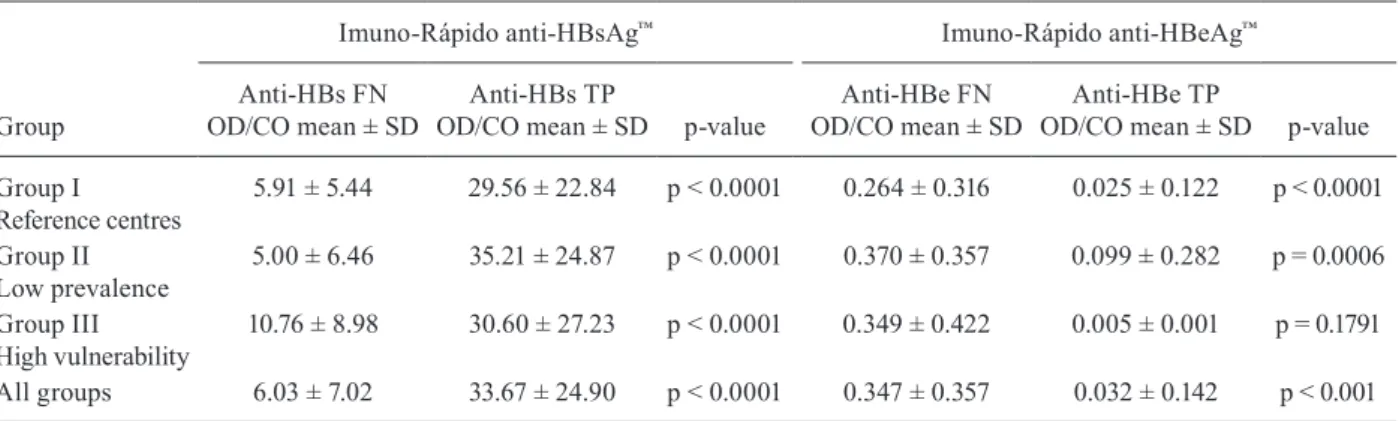
Samples that presented a false-negative result for anti-HBs in RT had low mean optical density/cut-off value ratio (OD/CO) values by ELISA compared to those samples considered anti-HBs true positive samples (Ta-ble II). Better sensitivity results of anti-HBs RT were observed in samples previously infected with HBV com-pared to vaccinated individuals in all groups and samples with anti-HBs titers higher than 100 IU/mL compared to titers lower than 100 IU/mL in all groups (Table III).
A total of 1,195 individuals were included in the anti-HBe RT evaluation. The mean age ± standard deviation was 45.3 (± 14.6) years, 31.6 (± 20.7) years, 30.4 (± 12.7) years for GI, GII and GIII, respectively. Anti-HBe results by ECLIA for GI, GII and GIII showed 113, 87 and 17 reactive results and 53, 701 and 224 non-reactive results, respectively. The sensitivities were 76.99% (87/111) in GI, 11.76% (2/17) in GIII and 10.34% (9/87) in GII. Spec-ificity values were above 95.00% for all groups, and a high concordance between anti-HBe RT and EIA was observed in GI (k = 65.36%) (Table I).
False negative anti-HBe samples by anti-HBeAg RT presented higher mean OD/CO values by ECLIA com-pared to the true positive anti-HBe samples (Table II). The anti-HBe RT also had a higher sensitivity in those individu-als who presented active HBV infection compared to those who were previously infected (Table III).
2
11
Mem Inst Oswaldo Cruz
, Rio de Janeiro, V
ol.
112
(3), March 2017
Accuracy values (%) and frequency of true-positive, false-positive, true-negative and false-negative results for rapid tests for anti-HBs
(Imuno-Rápido anti-HBsAg™) and anti-HBe (Imuno-Rápido anti-HBeAg™) among serum samples compared to gold standard (anti-HBs EIA: and anti-HBe ECLIA)
Parameters
Imuno-Rápido anti-HBsAg™ Imuno-Rápido anti-HBeAg™
Group I Reference centres
(n = 423)
Group II Low prevalence
(n = 1,526)
Group III High vulnerability
(n = 381)
All groups (n = 2330)
Group I Reference centres
(n = 166)
Group II Low prevalence
(n = 788)
Group III High vulnerability
(n = 241)
All groups (n = 1,195)
Sensitivity (CI%)
50.38% (41.63-59.10)
51.05% (46.92-55.16)
46.73% (37.05-56.59)
50.37% (46.94-53.80)
76.99% (68.18-84.39)
10.34% (48.43-18.76)
11.76% (14.57-36.41)
45.16% (38.43-51.97) Specificity
(CIs%)
99.66% (98.09-99.99)
98.01% (96.91-98.80)
98.54% (96.30-99.60)
98.42% (97.66-98.99)
96.23% (87.02-99.54)
100.00% (99.48-100.00)
100.00% (98.37-100.00)
99.80% (99.26-99.98) PPV
(CI%)
98.53% (92.09-99.96)
93.89% (90.62-96.27)
92.59% (82.13-97.95)
94.46% (91.86-96.41)
97.75% (92.12-99.73)
100.00% (66.39-100.00)
100.00% (15.81-100.00)
98.00% (92.96-99.76) NPV
(CI%)
81.41% (76.94-85.33)
76.95% (74.54-79.28)
82.57% (78.06-86.50)
78.76% (76.86-80.62)
66.23% (54.54-76.60)
89.99% (87.69-92.00)
93.72% (89.85-96.44)
89.13% (87.15-90.94) K
(CI%)
57.66% (48.36-66.96)
53.99% (49.31-58.67)
53.32% (42.58-64.06)
54.73% (50.85-58.61)
65.36% (53.66-77.06)
17.03% (0.00-34.51)
19.86% (0.00-59.13)
56.89% (49.61-64.17)
p-value < 0.0001 < 0.0001 < 0.0001 < 0.0001 < 0.0001 < 0.0001 0.0047 < 0.0001
TP (n) 67 292 50 409 87 9 2 98
FN (n) 66 280 57 403 26 78 15 119
TN (n) 289 935 270 1494 51 701 224 976
FP (n) 1 19 4 24 2 0 0 2
Poor sensitivity of HBV AB rapid test • Helena Medina Cruz et al. 212
TABLE III
Sensitivity of the anti-HBs rapid test (Imuno-Rápido anti-HBsAg™)
according to the anti-HBs titer and HBV status and sensitivity of anti-HBe rapid test (Imuno-Rápido anti-HBeAg™)
Evaluated groups
Anti-HBs Anti-HBe
Sensitivity of anti-HBs rapid test according to HBV status
Sensitivity of anti-HBs rapid test according to anti-HBs titer
Sensitivity of anti-HBe rapid test according to HBV status
Previously, HBV infecteda
n (%)
HBV vaccinationb
n (%)
anti-HBs titers < 100 IU/mL
n (%)
anti-HBs titers
≥ 100 IU/mL
n (%)
Active HBV infectionc
n (%)
Previously, HBV infectiond
n (%)
Group I
Reference centres
28/47 (59.57) 39/86 (45.35) 7/51 (13.72) 60/82 (73.17) 84/100 (84.00) 3/13 (23.10)
Group II Low prevalence
134/176 (76.14) 158/396 (39.90) 40/268 (14.92) 252/304 (82.89) 1/1 (100.00) 8/86 (9.30)
Group III High vulnerability
15/18 (83.33) 35/89 (39.32) 2/41 (4.87) 48/66 (72.72) 1/3 (33.30) 1/14 (7.10)
All groups 177/241(73.44) 232/571 (40.63) 49/360(13.61) 360/452 (79.65) 86/104 (80.77) 12/113 (10.62)
a: anti-HBs/anti-HBc reactive; b: anti-HBs alone;c: anti-HBe reactive /HBsAg reactive; d: anti-HBe reactive/HBsAg non-reac-tive; IU: international units; n: number of samples.
TABLE II
Mean values of OD/CO from EIE among false-negatives and true positive rapid tests for anti-HBs and anti-HBe detection
Group
Imuno-Rápido anti-HBsAg™ Imuno-Rápido anti-HBeAg™
Anti-HBs FN OD/CO mean ± SD
Anti-HBs TP
OD/CO mean ± SD p-value
Anti-HBe FN OD/CO mean ± SD
Anti-HBe TP
OD/CO mean ± SD p-value
Group I
Reference centres
5.91 ± 5.44 29.56 ± 22.84 p < 0.0001 0.264 ± 0.316 0.025 ± 0.122 p < 0.0001
Group II Low prevalence
5.00 ± 6.46 35.21 ± 24.87 p < 0.0001 0.370 ± 0.357 0.099 ± 0.282 p = 0.0006
Group III High vulnerability
10.76 ± 8.98 30.60 ± 27.23 p < 0.0001 0.349 ± 0.422 0.005 ± 0.001 p = 0.1791
All groups 6.03 ± 7.02 33.67 ± 24.90 p < 0.0001 0.347 ± 0.357 0.032 ± 0.142 p < 0.001
FN: false negative; OD/CO: optical density/cutoff; SD: standard deviation; TP: true positive.
et al. 2013, 2016, El-Ghitany & Farghaly 2013, Wu et al. 2016). In the present study, two RTs (Imuno-Rápido anti-HBeAg™ and Imuno-Rápido anti-HBsAg™) were evaluated
and showed high specificity and low sensitivities regardless of the endemicity profile of the populations analysed.
Anti-HBs RT showed high specificity values regard-less of the endemicity profile of the populations evalu-ated and had similar values as those observed in France (97.80%), Taiwan (96.5%) and Egypt (95.08%) (Bottero et al. 2013, El-Ghitany & Farghaly 2013, Wu et al. 2016). These assays demonstrate an ability to identify true nega-tive samples. Additionally, the sensitivity of anti-HBs RT was low in all groups (less than 51.5%), which is similar to what was observed using whole blood with Quick Pro-file (Lumiquick, USA) (58.08%) and sera samples with Advanced Test Quality One Step (Intec Products, China) (64.20%) (Bottero et al. 2013, El-Ghitany & Farghaly
2013). Furthermore, some studies have shown that the test sensitivity is above 91% in volunteers and children (Bot-tero et al. 2016, Wu et al. 2016), and a meta-analysis study showed a pooled sensitivity and specificity of 93.2% and 93.1%, respectively. However, RTs from different manu-facturers were evaluated in those studies (General Biolog-icals Corporation, Genedia, Daewoong, Asan, Lumiquick diagnostics, and SD) (Shivkumar et al. 2012).
infec-tions compared to individuals with a vaccine response. This difference may be due to the low anti-HBs titers obtained by vaccination in different circumstances, in-cluding immunosuppression, liver disease, renal failure, smoking, obesity, improper vaccine administration, short time interval between the second and third dose, age of the subject when vaccinated and the progressive decline of antibody titers in a large proportion of most individu-als 9-11 years after vaccination (Kwon & Lee 2011).
In agreement with previous studies, anti-HBs RT and anti-HBe RT also demonstrated high specificity (above 96.00%) in all groups analysed, demonstrating an ability to discriminate negative results. The best performance of the anti-HBe RT was observed among patients referred to the Viral Hepatitis Clinic (65.36%) demonstrating the usefulness of this assay in the evaluation of seroconver-sion of HBeAg to anti-HBe in patients who have HBV. This is a favorable outcome that might be associated with a better prognosis among HBV patients according to the guidelines issued by the BMH (2011).
The anti-HBe RT was highly effective when samples with HBV active infection or samples with low values of OD/CO by ECLIA were considered. Conversely, El-Ghitany and Farghaly (2013) did not observe this find-ing which was probably due to differences in the RT and gold standard tests used.
In conclusion, RTs for anti-HBs and anti-HBe evalu-ated in the present study showed low sensitivity and high specificity indicating their use as a screening method in high HBV endemicity areas.
ACKNOWLEDGEMENTS
To Jaqueline Correia de Oliveira, Elisangela Ferreira da Silva, Renata Tourinho Santos and Paula Guerra Murat, for technical assistance.
AUTHORS’ CONTRIBUTION
LMV conceived the study; LMV, HMC and EL designed the study protocol; KMRO, FAPM, MSC, FIB, PPF, ErL, ARCMC, LLLX carried out the clinical assessment, subject selection and recruitment; HMC, LPS, VSP, JCM, LMV performed the rapid tests, immunoassays, analysis and interpretation of these data; LMV, HMC drafted the manuscript; FIB, VSP, LMV, LLLX, EL critically revised the manuscript for intellectual content. All authors read and approved the final manuscript.
REFERENCES
BMH - Brazilian Ministry of Health. Clinical protocol and therapeutic guidelines for the treatment of chronic viral hepatitis B and coin-fections. 2011. Available from: http://funed.mg.gov.br/wpcontent/ uploads/2011/07/prot_clinico_diretrizes_terapeuticas_hep_B.pdf.
BMH - Brazilian Ministry of Health. Epidemiological Bulletin - Vi-ral Hepatitis. 2015. Available from: http://www.aids.gov.br/sites/ default/files/anexos/publicacao/2015/58210/_ p_boletim_hepa-tites_final_web_pdf_p__16377.pdf.
BMH - Brazilian Ministry of Health. Include procedures concern-ing rapid tests for detection of hepatitis B virus infection - HBV in table of procedures, drugs, orthotics, prosthetics and
spe-cialty materials for SUS. Ordinance nº 828 from 2016-07-05. 2016. Available from: http://www.lex.com.br/legis_27165116_ PORTARIA_N_828_DE_5_DE_JULHO_DE_2016.aspx.
Bottero J, Boyd A, Gozlan J, Carrat F, Lemoine M, Rougier H, et al. Effectiveness of hepatitis B rapid tests toward linkage-to-care: results of a randomized, multicenter study. Eur J Gastroenterol Hepatol. 2016; 28(6): 633-9.
Bottero J, Boyd A, Gozlan J, Lemoine M, Carrat F, Collignon A, et al. Performance of rapid tests for detection of HBsAg and anti-HBsAb in a large cohort, France. J Hepatol. 2013; 58(3): 473-8.
Cha YJ, Yang JS, Chae SL. Evaluation of indigenously manufactured immunochromatographic assay systems for rapid detection of hepatitis B surface antigen and antibody. Korean J Lab Med. 2006; 26(1): 52-7.
El-Ghitany EM, Farghaly AG. Evaluation of commercialized rapid diagnostic testing for some Hepatitis B biomarkers in an area of intermediate endemicity. J Virol Methods. 2013; 194(1-2): 190-3.
Gerlich WH. Medical virology of hepatitis B: how it began and where we are now. Virol J. 2013; 10: 239.
Kwon SY, Lee CH. Epidemiology and prevention of hepatitis B virus infection. Korean J Hepatol. 2011; 17: 87-95.
Oh J, Kim TY, Yoon HJ, Min HS, Lee HR, Choi TY. Evaluation of Gene-dia HBsAg rapid and GeneGene-dia anti-HBs rapid for the screening of HBsAg and anti-HBs. Korean J Clin Pathol. 1999; 19(1): 114-7.
Santos-Cruz M, Andrade T, Bastos FI, Leal E, Bertoni N, Villar LM, et al. Key drug use, health and socio-economic characteristics of young crack users in two Brazilian cities. Int J Drug Policy. 2013; 24: 432-8.
Shivkumar S, Peeling R, Jafari Y, Joseph L, Pai NP. Rapid point-of-care first-line screening tests for hepatitis B infection: a meta-analysis of diagnostic accuracy (1980-2010). Am J Gastroenterol. 2012; 107(9): 1306-13.
Soeung SC, Rani M, Huong V, Sarath S, Kimly C, Kohei T. Results from nationwide hepatitis B serosurvey in Cambodia using sim-ple and rapid laboratory test: implications for National Immuni-zation Program. Am J Trop Med Hyg. 2009; 81(2): 252-7.
Villar LM, Amado LA, de Almeida AJ, de Paula VS, Lewis-Ximenez LL, Lampe E. Low prevalence of hepatitis B and C virus markers among children and adolescents. Biomed Res Int. 2014a; 2014: 324638.
Villar LM, Cruz HM, Barbosa JR, Bezerra CS, Portilho MM, Scal-ioni LP. Update on hepatitis B and C virus diagnosis. World J Virol. 2015; 4(4): 323-42.
Villar LM, de Paula VS, de Almeida AJ, do Ó KM, Miguel JC, Lampe E. Knowledge and prevalence of viral hepatitis among beauti-cians. J Med Virol. 2014b; 86(9): 1515-21.
Whang D, Um T. Comparison of immunochromatographic assays and quantitative immunoassays for detecting HBsAg and anti-HBs. Korean J Lab Med. 2005; 25: 186-91.
WHO - World Health Organization. Hepatitis B. 2015. Available from: http://www.who.int/mediacentre/factsheets/fs204/en/.