Chromosome 19p13.3 deletion in a child with Peutz-Jeghers syndrome,
congenital heart defect, high myopia, learning difficulties and dysmorphic
features: Clinical and molecular characterization of a new contiguous gene
syndrome
Josiane Souza
1, Fábio Faucz
1, Vanessa Sotomaior
1, Aguinaldo Bonalumi Filho
1, Jill Rosenfeld
2and Salmo Raskin
1,31
Núcleo de Investigação Molecular Avançada, Programa de Pós-Graduação em Ciências da Saúde,
Centro de Ciencias Biológicas e da Saúde, Pontificia Universidade Catolica do Paraná, Curitiba,
PR, Brazil.
2
Signature Genomics, Spokane, Washington, USA.
3
GENETIKA – Centro de Aconselhamento e Laboratorio de Genetica, Curitiba, PR, Brazil.
Abstract
The Peutz-Jeghers syndrome (PJS) is an autosomal-dominant hamartomatous polyposis syndrome characterized by mucocutaneous pigmentation, gastrointestinal polyps and the increased risk of multiple cancers. The causative point mutation in theSTK11 gene of most patients accounts for about 30% of the cases of partial and complete gene deletion. This is a report on a girl with PJS features, learning difficulties, dysmorphic features and cardiac malforma-tion, bearing ade novo 1.1 Mb deletion at 19p13.3. This deletion encompasses at least 47 genes, including STK11. This is the first report on 19p13.3 deletion associated with a PJS phenotype, as well as other atypical manifestations, thereby implying a new contiguous gene syndrome.
Key words:19p13.3 deletion, comparative genomic hybridization array, contiguous gene syndrome, Peutz-Jeghers syndrome,STK11gene.
Received: April 15, 2011; Accepted: July 14, 2011.
The Peutz-Jeghers syndrome (PJS) is a rare auto-somal-dominant disease characterized by gastrointestinal polyposis and mucocutaneous pigmentation. It is associ-ated with a predisposition for various types of benign and malignant gastrointestinal and extra-intestinal tumors (Giardiello and Trimbath, 2006). In 1998, point mutations in theSTK11(LKB1)gene were described as inducing PJS (Hemminki et al., 1998; Jenne et al., 1998). STK11, mapped at 19p13.3, encodes a serine-threonine protein kinase that acts as a regulator of cell-cycle metabolism and cell polarity, with evidence of tumor suppressor functions (Forcetet al., 2005).
Germline point mutations inSTK11have been identi-fied in most patients with PJS, with partial or whole gene deletion in approximately 30% of these (Aretzet al., 2005; Restaet al., 2010). Some PJS individuals with deletions of up to 250 kb, encompassingSTK11and neighboring genes, have been described (Le Meuret al., 2004; Resta et al., 2010). Only one patient with a large deletion, between
220-250 kb, presented other features in addition to PJS characteristics, namely learning disability and scoliosis (Le Meuret al., 2004). Carriers of larger deletions at 19p13.3, but without PJS features, have been reported (Archeret al., 2005; Hurgoiu and Suciu, 1984). Here, a patient with PJS, as well as other atypical clinical manifestations due to a ~1.1 Mb deletion at 19p13.3, is described.
The patient, a girl, was the second child of a non-con-sanguineous and healthy couple. The father was 30-years-old, and the mother 28, at the time of birth. The first child, an apparently normal boy at birth, was stillborn after a com-plicated delivery. The girl was delivered at term, by caesar-ean section, after an uncomplicated pregnancy. Birth weight was 2500 g, body length 44 cm, and Apgar scores 3 and 5. For the first 18 days, she required intensive care-unit intervention with supplemental oxygen. At five days of age, atrial and ventricular septal defects were diagnosed, which were surgically corrected at 10 months. Hypotonia was noted in the first year of life. She had a seizure at five years-old, without recurrence. She started walking at age five, when she also developed diurnal sphincter control. The onset of menarche occurred at 13, followed by normal menstrual periods. At 14, learning disability was apparent, www.sbg.org.br
Send correspondence to Salmo Raskin. GENETIKA - Centro de Aconselhamento e Laboratorio de Genetica, Rua Saldanha Ma-rinho 1782, Bairro Bigorrilho, 80730-180 Curitiba, PR, Brazil. E-mail: [email protected].
together with the absence of nocturnal sphincter control. Her height was 153.5 cm (10thcentile), weight 48.5 kg (10th centile) and head circumference 54 cm (50thcentile). High myopia of -13 diopters affected both eyes. Dysmorphic fea-tures included epicanthic folds, high nasal bridge, mild kyphoscoliosis, cubitus valgus and a wide gap between the 1st and 2nd toes. Black pigment spots were noted on the eyelids, nose, cheeks and lips (Figure 1).
At 14 years-old, medical evaluation included normal karyotype, renal ultrasound, magnetic resonance-imaging of the brain, electroencephalogram and electroneuromyo-graphy and colonoscopy. Vertebral column radioelectroneuromyo-graphy documented mild kyphoscoliosis and hyperlordosis. Poly-somnography revealed 63 apneic episodes.
Microarray-based comparative genomic hybridiza-tion (array CGH) was initially carried out with DNA ex-tracted from the peripheral blood of the patient and her parents, using a bacterial artificial chromosome (BAC) microarray (the SignatureChip Whole Genome; Signature Genomic Laboratories, Spokane, WA), as previously de-scribed (Ballifet al., 2008). The extent of deletion in the pa-tient was more precisely defined using a 135K-feature oligonucleotide-based microarray (SignatureChip Oligo SolutionTM, version 2.0, designed by Signature Genomics and manufactured by Roche Nimblegen, Madison, WI), ac-cording to previously described methods (Duker et al.,
2010). Fluorescencein situhybridization (FISH) was with metaphase cells from the patient and her parents, using BAC clone CTD-2589F14 from 19p13.3, according to Trayloret al. (2009). Interphase FISH using BAC clone CTD-2086M18 from 3q29 was also carried out on the pa-tient, according to Ballifet al.(2008).
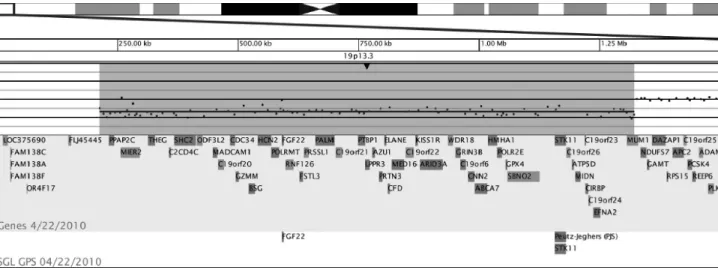
Oligonucleotide-based array CGH revealed an ap-proximately 1.1 Mb deletion at 19p13.3 (chr19:213,080-1,322,552, UCSC hg 18 in the patient). Normal FISH and BAC-based array results in her parents pointed to this dele-tion as beingde novo. Furthermore, the patient also
pre-sented 760 kb duplication at 3q29
(chr3:197,254,006-198,014,826). As BAC-based microarray analysis of the parents showed the mother as carrying this same duplication, this was considered as ma-ternal in origin.
The ~1.1 Mb deletion in our patient encompassed at least 47 genes:PPAP2C,MIER2,THEG,C2CD4C,SHC2 ODF3L2,,MADCAM1,C19orf20,CDC34,GZMM,BSG,
HCN2, POLRMT, FGF22, FSTL3, RNF126, PRSSL1,
PALM, C19orf21, PTBP1, LPPR3, AZU1, PRTN3,
ELANE, CFD, MED16, C19orf22, KISS1R, ARID3A,
WDR18, GRIN3B, C19orf6, CNN2, ABCA7, HMHA1,
POLR2E, GPX4, SBNO2, STK11, C19orf26, ATP5D,
MIDN,C19orf23,CIRBP,C19orf24,EFNA2, andMUM1
(Figure 2).
The girl, although here described as the third patient reported with a larger than 1 Mb deletion at 19p13.3, is the first presenting a PJS phenotype and other atypical clinical manifestations in association with this deletion. The two-months-old patient reported by Hurgoiu and Suciu (1984), presented, through ocular findings, primitive vitreous body and punched-out lesions of the retina. Besides being deaf, spastic, microcephalic and anemic, there were epicanthic folds and umbilical hernia. By karyotyping, his deletion was defined as 19p13-pter, with no further molecular char-acterization, thus thwarting a clear comparison with the de-letion in our patient.
The male patient described by Archeret al.(2005) presented unusual facial appearance, cleft palate, mixed sensorineural and conductive deafness, a congenital heart defect, keloid scaring, immune dysfunction, seizures and moderate learning difficulties. His ~1.2 Mb deletion in-volved approximately 60 genes. After FISH, a BAC clone containingSTK11gene was found to be partially deleted, thus impeding gene-status definition. Features shared with our patient were a congenital heart defect and learning dif-ficulties. The aforementioned congenital heart defect was characterized by pulmonary stenosis with dysplastic tricuspid valve, a ventricular septal defect (VSD) and mild over-ride of the aorta. Two of his five siblings, although without the 19p13.3 deletion, also bore congenital heart de-fects, as coarctation of the aorta, bicuspid aortic valve and a VSD in one, and an atrioseptal defect in the other. Notwith-standing, the authors suggested that the cardiac defect in their patient was more likely related to deletion of the 19p13.3 chromosome, than to a family-trait.
Some of the genes mapped to the deleted segment, both in our patient and that of Archeret al.(2005), might be related to cardiac anomalies.CNN2(calponin 2) codes for a protein that is involved in smooth-muscle contraction. Shown to be expressed in mouse embryonic and adult hearts (Masudaet al., 1996), it appears to be co-localized
with vinculin in the cell-to-cell junctions of cardiomyocytes.SHC2(SHC transforming protein 2), be-sides encoding a member of the SHC family of cell signal-ing proteins, interacts with the vascular endothelial growth factor (VEGF) (Ratcliffeet al., 2002). The VEGF signaling system plays a critical role in heart formation (Vannayet al., 2006; Zhaoet al, 2010).FSTL3(follistatin like 3), a de-velopmental gene coding for a member of the follistatin-module protein family, is composed of extracellular ma-trix-associated glycoproteins. It acts by binding morpho-genesis or growth and differentiation factors, as well as regulating their activity during development (Araiet al., 2003). FSTL, abundantly expressed in fetal and adult mouse hearts, neutralizes several transforming growth fac-tor-beta (TGF-beta) superfamily members, this including myostatin (Takehara-Kasamatsuet al., 2007). FSTL3 also binds both activin and BMP2 (Tsuchidaet al., 2000). A hypomorphic BMP2 (bone morphogenetic protein 2) re-ceptor has been associated with congenital heart defects in murine models (Delot et al., 2003). Recently BMP2-induced kinase was associated with the high level myopia (Liuet al., 2009) present in our patient. Therefore, haplo-insufficiency ofFSTL3may contribute to both heart defects and ocular anomalies.
Another gene, possibly related to cardiac malforma-tion, is PTBP1 (polypyrimidine tract binding protein 1). This belongs to a subfamily of ubiquitously expressed het-erogeneous nuclear ribonucleoproteins, RNA-binding pro-teins that appear to influence mRNA processing. Zhanget al.(2009) showed that PTB, besides contributing to apop-totic gene expression, also modulates susceptibility to caspase activation by differentiating rat cardiomyocytes. Cardiac morphologic abnormalities were also found in mice deficient in key regulators of caspase-dependent sig-naling.
The DatabasE of Chromosomal Imbalance and Phe-notype in Humans using Ensemble Resources
(DECIPHER) lists large 19p13.3 deletion cases. Pheno-types were not reported in a patient with an 0.72 Mbde novodeletion and another with an 0.89 Mb, whose parents had not been analyzed. Another patient with an atrial sep-tum defect and intellectual disability, besides bearing an 0.58 Mb deletion at 19p13.3 which did not encompass
STK11, also carried 2 Mb duplication at 16q24. Parents had also not been analyzed.
Le Meur et al. (2004) reported a PJS patient with learning disabilities, scoliosis and paternally inherited type 1 neurofibromatosis (NF1). His 250 kb deletion at 19p13.3, includingSTK11, was inherited from his mother, also diag-nosed as PJS. The concomitant presence of NF1 makes it difficult to attribute learning disability to 19p13.3 deletion. This deletion also removed GRIN3B, CNN2, ABCA7,
HMHA1,POLR2E,GPX4andSBNO2genes.
The PJS features in our patient can be attributed to haploinsufficiency for STK11. STK11 haploinsufficiency could not be proved in the patient with a deletion at 19p13.3, but without PJS features, as reported by Archeret al.(2005). Whereas, it was proposed that this patient might have a milder and undiagnosed disease or that haploin-sufficiency for STK11 might not cause PJS, in the very same year, Aretzet al.(2005) reported that approximately 30% of the patients with PJS presented partial or complete
STK11deletion, and STK11 haploinsufficiency was con-firmed as a cause for PJS in other patients (Hearleet al., 2006; Restaet al., 2010; Volikoset al., 2006).
Resta et al. (2010), on evaluating 51 patients with PJS, found 15STK11deletions ranging from 2.9 to 180 kb, six of which including additional genes. As these patients presented classical PJS features, but no further anomalies, they proposed that haploinsufficiency of the contiguous genes SBNO2, C19orf26, ATP5D, MIDN, C19orf23,
CIRBP,C19orf24andEFNA2 did not impact the pheno-type. These genes, also deleted in our patient, should not be considered as candidates for her atypical clinical features.
In addition to the 19p13.3 deletion, our patient showed a maternally inherited 760 kb duplication at 3q29, encompassing 10 genes. Most probably it is a copy number variation without overt clinical impact, as this was also present in her phenotypically normal mother.
In conclusion we describe a patient with PJS and other clinical findings associated with a deletion at 19p13.3. This case illustrates the need of screening for large deletions those patients who present PJS together with atypical clinical features.
References
Arai KY, Tsuchida K, Uehara K, Taya K and Sugino H (2003) Characterization of rat follistatin-related gene: Effects of estrous cycle stage and pregnancy on its messenger RNA ex-pression in rat reproductive tissues. Biol Reprod 68:199-206.
Archer HL, Gupta S, Enoch S, Thompson P, Rowbottom A, Chua I, Warren S, Johnson D, Ledbetter DH, Lese-Martin C,et al.
(2005) Distinct phenotype associated with a cryptic sub-telomeric deletion of 19p13.3-pter. Am J Med Genet A 136:38-44.
Aretz S, Stienen D, Uhlhaas S, Loff S, Back W, Pagenstecher C, McLeod DR, Graham GE, Mangold E, Santer R, et al.
(2005) High proportion of large genomic STK11 deletions in Peutz-Jeghers syndrome. Hum Mutat 26:513-519. Ballif BC, Theisen A, Coppinger J, Gowans GC, Hersh JH,
Madan-Khetarpal S, Schmidt KR, Tervo R, Escobar LF, Friedrich CA,et al.(2008) Expanding the clinical pheno-type of the 3q29 microdeletion syndrome and characteriza-tion of the reciprocal microduplicacharacteriza-tion. Mol Cytogenet 1:e8. Delot EC, Bahamonde ME, Zhao M and Lyons KM (2003) BMP signaling is required for septation of the outflow tract of the mammalian heart. Development 130:209-220.
Duker AL, Ballif BC, Bawle EV, Person RE, Mahadevan S, Alliman S, Thompson R, Traylor R, Bejjani BA, Shaffer LG, et al. (2010) Paternally inherited microdeletion at 15q11.2 confirms a significant role for the SNORD116 C/D box snoRNA cluster in Prader-Willi syndrome. Eur J Hum Genet 18:1196-1201.
Forcet C, Etienne-Manneville S, Gaude H, Fournier L, Debilly S, Salmi M, Baas A, Olschwang S, Clevers H and Billaud M (2005) Functional analysis of Peutz-Jeghers mutations re-veals that the LKB1 C-terminal region exerts a crucial role in regulating both the AMPK pathway and the cell polarity. Hum Mol Genet 14:1283-1292.
Giardiello FM and Trimbath JD (2006) Peutz-Jeghers syndrome and management recommendations. Clin Gastroenterol Hepatol 4:408-415.
Hearle NC, Rudd MF, Lim W, Murday V, Lim AG, Phillips RK, Lee PW, O’Donohue J, Morrison PJ, Norman A, et al.
(2006) Exonic STK11 deletions are not a rare cause of Peutz-Jeghers syndrome. J Med Genet 43:e15.
Hemminki A, Markie D, Tomlinson I, Avizienyte E, Roth S, Loukola A, Bignell G, Warren W, Aminoff M, Hoglund P,et al. (1998) A serine/threonine kinase gene defective in Peutz-Jeghers syndrome. Nature 391:184-187.
Hurgoiu V and Suciu S (1984) Occurrence of 19p- in an infant with multiple dysmorphic features. Ann Genet 27:56-57. Jenne DE, Reimann H, Nezu J, Friedel W, Loff S, Jeschke R,
Mul-ler O, Back W and Zimmer M (1998) Peutz-Jeghers syn-drome is caused by mutations in a novel serine threonine kinase. Nat Genet 18:38-43.
Le Meur N, Martin C, Saugier-Veber P, Joly G, Lemoine F, Moirot H, Rossi A, Bachy B, Cabot A, Joly P,et al.(2004) Complete germline deletion of the STK11 gene in a family with Peutz-Jeghers syndrome. Eur J Hum Genet 12:415-418.
Liu HP, Lin YJ, Lin WY, Wan L, Sheu JJ, Lin HJ, Tsai Y, Tsai CH and Tsai FJ (2009) A novel genetic variant of BMP2K con-tributes to high myopia. J Clin Lab Anal 23:362-367. Masuda H, Tanaka K, Takagi M, Ohgami K, Sakamaki T, Shibata
N and Takahashi K (1996) Molecular cloning and character-ization of human non-smooth muscle calponin. J Biochem 120:415-424.
participates in vascular endothelial growth factor-induced signaling. Oncogene 21:6307-6316.
Resta N, Giorda R, Bagnulo R, Beri S, Mina ED, Stella A, Piglionica M, Susca FC, Guanti G, Zuffardi O,et al.(2010) Breakpoint determination of 15 large deletions in Peutz-Jeghers subjects. Hum Genet 28:373-382.
Takehara-Kasamatsu Y, Tsuchida K, Nakatani M, Murakami T, Kurisaki A, Hashimoto O, Ohuchi H, Kurose H, Mori K, Kagami S, et al. (2007) Characterization of follistatin-related gene as a negative regulatory factor for activin fam-ily members during mouse heart development. J Med Invest 54:276-288.
Traylor RN, Fan Z, Hudson B, Rosenfeld JA, Shaffer LG, Torchia BS and Ballif BC (2009) Microdeletion of 6q16.1 encom-passing EPHA7 in a child with mild neurological abnormali-ties and dysmorphic features: Case report. Mol Cytogenet 2:17.
Tsuchida K, Arai KY, Kuramoto Y, Yamakawa N, Hasegawa Y and Sugino H (2000) Identification and characterization of a novel follistatin-like protein as a binding protein for the TGF-beta family. J Biol Chem 275:40788-40796.
Vannay A, Vasarhelyi B, Kornyei M, Treszl A, Kozma G, Gyorf-fy B, Tulassay T and Sulyok E (2006) Single-nucleotide polymorphisms of VEGF gene are associated with risk of
congenital valvuloseptal heart defects. Am Heart J 151:878-881.
Volikos E, Robinson J, Aittomaki K, Mecklin JP, Jarvinen H, Westerman AM, de Rooji FW, Vogel T, Moeslein G, Lau-nonen V,et al.(2006) LKB1 exonic and whole gene dele-tions are a common cause of Peutz-Jeghers syndrome. J Med Genet 43:e18.
Zhang J, Bahi N, Llovera M, Comella JX and Sanchis D (2009) Polypyrimidine tract binding proteins (PTB) regulate the ex-pression of apoptotic genes and susceptibility to caspase-dependent apoptosis in differentiating cardiomyocytes. Cell Death Differ 16:1460-1468.
Zhao W, Wang J, Shen J, Sun K, Zhu J, Yu T, Ji W, Chen Y, Fu Q and Li F (2010) Mutations in VEGFA are associated with congenital left ventricular outflow tract obstruction. Bio-chem Biophys Res Commun 396:483-488.
Internet Resources
DECIPHER, DatabasE of Chromosomal Imbalance and Pheno-type in Humans using Ensemble Resources, http://deci-pher.sanger.ac.uk (June 30, 2011).
Associate Editor: Angela M. Vianna-Morgante