Lack of association between the TNF-
α
-308 (G/A) genetic polymorphism and
periodontal disease in Brazilians
Abstract: This study evaluated the frequency of the tumor necrosis fac-tor-alpha (TNF-α) -308 G/A polymorphism in Brazilians with periodon-tal health (PH = 51), chronic periodontitis (CP = 74) and generalized aggressive periodontitis (GAgP = 38). Human DNA was obtained from
mouthwash samples and TNF-α genotyping was performed by PCR and
RFLP analyses. Differences in clinical and genetic parameters among groups were sought by Kruskal-Wallis, χ2 and Fisher’s exact tests. The
al-lele -308G was detected in 91.7%, whereas the alal-lele -308A was found in 35.4% of all subjects. No signiicant differences were observed in the fre-quency of these alleles (χ2 = 2.610, p > 0.05) and the genotypes G/G, G/
A, and A/A (χ2 = 2.547, p = 0.636) among groups. The data suggest that
the TNF-α -308 G/A polymorphism is not associated with periodontitis in this Brazilian population.
Descriptors: TNF-alpha; Periodontal diseases; Genetic polymorphism; PCR.
Natascha Giovannetti de Menezes(a)
Ana Paula Vieira Colombo(b)
(a) MSc in Periodontology, School of Dentistry,
Federal University of Rio de Janeiro, Brazil.
(b) PhD in Medical Sciences (Oral Biology),
Adjunct Professor, Department of Medical Microbiology, Institute of Microbiology, Federal University of Rio de Janeiro, Brazil.
Corresponding author:
Natascha Giovannetti de Menezes Rua Xavier da Silveira, 45, C0B 08 Copacabana
Rio de Janeiro - RJ - Brazil CEP: 22061-010
E-mail: [email protected]
Introduction
The cytokine TNF-α has been found at high lev-els in gingival crevicular luid and gingival tissues from periodontitis lesions.1 TNF-α was clearly
iden-tiied as a potent inducer of tissue destruction and bone resorption in different forms of periodontal disease.2 A guanine (G) to adenine (A) transition at
position -308 of the TNF-α promoter affects a con-sensus sequence for a binding site of the transcrip-tion factor AP-2.3 Carriage of the rare -308 A allele
is associated with signiicantly greater TNF-α pro-duction and transcription.3 In addition, the A allele
has been associated with increased risk for various non-related infectious and inlammatory diseases,4
including periodontitis.5,6 In contrast, other
inves-tigators have failed to corroborate the association between this polymorphism and increased risk for periodontal diseases.7-11 The frequency of genetic
polymorphisms may vary considerably among dis-tinct ethnic groups, so that the application of such markers for diagnosis and prognosis of periodontitis should be examined in different populations.12 This
study determined the frequency of the -308 (G/A) TNF-α alleles and genotypes in individuals with different periodontal status from a Brazilian popu-lation.
Material and Methods
Human subjects and clinical assessments A total of 163 adult subjects who sought den-tal treatment at the Denden-tal School of the Federal University of Rio de Janeiro were recruited for the study. Informed consent was obtained from all in-dividuals. The study protocol was approved by the Review Committee for Human Subjects of the Cle-mentino Fraga Filho University Hospital. Exclusion criteria included pregnancy, use of local or systemic antimicrobials in the previous 6 months, diabetes, and other systemic conditions that could affect the periodontal status. All subjects had at least 10 teeth and were over 18 years of age. Clinical mea-surements were performed at 6 sites/tooth and in-cluded probing depth (PD), clinical attachment level (CAL), presence or absence of supragingival bioilm (SB), bleeding on probing (BOP) and suppuration (SUP). Subjects were categorized into: periodontal
health controls (PH = 51; no sites with PD and/or CAL > 3 mm and no more than 10% of sites with BOP); chronic periodontitis (CP = 74; at least 10% of teeth with PD and/or CAL ≥ 5 mm, or 20% of teeth with PD and/or CAL ≥ 4 mm); and general-ized aggressive periodontitis (GAgP = 38; ≥ 30% of teeth with PD and/or CAL ≥ 5 mm, or ≥ 60% of teeth with PD and/or CAL ≥ 4 mm). Patients were deined (by self-reporting) as White, African-Brazil-ian, or others. Individuals were classiied as smok-ers, never-smokers and former smokers (subjects who had stopped smoking for at least 2 years).
Determination of -308 (G/A) TNF-α genotypes
Mouthwash samples were obtained from patients as previously described.13 Human genomic DNA was
isolated from samples by using the QIAmp DNA Mini Kit (QIAGEN, Valencia, CA, USA), and stored at –20°C. PCR was performed in a 50 µL reaction mix containing 100 ng of DNA, 5 µL of 10 X PCR buffer (100 mM TrisHCl, pH 8.3, 500 mM KCl),
1.5 mM MgCl2, 0.2 mM of each dNTP, 1.25 U of
Taq polymerase (PROMEGA, Madison, WI, USA),
and 0.2 pM of each primer14 (sense primer 5’ -AGG
CAA TAG GTT TTG AGG GCC AT- 3’ and anti-sense primer 5’ -TCC TCC CTG CTC CGA TTC CG- 3’; Bio-Synthesis, Inc., Lewisville, TX, USA). The PCR program included a step of 95°C for 10 min, followed by 38 cycles of 94°C for 1 min, 57°C for 1 min and 72°C for 1 min. Subsequently, 20 µL of the amplicon (107 bp fragment) were digested with 5 U of Nco I (PROMEGA) at 37°C overnight and the generated DNA fragments were analysed by electrophoresis on a 2.5% agarose gel.
Statistical analysis
Analyses were performed using the software SPSS (SPSS Inc v.13 Chicago, IL, USA). Clinical measure-ments were computed for each subject and averaged across subjects within the groups. Differences on clinical parameters among groups were sought us-ing Kruskal-Wallis, Mann-Whitney (between pairs of groups) and χ2 tests. The frequency of alleles and
genotypes were compared among groups by χ2 and
coni-dence intervals were determined. In order to control for age and race, the data were stratiied by these cat-egories and analyzed by Kruskal-Wallis and χ2 tests.
A 5% signiicance level was set for all analyses.
Results
Demographic and clinical features
The demographic data of the 3 clinical groups are summarized in Table 1. PH and GAgP patients were signiicantly younger than CP individuals (p < 0.01). A greater % of White patients was observed in the PH group (81%), whereas the CP and GAgP groups presented a higher proportion of African-Brazil-ians (22% and 14%, respectively) and individuals of mixed racial background (19% and 50%, respec-tively) (p = 0.002). In general, most of the patients were never-smokers (78.5%). Nevertheless, a high-er frequency of current and formhigh-er smokhigh-ers with chronic periodontitis was detected (p < 0.001).
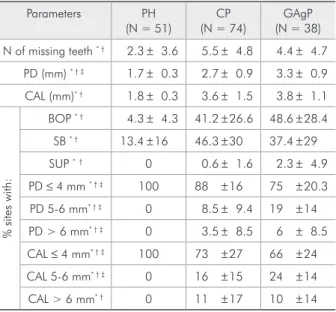
Table 2 shows that statistically signiicant differ-ences among groups were observed for all clinical parameters (p < 0.01). When pairs of groups were compared, no signiicant differences were found for number of missing teeth, BOP, SB, SUP, and CAL > 6 mm between the CP and GAgP groups. In order to control for smoking and race, comparisons of clinical parameters among groups were carried out only in never-smokers and White individuals. Even though, differences among groups were
sta-tistically signiicant for all clinical measurements (p < 0.001; data not shown).
Frequency of the TNF-α (-308 G/A) alleles and genotypes
The allele distributions of the TNF-α among clinical groups are shown in Table 3. No differences were found between observed and expected distribu-tions of genotypes for the PH control group. Thus, the allele distribution was assumed to be in Hardy-Weinberg equilibrium. A high incidence of allele G was observed in all groups. Likewise, the % of sub-jects carrying at least one copy of the G allele was greater than subjects carrying allele A. However, no signiicant differences in the distribution of these al-leles were found among groups (χ2 = 2.610, p > 0.05
for allele frequency; χ2 = 1.01, p = 0.604 for G+ and
χ2 = 2.12, p = 0.345 for A+ individuals). When PH
subjects were compared with the CP or GAgP pa-tients, no signiicant differences between groups were observed for allele frequency. Also, no signii-cant differences in the distribution of these alleles
Table 1 - Demographic parameters (mean ± SD) of Peri-odontally Healthy (PH), Chronic Periodontitis (CP), and Generalyzed Aggressive Periodontitis (GAgP) subjects of the study population.
Parameters PH
(N = 51) CP (N = 74)
GAgP (N = 38)
Age * ‡ 30 ± 10 48 ± 12 31 ± 6
(%) Males 31 41 18
Race (%)**
Whites 81 59 36
African-Brazilians 8 22 14
Others 11 19 50
Smoking (%)**
Never-smokers 88 61 100
Former-smokers 8 27 0
Current-smokers 4 12 0
* Refers to p < 0.01, Kruskal-Wallis test, and ‡, to Mann-Whitney test; ** refers to p < 0.01, χ2 test.
Table 2 - Full-mouth clinical parameters (mean ± SD) of Periodontally Healthy (PH), Chronic Periodontitis (CP), and Generalyzed Aggressive Periodontitis (GAgP) subjects of the study population.
Parameters PH
(N = 51)
CP (N = 74)
GAgP (N = 38)
N of missing teeth * † 2.3 ± 3.6 5.5 ± 4.8 4.4 ± 4.7
PD (mm) * † ‡ 1.7 ± 0.3 2.7 ± 0.9 3.3 ± 0.9
CAL (mm)* † 1.8 ± 0.3 3.6 ± 1.5 3.8 ± 1.1
%
site
s
with:
BOP * † 4.3 ± 4.3 41.2 ± 26.6 48.6 ± 28.4
SB * † 13.4 ± 16 46.3 ± 30 37.4 ± 29
SUP *† 0 0.6 ± 1.6 2.3 ± 4.9
PD ≤ 4 mm * † ‡ 100 88 ± 16 75 ± 20.3
PD 5-6 mm* † ‡ 0 8.5 ± 9.4 19 ± 14
PD > 6 mm* † ‡ 0 3.5 ± 8.5 6 ± 8.5
CAL ≤ 4 mm* † ‡ 100 73 ± 27 66 ± 24
CAL 5-6 mm* † ‡ 0 16 ± 15 24 ± 14
CAL > 6 mm* † 0 11 ± 17 10 ± 14
were found when only never-smoker and White sub-jects were included in the analyses (data not shown). As seen in Graph 1, no signiicant differences among groups were observed regarding the distri-butions of the three genotypes AA, AG and GG (χ2
= 2.547, p = 0.636).
Discussion
Periodontal diseases are considered to be complex diseases. Complex diseases are typically polygenic.12
Disease modifying genes associated with susceptibil-ity and seversusceptibil-ity of periodontitis have been proposed, but very little is known about which genes may be involved in these diseases.12 The current study
inves-tigated the frequency of the TNF-α -308 G/A alleles and genotypes in Brazilians with different
periodon-tal conditions. Our results showed that the carriage rate of the rare allele A was slightly higher in the PH controls compared to diseased groups, but no sig-niicant differences among groups were found. The frequency of allele A varied widely in most of the studies carried out in different populations (range 3% - 32%).7-9,11,15-17 Despite these differences, our
indings are in agreement with the majority of the literature data that failed to show an association of this polymorphism with susceptibility and/or sever-ity of periodontal disease.7-9,11,15-17
Regarding the G/G, G/A and A/A genotypes, a similar distribution was observed among the groups as well. Usually, the -308A allele is considered to be the marker of disease susceptibility due to the upreg-ulatory effect of this allele on the cytokine produc-tion. However, Folwaczny et al.9 (2004) and
Sakel-lari et al.11 (2006) reported low frequencies for the
A/A genotype in periodontitis patients (2% - 4%), whereas this genotype was not detected in periodon-tally healthy subjects. Other studies did not ind the A/A genotype neither in patients nor in controls.7,17
Our data indicated that the A/A genotype tended to be more prevalent in the PH group (11.6%) in re-lation to the CP (7.7%) and GAgP (5.6%) groups, although these differences were not signiicant. Very few studies have reported some correlation between TNF-α polymorphism and periodontitis. Some au-thors found a signiicant high frequency of the G/G genotype in severe periodontitis patients,6,16 whereas
Lin et al.5 (2003) reported a signiicant association
between the A allele and moderate-to-advanced peri-odontitis. Other TNF-α polymorphisms have been
Graph 1 - Bar chart of the distribution of the TNF-α -308 G/A genotypes in Periodontally Healthy (PH), Chronic Periodontitis (CP), and Generalyzed Aggressive Periodonti-tis (GAgP) subjects of the study population. No significant
differences were observed among groups (χ2 = 2.547,
p = 0.636).
Table 3 - Frequency of alleles in the TNF-α -308 G/A gene polymorphism in Periodontally Healthy (PH), Chronic Periodontitis (CP), and Generalyzed Aggressive Periodontitis (GAgP) subjects of the study population.
PH CP GAgP PH vs. CP *** PH vs. GAgP ***
n = 51 n = 74 n = 38 OR (95%CI) OR (95%CI)
Allele frequency * † TNF-α -308G 72.5% 81% 81.6% 0.616 (0.34-1.12) 0.596 (0.29-1.23)
TNF-α -308A 27.5% 19% 18.4%
Polymorphic allele positivity ** G+
§ 88.4% 92.3% 94.4% 1.5 (0.43-5.82) 4.5 (0.40-12.3)
A+ ⊥ 44.2% 31% 33.3% 0.59 (0.25-1.25) 0.69 (0.25-1.58)
* Values represent the % in which the alleles appear of the total possible times (2n) that they may occur in each group (PH = 102; CP = 148; GAgP = 76); †χ2 = 2.610, p > 0.05; ** Percentage of individuals who carry at least one copy of each polymorphic allele; §χ2 = 1.01, p = 0.604; ⊥χ2 = 2.12, p = 0.345; *** Not significant (Fisher’s exact test).
11.6
7.7 5.6
32.6
23.1
27.8 55.8
69.2
66.7
0 10 20 30 40 50 60 70 80
PH (n = 51)
Su
bje
cts
(%)
CP (n = 74) GAgP (n = 38) AA
investigated.15,17 Only Soga et al.17 (2003) showed a
signiicant association between TNF-α -1031, -863 and -857 polymorphisms and severe periodontitis in Japanese individuals.
The inconsistent results observed in the literature could be attributed to several factors related to the deinition of disease, population heterogeneity, envi-ronmental and demographic confounding risk fac-tors.12 Although differences in age, ethnicity, gender
and smoking history were observed among the sub-ject groups in the current study, the distribution of alleles and genotypes has not changed when the data were independently analyzed in subgroups of patients (data not shown). The sample size in this study was small, thus careful interpretation of the data is nec-essary. Lack of association between genotypes and clinical status may be due to small sample size, par-ticularly for alleles of low prevalence. Nevertheless, we observed a quite elevated carriage rate for the rare allele A compared to other investigations.7,9,11,17
Deining a subject population in relation to the type of periodontal disease may also contribute to signiicant differences among genetic studies. It is likely that overlapping of clinical phenotypes exists between different forms of periodontitis, regardless of the diagnostic criteria used. Even though we used commonly accepted criteria to differentiate clinical groups, comparing our indings with those of other studies is quite dificult due to the different classii-cation systems used.
Finally, the genetic basis for periodontitis may not be related to a single genetic variant, but may be inluenced by multiple genes acting synergisti-cally with environmental factors to increase or de-crease the likelihood of developing a disease. The TNF cluster region exhibits a high degree of link-age disequilibrium with other polymorphic nearby genes involved in inlammatory responses.18 For
in-stance, Fassmann et al.8 (2003) suggested that
com-bined genotypes of the TNF-α -308 G/A and LT-α +252 G/A polymorphisms may inluence the suscep-tibility to chronic periodontitis. Thus, the analysis of a single genetic polymorphism might be meaning-less for determining a genetic risk factor for peri-odontal diseases. Instead, combinations of different genotypes for possible gene-gene interactions should be evaluated in these studies.
Conclusion
Based on our results, the TNF-α -308 G/A poly-morphism is not associated with increased suscepti-bility to or severity of periodontitis in this particular Brazilian population.
Acknowledgments
This work was supported in part by the National Council for Scientiic and Technological Develop-ment (CNPq), 470103/2004-3; and by the Research Foundation for Financial Support in the State of Rio de Janeiro, E-26/ 170.562/2004.
References
1. Engebretson SP, Lamster IB, Herrera-Abreu M, Celenti RS, Timms JM, Chaudhary AG et al. The influence of interleukin gene polymorphism on expression of interleukin 1 beta and tumor necrosis factor-alpha in periodontal tissue and gingival crevicular fluid. J Periodontol. 1999;70(6):567-73.
2. Graves DT, Delima AJ, Assuma R, Amar S, Oates T, Cochran D. Interleuk1 and tumor necrosis factor antagonists in-hibit the progression of inflammatory cell infiltration toward alveolar bone in experimental periodontitis. J Periodontol. 1998;69(12):1419-25.
3. Abraham LJ, Kroeger KM. Impact of the -308 TNF promoter polymorphism on the transcriptional regulation of the TNF gene: relevance to disease. J Leukoc Biol. 1999;66(4):562-6.
4. Wilson AG, di Giovine FS, Duff GW. Genetics of tumour ne-crosis factor-alpha in autoimmune, infectious, and neoplastic diseases. J Inflamm. 1995;45(1):1-12.
5. Lin L, Pan YP, Yin LY. Study on the correlation of cytokine gene polymorphism with chronic periodontitis. Shanghai Kou Qiang Yi Xue. 2003;12(6):456-9.
6. Qian W, Zhang J, Zhang Y. [The relationship between tumor necrosis factor A-308 gene polymorphism and susceptibility of severe periodontitis in adults] [Article in Chinese]. Zhonghua Kou Qiang Yi Xue Za Zhi. 2002;37(2):126-8.
IL-4RA polymorphisms with severe chronic periodontitis in Swedish Caucasians. J Clin Periodontol. 2005;32(5):474-9. 8. Fassmann A, Holla LI, Buckova D, Vasku A, Znojil V, Vanek J.
Polymorphisms in the +252(A/G) lymphotoxin-alpha and the -308(A/G) tumor necrosis factor-alpha genes and susceptibil-ity to chronic periodontitis in a Czech population. J Periodon-tal Res. 2003;38(4):394-9.
9. Folwaczny M, Glas J, Torok HP, Mende M, Folwaczny C. Lack of association between the TNF alpha G -308 A promoter polymorphism and periodontal disease. J Clin Periodontol. 2004;31(11):449-53.
10. Kornman KS, Crane A, Wang HY, di Giovine FS, Newman MG, Pirk FW et al. The interleukin-1 genotype as a sever-ity factor in adult periodontal disease. J Clin Periodontol. 1997;24(1):72-7.
11. Sakellari D, Katsares V, Georgiadou M, Kouvatsi A, Arsenakis M, Konstantinidis A. No correlation of five gene polymor-phisms with periodontal conditions in a Greek population. J Clin Periodontol. 2006;33(11):765-70.
12. Kinane DF, Shiba H, Hart TC. The genetic basis of periodon-titis. Periodontol 2000. 2005;39:91-117.
13. Laine ML, Farre MA, Crusius JB, van Winkelhoff AJ, Pena AS. The mouthwash: a non-invasive sampling method to
study cytokine gene polymorphisms. J Periodontol. 2000; 71(8):1315-8.
14. Wilson AG, di Giovine FS, Blakemore AI, Duff GW. Single base polymorphism in the human tumour necrosis factor al-pha (TNF alal-pha) gene detectable by NcoI restriction of PCR product. Hum Mol Genet. 1992;1(5):353.
15. Galbraith GM, Steed RB, Sanders JJ, Pandey JP. Tumor ne-crosis factor alpha production by oral leukocytes: influence of tumor necrosis factor genotype. J Periodontol. 1998;69(4): 28-33.
16. Galbraith GM, Hendley TM, Sanders JJ, Palesch Y, Pandey JP. Polymorphic cytokine genotypes as markers of disease se-verity in adult periodontitis. J Clin Periodontol. 1999;26(11): 705-9.
17. Soga Y, Nishimura F, Ohyama H, Maeda H, Takashiba S, Murayama Y. Tumor necrosis factor-alpha gene (TNF-alpha) -1031/-863, -857 single-nucleotide polymorphisms (SNPs) are associated with severe adult periodontitis in Japanese. J Clin Periodontol. 2003;30(6):524-31.