Marina Sousa Azevedo(a) Daniela Vilas Boas(b) Flávio Fernando Demarco(c) Ana Regina Romano(a)
(a) Department of Social and Preventive Dentistry, School of Dentistry, Federal University of Pelotas, Pelotas, RS, Brazil.
(b) School of Education, Federal University of Pelotas, Pelotas, RS, Brazil.
(c) Department of Operative Dentistry, School of Dentistry, Federal University of Pelotas, Pelotas, RS, Brazil.
Corresponding author: Marina Sousa Azevedo
Rua Carlos Gomes, 23, Três Vendas Pelotas - RS - Brasil
CEP: 96055-450
E-mail: [email protected]
Received for publication on Jun 10, 2010 Accepted for publication on Aug 05, 2010
Where and how are Brazilian dental
students using Glass Ionomer Cement?
Abstract: Glass Ionomer Cements (GICs) have a wide range of uses in Dentistry, and the manipulation technique used can inluence the results obtained. This study aimed at assessing the knowledge held by Dental School students from a city in Southern Brazil regarding the use of GIC, and the clinical technique chosen for its use and its applications. A struc-tured questionnaire was applied to 60 advanced dental students. Descrip-tive statistics was used to analyze the quantitaDescrip-tive data. All students had already used the material. Regarding the purpose for which the mate-rial was used, all students (100%) had used it as a dental cavity liner, 83.3% had used it as a temporary restorative material after endodontic treatment, and 73.3% had used it as a permanent restoration in primary teeth. Regarding the clinical technique used, 86.7% said that they insert the material while it still has a shiny surface, 33% said that they inish and polish the restoration in a following session, and only 28.3% said that they apply a surface protection immediately after the restoration is placed. Although students generally seem to be acquainted with the fun-damental knowledge and main techniques involved in GIC use, they oc-casionally fail to follow all the technical steps required during clinical application, which may affect treatment outcome. Therefore, professors should stress that all the clinical procedures required during GIC appli-cation must be followed strictly to improve the performance of this mate-rial.
Descriptors: Knowledge; Students, Dental; Glass Ionomer Cements; Education, Dental.
Introduction
Glass Ionomer Cements (GICs) were developed in the 1970s by the English researchers Wilson and Kent,1 and have evolved constantly since then. These cements exhibit clinical advantages, such as continuous luo-ride release throughout the life of the restoration,2 which gives the mate-rial anticariogenic properties,3 adhesion to both enamel and dentin, and a low coeficient of thermal expansion, similar to that of the dental struc-ture. However, Glass Ionomer Cements present some negative properties, such as low cohesive resistance and low wear resistance, factors limiting their use as illing materials to areas subject to low masticatory stresses.4
One of the most critical aspects related to the clinical performance of GIC is the way they are manipulated and the technique employed. Varia-tions in these aspects can modify not only the inal consistency of the material, but also its mechanical properties,6 which may interfere in the expected outcome.
Although it is expected that students should be aware of the biological, chemical and physical principles involved in GIC application techniques, there have been some doubts as to whether dental students are fully qualiied to use these dental ma-terials properly.7 Surveys with dental students are important tools to assess how well they know the topics covered in dental course curricula.8 Thus, the aim of this study was to assess how well the Dental School students from a city in Southern Brazil knew the techniques employed in using Glass Ionomer Ce-ment as restorative, luting and lining materials.
Material and Methods
This study was reviewed and approved by the in-stitutional Ethics Committee (protocol 067/2008). The students were informed of the objectives of the study, and a questionnaire was applied after obtain-ing their written consent.
The questionnaire comprised 35 questions grouped in 5 main areas:
• General information about the population (age, gender, and which semester they were attending)
• Frequency and use of Glass Ionomer Cement in different areas of Dentistry
• Kind of material used and preferences
• Clinical use of Glass Ionomer Cement
• Technique employed
The questionnaire was applied by 4 previously trained interviewers (May 2009) and answered by advanced students (from the 8th and 9th semesters).
Descriptive statistics was used to analyze the quantitative data, and keywords and concepts were used to analyze the open questions.
Results
Of the 77 regularly enrolled students in the 8th and 9th semesters of Dental School, 17 refused to answer the questionnaire. Fifty-eight percent of the
respondents were enrolled in the 8th semester, and 41.7%, in the 9th semester. The average age of the students was 24.2 years; 38.3% of them were male and 61.7% were female.
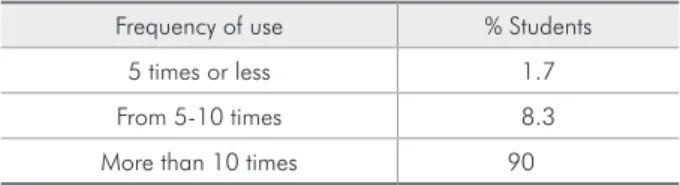
All students reported having already used GIC at least once in their clinical practice (Table 1).
When asked in which areas they had already used GIC, the only area that was not mentioned was surgery. The great majority reported having used the material in Restorative Dentistry (100%) and Pediatric Dentistry (96.7%).
Regarding the type of material, conventional Glass Ionomer Cement was the most widely used (100%), mainly for restorative purposes (93.3%), followed by luting (80%) and cavity lining applica-tions (38.3%). Light-cured GIC was used by 60% of the respondents, resin-modiied GIC was used by 58.3% of the respondents, and metal-reinforced GIC was used by one student.
Seventy percent of the students said that they did not have any preferences regarding GIC type. Most students who stated their preferences mentioned res-in-modiied GIC as their material of choice.
It was observed that 98.4% of the students in-tended to use these materials in their future clini-cal practice. When asked about the reasons for this, most mentioned that it was because of the charac-teristics of the material, especially:
• Biocompatibility with dental tissues
• Easy use
• Cost effectiveness
• Effective use as a cavity liner
Table 2 shows the clinical uses of GIC reported by the dental students.
Most students (93.3%) said that they followed the manufacturer’s instructions regarding the rec-ommended powder/liquid ratio to be used during
Table 1 - Frequency of use of Glass Ionomer Cement by students attending the Dental School, Federal University of Pelotas, RS, Brazil (n = 60)
Frequency of use % Students
5 times or less 1.7
From 5-10 times 8.3
the clinical procedure. In addition, 86.7% reported that they inserted the cement when it still presented a shiny surface, 33% inished and polished the res-toration in a following session, and only 28.3% ap-plied an immediate surface protection after restora-tion.
Discussion
The criterion used to select the students for this survey was how advanced they were in their under-graduate course curriculum. By the time students have gained experience in the clinical areas where GIC could be used, it is expected that they would also have had dental materials classes (4th semester), where they are supposed to receive the necessary knowledge regarding GIC. Therefore, we assessed whether the basic knowledge received during den-tal materials classes was still in the students’ minds when using GIC clinically. Since these materials are
very sensitive regarding the techniques of manipula-tion and applicamanipula-tion used, dental students should be fully aware of these techniques in order to use the materials effectively, hence the importance of apply-ing a questionnaire to measure how well students know about GIC use.
Our results were limited to a single dental school, and we were aware that our indings could not be generalized since each school follows a differ-ent curriculum and uses differdiffer-ent teaching methods. The continuous development of GIC since its intro-duction has allowed a wider range of uses in clinical dentistry. In this study, 90% of the students report-ed having usreport-ed these materials more than 10 times, indicating that they have used them frequently. Stu-dents have used GIC in different clinical areas, and all of them reported having used it in Restorative Dentistry. This could explain the several applica-tions of GIC in this area, where it can be used as cavity liner, temporary restorative material, perma-nent class V restoration, and for the provisional ce-mentation of indirect restorations.
GIC was also largely applied (96.7%) in Pediatric Dentistry, probably because resin-modiied and con-ventional GICs have proven to be durable and reli-able materials for Class I and II restorations. Resin-Modiied Glass Ionomer Cements (RMGIC) have also proven to be suitable materials for Class III and Class V restorations in primary teeth.4,9 However, according to Qvist et al.,10 Class III/V restorations should be made in conventional GIC, since it boosts the longevity of restorations, whereas RMGIC should be used preferably for Class II restorations in primary dentition. However, there is a study that as-sessed the need for prospective randomized clinical trials lasting at least 5 years to determine correctly the success rate of Class II restorations in primary molars.11 GIC is an alternative to silver amalgam and resin-based composite for primary teeth resto-rations, with the advantages of being less technically demanding12 and providing luoride release that is highly important for high-risk patients.
Furthermore, this material can be used as a pit and issure sealant to prevent occlusal caries; an in situ study has also shown that sealing with glass ionomer cement made the enamel of pits and issures Table 2 - Percentage of the clinical uses of Glass Ionomer
Cement reported by the dental students.
Use of Glass Ionomer Cement % Students
Cavity liner 100.0
Temporary restorative material
after endodontic treatment 83.3
Permanent restoration in primary teeth 73.3
Class V restoration in permanent teeth
(erosion, abrasion, abfraction) 66.7
Atraumatic restorative treatment (ART) 51.7
Class V restoration in permanent teeth (caries) 48.3
Fissure sealant 36.7
Cervical barrier in bleaching procedures 35.0
Class I conservative restoration in permanent teeth 25
Class II tunnel restoration in permanent teeth 21.7
Prosthesis cementation 18.3
Core build-up 16.7
Class II restoration in permanent teeth 15
Orthodontic band cementation 13.3
Furcation perforation treatment 8.3
Restoration in cusp area in permanent teeth 8.3
Class III restoration in permanent teeth 4
Class IV restoration in permanent teeth 3
more resistant by increasing its Knoop hardness.13 Although resin composite is more commonly used as a sealant, both materials appear to be equally suit-able for clinical application as a issure sealant mate-rial.14,15 GICs have been employed in primary teeth as a “permanent” restorative material because these teeth will be later replaced by the permanent ones. Nevertheless, in permanent teeth, restorations made with resin-modiied GIC, which has better mechani-cal properties than those of conventional GIC, do not seem to perform well in terms of marginal char-acteristics, surface properties and color stability over time.16 Its relatively poor mechanical properties indicate the use of GIC as a permanent restorative material only in low stress situations.17 This could explain why such a high rate of students (83.3%) re-ported using it as a temporary restorative material in permanent teeth.
Another use of GIC widely reported by the stu-dents was in Class V restorations (66.7%). Clinical studies have shown that resin-modiied GIC has an acceptable performance in Class V cavities.18 In-terestingly, however, the number of respondents that used RMGIC (58.3%) for Class V cavities was lower than the number that reported using conven-tional GIC for this application. Based on this data, we may infer that students may not be choosing the best GIC type to achieve the expected performance, which may consequently lead to a reduced clinical service of Class V restorations when conventional GIC is used.
GIC is the material used for Atraumatic Restor-ative Treatment (ART) because it is self-curing, has adhesive properties and is biocompatible. Although ART was developed to be used in the less industrial-ized parts of the world, this procedure has been ac-cepted as part of a minimal intervention philosophy in developed countries, proving to be an appropri-ate option for the treatment of primary teeth.19 This may explain why more than 50% of the students re-ported applying GIC for the ART technique.
Class II tunnel restorations preserve the anatom-ical marginal ridge and minimize the loss of healthy tooth structure adjacent to the carious lesion. How-ever, the main disadvantage of the tunnel technique has been the dificulty in completely removing
den-tin caries.20 GIC is thus the material of choice for these cavities because of its anticariogenic proper-ties, which may contribute to remineralization.
Few students mentioned the use of GIC in orth-odontic band cementation. This procedure is rarely used in the school surveyed since only preventive orthodontics is employed and, in many cases, only removable appliances are used. A systematic review that evaluated the effectiveness of the adhesives used to attach bands to teeth during ixed appliance treatment concluded that there is insuficient high quality evidence to indicate the most effective adhe-sive for attaching orthodontic bands.21 However, the advantages of choosing GIC are its ability to bond to enamel and stainless steel, and its ability to leach luoride.
It was also found that conventional GICs were more frequently used than RMGICs (100% and 58.3%, respectively). Probably, the main reason for the lower application of RMGICs is their signii-cantly higher cost as compared to that of conven-tional GICs. Convenconven-tional GIC also presents better biocompatibility, which could account for its broad-er application. RMGIC has HEMA (2-hydroxethyl methacrylate) in its formulation, meaning that the release of this monomer and its diffusion through the dentin may cause toxic effects on the pulp tis-sue,22 thus restricting the use of RMGIC in some cases. Although RMGICs offer some advantages over conventional GICs, such as increased resistance and longer working time, conventional GICs may also be used in many of the procedures mentioned above. Perhaps, this is the reason why 70% of the students did not report any preference regarding ce-ment types, although it could be expected that stu-dents from more advanced semesters would be able to select the best material for each procedure.
It should be pointed out that all the students had already used Glass Ionomer Cement as cavity liners, probably because the use of this cement as an un-derilling material considerably reduces the required resin composite bulk, thus reducing the total com-posite polymerization shrinkage, which improves marginal adaptation.23
recom-mendations regarding the powder/liquid ratio used and that they inserted the material when it still had a shiny surface (86.7%). According to Behr et al.,6 mistakes during GIC manipulation can reduce the wear resistance and the hardness of the material, reinforcing the importance of following the manu-facturers’ instructions, mainly because the powder/ liquid ratio varies signiicantly not only between dif-ferent manufacturers, but also according to the pur-pose of the application (lining, luting or restorative). Inserting the material when it is still shiny is another important factor, since GIC bonds chemically to the tooth substrate, and the shiny surface indicates the presence of available liquid, which contains carbox-yl radicals that will bind to calcium ions, dentin and cement, promoting adherence to the tooth.17
As regards surface protection, 71.7% of the stu-dents said that it was not necessary to protect the surface of GIC restorations with coatings. GIC is highly sensitive to humidity during its chemical set-ting reaction (irst 24 hours). If newly-placed glass ionomer restorations are exposed to water during this period there will be water sorption,24 surface erosion25 and loss of translucency, which negative-ly affect the clinical performance of the material.12 Thus, surface protection is indicated, and some products, such as nail varnish, are effective for this purpose at a low cost.26,27 During the dental materi-als classes of their regular curriculum, students are taught that the surface needs to remain protected, and they should therefore be aware of this.
The period observed before inishing and polish-ing GIC restorations is a factor that may inluence
their surface topography and sealability. Polishing after 24 hours showed more acceptable surface to-pography and less gap incidence compared to pol-ishing immediately afterwards;28,29 however few students (33%) reported observing the prescribed period of time before conducting polishing proce-dures.
This data highlights the importance of not only teaching about GICs, but also reminding students constantly about the need to follow the protocols and instructions for their correct manipulation and use.
Conclusion
The overall results of this study demonstrate that students seem to be acquainted with the types, properties, uses, and technical procedures regard-ing GICs. However, in some situations, students do not follow some clinical procedures that may affect the properties of the materials and the treatment outcomes. Therefore, dental instructors should con-stantly remind their students of how important it is to follow strictly the correct procedures for use of these materials, thus making them better qualiied to choose the best technique to guarantee the best performance of the product and, consequently, the best outcomes for their patients.
Acknowledgments
The authors would like to thank students Leti-cia Brancher, Fernando Silva, Paula Silva, Marcela Yurgel and Jorge Pereira Jr. for their assistance in collecting the data.
References
1. Wilson AD, Kent BE. A new translucent cement for dentistry. A glass ionomer cement. Br Dent J. 1972 Feb 15;132(4):133-5. 2. Garcez RMVB, Buzalaf MAR, Araújo PA. Fluoride release of
six restorative materials in water and pH-cycling solutions. J Appl Oral Sci. 2007 Oct;15(5):406-11.
3. Wiegand A, Buchalla W, Attin T. Review on fluoride-releasing restorative materials-Fluoride release and uptake characteris-tics, antibacterial activity and influence on caries formation. Dent Mater. 2007 Mar;23(3):343-62. Epub 2006 Apr 17.
4. Croll TP, Bar-Zion Y, Segura A, Donly KJ. Clinical perfor-mance of resin-modified glass ionomer cement restorations in primary teeth. J Am Dent Assoc. 2001 Aug;132(8):1110-6. 5. Pegoraro TA, da Silva NRFA, Carvalho RM. Cements
for use in esthetic dentistry. Dent Clin North Am. 2007 Apr;51(2):453-71.
7. Ueda M, Mine A, DE Munck J, Hakogi T, VAN Meerbeek B, Kuboki T. The effect of clinical experience on dentine bonding effectiveness: students versus trained dentists. J Oral Rehabil. 2010 Sep;37(9):653-7. Epub 2010 May 21.
8. Cardall WR, Rowan RC, Bay C. Dental education from the students’ perspective: curriculum and climate. J Dent Educ. 2008 May;72(5):600-9.
9. Daou MH, Tavernier B, Meyer JM. Two-year clinical evalu-ation of three restorative materials in primary molars. J Clin Pediatr Dent. 2009 Fall;34(1):53-8.
10. Qvist V, Manscher E, Teglers PT. Resin-modified and con-ventional glass ionomer restorations in primary teeth: 8-year results. J Dent. 2004 May;32(4):285-94.
11. Toh SL, Messer LB. Evidence-based assessment of tooth-colored restorations in proximal lesions of primary molars. Pediatr Dent. 2007 Jan-Feb;29(1):8-15.
12. Davidson CL. Advances in glass-ionomer cements. J Appl Oral Sci. 2006;14 Suppl:3-9.
13. Amaral MT, Guedes-Pinto AC, Chevitarese O. Effects of a glass-ionomer cement on the remineralization of occlusal car-ies – an in situ study. Braz Oral Res. 2006 Apr-Jun;20(2):91-6. 14. Yengopal V, Mickenautsch S, Bezerra AC, Leal SC.
Caries-preventive effect of glass ionomer and resin-based fissure seal-ants on permanent teeth: a meta analysis. J Oral Sci. 2009 Sep;51(3):373-82.
15. Niederman R. Glass ionomer and resin-based fissure sealants - equally effective? Evid Based Dent. 2010;11(1):10.
16. Sidhu SK. Clinical evaluations of resin-modified glass-ionomer restorations. Dent Mater. 2010 Jan;26(1):7-12.
17. Tyas MJ. Clinical evaluation of glass-ionomer Cement restora-tions. J Appl Oral Sci. 2006;14 Suppl:10-3.
18. Loguercio AD, Reis A, Barbosa AN, Roulet JF. Five-year dou-ble-blind randomized clinical evaluation of a resin-modified glass ionomer and a polyacid-modified resin in noncarious cervical lesions. J Adhes Dent. 2003 Winter;5(4):323-32. 19. Honkala E, Behbehani J, Ibricevic H, Kerosuo E, Al-Jame G.
The atraumatic restorative treatment (ART) approach to
re-storing primary teeth in a standard dental clinic. Int J Paediat Dent. 2003 May;13(3):172–9.
20. Pilebro C, van Dijken JWV, Stenberg R. Durability of tunnel restorations in general practice: a three-year multicenter study. Acta Odontol Scand. 1999 Feb;57(1):35–9.
21. Millett DT, Glenny AM, Mattick CR, Hickman J, Mandall NA. Adhesives for fixed orthodontic bands. Cochrane Data-base Syst Rev. 2007 Apr 18;(2):CD004485.
22. Nicholson JW, Czarnecka B. The biocompatibility of resin-modified glass-ionomer cements for dentistry. Dent Mater. 2008 Dec;24(12):1702-8. Epub 2008 Jun 9.
23. Friedl KH, Schmalz G, Hiller KA, Mortazavi F. Marginal adaptation of composite restorations versus hybrid ionomer/ composite sandwich restorations. Oper Dent. 1997 Jan-Feb;22(1):21-9.
24. Karaoglanoglu S, Akgül N, Özdabak HN, Akgül HM. Effec-tiveness of surface protection for glass-ionomer, resin-modi-fied glass-ionomer and polyacid-modiresin-modi-fied composite resins. Dent Mater J. 2009 Jan;28(1):96-101.
25. McLean JW. Glass ionomer cements. Br Dent J. 1988 May 7;164(9):293-300.
26. Brito CR, Velasco LG, Bonini GA, Imparato JC, Raggio DP. Glass ionomer cement hardness after different materi-als for surface protection. J Biomed Mater Res A. 2010 Apr;93(1):243-6.
27. ShintomeI LK, NagayassuI MP, NicolóII RD, MyakiII SI. Microhardness of glass ionomer cements indicated for the ART technique according to surface protection treatment and storage time. Braz Oral Res. 2009 Oct-Dec;23(4):439-45. 28. Amin A-el-H M, Farid MR. Finishing of glass-ionomer cement
(SEM study). Egypt Dent J. 1994 Oct;40(4):903-8.