RBCCV 44205-1603 DOI 10.5935/1678-9741.20140069
Right-sided reverse T composite arterial grafting
to complete revascularization of the right
coronary artery
Enxerto arterial composto reverso T do lado direito para completar a revascularização da artéria
coronária direita
Mathias H. Aazami
1, MD; Mohammad Abbasi-Teshnizi
2, MD; Shahram Amini
3, MD; Nasim Sadat
Lotinejad
4, MD
1Cardiac Surgery Department, Cardiac Anesthesia Research Center ad Car-diothoracic Surgery and Transplantation Research Center of Imam Reza Hospitalthe Mashhad University of Medical Sciences, Mashad, Iran. 2Cardiac Surgery Department of Imam Reza Hospital the Mashad University of Medical Sciences, Mashhad, Iran.
3Cardiac Surgery Department and Cardiac Anesthesia Research Center of Imam Reza Hospitalthe Mashhad University of Medical Sciences, Mash-had, Iran.
4Mashhad University of Medical Sciences, Mashhad, Iran.
This study was carried out at Cardiac Surgery Department of Imam Reza Hospital, The Mashhad University of Medical Sciences, Mashhad, Iran.
No inancial support.
Correspondence address:
Nasim Sadat Lotinejad
Faculty of Medicine, Azadi Square, Pardis Campus, Mashhad-Iran
E-mail: [email protected]
Article received on February 28th, 2014 Article accepted on May 3nd, 2014
Abstract
Complete arterial revascularization for the right coronary artery is underused mainly due to technical issues. Herein we report on a new approach for complete arterial revasculariza-tion of arterial revascularizarevasculariza-tion for the right coronary artery branches. Complete arterial revascularization for the right coronary artery revascularization was performed in 8 patients using a reverse T composite arterial graft. None of the patients suffered perioperative myocardial infarction. All patients under-went noninvasive coronary imaging, displaying an early patency rate of 100%. Complete arterial arterial revascularization for the right coronary artery revascularization using a reverse T
graft offers a new paradigm with enhanced technical lexibility
in performing all arterial myocardial complete revasculariza-tions in selected patients.
Descriptors: Coronary Artery Bypass. Coronary Circulation. Internal Mammary-Coronary Artery Anastomosis. Tomography Scanners, X-Ray Computed. Radial Artery.
Resumo
Revascularização arterial completa para a artéria coronária direita é subutilizada, principalmente devido a problemas técni-cos. Nós relatamos uma nova abordagem para a revascularização arterial completa para os ramos da artéria coronária direita. Revascularização arterial completa da artéria coronária direita
foi realizada em 8 pacientes usando um enxerto T arterial com -posto inverso. Nenhum dos pacientes sofreu infarto do miocárdio
perioperatório. Todos os pacientes foram submetidos a exame de imagem não invasivo coronária não invasiva, exibindo taxa de
patência precoce de 100%. Revascularização arterial completa
da artéria coronária direita com enxerto inversa T oferece um novo paradigma com maior lexibilidade técnica na execução
todas as revascularizações arteriais completas do miocárdio em pacientes selecionados.
INTRODUCTION
The right coronary artery (RCA) is an important provider of collateral low to the left coronary system and interventricular septum (IVS)[1,2]. In the setting of a multisite diseased right coronary artery (MDR), surgical revascularization is generally conined to its inferoposterior branches. We report on a new approach, attempted at complete arterial revascularization of RCA (CRR) in selected patients. These techniques enable us to achieve double inlow all arterial revascularizations using two arterial composite grafts at their utmost technical aspect.
METHODS
This study was approved by our institutional ethics com-mittee, and written informed consent was obtained from each patient. This approach is based on constructing a reverse T composite arterial graft placed between the RCA targets along with complete left-sided arterial revascularization. Arterial revascularization is performed using left internal thoracic artery (LITA); right internal thoracic artery (RITA), or radial artery (RA). Bicaval venous cannulation in view of optimal integrated myocardial protection, cold blood inter-mittent anteroretrograde cardioplegia, mild systemic hypo-thermia, and peri- and postoperative tight glycemia control were used systematically.
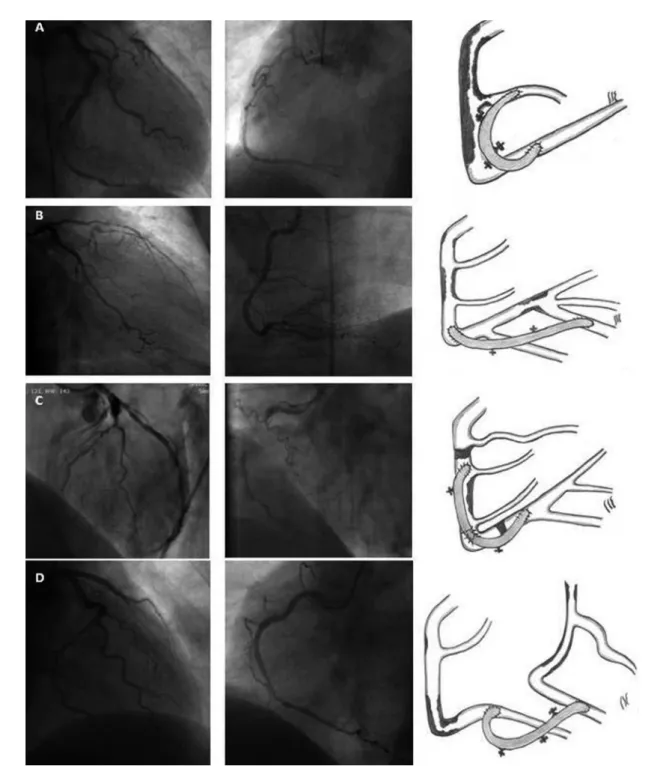
An intracoronary bridge (ICB) is constructed between the RCA targets using a segment of free arterial graft (Figure 1A-D). Preprocedural measuring of the grafts’ length and
ICB on a fully beating heart avoids pitfalls in its inal layout;
thereby preventing kinking/angulation. An anterolateral or acute marginal branch can be bypassed directly (diameter > 1 mm) or indirectly through RCA segments giving them
take-off (Figure 1C). Then ICB is connected to an arterial inlow
according to two distinct modes, the choice of which depends
on inal layouts for left- and right-sided revascularizations in
line with availability of the arterial grafts: Abbreviations, acronyms & symbols
RCA Right coronary artery
MDR Multisite diseased right coronary artery CCR Complete RCA revascularisation
CBF Coronary blood low
CRTG Coronaro-coronary reverse T grafting ICB Intracoronary bridge
IRTG In situ reverse T grafting ITA Internal thoracic artery IVS Interventricular septum LAD Left anterior descending artery LITA Left internal thoracic artery
MI Myocardial infarction
RA Radial artery
RITA Right internal thoracic artery
1) In-situ reverse T grafting (IRTG) using RITA (Figure 2A). 2) Coronaro-coronary reverse T grafting (CRTG) (Fig-ures 2B and 2C).
Eight patients with a mean age of 57.13 9.7 years old (fe-male 25%; mean logistic Euroscore: 5.2±5.6%; elective: 75%;
mean preoperative left ventricle ejection fraction (LVEF):
45.71±9.32%; diabetes mellitus: 75%) underwent CRR as a part of complete arterial revascularization. 75% of patients had a three vessel or left main disease and had a history of recent myocardial infarction (MI). Two patients underwent previous PTCA with intracoronary stenting (mean stent per patient: 4). An occluded LAD and RCA were noticed in 50% of patients, and RCA was dominant in 6 patients.
RESULTS
The mean number of total arterial anastomoses (distal/ composite/ proximal coronary-coronary) was 7±1.5 per pa-tient. The mean numbers of distal and CRR anastomoses were 4.88± 1.26 and 2.25±0.463 per patient respectively. Double internal thoracic arteries (ITAs) and RA were used in 75 and 62.5% of the patients. Six patients had right- and left-sided double composite arterial grafting. CRR was per-formed as IRTG in 5 and as CRTG in the remaining patients. An ICB was constructed using a segment of RA in 5 patients or ITA in the rest. An anterolateral or acute marginal branch was revascularized in 6 patients directly or via their support-ing RCA segment (4 patients).
Fifty percent of patients required extensive LAD
re-construction (endarterctomy, arterial rooing, and On-Lay
anastomosis). Two patients needed concomitant releas-ing of a muscle bridge on LAD (>3 cm). The mean pump and ischemic times were 257±47.7 and 180±47.3 minutes respectively. None of the patients suffered perioperative MI, nor required mechanical/inotropic cardiocirculatory
support. 87.5% of patients were extubated within the irst
24 hours postoperatively and the mean time of ICU stay
was 3.1±1.5 days. None of the patients suffered major
cardiocerebral adverse events except one with resolving postoperative neurocognitive dysfunction (preoperative strokes with carotid stenting). The mean LVEF at dis-charge was 45.71±3.45%. All patients underwent
nonin-vasive coronary imaging within the irst four months post -operatively displaying an early patency rate of 100% for the grafts and distal anastomoses.
DISCUSSION
A double inlow feature of coronary arterial system confers RCA the role of a main provider for collateral low
with regards to the left coronary system and IVS; there-by, federating a salient backup in regulations of coronary
Fig. 1 - The examples of a right-sided intracoronary bridge.
A-I: severe three vessel CAD with an occluded LAD. A-II: Diffuse MDR involving an anterolateral branch (the dashed arrow). A-III: ICB placed between the anterolateral branch and distal RCA. [ICB: radial artery; Inlow mode: IRTG with in situ RITA, see Fig. 2A].
B-I: Left coronary branches with diffuse LAD disease. B-II: a MDR. The dashed arrows show a second anterolateral and acute marginal branches arising from the RCA segment between the two stenoses. B-III: ICB placed between mid and distal RCA. [ICB: radial artery; Inlow mode: ITRG with in situ RITA].
C-I: LAD is nearly occluded; the distal segment of a dominant RCA is illed retrogradely (arrow). C-II: an occluded MDR, a second anterolateral and acute marginal branches are detected (dashed arrows). C-3: ICB providing 3 distal anastomoses. The distal anastomoses for second anterolateral and acute marginal branches are placed on the corresponding RCA segments. [ICB: radial artery; Inlow mode: IRTG with in situ RITA].
Fig. 2 - The arterial Inlow modes by in situ RITA (IRTG) and coronaro-coronary grafting (CRTG).
A-I: operative view of an ITRG with in situ RITA. A-II: postoperative CT angiography showing the arterial inlow (arrow) and ICB (dashed arrow). A-III: the postoperative CT-angiography of the left-sided composite arterial graft (endarterctomized LAD with extensive arterial rooing). B-I: operative view of CRTG: arrows and dashed arrows show the arterial inlow and ICB respectively. BII: postoperative CT angiography of CRTG. The head of arrow shows the native RCA with in-stent stenosis. The arrow displays the arterial inlow and ICB at the level of their composite anastomosis. B-III: operative view and postoperative control of the left-sided composite arterial graft.
Restoring the collateral pathways and functional fea-tures of coronary circulation should render the aim of complete revascularization more attainable. Reaching a coronary reserve closer to the normal does support a better myocardial protection and enhances the ability of myocar-dium to meet an increased demand in CBF. Despite a myr-iad of all arterial bypassing techniques being successfully reported; yet, controversy exists regarding their functional capacity to restore an aortocoronary reserve close to that
of a normal double inlow coronary system. A single in
-low feature and increased vulnerability of the arterial grafts facing native competitive low are still matters of
debate[3-5].
In the setting of coronary artery disease with MDR referred to surgical revascularization, bypassing the right
coronary system is generally conined to its inferoposteri -or territ-ory. An inadequate length of arterial grafts, a m-ore complex layout required for sequential bypassing, a small size of an anterolateral or acute marginal branch to host
for a distal anastomosis, and severe calciications are tech -nically the main limiting factors that could compromise graft’s patency. In addition, the existence of a differential
proile along RCA for native competitive low (adversely
affecting patency of the arterial grafts especially for coro-nary stenosis less than 90%) arouses the current reluctance for arterial CRR[2-5].
From a technical point of view, using an ICB over-comes the aforementioned technical issues: ICB reduces the number of sequential bypassing, enhances
techni-cal lexibility in fashioning sequential anastomoses with
proper angulations if required, and remedies the limiting length of arterial grafts. Performing the distal anastomosis on an intermediate segment of RCA supporting an antero-lateral or acute marginal branch is an alternative in a case of unsuitable anatomy (Figure 1C). It may be preferable
to establish the inal layout of ICB operatively, as the pre -operative coronary angiography could lead to over- or un-derestimation of the total number of targets amenable to revascularization (Figure 1).
Patients with compromising revascularization of LAD or distal RCA (poor runoff, extensive endarterectomy, and arterial reconstruction) incur an exceptionally high risk for perioperative myocardial infarction, therefore restor-ing some amount of the coronary collateral pathways as a “backup” sounds crucial. Diffuse coronary artery disease severely affects the epicardial arterial network that is in charge of optimizing the diastolic phase of CBF. The latter can be partly compensated for by using an arterial ICB, creating a new functional epicardial arterial network. Our results show a 100 % early patency rate for ICBs placed between different RCA branches with various degrees of stenosis, suggesting a better aptitude of ICB to face the
native competitive low. It can be speculated that ICB acts
as a systolic redistributing circuit between the targets,
thereby reducing the amount of systolic reversed low in its arterial inlow.
Right-sided reverse T grafting should only be performed on carefully selected patients. If any doubts remain about the suitability of target sites for hosting a distal anastomosis,
dif-iculty in dissection for RCA or its branches, and quality of
arterial grafts, the patient should not be put on the risk side
of the beneit/ risk ratio. It is deinitively inadvisable to pro -ceed with such a procedure using the unsuitable distal rest of arterial conduits.
Being technically more demanding with an increased ischemic time can be reproached. The increased ischemic time is related to a greater number of large arterial anasto-moses that should be fashioned meticulously. In addition, 50% of patients in the current series needed extensive coronary arterial reconstruction. A safer pump run, metic-ulous cardioprotection encompassing a protocol for tight
glycemic control, and the expected beneits of a double in
-low complete revascularization do outweigh the foresee -able and inevit-able reluctances[1,2]. Bicaval cannulations
with right atrial isolation were used in this series as part of integrative myocardial protection. By the time of heart displacement, kinking of vena cava increases venous pres-sures; therefore, selective drainage of vena cava provides additional organ protection, specially reducing the rate of neurologic and neurocognitive disorders. As the appropri-ate lengths of all grafts and ICB are measured pre-pro-cedurally on loaded heart, its subsequent unloading with bicaval drainage does not induce errors in estimation. The
absence of in-hospital mortality and occurrence of major
adverse cardiocerebral events supports the aforementioned
perioperative majors and the current techniques, recalling
that best myocardial protection is provided by integrated revascularization.
So far, further functional investigations, a larger scale clinical series, and longer-term results are mandatory to
sup-port the advocated beneits of CRR using a composite arterial
reverse T graft.
Authors’ roles & responsibilities
MHA Conception and study design, performed procedures and/or experiments, writing of the manuscript or review of its content MAT Final approval of manuscript
SA Final approval of manuscript conception and design of the study
REFERENCES
1. Osswald BR, Blackstone EH, Tochtermann U, Schweiger P, Thomas G, Vahl CF, et al. Does the completeness of revascularization affect early survival after coronary artery bypass grafting in elderly patients? Eur J Cardiothorac Surg. 2001;20(1):120-5.
2. Gaudino M, Alessandrini F, Glieca F, Luciani N, Cellini C, Pragliola C, et al. Effect of surgical revascularization of a right coronary artery tributary of an infarcted nonischemic territory on the outcome of patients with three-vessel disease: a prospective randomized trial. J Thorac Cardiovasc Surg. 2004;127(2):435-9.
3. Yie K, Na CY, Oh SS, Kim JH, Shinn SH, Seo HJ. Angiographic
results of the radial artery graft patency according to the degree of native coronary stenosis. Eur J Cardiothorac Surg. 2008;33(3):341-8.
4. Nakajima H, Kobayashi J, Tagusari O, Bando K, Niwaya
K, Kitamura S. Competitive flow in arterial composite grafts and effect of graft arrangement in off-pump coronary revascularization. Ann Thorac Surg. 2004;78(2):481-6.