VIII
Editorial
Cardiac Surgery, the Brazilian Archives
of Cardiology and the Brazilian Journal of
Cardiovascular Surgery
Paulo Roberto B. Evora
1DOI: 10.5935/1678-9741.20120088
In the last Brazilian Congress of Cardiology, there
was a round table dedicated to the Brazilian Archives of Cardiology (BAC). The interesting initiative of the Editor, Professor. Luiz Felipe Pinho Moreira, was addressing the varied lines of articles published in the triennium 2010-2013 in its co-editors' view. The idea was that the presentations gave rise to editorials that, in analytical style, provide the
reader with a sectoral analysis of co-auditorships. In the case of our presentation, we adopted a strategy based on
three topics: 1) Establishing a parallel between the BAC editorial and two journals devoted to cardiology clinics,
2) assessing the content based on published articles, and
3) searching possible evidence of impact of the creation of the Brazilian Journal of Cardiovascular Surgery (BJCVS)
on the publication of articles in cardiac surgery at the
Brazilian Archives of Cardiology.
Editorial parallel between the BAC and two famous clinical cardiology journals
The journals chosen for editorial comparisons were the
Journal of the American College of Cardiology (JACC)
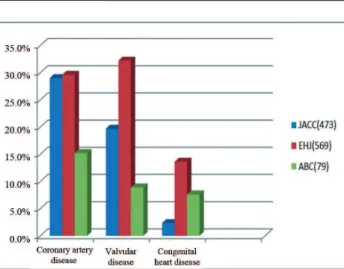
and the European Heart Journal (EHJ). The source of information was the MEDLINE. In the period in question, there were published a signiicant number of studies: 2286 (JACC), 3299 (EHJ) and 689 (BAC). Of this total, 473/20,7% (JACC), 569/29,6 (EHJ) and 79/11,6 (BAC) are
articles related to cardiac surgery and among these items were separated the articles according to the three groups of more common surgical heart diseases: coronary artery
disease, valvular and congenital heart disease (Figure 1).
Thus, the numbers calculated were: 1) Coronary Disease:
140/29% (JACC), 126/29, 6% (EHJ) and 12/15,2% (BAC) 2) Valve Disease: 93/19,7% (JACC), 93/32,2% (EHJ) and
7/8,9% (BAC), and 3) Congenital heart defects: 11/2,33%
(JACC), 18/13,6% (EHJ) and 6/7, 6% (BAC).
Content analysis based on articles published in BAC
For this assessment we adopted a systematic similarly
based on the three most common cardiac surgery and heart transplantation. But regardless of any editorial strategy, with large margin of certainty, the publication of greatest
impact was the publication of analytical evolution of cardiovascular surgery at the Heart Institute based on impressive institutional experience and 71,305 surgeries 1. Cardiovascular Surgeon. Full Professor, Department of Surgery and
Anatomy, Faculty of Medicine of Ribeirão Preto, University of São Paulo. Associate Editor of the Arquivos Brasileiros de Cardiologia. Member of the Editorial Board of the Brazilian Journal of Cardiovascular
Surgery.
IX Abbreviations, acronyms and symbols
BAC Brazilian Archives of Cardiology CVA Stroke
CPB Cardiopulmonary bypass IAC Interatrial communication IVC Interventricular communication EHJ European Heart Journal
JACC Journal of the American College of Cardiology BJCVS Brazilian Journal of Cardiovascular Surgery
between 1984 and 2007, considering the trend of the main procedures and mortality rates. The study shows
the following results: 1) The number of CABG surgeries, which in the 1980s had an average of 856/year increased to about 1.106/year, 2) heart valve procedures increased
from 400 to 597 operations/year, an increase of 36.7% compared to the 1990s, and 3) the correction of congenital
heart disease also had a signiicant increase of 50.8% over the last decade. The average overall mortality, which at the
beginning was 7.5%, decreased to 7%, and 4.9% among
elective procedures [1]. This article deserved a brilliant
editorial, which highlights the numbers presented, but
above all draws a parallel with the historical evolution of Brazilian heart surgery. The title of the editorial speaks for itself: “Evolution of Cardiovascular Surgery. The Brazilian Saga. A History of Work, Success and Pioneering”[2].
CABG Surgery
In relation to coronary artery bypass grafting, two aspects were addressed: surgery in octogenarians and prospecting results between surgery with and without cardiopulmonary bypass (CPB).
We studied 140 consecutive cases between January 2002 and December 2007. Patients were on average 82.5
± 2.2 years (80-89), and 55.7% were male. In the sample,
72.9% were hypertensive, 26.4% had diabetes, 65.7% had severe lesions in three or more vessels and 28.6%
in the left main coronary artery. Associated surgery was
present in 35.7% of patients, and aortic valve in 26.4%
and mitral in 5.6%. These results led to the conclusion that bypass surgery in octogenarians is associated with greater morbidity and mortality than in younger patients, which,
however, does not preclude intervention if indicated by the
clinical condition [3].
A meta-analysis of available randomized trials demonstrated that off-pump CABG is associated with lower mortality rates and lower risk of cerebrovascular accident (CVA). However, this apparent clinical superiority compared to CPB in CABG surgery still
needs to be demonstrated in particular clinical contexts.
Both techniques are evolving and have advantages and disadvantages in certain subgroups of patients in whom
the risks and beneits of both approaches need to be
considered, so that the choice of strategy to allow the
patient to maximize the long-term beneit and minimize risks in the short-term [4].
Since the review published in BAC was quite cautious, we opted for the inclusion of the concepts derived from
recent meta-analysis published by the Cochrane Database
Systematic Review. This systematic review did not observe any signiicant beneit of OPCAB surgery compared to surgery with CPB, considering the operative mortality. In contrast, we observed better survival in the group undergoing surgery with CPB. Based on this evidence, the CABG with CPB should be the standard procedure.
The surgery without CPB should be used when there is contraindication to aortic cannulation [5].
Cardiac Valve Disease
A text of my own illustrates a view of the carcinoid valvulopathy as a puzzle and a challenge of modern
cardiology. Why puzzle and challenge? Some data would
be still enigmatic: 1) the unknown role of serotonin in valvular disease, 2) against the hypothesis of the presence of IAC, as a condition for left valvulopathies, there are cases approaching left valvulopathy without the presence
of such communication, 3) the natural history of the disease is still unclear and the disease could be underestimated.
Some highlights “challenges” would be: 1) early diagnosis
based on imaging examination and more accurate
biomarkers, 2) what is the optimal surgical timing? 3)
although there is a preference for bioprostheses, would
possible treatments that reversed the binomial term graft/ patient survival arise? 4) does the association between repair and valve exchanges make sense? It is noteworthy
that the increasing number of publications on carcinoid
heart disease can provide it characteristic of emerging disease, deserving more attention to basic researchers,
clinicians and surgeons [6].
Congenital heart defects
A study aimed to assess the feasibility and effects
of anatomic repair of Ebstein's anomaly with the cone technique in the clinical evolution of patients, the function of the tricuspid valve and right ventricular morphology.
This is an original surgical technique, proposed by the authors in 1989, called cone reconstruction of the
tricuspid valve, aimed at rebuilding valve like normal. We
compared the clinical, radiological and echocardiographic
data obtained in the preoperative, immediate postoperative and long-term of 52 consecutive patients with a mean age
of 18.5 ± 13.8 years, who underwent cone technique. The cone technique showed low hospital mortality, correcting
X
area, allowing the heart reverse remodeling and clinical improvement in most patients in the long-term [7]. The relevance of this issue prompted an editorial which
highlights three important points: 1) the introduction of the cone technique, as it is called, immediately becomes
an important technical advance of considerable magnitude and breath in the general management of Ebstein's anomaly, 2) the dificulty with this cone technique is still expressed
in its non-reproducibility and use in other medical centers,
thus it is believed that hereafter it may be performed more,
stimulated by the good results demonstrated already in
suficient period of long-term outcome, and 3) one aspect
that should be further emphasized is that the technique could be performed on younger patients than that currently
performed (18.5 ± 13.8 years), in order to prevent unfavorable evolutionary adverse aspects, as the marked right ventricular dilatation and subsequent ventricular
dysfunction [8].
It is worth mentioning a study proposed to identify
the risk factors associated with dysfunction and
pulmonary homograft failure in children undergoing
expansion of the right ventricular outlow tract. The inal sample of 75 patients with a median age at
surgery of 22 months, ranging from 1 to 157 months,
showed 13 (17%) patients who developed homograft dysfunction, characterized by severe pulmonary stenosis or insuficiency. The authors concluded that the
pulmonary homograft of size smaller than 21 mm and
the pulmonary valve inadequate for the patient's age and
weight are factors for graft dysfunction [9].
Still in the ield of congenital heart disease, deserves special mention the growing individualized interest
in adult congenital heart disease, and who should be responsible for operating them: the pediatric surgeon
or adults' surgeon? Two articles were published on the subject. One aimed to describe the proile of patients who had undergone surgery over the age of 16 years and assessing the risk factors predictive of hospital mortality. One thousand ive hundred and twenty patients (mean age
27 ± 13 years) underwent surgery between January 1986
and December 2010. We performed descriptive analysis of the epidemiological proile of the population studied and analysis of risk factors for hospital mortality, considering
the complexity score, the year in which the surgery was performed, a procedure performed by pediatric surgeon or
not and the presence of reoperation. It was also observed an increasing number of patients aged over 16 years and
that, despite the large number of simple cases, the most complex were referred to pediatric surgeons, who had lower mortality, especially in recent years [10].
The other study aimed to describe the basic clinical
proile of adults with congenital heart disease receiving
care at a tertiary center. In the study, the most patients were
treated invasively, residents in the region and most aged
below 40 years. Defects such as atrial septal defect (ASD),
ventricular septal defect (VSD) and pulmonary stenosis
predominated in the untreated group, while in the treated, most had undergone surgical correction of ASD, tetralogy
of Fallot, aortic coarctation and VSD. Hypertension and arrhythmias were signiicant in both groups, and large variety of other comorbidities was also recorded [11].
Heart Transplant
A study aimed to compare the effects of sildenail and
sodium nitroprusside on hemodynamic, echocardiographic,
and neurohormonal variables during lung reactivity test. Sildenail and nitroprusside are vasodilators that reduce, signiicantly, pulmonary hypertension and cardiac geometry, besides improving biventricular function. Nitroprusside, unlike sildenail, was associated with systemic hypotension and worsening of venous oxygen
saturation [12].
A well-designed meta-analysis concludes that the
bicaval and total orthotopic heart transplants are better
in terms of prognosis than the biatrial. Therefore, the indication of biatrial technique for transplantation should be the exception and not the rule [13].
Impact of the creation of BJCVS approaching heart surgery articles publishing on BAC
After the arbitrary evidence above described emerged
the curiosity if the publication of BJCVS caused some
impact on the proile of publications with respect to cardiac surgery issues in BAC. Querying MEDLINE in
the triennium 1983-1985 (before BJCVS), the following numbers were calculated: a total of 615 studies, 58 (9.43%) were about the heart surgery.
XI
REFERENCES
1. Lisboa LA, Moreira LF, Mejia OV, Dallan LA, Pomerantzeff PM, Costa R, et al. Evolution of cardiovascular surgery at the Instituto do Coração: analysis of 71,305 surgeries. Arq Bras Cardiol. 2010;94(2):162-8.
2. Braile DM, Gomes WJ. Evolution of cardiovascular surgery: the Brazilian saga. A history of work, pioneering experience and success. Arq Bras Cardiol. 2010;94(2):141-2.
3. Pivatto Júnior F, Kalil RA, Costa AR, Pereira EM, Santos EZ, Valle FH, et al. Morbimortality in octogenarian patients
submitted to coronary artery bypass graft surgery. Arq Bras
Cardiol. 2010;95(1):41-6.
Among these, 9 (13.9%) were related to coronary
surgery, 3 (4.9%) with valvular heart disease, and were
not published articles on congenital heart defects. If there
is a gross bias, Figure 2 shows it is favorable to BAC in relation to publications related to valvular and congenital heart disease. Emphasizing that presentations of case
reports were not considered, it is curious to note the almost nonexistent publications of studies on congenital heart diseases in BJCVS.
As a inal comment, the studies published in BAC
may be considered compatible with the orientation of disseminating information that are of mutual interest among clinicians and surgeons.
4. Godinho AS, Alves AS, Pereira AJ, Pereira TS. On-pump versus off-pump coronary-artery bypass surgery: a meta-analysis. Arq Bras Cardiol. 2012;98(1):87-94.
5. Møller CH, Penninga L, Wetterslev J, Steinbrüchel DA, Gluud C. Off-pump versus on-pump coronary artery bypass grafting for ischaemic heart disease. Cochrane Database Syst Rev. 2012;3:CD007224.
6. Evora PR, Bassetto S, Augusto VS, Vicente WV. Carcinoid heart valve disease: still a puzzle and a challenge. Arq Bras Cardiol. 2011;97(5):e111-2.
7. Silva JP, Silva LF, Moreira LF, Lopez LM, Franchi SM, Lianza AC, et al. Cone reconstruction in Ebstein's anomaly repair: early and long-term results. Arq Bras Cardiol. 2011;97(3):199-208.
8. Atik E. Ebstein's anomaly. Arq Bras Cardiol. 2011;97(5):363-4.
9. Lenzi AW, Olandoski M, Ferreira WS, Sallum FS, Miyague NI. Dysfunction of the pulmonary homograft used in the reconstruction of the right ventricle exit tract. Arq Bras Cardiol. 2011;96(1):2-7.
10. Caneo LF, Jatene MB, Riso AA, Tanamati C, Penha J, Moreira LF, et al. Evaluation of surgical treatment of congenital heart disease in patients aged above 16 years. Arq Bras Cardiol. 2012;98(5):390-7.
11. Amaral F, Manso PH, Granzotti JA, Vicente WV, Schmidt A. Congenital heart disease in adults: outpatient clinic proile at
the Hospital das Clínicas of Ribeirão Preto. Arq Bras Cardiol.
2010;94(6):707-13.
12. Freitas Jr AF, Bacal F, Oliveira Júnior JD, Fiorelli AI, Santos RH, Moreira LF, et al. Sildenail vs. sodium before nitroprusside for the pulmonary hypertension reversibility
test before cardiac transplantation. Arq Bras Cardiol.
2012;99(3):848-56.
13. Locali RF, Matsuoka PK, Cherbo T, Gabriel EA, Buffolo E.
Should biatrial heart transplantation still be performed? A