Statistical Properties of the Squeezed
Displaced Number States
Celia M. A. Dantas
, Norton G. de Almeida and B. Baseia
InstitutodeF
isica,UniversidadeFederaldeGoias, CaixaPostal131,74001-970,Goi^ania,GO,Brazil
Received1August,1998. Revisedversionreceived5Octob er,1998
Squeezed Displaced Number States of the light were introduced in the recent literature. They exhibit various nonclassical properties as sub-Poissonian statistics, squeezing and oscillations in the photon-number distribution. Here we investigate other properties of these elds, as waiting-time and photoelectron-counting distributions. We considerably simplify previous calculations in the literature while showing that these states constitute a unied approach for number, coherent, and squeezed states.
PACS Numbers: 42.50. -p 42.50.Dv 03.65.-w
I Introduction
In recent years, many authors have investigated new quantum states of the electromagnetic eld. The squeezed state can be considered as one of the most studied state [1]. It is characterized by the fact that the indetermination in one of the two quadrature-components of the electromagnetic eld is smaller than in the usual coherent states. It is of great importance, as in optical communication and interferometry [2]. Special attention is given to three classes of squeezed states: (i) squeezed vacuum states, (ii) squeezed coher-ent states and (iii) squeezed number states.
Here we will study a new class of squeezed states, called Squeezed Displaced Number State [SDNS], re-cently introduced in the literature [3]. We show that this class contains, as particular cases, various states already studied in the literature, such as the squeezed coherent states [4], squeezed number states [5], dis-placed number states [6], including the coherent state and number states. The photoelectron-counting dis-tribution P(m;T) and the disdis-tribution of waiting-time intervals !(); between the arrivals of successive pho-tons, are analyzed as a function of various parameters. Depending on the values of the parameters
characteriz-ing a particular realization of the SDNS, it may exhibit sub-Poissonian or super-Poissonian statistics, which is analyzed in terms of Mandel's Q -parameter. As a con-sequence, it exhibits photon bunching or photon anti-bunching, which is analyzed in terms of the distribution !().
This paper is organized as follows: In Section II we introduce the SDNS and analyze the photon number distribution P(j), including variances of number oper-ator ^n = ^a+^a and quadrature operators
b
X1= (^a+^a y)=2
andXb 2= (^a
,^a
y)=2i, where ^ay(^a) is the creation
(an-nihilation) operator for photons in a single-mode state. In Section III we analyze the photoelectron-counting distribution P(m;T) and in Section IV we discuss the behavior of waiting-time distribution !(): Finally, Sec-tion V contains a summary of results and conclusion.
II Squeezed Displaced Number
State
The squeezed displaced number statejn;;ziis
ob-tained by the application of the squeeze operator S(z)b
followed by the displaced operatorD(), on the numberb
jn;;zi b
D()S(z)b
jni; (2:1)
whereD() andb S(z) are the displacement and squeezeb
operators, given respectively by
b
D() = exp(^a+
,
^a); (2:2)
b
S(z) = exp[(z^a+2 ,z
^a2)=2]; (2:3)
where is the coherence parameter, =jjei, and z
is the squeeze parameter, z = r ei:
Alternatively, the equation (2.1) can be written as
jn;z;i= b
S(z)D()b
jni (2:4)
with
= + (2:5)
where = cosh(r) and = eisinh(r): The
Eqs.(2.1)-(2.4) are connected, via the unitary
trans-formation,D() =b Sb +(z)
b
D()S(z) withb Sb +(z)
b
S(z) =
b
S(z)Sb
+(z) = 1.
The coecients Cj for the SDNS in the Fock
repre-sentation are dened as Cjhjj
b
S(z)D()b
jni=hjjn;z;i; (2:6)
and the application of the completeness relation of the number states fjmig, in the Eq.(2.6), gives
Cj=
1 X
m=0 hjj
b
S(z)jmihmj b
D()jni
= 1
X
m=0
SjmDmn; (2:7)
where Sjm , Dmn are respectively the coecients of
the squeezed number state [5] (with = 0) and the displaced number state [6], given by
c
Sjm =
p
m!j! (cosh r)j+1=2
1 2 tanhr
(m,j)=2
F(r;m;j)cos 2(j
,m)2 (2:8)
with
F(r;m;j) =
1 2j X
k= 1 2
(j,m)
(,1)k(2
,1sinhr)2k
k!(j,2k)![k + (m,j)=2]!
(2:9) and
Dmn=
n! m!
1 2
m,ne, 1 2
jj 2
L (m,n)
n (jj
2) (2:10)
d
where is given in Eq.(2.5) andL (m,n)
n (jj
2) is the
as-sociate Laguerre polynomial. As we can see in Eq.(2.7), the coecients of the SDNS are a sum of products of the coecients of Displaced Number State and the Squeezed Number State. These coecients Cj are
sim-ilar to those reported in Ref.[3], but dened here in a more simplied way. Computer manipulations involv-ing the sum in Eq.(2.7) employs a truncation procedure,
namely, 1 P
j;m=0
(:::)!
J;MP
j;m=0
(:::). This procedure requires a rapid convergence of this series in the interval j2[0;J]
and m2 [0;M], a property obeyed in our plots, with
the condition that PJ
j=0
P(j) = 1.
P(j)jhjjn;;zij 2=
1 X
m=n q
n!j!(1 2tanhr)
(m,j)=2
(cosh r)j+1=2
m,ne, 1 2
jj 2
L (m,n)
n (jj
2)F(r;m;j)cos2(j ,m)2
2
: (2:11)
d
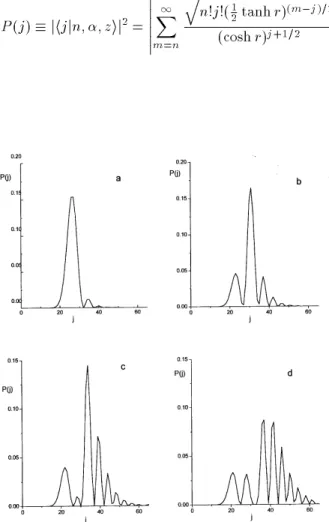
Figure 1. Photon number distribution P(j) for the SDNS,
forr = 1;= 5; = = 0 and (a)n= 0; (b) n= 1; (c) n= 2; (d)n= 3.
Fig. 1 shows plots of P(j) as function of j; for = 5, r = 1 and n = 0;1;2;3. Note that the distribution of photons shows oscillations which increase when n in-creases. P(j) is near zero around j = 32; 38;42 in Fig.(1a); j = 28; 35; 40; 44 in Fig.(2b); j = 26; 30; 38; 41; 43; 45; 47 in Fig.(1c) and j = 25; 32; 39; 44; 48; 52 in Fig.(1d). These oscillations may be interpreted using the phase-space interference concept, introduced by Schleich and Wheeler [7]. According to Eq.(2.11)
the photon number distribution P(j) is given by the projection of the SDNS in the state jji. The pictoric
representation of the statesjjiandjn;;ziin the phase
space is shown in Fig.(2), discussed below. When n = 0 [Fig.1(a)], we obtain the Squeezed Coherent State [4], being one of the various particular cases of the SDNS. Other particular cases occur when r = 0; 6= 0 and
= 0;r6= 0: in the rst case, b
S(z) given in Eq.(2.3) be-comes the unity and our SDNS coincides with the Dis-placed Number States [6], whose coecients are given in Eq.(2.10); in the second case,D() given in Eq.(2.2)b
becomes the unity and the SDNS now coincides with the Squeezed Number State [5], whose coecients are given in Eq.(2.8).
The elipses in Figs(2a) and (2b) represent the squeezed-number state and the SDNS, respectively, whereas the shadowed region in Fig.(2c) stands for the intersections among the SDNS (elipses) and the number states (circles). For example, the intersection between the SDNS and a number statejjigives the probability
P(j) to nd j photons in the SDNS. Interference comes from these intersections in the phase space, for this rea-son being named \interference in the phase space".
Next, the mean photon number and the photon number variance for the SDNS are given respectively by
h^ji=jj
2+ (2n + 1)sinh2(r) + n (2:12)
and
c
h^j 2
ih^j 2
i,h^ji 2=
jj
2(2n + 1)
e2rcos2
,
2
+ e,2rsin2
,
2
+,
n2+ n + 1
2sinh2(r)cosh2(r):
Finding the Mandel'sQ,parameter is now a straightforward calculation. We have,
Q
h^j 2
i,h^ji h^ji
= jj 2(2
n+ 1)
e 2rcos2
, , ' 2 +e ,2rsin 2 , , ' 2
+ 2sinh2( r)cosh 2( r) , n 2+ n+ 1
jj
2+ sinh 2(
r)(2n+ 1) +n
,1
(2:14)
which gives the departure from the Poissonian statis-tics: for positive, zero or negative values ofQthe
statis-tics are super-Poissonian, Poissonian or sub-Poissonian, respectively. For n= 0 it corresponds to the squeezed
coherent state [3], in which the statistics is sub or super-Poissonian, depending on the values of parameters ;'
and r:
Figure 2. Pictoric representation of: (a) squeezed number states, (b) squeezed displaced number states, and (c) in-tersection of squeezed displaced number states and number states.
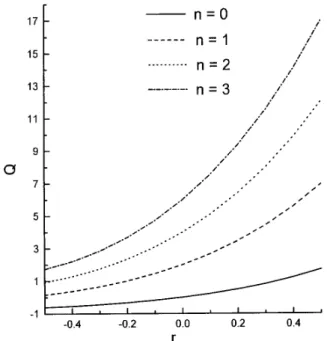
Fig.(3) shows plots of Mandel's Q - parameter as
function ofr, for= 5, ='= 0 and n = 0;1;2;3.
When n= 0, for negative, zero and positive values of
the squeezing parameter r, we have thatQ<0;Q= 0
and Q > 0, and it is sub-Poissonian, Poissonian and
super-Poissonian, respectively. Whenn1, the
statis-tics becomes dierent from that for squeezed coherent states and the sub-Poissonian eect disappears..
The variances b X
1 and b X
2 of the quadrature
op-erators b X 1and b X 2
;when calculated in the SDNS, result
respectively ( with b X 2 i = h b X 2 i
i,h b X i
i 2
;i= 1;2 ),
Figure 3. Mandel'sQ-parameter as a function ofr for the
SDNS, for == 0,= 5 and (a)n= 0; (b)n= 1; (c) n= 2; (d)n= 3:
c
b X 2 1 = 14
e
2rcos2
2 +e ,2rsin2
2 +n e 2rcos2
2 +e ,2rsin2
2
; (2:15)
b X 2 2 = 14
e
2r
sin2
2 +e ,2r cos2 2 +n e 2r sin2
2 +e ,2r
cos2
2
: (2:16)
d
Squeezing occurs when b X i
< 1 2,
i = 1 or 2.
De-pending on the signal of the squeeze parameter r, the
eect occurs in the quadrature b X
1 or b X 2.
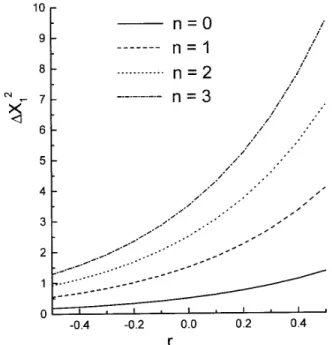
Fig.(4) shows plots of b X 2
Xb 2
1 shows squeezing for negative values of r (the
op-posite occurs for Xb 2
2 as we can see by comparing the
Eqs.(2.15) and (2.16) ). When n increases the squeezing eect disappears.
Figure4. Variance in quadratures b
Xi as afunction of r fortheSDNS,for=0and(a)n=0;(b)n=1;(c)n=2; (d)n=3:
III Photon-Counting
Distribu-tion
The probability G(T) of detecting no photons in an
arbitrary state, with photon number distribution P(j); is given by [8]
G(T) = 1 X
r=0
(,T)r
r!
1 X
j=0 hjj^a
+rar jjiP(j)
= 1 X
j=0
P(j)[1,T]
j; (3:1)
valid for small counting-time separation between suc-cessive photodetections, where is the eciency of the detector. The quasimonochromatic eld at the detec-tor is described by the photon-ux operadetec-tor I (t) andb
is a factor converting the photon number operator ^j = ^a+^a into a photon ux operator ^I and the mean
photoelectron counting rate is h b
I(t)i: For a small time
intervals (T << 1) we can write:
Z T 0
b
I(t)dt = ^IT = T ^n: (3:2) By introducing an adjustment parameter s in the Eq.(3.1), in the following manner:
G(T;s) = 1 X
j=0
P(j)[1,sT]
j (3:3)
we can calculate the photon-counting distribution P(m;T); which gives the probability of detecting m photons in the (small) interval [0,T], according to
Ref.[8]:
c
P(m;T) = (,1)m
m! dsdmmG(s;T)js =1
= 1 X
j=m
j!
m!(j,m)! (T)
m[1
,T]
j,m
P(j); (3:4)
d
where we put = . It coincides with the photon-number distribution P(j), when quantum eciency is unity, T = 1. In practice quantum eciency is less than unity and the photon-counting distribution is only related to P(j), as in Eq.(3.4).
Fig.(5) shows plots of P(m;T) as function of m for r = 1; = 5; = ' = 0, T = 0:8 and various val-ues of n. Note that it diers from the photon number
distribution P(j) (dashed curve). The dierence be-tween them increases when n increases, as can be seen in Figs.(5a)-(5d).
Fig.(6) Same as in Fig.(5), for = 5; r = 1 and n = 1 and various values of quantum eciency T. Note again that P(m;T) diers from P(j), this dierence disappearing when T ! 1 (ideal
Figure 5. Photon-counting distribution P(m;T) for the SDNS, for r = 1; = 5; = = 0, T = 0:8 and (a)
n= 0;(b) n= 1;(c)n= 2;(d)n= 3, in comparison with the photon number distribution P(j) (dashed curves).
Figure 6. Same as in Fig.(4), for r= 1; = 5; == 0; n = 1 and (a)T = 0:8 (b) T = 0:9, (c)T = 0:95, (d)
T = 0:99, in comparison with the photon number distri-butionP(j) (dashed curves).
IV Waiting-Time Distribution
The waiting-time distribution!(T), which denotes
the probability of detecting the next photon at timeT,
given that a photon was detected at timeT = 0;can be
written in terms of G() given in Eq.( 3.1). We have
[8],
!(T) = 1 hI^i
d 2
G(T) dT
2
=
1 X
j=2
j(j,1) h^ji
2 (1 ,T)
j,2
P(j); (4:1)
where and concern to the quantum eciency.
Us-ing a scaled time dened by =Th^ji;and considering == 1, we can write the Eq.(4.1) in the form
!() = 1 X
j=2
j(j,1) h^ji
2
1,
h^ji
j,2
P(j): (4:2)
So, the photon sequence in time can be written in terms of!() [8]. For a coherent state, the waiting-time
dis-tribution!() results
! c(
) =e ,
; (4:3)
which comes from the substitution of the photon-number distribution P(j) for a coherent state, given
by
P(j) =e ,jj
2jj 2j
j!
; (4:4)
in Eq.(4.2), with subsequent evaluation of the sum. For
= 0, we have!
c(0) = 1
:So, when!(0) <1 the light
eld has a photon sequence antibunching, whereas for
!(0) > 1 it shows a photon sequence bunching.
Figure 7. Waiting-time distribution !() for the SDNS as
a function of;for= 1;== 0 and (a)r= 0;4;n= 0
(b)r= 1;n= 3 (c)r= 2;n= 1 (d)r= 2;n= 2, in
com-parison with!() of the coherent state (dashed curves) [cf.
Eq.(4.3)] and thermal state (dotted curves) [cf. Eq.(4.5)].
Fig.(7) shows the waiting-time distribution !() as function of , for = 1; = ' = 0 and dierent val-ues of r and n characterizing the SDNS (solid curves). Note that depending on the parameters r and n, the SDNS shows antibunching eect, !(0) < 1, as we can see in Figs.(7a), (7c) and (7d), and also bunching eect, !(0) > 1, shown in Fig.(7b). For comparison, we have also plotted !() for a coherent state (dashed curves), given in Eq.(4.3), and thermal eld (dotted curves), given by [8]
!() = (1 + )2 3
(4:5)
V Conclusion
We have studied statistical properties of the Squeezed Displaced Number State. It was shown that the photon number distribution of SDNS is a sum of the product of the coecients of Displaced Number State and the Squeezed Number State [cf. Eq.(2.7)], resulting in one of them in appropriated limits. The photon-counting distribution P(m;T) and waiting-time distribution !() were also analyzed. The antibunch-ing eect, which measures photon sequence in time, was
analyzed in terms of !(): We have shown that, for con-venient choice on parameters distinguishing the SDNS from others in the literature, the photon-number dis-tribution P(j) exhibits oscillations which are stronger than those found in particular states obtained in this scheme, as mentioned before. Concerning to some as-pects [See Eqs.(2.7)-(2.10) ] the present approach sim-plies considerably the calculations, in comparison with others in the literature [3]. Finally, it is worth stressing that since the SDNS contains various particular states studied in the literature (e.g., number state, coherent state, squeezed number state, displaced number state, etc.), then it permits an unied approach incorporating all these states, and their properties, as special cases. So, it constitutes a theoretical tool allowing us to get a compact treatment including various important states of the literature, as well as furnishing a new interpolat-ing state [9] alternative to the binomial state by Stoler et al.[10]. Concerning to its generation, a method rst suggested by Glauber [11] and Louisell [12], when ap-plied to a eld initiallyin a number statejnileads it to a
displaced-number state j;ni[13]. Subsequent
squeez-ing generated by the variation of a cavity-parameter [14] would lead the state j;nito the SDNS.
Alterna-tive procedure, generating similar states can be seen in Ref.[15].
Acknowledgments
This research was partially supported by Conselho Nacional de Desenvolvimento Cientco e Tecnologico (CNPq), of Brazil, and PRONEX/MCT/FINEP.
References
[1] Collection of works on squeezing can be found in: J. Opt. Soc. Am. B4, (10) (1987).
[2] C. M. Caves, Phys. Rev. D23, 921 (1981).
[3] P. Kral, J. of. Mod. Opt.37, 889 (1990).
[4] H. P. Yuen, Phys. Rev. A13, 2226 (1976).
[5] M. S. Kim, F. A. M. de Oliveira and P. L. Knight, Phys. Rev. A40, 2494 (1989).
[6] F. A. M. de Oliveira, M. S. Kim and P. L. Knight, Phys. Rev. A41, 2645 (1990).
[7] W. Schleich and J. A. Wheeler, J. Op. Soc. Am. B
4, 1715 (1987); W. Schleich, D. F. Walls and J. A.
[8] Reeta Vyas and Surendra Singh, Phys. Rev. A , 2423 (1988); H. J. Carmichael, Surendra Singh, Reeta Vyas and P. R. Rice, Phys. Rev A39, 1200 (1989); B. E. A.
Saleh,Photoelectron Statistics(Springer-Verlag, Berlin (1978)).
[9] Celia M. A. Dantas, B. Baseia and V. S. Bagnato, Phys. Scripta 58, 145 (1998).
[10] D. Stoler, B. E. A. Saleh and M. C. Teich, Opt. Acta
32, 345 (1985).
[11] R. J. Glauber, Phys. Rev. 131, 2766 (1963); see also:
H. M. Nussenzveig, Introduction to Quantum Optics
(Gordon and Breach, NY (1973)), p.73.
[12] W. H. Louisell, Quantum Statistical Properties of Ra-diation(Wiley&Sons, NY (1973)), p. 231.
[13] For the generation of the particular case 0 see: M. Brune, S. Haroche, J. M. Raimond, L. Davidovich and N. Zagury, Phys.Rev. A45, 5193 (1992); L. Davidovich,
A. Maali, M. Brune, J. M. Raimond and S. Haroche, Phys. Rev. Lett.71, 2360 (1993); S. Zheng and G.Guo,
Opt. Commun.133, 139 (1997).
[14] See, e.g., A. D. Janussis and B.S. Bartzis, Phys. Lett. A129, 263 (1988); C. F. Lo, N. Cim. B105, 497 (1990);
Phys. Rev. A43, 404 (1991); B. Baseia et al. Phys.
Rev. A45, 5308 (1992); A46, 5885 (1992); A45, 1320
(1992); Phys. Lett. A170, 311 (1992); F. li Li, Phys.
Lett. A168, 400 (1992); T. Kiss, P. Adam and J.
Jan-szky, Phys. Lett. A192, 311 (1994).