2
TABLE OF CONTENTS
Rats Hunt Stag
Integration of social and economic information drives
cooperation in a collective decision making task.
Scott Rennie
Dissertation presented to obtain the Ph.D degree in neurosceince
Instituto de Tecnologia Química e Biológica | Universidade Nova de LisboaResearch work coordinated by:
Oeiras,
Rats Hunt Stag
The integration of social and economic information drives
cooperation in a collective decision making task.
Scott Mckenzie Rennie
A Dissertation Presented to the faculty Of Universidade Nova de Lisboa
In Candidacy for the degree Of Doctor in Neuroscience Under the supervision of:
Dr Marta A Moita August 2016
4
Acknowledgements
(I admit, I don’t quite know how, and I have tried, to find the words that rise to task express the depths of gratitude to those that have given their time, and love and support over these last eight years. Explaining this is more daunting a task than all the data contained within these pages. I want to express at the very least that they did not just help, but were necessary in this process. To each of them I will express in person my thanks, and my apologies to those I have failed to list here. I will mention in detail those that collaborated directly on this project)Marta. Who more than my supervisor, is my friend, and continues to show me, daily, how to be not only a better scientist, but a better person.
Eric: Who is only in these acknowledgements because convention prevents me from making him co-author of this thesis.
Alexandra: For collecting the all cooperate stooge, and decoupled condition data and for sharing the frustrations of these experiments, and without doubt, of working with me.
To my lab, all of whom helped in their unique way, particularly Cristina Marquez for her collaboration and attention to detail.
To my thesis committee Zach and Eugenia, and also Goncalo Polavieja, and Alfonso for their guidance, Adam also, I think.
Susana. Were it not for your strength and friendship this thesis would never have been completed.
Zach, for unwavering inspiration, friendship, and for being the right DJ at the right time so frequently.
To Andreia for the support and friendship when it was most needed. To my family for tolerating my absence all these years and supporting me nonetheless.
Sam: for lessons in how to get things done that I haven’t got around to learning (muurgh)
Daniel: For his genius whether practical, nourishing, or both. Tom: For many useful discussions and perhaps as many arguments. Marina: For friendship, essential care and for important introductions.
6
Sumário
Tomadas de decisão social apresentam, discutívelmente, o problema mais complexo que um animal pode encontrar. Tomadas de decisão económicas colectivas requerem a integração de predições baseada em resultados de interações prévias, conjuntamente com predições geradas por informações sociais correntes. Muitas decisões
económicas são feitas enquanto indivíduos interagem, contudo como a maneira com que animais percebem e expressam informação social afeta decisões económicas permanence amplamente ignorado.
Portanto, desenvolvemos uma tarefa de dilema social,
tradicionalmente focada em como resultados de experiências prévias afectam escolhas, permitindo o acesso de cada rato jogador à
informação social proximal. Afim de explorar como pares de ratos integram tais formas de informação, desenvolvemos um ensaio baseado em um labirinto em T duplo para testar jogos de dilema social 2x2 e estabelecemos uma tarefa de escolha social que corresponde à um jogo de Caça ao Veado (Stag Hunt, aqui SH) de alto risco, onde cada animal possui acesso completo à informação social enquanto fazem escolhas e recebem recompensas. No jogo SH existem dois equilíbrios de Nash: cooperação mútua, produzindo a recompensa mais alta com o maior risco (a recompensa depende da reciprocação do outro) e deserção mútua, que confere uma
recompensa intermediária constante (independente do outro). Isso faz com que a escolha óptima para cada animal seja, em cada tentativa, fazer a escolha que acreditam que o oponente também fará.
Nós demonstramos que animais têm a capacidade de associar a sua própria escolha com àquela de animais fantoche controlados
experimentalmente, aumentando a sua recompensa de forma
consistente com os termos económicos do SH. A seguir examinamos o comportamento livre de duplas de ratos na ausência de incentivos económicos e observamos uma tendência moderada à coordenação de suas escolhas e uma marcante preferência de alternar escolhas a cada tentativa.
A seguir, examinamos o comportamento de duplas de ratos, onde cada rato possui a opcão de escolher primeiro e desertar ou arriscar cooperar, ou então escolher em segundo e coordenar, realizando a mesma escolha que o oponente ou anti-coordenar, escolhendo diferentemente. Os ratos apresentaram uma habilidade robusta de coordenar em alternância desde a primeira sessão (65%) e gradualmente aumentar a tendência à enviesar mútuamente a alternância rumo à cooperação mútua (50% até a sessão 6, com probabilidade de 25%) significativamente ultrapassando a deserção mútua. Esse alto nível de cooperação mútua é suportado e
caracterizado por altos níveis de tolerância à resultados baixos recebidos por cooperação não reciprocada. Assim que a cooperação estável foi estabelecida em todas as duplas nós removemos toda a informação social que resultou na maioria dos pares revertendo à estratégia dominada por deserção. Além disso, ao manipular a matriz de recompensas descobrimos que somente o histórico de recompensa, quandos as recompensas são independentes de outros comportamentos, não levam à preferência pela cooperação
unilateral ou mutual. Isso sugere que a cooperação é baseada na capacidade dos animais prever resultados em cada tentativa como uma função da ação colaborativa colectiva. Nossos resultados
8 mostram que ratos aprendem a integrar a informação social
corrente derivando de sua interação para cooperar em um jogo de coordenação de alto risco, para o qual eles usam ambas
informações económicas e sociais. Acreditamos que este estudo pavimenta o caminho para os mecanismos subjacentes às decisões coletivas entre roedores em interação.
Abstract
Social decision-making presents arguably the most complex problem an animal can face. Collective, economic decision-making requires the integration of predictions based on the outcomes of prior interactions alongside predictions generated from ongoing social information. Many economic decisions are made as individuals interact with each other, however how the manner in which animals perceive and display social information affects economic decisions remains largely overlooked. Hence we developed a social dilemma task, traditionally focused on how experienced outcomes affect choices, but allow each rat player access to proximate social information. To explore how pairs of rats integrate these forms of information we developed a double T-maze assay for testing 2x2 social dilemma games and established a social choice task that corresponds to a high risk Stag Hunt (SH) game, where each animal has complete access to social information as they make choices and received rewards. In the SH game there are two Nash equilbria: mutual cooperation, yielding the highest reward at the greatest risk (reward depends on reciprocation by the other) and mutual defection, which provides a constant (independent of the other) intermediate reward. This makes the optimal choice for each animal, in each trial to make the choice they believe their opponent will also make.
We established that animals had the capacity to associate their own choice with that of experimentally controlled stooge animals to increase their reward in a manner consistent with the economic terms of the Stag Hunt. We then examined behaviour of freely behaving rat
10 dyads in the absence of economic incentives and observed a moderate tendency to coordinate their choices and a striking preference to alternate trial-by-trial choices.
Next we examined the behaviour of rat dyads, where each rat has the option to choose first and defect or risk cooperating, or choose second and coordinate, by making the same choice as their opponent or anti-coordinate, by choosing differently. Rats displayed a robust ability to coordinate in alternation from the first session (65%) and gradually increased their tendency to mutually bias their alternation towards mutual cooperation (50% by session 6, chance levels corresponds to 25%) significantly surpassing mutual defection. This high level of mutual cooperation was supported and
characterized by high levels of tolerance to low outcomes received by unreciprocated cooperation. Once stable cooperation was established across all dyads we removed all social information, which resulted in the majority of pairs reverting to a strategy dominated by defection. Furthermore, by manipulating the payoff matrix we found that reward history alone, when rewards are independent of the other behaviors, does not lead to a preference for unilateral or mutual cooperation. This suggested that cooperation is based on animals being able to predict trial-by-trial outcomes as function of collaborative collective action. Our results show that rats learn to integrate the ongoing social information derived from their interaction to cooperate in a coordination high-risk game, for which they use both economic and social information. We believe this study paves the way for
mechanistic underpinnings of collective decisions between interacting rodents.
12
TABLE OF CONTENTS
GENERAL INTRODUCTION………14
CHAPTER 1 – THE STAG HUNT 1.1 Social Dilemmas and Nash Equilibrium………25
1.2 Choosing a Game………30
1.3 Implementing an Iterated Stage Hunt Task………..32
1.4 Determining a payoff matrix………...35
1.5 Animal Subjects………35
1.6 Discrimination Results………..35
1.7 Building a payoff matrix………36
1.8 Discussion………39
CHAPTER 2 – STAG HARE AND STOOGE 2.0.1 Introduction………..43 2.1.2 Experimental Environment………..49 2.1.3 Animal Subjects…….……….50 2.1.4 Training………51 2.1.5 Statistical Analysis………..….….51 2.2.1 Coordination Experiments……….…...52
2.2.2 Coordination Experiment Results………53
2.2.3 Interim Summary………..56
2.3.1 Anti-Coordination Experiments……….57
2.3.2 Anti-Coordination Experiment Results……...58
2.3.3 Interim Summary………...63
2.4 Discussion………64
CHAPTER 3 – SIMULTANEOUS CHOICE 3.0.1 Introduction………..71
3.0.2 Training……….………...81
3.0.3 Statistical Analysis………..…82
3.1.0 iSH: Equal Rewards Condition………...82
3.1.1 Equal Rewards Condition Results………..…………..……....83
3.1.2 Summary………...89
3.2.1 iSH Standard Condition Results…….………91
3.2.2 iSH Standard Condition Summary………..………..……....99
3.3.1 Reversal Condition………101
3.3.2 Summary………...103
3.4.1 Isolated Condition………...104
3.4.2 Isolated Condition Results………..……...…105
3.4.3 Summary……….…110
3.5.1 Decoupled Condition………..……..113
3.5.2 Decoupled Condition Results………..…..…….114
3.5.3 Summary………..……….116
3.6.1 Cross condition comparisons………..117
3.6.2 Summary………...……120
3.6.3 Analysis of Switching………..…121
3.6.4 Summary………...…….125
3.6.5 General Linear Models and Choice History……….…127
3.6.6 Summary………...136
3.7 Discussion……….138
4 GENERAL DISCUSSION 4.0 Summary of empirical findings………145
4.1 Social Information, cooperation and forgiveness…….……..148
4.2 The meaning of social information ………...…151
4.3 Social Competence and Cooperation………..….153
4.4 Cooperation, cooperation or cooperation………...…157
4.5 Future Directions………..159
4.5.1 Video Analysis………159
4.5.2 The Role of learning………162
4.6 Final Remarks………..162
REFERENCES……….164
14
General Introduction
‘There’s a crack in everything’ Anthem, Leonard Cohen.
Social decision-making presents arguably the most complex problem an animal can face1. An animal’s fate and fitness hinges upon its
capacity to efficiently navigate the reciprocally intertwined
probabilistic elements of its own perceptions, behaviour and that of the world around it. The study of social behavior is predicated on the position that the relationship between interacting conspecifics are in some manner distinct from that an animal has with the rest of its environment. At the heart of this distinction is the assertion that there is no other aspect of an animal’s environment that is as likely, in any given moment, to share such a similar nexus of inclinations,
capacities, proclivities, sensitivities and responses as a conspecific. The dilemma of how interacting conspecifics best manipulate their states and behaviours when both are engaging in much the same process is, in the context of such deep similarity, in principle, though perhaps in principle only, an unboundedly complex one.
A central question within the field of social behaviour and decision-making is that of cooperation. Cooperation is a mystery that refuses solution as much as it does definition. It can be employed in
proximate or ultimate2
terms, as a collective action3
or individual behaviour, as being other regarding, or rationally self interested4
, and in the context of game theory it can be defined purely operationally5
. Such diversity of definition has given rise to a cornucopia of
approaches and experimental procedures of such variety that it is surprising that they share a collective interest6
2 The common intuitive consequence underlying this flea market of particulars, that individuals choose to interact in a manner where things work out collectively rather well, is (perhaps ironically) a defining aspect of human social behavior. This is particularly so when observed outside the constraints of kin, which presents the most commonly invoked factor supporting cooperation in other species2,7,8
. In this sense humans represent an ‘ideal model organism’ for
cooperation just as pigeons do for navigation9
, rats for olfaction10–12
or starfish for regeneration13
. The problem comes when we use the particular capacities of such an organism to etch out the very definition of that capacity and then set off to look for them in other species. While we have not done this for navigation, olfaction, or regeneration, it appears that we have for cooperation and indeed for social behavior in general. In so doing anthropomorphism and anthropocentrism cast a shadow upon the whole enterprise from the outset. The risk this brings is that we permit our conception of our own folk psychology to generate categories of social behaviour that are not appropriate to other species, or having done so, misinterpret the behaviour of those species as being supported by cognitive mechanisms much more aligned with our own folk psychology than they really are14
. Exacerbating these problems is the very real concern that we may be mislead by confabulation and ascribe complex
cognitive strategies and motivations to our own cooperative behaviours when more ergonomic explanations would suffice. One way to mitigate the risks of such explanatory pitfalls is to, as best as one can, define a minimum set of conditions that circumscribe a tangible concept of cooperation, and where possible bring to bare
some quantifiable framework, whilst being careful not to drain the concept of meaning or application. The most widely and, arguably, successful approaches to cooperation by both experimental
psychologists and evolutionary biologists have taken an economic perspective2,7,15
. From this perspective the definition of cooperation that carries the least assumptions has two key components. Firstly it requires that the outcomes of individual action are dependent not only upon the actor’s choice but are also, at least in part, dependent upon the actions of others. And secondly, that such actions lead to a more equitable distribution of available outcomes amongst actors6,15
Part of the confusion that often obscures what is meant by
cooperation is that while psychological and evolutionary approaches are both trying, in their own way, to fully understand cooperative behaviour they emphasize different questions in their attempt to do so. The evolutionary approach to cooperation attempts to determine how behaviour that is beneficial to another would arise in a
population2,16
. It asks why do individuals cooperate. A psychological approach on the other hand asks how do individuals go about the act of cooperation. Of course to approach a complete understanding of behaviour both the how and they why must be addressed. Both proximate and ultimate explanations must be obtained16,17
. This is particularly important when it comes to what is meant by ‘outcomes’ in the definition of cooperation above. From an evolutionary
perspective outcomes are thought of in the currency of inclusive fitness, the number of offspring an individual produces that survive to reproductive age, or proxies thereof, whereas the psychological perspective considers such outcomes represent proximate rewards
4 such as food, or sex or safety. A complication here is that such proximate rewards are potentially meaningful proxies of fitness. This distinction between what is meant by outcomes gets right to the nub of the confusion. While these questions may be distinct, their role in a given behaviour or cognition is not. Natural selection leads animals to behave in the manner that they do, yet the manner in which animals behave is likely aimed at improving the proximate rather than optimization of the ultimate. For instance, the statement
“females wish to mate with the highest status male the can find” can be made by both an evolutionary biologist and an experimental psychologist. Yet the former refers to behavioural strategies that maximize fitness and the latter to proximate psychological motivations16
. To quickly address any potential confusion, this thesis will primarily follow a more traditional experimental psychological rather than evolutionary perspective foveating upon the proximate while keeping an eye upon the wider evolutionary context.
Cooperation thus defined; as an individual act that leads to collective benefit, has been then further categorized by the consequences too, and thusly considerations of, the actor. One such category is referred to as a mutualism. This refers to cooperative acts that incur no net costs and also provide immediate benefits, for example when two individuals groom each other at the same time.18
This form of
cooperation is quite common in diverse animal societies, particularly in cooperative hunting or breeding contexts187
. Cooperative hunting can be defined as mutualism when the per capita rate of benefit of food intake within a particular hunting group exceeds that available to a solitary hunter19
not to cooperate by joining the hunting group, given the opportunity to do so, as it gains more than it would lose, and does not incur a cost in the process. From the perspective of learning theory cooperation of this form is reinforcing as a cooperator is guaranteed benefit, and therefore cooperative acts are reinforced, increasing their likelihood of being repeated20
.
The absence of some cost to cooperation is what distinguishes mutualism from reciprocal altruism. Reciprocal altruism, or simply reciprocity, describes cases where an individual incurs a short-term cost for a cooperative act, but receives benefit in the long term. If we take the example of cooperative hunting and simply add the
possibility that animals that engage in the hunt increase personal danger in the process or having expended energy engaging in a successful hunt, then run the risk of being excluded from the spoils, then this describes a type of cooperation that is much more complex in character.
In contrast to mutualisms, this more complex form of cooperation referred to as reciprocity has been much less frequently observed in animal societies7,21. This may be in part becasue it is not always clear
precisely what are the outcomes and costs that may be being
optimized by interactors which, in wild populations, complicates the identification of such cooperation. A further explanation for the apparent scarcity of this form of cooperation in animal societies is that it places greater cognitive demands upon the cooperator. Simply put, because now cooperation carries a cost that must be calculated. While there have been multiple examples in laboratory and natural populations such as tree swallows22
. stickelbacks23
, impala24
6 jays21
, cotton top tamarin monkeys25
red winged blackirds26
, pied flycatchers27
, and in the rat28
, these examples remain controversial. To better understand the nature of the cognitive constraints and controversies that surround this concept of reciprocal cooperation it is important to understand the methods used to study it. The dominant approach taken by both evolutionary and psychological approaches to the study of reciprocity has been to employ game theory. Game theory is a collection of beguilingly simple ‘games’ that provide both a powerful means of quantifying the collective outcome of interacting individuals combined with a compelling theoretical framework upon which one can generate and test hypotheses about the cognitive processes of those individuals5,7,20
. For a quarter of a century now, one particular game, the Prisoners Dilemma, has dominated both theoretical and empirical studies of reciprocity amongst unrelated individuals.
In the Prisoners Dilemma each player has two possible options, they may either choose to cooperate or choose not to. Choosing not to cooperate is termed defection. The resulting outcome each player receives depends upon both players’ choices. Mutual cooperation results in a moderate reward to both players (Reward (R)) while mutual defection (Punishment (P)) yields a low reward to both players. The greatest reward is achieved through exploitation; by defecting upon a cooperator (Temptation (T)) and the lowest reward is received by the exploited player, one that cooperated with a defector (Sucker (S)). This relationship between the outcomes of collective choices, that T>R>P>S must be satisfied for a game to qualify as a Prisoners Dilemma7
A further concept, the Nash equilibrium, is required to fully understand why the Prisoners Dilemma was presented as such a powerful tool in the study of reciprocity . The Nash equilibrium is a complete analytical solution for social dilemma games that defines the action players should take when playing. The Nash equilibrium defines a collective act that neither player can improve upon by unilateral action. In the case of the Prisoners Dilemma, in a single round of play, regardless of the other player’s choices, defection will always yield a greater reward. This is true regardless of whether one’s opponent cooperates as one can exploit them by defecting, receiving the highest reward (T) or if they defected as one avoids exploitation and lowest outcome (S) in favor of a low reward (P). In essence, in a single round of the Prisoners Dilemma, each player
should defect making mutual defection the Nash Equilibrium.
One might question the wisdom in studying cooperation in a game where the relationships between payoffs predict that each player should no do so. However, should players engage in multiple iterated rounds of the Prisoners Dilemma (iPD) a collective means of
escaping this equilibrium becomes available. For a game to be described as an iPD a further rule must be conformed to; the value of two mutual cooperation choices (R) must be greater than the sum of the value of being exploited (T) and that of being exploited (S), or 2*R>T+S. This creates conditions where repetitive mutual
cooperation exceeds that of unilateral or mutual defection. This elegantly formalizes the essence of what is being described by reciprocal cooperation where cooperation requires a short term cost, the risk of being exploited and forgoing the immediate benefits of
8 being an exploiter. However should such a cooperative act be
reciprocated it provides each player with greater rewards over multiple iterations.
While the iPD may frame the tricky problem of reciprocal cooperation in an intuitive and quantifiable framework, it nonetheless makes cooperation a rather cognitively demanding task. For agents that wish to maximize their outcomes, the cost and benefits of cooperation must be compared. This requires some capacity of numerical discrimination and an ability to learn from prior outcomes. As cooperation in this context involves one forgoing a greater
immediate reward for increased reward over time, it further requires that an animal does not devalue future rewards too strongly over immediate ones7
. The rate at which future rewards are devalued is referred to as temporal discounting. As the future for any animal necessarily introduces uncertainty, it is proposed that such
discounting, though at different rates, may be both universal among animals and under strong selection pressure7,21
. This has led many psychologists to describe the iPD as primarily an extension of the temporal discounting problem29, suggesting that cooperation in this
context is as at least as much a cognitive feat as it is a reciprocal act. The primary explanation for why reciprocal cooperation may be rare in animal populations is one of cognitive constraints amongst
individuals of those populations. This reveals important assumptions that are made when applying a game theoretic framework to animal behaviour. In its pure form, game theory does not pose dilemmas to cognitively constrained individuals. Rather it asks how rational, emotionless geniuses should behave within particular games5
Rationality in this context makes the assumption that players behave in a normative manner by making individual choices in an attempt to maximize their outcome and do so by making optimal choices given the options available and are endowed with perfect knowledge of those options.5
Such assumptions of rationality present several problems when being applied to complex social phenomena. Classical game theoretical analyses predict that rationally self interested players will make decisions that align with Nash equilibria, however players, whether human or other animals, rarely play according to these strategies5
. This may be in part due to the difficulty of ensuring that there are no aspects of an interaction that are being optimized by players that fall outside the scope of quantification ascribed by the chosen payoff matrix. Further, they are subject to the sorts of cognitive constraints detailed above, which limit their capacity to conform to economic predictions. In general animals have a range of reward driven behaviours that deviate strongly from economic expectations. One common example is that of Herrnstein’s matching law. Matching refers to animals tendency to match their relative rates of response to the relative rates of reward30
. For example if an animal is given two choices, once choice leads to a reward 70% of the time and the other 30% of the time. In such a situation the normative behaviour would be to choose the option where reward is available 70% of the time, 100% of the time, as this would yield the highest reward overall. However animals reliably match their ratio of choice to the ratio of reward, choosing the more rewarding option on 70% of choices and the less rewarding one 30% of the time. Again this points to another
10 limitation of economic rationality. In the context presented animals are behaving sub-optimally, however real world environments are characterized by uncertainty in both the sources and timing of rewards, suggesting that reacting to the statistics of foraging
behaviour in such a manner may be adaptive and even more rational in general, even if it is not in the precise experimental context31
. Game theory also defines cooperative choice as an individual act. Games such as the iPD demand not only that players behave as rational utility maximizers, but that they also do so in a purely self regarding manner. The payoff matrix that defines particular game formalizes the interdependence between collective choices and outcomes. Despite this interdependence off outcome the assumption remains that each player is trying to maximize their own outcomes and are entirely ambivalent as to the outcomes or behaviours of the other player(s). This assumption presents similar problems to that above, it is simply not an entirely accurate description of animal behaviour. Many species that are employed in cooperation
experiment use ‘safety-in-numbers’ as a defense against predators, and such species often show a preference for proximity to
conspecifics in safe cages or aquariums, even in the absence of a threat3
. It has also been shown that rats32,33
, capuchins34
and chimpanzees35
are more likely to behave cooperatively when they can observe the behaviour of the conspecific they are interacting with. The nature of the social relationship between players can also have an important role upon the likelihood of cooperation. For example monogamous zebra finches have demonstrated an increased tendency to cooperate with their long term social partner compared to a novel
opposite sex conspecific, and this behaviour seemed to be, in part, determined by increased ‘forgiveness’ of occasional defection by their long term social partner36
1. Status can also influence the
likelihood of cooperative behaviour. In macaques, a despotic species, dominant individuals tend to be more cooperative while low status animals show the opposite behaviour37
These examples present powerful criticisms of game theory when applied to social behaviour. However there are further criticisms that can be leveled against the iPD in particular. One has already been mentioned; that arguably it is primarily an extension of the temporal discounting problem rather than a ecologically valid measure of reciprocity. The iPD also presents a stricter formalism than other social dilemma games as it requires a particularly specific
relationship between the outcomes (2R>T+S) and that each player has the ability to exploit the other. This has led to rising skepticism as to whether it is an accurate representation of the type of real world cooperation that animals will actually engage in7,21,33,38
. Or, more concisely researchers applying the paradigm are “searching in the dark for a cat that isn’t there”.3
Given that there are clear violations of the assumptions underpinning game theory and its application to animal behaviour, and of the iPD in particular, one might wonder what exactly is the appeal of such an approach, what exactly is it useful for?
1 This seems like an eminently adaptive trait in a monogamous species. It
might even be a prerequisite.
2 Arguably this belief in humans as rationally unconstrained still defines
12 One important point is that these criticisms fall most strongly upon the assumptions of game theory in examining cooperation in the proximate sense. In the context of evolutionary game theory, these assumptions may hold more water. There is a strong analogy between the concept of rationality and the concept of inclusive fitness in evolutionary biology. While rational choice theorists assume that agents are making choices to maximize their utility, evolutionary biologist assume, and indeed in some cases can demonstrate, that animals will make choices that maximize their inclusive fitness. Evolutionary game theory, as it focuses upon the evolutionary processes, in the cases where animal behaviour is involved, is examining the success or failure of behavioural strategies or phenotypes within a population. The rational, emotionless decision maker described above in this case is natural selection rather than the animals themselves39
.
One can then proceed to turn this around, and look back again to the proximate context. Behaviours and the cognitive capacities that support them have undergone selection and are presumably adaptive in some manner. The implication of this is that natural selection may lead to behaviours that may approach rationality in one context but are not indicative of more general facultative competence. One possible illustration of this is that in autumn blue jays switch from consuming every acorn that they find, to caching them for later consumption throughout the winter, indicating an impressive control of temporal discounting in this particular ecological context.7
In the context of an experimental iPD game, however, they only cooperate with a reciprocating partner when the burden of temporal discounting
is removed21
. This suggests that while the behaviours associated with preparing for winter are under selection in such a manner that
supports a greater control of temporal discounting, those relating to reciprocity are not. Another example may be that of the monogamous zebra finches mentioned above, as they appear to demonstrate
cooperative behaviour in an iPD task only in a context where they interact with a mate. This, one could argue, may be adaptive in a monogamous pair bonding species as male and female partners work together during the breeding season to raise offspring40
. When employing the iPD in the proximate sense, and examining function, one is essentially checking to see if selection has acted particularly upon the organism in question’s tendency to cooperate.
In light of this it is interesting to note that humans while falling short of rational assumptions, in the context of cooperation, tend to fall up rather than down. Humans often tend to be more cooperative than an economic perspective might suggest, though many experiments have shown there is often a smaller fraction of subjects that behave in a self-regarding manner that is much closer to rational expectations4
. If there is one clear ‘arrow of history’ in the study of human decision making, both economic and social, it points away from more rational and strategic assumptions towards more automatic, implicit and embodied ones. In an economic context the prevailing assumption for much of the last century was that humans obeyed the rational
expectations of expected utility theory. The clearest attack on this belief came only in the late 70’s when Kahneman and Tversky published their seminal paper on Prospect Theory where they clearly demonstrated the limitations of economic rationality in humans41
14 Similarly approaches to social cognition, particularly theory of mind, focused on rational hypothesis testing models and Machiavellian strategic analysis. Whereas recent work has focused on more automatic processes such as direct simulation and embodied inter-subjectivity42
.
This, now sharply declining, view of humans as rational and strategic5
2 has generated a view of social interactions as unboundedly
complex in their predictive requirements. There is an assumption that a social interaction is much like a game of chess, each player trying to infer all the possible responses their opponent might make to their own strategic choices3. From such a vantage point it is the rules of the
game rather than the inferential ability of players that bounds the interaction. Similarly, game theory presents a context where the interacting agents are not constrained in their cognitive capacities, but rather by the nature of game they play. The Nash equilibria in a particular game is defined not by constraints upon the capacities of the player, but by their accurate perception and unconstrained
consideration of all the strategic possibilities. One might suggest that the iPD in particular and game theory in general has defined
cooperation, in part, because we thought that was the way we think in social and economic contexts. And, while humans tend to be
cooperative in this game, we tend to do so in a manner that does not align with these preconceptions. Rather than behaving strategically 2 Arguably this belief in humans as rationally unconstrained still defines libertarian economics and thought. The Randian focus on radical autonomy, and the idea of ‘letting the market decide’ lean still strongly leverage this perspective. 3 It is telling that we developed computational approaches to defeat the best human players many years before we developed similar approaches to lift a chess piece in a similar manner to a human
and self-regarding, humans tend to be cooperative and other regarding4,5
. More importantly, by casting cooperation in a strategic and individualized context it has de-emphasized ongoing social information, the implicit signals, other regarding behaviours and intrinsic rewards that are being seen as increasingly defining aspects of our real world social interactions42,43
.
The aspects of social interaction that game theory does not speak to how individuals make use of available social information to guide their social behaviour and decision making is described by the field of social competence. Social competence has primarily fallen under the auspices of the social sciences and has largely focused on the development and expression of social behaviours in humans1
. Taborsky and Oliveira, however, have recently proposed a
compelling approach to examine social competence in non-human animals. While the game theoretical approach we have explored has cast social behaviour very much in the context of cognitive evolution and ecology, Taborsky and Oliveira propose that flexible, adaptive social behaviour be observed through the lens of phenotypic plasticity. Phenotypic plasticity refers to the production of multiple phenotypes from a single genotype, depending on feedback from the biotic and abiotic aspects of their environments44
.
Social competence, from this perspective, refers to the ability of an animal to leverage evolved cognitive mechanisms that allow it to perceive the internal state of conspecifics and then to integrate this perceptual information to select the most appropriate social behaviour
16 from their repertoire of responses4. For example, rats appear to
flexibly optimize their behaviour in response to experience in conflict situations by reducing fighting costs following a win or a loss.
Previously victorious rats would defect against naïve conspecifics more quickly and with a lowered level of aggressive behaviour. Rats that had previously been defeated would concede more quickly and produced behaviour that reduced aggressiveness in their naïve opponent1,45
. This example captures the manner in which animals can use experience to flexibly select an appropriate behaviour given their social experience and that they express this behaviour in a manner that naïve animals are sensitive to. As a result the potential cost of an agonistic interaction is reduced for all participants. Such use of social information has been observed in a wide variety of natural populations1
This discussion of cooperation began by referring to it, in the most general manner, as individuals “choosing to interact in a manner
where things work out collectively rather well”. The above example
seems to fit this basic definition quite neatly. Both animals with experience of victory and those that experienced defeat were able to express behaviours as a result of this experience, that led to a
decreased duration of aggressive or submissive responses required to resolve a conflict, that, if protracted could cost both interactors more. This type of agonistic interaction has rarely been cast in the
proximate sense as an example of cooperation. Here winners reduced mutual costs by acting like a winner, in being more rapidly
4 Though to what extent this is a result of predicting the behaviour of a
conspecific and how much this requires active inference of that conspecifics internal states is left ambiguous by the authors.
aggressive, which reduced the duration of conflict required to lead to a resolution and preventing further escalation that could lead to injury45. It is quite possible that animals may engage in such
behaviours in a manner that may also escalate conflict. Should a prior winner encounter an animal and misinterpret it’s state a rapid onset of aggression could lead to an escalation of conflict. Similarly an animal that has previously lost may produce submissive responses that, if ignored by their opponent, may put them at a disadvantage. In principle each animal is incurring a cost, risking greater injury by their behavioural strategy, however if both interacting animals behave in a socially competent manner they both benefit from a clear display of their intentions.
I would argue that it is very human to balk at the thought of rapid aggression and submission in agonistic interactions as examples of cooperation. Surely cooperation is about working together, and so not being aggressive at all seems much more like cooperation than
resolving conflict quickly. Yet such a position makes assumptions about the social structure within which a given organism exists and what behavioural options are within the perimeter of its behavioural repertoire. As such agonistic interaction seems to be a common component in various animal societies1,46
and protracted conflict and the social stress that it results in often carries both proximate costs and impacts upon fitness in many species47
, then this particular display of social competence may be an instance of cooperation. It is surprising then that Taborsky and Oliveira barely mention cooperation in their description of social competence. Rather they focus on animal’s capacity to perceive relevant internal states of a
18 conspecific, and act upon this perceptual information to produce desired social outcomes. This presents more of a ‘bottom up’ approach to animal social behaviour, examining, within the ecological context and within the behavioural and perceptual repertoire of the organisms in question, their capacity for social competence. Game theory5
on the other hand seems to adopt a top down approach, defining cooperation in more human, more economic terms and then searching for exemplars within animal societies. It is interesting that, asides from individual recognition, the primary cognitive requirements for reciprocity are numerical discrimination, temporal discounting, learning and memory. They are all essentially non social in nature7
. Taborsky and Olivera, on the other hand, emphasize a very different view that social competence leverages a distinct sub-domain of general intelligence that is modulated by social experience1
.
And so we are presented with two approaches to social behaviour, one that provides a powerful mathematical framework and
compelling formalism. However it suffers from simplifying assumptions and has little to say about the proximate manner in which animals interact, how they use the flow of ongoing social information to guide their choices in social contexts. It also presupposed a collection of sophisticated cognitive capacities6
. While social competence focuses quite precisely on these aspects game theory ignores; adaptive behavioural plasticity in ecologically valid
5 It is perhaps the more mathematically inclined, and/or those who rise to
positions of influence within their field that tend to take this approach to social interaction.
social contexts. However this approach has little if anything explicit to say about cooperation, and lacks a mathematical framework. Integration of these two approaches, it would seem, may provide a compelling framework within which to examine the how animals engage in cooperation.
To proceed with such integration begs the question of how social competence can add to the concept of cooperation, and what might constitute a socially competent cooperative act. While the above example of agonistic interactions is a tentative example of cooperation, not all socially competent acts are likely to be
cooperative. For example dominant Great Tit’s (Parus Major) protect food resources they have monopolized by making alarm calls to deceive other dominant birds. But they do no do so towards
subordinate ones. Subdominant animals behave similarly to both sub-dominant and sub-dominant birds. These calls were modulated by food scarcity, or during periods where birds were more likely to feed48
. This type of deception seems to carry the hallmarks of social competence. Animals here are monitoring the status of other
conspecifics and mitigating the risks of both conflict, and the loss off monopolized resources. However as the deceiving animal is receiving most of the benefit at the expense of its potential competitor it would be hard to argue for this as a form of cooperation. This falls short of the example of agonistic interactions above7 where each animal
seemed to both accurately signal information relevant to the 7 It is interesting, and perhaps mistaken that Taborsky and Oliveira refer to status, age and other differences as adding to the complexity of social interaction. For example when faced with a larger, higher status male, the decision of whether to engage in conflict seems less complex than when face with one of similar size and status. One probably should not.
20 interaction and respond to it appropriately and in so doing both animals appear to benefit.
The distinction between these two examples starts to circumscribe components of social competence that one might consider
cooperative. At the core of this is the accurate signaling of intentions in a social context, rather than deceptive signaling, as this provides the other animal a greater opportunity to react appropriately, and may also risk exploitation. For such an act to be socially competent it would also have to based, to some extent, upon predictions of the other animals internal state and likely response1
. I would therefore propose the following conditions for a socially competent cooperative act. First, each animal must honestly signal their intentions, in that they behave in a manner that makes them more predictable to a conspecific. Secondly each animal must attempt to interpret the signals of the conspecific they interact with and respond on the basis of the predictions they thus derive. Thirdly this response must increase the likelihood of benefits, or limit the cost of the interaction for both themselves and the interacting conspecific. Should these three conditions be met, I would argue that this constitutes a starting point from which to explore socially competent cooperative acts. Fortuitously game theory offers one particular game, the Stag Hunt that formalizes quite precisely these three conditions. The Stag Hunt is in many respects very similar to the Prisoners Dilemma. Crucially it maintains a cost for cooperation, as to do so still carries the risk of receiving the lowest of all outcomes (S) if ones opponent defects. The Stag Hunt in does have one subtle but pivotal difference to the iPD. In the Stag Hunt mutual cooperation (R) offers the highest reward,
rather than in the iPD where exploitation (T), provides the greatest reward. This one simple change in the relationship between payoffs, whilst maintaining a cost for cooperation, drastically changes the dilemma the game poses. It means that the decision to cooperate is now contingent only upon the fear of being exploited whereas the presented double bind that combined a fear of exploitation with a temptation to exploit cooperators. Such exploitation yields an immediate high reward greater than that of mutual cooperation, and thusly required control of temporal discounting whereas the Stag Hunt relaxes this requirement. This is perhaps best illustrated by the fact that it has two Nash equilibria; mutual cooperation and mutual defection. Unlike the iPD where each animal is being asked to overcome defection based on the belief that their opponent will cooperate both now and in the future and whether they are able to overcome temporal discounting. The Stag Hunt, on the other hand focuses the dilemma on the current trial, and makes the best choice for each player the choice they believe the other is making. It first asks each if player can, coordinate their choices and then asks
whether animals are able to collectively choose to mutually cooperate for greater reward. By posing this particular dilemma to animals with access to social information one has a potential means of quantifying cooperative social competence.
Having selected a game that emphasizes the role of social
information, and that has previously been employed to do so, one is still left with assumptions of rationality that have been questioned in this introduction. It is important, and perhaps overdue, to make an important distinction. Game theory is the combination of two separate components, games and, of course theory. Theory provides
22 powerful simplifying assumptions, which, while useful, tends to reduce cooperation to an unintended by-product of the instrumental pursuit of private gain49. This poses a problem, as these assumptions are not likely to be met, and our interest is focused very much upon the social interdependence of actors. Games, on the other hand, simply propose strategic contexts. In so doing they precisely define the structure of interdependence between these actors. Here we intend to use theory to provide normative benchmarks against which trends in behavior can be compared while use the Stag Hunt game as a framework upon which social behaviour can be examined. In the following chapters I will explore how rats integrate ongoing social information and rewards in a Stag Hunt task.
Chapter 1 explores in more detail the differences between the Stag Hunt and the Prisoners Dilemma and the assay that has been built to carry out the subsequent experiments.
Chapter 2 focuses upon social learning and examine the extent to which animals demonstrate an understanding of the economic terms of the Stag Hunt through observation of them interacting with an experimentally controlled stooge animal.
In chapter 3 we will focus on a series of experiments that examine the behaviour of freely behaving dyads in the Stag Hunt game and the role of social information
In the discussion we will return the idea of social competence mentioned here and examine whether the integration of these two distinct approaches to social behaviour presents a useful approach to
24
Chapter 1. The Stag Hunt
“If it was a matter of hunting deer, everyone well realized that he must be
faithful to his post; but if a hare happened to pass within reach of one of them, we would not doubt that he would have gone off in pursuit of it without scruple”
1.1 Social Dilemmas and Nash Equilibrium
The purpose in the following chapters is to examine the manner in which freely behaving rat dyads make use of social information to increase reward via collective action in an economic decision making task. It is the purview of this chapter to describe the genesis of the assay that has been designed for this purpose and to detail the theoretical considerations behind it. Both, the assay and theoretical approach that will be described here builds strongly upon prior work conducted within the lab and later published by Viana et al (2010) 28.
Viana et al (2010)28 examined the behaviour of rats as they
engaged in a particular social dilemma task, the Prisoners Dilemma. Game theoretical social dilemma tasks such as the Prisoners Dilemma are
particularly useful for examining socio-economic decision-making as they provide a means of mathematically formalizing the relationships between collective action and outcomes. In so doing, they mathematically ground the problem of collective action and cooperation as a beguilingly simple mixed motive, two-person game with two choices: cooperation or defection. These choices intersect at four possible collective choices, mutual cooperation, mutual defection, unilateral cooperation, and
unilateral defection abbreviated respectively as CC, DD, CD and DC. Each of these choices has an associated payoff: Reward (R), Punishment (P), Sucker (S) and Temptation (T) (see table 1.1). A social dilemma game here is defined as one where mutual cooperation provides the best collective outcome, but where this outcome is constrained by the temptation to cheat (T>R) or the risk of being cheated upon (P>S). 20
26 As the title of this chapter suggests; a different social dilemma
game, the Stag Hunt was employed in subsequent experiments rather than the Prisoners Dilemma. There are subtle but important differences between these two games that motivated this choice and that we will now explore. In the Prisoners Dilemma the outcomes are ordered thusly T>R>P>S, placing both, the fear of cheaters (P>S) and the temptation to cheat (T>R) as constraints upon cooperation. The Stag Hunt outcomes are ordered thusly (R>T=>P>S). By having the temptation outcome lower than reward (R>T) the temptation to cheat (defecting upon a cooperator) is removed, but the risk of being cheated upon is maintained by keeping punishment greater than sucker (P>S). This simple distinction between the Prisoners Dilemma and Stag Hunt outcomes leads to fundamental differences in the dilemma posed to players of each game. These differences are perhaps best described by comparison of the Nash Equilibria5 of each game.
Nash Equilibria are complete analytical solutions derived from the relationships between the outcomes defined by each social dilemma game. A Nash equilibrium, simply put, is a collective choice from which an individual could not do better by changing its strategy5. In the Prisoners Dilemma the double bind of the fear of being cheated (P>S) and the temptation to cheat (T>R) means that mutual defection is the single Nash Equilibrium and defection the dominant strategy20. The Stag Hunt on the other hand has two Nash Equilibria, mutual cooperation(R) and mutual
Cooperate Defect
Cooperate R,R (S,T)
defection(P). The mutual cooperation equilibrium is considered payoff dominant, in that it offers the highest outcome whilst mutual defection is considered risk dominant, as it provides a lower positive outcome but mitigates the risk of receiving the lowest sucker outcome50.
To create an intuition for this, consider two players with complete knowledge of the outcomes engaging first in a single instance of the Prisoners Dilemma. Now imagine you are player one and player two has announced that they will definitely cooperate. As defecting on a
cooperator yields a better outcome than cooperating with a cooperator (T>R) you should defect to get the maximum outcome. Now let us assume that your opponent will certainly defect, the best choice here is that you also defect as cooperating with a defector yields the lowest outcome (P>S). As defection in the Prisoner dilemma yields the greatest outcome
regardless of the choice of one’s opponent, it is considered the dominant strategy and mutual defection forms the single Nash equilibrium. Now if we follow the same reasoning with Stag Hunt, we are left with a very different choice. If one’s opponent announces they will cooperate,
cooperation becomes more lucrative as (R>T) and if they will defect then defection becomes the better choice as (P>S). Consequently in the Stag Hunt there is no dominant strategy and there are two Nash Equilibrium; mutual cooperation and mutual defection50.
This difference in Nash equilibria in the Prisoners Dilemma and Stag Hunt creates very different predictions for what players should do in a single round of the game. In the Prisoners Dilemma players are expected to defect. In the Stag Hunt a player should make the same choice as they expect their opponent will make. However, expanding these games from a
28 single choice it is possible that in each case, there are conditions where two players may engage in consistent cooperation
The concept of the Nash Equilibria as described above has limitations in its formal applicability in the iterated case, where agents engage in n sequential rounds of choice. In the iterated case, the Nash Equilibrium can be calculated over multiple trials, and thusly incorporate the history of outcomes; this can lead to novel Nash equilibria over different strategies. Nonetheless, the Nash equilibrium concept, in the manner in which we have described above, captures a clear description of the fundamental dilemma each game poses to its players. A further rule is applied to create the iterated case of the Prisoners Dilemma (iPD). Here the repeated mutual cooperation is fixed as a greater outcome over multiple trials by fixing the reward outcome as greater than the sum of a temptation and sucker outcome so that 2*R>T+S. This ensures that mutual cooperation is more lucrative over multiple iterations than alternating defection and cooperation. This provides agents a means of escaping the Nash equilibrium through collective cooperation assuming that they have memory of at least one iteration back and have sufficient control over temporal discounting. Temporal discounting refers to rate at which a delay in receiving a reward devalues it in comparison to those received directly. Should both the criteria be satisfied, it is in principle possible that
subsequent mutual cooperation will be considered beneficial over
proximate temptation.7 In the iterated Stag Hunt (iSH), the Nash equilibria remain the same so that in each iteration, each player’s best choice remains coordination where each player makes the choice that they believe their opponent has made. Across multiple iterations, the question now asked is whether interacting agents can collaborate to achieve more coordinated
cooperation trials than coordinated defection and thusly increasing the proportion of R than P outcomes.
The concept of Nash equilibrium finds further limitations in its applicability to a social decision making task in the rat. Primary amongst these is that for such rules to be entirely applicable each player must have complete knowledge of the outcomes available to themselves and the other
player prior to making a choice. The iterated case of each game provides a
means for rats to learn the pattern of choices of the other. This provides each player with a means to develop expectations of their opponents’ choices and how they might influence received outcomes. This may
provide a functional approximation of the outcomes that the other receives. However, the Nash equilibrium concept offers analytical solutions to games. Its purpose is to demonstrate under various conditions what players should do, not predict what players will actually do5
. More precisely, the Nash concept cannot make precise predictions about the selection of super-game equilibria, that is, about the outcome of ongoing, mixed motive games. More importantly, it has little to say about the dynamics by which players can move from one equilibrium from another20
. The Nash concept also has very little application in how agents’ behaviour in a game theoretical context may be based upon learning5
. Nonetheless they do provide a clear description of the fundamental dilemma each game poses to its players. In the context of iterated versions of these games, for the Prisoners Dilemma, the primary question being asked is whether two players can overcome the dominant strategy of defection and maintain mutual cooperation. The iterated Stag Hunt (iSH) asks first if animals will coordinate, then asks whether they do so via mutual cooperation or mutual defection.
30
1.2 Choosing a game
While the Prisoners Dilemma has been more widely applied and is generally accepted as the ‘gold standard’ for measuring reciprocity, there are several theoretical and practical reasons why the Stag Hunt provides a compelling alternative. Firstly, the Prisoners Dilemma is being
increasingly seen as a very particular case, the conditions of which are rarely met under natural conditions, questioning its empirical
relevance35,40,51. The Stag hunt, in contrast may be a more accurate description of the sort of social dilemmas animals may face in real world situations35. The Stag Hunt describes situations where individuals must collaborate with others, that the benefits of this collaboration are greater than solitary action, but that cooperation risks loss of those benefits. This has been proposed as an accurate description of collective hunting in a number of cases in chimpanzees35,38 and proposed as such for early human foraging35 and orchestrated whale hunts52.
This difference has important implications for attempting to understand the motivations behind a player’s choice to defect in each game. The Prisoners Dilemma offers two motivations for defection, while the Stag Hunt
suggests only one. In the Stag Hunt, defection is expected when a player doubts their opponent will cooperate. This also motivates defection in the Prisoners Dilemma, but in addition to this there is also the temptation to exploit a cooperator for greater reward. This mandates that one take a further inferential step in the iPD than in the iSH when attempting to determine the motivations behind the propensity to defect.
While the iSH does provide a less complex dilemma for its players, it does not provide a less interesting one. In the iSH, by ensuring that the sum of the two possible outcomes for cooperation are less than that of the two possible defect outcomes so that R+S<2x(T|P), one ensures that a self interested player will only cooperate if they expect the other to do so. This is because if one plays against an unpredictable and random player, on average, choosing to cooperate will yield less reward than the constant reward received for defection. The cost of cooperation becomes a
probabilistic one, choosing to cooperate carries with it the risk of receiving the lowest payoff. This captures a fundamental component of reciprocity; that cooperation can be costly. However, unlike the iPD where cooperation only increases rewards only over multiple iterations (T<P), in the iSH, the benefits and cost of cooperation (R or S) are received in the same trial. While relaxing the requirement to minimize temporal discounting, this fails to satisfy a further requirement of reciprocity; that there be delay between the incurring of a cost and the resulting benefit.
This is not always the case. The Stag Hunt has also been used to explore mutualisms in a variety of species and contexts35. This is not incorrect; the Stag Hunt can indeed be used to formalize a mutualistic interaction, where there is no cost for cooperation. This is achieved by simply increasing the R outcome so that it is greater than 2x(T|P). This means, in the iterated case, if one is playing against a random player, cooperation will yield a greater reward on average, and thus remove the cost of cooperation. Arranging the Stag Hunt payoffs so that cooperation is risky and therefore incurs a cost arguably means that it formalizes a form of cooperation that lies in between mutualism and reciprocal altruism.
32 Here we are attempting to understand the manner in which freely behaving animals collaborate to achieve reward. Approaching this in the context of a formalism that is more likely to describe real world
interactions potentially adds to the empirical relevance of any findings. The Prisoners dilemma adds a further layer of complexity and cost to cooperation over the Stag Hunt but offers the opportunity to examine it in the classical context of reciprocal altruism. While Viana et al (2010) have demonstrated that individual rats are capable of cooperation in the iPD task when faced with a reciprocal opponent, freely behaving animals have not demonstrated this capacity. While this might well be possible, our question here is not simply will animals cooperate under these conditions but how they integrate outcomes with an ongoing flow of social
information. It therefore seems pertinent to approach the question of cooperation under conditions where such behaviour is more likely to occur, its explanation more easily approached, and where the choice to cooperate still poses a dilemma. In this case, that dilemma is defined by risk and the ability to determine what one’s opponent will do in the current trial rather than in the future.
1.3 Implementing an Iterated Stag Hunt Task.
Viana et al (2010) implemented their version of the iterated Prisoners Dilemma (iPD) in the form of a dual two alternative forced choice task (2AFC). In this example one compartment of a T-maze was defined as cooperate, the other as defect for a freely choosing animal and the same for an adjoining T-maze where the experimenter controlled the choice of a stooge animal. This instantiation of the iPD required an experimenter to manually secure the rat’s choice during each trial once it had shown a preference for either the cooperate or the defect compartment,
deliver outcomes, and to return the rat and stooge to a start location following each trial. Similar versions have been implemented with levers53. To reduce the role of the experimenter and in an attempt to increase the number of trials performed by rat dyads, we designed and implemented a fully automated dual 2AFC task along similar principles.
This particular design of the assay has a further advantage. Rats live in burrow systems consisting of various chambers interconnected by tunnels. In such environments, subordinate males have been shown to coordinate defensive behaviours, collaboratively blocking access to
tunnels that lead to food resources against larger, dominant males54,55. This design of the assay echoes aspects of this ecological context, consisting of larger chambers and interconnected corridors, and defining cooperate and defect as the end point of a trajectory towards one spatial location or another.
This design consists of two identical, independent T-mazes (70 cm x 40 cm, 30 cm high each individual maze) that were placed together for the iSH task (see schematic 1.1). Separating these two mazes is a single transparent perforated acrylic wall that allows each animal to see, smell and make limited contact with the other. Automated infra-red beams (dashed red lines) were strategically placed in each maze to record access to either choice arm of the T-maze and when animals return to the start area. Automated doors controlled access from the start area to a central decision area, to the choice arms and from the return corridors back to the start area. This series of doors ensured that the progression of one or both rats from start area, to the choice arms at the end of which rewards were delivered and then back to start area could be strictly controlled. The
34 direction of movement is indicated by the colored arrows in
(schematic.1.1) Automated pellet feeders placed at the end of each choice arm delivered pellets. The activity of these doors were controlled using Graphic State 3.03 software and the Habitest interface (Coulbourn Instruments Allentown, PA, USA).
IR beams
Automated doors
Choice arms
Start area
Schematic 1.1 | Maze design
Design of maze. Red dashed lines indicate infra red beams. Dashed grey line indicates perforated acrylic partition, double black lines indicate automated doors. Green arrows indicate the direction of movement for cooperative choice and blue indicates the direction of movement for a defection choice.
1.4 Determining a payoff matrix
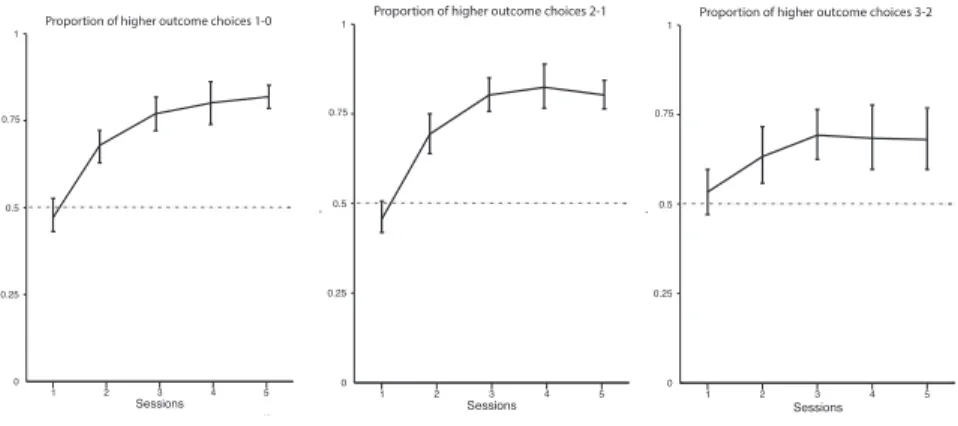
The relationship between outcomes in the iSH game is organized as R>T>=P>S. Our interest here is to determine a set of outcomes that are both discriminable to the rats and the rewards as low as possible to increase the number of trials rats will complete within a session. To
determine this, we conducted a series of simple discrimination experiments where preference for different outcomes were tested pairwise with each of two rewards being available consistently on one of two arms of a single T-maze. All rats were tested individually.
1.5 Animal Subjects
The experiments were performed using 12 pairs of male non-litter mates of the outbred Sprague Dawley rat strain, from Charles River, Barcelona, Spain. All animals were housed in pairs under 12 h light/dark cycle. Experiments were conducted during the light period. All rats were habituated to the experimenter alone for one week and for approximately 4 days to the automated double T-maze assay and to the novel food used for the positive reinforcements in the iSH stooge task. All rats were given free access to food and water.
1.6 Discrimination Results
In each of the following early experiments, four naïve animals were each exposed to one of three different single pellet discriminations: 1-0, 2-1 and 3-2. In each of these cases, we examined the proportion of total choices made to the higher arm side. Rats in all cases demonstrated a preference greater than chance for the more rewarded arm (one tailed t