Vicente Ferreira
Why Economics Must be an
Evolutionary Science
WP01/2019/DE _________________________________________________________ Department of EconomicsW
ORKINGP
APERS ISSN 2183-18151
Why Economics Must be an Evolutionary
Science
On the evolution of evolutionary thought in economics, from Thorstein Veblen’s institutional approach to modern complexity and chaos theories.
“O caos é uma ordem por decifrar.” José Saramago, in O Homem Duplicado
Abstract
This paper addresses the evolution of evolutionary thought in economics as an alternative to the dominant static view of the economy.
A short history of the earlier institutional approach, announced by Thorstein Veblen’s 1898 paper ‘Why is economics not an evolutionary science?’, is presented alongside a discussion of its key methodological and philosophical aspects. Veblen’s critiques of neoclassical economics are also discussed. Then the role of evolutionary concepts in economics throughout the twentieth century is analysed, from later institutionalists to recent complexity and chaos theories. It is argued complexity approaches are developed in line with Veblen’s institutional theory, and may be incorporated in an evolutionary theoretical framework which constitutes a necessary alternative to the neoclassical paradigm, as it better describes and studies real-world socio-economic phenomena.
2
Introduction: The Origins of Institutional Economics in Historical Context
Institutional thought emerged in economics in the late nineteenth century, with the publication of ‘Why is economics not an evolutionary science?’ in 1898 by Thorstein Veblen. In order to analyse the evolution of evolutionary concepts in economics, it is helpful to briefly describe the historical context of its origins.
Thorstein Bunde Veblen (1857-1929) was a Norwegian-American economist, born in Wiscounsin. Having studied philosophy and economics under John Bates Clark (at Carleton College) and Charles Sanders Peirce (at Johns Hopkins University), Veblen eventually got his Ph.D. from Yale University in 1884, with a major in philosophy and a minor in social studies.
He started teaching at the University of Chicago in 1892, and developed some of his most important work in the following period – his Theory of the Leisure Class is published in 1899. He would then move to teach at Stanford University, and later at the University of Missouri. Veblen also worked for public organisations and magazines, where he met other academics such as the historian Charles A. Beard and the pragmatist philosopher John Dewey.
Apart from philosophy, anthropology or psychology, Veblen also read widely in the natural sciences, thus becoming an enthusiast of the Darwinian evolutionary theory. The ideas of Peirce and William James would also influence him.
Therefore, contemporary biology (Darwinian evolutionary theory), philosophy and psychology (Peirce, James, Dewey and the pragmatist theory of action) are core influences in the development of Thorstein Veblen’s institutional and evolutionary approach. It is worth noting that by the time Veblen developed his works economic theory was mostly influenced by the metaphor of physics, not biology (Mirowski, 1984).
Veblenian ‘Institutionalism’ and the Critique of Neoclassical Economics
The first feature of Veblen’s institutionalist approach considered in this essay, perhaps the most important one, is how it addresses the ever present dilemma of social sciences – the agency-structure dichotomy. One can trace this discussion at least back to ancient Greek philosophy. To address it properly, it is necessary to discuss the different metaphors used to describe social reality, as they play a fundamental role in the constitution of social sciences (Louçã, 1997; Hodgson, 1999). This role has been described brilliantly by Paul Ricoeur (1977) in his The Rule of the Metaphor:
3 “In service of poetic function, metaphor is that strategy of discourse by which language diverts itself of its function of direct description in order to reach the mythical level where its function of discovery is set free”.
Biological metaphors of society can be found in the works of Greek philosophers like Plato, who described the individual as a part of a living organism (i.e. society). Authors from the beginnings of modern economics also grasped this notion – the French physician François Quesnay, in his Tableau Économique, developed a model which sought to explain economic dynamics by an analogy with blood circulation in the economic structure.
The ascent of atomistic conceptions of society occurs in the period of the European Enlightenment (seventeenth and eighteenth centuries). Classical economists such as Adam Smith, Jean-Baptiste Say, David Ricardo, and the philosophers John Locke or John Stuart Mill are associated with this individualist perspective which is currently dominant in economic thought.
In the nineteenth century, Karl Marx (metaphors of structure and superstructure) and German historicists also used the idea of society as an organism “to connote the existence of social structure above constituent individuals” (Hodgson, 2004). Even Alfred Marshal, usually considered a neoclassical economist, argued for an organicist metaphor, although he failed to develop it consistently.
Veblen and later institutionalists (such as John R. Commons or Wesley Mitchell) introduced the concept of “institution”. Hodgson defines institutions as “durable systems of established and prevalent social rules that structure social interactions.” (Hodgson, 2006). Organisations (such as firms, unions, states, among others), laws, regulations, norms of behaviour, systems of language, money or social conventions are all institutions. These systems of rules (either legal rules, or norms of behaviour) are explicitly or implicitly acknowledged and accepted by the members of society. Rules are replicated through language and the prevalent social culture – they are ‘socially transmitted’.
Veblen sought to offer an explanation on the transformation of both individuals and societies. He opposed the explanations of socio-economic phenomena exclusively in terms of individuals (that is, methodological individualism), but he also did not accept explanations exclusively in terms of systemic wholes. What Veblen proposed was a Darwinian framework to analyse the co-evolution of agents and structures, based on a materialistic interpretation of history. Veblen understood this evolutionary process as a result of causal interactions in both directions (from individual to structure and from structure to individual), emphasizing the historical, structural and biological aspects of the human condition. In order to explain origin, he conceived the individual in biological and socio-economic terms.
4 His Darwinian focus on ongoing processes and ‘cumulative causation’, rather than static equilibria, as well as the rejection of teleological explanations, can be considered radical approaches (Hodgson, 1998; Bateira, 2010). Veblen rejected mechanistic analogies and wanted to replace them with evolutionary methods and metaphors, thus criticising neoclassical and other schools of thought and arguing for a complete reconstruction of economic theory. Veblen himself (1898a) explained:
“Any evolutionary science…is a close-knit body of theory. It is a theory of a process, of an unfolding sequence…of cumulative causation.”
Although social structures depend on individuals, they are not reducible, in an ontological sense, to them. Yet it is also true that individual behaviour is influenced by social context. This means institutions and individuals are mutually constitutive. Veblen thus distanced from any reductionist methodology (biological, structuralist or individualist), as he refused to explain all aspects of complex phenomenon in terms of one type of unit (Hodgson, 1998).
Institutions can affect individuals’ preferences by shaping their habits – a mechanism of ‘reconstitutive downward causation’ (Hodgson, 2002). Individuals can also influence social structures, meaning upward causation is also possible. It is important to notice there are some social structures which precede individual interactions - people are born in a society shaped by past generations. Therefore institutions and individuals are different entities (the former are not simple aggregates of the latter).
The metaphors found in Veblen’s writings constitute an important evidence of his Darwinian framework. In the discussion of habits and institutions, the author frequently referred to the concepts of ‘variation’ – among populations –, ‘continuity’ – the mechanism involved in the transmission of individual characteristics (inheritance) – and ‘natural selection’ – the prevalence of the better-adapted organisms (Veblen, 1898b, 1899, 1906).
Hence Veblen did not neglect human’s purposes and beliefs, but understood them as a result of an evolutionary process similar to Darwin’s natural selection, and shared the biologist’s rejection of religious and teleological explanations of events. In this sense, preferences are not given features of an individual; they are socially (thus endogenously) constructed. Veblen used the metaphor of ‘mutation’ when referring to habits’ and institutions’ changes (Veblen 1904, Veblen 1909). This is much more than a mere literary choice, since mutation implies the notion of irreversibility.
In Veblen’s approach, institutions or social structures are also a result of a materialistic evolution. As Hodgson states, “intentions can be causes, but intentions are always caused.” (Hodgson, 2004).
5 Veblen (1899) described his evolutionary perspective on socio-economic events in the following terms:
“The evolution of social structure has been a process of natural selection of institutions. The progress which has been and is being made in human institutions and in human character may be set down, broadly, to a natural selection of the fittest habits of thought and to a process of enforced adaptation of individuals to an environment which has progressively changed with the growth of community and with the changing institutions under which men have lived. Institutions are not only themselves the result of a selective and adaptive process which shapes the prevailing or dominant types of spiritual attitude and aptitudes; they are at the same time special methods of life and human relations, and are therefore in their turn efficient factors of selection.”
Human intentionality is not denied, but rather included as a necessary element of an interactive process between individuals and institutions (for a more detailed explanation of rules and social ontology, see Martins, 2009). The psychological mechanisms of deliberation are themselves an outcome of evolution through social interactions and habituation. Thus habits and routines are an essential part of the deliberation process, which means a rejection of the neoclassical atomistic view of the fixed individual.
Veblen criticised neoclassical utilitarian explanation of human behaviour, as it did not explain the origin of such behaviour. “Darwinism meant not only a critique of Divine intervention, but it also required a rejection of immanently conceived preference functions.” (Hodgson, 2004). Veblen thus challenged the narrow definition of economics as ‘the science of choice’ – even if one attempts to analyse individual choices, the origins of his or her preferences need to be considered. His criticism is made clear by his biting comments on neoclassical approach to institutions:
“It is characteristic of the school that whatever an element of the cultural fabric, an institution or any institutional phenomenon, is involved in the facts with which the theory is occupied, such institutional facts are taken for granted, denied, or explained away. (...) And yet these economists are lacking neither in intelligence nor in information.” (Veblen, 1909).
The circularity of the neoclassical thesis of utility-maximizing behaviour has also been exposed by some authors (see, for example, Sen, 1977).
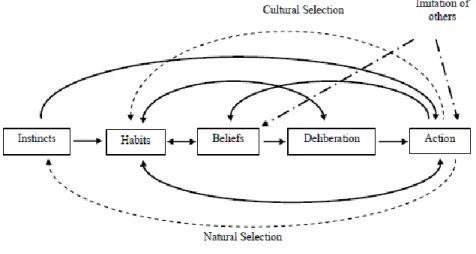
Inherited instincts (such as fear or imitation) and habits are crucial to human development. Veblen approached the relation between biological instincts and socio-economic evolution in his Theory of the Leisure Class, arguing human mental capacities have evolved from less deliberative forms (a Darwinian emphasis that human reason and deliberative capacities are the outcome of an evolution from previous and less conscious forms, such as habits and instincts), and were influenced by the social
6 culture (Hodgson, 2010). Thus habits and reason interact in an adaptation process to an ever changing environment, thus evolving and generating new behavioural outcomes. This pragmatist theory of action stresses that human purposes, deliberations and actions are primarily driven by habits (Barbalet, 2004). Habits are in turn dependent upon prior and inherited instincts. Veblen assumed “there is multidirectional, complex feedback, and intersectional processes at work in the instincts - habits - institutions - behaviour nexus.” (O’Hara, 2000).
The crystallisation of individuals’ ‘habits of thought’ gives rise to institutions (Bögenhold et al., 2016). Institutions are durable because they impose consistency on human activities, by moulding (though not determining) humans’ purposes and preferences. Dewey described this process as “the cumulative effect of insensible modifications worked by a particular habit in the body of preferences” (Dewey, 1922). Veblen identifies three elementary propensities of the human race: ‘the instinct of workmanship’, ‘the parental bent’ and the ‘instinct of idle curiosity’. According to his view, these instincts are the primitive base for human action and deliberation (Brette, 2003).
Thus, human mental capacities are not conceived as static, but rather as resulting from a process of evolution in which agents react to institutional changes by learning processes. These processes of behaviour transformations influence the very institutional framework in which agents live.
In his Theory of the Leisure Class, Veblen develops this idea, arguing modern institutions directed consumption patterns in such a way that “no class of society, not even the most abjectly poor, forgoes all customary conspicuous consumption” (Veblen, 1899). Veblen argued social standards play an important role in consumer behaviour.
Therefore, it can be concluded that social structures exert considerable influence in human action. Each cultural environment may inhibit or encourage the expression of some instincts and the acquisition of certain habits. Established institutional systems tend to impose themselves upon agents and new institutions, by reproducing shared habits of thought and behaviour and creating mechanisms of conformism (Brette, 2003).
As Veblen (1906) wrote:
“The economic life history of the individual is a cumulative process of adaptation of means to ends that cumulatively change as the process goes on, both the agent and his environment being at any point the outcome of the last process.”
7 The Darwinian evolutionary perspective on the complex processes involved in human behaviour and cognition is best described by the following figure.
Emergent processes and cumulative causation
Veblen’s ‘emergentist’ conception of socio-economic phenomena consists in understanding the world as a result of continuous causal relations between its parts. These social interactions can originate systems exhibiting emergent properties (that is, features that are not identifiable within the parts alone). Macroeconomic systems are conceived as exhibiting emergent properties and causal power – novelty is an example of a systemic emergent property, not possessed by the parts alone.
Davis (2017) provides a schematic representation of cumulative causality in an attempt to demonstrate its relevance in human behaviour analysis. In the case of agents acting upon habits, the action of some factor A in some other factor B also involves the causal relationship from A to B. It is then also the case that a -> b -> (a -> b). The combined overall effect is given by:
(1) a and a -> b and a -> b -> (a -> b)’ => b and (a -> b)’.
As Davis notices, “the linear causal relation a -> b has causal effects on itself, which are additional to the linear effects that a has on b.” The author adds that “cumulative causation processes combine continuity and non-identity of linear cause-and-effect sequences. Their non-identity is associated with the linear sequence part of the overall relation”, represented below:
(2) a and a -> b => b.
8 Continuity is associated with the part of the overall relation in which the linear sequence operates on itself:
(3) a -> b and a -> b -> (a -> b)’ => (a -> b)’.
The overall relation (1) combines the effects (2) and (3), demonstrating that the initial relation (a -> b) builds on itself, and providing an evolutionary scheme which may serve as an example of how habits and actions mould each other.
The notions of cumulative causation and emergentism may explain Veblen’s analysis of technological change. Veblen criticised the neoclassical theory of production – the fiction of Robinson Crusoe – for it neglected historical and social context. Veblen argued that any detailed analysis of the mechanisms of production must address the specific organizational structures involved in the process. He stressed the complex organic relation between workers and production factors, thus rejecting the neoclassical idea that productivity could be calculated for each factor alone, as it does not realistically describes productive processes. As O’Hara (2000) wrote,
“(...) the processes of production, distribution and exchange need to be situated within the context of the reproduction of institutions associated with belief and organisation. Socioeconomic reproduction implies the need for a wide scope of vision when viewing the production of goods and services; the distribution of income, wealth and power between the social classes; and the exchange of money, credit and goods and services in the market.”
In this sense, technological change plays a fundamental role in the capitalist evolution. It depends on the capitalist system’s tendency to replace older systems of production for new ones, later identified by Schumpeter (though he attributed technological change to the figure of the ‘entrepreneur’ – an individualist perspective Veblen would not embrace). Nevertheless, both authors agreed capitalism was an evolving system which endogenously generated its own changes.
Besides permanently changing the material conditions of production and distribution, technological progress also influences social relations through complex processes of habituation and adaptation. Veblenian notions of ‘cumulative causation’ and ‘path-dependency’ also apply to technological progress and capitalistic metamorphosis.
Evolutionary thought in 20th century economics
Throughout the twentieth century, several authors tried to develop organicist approaches to the study of economic phenomena.
9 Wesley Mitchell and John Rogers Commons are the most prominent authors who followed Veblen´s legacy. Both authors’ works are included in what is usually called ‘Institutional Economics’, whose main features are the study of evolutionary processes and the role of institutions. Commons analysed phenomenon such as collective action, and provided important works in the history of labour unions in the United States, while Mitchell, who studied under Veblen and Dewey, became known for working on the National Bureau of Economic and Research (NBER) and for his works on business cycles.
These and other authors tried to develop the philosophical framework proposed by Thorstein Veblen. Mitchell argued that the calculative mentality assumed by neoclassical economics was historically specific (an argument shared by Max Weber, for example), and economics should instead deal with the institutional context that shapes human behaviour, criticising orthodox economists for not using psychological insights in their works. Mitchell’s notion of circular feedback between institutions and agents is consistent with Veblen’s idea of endogenous preference construction, and can help to explain the durability of some emergent properties.
The significance of psychology was also stressed by John Maurice Clark (1918), who argued individuals were constrained by human mental limitations. Mitchell and Clark also developed major works concerning business cycles analysis (Mitchell, 1913; Clark, 1917).
It is worth mentioning by the time these authors developed their works, the intellectual environment in the social sciences was less favourable to the Veblenian framework. Positivism was becoming the dominant methodology in economics, and behaviourism had replaced the instinct-habit psychology. Institutionalism was influenced by positivism, and much more emphasis was given to empirical research (Rutherford, 2000).
Later on, the evolutionist approach and metaphors were developed by such heterogeneous authors as Joseph Schumpeter (1934), Gunnar Myrdal (1972), Georgescu-Roegen (1976), or more recently Richard Nelson and Sidney Winter (1982). Although not all these authors operated under a Darwinian framework, they all criticised orthodoxy for dealing only with the study of equilibrium states, and opted to analyse economic changes and processes of adjustment.
Despite these heterogeneous efforts, the Darwinian approach was marginalized within social sciences, lacking a solid theoretical framework. Nevertheless, institutionalism influenced some later heterodox authors. The development of the foundations of a macroeconomic level of analysis by Wesley Mitchell and others is a major step in the history of economic thought. John Maynard Keynes, Nicholas Kaldor, Michal Kalecki,
10 Joan Robinson and later post-Keynesian scholars have built on this important legacy of ‘old’ institutionalism.
Some of the new approaches to the discipline which have emerged in the last decades resonate with a Veblenian evolutionary program. Such is the case of modern complexity approaches, which defy the neoclassical paradigm and may achieve what Veblen could not – that is, establishing evolutionary foundations to the study of economic dynamics. These will be described in the next section.
“The blurring of the boundaries between order and chaos”: linking Veblen and
complexity approaches
In this section, it is argued that the development of complexity theories in recent years undermines the reductionist approach of neoclassical economics, and provides an alternative theoretical framework which resonates with the intellectual legacy of Thorstein Veblen and the old institutionalism.
Complex, non-linear systems have been studied the discipline of economics in the last decades, in a clear rupture with the neoclassical paradigm. The emergence of chaos theory, and its application to economic thought, is representative of this tendency. As the biologist Ernst Mayr (1985) asserts:
"Nowhere in the inanimate world can one find a system, even a complex system, that has the ordered internal cohesion and coadaptation of even the simplest of biological systems. And this requires an entirely different approach from that of the classical philosophy of science".
Scholars working under a theoretical framework which is currently labelled “complexity theory” develop non-linear computer systems with heterogeneous agents. The Santa Fe Institute (SFI) is one of the leading organisations in which this research is developed. Santa Fe’s models undermine the foundations of neoclassical paradigm, in the sense that they display structures dependent on specific emergent networks and complex dynamics. This is opposite to the idea that macroeconomic theory must be based in solid ‘microfoundations’ such as the assumption of utility-maximizing individuals (Prasch, 2000). This approach also refuses the possibility of studying society assuming it behaves as if it were an individual, which underlies general equilibrium theory (Lavoie, 1992). In these complex systems, as the structure of the economy in unknowable in advance, agents’ strategies and expectations are adaptive and dependent on the environment in which they are embedded, which distinguishes them from New Institutional Economics “bounded rationality” models, as that of Williamson (1985) or North (1986).
11 Although the sciences of complexity do not reject causal links, they argue sometimes it is difficult to identify them clearly. Therefore, they emphasize historically dependent explanations and emergent properties (in line with the philosophy of Veblen).
Therefore, complexity approaches and Veblenian-style theory have some common ideas regarding the heterogeneity of individuals and the psychological factors underlying human action, as well as the notion of a constant evolution of the institutional structure.
There is already some important literature trying to link complexity analysis and economics (Arthur et al., 1997; Louçã, 1997; Rosser, 1999; Colander, 2000; Kirman, 2010).
Another stream of research which has evolved in recent years is chaos theory. The application of chaos theory to the study of economics may be traced back to Benoit Mandelbrot, who wrote some relevant papers in economics in the 1960’s. Mandelbrot explained his research was intended to explore indeterministic phenomena, such as turbulence, weather prediction or economics (Mirowski, 1990). The ideas of irregularity and randomness are central to his works, and he strongly criticised neoclassical economics for focusing exclusively in studying conservative and deterministic systems which did not reflect reality.
Mathematicians of chaos argue chaos theory “brings a new challenge to the reductionist view that a system can be understood by breaking it down and studying each piece” (Crutchfield et al., 1986).
A full meaning of chaos is provided by Sunny Auyang (1998):
“A deterministic dynamic system is regular if initially nearby paths stay close together, chaotic if they separate at an exponential rate. Exponential divergence makes chaotic processes unpredictable in the long run because it amplifies tiny errors in the initial conditions.”
Richard Goodwin (1990) also offered an explanation on dynamic systems:
“Dynamical systems display themselves as attractors and/or repellors. There are motions into or out of fixed points (or equilibria). There are also well-defined motions such as periodic. The interesting and difficult cases are the chaotics (more soberbly called aperiodics) which are not yet, and possibly will never be, fully understood, precisely because they are ever-changing.”
Goodwin’s dynamic models endogenously generated irregular tendencies due to these chaotic attractors. Chaos theory has shown that even deterministic systems can produce randomness. If we assume reality is non-linear, it means we have to treat its descriptive models as if they were unpredictable. Rather than rejecting causality, it is
12 acknowledged not all causes may be identified. Emergent properties, path-dependency and irreversibility are key features of chaotic systems (Arthur, 1989). The implications of this approach are quite clear – precise predictability is undermined by non-linear and chaotic tendencies.
Hodgson (2013) suggests the limited capacities of prediction of agent-based modelling and other techniques for dealing with complex systems might be a possible explanation of why it has not yet become an established theoretical framework in academia.
Therefore, chaos literature reveals “the blurring of the boundaries between order and chaos” (Mirowski, 1990).
In line with Veblenian institutionalism, Bateira (2010) describes social relations as “units that emerge from person’s interactions. In their multiple interconnections, social relations form roles and positions in order to specialise and pattern individuals’ interactions; roles and positions in turn are organised into networks (themselves elementary ‘systems’) that form layers of social structures. Some of those networks have highly dense nonlinear relations with multiple feedback and feedforward links. These connections originate a complex self-organising structure that emerges as a unity, a social system displaying properties of its own.”
This perspective provides and argument for the existence of a link between ‘old’ institutionalism and recent complexity theories. Veblen’s analysis of institutional mutation and agents’ processes of adaptation to recurring changes in the economic structure builds on the notion of ‘non-equilibrium’ as an endogenous aspect of socio-economic evolution. Therefore, ‘old’ institutionalism resonates with modern complexity theories which develop dynamic economic models.
Conclusion
This essay presented a short history of evolutionary thought in economics, from its origins in the works of Thorstein Veblen to recent developments in complexity theories. It also discussed the conceptual framework of the ‘old’ institutionalism, and presented it as a necessary coherent alternative to the contemporary dominant paradigm. There is already some important literature on the legacy of Thorstein Veblen and his evolutionary program (Louçã and Perlman, 2000; Hodgson, 2004). A Darwinian perspective allows social sciences to overcome the problem of agency and structure, as it explains the relations between said agents and structures as a causal process through time. Human behaviour involves instincts, habits, deliberation and social interactions. The processes of interactions between individuals, and between
13 them and their cultural and natural environment may help to explain the emergence of systemic properties which are not found in the parts alone.
The Darwinian evolutionary approach requires a layered ontology, since it presents several levels of analysis: the material, the psychic and the social one. This anti-reductionist approach also points to the possibility of a macroeconomic level of analysis.
It may be argued that ‘critical realism’ is a stream of research in line with Veblen’s legacy. Critical realists (Archer et al., 1998; Lawson, 1997) call for an analytical distinction between individual’s interactions and social systems, emphasizing social structures “have an historical dimension based on material and discursive resources, which in the overall are not reducible to current agency and interpersonal relations.” (Bateira, 2010). This perspective resonates with an emergentist philosophy which describes the interaction of human agency and society’s structural levels as a complex relation. Critical realists highlight the complexity of economic phenomena, the fundamental role of uncertainty and the recognition of heterogeneity among agents as crucial features of any theory attempting to analyse real-world events.
An evolutionary economic theory is needed to overcome the current paradigm. This implies setting a coherent theoretical framework which may build on the notions of recent approaches such as critical realism and complexity and chaos theories, thus reviving the ‘old’ institutionalism concepts.
Since mainstream economics has been “based for a long time in what we might call a linear orthodoxy” (Louçã, 2000), an evolutionary approach needs to defy this static view of the economy, and develop an alternative based on ‘heretic’ non-linear and chaotic notions. The economy must therefore be presented as a living, adaptive and unpredictable organism.
More than a century ago, Veblen (1898a) wrote:
“Probably no economist today has either the hardihood or the inclination to say that the science has now reached a definitive formulation, either in the detail of results or as regards the fundamental features of theory.”
The contemporary relevance of this statement is noteworthy, as it remarkably applies to the current state of economics. It helps to make the case for the need of alternative conceptual frameworks to defy orthodoxy canons. In order to develop a modern institutional-evolutionary approach, economists may learn a lot from this perspective.
14
References
Archer, M. S. et al. (1998). Critical Realism: Essential Readings. Routledge, London, UK. Arthur, W. B. (1989). Competing Technologies, Increasing Returns, and Lock-in by Historical Events. Economic Journal, 99(1), pp. 116–131.
Arthur, W. B.; Durlauf, S. and Lane, D. (eds.) (1997). The Economy as an Evolving Complex System II. Addison-Wesley, Redwood City, CA., USA.
Auyang, S. (1998). Foundations of Complex-System Theories: In Economics, Evolutionary Biology, and Statistical Physics. Cambridge University Press, New York, USA.
Barbalet, J. (2004). William James: Pragmatism, Social Psychology and Emotions. European Journal of Social Theory, 7(3), pp. 337-353.
Bateira, J. (2010). Institutions, Markets and Economic Evolution – Conceptual Basis for a Naturalist Institutionalism. PhD Dissertation, Manchester Business School, The University of Manchester, UK.
Bögenhold, D.; Michaelides, P. and Papageorgiou, T. (2016). Schumpeter, Veblen and Bourdieu on Institutions and the Formation of Habits. MPRA Paper No. 74585.
Clark, J. M. (1917). Business Acceleration and the Law of Demand: A Technical Factor in Economic Cycles. Journal of Political Economy, 25(1), pp. 217–235.
Clark, J. M. (1918). Economics and Modern Psychology, parts I and II. Journal of Political Economy, 26(1–2), pp. 1–30, 136–166.
Colander, D. (ed.) (2000). Complexity and the History of Economic Thought. Routledge, London, UK.
Crutchfield, J.; Farmer, J.; Packard, N. and Shaw, R. (1986). Chaos. Scientific American, 255(6), pp. 38–49.
Davis, J. (2017). Hodgson, Cumulative Causation, and Reflexive Economic Agents, in Gaglierda, F. and Gindis, D. (eds.) Institutions and the Evolution of Capitalism, Essays in Honour of Geoffrey M. Hodgson, Edward Elgar Publishing, Cheltenham, UK.
Georgescu-Roegen, N. (1976). Energy and Economic Myths: Institutional and Analytical Economic Essays. Pergamon Press Ltd., Oxford, UK.
Goodwin, R. (1990). Chaotic Economic Dynamics. Oxford University Press, New York, USA.
15 Hodgson, G. (1998). On the evolution of Thorstein Veblen's evolutionary economics. Cambridge Journal of Economics, 22(4), pp 415-431.
Hodgson, G. (1999). Evolution and Institutions: On Evolutionary Economics and the Evolution of Economics. Edward Elgar Pub, Cheltenham, UK.
Hodgson, G. (2002). Reconstitutive Downward Causation: Social structure and the development of individual agency, in Fullbrook, E. (ed.) Intersubjectivity in Economics - Agents and Structures. Routledge, London, UK.
Hodgson, G. (2004). The Evolution of Institutional Economics: Agency, structure, and Darwinism in American institutionalism. Routledge, London, UK.
Hodgson, G. (2006). What are Institutions?. Journal of Economic Issues, 40(1), pp 1-25. Hodgson, G. (2010). Choice, habit and evolution. Journal of Evolutionary Economics, 20, pp. 1-18.
Hodgson, G. (2013). On the Complexity of Economic Reality and the History of the use of Mathematics in Economics. Filosofía de la Economía, 1(1), pp 125-148.
Kirman, A. (2010). Complex Economics: Individual and Collective Rationality. Routledge, London, UK.
Lavoie, M. (1992). Foundations of Post-Keynesian Economic Analysis. Edward Elgar, Aldershot, UK.
Lawson, T. (1997). Economics and Reality. Routledge, London, UK.
Louçã, F. (1997). Turbulence in Economics: An Evolutionary Appraisal of Cycles and Complexity in Historical Processes. Edward Elgar, Aldershot, UK.
Louçã, F. (2000). Complexity, chaos, or randomness: Ragnar Frisch and the enigma of the lost manuscript, in Colander, D. (ed.) Complexity and the History of Economic Thought. Routledge, London, UK.
Louçã, F. and Perlman, M. (eds.) (2000). Is Economics an Evolutionary Science? The Legacy of Thorstein Veblen. Edward Elgar Publishing Limited, Cheltenham, UK.
Martins, N. O. (2009). Rules, Social Ontology and Collective Identity. Journal for the Theory of Social Behaviour, 39:2.
Mayr, E. (1985). How biology differs from the physical sciences, in Depew, D. and Weber B. (eds.) Evolution at a Crossroads: The New Biology and the New Philosophy of Science. MIT Press, Cambridge, USA.
16 Mirowski, P. (1984). Physics and the ‘marginalist revolution’. Cambridge Journal of Economics, 8, pp. 361-379.
Mirowski, P. (1990). From Mandelbrot to Chaos in Economic Theory. Southern Economic Journal, 57(2), pp. 289–307.
Mitchell, W. (1913). Business Cycles. University of California Press, Berkeley, USA. Myrdal, G. (1972). Against the Stream: Critical Essays in Economics. Pantheon Books, New York, USA.
Nelson, R. and Winter, S. (1982). An Evolutionary Theory of Economic Change. Harvard University Press, Cambridge, MA., USA.
North, D. (1986). The New Institutional Economics. Journal of Institutional and Theoretical Economics, 142(1), pp. 230-237.
O’Hara, P. A. (2000). How can Economics be an Institutional-Evolutionary Science?, in Louçã, F. and Perlman, M. (eds.) Is Economics an Evolutionary Science? The Legacy of Thorstein Veblen. Edward Elgar, Aldershot, UK.
Prasch, R. E. (2000). Complexity and Economic Method: An institutionalist perspective, in Colander, D. (ed.) Complexity and the History of Economic Thought. Routledge, London, UK.
Ricoeur, P. (1977). The Rule of the Metaphor: The creation of meaning in language. Routledge, London, UK.
Rosser, J. B. (1999). On the Complexities of Complex Economic Dynamics. Journal of Economic Perspectives, 13(4), pp. 169–92.
Rutherford, M. (1984). Thorstein Veblen and the processes of institutional change. History of Political Economy, 16(3), pp. 331-348.
Rutherford, M. (2000). Institutionalism Between the Wars. Journal of Economic Issues, 34(2), pp. 291–303.
Rutherford, M. (2001). Institutional Economics: Then and Now. Journal of Economic Perspectives, 15(3), pp. 173–194.
Sen, A.K. (1977). Rational Fools: A Critique of the Behavioral Foundations of Economic Theory. Philosophy and Public Affairs, 6(4), pp. 317-344.
Schumpeter, J. (1934). The Theory of Economic Development: An Inquiry into Profits, Capital, Credit, Interest, and the Business Cycle, translated by Redvers Opie from the second German edition of 1926. Harvard University Press, Cambridge, MA., USA.
17 Veblen, T. (1898a). Why Is Economics Not an Evolutionary Science?. Quarterly Journal of Economics, 12(3), pp. 373–397.
Veblen, T. (1898b). The Instinct of Workmanship and the Irksomeness of Labor. American Journal of Sociology, 4(2), pp. 187–201.
Veblen, T. (1899). The Theory of the Leisure Class: An Economic Study in the Evolution of Institutions. Macmillan, New York, USA.
Veblen, T. (1904). The Theory of Business Enterprise. Charles Scribners, New York, USA. Veblen, T. (1906). The Place of Science in Modern Civilisation. American Journal of Sociology, 11(1), pp. 585–609.
Veblen, T. (1909). The Limitations of Marginal Utility. Journal of Political Economy, 17(9), pp. 620–636.
Williamson, O. (1985). The Economic Institutions of Capitalism: Firms, Markets, Relational Contracting. Macmillan, London, UK.