Designing product-service systems for sustainability –
a methodological exploration
Nils Frithjof Decker
Dissertação de Mestrado
Orientador na FEUP: Prof. Lia Patrício
Faculdade de Engenharia da Universidade do Porto
ii Dedicated to Portugal, Europe and the World
iii Designing product-service system for sustainability – a methodological exploration
Abstract
“The Stockholm Memorandum”, one well-publicized report written by a group of Nobel Laureats, called our attention to one of the most serious problems of today´s societies: how do we treat and protect the habitat that protains us?1 From a top-down perspective, the report points to the fact that actions towards sustainability are urgently needed, and scientific contributions had to be integral part to the solution. From a bottom-up perspective, a new start-up project in Berlin adresses one aspect of the same problem, but in practical terms. The “CupCycle” company aims at implementing recyclable on-the-go coffee cups in closed infrastructures, replacing unsustainable cradle-to-grave solutions by a new system approach. Both perspectives in conjunction bring us to the central research question that is central to this work: “How to design product-service systems (PSS) for sustainability?”
While using interdisciplinary approaches, the work at hand touches the phenomenom of PSS at different levels. First, it includes an extant literature review on state-of-the-art PSS design methodologies, which is inspired by an interview with Birgit Mager, a prominent researcher from the service design area. Second, it encompasses a methodological exploration that hopes to offer better guidance towards sustainable PSS design, taking a service design method as fundament. Here, new combinations of techniques and models are explored thanks to the mutual integration of product design, service design and sustainability-driven research. Finally, a case study analysis based on the CupCycle case is presented in order to discuss the usefullness, strenghts and weaknesses of the introduced multilevel design framework.
In sum, the work at hand not only gathers new insights for a quite immature field of studying, it also deales with real world problems of sustainable design at CupCycle. In doing so, the thesis contributes to shift CupCycle to another level of scientifically grounded, holistic PSS design. Nevertheless, the contribution of this research should not be regarded as closed book and complete at this stage, but as an invitation for further research on sustainable PSS design methodologies that include multiple aspects of sustainability.
1
Third Nobel Laureate Symposium on Global Sustainability, “The Stockholm Memorandum: Tipping the Scales Towards Sustainability” (18 May 2011).
iv Acknowledgements
First of all, I would like to express my deep gratitude to Professor Lia Patrício, my research supervisor, for her enthusiastic encouragement and support of this work. Even at a distance, she offered me in many sessions her brilliant guidance to always stay focused and on schedule. I also wish to deeply thank Professor João Falcão e Cunha, for his patient support during the entire pathway from first entrance into the master program at Universidade do Porto until the very end of this travel. Without his helping hand this master thesis would not have been written down. My grateful thanks are also extended to Professor Birgit Mager, for her willingness to give an interview on the relationship of service design and sustainability and for giving her time so generously the same day at her workplace, the Köln International School of Design.
I would also like to offer my thanks to Professor Teresa Franqueira, for her readiness to be my external supervisor. This surely has caused special efforts, thank you very much for that.
Finally, I wish to thank my parents for their love, help and continued support in all my doings. They are always there when I need them. Special final thanks go to the rest of my family, particularly to my two brothers, who are great motivators even in stressful times, and to my friends in Portugal, who offered me far too much hospitality during my trips to their beautiful country.
v Index
1 Introduction ... 2
1.1 Motivation and objective of the thesis ... 2
1.2 Description of the case ... 3
2 Literature review ... 4
2.1 Introduction to PSS research ... 4
2.2 PSS design ... 7
2.3 Basic elements for the methodological exploration ... 10
2.3.1 Service design path ... 10
2.3.2 Product design path ... 16
3 Methodological exploration: designing PSS for sustainability ... 21
3.1 Starting point: Multilevel service design ... 21
3.2 Strategic level ... 22
3.3 Organizational level ... 25
3.4 Interface level: ... 29
3.5 End point: Multilevel PSS design ... 33
4 Case Study: designing PSS at CupCycle ... 35
4.1 Case study methodology ... 35
4.2 Eco-system level ... 36
4.3 PSS concept level ... 37
4.4 PSS organizational level ... 39
4.5 PSS interface level ... 43
5 Discussion: Implications of the case study ... 48
6 Conclusions and outlook ... 50
References ... 52
ANEXO A: <Overview on PSS design methodologies> ... 56
1
List of Figures
Figure 1: General model of multilevel service design. ... 12
Figure 2: The service blueprint structure. ... 14
Figure 3: Product life cycle process and life cycle option.. ... 18
Figure 4: Recycling network representation technique (RNRT).. ... 20
Figure 5: Multilevel service design framework ... 21
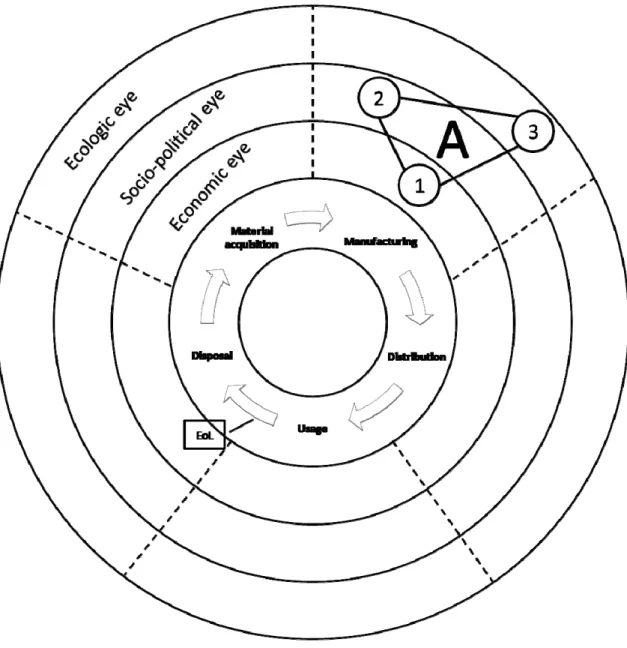
Figure 6: Eco-stakeholder map. Own representation. ... 23
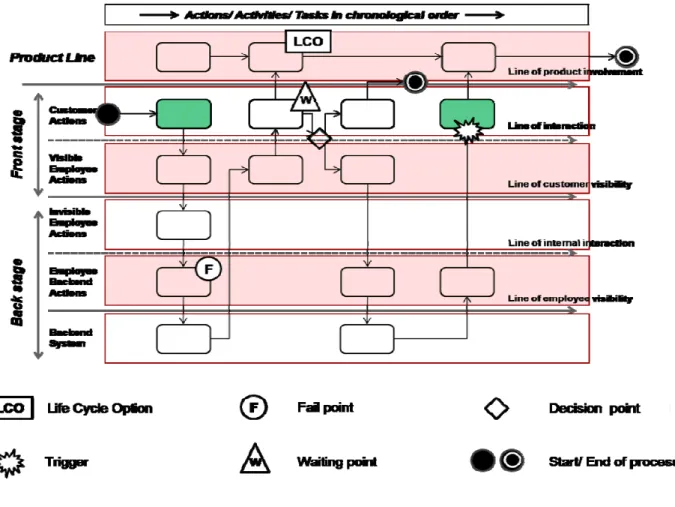
Figure 7: Extended PSS blueprint - PSS system architecture ... 27
Figure 8: Extended PSS blueprint - PSS system navigation ... 28
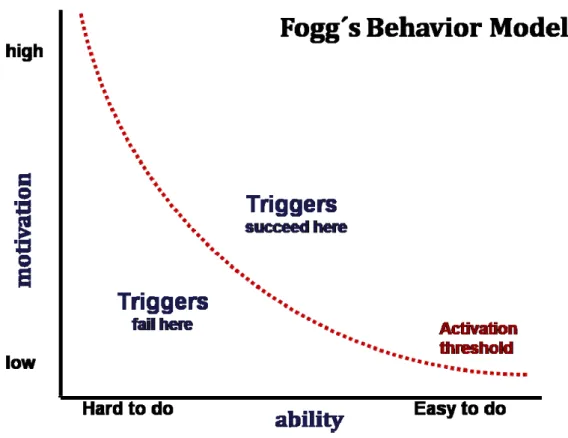
Figure 9: Fogg´s behavior model.. ... 30
Figure 10: Extended system navigation blueprint for green touchpoint analysis ... 33
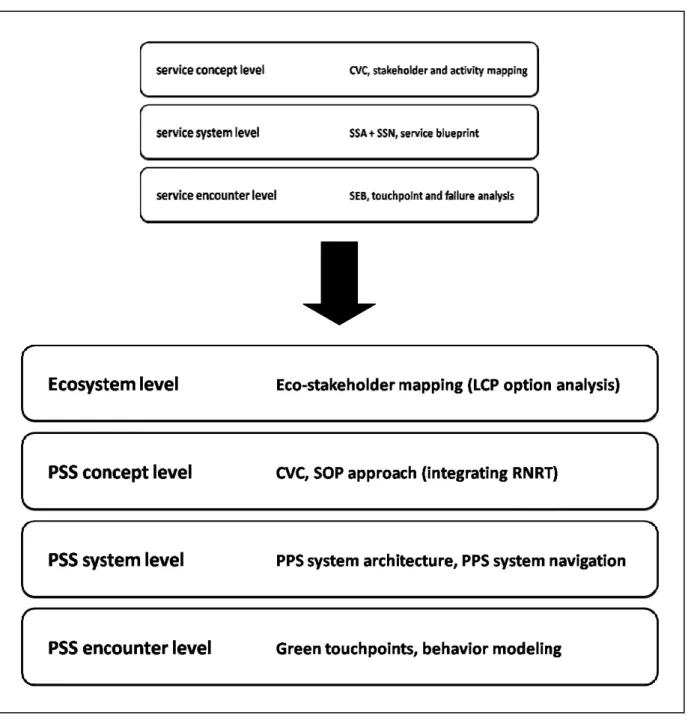
Figure 11: Multilevel PSS design framework. ... 34
Figure 12: ESM at CupCycle ... 36
Figure 13: Recycling network building at CupCycle ... 38
Figure 14: PSS system navigation - CupCycle experience ... 40
Figure 15: PSS system navigation - Troubleshooting experience ... 42
Figure 16: SEB of participating in eco-related rafles or online games at CupCycle... 47
Figure 17: Design for X framework, relevant part for the thesis highlighted. ... 59
List of tables Table 1: Triggers at CupCycle... 45
Table 2: Strengths and weaknesses of the novel PSS framework ... 49
2 1 Introduction
1.1 Motivation and objective of the thesis
Companies in today´s business world do more and more realize that ecologic and social concerns have to be integral part in the management of and decision-taking in innovation projects. In addition, it is a fact that sustainability-driven research approaches have found their way to various investigations at strategic, organizational and operational level. At the same time, the role of the customer has become increasingly powerful in the development of new services or new products, both in the fuzzy frontend and in the detailed design of innovation processes. To be clear, companies are often hoping to offer more than just pure services or pure products. Designers are increasingly asked to accurately design so-called product-service systems (PSS) in order to properly meet customer needs.
Within my master thesis, I am going to explore at the intersection of PSS design and sustainability-driven research from a methodological perspective. I will therefore include various viewpoints from service design, product design, PSS design and sustainability research in order to shed light to the central research question: “How to design
product-service systems for sustainability?” The work encompasses a profound literature review, a big
chapter of methodological exploration and final approaching of methods within a case study. The initial motivation for the research question stems from a real world project I am personally involved in, which is the “CupCycle” project. This is a start-up dedicated to the sustainable usage of coffee on-the-go cups, ventured as one of the numerous start-ups within the fast-growing Berlin entrepreneurial scene. For the last time, it was based in the “Social Impact Lab Berlin”2 and processed as a pilot at Technical University of Berlin. However, it seems to be a good cornerstone to approach sustainability-driven PSS design. In consequence, the objective of the thesis at hand is formulated on basis of two purposes: One objective is to bridge an existing research gap that exists in scientifically grounded PSS design in regards of sustainability. On the other hand, it is intended to find adequate design methods for the CupCycle case as well as to derive implications that both help putting together theory and practice in design scholarship and supporting decision-making at CupCycle.
2
The Social Impact Lab Berlin is an incubator for social entrepreneurs and is promoted by the German Federal Ministry of Family, Senior Citizens, Women and Youth and by the SAP AG.
3
1.2 Description of the case
CupCycle (online to find at http://cupcycle.eu) is a real world company founded in early 2012 by four students of Industrial Engineering and Communication Sciences of Technical University and Free University of Berlin. The founder´s story is easy to tell: Rafael and Arno, two students at TU Berlin, felt always very bad when they saw the tons of waste produced only in the main hall of the university. Taking a closer look to the type of waste, they realized that the hall was almost choking on one-way paper cups for tea and coffee which were incorrectly disposed in every corner. Both found that this is unnecessary in the era of “eco-solutions”, so they were searching for more information about alternative options. They did research on deposit systems for plastic cups used at big events and about chances for recycling systems in closed infrastructures. Controversial discussions emerged, followed by several meetings together with industrial experts and researchers from TU Berlin. Finally, the founders were joined by Carolin and Thomas and came out with a simple, but very clear idea about how to tackle the waste problem at university level. They developed a new recycling system for the university cafeteria: the “CupCycle” idea was born.
From early on, the founders decided that fast action is better than waiting, so they rapidly implemented the CupCycle system between March and July 2012 at the universities’ main cafeteria, in which usually about 1.200 one-way paper cups were used per day. In the end of testing, the project was happy to announce that almost 18.000 paper cups were pushed out of circulation within five months, substituted by reusable CupCycle cups made of pure polypropylene. The underlying activities of the company are best described as the processing of a system encompasses provision, collection, washing and reprovision of multi-way plastic cups. By summer 2013, a second pilot project was conducted to improve the workability of the system in the university context. However, a systematic design approach was always missing which may cause problems if the company is looking forward to growing. Meanwhile, the project also watched out to shift their idea to new business environments: it was found that fairs and congresses, sport events or firm canteens are interesting places that are often not having sustainable design solutions for on-the-go experiences of customers yet. In conclusion, CupCycle´s focus is on the to-go market, which they want to see more cautious about ecologic and social concerns. The company´s mission is defined as striving towards a more sustainable on-the-go world - by triggering mobile people to more environmentally-friendly behavior. The team is looking forward to finding many like-minded people that are willing to join the sustainable path that CupCycle is trying to take.
4 2 Literature review
It is obvious that CupCycle´s business idea is better described by a mix of product and service offering rather than by one single side only. Hence, the CupCycle case can be grouped into the increasing phenomenon of PSS. The following chapter will concentrate on the theoretical grounds of such PSS. Therefore, an adequate definition will be given, and an extra focus will lie on methodologies and models for the designing of PSS.
2.1 Introduction to PSS research
The notion “PSS” was first coined in 1999 within a research project promoted by the Dutch Ministries of Environment (VROM) and Economic Affairs (EZ). PSS was defined here as a “system of products, services, networks of players and supporting infrastructure that continuously strives to be competitive, satisfy customer needs and have a lower environmental impact than traditional business models“.3 However, the ecologic aspect of the definition was often not considered in PSS research,4 but as it is an integral part for the purpose of my thesis, the definition above is well-suited for the ongoing work. For further clarification, the inherent elements of PSS are defined as:
- a product: a tangible commodity manufactured to be sold. It is capable of “falling on your toes” and of fulfilling a user´s need.
- a service: an activity (work) done for others with an economic value and often done on a commercial basis.
- a system: a collective entity that aims to achieve an objective, consisting of an arrangement of material and immaterial elements (components, parts, and subsystems).5
- sustainability: “development that meets the needs of the present without compromising the ability of further generations to meet their own needs”, as introduced by the World Commission on Environment and Development in 1987.
3 Goedkoop et al. (1999). 4 Baines et al. (2007). 5
Definition of the terms product and service stem from Goedkoop et al. (1999), the term system was defined in line with Evans et al. (2010).
5
PSS research is a still young, but very interdisciplinary field. At the turn of the millennium, Morelli highlighted different perspectives on PSS, coming on the one hand from disciplines such as traditional or service marketing, and on the other hand from product management.6 As a matter of fact, the interdisciplinary background challenges the field to become more consistent and mature in the next years.7 However, at least some consolidation has been achieved in the following points:
1) PSS display the wide spectrum in between pure services and pure services.8 On the one side PSS is a special case of servitization,9 whereas servitization can be understood as a change process within the manufacturing industry to foster service orientation. Here, PSS strategies often mean adding service-oriented business models to the product component, with the ultimate goals of achieving higher customer satisfaction, competitive advantage and enhancing firm performance.10 From the asserted perspective, PSS research remarks a trend
towards the industrialization of services or productization of services.11 This shift can be claimed as “evolution of the services´ component to include a product or a new service component marketed as a product”.12 Hence, the research community agrees that the borderline between products and services has gotten more and more blurred.13
2) PSS share some specific characteristics, making them different from traditional pure product-based or service-based offerings. They can be summarized by the following points: reflection of a functional economy14; specific concerns to ownership issues15, the explicit drive for lower environmental impact or sustainability16, as well as the creation of value networks.17 6 Morelli (2002). 7 Gebauer et al. (2012). 8 Wong (2004). 9 Tan et al.(2010). 10 Ren (2009). 11
Evans et al.(2010), Baines et al. (2007).
12
Baines et al. (2007).
13
Lay (2002), Goedkoop et al. (1999).
14 Stahel (1997). 15 Baines et al. (2007). 16 Mont (2001), Brandsotter (2003). 17
6
3) PSS are often typed into product-oriented, use-oriented and result-oriented business models.18 Product-oriented PSS are usually characterized by the fact that the product constitutes the core value to the client and is only complemented by additional services. The business model is mainly geared towards sales. In contrast, use-oriented PSS are characterized by the fact that the product ownership usually stays with the provider. The traditional product still has an important role, but the business model is no longer focused on sales. Result-oriented PSS represent the most intangible form of agreeing on a business. The client and the supplier fix a desired result, but there is no pre-determined product involved in the solution that is provided by the supplier.19
Furthermore, it was shown by various studies that there is a wide range of benefits coming from the application of PSS. Among other benefits, PSS strategies may promise better chances to meeting customer needs and receiving higher margins as well benefiting from sustainable solutions and long-term relationships with the customer.20
Empirical studies underpinned the increasing trend of PSS applications in practice, often claimed as the “servitization of industry”.21 Some prominent examples may epitomize the increasing use of PSS business models in practice: product-based service offerings such as car-sharing or copy-shop services, leasing strategies and maintenance services within the manufacturing industry or integrated solutions for sustainable food delivery are just some of them among others.22
On the other hand, research revealed that putting PSS into practice often comes in hand with several challenges. Cultural, corporate and regulative barriers were identified especially due to the radical innovative shift that is usually needed for PSS implementation.23 Frequently, a significant system change in sales and business modeling is needed, which often deter companies to run a PSS-based approach.24 In addition to that, the integration of different stakeholders into a system demands for substantial network qualification, interaction skills
18 Tukker (2004). 19 Tukker (2004). 20
Oliva and Kallenberg (2003).
21
Santamaria et al. (2012).
22
i.e. Gebauer et al. (2012), Oliva and Kallenberg (2003); Evans et al. (2010); Tukker (2004).
23
Creschin (2013) based on UNEP (2002), Mont (2002) and Tukker and Tischner (2006) as well as Stahel (1997), Goedkoop et al. (1999).
24
7
and cultural knowledge among all participants. Frequently, this causes insurmountable barriers to the application of PSS.
2.2 PSS design
The challenging issue of PSS design will be particularly stressed in the following chapter. PSS design is a sub-part of PSS research, in which scientists intend to support practitioners in systematically developing new or improved PSS.25 That is, design science can be understood as a body of theories, paradigms, models, methods and knowledge describing and explaining a proven fundament of what design is, what happens while designing and how one might improve it.26 In consequence, the challenge for designers is to translate fictions about object characteristica into the real world, using i.e. visual, spacial, haptic or written language.
Since the PSS concept was derived from very different research backgrounds, it is too early to say that there is a common understanding on how to properly design PSS. A recently conducted literature review on design methodologies presents eight powerful approaches in detail, considering only most cited and peer-reviewed ones which had “survived” a multi-criteria selection process.27, 28 An overview of these approaches is given in the annexes (Anexo A), emphasizing once more that there is only few convergence in PSS design reached yet. For example, some methodologies have been addressed to marketing or designers, others to technicians or engineers. Moreover, very different objectives are targeted by researchers depending on research purpose and background.29 Nevertheless, the review makes it possible to better understand key aspects of PSS design methodologies. The six following issues can be highlighted which were addressed by the majority of research contributions:
- context specifications
- positioning and importance of stakeholders - design stages
- the development cycle - life cycle considerations and - representation rigour. 25 Baines et al. (2007) 26 Birkhofer (2011). 27
Vijaykumar and Roy (2011).
28
As a side note, it is usefol to comment briefly on the difference between methodologies and methods. Following Morelli (2006), “methodologies define an operative paradigm, like a toolbox, encompassing different methods and tools that can be used to solve determined logical or operational problems”. Hence, methods and models can be seen as sub-elements of methodological approaches.
8
One outstanding design methodology in regards of these issues is the so-called SOP methodology, whereas SOP stands for solution-oriented partnerships. This is a systematic approach of integrating PSS stakeholders into one systemic solution, using an open framework for smooth partnership building processes.30 More precisely, it covers the co-evolution of industrial production and social patterns by the generation of partnerships between companies and other stakeholders, including final users. This concept was developed in 2004, within an EU-funded research project called HiCS (Highly Customerized Solutions). It focuses on the designing of “products and services for a sustainable and competitive growth” and has been widely discussed in several conferences.31 Although it is not intended to approach SOP methodology in detail, its possible impact for partnership building under sustainability aspects will be particularly stressed in later parts of the work.
In regards of models and tools used in PSS design, many approaches refer back to service engineering, use case modeling or scenario analysis (software engineering). Only to give a first glimpse into the topic, extended PSS blueprints, Business Process Modeling Notion(BPMN), Unified Modeling Language (UML), Information Flow Diagrams (IFD), have been applied with varying success, among others. However, the crucial point in regards of methods and tools is not to know and overview all of them in detail, but to consistently select the proper methods and models for your own research purposes. Morelli and Most highlight both an important point for this thesis: an ultimate unification within the PSS design research community is probably neither achievable nor desirable, although more harmonization and maturity of theory in needed in many aspects. But this should not detract from the fact that each individual case needed its own portfolio of models, tools, and guidelines. 32
Nevertheless, main challenges for PSS design lie in the generation of widely accepted ontology (which means to establish an explicit formal specification of terms that is mutually used by the research community), in exploiting system modeling techniques (which encompasses representation techniques, visual modeling language and information aspects)
29
Vijaykumar and Roy (2011).
30
Manzini and Vezzoli (2003), Manzini et al. (2004).
31
Morelli (2006).
32
9
and to not only mention sustainability concerns, but to thoroughly integrate methodologies, methods and tools for sustainable PSS design.33
Taking these points at first glimpse into the topic, the methodological exploration will be based on a structural guide of three preliminary conditions for smooth PSS design according to Geum and Park (2011): consideration of product-service integration, considerations on sustainability and consideration of the business perspective.34 This allows for principal orientation throughout the ongoing work and will help to overcome research gaps as follows:
1) Considerations of product-service integration.
Aurich put on the table that PSS design often faces the problem that service design is processed detached from product design.35 This leads to an insufficient consideration of mutual influences when designing PSS. Henceforth, the importance of balancing the product and service perspective is crucial in PSS design and should be considered thoroughly in the next chapters.36
2) Considerations of sustainability
As touched above, researchers do point to the huge gap in view of how to combine sustainability concerns with systematic PSS design.37 What has been argued about the lack of knowledge in methodologies, has been similarly claimed about models.38 One example is the design from a life cycle perspective: there are many fragmented solutions, but hardly one from a holistic perspective ready to be applied by practitioners.39 This is why special sub-parts of the methodological exploration will be dedicated to sustainability in particular.
3) Considerations of the business perspective
Lastly, the economic perspective should not be underestimated when designing PSS. As the ultimate goal of PSS designers has to be the successful PSS implementation into practice, it is relevant to link theoretical consideration with practical aspects. That is especially relevant in
33
Vijaykumar and Roy (2011).
34
Geum and Park (2011).
35
Aurich et al. (2006)
36
Sakao and Shimomura (2007).
37
i.e. Baines et al. (2007), Morelli (2006), Vijaykumar and Roy (2011).
38
Wong (2004).
39
10
regards of stakeholder integration, ownership structures and contracting.40 It is pursued to be integrated in chapter 4, when the work turns towards the CupCycle case.
2.3 Basic elements for the methodological exploration
The first part of the literature review disclosed that there are very different experiences, trends and viewpoints about designing at play and that there is nothing ready to be easily applied to the design of CupCycle´s business idea. That is why taking a backward step, carefully searching for a novel pathway, may promise the best chances to finding adequate solutions for sustainability-driven PSS design at CupCycle. It was decided to step further in two ways: a
service design path in view of the industrialization of services (3.1) will cover
service-oriented research and a product design path in view of the servitization of industry (3.2) will be used to integrate product-based approaches on PSS design. Both paragraphs will be structured in a similar manner and in doing so, methods from service design and from product life cycle design will be introduced more detailed. This proceeding guarantees that influences of product design and service design are mutually considered in later parts of the thesis.
2.3.1 Service design path
As it is indended to introduce a method from service design in this chapter, central issues of research should be clarified first. According to Ostrom, service design is concerned with the “orchestration of clues, places, processes and interactions that together create holistic service experiences for customers, clients, employees, business partners or citizens”.41 In doing so, strategic, organizational and operational issues have to be considered, and in consequence, service design is grounded upon different disciplinary traditions. Just to give some examples: designing the value proposition is related to management, designing the service backstage is related to engineering/ operations management, designing the service frontstage to interaction design and designing supportive technologies to information systems/ software engineering.42 These traditions fuse into a scientific paradigm that puts the value creation - for and together with - the customer at the heart of research.43
40
Mont (2004), Baines et al. (2007).
41
Ostrom et al. (2010).
42
Patricio and Fisk (2012).
43
11
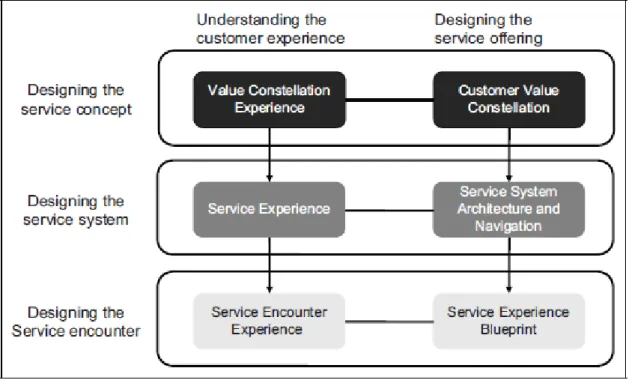
When bringing ideas to life, service designers have to carefully consider some intrinsic characteristics of services that make them different from products: the impossibility to store services44; the relevance of time components45 or the high level of personal intensity46, among others.47 They have to take into account the growing complexity of service systems, the emergence of multichannel services, customer co-creation and the need for interdisciplinary viewpoints.48 To master these challenges, it has been proven that using a systematized service design process is helpful. One approach of processing service design systematically distinguishes into four consecutive phases: 1) inspiration (understanding the customer experience); 2) ideation (designing the service offering), 3) reflection (service experience prototyping) and 4) implementation.49 This sequence allows for iteratively managing the design process, being based on specifically developed methods and modeling techniques for each stage of the process. Besides this, it may be relevant to loop back from one stage to a previous one, even more than once, in order to improve different aspects of the service offering along the service design process.50
The multilevel service design (MSD) method
In consistence to the process approach, a methodology for holistic service design was developed by Patricio and Fisk (2011) that conjures different hierarchies of analysis within a multilevel framework. It ranges from strategic to organizational to interface concerns, using three levels of analysis that integrate a number of specific methods, models and representation techniques. Having its roots in the creative design field, it particularly looks at the experience of the service users, stressing the search for solutions that adequately meet customers´ needs.51 MSD was designed in light to the fact that service design involves different elements, such as the definition of the service concept, the service system, and the service process.52
44 Eiglier (1977). 45 Morelli (2009). 46 Normann (1991). 47 Morelli (2009). 48
Mager (2007), Patricio and Fisk (2012).
49
Patricio and Fisk (2012), adapted from Brown (2008).
50
Stickdorn and Schneider (2010).
51
Patricio and Fisk (2012).
52
12
More precisely:
- the service concept can be defined as a coherent strong idea for a future desired state that contains: 1) a focused value statement – linked to strategies and users 2) clear main principles – for functions, structure and actions and 3) clear main characteristics – for actors, offers and products;53
- the service system focuses on the interplay of resources (people, technology, processes, and other relevant components) to co-create value with the costumer;54 - the service process, as introduced above, structures several activities that must be
performed in a certain order, involving different participants, physical environments or channels of contact.55
The first level can be claimed as the strategic one, looking at the service concept. The second level deals overwhelmingly with organizational concerns of the service system, whereas the third level represents the interface level. figure 1 summarizes illustratively the procedure at play and just afterwards, the MSD process is shortly explained in four steps.56
Figure 1: General model of multilevel service design. Source: Patricio and Fisk (2012).
53 Tollestrup (2009). 54 Patrício et al. (2011). 55 Bitner et al. (2008). 56
13
1) Study thoroughly the customer experience on three levels: value constellation experience, service experience, service encounter experience. Use interview designs, apply ethnographically motivated approaches or drive a participatory design therefore.
2 ) Use customer value constellation (CVC) to design the service concept. CVC represents the set of service offerings and respective interrelationships that enable customers to co-create their value constellation experience for a given customer activity.
3) Design the firm´s service system based on service system architecture (SSA) and service system navigation (SSN), which define the structure of the service system and map alternative paths customers may take across different service encounters.
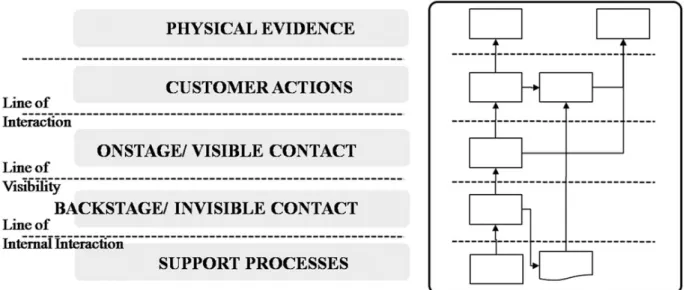
4) Apply service experience blueprinting (SEB) to design the service encounter,57 whereas SEB maps key activities of service delivery and other service aspects. Waiting points and failure points should be identified in order to optimize touchpoints in the customer journey.58 Particularly the blueprinting method should be clarified in more detail, as it pictures accurately the service system and helps involved people to objectively understand how to deal with it regardless of their individual role in the system.59 Blueprinting was firstly introduced by Shostack (1982) and is a customer-focused, visual schematic that enables companies to “visualize the service processes, points of customer contact, and the physical evidence associated”.60 One big advantage of service blueprinting is that it is quiet intuitively understandable, and thus it allows for involving different stakeholders for co-creating value. As a result, it reduces the risk of misunderstanding in between stakeholders.61
There are various modifications of blueprint structures to find in literature, but one typically way is illustrated in Figure 2. The horizontal axis represents the chronology of actions, while the vertical axis shows the different service areas.62 There are frontend (onstage) activities that are visible to the customer and backend (backstage) actions that are invisible to the customer. The line of visibility differentiates these actions. Furthermore, there are channels (swimlanes) for the physical evidence, customer actions, employee actions (visible and invisible contact) and support processes. They are visually divided by the lines of interaction
57
Patricioet al. (2008).
58
For a detailed description: Patricio and Fisk (2012).
59
Fließ and Kleinaltenkamp (2004).
60
Bitner, Ostrom, and Morgan (2008).
61
14
and of internal interaction. Whereas the line of interaction separates the customer action area from the employee action area, the line of internal interaction distinguishes between backend actions of employees and support processes.63
Figure 2: The service blueprint structure. Source: Geum and Park (2011)
SEB slightly modifies this structure by setting a service interface link instead of using a swimlane for the physical evidence. In addition, it integrates Human Activity Modeling (HAM) to map customer needs.64 HAM provides a hierarchical view of user activity, decomposing them into tasks and operations. SEB also embeds backstage actions more detailed, replacing the support process channel with a backend channel that systematically considers information technology. In SEB, the line between invisible employee actions and backend process is claimed as “line of employee visibility”.65
Service Design and Sustainability
This is the time to overview the interplay of service design and sustainability in order to fulfill in part the second preliminary consideration initially outlined; In order to get expert insights into the relationship between service design and sustainability, an interview was conducted with Birgit Mager, professor for service design at Cologne´s International Design School
62
Geum and Park (2011)
63
Fließ and Kleinaltenkamp, (2004).
64
Constantine (2009).
65
15
“KISD”. The key findings of our talk on service design research and its relation to sustainability are presented in the following.66
Mager´s initial statement to the topic was in line with the MSD method, namely that service design had to integrate three different levels (or dimensions) at the same time: the strategic, the organizational and the interface level of service design. All the three dimensions had to be adequately included within the problem-solving process towards sustainable service design. I then derived the following implications from the interview:
First, strategic aspects are integral to the process, which comes in hand with issues around planning and positioning. Within the fuzzy front end of service development, innovators have to keep in mind not only the great impact of early stage decisions for the overall economic success of a project, but they also should try to foresee the ecologic and social consequences. According to Mager, the central question within this level in regards of sustainability could thus be formulated as how relevant it is for the company to strategically position
sustainability within the service offering? Hence, the strategic dimension of “sustainable”
service design should encompass guidelines, methods and tools for market analysis and positioning on green and social issues. Especially the systems´ ecologic dimension has to be carefully considered, statements of relevant stakeholders must be included as well as “green” needs of customers and society.
Second, the service delivery process has to be approached on an organizational dimension. Mager points out that internal transformation processes (“change management”) play a crucial role to implement service strategies in practice. Well organized service offering can take service design research as strong fundament and both, researchers and practitioners, have to find systemic solutions for the translation of strategic views into operational processes. One interesting path of integrating sustainability aspects to this level might emerge based on a discussion on critical touchpoints for sustainability. Creating green journeys could build one promising avenue therefore.
As a third level of service design, Mager highlights the importance of looking at the interface between users and suppliers, shifting to the external dimension of design research. This dimension can be seen as the bridge builder to the customer. Mager suggests analyzing behavioral aspects in order to better understand the system´s functionality in regards of
66
The interview took place at KISD on June 22, and was processed in an unstructed and informal way, as it emerged quite spontaneously. However, the different levels of service design methodology guided the interview anyway.
16
sustainability. Research within this level should question how to enable a sustainable
designing and shaping of services, considering typical patterns of cognition and personal emotions? Are there any systems that are superior to others in respect to sustainable
consumption of goods or services? How do customers perceive a service? What can be done to trigger sustainable behavior? When talking about those issues, Mager referred to one approach on persuasive technology introduced by Fogg (2009) as one example of relevant research for the interface design of services.
Inspired by MSD and this interview, three approaches were identified that may particularly offer potential to not only support service design activities, but to also be applied with some modification in a PSS context: stakeholder mapping, service greenprinting and Fogg´s behavior model on persuasive technology. Stakeholder mapping is an easy tool used in research and practice to foresee the relationship of groups or individuals to a specific action that is probably being positively or negatively affected by them or which has an impact to them. Stakeholders are usually grouped by certain criteria within the map, for example dependent on the weight of impact or by their overall power.67 Service Greenprinting is a recent try to modify the SEB and attempts to especially consider green touchpoints and sustainability concerns within the customer journey of value co-creation. Therefore, it integrates the “4 R’s” of greening the service sector (reduce, re-use- recycle and renew; Fisk and Grove 2008) to the blueprint schematic while orchestrating a “green path service experience”.68 Fogg´s behavior model is based on the assumption that a person´s decision to change her behavior is influenced by three components: sufficient motivation, sufficient ability, and an effective trigger. Sketching behavior that way may offer potential to systematically develop concepts for behavioral change towards sustainability.69 A detailed description will be given as soon as the methodological exploration needs further clarification in that regards.
2.3.2 Product design path
An in-depth introduction to the evolution of product design as well as to the Design for X (DfX) framework, one popular approach to structure product design research, are both given in Anexo B. You will also find exhaustive reasoning for the selection of the two approaches that are presented in detail in the following: Design for Life cycle and Design for Recycling.
67
Fletcher et al. (2003).
68
17 Design for Life cycle (DfLC)
Life cycle thinking opens the door to connect product thinking with the service world, as alongside one´s product life cycle varying service components are at play. The product life cycle refers to all the phases that a product goes through, such as material acquisition, manufacturing, usage, disposal etc.70 The achievement of an effective product requires the effective integration of the various aspects of the product life cycle.71 Typically, there is life cycle assessment (LCA) to assess the environmental performance of a product or service.72 LCA is widely approached in research and practice, and was standardized in several specifications and guidelines (ISO 14040 et seq.) by the International Organization for Standardization (ISO). Even a social impact assessment was specified in ISO 14044 in order to assess stakeholder-specific impacts on life quality to aspects of human health and the environment.73 However, applying LCA in an early design stage is often hardly to achieve, as data collection is often confronted with little information available at this stage of designing.74 That is why research tried to develop methods that simplify LCA methods to a degree that still allows for making assessments on the environmental performance of a product or service, but that is no longer dependent on detailed product data.75 Regarding this, publishing authors of the field agreed on general life cycle design principles:
- the design horizon should be extended from product design to the systemic design of all product life cycle stages;
- product design should shift towards product function design.76
One particularly interesting approach in that view has been proposed by Koyanbashi (2005). In a methodology called life cycle planning (LCP), the product life cycle process is illustratively connected to occurring life cycle options alongside the entire process (figure 3).
69 Fogg (2009). 70 Ji et al. (2013). 71
Ulrich and Eppinger (1995), Sy and Mascle (2011).
72
Thabrew and Rice (2009).
73
Grießhammer et al./ UNEP (2006).
74
Ji et al. (2013).
75
Fitch and Cooper (2005).
76
18
Figure 3: Product life cycle process and life cycle option. Source: Kobayashi (2005).
As figure 3 indicates, LCP may facilitate designers asking the proper questions throughout the entire life cycle, “eco-optimizing” the decision-taking process. It considers thoroughly the possible impact of different life cycle options at each stage and furthermore, it highlights the interrelationships between the phases from a systemic perspective. The LCP methodology finally supports designers to develop a procedure from rough image sketching of the material flow cycle from a medium- and long term perspective unto the final concept evaluation at component level of the product.77 However, a more detailed description of the LCP methodology is not relevant to the topic, but the way of processing shall be kept in mind. This option-based approach of life cycle thinking may be taken as good starting point for the explorative work ahead.
Design for Recycling (DfRe)
Recycling has to face many challenges in technology, logistics, environmental issues or profitability.78 Nevertheless, modern resource management naturally has to include recycling in its cleaner production portfolio, as there are multiple benefits present. From a firms´ perspective, recycling can substantially reduce waste generation and thus disposal costs. Moreover, it may help minimizing demand for virgin raw materials or reduce risks of shortages in material supply.79 From a societal perspective, recycling can claim to be one
77 Kobayashi (2005). 78 Schwarz (1997). 79 Schwarz (1997).
19
pillar for intergenerational justice. In consequence, product designers should be sensitive to recycling, and so emerged DfRe.
In alignment with the previously presented LCP approach in DfLC, material recycling is a life cycle-option that occurs when a product has reached its “end-of-life” (EoL). In order to optimize the recyclability of a product, scholarship deployed multiple DfRe strategies alongside the varying sequences of the product design process. Frequently, research is concerned with the product-scope, searching for adequate modularization, disassembly or decomposition techniques.80 In that context, it was found that DfRe has to strongly refer to the product characteristics (material, shape, material mix etc.) and it was shown that distinguishing into destructive and non-destructive recycling techniques is effective therefore.81
Besides these product-based concerns, there are studies on DfRe about the interplay of stakeholders within the recycling process. This is important, since in most cases waste stemming from one production process cannot be used again in the same, but only in another process. 82 As a result, the creation of recycling networks may become a crucial task for the designer. Krewit illustrated such a recycling network and put the designer at the core of it, making him responsible for the orchestration of processes and partnerships. Here, the designers´ role is to organize the networks´ functioning and to manage different messages between stakeholders. He gets responsible for information exchange with recyclers about material properties, ways of collection and available recycling methods. Regarding the customer, he shall track the usage of the product and the functionality of the recycling system, and with suppliers he should interact in view of possible recycling scenarios to improve the value chain efficiency.83
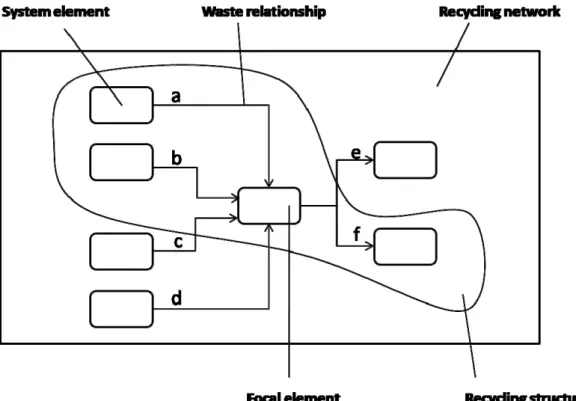
Another attempt on recycling networks has been made using a system theory approach in order to develop a representation technique for recycling networks (RTRN). It primarily builds upon the fact that companies have to establish relationships if one´s waste is another´s raw material, or if waste-related information has to be exchanged. In consequence, RTRN creates “system elements” that are linked to each other by “waste relationships”. From
80 Chiu Kremer (2011). 81 Kuo et al. (2010) 82 Schwarz (1997). 83 Kriwet et al. (1995).
20
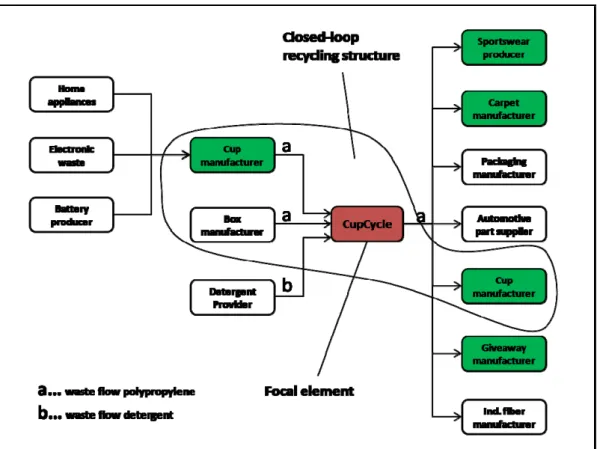
interconnecting suppliers and receptors of waste, which both are “system elements”, a “recycling cell” emerges. On a larger scale, multiple “recycle cells” create a whole “recycling structure” that can represent the interrelationships of different stakeholders in a “recycling network”. This approach, as shown in figure 4, can be used in the conceptual design phase of product design.84
Figure 4: Recycling network representation technique (RNRT). Source: Own representation based on Schwarz (1997).
84
21 3 Methodological exploration: designing PSS for sustainability
We have seen that the physical feature development of products is based on an exploration of dimensional, functional, esthetical, technological and mechanical characteristics of the product. In contrast, the service components perspective in service design has to introduce new variables, such as the time dimension, the dimension of the interaction between people, and other dimensions related to cultural mind frames and social habits.85 The challenge for designing PSS is thus to integrate both approaches and to not increase unnecessarily the complexity of the system at the same time.
3.1 Starting point: Multilevel service design
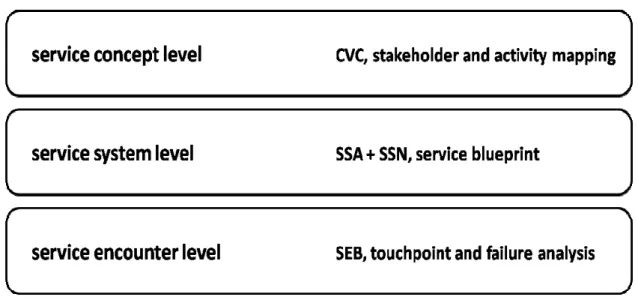
The starting point for the methodological exploration is the MSD approach, as presented in 2.3.1. Being an interrelated set of tools and methods for the customer-oriented design of services, figure 5 summarizes the inherent levels and approaches to run a MSD analysis.
The idea is now to lever the MSD framework towards an integrated multilevel approach for the design of sustainable PSS. This comes in hand with the request to effectively manage the knowledge gap between engineers and service experts by building conceptual bridges. This shall be achieved through shifting from the customer focus towards a perspective that mutually includes customer needs and ecologic requirements, considering the involved
85
Morelli (2005).
22
product dimension. The focus will be lie on life cycle aspects, as the CupCycle case demands for new design solutions in that regards. That is why DfX strategies will be considered, namely DfLC and DfRE. Adjustments to the methodological structure of MSD may be systematically made by:
- adding/ eliminating/ modifying levels
- adding/ eliminating/ modifying techniques/ models/ tools at each level
Surely, the exploration cannot completely scope within a master thesis the required depth for full reliability, but the exploration shall be justified by the following arguments: First, as mentioned in the previous literature review, there has been done only little research on methodologies consequently integrating sustainability concerns in a multilevel approach, so novel pathways are needed. Second, the MSD method and the DfX principals are both consistent and holistic in their approach. By combining both concepts, it might be possible to gather a global perspective to sustainable PSS design, gaining new insights while keeping the holistic perspective on all relevant design stages.
3.2 Strategic level
MSD on the conceptual level starts with collecting information about customer needs. Different techniques are considered in order to find ideas on how to better understand the customer experience such as interviews, participatory activities and focus group approaches. However, in order to integrate a product and eco-perspective to this stage, it is relevant to methodologically explore the life cycle options at play.
1 Adding an ecosystem level
I suggest introducing methods or techniques that help designers to better identify problems in regards of the product life cycle. They shall aim at encouraging designers to not only consider customer value constellation as inspiring source for the designing of the PSS concept, but to also analyze the underlying relationships of relevant stakeholders and their impact on the environment. As soon as there rises an even vague idea about the inherent product scope or the product´s bill of material, the designer should start sketching ecosystem aspects of PSS. This may facilitate positioning sustainability aspects in the overall firm strategy, which is in line with outcomes from the expert interview in 2.3.1. In the following, I am going to explore one new approach for this purpose more detailed.
One primary undertaking to systematically display the interrelationships among ecologic, socio-political and economic stakeholders can be reached through application of an
eco-23
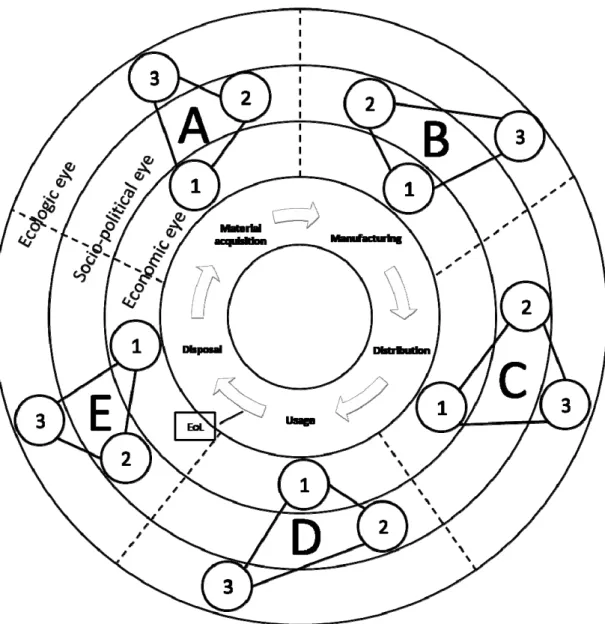
stakeholder map (ESM). The ESM is a new combination of the introduced LCP approach in conjunction with known stakeholder or action mapping (Morelli 2006) in a way that illustratively visualizes the interdependencies of stakeholders alongside the product life cycle. It offers the opportunity to think of relevant stakeholder interaction within the PSS and to further identify possible partner scenarios in view of varying life cycle options (Figure 6).
Figure 6: Eco-stakeholder map. Own exploration based on actor mapping (Morelli 2006) and LCP (Kobayashi 2005).
24
It incorporates three “eyes” or “layers” of sustainability that do represent the economic, socio-political and ecologic perspective. ESM allows grouping stakeholders according to their different origins and according to their role in each specific stage of the product life cycle. The ecologic layer may include stakeholders such as:
- ecosystems that are touched by the PSS alongside the product life cycle - organizations that are dedicated to ecology and nature protection
- external stakeholder that may have crucial positive or negative impact on the environment participating in the PSS
The socio-political layer may include:
- governmental institutions and legislation
- organizations that are dedicated to societal welfare
- specific social groups or segments that are relevant to the PSS The economic layer may include:
- companies that directly participate in the PSS alongside the product life cycle - individuals that are economically affected by the PSS throughout the life cycle
Furthermore, the map is structured into five parts that depict stakeholders at each life cycle stage. As illustrated in the schema, a relevant stakeholder relationship “A” is exemplified for the manufacturing stage, but critical relationships should be identified for all stages from material acquisition to final disposal. At this level, they should at least be detailed by further qualitative description. Hence, the novel ESM approach discloses relationships between the layers and supports creating systemic solutions in the service concept generation stage.
2 Modifying the service concept level
In this level, MSD spends time to thoroughly understand the customer value constellation. In line with the new ecosystem level explored above, I propose modifying MSD´s service concept level through the additional inclusion of designing for solution-oriented partnerships. SOP can be used to connect service design and life cycle thinking in a way that promises additional insights to system innovation.86 The big advantage of the methodology is that it
86
25
was exactly developed for PSS design purposes at the strategic level, thus it seems well-prepared to be smoothly integrated to this conceptual stage. However, it is not intended to fully demonstrate the processing of SOP methodology at this stage, but rather to demonstrate how an SOP approach can be fruitfully combined with recycling issues. As recycling is an important resource to the case study, SOP may support linking the ESM approach to the context of recycling networks and network economy. I therefore suggest a processing in two steps, using the introduced approaches from chapter 2.3.2
1) Develop a recycling structure, or if possible, a recycling network in line with the RNRT approach introduced by Schwarz, using ESM as inspiring start.
2) Identify and work on creating SOP´s based on that structure, and optionally use elements or ontology from the SOP methodology as presented by Morelli et al.
Relevant for adequate application of RNRT is a rough image on what sequences of waste or waste-related information flows have to be managed within the PSS. Therefore, ESM may inspire designers to explore possible waste relationships and stakeholders involved. Next, the designer can continue by exploring network structures. For example, assuming that electronic waste is generated through the product usage involved in a PSS, the designer uses RNRT to overview all relevant waste flows for involved sub-components and its materials, i.e. metals and plastics. He can also illustrate specific regional companies that are professionals in recycling electronic waste. In doing so, RNRT allows for highlighting key players of recycling networks. Identifying focal elements (companies that are critical to the recycling network) and important recycling cells (two system elements connected by a waste relationship) may be facilitated. If identified, the designer can finally switch to concrete action by striving for solution-oriented partnerships. This move remarks step two in the processing, whose detailed explanation is not part of the work. Both steps applied in conjunction can support putting the PSS concept in concrete terms.
3.3 Organizational level
To design the service system in MSD means operationalizing the value proposition. This comes in hand with transforming the customer needs into an orchestration of processes, sets of interfaces, tangible evidence, technology and people that altogether enable the system to organize the service co-creation. It uses SSA and SSN to display the sequence of tasks and actions that are relevant to fulfill a specific customer need in the frontend and in the backend.
26
It prepares forming a sequence of touchpoints across different actions and service interfaces that represent the customer journey. 87
However, from a PSS perspective, this approach lacks the inclusion of products and life cycle considerations within the systems´ orchestration. To my knowledge, there are two approaches present that at least attempt to include one of the two lacking dimensions. Service greenprinting considers life cycle concerns within the service co-creation through visualizing a green path service experience. This offers potential to systematically reduce negative environmental impact caused by the system, but it does not explicitly include the product side. By contrast, an extended blueprint presented by Geum and Park (2011) attempts to carefully redesign the schematics´ structure through integrating products and services at the same time. However, this research was not executed to explicitly integrate life cycle considerations within the schematic. In consequence, I suggest developing a novel PSS blueprint that interconnects both, product and life cycle design, at the same time. This could be achieved by modifying the service system level, system architecture and system navigation, in two steps.
1 Redesigning the SSA to PSS system architecture
As shown in Figure 7, SSA is modified by integrating a product line on top of the blueprint. This enables designers to highlight the product involvement within the orchestration of the PSS and in doing so, frontstage and backstage tasks of the firm that deal with different phases of the product life cycle can be easier revealed. Clearly, the main focus lies on visualizing the usage of the product along the chronological order of actions, but this modification shall also enable designers to generate relations to the products´ manufacturing, EoL and final disposal.
87
27
Figure 7: Extended PSS blueprint - PSS system architecture
2 Redesigning the SSN to PSS system navigation
28 Figure 8: Extended PSS blueprint - PSS system navigation
29
As illustrated above, the new PSS system navigation approach strongly refers to the classical representation technique used in SSN. Similarly, it encompasses the generation of a customer journey, highlighting the start and end of the journey as well as relevant elements for detailed analysis (decision points, fail and waiting points) that may change or risk the functioning of the process. However, the novel product line brings another element in place, which is the symbol of “life cycle options”. This symbol is introduced for better analyzing how to internally manage life cycle options that occur during the PSS experience. Particularly actions or tasks that cross the line of product involvement are critical to the system´s orchestration in view of sustainability concerns, that is why they should be specially highlighted in the blueprint.
Furthermore, the novel “LCO” symbol shall be understood in line with the already presented LCP approach. According to that perspective, four life cycle options may be identified along the systems´ mapping: extension of useful lifetime, upgrading and maintenance services, product re-use as well as recycling. This categorization may support finding new solutions on environmental problems that occur time and again during the PSS application. How that all may work out in practice will be epitomized within the CupCycle case study in chapter 4.
3.4 Interface level:
Turning to the interface level requires smart consideration of what has to be managed within the varying service encounters, which represent the moments of interaction with the customer.88 In MSD, service experience blueprinting (SEB) allows for designing each concrete service encounter, as it highlights actions in detail in which customer and company co-create value through crossing the line of interaction. The next step of exploration examines what can be additionally done to either modify SEB or to find a new way towards sustainable PSS design in the PSS service encounter level. Based on the presented literature, the following pathway has been derived.
1 Start by considering Fogg´s behavior mode89l
The critical point in this part of the work is the question how to make people change their habits such as consumption patterns to make the PSS workable and functioning in terms of its sustainable potential. A system of value co-creation is only successful, if people join the
88
Patricio and Fisk (2012).
89
30
pathway towards sustainability. What make people change their behavior might be much better understood approaching Fogg´s model on persuasive technology to the interface level.
Figure 9: Fogg´s behavior model. Source: Own representation adapted from Fogg (2009).
Fogg did extensively research on the question what may increase or decrease the likehood that people do perform a target behavior, and he finally came to the conclusion that a model based on three key factors may be useful to answer that question. According to Fogg, there are three key factors that do lead to behavioral change: motivation, ability and triggers. More precisely, his statement is that people only would perform a targeted behavior if they are first sufficiently motivated, second enabled to easily execute a desired action and third triggered in the right moment of time. He explains the factors more detailed within conceptual frameworks including a set of sub-elements, as briefly outlined in the following.
First, motivation is embedded in a framework of three core motivators, which are designed as two-dimensional counterparts. The first ambivalent pair/ key motivator is “pleasure vs. pain”. This is the most concrete motivator of the three, as it underlines the importance of direct emotions for persuading people to change their behavior. Pleasure and pain are both powerful emotional reactions that may activate behavioral change. The second motivator is the ambivalence of “hope vs. fear”. This is based on the assumption that decisions to behave in a certain mode may be taken due to the anticipation of coming events. For example, taking a bitter medicine is usually done not because of the pleasure (or in this case better: the pain)
31
caused by this activity, but is rather done in hope to get well soon. Thirdly, the last core motivator is domiciled in the social dimension. The ambivalent pair of “social acceptance vs. rejection” catches the fact that a certain individual behavior can often be traced back to the social context in which individuals act.
Heading to the factor ability, the conceptual framework is constituted by six so-called factors of simplicity. This gives an additional dimension to the model, as it considers the fact that behavioral change is more likely to be performed if it is easy to do. According to Fogg, the power of simplicity depends on the following interrelated elements, as briefly listed and described:
1) Time: Based on the assumption that the more time I have to spend to perform a target behavior, the more complex is the entire problem.
2) Money: Money can obviously be another factor to behavior change. Monetary resources can be a constraint to easily perform a target behavior, even if I am motivated to do it. 3) Physical Effort: The more physical effort I have to invest for a behavioral change, the less
likely I am ready to go for it.
4) Brain Cycles: Similar to physical effort - The more brainpower I have to invest, the less likely I am ready to perform a target behavior.
5) Social deviance: Less obvious than the others – if the target behavior requires me to perform against the social norm, the more complicated may things become for me. The social price may deter me from performing that behavior.
6) Non-routine: Routines facilitate everyday-life. If behavioral change challenges me to think out-of-the-box, the less likely I have the ability to perform non-routine actions.
The third factor in the model, triggers, is crucial to overcome the activation threshold, as illustrated in Figure 99. The underlying idea is here, that even though a person might be motivated or able - or even both at the same time - to perform a target behavior, he or she may possibly not go for it. This may happen, because a trigger is missing that helps activating behavioral change. The factor is further distinguished into three types: sparks, facilitators and signals. The type “sparks” refers back to the key motivators. One example is an advertizing video clip in which a well-known person performs a certain target behavior. A spectator who actually likes that person may be triggered to follow the prominent in performing the same behavior. Then, literally, the spark has jumped across and led to behavioral change.
32
In contrast, “facilitators” focus on making a behavior easier to do. Like sparks, they can be embodied in text, graphics, videos, etc., but they are more related to the ability factor. “Signals” represent the third form of triggers and do neither motivate nor enable people to perform a target behavior; they only indicate the option of changing one particular behavior. Traffic lights are such signals, or alarm timer, or warning labels, as they all have a sort of reminder function.90
2 Apply Fogg´s behavioral model at the PSS interface level
After this quick presentation of Fogg´s behavior model, it can be said that the model may offer opportunities to better understand patterns of behavioral change at the interface level, designing at the PSS encounter may be fruitfully refreshed by integrating such a concept. However, the question is in what form and content implications can be derived out of the concept. Therefore, the following thoughts on methodological exploration have been made. First, I see the option using a question-based approach that transforms Fogg´s approach towards sustainability. In view of the designer´s task, the model could be applied through systematically analyzing which key factors of behavioral change are powerful to foster green behavior of customers. According to Fogg´s conceptual frameworks, the following central questions may guide this approach:
1. What are key motivators to perform sustainable behavior within a PSS?
2. How to consider the ability of stakeholders to go for the green path of a PSS without weakening the user experience?
3. How to trigger sustainable behavior of users alongside the PSS process?
Furthermore, critical sub-elements such as trigger types or factors of simplicity can be identified while analyzing the behavioral context of the PSS. After examination of user´s motivation and abilities in view of performing a target behavior, companies may systematically find green pathways and triggers for their PSS. Designers can even visualize ideas on triggering behavior thanks to redesigning the PSS blueprint. More precisely, I see the possibility to slightly extent the usage of SEB within multilevel PSS design towards an inclusion of behavioral aspects at the PSS encounter. This design option is touched through the following modification:
90
33
- integration of “triggers” within PSS system navigation and SEB according to the results of what kind of triggers have been identified to be the critical ones to the PSS in view of sustainability
- highlighting those tasks performed by customers that require special attention in regards of “motivation” and “ability”. They can be visually highlighted in the customer swimlane of the PSS system navigation and SEB.
In doing so, designers, employees and customers are enabled to better co-create solutions at the interface level that foster sustainable behavior The visual application is exemplified within a PSS system navigation blueprint as illustrated in Figure 10.
3.5 End point: Multilevel PSS design
After having reached the final level of MSD, a short summarizing overview shall be given that illustrates the new framework that was developed for sustainable PSS design. For the inherent services of the PSS, the MSD approach is perfectly fine applicable. However, in order to extend its spectrum towards products and sustainability, some redesigning has been made, as figure 11 indicates.
34
Figure 11 represents a central result of the work. It sums up that exploring new ways of designing PSS was proceeded by:
- Adding an ecosystem perspective
- Slightly modifying the service blueprint to PSS blueprinting
- Extending the service encounter level through integration of Fogg´s behavioral model and green touchpoint analysis
It is now interesting to see how this framework can be applied to the CupCycle case study, for which it was made for. This is the task for the next chapter.