WORKING PAPERS
ECONOMICS
Nº 02/2019
IDENTITY, DISTRIBUTION RULES AND PRODUCTIVITY IN
HETEROGENEOUS TEAMS: AN EXPERIMENT
Hélia Marreiros
Identity, Distribution Rules and Productivity in Heterogeneous Teams: An experiment.”
Hélia Marreiros
Universidade Caltolica Portuguesa, Catolica Porto Business School and CEGE. Rua Diogo Botelho, 1327 4169-005 Porto, Portugal
Email: [email protected].
This version: March 2017
Abstract
This paper examines experimentally the effects of social identity and communication on teams’ distributional rules and wealth creation. The context studied is team production with multiple resource owners of different skills. In these organizational settings, heterogeneity of skills might create a conflict between equity, equality and social welfare. The results of a two-stage experiment, where participants vote in the distributional rule in stage I and make their effort decisions in stage II, indicate that induced group identity prompts preferences for equality even at the expense of wealth creation. We find that compared to a setting where social interaction is absent, identity does not increase team productivity, but equalizes individual payoffs. These findings suggest that group identity triggers the wide spread use of equal sharing rules by heterogeneous teams, as it increases the team’s level of egalitarianism. This paper provides recommendations for organizational decision-making.
JEL Classification: C92, D31, D63, J33, M52
Keywords: Teams; Heterogeneous skills; Social identity; Communication; Voting; Distributional preferences; Experiments.
I am grateful to Vicente Salas, Carles Sola and Jordi Brandts for their support and comments. I am also greatful to Pablo Guillen and Matthew Ellman for their comments. I would also like to thank to Jose Ortiz for research assistance. I acknowledge financial support from the Antoni Serra Ramoneda (UAB- Catalunya Caixa) Research Chair.
I. Introduction
This paper examines experimentally how social identity affects distributional preferences and productivity of heterogeneous teams. The context is team production technology with self-management organization design and the heterogeneity focus is individual skills.
Self-management organization design implies that each collaborating party receives in return a share of the total output produced, and input contributions do not enter into the compensation function (no monitoring).
The relevance of this study is justified by the proliferation of production setups with output based compensation practices (workers cooperatives, partnerships, self-managed production teams, profit sharing scheme, etc.) even though standard economic theory predicts inefficiencies in these organization designs due to free riding behavior (Alchian and Demsetz, 1972; Holmstrom, 1982).
Self-managed teams have grown rapidly in popularity following their introduction in the 1960s along with the idea that teamwork is a key to productivity. In the 1980’s in the United Kingdom and United States alone almost 50 per cent of companies were using self-managed work teams within their organizational structure (Huczynski and Buchanan, 1985). This percentage grows to around 70 percent of companies in the Fortune 1000 and to 81 percent of US manufacturing companies in the 1990’s (Lawler et al., 1995). Because of their widespread use, research has been devoted to analyze how to increase productivity. However, little is known about output distributional rules among group members with different skills, in production settings with team production technology and self-management organization design.
This article aims to bridge this gap by answering three research questions: (1) What are the individual distributional preferences when they interact in an heterogeneous group? (2) Does induced group identity with communication change these preferences? (3) Does induced group identity affect effort supply and wealth creation?
Distributional preferences show up as individual or team sharing rule decisions that determine how joint output is allocated among them. By group identity we mean that individuals actions when collaborating in production consider the benefit of the group instead of self-benefit. An individual that is identified with the team cares about the wellbeing of other group members when making some actions. Finally, wealth
creation is measured by the difference between the value of production and the inputs total opportunity costs.
Having heterogeneous inputs into the same team production technology makes sense, because it takes advantage of the combination of different backgrounds and experiences of team members (Hamilton, 2003, 2004; Lazear, 1998; Farrel and Scotchmer, 1988). Consider, for example, the range of abilities in university’ research groups or in medical and lawyer partnerships. Deciding upon a distributional rule that doesn’t damage personal relations and work motivation is a social and economic dilemma. Social identity and social preferences can play a determinant role in mitigating these conflicts. Nonetheless, research on the effects of social identity in redistribution in a team production setting has been scant.
To answer our research questions, we design a non-real effort experiment with two treatments. In the first treatment no interaction is allowed, in the second treatment, identity is manufactured in a pre-stage game and communication is allowed in the first stage of a two-stage game. We induce identity as in Chen and Li (2009), where participants were randomly matched in different group colors and discussed for about 10 minutes which author, Picasso or Dali, painted the pictures we showed them.
The game is the same in both treatments. Groups, composed by individuals that differ in skills, have to decide how to distribute the team production in a first stage, by simple majority rule, and make their contributions in a second stage. In the first stage they are given three options: an equal distribution rule; the second best sharing rule, which is proportional to members’ skills and a median sharing rule that weights equal sharing and wealth maximization criteria, i.e. gives part to needs and part to skills. Therefore, the first treatment allows us to understand individual and team’s level of preferences for equality. The second treatment allows us to study the effect of induced identity on those preferences.
Our results provide clear answers for our research questions. We show that: (1) when no interaction is allowed, individuals show selfish behavior in their choice of the sharing rule. A higher proportion of individuals with high (low, respectively) skills choose the second best (egalitarian, respectively) sharing rule, which is the one that benefits them the most. (2) We find that communication and group identity formation changes distributional preferences favoring a more egalitarian sharing rule among the high skilled individuals. (3) Communication-group identity increases the effort contribution of low skilled individuals in equal sharing groups, with respect to
those without group identity, but do not affect the input contributions of high skilled individuals, also compared with the contribution without identity.
Most of the research on team incentives considers symmetric members where equal sharing is common practice (see for example Encinosa, et al., 2007, Farrel and Scotchmer, 1988). However, in teams composed by members who differ in skills or productivities, a distributional rule proportional to members’ skills should be used to increase productivity (see chapter 3).
Some reasons for this apparent paradox are connected to theories of justice that incorporate a concern for the well-being of the least well-off members of the society. Examples are Rawlsian preferences for equality or the need principle, which calls for the equal satisfaction of the basic needs (see Konow, 2003 for an extensive review on theories of justice). Other reasons are connected with difference aversion theories supported by experimental evidence that suggests that some individuals dislike inequitable outcomes (Fehr and Schmidt, 1999; Bolton and Ockenfels, 2000; Charness and Rabin, 2002) or fairness considerations (Akerlof and Yellen 1990). However, most of the difference aversion experiments consider homogenous participants and/or equal split.
Social identity is considered a phenomenon that prompts actions that favour the group instead of self-maximization (Tajfel and Turner, 1979, Ashforth et al, 1989; Akerlof and Kranton 2000, 2005, 2008; Eckel and Grossman (2005); Chen and Li, 2009; Klor and Shayo, 2010). According to the social identity theory, if individuals are identified with the group they belong to, they will take actions that are congruent to the prescribed behaviour for the group, even if those actions depart from self-maximization and imply a monetary loss. However, group identity experiments mainly focus on ingroup versus outgroup interactions.
The results of this experiment show that communication and identity do not change the total wealth creation in production; the change towards more egalitarian output sharing rules induced by identity is followed up by an input contribution behavior that neutralizes the potential effects of more equal sharing rules in wealth created.
Our findings suggest that if individual get an intangible payoff from more egalitarian sharing rules then equal sharing rules increase welfare as the intangible payoff is at no cost from efficiency lost.
This paper contributes to management and economic literature by taking a novel approach that combines the social identity and the social preferences streams of research in a team production technology setting that allows for diversity.
II. Related literature
A. Theories of justice and social preferences
The conflict between equality and efficiency has been continuously present in economic environments, since Adam Smith (1759), Marx (1875), Sen (1966) and Rawls (1971) to the present day. The literature on theories of justice shows that different principles of justice lead to heterogeneous distributional preferences in different contexts. For one hand individuals can have principles that incorporate a concern for the well-being of the least well-off members of the society such as Rawlsian preferences for equality or the need principle, which calls for the equal satisfaction of the basic needs. On the other hand, individuals can have utilitarianism principles, which implies that resources must be allocated first to the person who derives the greater marginal utility; or welfarism, which implies aggregation of individual utilities to derive social welfare; or even equity principles, which are based on proportionality and individual responsibility and accountability (see Konow, 2003, for an extensive review on theories of justice and its empirical evidence).
Although the impact that distributional preferences have on economic outcomes have been discussed under several theories of justice during the past years, in the last decade the social preferences literature has been given a great deal of attention due to the growing number of economic experiments finding discrepancies between efficiency and equality in agents’ behavior. (Fehr and Schmidt, 1999; Bolton and Ockenfels, 2000; Charness and Rabin, 2002). These scholars developed models of difference aversion based on the premise that in addition to self-interested individuals, some are concerned about the payoff of others, disliking outcomes that are perceived as inequitable.
A. Social Identity
a. Social Identity Theory: From Psychology to Economics
Bringing the social-psychological concept of identity to economic analysis can convey advantages for the study of group behavior as it can account for many phenomena that standard economics cannot well explain. According to the social
identity theory (SIT), developed by Tajfel and Turner (1979), social identity could be defined as a perception of oneness with a group of persons. It has three major components: categorization, identification and comparison. The first is the process of putting others and ourselves into categories, such as gender, ethnicity, profession, age cohort, religious affiliation, sports clubs, etc. As these examples suggest, people may be classified in various categories. A woman can be Asian, a young lawyer, affiliated to some religion, political party and/or be a fan of some sports club. This social classification enables individuals to locate or define themselves in the social environment. Categorization leads to identification, which is the process by which we associate ourselves with certain groups. Finally, identification may lead to comparison, which is the process by which we compare our groups with other groups, creating some favoritism towards the group we belong to.
Social identity has been shown to be a central concept in understanding group behavior in social psychology, sociology, anthropology and political science. Management science has also applied the SIT to explain organizational identification. Ashforth el al. (1989) argues that organizational identification is a specific form of social identification as the individuals’ organization may provide an answer to the question: who am I? The SIT literature suggests three general consequences to organizations. Firstly, individuals tend to perform actions consistent with relevant aspects of their identities. Secondly, it affects the outcomes associated with intragroup cohesion, cooperation, fairness, altruism, pride and loyalty to an organization or to its corporate culture. Finally identification may also prompt internalization and adherence to group values and norms and engender homogeneity in attitudes and behavior. Being our experiment on a certain type of organizations, we expect to shed light on these consequences.
The concept of identity was formal introduced by Akerlof and Kranton (2000). They incorporate identity as a motivation for behavior in individual’s utility function. In their formulation, identity is based on social categories, C. Each person i has an assignment of people to these categories, 𝒄𝒊, so that each person has a conception of
her own categories and that of all other people. Prescriptions P indicate the behavior appropriate for people in different social categories in different situations. The prescriptions may also describe an ideal for each category in terms of physical characteristics and other attributes. Categories may also have higher or lower social
status. They use the word identity to describe both a person’s self-image as well as her assigned categories.
In the last years the economics of identity analysis was extended to organizations (Akerlof and Kranton, 2005) and workgroup (Akerlof and Kranton, 2008). In these studies identity is incorporated in a principal-agent model and in principal-multi agent model (respectively) and works as a part of incentives. Their model contrasts with the standard economic model where an individual’s preferences are fixed and utility are not situation dependent. In their framework when an individual enters an organization and adapts its organization culture, he will take actions to fulfill the organizations’ goals to feel like an insider. On the other hand, if he feels like an outsider, he will take actions that are against the organization or workgroup.
In this article we adopt AK formulation and expand on their work to study how social identity conditions fairness and affects effort levels and productivity in a self-managed organization setting composed by heterogeneous members.
b. Social Identity Research in Experimental Economics
There is a growing number of economic experiments suggesting that natural group identity increase ingroup favoritism, which increases altruism and cooperation (Bernhard el al., 2006; Goette et al., 2006).
The study that more relates to ours is Chen and Li (2009). Their results suggest that in allocation games induced social identity increases altruism and charity concerns towards members of their own group and decreases envy as well as increases the odds that individuals choose social welfare maximizing actions. Our experiment has clear differences from theirs. First, our setting is set to represent organizations, specifically self-managed teams, where individual profits are not directly comparable since contributions are not observable. Second, we allow subjects to vote on the distribution rule, which in turn will derive the payoffs. Third, and more importantly, we focus on members with heterogeneous skills; and finally we do not use ingroup/outgroup comparison, mainly due to our experimental setting.
Eckel and Grossman (2005), find that induced team identity in a repeated public good game increases cooperation limiting the individual free-riding problem normally observed in team games. However, once again, they focus on homogeneous subjects and use an equal distributional rule given exogenously.
Another study on social identity that is related to our work is Klor and Shayo (2010) minimal group experiment on the effect of social identity on preferences over distribution. They analyze the voting decisions on redistribution of tax regimes of two distinct natural groups that are randomly assigned gross incomes, majority rules. They find that in many cases, individuals forego monetary payoffs and vote for the tax rate that benefits their own group.
Therefore, this article differentiates from previous experimental evidence on social identity as it studies heterogeneous teams’ behavior, both in terms of redistribution and effort decisions. Moreover, our analysis does not focus only on the effects of identity on distribution rules but also on efficiency considerations. Next, we present a theoretical explanation for teams’ distributional rules, based on social identity, which we then test experimentally.
III. Theoretical framework: A Team production setting
This section contains the description of the collective and individual decision process in a production set up with a team production technology where each input is provided by a different collaborating person. In exchange for the collaboration each input provider receives a share of the total output produced. The way output is shared among the group members is decided by secret majority voting among group members. When voting team members know that there will be a second stage when the input decisions are made, output is observed and the sharing rule is applied to that output. The experimental game is played under two situations, no identity treatment and identity treatment. In the second case the identity treatment is the first step, next the voting of the sharing and finally the input contribution decisions. As indicated, and to make relevant the efficiency-equality dilemma in the choice of the decision rule, production groups are composed of two types of individuals, high skilled and low skilled ones. Individuals collaborating in the experiment are randomly assigned to one or other skills’ groups before they decide on the sharing rule.
Production involves N>2 inputs, each belonging to a different resource owner, indexed by i=1,2,…N. To simplify the exposition we identify a resource owner with a worker endowed with an observable level of skill takes contributes to
production with an unobservable and unverifiable resource quantity .
+ Â Î i q + Â Î i a
As usual, let 𝑎 = (𝑎&, … , 𝑎)) ∈ ℜ-); 𝑎
./ = (𝑎&, … , 𝑎/.&, 𝑎/-&, … , 𝑎)); 𝑎 = (𝑎/, 𝑎./)
and 𝑞 = (𝑞&, … , 𝑞)) ∈ ℜ-); 𝑞./ = (𝑞&, … , 𝑞/.&, 𝑞/-&, … , 𝑞)); 𝑞 = (𝑞/, 𝑞./).
The inputs of the N individual agents determine a joint monetary outcome
according to the production function .Let be a
non-decreasing, continuous, twice differentiable and concave function homogenous of degree r >0 that satisfies the team production technology condition
å
= > -j j j N F a a a aF( 1,..., ) ( ; 0). In exchange for the collaboration each resource
owner receives a share (S1,...,SN) of the total output so that >
å
=i i
i S
S 0, 1.
Therefore the sharing rule satisfies the budged constraint by equality, ). ,..., ( ) ..., ( 1 1
å
= i N N iF a a F a aS Where,SiF(a1,...,aN)is the compensation received
by resource owner i. Total output is allocated among collaborating input suppliers so the budged constraint is binding. Each resource owner has an alternative use for the input quantity supplied ai so the opportunity cost of the input quantity supplied to
production isC a i N
i
i( ), =1,..., , where the cost function is increasing with the input
quantity.
The output sharing rule will belong to the family of sharing formulas proposed by Sen (1966):
N S Si =(1-a) i* +a
.
Where α is a parameter between zero and one and the Si* is the second best
efficient sharing rule calculated as follows:
i S S to Subject S S a C S S a S S a F Maximize i i i N i i i N N N S S N " ³ =
-å
å
, 0 , 1 )) ,..., ( ( )) ,... ( ),... ,..., ( ( 1 1 1 1 ,... 1 Where a S S i Ni( 1,..., )," is the Nash equilibrium solution to the input contribution
decision by the input suppliers for a given output share: i a C a a F S Maximizea i N i i i ( 1,..., )- ( ),"
The parameter α captures the weight assigned to the second best efficiency outcome relative to the weight given to egalitarian considerations. A value of the parameter equal to 0 means that only efficiency matters, while a value of 1 implies that all the weight is on equal output sharing. A value of α=1/2 indicates that an
+
+ ®Â
ÂN
F : F= F(a
intermediate weight is given to each goal, efficiency and equality. In the experiment set up the group members will vote on the choice between these three values of α.
In this research we follow Akerlof and Kranton (2010) and assume that individuals’ perception of equality or fairness depends on the social context. When individuals join for production each can have a different personal and social background that conditions her preferences for egalitarian or efficiency led outcomes. Therefore we expect that individual preferences will show up in the voting stage. Since some individuals will be that they are assigned to the high skill or to the low skill group when they decide on the sharing rule, the high skilled ones will be aware that the efficiency based sharing rule will give them higher monetary pay off than the equal sharing one. On the other hand, low skilled individuals will know that their pay off will be higher under the equal sharing rule than under the efficient one. From a selfish behavior we expect then that high (low) skilled individuals will majority vote for α=0 (1). Deviations from this selfish behavior will indicate the starting preferences for egalitarian outcomes of high skilled individuals, and efficiency preferences shown by the low skilled ones.
The experiment is next modified to allow for communication among group members and to induce some sense of group identity among them. This could modify the initial social context and change the relative preference for egalitarian, efficiency sharing rules, with respect to those before the treatment.
IV. Experimental design and implementation
The goal of the experiment is to observe the behavior of individuals in the organizational environment described above, and obtain evidence on whether distributional concerns and social preferences influence the behavior of people so that this behavior departs from the predicted one under the assumption that individuals are selfish and social concerns do not matter in production environments. The experiment consists in a two-stage decision process where first individuals decide on how they will share the output from production and next they decide on the effort contribution. The two stages decision process is repeated, one time without identity treatment (VT) and the other time after the identity treatment (IT).
In this section we describe in detail the team production technology with inputs of different quality, high and low skilled labor input, together with the functional form for the opportunity cost of the resource input. Next we solve for the Nash equilibrium
solution in input contributions by the team members for each sharing rule proposed above, and no social preferences at all, i.e. individuals maximize only monetary pay-offs. The solution to the game in terms of Nash equilibrium and no social preferences provides a benchmark to which compare the observed decisions and outcomes after running the experiment. If the observed behavior and performance departs from the benchmark then we will examine if the departure is consistent with the predictions under the assumption that group identity and social preferences do indeed influence the effort decisions of group members in self-managed, output-sharing, organizational designs.
Along the experiment each production group will have five members, N=5. Three of the members are high skilled and two low skilled. Each group member has a vote and the output sharing rule is decided my secret majority voting. The level of skills for each of the high and for each of the low skilled individuals is the same so in terms of pay offs this symmetry implies that each high and each low skilled individual will expect the same pay off once the sharing rule is decided. Therefore all else equal in the choice of the sharing rule there is a natural majority of high skilled individuals whose interests should determine the chosen rule.
A. Experimental parameters
The team production technology is given by the functional form1:
𝐹(𝑎&, 𝑎3, … , 𝑎4) = 4/6&𝑘/(𝑞&, 𝑞3, … , 𝑞4)𝑎/ , qi >1 (1)
Where and qi is set to represent member’s skills and ki is a function that aggregates
the skills of team members into a measure of the productivity of member i. The complementary skills of group members that justify the joint production and give an output from joint production higher than the sum of individual outputs, for the same level of input ai, is captured by the assumption that ki is increasing in qi, for all i, and
ki(q1,…,qN)>ki(q1,,,qN-S) for any subset S in N. ki≥1 for any i2. In our experiment we
set the function ki( ) so that the contribution to productivity of input i is higher for the
own skill than for the skills of other team members: , qi>1.
1 The functional form of the production technology borrows from Hamilton et al (2004).
2
Let K= (k1, ..., kN ), where K is symmetric in the sense that ki (q1, ..., qN ) = kπ (i) (q
π −1(1), ...,qπ −1( N ))for any permutation π. Therefore, assuming, without loss of generality, that q1 > q2 > ... > qN, then
k1(q1, ..., qN ) ≥ k2 (q1, ..., qN ) ≥ ... ≥ kN (q1, ..., qN ).
The cost of input i is given by:
By assumption so higher implies a lower marginal cost, for a given value of ; therefore marginal cost decreases with the endowed skill.
The distinction between high and low skilled individuals implies is instrumented by setting qhigh=10, for each of the three high skilled group members, and qlow=5 for
each of the two low skilled members, in all the experiments.
Taking into account the general output sharing rule introduced above, the payoff of individual i is given by:
𝜋/ = 1 − 𝛼 𝑆/∗+ 𝛼 5 4/ 𝑘/𝑎/ − 𝑎/3 2𝑞/, (2)
with 𝛼 𝜖 0,1 and khigh skilled=24 and klow skilled=17, for the functional form and
selected q values.
The three sharing rules the group members will vote on imply different values of parameter α that captures the weight given to the egalitarian sharing rule, α=1 (equal sharing), α=0, only efficiency matters (second best) and α=1/2, half and half. The solution for the Nash equilibrium that will serve as benchmark for comparing the results of the experiment for the three sharing rules requires first solving for the second best sharing rule, Si*. Following the solution process described in section , the
second best solution is S*iH=0.30, S*iL=0.05. This implies that under option A, equal
sharing, Si=1/5, the same for all members; under option B, what we call median
proportional, SiH=0.25 for each of the high ability participants and SiL=0.125 for each
low ability participants; and under option C, second best shares, SiH=0.30 for each of
the high ability participants and SiL=0.05 for each low ability ones. Table 1: Experimental parameters
Parameters
Ability of high types 10
Ability of low types 5
k (value of number) high types 24
k (value of number) low types 17
Cost high ai2/20
Cost low ai2/10
Option A 20%
Option B - high ability 25%
Option B - low ability 12.5%
Option C - high ability 30%
Option C - low ability 5%
i i q a 2 ) (a c 2 i i = N q q q > >...> 2 1 qi i a
Table 2: Experimental predictions Predictions Equal Sharing Median Proportional Second Best Nash Equilibrium effort High 48 60 72 Low 17 11 4 Expected payoff High 692 994 1337 Low 778 575 265
Total team profit 3631 4130 4540
Efficient effort
High 240
Low 85
Team wealth 10085
As expected the Nash equilibriums for the output sharing self-managed organizations give lower welfare and lower input contributions than the first best. The second best is, by construction, the sharing rule with higher pay off. As we move from equal sharing to second best the high (low) skilled members contribute with higher (lower) input to joint production. Under the equal sharing low skilled get high pay off than high skilled even though the former contribute with lower input to production than the latter. If the correlation between input contribution and pay off is taken as an indication of fairness then the proportional and the second best sharing rules would be consider fairer than equal sharing. Equal output sharing is the sharing rule with more equal pay off for high and for high skilled individuals, while the second best sharing rule is the one giving less egalitarian outcome.
B. Experimental treatments and implementation i) Treatments
As mentioned the experiment is designed to understand the effects of identity on participants distributional preferences and on team efficiency taking into consideration the setup described previously. Thus, it has two treatments: the voting treatment, henceforward VT, where no interaction is allowed and the identity treatment, henceforward IDT, where the structure is similar to the VT but identity is manufactured in a pre-stage and communication allowed in the voting stage. We
discuss in detail the design choices for induce identity in a separate subsection ahead. The VT is designed to help us understand the distribution preferences of members when there is no social interaction and serve as a control treatment to compare individual and group behavior under the IDT.
We divide the treatments in two settings: the one shot setting, where participants vote and make decisions on effort in one round; and the 10 rounds setting, where participants play the vote stage just in the first round and make decisions on effort for 10 rounds. The 10 rounds setting is partner matching. This division was based on two concerns. First, the one-shot setting will allow us to study distributional preferences without reputation and reciprocity considerations. On the other hand, a repetition of the contribution stage is important to form a higher degree of group cohesion and allow for “long-term” interaction. Therefore, the one-shot setting and the first round of the ten-rounds setting allow us to compare individual distributional preferences when matched with a group just for one time and when matched for ten rounds.
At the end of each session participants fulfill a questionnaire were in addition to some demographic questions, they are asked about the level of fairness of the sharing rule decided by the group, their level of group attachment during the experiment and the effect of communication on voting and effort decisions. In the VT we omit from their questionnaire questions related with communication. For more details in implementation, information conditions and design discussion see Appendix B.
V. Hypotheses
The experiment is designed to understand teams’ decision making and test the validity of our theoretical explanation. Next we present the null hypothesis and our conjectures on results.
i) Hypotheses: Voting treatment
Hypothesis 1a:High ability members vote for the second best sharing rule Hypothesis 1b: Low ability members vote for the equal sharing rule.
Assuming standard economic preferences, it is a dominant strategy for more productive members to choose second best sharing rules (α=0 in equation 1 and 2), whereas it is a dominant strategy for less productive members to choose equal sharing rules (α=1) since it maximizes their utility. Therefore, our null hypotheses are that the majority of individuals will show self-interest behavior. We do not expect to reject these hypotheses.
Hypothesis 2: In majority high ability teams, the most voted sharing rule is the
second best sharing rule.
i) Hypotheses: Effect of Identity
Hypothesis 3: Identity does not affect participants’ distributional preferences.
According to the standard economic theory, individuals are self-interested and identity should not have an impact on their decisions. However, following our theoretical argument that preferences can be changed by the creation and manipulation of the social categories (ci) and prescriptions (P) backed up by previous
experimental evidence (Chen and Li, 2009; Klor and Shayo, 2010) we conjecture that induced identity may affect individuals decision on efforts. Therefore, we expect to reject this hypothesis.
Hypothesis 4: Identity does not affect teams’ distributional rules. Thus, in majority
high ability teams, the most voted sharing rule is the second best sharing.
Following hypothesis 3, with or without induced identity teams composed by majority high skilled members will chose second best sharing rules.
Hypothesis 5a: Identity does not increases effort levels of high skilled players. Hypothesis 5b: Identity does not increase effort levels of low skilled players.
According to the standard economic theory induced identity should not influence effort decisions. However, there is previous experimental evidence indicating that identity increases the effort level of team members (Eckel and Grossman, 2005) Additionally, a number of experiments provide evidence that communication increases cooperation (Farrel, 1995; Crawford, 1998; Blume and Ortman, 2007).
Hypothesis 6: Identity does not increase team efficiency.
Following hypotheses 5, induced identity should not increase team efficiency. Nevertheless, as we conjecture that identity increase effort levels it should also increase efficiency. Thus, we expect to reject this hypothesis.
VI. Results
A total of 100 participants were recruited from undergraduate courses in several disciplines (economics, literature, business, sociology, etc) by Orsee recruitment software at Universitat Autonoma de Barcelona. The experiment was designed in Z-tree software and lasted around 2 hours on average. All participants received a 5€ participation fee and earn, on average, 14€ per subject. We conducted two session per
treatment. We collected a total of 40 independent observations per group, which are the base of our statistical analysis.3
We first present the voting results analyzing team’s distributional preferences and the effect of identity in those preferences. We then analyze the effect of voting decisions and induced identity on contributions and team efficiency. Following this, communication and post-experimental questionnaire analyses are presented.
1. Voting results
1) Individual distributional preferences
In this section we analyze the team voting decisions. Recall that participants could vote for option A, equal sharing; option B, median proportional or on option C, second best sharing rule. Each subject voted twice in each session, in the one shot setting and in the first round of the 10 rounds setting. As we do not find significant differences on voting decisions between the two settings (U-test p= 0.8474) we use both in the results report.
Figure 1. Percentage of votes by treatment and type
Figure 1 shows the voting decisions per type and treatment. It can be seen that in the VT 60 percent of the high ability players vote for the second best (option C), 33 percent voted for the equal share (75 percent being females) and 7 percent voted for the median share; 85 percent of the low ability participants vote for the equal sharing rule, 13 percent voted in the median share (all males) and only 2 percent voted in the second best.
3
The observations of high and low ability are not independent and are treated as dependent observation in the statistical analysis
0.0% 20.0% 40.0% 60.0% 80.0% 100.0% High abilityLow abilityHigh abilityLow ability Voting treatment ID treatment
Vote Results
(A) Equal (B) Median (C) Second best
Therefore, we observe that participants exhibit standard economic preferences and make their decisions according to their dominant strategy. While the majority of high ability members vote for the second best sharing rule (binomial test α=0.5, p= 0.077), the majority of low ability members vote for the equal sharing rule (binomial test α=0.5, p= 0. 0.000) 4. As expected we cannot reject hypothesis 1a or 1b that members prefer the compensation scheme that gives them better monetary payoffs.
Although these results are in line with our conjectures, we find a considerable number of high ability participants voting for equal sharing (33 percent) in the VT and heterogeneity on individual preferences. According to our theoretical explanation, in the groups test in the experiments, there are 67 percent of participants whose identity (Ii) reflects self-interest, equity or social welfare concerns and 33
percent whose identity reflect preferences for equality, concern for the least well off or even advantage aversion5 a la Fehr and Schmidt (1999). In what concerns the low ability participants, the high majority shows self-interest, equality concerns or disadvantage aversion. Nevertheless, we find 13 percent of participants preferring the mix sharing rule, indicating some equity or social welfare concern. Although is quite difficult to disentangle the reasons behind the voting decisions, as one or all these reasons could be behind participants decisions, the results support our theory that individuals level of egalitarianism depend of their personal identities, which can be quite heterogeneous taking in account the different social categories an individual might belong to (e.g. being a woman, a mother, a sports fan, a lawyer, an ecological activist, etc) and the different past experiments that form each individual in an unique personality. On the other hand, we have assumed that fairness considerations are context depend. Fehr and Schmidt (1999) argue that in an experimental context, individuals enter at the laboratory as equals, without knowing anything about each other and are given random roles. Because of that participants could consider an egalitarian outcome as equitable. The post-questionnaire analysis ahead could give us some insights on this phenomenon. We then came back to this point.
Our results are in line with experiments on democratic choice of institutions as in Balafoutas et al. (2013). They use a sharing rule a la Sen (1966) in a public group experiment where three different participants with different initial endowments have to vote on their preferred level of redistribution in each period, from equal to
4 Fisher test confirms the significance of the results. .
proportional. Although this experiment is not directly comparable with ours, as in each period contributions are observable and voting is repeated, it is the closest experiment in the literature. Similar to our results, they find that the high majority of high endowment participants prefer proportional and low endowment participants prefer more equal distributions. They also find that a few percentage of participants deviate from selfish preferences. They attribute this behavior to inequality aversion motives. Nevertheless, in our context, where contributions are not observable and the proportional sharing rule is not on effort but on skills, inequality aversion is hardly probable to be the case. According to Mohnen et al. (2008), when contributions are not observable after each period (they called the nontransparent case), inequality aversion does not alter equilibrium levels of effort when compared to the case where individuals are purely selfish.
An interesting and clear result of the VT is the significant effect of gender in voting decisions (the gender coefficient is highly significant in a logit regression analysis - table 9 in appendix B). We find that 75 percent of the high ability participants that vote for equality were females. This is an indicator that belonging to other social categories matter for distribution preferences. This result contradict Balafoutas et al. (2013) as they do not find support for the effect of individual preferences on voting and find no significant differences in voting behavior of females. They argue that voting is only directly affected by their earning,
In the IDT we observe a significant difference in the voting decisions of high ability members in comparison to the VT (Mann-Whitney test, p= 0.0003). We find that the percentage of votes in equal share increases from 33 percent in the VT to 67 percent on the IDT. However, we do not find a significant effect of identity on low ability distributional preferences (Mann-Whitney test, p=0.2915). Therefore, we can only partial reject hypothesis 3.
While in the VT the proportion of self-maximizers6 is seventy percent and the egalitarians7 are just twenty percent, in the IDT the percentage of self-maximizers decreased by 29 percent (U-test, p=0.0040) and the percentage of egalitarians increased 50 percent (U-test, p= 0.0021).
Our theoretical explanation suggests that individuals can be affected by social identity. We consider that in the IDT the induced identity could have manipulated or
6 Participants that choose the sharing rule that lead them to a better payoff.
even changed the prescribed behavior (P) for the team (ci) and therefore affected
individuals revealed preferences. Consider for example, a high ability individual that had equity preferences but due to social interaction with the group, in the pictures stage and/or in the voting stage chat, changed her reveled preferences towards equality. The reason behind this decision is connected with the behavior she considers ideal (P), or because is the social correct action, or because she became altruist towards her teammates or even because an implicit norm of equality emerged on the group. The communication analysis ahead could helps to understand behavior under induced identity.
Our results on the effects of social identity are consistent to Chen and Li (2009) and Klor and Shayo (2010) in the sense that it seems to increase charity concerns for the least well off even at expense of monetary compensation. However, our findings contradict their results and the SIT (Tajfel and Turner, 1979) as it fails to induce social welfare-maximizing actions in favor of self-interest actions. Considering that induced identity should lead participants to take non-selfish actions in favor of the group welfare, we expected to find a higher and considerable number of low ability participants choosing second best sharing rule or at least median sharing as the second best create a great amount of dispersion. However, this is not the case. It seems that in this setting, induced identity only induce to equality. It could be the case that this happens because there is a majority of high ability members on the team. It would be interesting to analyze the effect of identity on majority low ability teams.
2) Teams’ distribution rules.
Figure 2 summarizes the voting results per groups. Interestingly, in the VT, the most voted sharing rule was the equal sharing with 11 out of 20 groups (55%) voting for it. There were 3 groups (15%) where the median share was chosen to be the distributional rule (determined randomly in two of them due to a tie) and there were 6 groups (30%) where the majority voted for the proportional sharing rule. We can reject hypothesis 2 that in teams mostly composed by high ability members, the most voted sharing rule is the second best (binomial test, α=0.5, p= 0.058).
Figure 2: Group vote results
This is an unexpected result. Considering that only 33 percent of the high ability participants voted for the equal sharing. We consider that this is an effect of the low majority rule of the voting procedure. As the less skilled participants vote strongly in favor of the equal sharing, in 50 percent of the teams at least one high ability member had to vote for equal sharing. In a more detailed analysis, we find that in all the cases (settings and sessions) where the team chose an equal distribution of output the decision was made by a low majority of two low ability and one high ability participants.
Figure 3 illustrates how groups reach the decision on the distributional rule. We can see that in the VT the majority of groups reaches a decision by low majority (3 members) and that reaching a consensus is quite rare. In both of the two ties, two high ability members vote for second best, one vote for the median share and the two low abilities vote for the equal sharing. The votes of low abilities on median share where in groups where the majority of high abilities vote for second best.
With identity, about 77 percent of the participants voted in the equal sharing, 13 percent voted in the proportional share and 10 percent voted in median share. Consequently, there was a significant increase of groups using equal compensation schemes (90 percent) (Mann-Whitney test, p=0.000). The percentage of groups that decide to perform under the second best distribution rule decreases by 100 percent (Mann-Whitney test, p=0.000) as the group performed under this compensation scheme was decided randomly due to a tie in the one shot setting. Therefore, as
0% 20% 40% 60% 80% 100% (A) Equal (B) Median (C) Second best
Chosen Sharing rule
ID Vote
expected, we can reject hypothesis 4 that identity does not affect team’s distributional rules.
Observation 1: Without social interaction, in majority high ability teams, a low
majority of groups (55%) decide to use equal sharing rules. With identity almost all groups (90%) decide to perform under an equal distribution rule. Therefore, team identity is a plausible explanation for the use of equal distributions in heterogeneous self-managed teams.
Under group identity, and given the possibility of communication, we would expect a group norm to emerge accordingly to on the team objectives. If the team seeks a higher creation of wealth they would choose second best sharing rules (α=0), if the teams decides it is important to give part to need and part to abilities, would choose an α=0.5. And if the team prefers to minimize differences in utility, even with a loss on wealth creation, would choose and α close to 1. However, an equal sharing (α=1) will minimize differences in utilities only if members have identical cost. In the case of heterogeneous teams on abilities, where costs on effort are different, the minimal α* is lower than 1 even for a difference aversion team. Notwithstanding, the majority of teams decided for an equal sharing which damages team efficiency (Marreiros, 2010). Therefore, we would expect contribution to increase to a threshold that suppresses the efficiency damage that arises with the equal sharing rule.
2. Effort levels
In this section we analyze the effect that the voting decisions and identity have on actual contributions. In the VT we find that the majority of high ability members exhibit standard economic preferences, i.e. choose second best sharing rules, however, the majority of groups chose an equal output sharing. On the other hand, identity induces high ability participants to choose more equal sharing rules. Next we analyze the effect of group decisions on subsequent individual contributions.
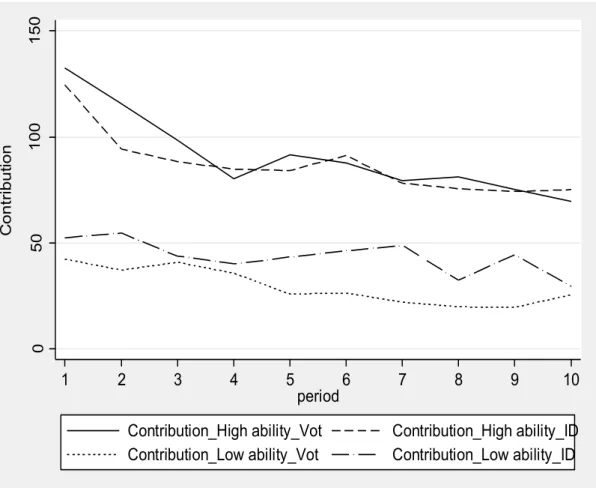
Figure 3a shows the average contribution for each treatment8. It can be seen that contributions decrease over time (regression analysis in table 10 of appendix B, indicates a decreasing trend). It is clear that identity slightly increase effort decisions, however not significantly (Man-Whitney test, p=0.1736). Consequently, we do not find differences in individual profit (Utest, p=0.4497) or in the total team revenue (Utest, p=0.9988). Figure 3b shows contribution by type of participants, as we can observe, there are no significant differences in contribution levels of high ability members (Utest, p=0.6501), however, identity increases effort levels of low ability members (Utest, p= 0.0025). Therefore, we cannot reject hypothesis 5a but we can reject hypothesis 5b. Moreover we fail to reject hypothesis 6 that identity increase team efficiency.
Figure 3a: Overall contribution by treatment
8
The data used to effort analysis is the ten rounds setting. Although we do not find statistical differences between the one-shot setting and the first round of the ten rounds setting in any of the analysis presented here, we consider more precise to present the results referent only to the ten rounds setting as the trend over time is worth of analysis.
50 60 70 80 90 C ont ribut ion 1 2 3 4 5 6 7 8 9 10 period
Figure 3b: Contribution by type and treatment.
Observation 2: Team identity does not increase the effort levels of high ability
members in teams with a heterogeneous composition, but increases contribution of low ability types.
This is result contradicts previous experimental evidence with identical members and equal split, where induced identity increases cooperation (Eckel and Grossman, 2005) as well as communication (Farrel, 1995; Crawford, 1998; Blume and Ortman, 2007; Bornstein et al., 1989; Brosig et al., 2003)
The effect of the different sharing rules decided by the group is each treatment is interesting to analyze, however, we do not have enough data to drive robust conclusions, as the high majority of groups decided to perform under an equal sharing rule. Therefore, we next analyze effort decisions under equal sharing rule. Nevertheless, we find some interesting results, which are reported in another version of the working paper for the interested reader.
0 50 100 150 C ont ribut ion 1 2 3 4 5 6 7 8 9 10 period
Contribution_High ability_Vot Contribution_High ability_ID Contribution_Low ability_Vot Contribution_Low ability_ID
1. Effort decisions under equal distribution rule.
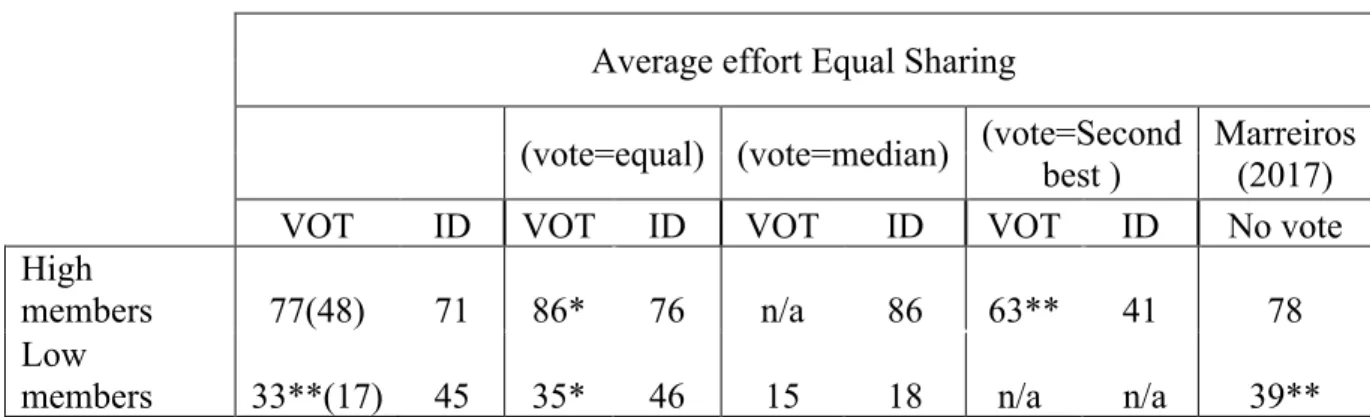
Table 3 shows the predicted and average effort by treatment, analyzing differences according to members’ individual voting decisions. The first two columns give the total average effort (predicted effort in brackets). The columns three to eight give the average effort according to participants voting decisions and column nine reports average effort when members do not have the option for voting (Marreiros 2010).
We can observe that both types of participants exert an effort higher than predicted (Wilcoxon test p=0.0033 for both). More interesting, we find that with identity and an equal sharing rule the high ability members decrease their effort levels, although not significantly (Man-Whitney test p= 0.4057) while low ability members increase it significantly (Man-Whitney test p= 0.0126).
Table 3: Average effort by type and vote decisions
Average effort Equal Sharing
(vote=equal) (vote=median) (vote=Second best )
Marreiros (2017)
VOT ID VOT ID VOT ID VOT ID No vote
High
members 77(48) 71 86* 76 n/a 86 63** 41 78
Low
members 33**(17) 45 35* 46 15 18 n/a n/a 39**
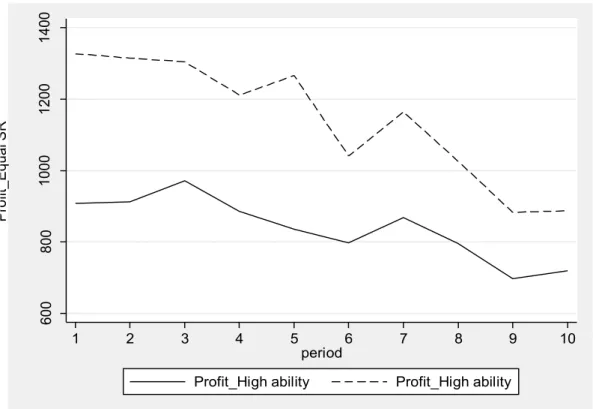
These results have an interesting effect on individual payoffs. While the high ability members increase their individual payoff with identity (Man-Whitney test p=0.0284), the low abilities decrease it (Man-Whitney test p=0.0413). Figure 4a shows that in the VT and an equal sharing rule the low ability members receive a higher individual payoff than their high ability team mates (Wilcoxon text p= 0.0051), figure 5b shows that in the IDT the profit of high and low abilities are not significant different (Wilcoxon text p= 0.5751). Therefore, under an equal sharing rule, identity decreases dispersion on efforts and on individual payoffs (Mann Whitney test, p=0.0064; p=0.0197 respectively).
In what efficiency is concerned, we do not find that identity increases team efficiency under an equal sharing rule (Mann Whitney test, p=0.5453). Therefore we cannot reject hypothesis 6.
Figure 4a: Average payoff under equal sharing in the voting treatment
Figure 4b: Average payoff under equal sharing in the identity treatment
600 800 1000 1200 1400 Prof it _Equal SR 1 2 3 4 5 6 7 8 9 10 period
Profit_High ability Profit_High ability
600 800 1000 1200 1400 1600 Prof it Equal SR 1 2 3 4 5 6 7 8 9 10 period
Observation 3: Under an equal sharing rule, identity does not increase team
efficiency but equalizes individual profits
As identity leads to the majority of the groups deciding for an equal compensation scheme but not all members vote for it, we analyze individuals behavior when they vote for the sharing rule that ends up being the distributional rule decided by the group and when they did not. When the distribution rule decided by the group was the equal sharing and low ability members vote for it, identity increases their effort level when compared to the VT (Mann-Whitney test: p=0.0527). However, surprisingly, we can observe that identity has a negative effect on high ability members’ effort levels. When they vote for the equal sharing and this is the sharing rule decided by the group, identity decreases contributions when compared to the VT (Mann-Whitney test, p= 0.0821).
3. Regression analysis.
i) Effort
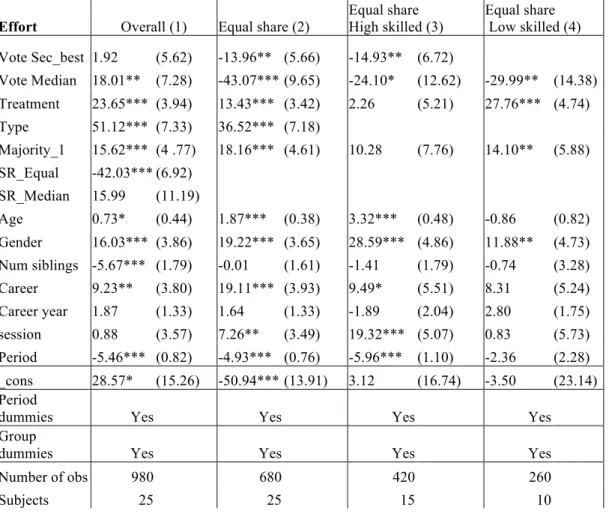
Table 7: Panel data regression on effort decisions – GLS
Effort Overall (1) Equal share (2)
Equal share High skilled (3) Equal share Low skilled (4) Vote Sec_best 1.92 (5.62) -13.96** (5.66) -14.93** (6.72) Vote Median 18.01** (7.28) -43.07*** (9.65) -24.10* (12.62) -29.99** (14.38) Treatment 23.65*** (3.94) 13.43*** (3.42) 2.26 (5.21) 27.76*** (4.74) Type 51.12*** (7.33) 36.52*** (7.18) Majority_1 15.62*** (4 .77) 18.16*** (4.61) 10.28 (7.76) 14.10** (5.88) SR_Equal -42.03*** (6.92) SR_Median 15.99 (11.19) Age 0.73* (0.44) 1.87*** (0.38) 3.32*** (0.48) -0.86 (0.82) Gender 16.03*** (3.86) 19.22*** (3.65) 28.59*** (4.86) 11.88** (4.73) Num siblings -5.67*** (1.79) -0.01 (1.61) -1.41 (1.79) -0.74 (3.28) Career 9.23** (3.80) 19.11*** (3.93) 9.49* (5.51) 8.31 (5.24) Career year 1.87 (1.33) 1.64 (1.33) -1.89 (2.04) 2.80 (1.75) session 0.88 (3.57) 7.26** (3.49) 19.32*** (5.07) 0.83 (5.73) Period -5.46*** (0.82) -4.93*** (0.76) -5.96*** (1.10) -2.36 (2.28) _cons 28.57* (15.26) -50.94*** (13.91) 3.12 (16.74) -3.50 (23.14) Period
dummies Yes Yes Yes Yes
Group
dummies Yes Yes Yes Yes
Number of obs 980 680 420 260
R-sq (overall) 0.3655 0.3743 0.4942 0.4088
Prob > chi2 0.0000 0.0000 0.0000 0.0000
Standard errors are in parenthesis. ***, ** and * indicate significance at p=0.01, p=0.05 and p=0.10, respectively.
In this section, we analyze the determinants of effort decisions using regression analysis. In table 7 we report the estimation results of a panel data general least squares with random effects at the subject level. We regress the individual effort on voting decisions, using dummy variables (vote equal; vote median and vote proportional); a dummy to represent IDT (treatment); a dummy for high skilled players (type); a dummy to represent if the decisions were made by the majority of members of if there was a tie (Majority); dummies for the sharing rule decided by the group (SR_equal; SR_median; SR_proportional). We control for age; gender; number of siblings; career (if studying economics or not) and career year. We also control for session and include period and group dummies in all models. In model 1 we include all the data, in model 2 we analyze effort decision under the equal sharing rule, in model 3 we focus on the high skilled level of effort under an equal sharing and in model 4 we center our focus on low skilled level of effort under an equal sharing.
The general model (1) indicates that the effort performed by those that vote for the second best sharing rule does not differ from the effort of those that vote for the equal share. In contrast, those who vote for the median share perform a significantly higher effort than those who vote for the equal share. We observe that identity has a positive effect on effort decisions, as observed by the significant coefficient of “Treatment” variable. This result clearly confirms our conjecture 5 that identity increase effort levels.
Confirming the non-parametric results, we observe that high skilled types exert a higher effort than their low skilled teammates. How the distributional rule was decided has also an impact on effort level, we observe that when it was decided by majority (three, four or five members) subjects performed a higher effort than when there was a tie and the sharing rule was decided randomly. In relation to the demographic characteristics, we find that females and economics students tend to exert higher effort, in contrast, higher the number of siblings, lower the effort.
Most importantly, and corroborating our non-parametric results, we find that when there is an equal division of total profit the effort level is significantly lower
than when the distributional rule is the second best (SR_Equal). No significant differences between the median share and the second best (SR_Median).
Considering this result we regress effort level when the distributional rule was the equal share (model 2). We find that, although effort is higher in the IDT, those who do not vote for the equal share (vote in the second best or in the median share) performed a lower effort than those who actually vote for the sharing rule decided by the majority of the group. This result is still highly significant when analyzing by type of subject (model 3 and 4), however, we can see that identity does not have an impact on high skilled subjects and does have it in low skilled’ subjects. We find that, in contrast to low skilled, effort of high skilled types was not affected by the fact that the sharing rule was decided by the majority or due to a tie.
We also find a session effect in high skilled level of effort when the equal share was the distributional rule decided by the group. This is due to group effects, as when the group dummies were taken out of the model this effect disappears. Period has an effect in all models, confirming a well known effect on group experiments, where higher the period lower the effort level.
VII. Discussion and Conclusion
Accordingly to standard economic theory heterogeneous teams should operate under a distributional rule that takes into account the differences in agents’ inputs or skills. However, under non-hierarchical forms of organization, when members have to decide how to divide the total team output, social concerns may emerge as individuals could be conflicted between what is the best for them and what the group or even the society expects them to do.
In this paper we explore how these social concerns affect teams mostly composed by high ability participants in terms of distribution preferences and consequently on team efficiency. We ask if heterogeneous self-manage teams tend to choose equal sharing rules instead of a sharing rule that maximizes team welfare. And if so, we ask why: Are there social preferences that induce members to prefer equal distributions? Or is there some group identity formation that induces to these preferences for equality?
To answer these questions we provide a theoretical explanation based on social identity and test is experimentally. We compare two treatments based on a team production model. The control treatment, which we call the voting treatment, is
designed to understand the distributional preferences of members without social interaction. The second treatment, which we call the identity treatment, is designed to understand the effects of induced identity in distributional choices and effort levels.
Our results indicate that in absence of social interaction participants tend to vote for the distributional rule that leads them to better monetary payoffs. While the majority of the high ability members vote for the second best compensation scheme, which gives them a higher share of the total team output, the low ability members vote for an equal split. Nevertheless, we find some heterogeneity in preferences, as 30 percent of high ability participants show preferences for equality. We argue that in this treatment, participants act in accordance with their perceptions of fairness, which are conditioned by their personal identities.
With induced identity the percentage of high ability members that vote on the equal share increases from 30 percent to 70 percent. This result indicates that social identity has a strong impact on distributional preferences. We argue that with social interactions and communication, reveled preferences can change as the prescribed or ideal behavior for the team (social category) could be affected by team decisions. As the high majority of groups where identity was manufactured decide to operate under an equal distributional rule, identity can be an explanation for the use of equal splits in heterogeneous self-managed teams.
Surprisingly, we do not find that identity increases team efficiency when heterogeneous teams operate under an equal distribution of total output, as is the case with homogenous agents (Eckel and Grossman, 2005). Identity has a positive effect on low ability participants, increasing their effort level, however does not have an impact on high abilities performance. Moreover, we find that the high ability members who do not vote on the sharing rule decided by the majority of the group highly decrease their effort level. We conjecture that they behave against the group goal as they feel as outsiders of the group. This result is consistent with Akerlof and Kranton (2005) theory that suggests that when members feel as outsiders they gain utility when acting against the group norms. Nonetheless, we find that identity equalizes individual payoffs. Therefore, we conjecture that difference aversion could be a consequence of group identity.
Our results confirm the three general consequences of identity in organizations suggested by SIT (Ashforth el al., 1989). First, identity induces individuals to perform actions consistent with relevant aspects of their identities. Second, it affects the
outcomes associated with intragroup cooperation and fairness to the team and third, may also prompt internalization and adherence to group values and norms and engender homogeneity in attitudes and behavior (equality and profits equalization).
We also find that when groups operate under a proportional compensation scheme that weighs equal sharing and wealth maximization criteria, (the median sharing rule in our experiment) participants tend to increase their effort level and team efficiency highly increases. This is consistent with Amartya Sen (1966) theory that an optimal allocation of resources should give part to needs and part to abilities. However just a few groups vote for it. More data on the effect on this type of sharing rules could be interesting.
A natural extension of this work is to test if the pictures stage alone or the communication stage alone also influences behavior, and if so to what extent. We conjecture that the results will be less evidence as we consider that without communication and socialization the effect of identity is lower. To increase the effect of identity, allow communication in all rounds of effort will be the nest step. We conjecture that it will increases high ability levels of effort as in other studies on communication and identity (Eckel and Grossman, 2005). Other extension could be allowing for renegotiation of the sharing rule after the 10 rounds period to understand if the high abilities’ participants maintain their votes for equal share under identity as in Balafoutas et al. (2013).
Performing this experiment with natural identities would give robustness to these results, as well as majority low ability teams. More data on a sharing rule that gives part to needs and part to skills would also be interesting.
In resume, the results of this paper are a contribution to better understand the black box of self managed teams, and it is again a reinforcement that social variables, as identity, influence team member’s behavior in a way that their actions have more in consideration group effects than self maximization.
References
Akerlof, G., Kranton, R.E. 2000. Economics and Identity. Quarterly Journal of
Economics, 115(3): 715–53.
___________
. 2002. Identity and Schooling: Some Lessons for the Economics of Education. Journal of Economic Literature, 40(4): 1167–1201.