Abstract—Determining the right requirements to develop a system is crucial as it involved variety of people and it affects the quality of the end product. Different stakeholders have different requirements which they may express in different ways. Naturally, they will express requirements in their own terms and with implicit knowledge of their own work. Generally, stakeholders are not sure of what they want from the computer system except in the most general terms. Hence, conflicts are inevitable. Negotiation is applied to resolve the conflicts and becoming popular nowadays to better improve requirements engineering process. Therefore, this paper is empirically confirming the effectiveness of negotiation effort in order to improve the level of agreement among all the stakeholders. Agreed requirements are believed to represent all the stakeholders’ perspectives and perceptions and to obtain a set of unambiguous, correct, complete, consistent and achievable requirements.
Keywords – negotiation, requirements engineering, software requirements
I. INTRODUCTION
Identifying requirements is accepted as one of the most crucial processes in developing system as it addresses the critical problem of developing the right system for the customer. Requirements are the basis for every project, defining what the stakeholders need from it and also what the system must do in order to satisfy that need. Agreed requirements provide the basis for planning the system development and accepting it on completion. Therefore the requirements are the basis to define the time and resources needed for the entire project. Due to the various stakeholders’ concerns, responsibilities, and priorities, negotiation is introduced to play a vital role to handle conflicted requirements and to resolve disagreement between stakeholders.
It is seldom technical problems which inhibit productivity and quality [1, 2]. Instead the vast majority of requirements problems are related to human interactions, process and communications. In 1987, Brooks [3] stated that the requirements engineering (henceforth RE) phase was one of
S. Ahmad is a PhD candidate of School of Computer Science and Software Engineering, The University of Western Australia, 35 Stirling Highway, Crawley, WA 6009 Australia.( phone: +618 6488 3778, fax: +618 6488 1089, email: [email protected])
the most important but difficult phases of software engineering. This is supported by empirical evidence [4-6] that proved an inadequately performed requirements engineering process is associated with software system failure. The failure is basically from developing systems that do not meet the customer’s needs and expectations. Therefore, in the short run for the development organization this weakness means time consuming activities such as error correction, performance enhancements and adding functionalities. In the long run it means a damaged reputation, lost orders and reduced profits.
Furthermore, problems in RE lead to insufficiency in requirements specification and are among the main contributors to software system failure. Alford [7] stated that for nearly every software project which fails to meet performance and cost goals, requirements inadequacies play a major and expensive role in project failure. As Mead [8] reported in her article, it is shown by several authoritative studies that RE defects cost 10 to 200 times as much to correct once incorporated in design implementation than if they were detected during requirements development. Meanwhile, reworking requirements defects on most software development projects costs 40 to 50 percent of total project effort, and the percentage of defects originating during RE is estimated at more than 50 percent [8]. Thus, the need for good requirements engineering, and the consequences of a lack of it, are apparent in software systems. Dorfman [9] determined that benefits of good requirements include agreement among all the stakeholders on the job to be done and the acceptance criteria for the delivered system, a sound basis for resources estimation, improved system qualities and the achievement of goals with minimum resources.
This paper is organized as follows. Following the introduction, section two is discussing the aims for the experiment done and the assumption used throughout the experiment. Next, section three is about the experiment background, the device and the procedure. Also, discussed here is the threat to the experiment validity. This is followed by section four which provides the results and the analysis for the experiments. The last section is the conclusion.
II. AIMS AND ASSUMPTION A. Aims
As the importance of negotiation is undeniable, the research is looking at the significance amount of negotiation effort worth applied to benefit the software
project. In this research, optimal negotiation is a
Measuring the Stakeholders’ Agreement Level in
Negotiation through Experiment
significance amount of negotiation exercised to minimize the amount of unhappiness among the stakeholders and to reduce the possibility of spending unnecessary project cost. Also, optimal negotiation represents the optimal set of requirements which means the best results with the best choices of requirements.
Based on Taguchi’s theory [10, 11], an optimal point is moving and invisible. Hence several role play negotiation experiments are designed to validate if the correlation between negotiation effort and requirements quality, project cost and stakeholders’ satisfaction value is valid. The objective of negotiation is simple; to achieve a consensus among the stakeholders. Thus, the ideal result out of a negotiation process is a total agreement. However, it is anticipated that not all negotiation processes do achieve ideal result due to many factors influence the degree of agreement achieved. Therefore, the first experiment is design to confirm the existence of improvement in the level of agreement if the consensus is not achieved. Also, second experiment is conducted to measure if the requirements obtained based on the consensus are the best choices of requirements. At this point, an experiment to identify the optimal negotiation effort is not implemented yet and therefore will be not reported here.
B. Assumption
At this point, assumption for the research is significant to the experiments. The qualitative factors which are believed to influence the negotiation results are not
applied in the experiments. Therefore, all the stakeholders involved in the experiment are assumed to have the same cultural background and the same level of knowledge, maturity and experience. To support this, efforts have been put to educate the stakeholders through
formal lectures, handouts and guided briefing in advance. Also, explanation and examples were given equally to all of them.
III. THE EXPERIMENT A. Background
It is a role play experiment in which the stakeholders need to negotiate among themselves in order to identify the right requirements to be developed. A system which is familiar to the subject who plays the role of the stakeholders is important. It will reduce the pressure on understanding the system environment, the functionalities and the constraints. Thus, the system to be used in the experiment is Unit Registration System for students at The University of Western Australia. That is a system to enable students to register their choice of courses units. The stakeholders for the system are the representative of students, lecturers, administration staff and the university finance department. The first experiment is designed to measure the level of agreement among the stakeholders while the second experiment has additional features to allow assessment on the requirements quality to be compared with the goal standard.
B. The Device
The device for the experiment is a case study named Unit Registration System, a list of fifteen requirements elicited from the case study and groups of computer science students. The students are third year, fourth year and master computer science students with software engineering knowledge background. Particularly, they are equipped with the negotiation theory and concept through formal lecture before the exercise. Besides, some of them have working experience in software development.
C. The Procedure
In order to ensure the existence of negotiation, a project constraint is inserted into the exercise. As an assumption, each group has 40 points which represents $40,000 and 40 days. The total effort needed to fulfil all the requirements are 56 points. Therefore, the students’ groups have to drop some of the requirements and identify the most desired requirements worth 40 points. Furthermore, requirements difficulty level is introduced here to show that in real situation, different amount of effort is needed for different requirements. Complicated requirements need more effort compared to a simple one. All the fifteen requirements are tagged as difficult, moderate and easy. Easy requirements need 2 points, moderate requirements need 4 points and difficult requirements need 6 points.
Both experiments were done in the classroom setting and the entire experiments took approximately an hour. Note that 30 minutes is allocated for negotiation for the first experiment while the second experiment is designed to allow maximum negotiation until consensus is achieved. The time allocation includes the instruction session, pre-negotiation and post-mortem session. The pre-negotiation is for assessing individual preferences for each requirement and this process will automatically identify the conflicts. The conflicts are detected based on the value of each requirement assigned by different stakeholders individually. It is a conflict whenever the values differ from each other. The preference value is based on the scale 0 to 4 as indicated in Table I.
Table I: Scale References
Scale Meaning
4 Must have this
3 Should have this if at all possible
2 Could have this if it does not effect anything else
1 Won’t have this time but would like in the future
0 Will not have this
agreement. However, suggestions and examples of ways to achieve group decision are given in advance. During the negotiation process and once agreement is achieved on a specific requirement, the students need to record the agreed value worth the said requirement in the preference value sheet. This will indicate the status of the requirements either selected to be in the list or dropped. Also, it portrays the importance of the requirements through prioritization. Applicable only in the second experiment, the requirements dependencies diagram is given to be considered during the negotiation session. The second experiment is designed to include the dependencies handling and expected to obtain a better result.
When the experiment is done, the post-mortem is executed to gather feedback from the students in order to know how far the exercise meets the objectives. The feedback is in a form of statements to be scaled by the students and two short questions. This feedback will assist with assessing the reliability of the data retrieved from the exercise.
D. Threats to the Experiment Validity
Whenever students are used as the subject for an experiment, a typical question will be asked if the experiment results are valid or not if compared to the real environment. Students are one of the most accessible sources of small scale project data. It has been shown that data gathered from students is generally applicable to the software industry. Host [12] observed no significant differences between students and professionals for small tasks of judgment. According to Tichy [13], using students as subjects is acceptable if students are appropriately trained and the data is used to establish a trend. These requirements are both fulfilled in this case.
A role play experiment always come with dilemma if the subject is really playing a role or incorporates their personal judgment. To minimize that possibility, prior to the experiment, the subjects were assigned to groups with the role to play, the study case, the candidate requirements and ample time to explore ways of negotiating. Observation done by the researcher and her supervisor throughout the experiment discovered that all of the subjects were seriously playing the role given to them. This is due to the peer assessment for the unit of the tutorial session where the experiment is done.
IV. RESULTS AND DISCUSSION A. Observation Findings
Both experiment runs smoothly with three groups achieved consensus before the 30 minutes allocated for negotiation is ended in the first experiment. In the second experiment, all groups which are A, B, C, D and Q achieve consensus in 43, 39, 34, 24, and 21 minutes respectively.
It was observed that most of the time was spent explaining to other stakeholders the reason why one choose the preference value for each requirement. This effort helps elaborating tacit knowledge and therefore helps to understand the role of the requirements functionality clearly. It also reveal the benefit of the requirement to the system generally and the importance of it to the specific
stakeholders. There was ‘give and take’ approach during the session which makes some of them agree to drop their preferred requirements if they will gain others. Besides, some of them were struggling to urge other team members to agree with their preference value. In several situations, the groups manage to find a middle ground for everybody’s satisfaction. Particularly in the second experiment, there was effort to carefully trace the requirements relationship and prioritize the requirements through reasoning among them. In summary, even though there was no negotiation technique introduced in the experiment, but through the experiment design, the negotiations exist and not simply free conversation among team members during the experiments.
B. Analytical Results
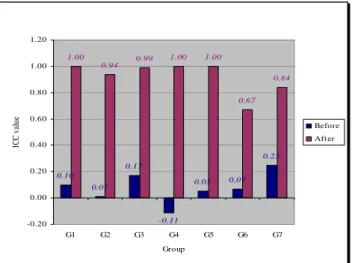
The data is analysed by intraclass correlation coefficient (ICC) with the scale of -1 to 1. Value -1 indicate the total disagreement while value 1 indicate the total agreement among all the stakeholders. The ICC is a measure of reliability that is a ratio of variances derived from repeated measures analysis of variance (ANOVA). This measurement is used for reliability study and the most popular method in medical research to measure the level of experts’ agreement. Therefore, ICC is suitable to be adopted to measure the level of agreement among the stakeholders in this research. In addition, the variance is used to show the agreement level for individual requirement before and after the negotiation.
0.10 0.01
0.17
-0.11
0.05 0.07 0.25 1.00
0.94 0.99
1.00 1.00
0.67 0.84
-0.20 0.00 0.20 0.40 0.60 0.80 1.00 1.20
G1 G2 G3 G4 G5 G6 G7
Group
IC
C
va
lu
e
Before Aft er
Fig 1: The Level of Agreement and Disagreement among the Stakeholders in Experiment 1
-0.09 0.41
0.08
0.00 0.03
1.00 1.00 1.00 1.00 1.00
-0.20 0.00 0.20 0.40 0.60 0.80 1.00 1.20
G1 G2 G3 G4 G5
Group
IC
C
V
a
lu
e
Before
After
Fig 2: The Level of Agreement and Disagreement among the Stakeholders in Experiment 2
0 1 2 3 4 5 6
G1 G2 G3 G4 G5 G6 G7
Groups
N
u
m
ber
of
R
equ
ir
em
en
t
Dropped Affected
Fig 3: Number of Requirements Dropped and Affected in Experiment 1
0 0.5 1 1.5 2 2.5 3 3.5 4 4.5
Q D C B A
Group
N
u
mb
e
r o
f R
e
q
u
ir
e
me
n
ts
Dropped Affected
Fig 4: Number of Requirements Dropped and Affected in Experiment 2
In the experiment conducted, in most cases, requirements dropped affected other requirements which are depending on them. In the first experiment, only two groups manage to drop their requirements without affecting other requirements which means the remaining requirements will be able to function appropriately and meaningfully. In most cases, the number of requirements dropped is more than the number of requirements affected. However there is an odd condition in Group 6 where the result is the other way round. This is due to their decision to drop important requirements which has significant relationship with many requirements. This suggests that Group 6 did not have such a good understanding of the requirements. Fig. 3 shows the number of requirements dropped and affected based on the first experiment.
On the other hand, second experiment is designed to handle requirements quality and to show if negotiation with the knowledge of dependencies will produce a better result. Fig. 4 illustrates the result from the second experiment. It is clearly shown that all the requirements dropped during the negotiation session do not affect other requirements.
0.53
0.7
0.21 0.21
0.4
0 0.1 0.2 0.3 0.4 0.5 0.6 0.7 0.8
A B C D Q
Gr o up
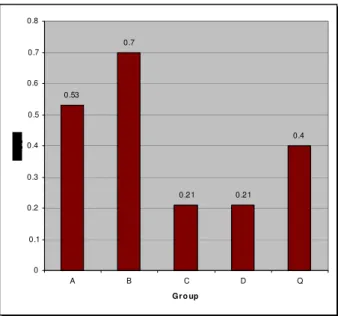
Fig 5: The Agreement between the Goal Standard and the Requirements Identified by Each Group.
Based on Fig. 5, all groups achieved certain amount of agreement which shows the good quality of requirements is obtained if the consensus is achieved. However, there are other factors influences the degree of agreement such as effort and initial ICC value. Based on the observation, time spend negotiating shows significance difference. As stated in section IV, group A and group B spend more time compared to other three groups and both groups obviously obtained better set of requirements.
0.00 0.10 0.20 0.30 0.40 0.50 0.60 0.70 0.80
0 10 20 30 40 50
Effort
K
a
ppa
Fig 6: Correlation between Kappa and Negotiation Effort Fig. 6 shows linear relationship between effort spend negotiating and agreement with the goal standard by kappa. The graph in Fig. 6 is calculated by using Pearson r which reflects the degree of linear relationship between two variables. It ranges from -1 to 1. A correlation of +1 means there is a perfect positive linear relationship between variables.
C. Discussion
Note that the result from this experiment doesn’t show if the stakeholders are good negotiator or not. There are many other factors which influence the success of negotiation. For instance, agreement level will be influenced by time devoted to negotiate, number of stakeholders, single-culture or multi-culture background, amateur or
experienced negotiator and knowledge on the subject discussed. However, the improvement in agreement level will make a significant difference on the project outcome as it represents all the stakeholders’ perspective and perceptions, surfacing tacit knowledge, underlies a sound basis for resource estimation, improved system quality and minimize the resources involved [2, 9, 14-21].
This is proven through feedback from the students involved in both experiments conducted in the post-mortem session. Fig. 7 shows the feedback in a scale of strongly agree, fairly agree, agree, disagree and strongly disagree. There are five items to be scaled and they represent the benefit of negotiations applied. The items are increase the feeling of happiness and belonging to the group (ideas acknowledged to allow dynamic cooperation), understand project constraints and adapt to change, fostering team learning and reveal shared interest, dealing with uncertainty and finding solution and promote rapport and positive relationship. The graph shows majority of the students voted agree to all the items mentioned with a number of them voted fairly agree and strongly agree. Only small proportions voted disagree and strongly disagree. Hence, according to this feedback, people involved in the negotiation process agree that negotiation effort does benefit the stakeholders and the organization as a whole.
0 5 10 15 20 25 30
Strongly agree
Fairly Agree
Agree Disagree Strongly disagree
Scale
Vo
te
Increase the feeling of happiness and belonging to the group (ideas acknowledged to allow dynamic cooperation) Understand project constraints and adapt to change
Fostering team learning and reveal shared interest
Dealing with uncertainty and finding solution
Promote rapport and positive relationship
Fig 7: Feedback
Also, the feedback portrays the stakeholders’ satisfaction value. This is important to ensure commitment from all the stakeholders during the initial stage, development stage and once the system is fielded. Without the commitment, the set of system requirements is doubt to represent all the stakeholders’ need and therefore directly impact the quality of the end product. Besides, it is afraid that a fully function system is neglected to be used.
V. CONCLUSION
The initiative to improve the RE process will never end as this process is evolving from time to time. Negotiation is just one attempt of making RE a better process by detecting and resolving the conflicts in requirements. This effort will reduce the possibility of having defects in the requirements or worst; developing unwanted system.
ACKNOWLEDGMENT
Thank you to both my supervisors, Associate Professor Mark Reynolds and Associate Professor Terry Woodings for their endless support, stimulating suggestions and encouragement throughout my research journey.
REFERENCES
[1] A. Al-Rawas and S. Easterbrook, "Communication Problem in Requirements Engineering: A Field Study Analyzing Requirements Engineering Problems," presented at First Westminster Conference on Professional Awareness in Software Engineering, Royal Society, London, 1996.
[2] D. E. H. Damian, "Challenges in Requirements Engineering," The University of Calgary, Calgary 4 January 2000.
[3] F. D. Brooks, The Mythical Man-Month: Essays on Software Engineering. U.S: Addison-Wesley, 1995.
[4] D. Damian and J. Chisan, "An Empirical Study of the Complex Relationships between Requirements Engineering Processes and Other Processes that Lead to Payoffs in Productivity, Quality, and Risk Management," Transactions on Software Engineering, vol. 32, pp. 433-453, 2006.
[5] V. R. Basili and B. T. Perricone, "Software errors and complexity: An empirical investigation," Communication ACM, vol. 27, pp. 42-52 1984.
[6] K. El Emam and N. H. Madhavji, "A field study of requirements engineering practices in information systems development," presented at Requirements Engineering, 1995. Proceedings of the Second IEEE International Symposium on, 1995.
[7] M. W. Alford and J. T. Lawson, "Software Requirements Engineering Methodology (Development), RADC-TR-79-168," U.S Air Force Rome Air Development Center, Griffiss AFB New York June 1979. [8] N. R. Mead, "Requirements Engineering for Improved System
Security," vol. 2007: Software Engineering Institute, Carnegie Mellon University 2002.
[9] M. Dorfman, "Requirements Engineering," in Software Requirements Engineering, R. Thayer, H. and M. Dorfman, Eds., Second Edition ed. Washington: IEEE Computer Science Society, 1997, pp. 7-22. [10] R. D. Moen, T. W. Nolan, and L. P. Provost, Improving Quality
Through Planned Experimentation, 1 ed: McGraw-Hill 1991. [11] R. V. León, A. C. Shoemaker, and R. N. Kacker, "Performance
measures independent of adjustment: an explanation and extension of Taguchi's signal-to-noise ratios (with discussion)," Technometrics, vol. 29, pp. 253-285 1987.
[12] M. Host, B. Regnell, and C. Wohlin, "Using Students as Subjects—A Comparative Study of Students and Professionals in Lead-Time Impact Assessment," Empirical Software Engineering, vol. 5, pp. 201 - 214 2000.
[13] W. Tichy, "Hints for reviewing empirical work in software engineering," Empirical Software Engineering, vol. 5, pp. 309-312, 2001.
[14] B. Boehm and A. Egyed, "Software Requirements Negotiation: Some Lessons Learned," presented at 20th International Conference on Software Engineering, Kyoto, Japan, 1998.
[15] P. Grunbacher and N. Syeff, "Requirements Negotiation," in Engineering and Managing Software Requirements, A. Aurum and C. Wohlin, Eds. Berlin: Springer-Verlag, 2005, pp. 143-158.
[16] N. Juristo, A. M. Moreno, and A. Silva, "Is the European Industry Moving Towards Solving Requirements Engineering Problems?," Software IEEE, vol. 19, pp. 70-77, 2002.
[17] G. Kotonya and I. Sommerville, Requirements Engineering Process and Techniques. New York: John Wiley & Sons, 1997.
[18] R. S. Pressman, Software Engineering A Practitioner's Approach 6th Edition. New York: McGraw Hill, 2005.
[19] J. Price and J. Cybulski, L., "The Importance of IS Stakeholder Perspectives and Perceptions to Requirements Negotiation," presented at Australian Workshop on Requirements Engineering, Adelaide, 2006. [20] I. Sommerville, Software Engineering 7th Edition. U.S:
Addison-Wesley, 2004.