A N A R I T A C A M P O S
I N T E L L I G E N T D E C I S I O N S U P P O R T
S Y S T E M S F O R C O L L A B O R A T I O N I N
I N D U S T R I A L P L A N T S
Dissertação apresentada para obtenção do Grau de Doutor em Sistemas de Informação Industriais, Engenharia Electrotécnica, pela Universidade Nova de Lisboa, Faculdade de Ciências e Tecnologia.
Lisboa
A C K N O W L E D G M E N T S
I would like to acknowledge the consortiums of the projects PICK (IST-1999-10442), AIM (IST-2001-52222), FOKSai (COOP-CT-2003-508637), InLife (FP6-2005-NMP2-CT-517018), InAmI (FP6-2004-IST-NMP-2-16788) and K-NET (FP7-ICT-1-215584), all of which were partially funded by the Research Framework Programs of the European Union. The research partners of these projects always provided me useful insights and fruitful discussions about the research topics being developed. The industrial companies of these consortiums have contributed quite significantly to my experience in different domains and sectors. These industrial companies have given their time, experience and information that enabled me to learn about industrial environments and test the approaches presented in this thesis.
I would like to thank all the companies that answered my questionnaire about decision-making practices in industry. Their collaboration is invaluable for this thesis, particularly to provide an overview of how companies do make their decisions.
My ten years of professional life have been equally divided in two five-year periods, between two research institutes. ATB, Institut für angewandte Systemtechnik Bremen GmbH, in Bremen, Germany, was my first workplace. This institute provided me the opportunity of working in several European projects, gathering experience from working with international and multi-disciplinary teams. All the staff members helped me to grow professionally. However, I would like to highlight the special role of Dr. Dragan Stokic and Dr. Uwe Kirchhoff. Dr. Kirchhoff taught me relevant lessons in the areas of best practices and industry in general. Dr. Dragan Stokic was a true mentor for five years, teaching me a bit of everything from technical, writing, administrative and personal skills. I will always be thankful to them for the role they played in my life.
S U M Á R I O
O principal objectivo desta dissertação é contribuir para um processo de tomada de decisão estruturado e sistemático em empresas industriais, permintindo que façam o melhor uso dos seus recursos.
Os paradigmas de operação das empresas industriais têm-se modificado nas duas últimas décadas. Este fluxo dinâmico e flexível de informação e pessoas entre empresas criou novos desafios para a indústria. Não é possível dissociar a empresa do conjunto dos seus recursos humanos e o conhecimento criado e utilizado por estes. As empresas enfrentam constantemente a necessidade de tomar decisões. Com a pressão do mercado e contextos empresariais em permanente mudança, as decisões são cada vez mais complexas, envolvendo pessoas com competências complementares e geograficamente dispersas. Os processos do conhecimento serão eficientes apenas se os actores puderem ancorar e relacionar a informação manipulada com a empresa estendida. Assim, o modelo da empresa é um aspecto fundamental para suportar a tomada de decisão na indústria. Este trabalho inclui uma visão sobre metodologias de modelação e standards existentes. Seguidamente, propõe um modelo para representar a empresa virtual ou estendida, adequado a aplicações de tomada de decisão, entre outras.
A dissertação considera métodos e sistemas de suporte à decisão e analisa tipos e processos de decisão. Depois, apresenta algumas considerações sobre tomada de decisão na indústria, incluindo, uma revisão de critérios comummente usados. Dois dos métodos mais utilizados nas áreas mencionadas, Case–Based Reasoning e Analytic Hierarchy
Process, foram usados no âmbito da resolução de problemas e tomada de decisão,
respectivamente. A dissertação apresenta uma nova aproximação baseada na combinação destes dois métodos para suportar processos de inovação, em particular o projecto de produtos na indústria. Esta combinação permite ultrapassar as limitações dos dois métodos para fornecer o suporte mais adequado a equipas multi-disciplinares em processos de inovação. Além disso, o trabalho propõe um algoritmo para ajuste automático dos pesos dos actores no processo de decisão.
A B S T R A C T
The objective of this thesis is to contribute for a structured and systematic decision-making process for industrial companies, particularly involving several actors, helping them make the best use of their resources.
The paradigms of how industrial companies operate have been progressively changing over the last two decades. The flexible and dynamic flow of information and persons over companies has created new challenges and opportunities for industry. It is not possible to dissociate an enterprise from its human resources and the knowledge they create and use. Companies face decisions constantly, involving several actors and situations. With the market pressure and rapid changing environments, decisions are becoming more complex, and involving more people with complementary expertise.
The knowledge processes are only efficient if the actors can anchor and relate the information handled to the extended enterprise. Therefore, an enterprise model is a fundamental aspect to support decision-making in industry. This work includes an overview of existing modelling methodologies and standards. Afterwards, it proposes an enterprise model to represent an extended or virtual enterprise, suitable not only for decision-making applications but also for others.
This thesis considers methods and systems to support decision and analyses decision types and processes. Afterwards, the thesis presents some considerations on decision-making in industry and a generic decision-making process, including, a review of decision criteria commonly used in industry. Two of the methods widely used in some of the mentioned areas, case-based reasoning and the analytic hierarchy process, have been used in the scope of problem solving and decision-making, respectively. This thesis presents an approach based on a combination of case-based reasoning and analytic hierarchy process to support innovation, particularly product design in industry. The combination overcomes shortcomings of both methods to provide the most adequate decision support for multi-disciplinary teams in innovation processes. Moreover, the work presented proposes an algorithm for automatic adjustment of the weight of the actors in the decision process.
S Y M B O L S A N D N O T A T I O N
Symbol Description Alternative
Matrix of pairwise judgements of all criteria by actor
Criteria
The number of times occurs in collection
Matrix of pairwise judgements of all alternatives, for criterion , given by actor
Data vector in recursive least squares
Human actor
Kalman matrix in recursive least squares
Number of actors in the team
Lowest Common Ancestor, i.e. the node of greatest depth that is an ancestor of both
and
Eigenvalue of a matrix or forgetting factor in recursive least squares
Number of alternatives in the decision situation
Number of criteria under consideration in the decision situation
Vector of weight of actors in the team, for aggregation of criteria weights
Optimal solution vector of actors‘ weights in the team, for aggregation of criteria weights
Co-variance matrix in recursive least squares
Vector of weights of actors in the team, for aggregation of alternatives ratings
Vector of ratings for all alternatives considering criterion , provided by actor
Matrix of ratings for all alternatives for all criteria, provided by actor
Matrix of aggregated ratings of all alternatives for all criteria
Similarity between two entities and
Matrix of ratings for all alternatives for all criteria, provided by the market
Vector of rankings of the alternatives in the market
Vector of weights for all criteria, defined by actor
Vector of aggregated weights for all criteria, provided by all actors
Matrix of weights for all criteria, provided by each actor (one column per actor)
Vector of weights for all criteria, provided by the market
Vector of best estimative of market‘s weights for all criteria
Matrix of rankings of all alternatives provided by each actor (one column per actor)
A C R O N Y M S A N D A B B R E V I A T I O N S
Acronym Description
AHP Analytic Hierarchy Process
ARIS Architecture of Information Systems
CAD Computer-Aided Design
CBR Case-Based Reasoning
CDM Collaborative Decision Making
CEN European Committee for Standardization
CEO Chief Executive Officer
CIMOSA Computer Integrated Manufacturing Open System Architecture
CORBA Common Object Request Broker Architecture
CRM Customer Relationship Management
DSS Decision Support System
ebXML eXtensible Markup Language
GDSS Group Decision Support System
GERAM Generalised Enterprise Reference Architecture and Methodology
GRAI Groupe de Recherche en Automatisation Intégrée
GRAI-GIM Groupe de Recherche en Automatisation Intégrée – Integrated Methodology
IDSS Intelligent Decision Support System
IEC International Electrotechnical Commission
IFAC International Federation of Automatic Control
IFIP International Federation for Information Processing
ISO International Organization for Standardization
MDA Model Driven Architecture
OASIS Organisation for the Advancement of Structures Information Standards
OMG Object Management Group
PERA Purdue Enterprise Reference Architecture
PLC Programmable Logic Controller
PLM Product Lifecycle Management
RBR Rule-Based Reasoning
RLS Recursive Least Squares
SCOR Supply Chain Operations Reference Model
STEP Standard for Product Data Representation and Exchange
STEP Standard for the Exchange of Product Model Data
TOVE Toronto Virtual Enterprise
UML Unified Modelling Language
G L O S S A R Y
active decision-making support systems. Intelligent decision-making support systems
that take the initiative without getting specific orders.
collaborative decision making. Process of decision making in a collaborative
environment where problems can be addressed through argumentative discourse and collaboration among the users involved.
collaborative decision support systems. Technologies or systems that enable or
enhance the ability of the participants involved in collaborative decision-making processes.
craft production. Production focused on craft, where highly skilled people transformed
materials to produce something, using mostly inexpensive tools.
decision. Choice, which is to realise a certain goal by analysing subjective-objective
conditions, generating alternatives, and choosing the most appropriate one among them.
decision-making. Process of reaching a conclusion after considering several alternatives.
decision support systems. Interactive computer-based information systems designed to
help human decision makers, by processing data and models in order to identify, structure, and solve semi-structured or unstructured problems.
enterprise model. Abstraction of an enterprise domain that represents enterprise entities,
their interrelationships, their decomposition and detailing to the extent necessary to convey what it intends to accomplish and how it operates.
enterprise modelling. Conceptual modelling techniques to describe the structure and
business processes of an enterprise, its missions and objectives with the way these objectives may be operationalised onto systems components.
extended enterprise. Formation of closer co-ordination in the design, development, costing
and the co-ordination of the respective manufacturing schedules of co-operating independent manufacturing enterprises and related suppliers.
group decision support systems. Interactive computer-based systems that facilitate the
solution of ill-structured problems by a set of decision makers that work together as a team.
intelligent decision support systems. Information systems to generate knowledge to
support decision-making, combining the research fields of decision support, artificial intelligence and knowledge management.
knowledge elicitation. Sub-task of knowledge gathering that deals with gathering knowledge from human experts.
lean production. Combination of craft and mass production, using multi-skilled workers and
flexible automated machines.
mass production. Production of inexpensive goods, using highly sophisticated machines
operated by relatively unskilled operators
virtual enterprise. Temporary alliance of enterprises that come together to share skills or
T A B L E O F C O N T E N T S
1. Introduction ... 1
1.1. Motivation ... 1
1.2. Original contributions ... 5
1.3. Organisation of the Thesis ... 6
2. Enterprise model ... 9
2.1. Existing modelling technologies ... 10
2.2. Existing modelling standards ... 12
2.3. Proposed model ... 13
2.3.1. Static knowledge ... 17
2.3.2. Dynamic knowledge ... 21
2.4. Modelling methodology ... 24
3. Decision support in industrial environments ... 29
3.1. Methods to support decision-making ... 30
3.2. Systems to support decision ... 36
3.3. A generic decision-making process ... 39
3.4. Types of decisions and the process of making a decision ... 41
3.5. Team decision-making process type ... 43
3.6. Industrial criteria ... 44
3.7. Decision-making in industry ... 47
4. Problem solving and innovation in industry ... 51
4.1. Case-based reasoning ... 52
4.2. The Analytic Hierarchy Process ... 58
4.2.1. Hierarchical representation of a problem ... 59
4.2.2. Comparing the decision criteria (individual judgements) ... 62
4.2.3. Analysing judgement consistency ... 64
4.2.4. Defining individual criteria weight ... 67
4.2.5. Calculating group criteria weight ... 69
4.2.6. Individual classification of alternatives ... 71
4.2.8. Ordering alternatives ... 73
4.3. Combining AHP and CBR ... 84
4.4. Actor‘s weights adaptation by market ranking feedback ... 86
4.4.1. The market ... 86
4.4.2. The decision making group ... 87
4.4.3. Feedback information from market ... 91
4.4.4. Examples with ranking uncertainty ... 98
4.4.5. Adaptive actors‘ weights from market feedback ... 104
4.5. Remarks ... 107
5. Case studies ... 109
5.1. Manufacturing Companies ... 109
5.2. Assembling Companies ... 115
5.3. Engineering Services Companies ... 122
5.4. Software Company ... 129
5.5. Remarks ... 132
6. Conclusions and future work ... 135
Annex A. Model Specification ... 149
Annex B. Modelling Methodology Tools ... 165
L I S T O F F I G U R E S
Figure 2.1. Proposed enterprise model. ... 15
Figure 2.2. Overview of model‘s static knowledge. ... 18
Figure 2.3. Overview of model‘s dynamic knowledge. ... 22
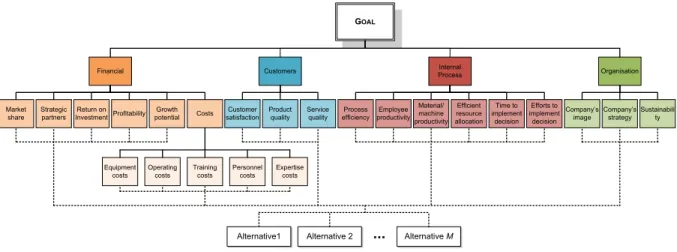
Figure 3.1. Hierarchical representation of decision criteria. ... 46
Figure 3.2. Costs criteria to make a decision. ... 46
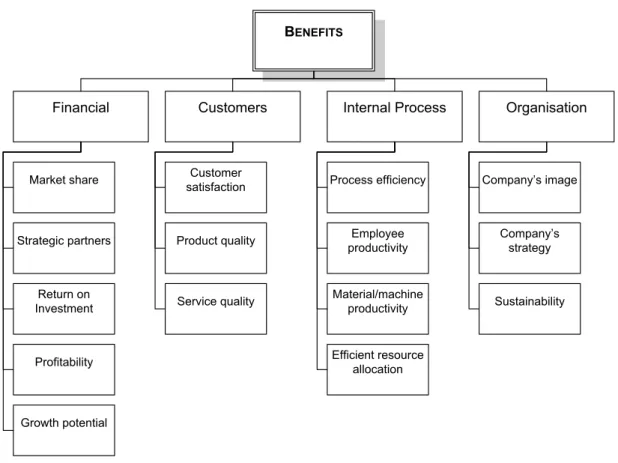
Figure 3.3. Benefits criteria to make a decision. ... 47
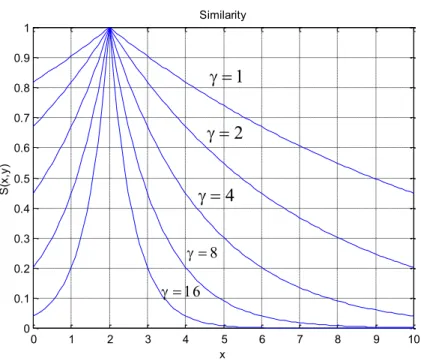
Figure 4.1. Effect of parameter in the computation of similarity value. ... 57
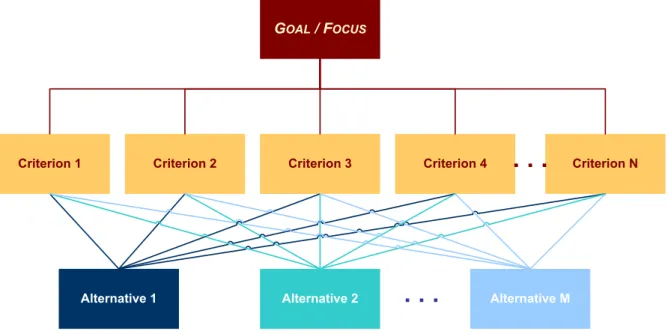
Figure 4.2. Hierarchical representation of a problem. ... 60
Figure 4.3. Hierarchical representation of a problem with defined criteria. ... 61
Figure 4.4. Hierarchical representation of problem‘s costs. ... 62
Figure 4.5. Hierarchical representation of problem‘s benefits. ... 62
Figure 4.6. Hierarchical representation of example of problem to meet customer‘s requirements. ... 75
Figure 4.7. Criteria priorities assigned by each actor. ... 78
Figure 4.8. Sub-criteria priorities assigned by each actor. ... 78
Figure 4.9. Criteria weights defined by the team. ... 79
Figure 4.10. Rating of alternatives by the team. ... 83
Figure 4.11. Ranking of the alternatives. ... 83
Figure 4.12. Approach combining CBR and AHP. ... 85
Figure 4.13. Values and criteria for alternatives in Example 4.4. ... 90
Figure 4.14. Values and criteria for alternatives in Example 4.5. ... 92
Figure 4.15. Actors‘ weights in Example 4.6. ... 94
Figure 4.16. values and criteria for alternatives in Example 4.7. ... 97
Figure 4.17. Values and criteria for alternatives in Example 4.8. ... 99
Figure 4.18. Values and criteria for alternatives in Example 4.9. ... 100
Figure 4.19. Actors‘ weights in Example 4.10. ... 101
Figure 4.20. Values and criteria for alternatives in Example 4.11. ... 103
Figure 4.21. Market‘s weights estimation in Example 4.12. ... 106
Figure 4.22. Actors‘ weights estimation in Example 4.12. ... 106
Figure 5.1. Manufacturing plant of a rear axle. ... 110
Figure 5.2. Production units of manufacturing company 1. ... 111
Figure 5.3. States of manufacturing company 1. ... 111
Figure 5.4. Process of necking and testing cans. ... 113
Figure 5.5. Examples of problems in manufacturing company 2. ... 114
Figure 5.6. Details of a problem‘s description. ... 115
Figure 5.8. Assembling of large-scale air conditioning units. ... 118
Figure 5.9. Production units defined for assembling company 2. ... 120
Figure 5.10. Examples of problems defined for assembling company 2. ... 121
Figure 5.11. Similar problems identified by CBR in assembling company 2. ... 121
Figure 5.12. Cutting form and fixture. ... 123
Figure 5.13. Product parts modelled in enginnering services company 1. ... 124
Figure 5.14. Problem types defined for engineering services company 1. ... 125
Figure 5.15. Actions defined for engineering services company 1. ... 125
Figure 5.16. Example of a customised spray painting solution. ... 126
Figure 5.17. List of problems from engineering services company 2. ... 127
Figure 5.18. CBR analysis of problems from engineering services company 2. ... 128
L I S T O F T A B L E S
Table 2.1. Mapping ISO19440 to the proposed model. ... 14
Table 3.1. Decision-making phases and steps. ... 40
Table 4.1. Similarity values for uniform p.d.f. of an unknown variable. ... 58
Table 4.2. Criteria pairwise comparison table. ... 63
Table 4.3. Scale to represent criteria judgement. ... 64
Table 4.4. Calculated values of random index. ... 65
Table 4.5. Alternatives pairwise comparison table. ... 71
Table 4.6. Individual judgemements of criteria by actor 1. ... 76
Table 4.7. Revision of some individual judgemements of criteria by actor 1. ... 76
Table 4.8. Individual judgemements of criteria by actor 2. ... 77
Table 4.9. Individual judgemements of criteria by actor 3. ... 77
Table 4.10. Individual judgemements of alternatives by actor 1. ... 80
Table 4.11. Individual judgemements of alternatives by actor 2. ... 81
Table 4.12. Individual judgemements of alternatives by actor 3. ... 82
Table 5.1. Results from tests in manufacturing company 1. ... 112
Table 5.2. Results from tests in manufacturing company 2. ... 115
Table 5.3. Examples of problems in assembling company 1. ... 117
Table 5.4. Results from tests in assembling company 1. ... 118
Table 5.5. Results from tests in assembling company 2. ... 122
Table 5.6. Results from tests in engineering services company 1. ... 125
Table 5.7. Results from tests in engineering services company 2. ... 128
Table 5.8. Examples of problems in software company. ... 131
1.
INTRODUCTION
The main objective of this thesis is to contribute for a structured and systematic decision-making process for industrial companies, helping them make the best use of their resources. This first chapter of the thesis describes the motivation for the work performed, how it was structured and the main original contributions proposed.
1.1. MOTIVATION
People have always used information in any aspect of their daily lives. It is not possible to think, act, decide or even feel without having information processed by our brains. In business companies, the same happens. Companies have been using information to handle the business. Until not long ago, companies‘ information was the people‘s information. This means that the only source of knowledge within a business was its employees. This was possible because businesses were less complex and the majority of people stayed their complete productive life in the same job and company. The structure of the society and
economy encouraged and permitted the ―job for life‖. However, this situation does no longer
hold.
The phenomenon of globalisation, which appeared in the 80s, has changed our world in a very significant way. The overall education of people around the world has increased and the jobs have changed. Local, regional and even national companies have been transformed into global business, operating in multiple countries. As people change jobs several times in their productive working life, they accumulate knowledge, but also move this knowledge from one place to another. Businesses have been losing information and knowledge, and not only employees. Therefore, companies started noticing the need to retain information in a way that did not entirely depend on the employees.
paradigm of mass production. The objective was to produce inexpensive goods, using highly sophisticated machines operated by relatively unskilled operators. However, the expensive and highly specialised machines were somehow less tolerant to modifications, which required companies to produce vast amounts of the same product, for as long as possible.
Henry Ford described the process best with his sentence ―Any customer can have a car
painted any colour that he wants so long as it is black.‖ After World War II, another
automotive company, Toyota, pioneered the paradigm of lean production. This paradigm combines craft and mass production, using multi-skilled workers and flexible automated machines. The objective was to use less human efforts, fewer tools, less manufacturing space and less investment, when compared to mass production.
The need for flexibility made companies analyse their internal structures and hierarchies, which were very pyramid-like. Businesses discovered several layers of middle management that were involved neither in any decision-making process nor in leading the companies. In fact, some of these middle layers were only relaying information, representing filters that were retaining some information, representing loss of information. The re-structuring of companies, cutting down the middle management, represented the movement of lean production (Womack and Jones, Lean Thinking 1996).
addition, extended enterprises centre their core competencies in one dominant company, while virtual enterprises have core competencies distributed over the participating companies (Jagdev and Browne 1998).
Increasing relations brought two main challenges for companies: flexibility and exchange of information. This made companies focus more on their information and knowledge, where to get it from and especially how to represent it. Exchanging information is only possible and efficient from the organisation viewpoint if a formal structuring is in place.
The recent advances in information and communication technologies have moved the industrial world from highly data-driven environments to a more cooperative information/knowledge-driven environment, taking into account more of the enterprise know-how, common-sense, and application semantics (Vernadat 2002).
The way people work has changed together with the operation paradigms of companies. Individuals not only work for several companies during their productive life, but the way people and companies are connected has also adjusted. Market constraints for companies to decrease their costs, and individual requirements of people who need to balance personal and professional lives, fostered the appearance of new ways of work, which are highly facilitated by technology, especially information and communication technologies, and particularly the Internet. Concepts such as freelancer, e-lancing, e-work, telework and telecommute are quite often nowadays. The number of freelancers, for example, reached 12 million in the end of 2009, in the United States, and the number of web sites to support e-lancing is also growing (Working in the digital age: a clouded future 2010).
This flexible and dynamic flow of information and persons over companies has created new challenges for industry. It is not possible to dissociate an enterprise from its human resources and the knowledge they create and use. A company can be seen as just a processor of information created by the individuals (Simon, Administrative Behaviour 1997), or the amplifier of knowledge created by the individuals (Nonaka and Takeuchi 1995). In any of the situations, what companies make with the knowledge they have is of key importance.
contributing to support decision-making processes, particularly involving several actors, which are designated by collaborative decision-making.
The recent economic downturn, which started in 2007, has led companies to cut their costs and many have underinvested in their information infrastructure. A recent study by the American consultant Gartner (Schlegel, et al. 2008) stated, ―most organisations find they do not have the information, processes and tools needed by their managers to make informed,
responsive decisions.‖ The same report estimates that through 2012, more than 35% of the
top 5000 global companies will fail to make insightful decisions about significant changes in their business and markets due to underinvestment in their information infrastructure and business user tools.
Companies need a systematic approach to support decision-making processes, which enables traceability and accountability. Companies need the best information and rules to make a decision, but they also need to learn from what went right and what went wrong. Being able to replicate a successful situation and avoid a downfall has to be part of a
company‘s strategic thinking.
Many sciences have studied topics relevant for decision-making, including neuro-sciences, psychology, management science, operations research, control, artificial intelligence, business intelligence and the recent behavioural economics. Already more than twenty years ago, Nobel Prize laureate Herbert Simon had said (Simon, Two heads are better than one: collaboration between AI and OR 1987):
JOINING HANDS WITH ARTIFICIAL INTELLIGENCE,
MANAGEMENT SCIENCE AND OPERATIONS RESEARCH CAN ASPIRE TO TACKLE EVERY KIND OF PROBLEM-SOLVING TASK THE HUMAN MIND CONFRONTS.
There has been a convergence among the research fields of decision support, artificial intelligence and knowledge management, developing a number of information systems to generate knowledge to support decision-making. Collectively, these systems can be called intelligent decision support systems (Hans and Peter 1992). These systems integrate the functions of decision support systems and knowledge-based systems to assist decision makers in performing decision analysis, and explain conclusions and recommendations (Hunsaker and Hunsaker 1981) (Tansley and Hayball 1993) (Sensiper 1998) (Silverman 1994).
segmentation between information, knowledge and their application. Companies invest heavily in expert systems for specific applications within the enterprise. Often, companies have several systems, which are completely independent, and are not able to communicate and use different and sometimes redundant information. The extended and virtual enterprises need tailored support for decision-making, which includes:
Full use of the enterprise‘s information and knowledge. Companies need to have one
model independent of the applications, which means only one knowledge base.
Efficient and methodical procedure to model and acquire knowledge in an extended or virtual enterprise. Companies need to be able to identify and select the knowledge relevant for the desired applications.
Systematic and clear approach to support decision-making processes involving complex teams with diverse expertise and geographical dispersed. Companies need to be able to review past decisions and learn from them.
The objective of this thesis is to contribute to minimise these state-of-the-art gaps, in order to help industrial companies in having an appropriate approach for decision support. The work presented has the objective of modelling extended enterprises for decision-making applications, and contribute to providing a systematic procedure to support accountable and repeatable decisions in industrial companies.
1.2. ORIGINAL CONTRIBUTIO NS
The main objective of this thesis is, in general terms:
Develop a systematic methodology to support industrial companies in making and revisiting
decisions, using the best resources available.
The work developed includes the following main original contributions:
2. A combination of case-based reasoning and the analytic hierarchy process to support decision-making situations in industrial enterprises, particularly in the scope of innovation processes. This combination overcomes the bottlenecks of each method individually, namely how to adapt the most similar case suggested by case-based reasoning and how to identify and formulate the hierarchy to use in the analytic hierarchy process. This proposed approach is tightly connected to the enterprise model and comprehends a hierarchy of criteria that can be applied in diverse decision situations in industrial environments.
3. An algorithm to adapt actor’s weights in a team by considering market ranking feedback and enterprise strategy. This method uses information about the implementation of decisions to potentiate the role of actors that systematically take
decisions aligned with the company‘s strategy. The proposed algorithm is presented as
a possible approach to support companies in learning from the implementation of decisions and adapting their decision making process to reinforce the most successful decisions.
4. A collection of case studies that represent tests of parts of the work presented in this thesis in industrial environments. The seven test cases include two manufacturing companies, two assembling companies, two services engineering companies and one software company. The enterprise model was applied in the seven test cases proving its diversity and showcasing different interpretations to the set of constructs proposed. The case-based reasoning method was also tested in the seven companies, allowing to show its successful application and enabling its continuous development. One of the test cases was used to perform a preliminary study on the analytic hierarchy process approach, providing results that supported the refinement of the approach.
1.3. ORGANISATION OF THE THESIS
This thesis is organised in six chapters, as described in the following text.
Chapter 1, Introduction, presents the motivation for the work developed, describing the background that led to the topic, namely in a business and industrial perspective. This chapter also describes the structure of the thesis and identifies its main original contributions.
Chapter 3, Decision support in industrial environments, introduces the topic of decision-making with a particular industrial focus. The chapter begins with a review of different systems to support decision, followed by a definition of decision types and the process of making a decision. Afterwards, the chapter presents some considerations on decision-making in industry and a generic decision-decision-making process. This chapter finalises with a review of criteria commonly used in decision-making in industry.
Chapter 4, Problem solving and innovation in industry, focus on decision-making applications in industrial companies. This chapter describes several systematic approaches to support industrial decision-making, namely based on case-based reasoning, the analytic hierarchy process and a combination of both. Additionally, this chapter proposes an algorithm to automatically adjust actors‘ weights in a team using information about the success of the implemented decisions.
Chapter 5, Case studies, presents the experimental part of this thesis, with detailed descriptions of practical applications of the model and methods developed.
2.
ENTERPRISE MODEL
Providing decision support for industrial companies requires the ability of modelling the extended enterprise and the decision process. This chapter proposes an enterprise model to represent an extended enterprise, suitable not only for decision-making applications but for others as well. The concept‘s foundation is that any application in an extended enterprise involves handling and exchanging knowledge. The knowledge processes are only efficient if the actors can anchor and relate the information handled to the extended enterprise.
With the increased relations among companies, the concern of representing information in a formal and structured way soon became a major concern (Nagarajan, Whitman and Cheraghu 1999). Companies started storing all bits of data and information, even if not relevant at all. Another aspect is also that each system inside the company (CRM, CAD, PLM etc.) uses its own information structure, making for a lot of redundancy in a less positive sense. However, the efficiency of a virtual or extended enterprise, once formed, is greatly determined by the speed and efficiency with which information can be exchanged and managed among business partners (Browne and Zhang 1999). Sharing information among partners of a supply chain will not only reduce the operation costs of each of the partners, but
the efficiency of this ‗trust‘ based business transaction will give rise to a sense of ‗customer
satisfaction‘ along the value chain (Jagdev and Browne 1998).
There are situations where extended and/or virtual organisations include competitors. Even in these situations, companies should not see as a disadvantage sharing information and knowledge, as it is an essential feature. Knowledge, even if public, may not be an obvious source of competitive advantage; what each company does with the knowledge, in terms of applying it to value-creating tasks, matters more than its public availability (von Krogh, Ichijo and Nonaka 2000).
Most industrial companies have a main concern in problem solving, because unsolved problems cause delays, increases waste and consumes resources ineffectively. In addition, companies want to extend their products by incorporating in them knowledge and expertise from all participants of the value chain (Sorli, et al. 2006). This added-value knowledge often comes from what it is possible to learn during the product lifecycle, especially from solving problems. Industrial companies usually use accumulated knowledge, especially from what went wrong (i.e. from solving problems) to innovate their products and processes. This thesis introduces a model to represent industrial enterprises, especially targeting problem-solving applications. The need for such a model came when developing problem-solving approaches for manufacturing industry, using methods such as reasoning. Companies lack an overview of their products, processes and resources, needed to document any problems occurring in the manufacturing processes. Additionally, companies were involved in extended and virtual enterprises and needed to document problems occurring all over the supply chain, i.e. in process of distinct companies.
2.1. EXISTING MODELLING T ECHNOLOGIES
Enterprise knowledge modelling, or enterprise modelling, is a generic name that refers to a collection of conceptual modelling techniques for describing the structure and business processes of an enterprise, its missions and objectives with the way these objectives may be operationalised onto systems components (Loucopoulos and Kavakli 1999).
The majority of enterprise modelling techniques provides concise descriptions of what an
enterprise ―does‖ in order to operate. To this end, they usually involve two kinds of sub
-models: an entity (or data, or information) model and a process (or functional) model.
There are several methodologies and tools that facilitate business process management, from the enterprise integration perspective, trying to support the life-cycle stages of the integrated manufacturing enterprise (Szegheo and Andersen 1999) (Kosanke, Comparison of Enterprise Modelling Methodologies 1996).
Purdue Enterprise Reference Architecture (PERA), developed at Purdue University, recognises the fact a computer cannot implement many human functions, especially innovative ones (Williams and Li 1998). Therefore, the focus of PERA is to separate human based functions in an enterprise from those with a manufacturing or information perspective. PERA separates enterprise tasks in three categories: information system tasks, manufacturing system tasks, and human based (organisational) tasks. PERA considers two views of the enterprise: a functional view and a manufacturing functional model view.
The Architecture of Information Systems (ARIS), developed at the University of Saarland, has an overall structure very similar to CIMOSA. However, instead of focusing on computer-integrated manufacturing systems, it deals with more traditional and business-oriented issues of enterprises, such as order processing, production planning and control, inventory etc. The focus is essentially on software engineering and organisational aspects of integrated enterprise system design (Szegheo and Andersen 1999).
The GRAI method (Doumeingts, et al. 1987), developed in the University of Bordeaux, deals with the decisional aspects of manufacturing systems. Based on the GRAI models, two formalisms were developed to model the macro decision structure and the micro decision centre; the GRAI grid and the GRAI nets. The GRAI method was extended to GRAI-GIM (GRAI Integrated Methodology) within the framework. GRAI-GIM contains two methods: one is user-oriented and the other is technical-oriented. The user-oriented method transforms user requirements into user specification in terms of function, information, decisions and resources. The technical-oriented method transforms the user specification into technical specifications in terms of information and manufacturing technology components and the organisation.
The Generalised Enterprise Reference Architecture and Methodology (GERAM) framework was defined by a task force from the International Federation of Automatic Control and the International Federation on Information Processing, starting from the evaluation of CIMOSA, GRAI/GIM and PERA. GERAM is about those methods, models and tools needed to build and maintain the integrated enterprise, be it a part of an enterprise, a single enterprise or a network of enterprises (virtual or extended enterprises) (IFIP-IFAC Task Force on Architectures for Enterprise Integration 1999). GERAM defines a toolkit of concepts for designing and maintaining enterprises for their entire life history.
referred in this section are quite complex or general to make their application possible in an industrial environment, by the actors of the extended enterprise. When the models are applicable in industry, they are usually very resource consuming, because they imply long hours not only from staff within the extended enterprise but also outsourced resources as knowledge experts.
2.2. EXISTING MODELLING STANDARDS
There has been significant work developed in trying to develop standards to unify approaches in enterprise engineering and integration. The International Organization for Standardization (ISO) and the International Electrotechnical Commission (IEC) on the international level and the European Committee for Standardization (CEN) on the European level have produced an important set of standards. However, there is still significant work to do, especially regarding human-related aspects. Recently, these organisations have joint efforts to produce comprehensive standards, unifying their previous work.
Some important standards lay important rules and concepts in a general perspective. In this category, it is important to refer ISO 14258, Concepts and Rules for Enterprise Models, and ISO IS 15704, Requirements for Enterprise Reference Architectures and Methodologies. These two documents describe fundamental concepts and objectives to be met by enterprise models.
In addition, there are standards defining framework that aim to improve business process interoperability, and standards structuring languages that provide languages for modelling different perspectives of enterprises. In the framework section, three standards are relevant: CEN/ISO 19439 Framework for Modelling, ISO 15745 Framework for Application Integration and ISO 15288 Life Cycle Management. Regarding languages, three other standards appear: CEN/ISO 19440 Constructs for Modelling, ISO 18629 Process Specification Language and ISO/IEC 15414 ODP Enterprise Language.
interoperability among services has gained major relevance because of the changes in computing paradigms (e.g. service-oriented architecture, web services). Some research work has been developing combinations of existing standards to improve interoperability among companies (Jardim-Gonçalves, Grilo and Steiger-Garção 2006).
For the work presented, the most interesting standard is CEN/ISO 19440 because it is, not only the most recent, but defines a general set of constructs that are considered essential when modelling an enterprise. As described below, this standard was used as basis for the model proposed.
2.3. PROPOSED MODEL
The work presented was realised in the context of developing a comprehensive approach for problem solving applications in industry, initially with manufacturing companies. The starting point was the need of some companies to quickly solve problems occurred in their shop-floor, while avoiding waste of resources. However, these companies recognised that about 95% of the problems occurred were repetitions of previous situations. This means that only 5% of the problems represented new situations in the machines. Therefore, the simple possibility of accessing what maintenance staff had done in a previous situation could enhance the problem solving approach in the companies. This simple fact uncovered the problem that companies do not record occurred problems in a structured way, enabling its future use.
The research work of how to represent and model problems occurred in a manufacturing shop floor cannot be isolated from the enterprise. Problems occur in specific machines, registering precise measures and conditions, and are handled in an exact way by employees. Therefore, all this information had to be part of describing a problem.
Companies also lack an overview of their structure and operation. They are missing an enterprise model, which is defined as an abstraction of an enterprise domain that represents enterprise entities, their interrelationships, their decomposition and detailing to the extent necessary to convey what it intends to accomplish and how it operates (ISO 2006).
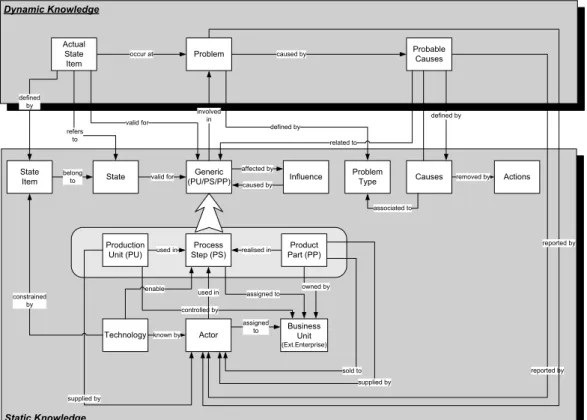
constructs of the model proposed. The main objective is to show that the model developed complies with all aspects of the standard, while extending it to cover additional aspects of problem solving. This means that companies that already have an enterprise model following ISO 19440 could easily extend it to have additional problem solving features.
TABLE 2.1. MAPPING ISO19440 TO THE PROPOSED MODEL.
ISO 19440 Constructs Proposed Model Constructs
Domain Business Unit
Business process Process Step
Enterprise activity Process Step
Event Actual State Item
Enterprise Object Generic
Enterprise Object View Production Unit Process Step Product Part
Order Problem
Product Product Part
Capability Technology
Operational Role Technology
Resource Resource
Functional Entity Production Unit
Person Profile Actor
Organisational Role Actor
Organisation Unit Business Unit
Decision Centre Business Unit
FIGURE 2.1. PROPOSED ENTERPRISE MODEL.
The dynamic data comprises information about actual data for a specific instant of time, i.e. specific values for any element, attribute or relation defined in the common knowledge base. This set of information represents problems, process deviations, specific values of machine states, probable causes for problems and actions.
The static data of the common knowledge base represents the complete infrastructure of the enterprise, and its modification reflects a business decision. The dynamic data of the common knowledge base contains information on the actual state of the enterprise's variables, which is described using components from the static set of the common knowledge base.
The model comprehends many relationships that enable to save interactions among elements, which constitute a major source of information in the enterprises.
Following the application of the ISO 19440 standard, the constructs that define the proposed enterprise model are described using a common structure and template. Each model construct is described, according to ISO 19440, by (ISO 2007):
a textual description consisting of brief text defining the modelling language construct in terms of a purpose, its description and its intended usage, and
a construct template, which organises and defines the attributes for the modelling language construct.
Static Knowledge
used in realised in valid for affected by controlled by assigned to owned by used in Production Unit (PU) Process Step (PS) Product Part (PP) Business Unit (Ext.Enterprise) assigned to belong to constrained by Dynamic Knowledge defined by refers to defined by occur at Problem
The template is described in an informal manner but using a common pro forma. In turn, the construct template shall have the form described below:
a) Header part having the same attributes for each modelling language construct and containing attributes relating to the identity of a construct instance and to its context. It shall be structured as follows:
1) construct label (a literal string denoting the kind of construct);
2) identifier (a literal string that is unique for each occurrence of the modelling language construct within the model);
3) name (the name of the instance of the modelling language construct);
4) authority for model design (i.e. the identifier of the Organisational Role or Organisational Unit responsible for the design of this construct): for all construct and for all attributes concerned with authorities or responsibilities, the identifier or name of the Organisational Unit may be omitted in the Concept Identification and Requirements Definition modelling phases.
b) Body part containing the particular attributes that are specific to each construct and whose description is derived from the particular modelling language construct definition. Body parts shall then be structured ion two further partitions as follows: 1) descriptives, containing descriptive attributes that comprise
construct-identifying description in textual form, construct attributes that are predefined,
additional construct attributes that may be defined by the user to meet particular needs, such as those required by additional model views, and
attribute qualifications – statements that are made about whether attribute values are mandatory or optional, when they are applicable, etc.
2) relationships, containing relationship attributes that can include
Operational relationships, that are responsibility and authority for model operation (i.e. the identifier of the Organisational Role and Organisational Unit responsible for the operational usage of this construct or authorised to change its usage),
Specialisation_of relationships, representing relationships between a
specialisation and its generalisation,
Part_of relationships, representing relationships between this construct
instance and the whole aggregated from such instances,
Consists_of relationships, representing relationships between this construct
instance and its constituent parts, and
The work done includes a full specification of the proposed model following this structure, to be compliant to the standard. However, this structure is not very suitable to present the proposed constructs in this thesis. Therefore, the following sections include a textual description of the model, presenting the same information requested by the standard template, while the standard-compliant forms are in Annex A, Model Specification.
2.3.1.
STATIC KNOWLEDGE
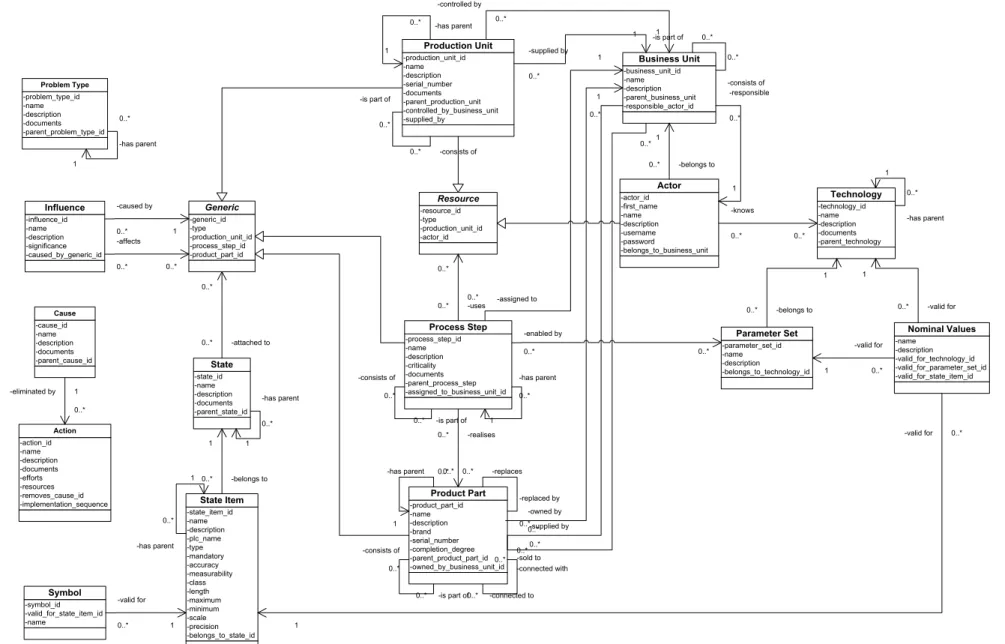
The static knowledge represents a model of the product and process models of the enterprise. Figure 2.2 represents the main objects in the static knowledge. Several inheritance relationships mark the model, which represent the complete hierarchy of the industrial companies, and especially the manufacturing processes. The hierarchy enables the representation of repeatable similar objects, with unique characteristics. This is a key aspect for the companies, which helped to ease the knowledge acquisition process.
The following text describes briefly each object of the static knowledge model. All the main objects of this model include attributes for identifier, name, description and documents. A business unit represents the organisational structure of the enterprise, according to its decomposition. A business unit can represent one company or one of its departments or units. The business unit corresponds to a domain, i.e. the boundary and the content of an enterprise or a portion of an enterprise for which an enterprise model is to be created. The business units are leading elements in the model because they control the production elements, i.e. process steps, product parts and production units. Business units are defined using attributes for identifier, name, description, documents and responsible. This last attribute characterises the person responsible for the business unit and is an actor. Business units have two relationships defined among themselves. A hierarchy defines a parent_of
relation that represents a generalisation between two elements. A decomposition relationship defined by consists_of and part_of indicates the organisational chart of the company. When modelling a multi-site company, it is possible to have one business unit ―maintenance
department‖ which is the parent of ―maintenance city A‖ and ―maintenance city B‖. The two
children are a specialisation of the parent business unit. On the other hand, it would be possible to define that business unit ―maintenance city A‖ consists_of two different business
units called ―routine maintenance‖ and ―emergency response‖.
FIGURE 2.2. OVERVIEW OF MODEL‘S STATIC KNOWLEDGE. -production_unit_id -name -description -serial_number -documents -parent_production_unit -controlled_by_business_unit -supplied_by Production Unit -process_step_id -name -description -criticality -documents -parent_process_step -assigned_to_business_unit_id Process Step -product_part_id -name -description -brand -serial_number -completion_degree -parent_product_part_id -owned_by_business_unit_id Product Part -business_unit_id -name -description -parent_business_unit -responsible_actor_id Business Unit -actor_id -first_name -name -description -username -password -belongs_to_business_unit Actor -resource_id -type -production_unit_id -actor_id Resource -controlled by 0..* 1 1 -belongs to 0..* 1 -has parent 0..* -consists of 0..*
-is part of 0..* -technology_id -name -description -documents -parent_technology Technology -knows 0..* 0..* 1 -has parent 0..* 0..* -uses 0..*
-is part of 0..*
-consists of 0..* -influence_id -name -description -significance -caused_by_generic_id Influence -generic_id -type -production_unit_id -process_step_id -product_part_id Generic -caused by 0..* 1 -affects 0..* 0..* -state_id -name -description -documents -parent_state_id State 0..* -attached to 0..* -parameter_set_id -name -description -belongs_to_technology_id Parameter Set 1 -belongs to 0..* -name -description -valid_for_technology_id -valid_for_parameter_set_id -valid_for_state_item_id Nominal Values 1 -valid for 0..* 1 -valid for 0..* -has parent 0..* 1 -is part of 0..* -consists of 0..* -enabled by 0..* 0..* -realises 0..* 0..* -has parent 0..*
1
-is part of 0..* -consists of 0..* -connected to 0..* -connected with 0..* -replaced by 0..* -replaces 0..* -state_item_id -name -description -plc_name -type -mandatory -accuracy -measurability -class -length -maximum -minimum -scale -precision -belongs_to_state_id State Item 1 -belongs to 0..* -symbol_id -valid_for_state_item_id -name Symbol -valid for 0..* 1 1 -assigned to 0..* -owned by 0..* 1 -responsible 0..* 1 -supplied by 0..* 0..* -sold to 0..* 0..* -has parent 0..* 1 -has parent 0..* 1 -cause_id -name -description -documents -parent_cause_id Cause -problem_type_id -name -description -documents -parent_problem_type_id Problem Type 1 -has parent 0..* -action_id -name -description -documents -efforts -resources -removes_cause_id -implementation_sequence Action 0..* -eliminated by 1
1
-valid for 0..* -supplied by
0..*
A technology represents application of scientific knowledge or techniques in the company‘s operational life. It describes all the techniques used in assembling or manufacturing and services, and for which knowledge is needed within the enterprise. This object comprehends attributes for identifier, name, description, equation and documents. There is a relationship
between technologies and actors, since technologies represent actors‘ expertise, i.e. actors
know technologies. In addition, technologies have a relationship among themselves, representing a hierarchy of scientific subjects, through the parent_of relation.
A production unit describes a physical resource of the enterprise used to realise an activity. In most cases, a production unit is some kind of machine used to produce something. Production units include attributes for identifier, name, description, and serial number. Each production unit belongs to one business unit, through the attribute controlled_by, providing information about its location and responsibility. Production units relate to business units, through relation supplied_by, since some organisational structure supplies each production unit, being a department within the company or another company in the extended enterprise. Production units have two relationships defined among themselves: a hierarchy defines a
parent_of relation that represents a generalisation between two elements; and a
decomposition relationship is defined by consists_of and part_of.
A resource is a generalisation of two existing objects, representing physical and human assets of the extended enterprise. Therefore, a resource is always either a production unit or an actor.
A process step is an activity of the enterprise that represents part of process functionality needed to realise a basic task within the enterprise. Each process step comprehends attributes for identifier, name, description, documents and criticality. Each process step is assigned to a business unit of the extended enterprise, through the attribute assigned_to, providing information about its exact location. Process steps have two relationships defined among themselves: a hierarchy defines parent_of relation that represents a generalisation between two elements; and a decomposition relationship defines consists_of and part_of. Technologies enable process steps, in the sense that to produce an activity it is necessary to have some specific scientific knowledge. As a process step is an activity, it uses resources of the extended enterprise, i.e. it uses actors and production units.
enterprise also supply and sell product parts. Product parts have four relationships among themselves: a hierarchy defines parent_of relationship that represents a generalisation between two elements; a decomposition relationship defines consists_of and part_of; a relationship connected_to and connected_with defines product parts that are attached or united; and the relationship replaced_by and replaces defines possible substitutions of product parts to use in case of stock rupture. Product parts are the result of a process step, defined in the relationship results_in.
A generic is a generalisation of three existing objects, representing the three main elements of the extended enterprise: production units, process steps and product parts. Generics exist to ease several relationships among different elements and the three objects.
An influence represents power or constraints that one generic may have upon others. It is quite common, in an extended enterprise, that for example one machine affects how other machines work (e.g. a controller affects machines beneath it). Influences comprehend attributes for identifier, name, description and significance. Each influence is cause by one generic, defined in the attribute caused by generic, and can affect several generics, defined in the relationship affects.
A state represents a group of characteristics that can describe a generic, especially measurable information. A state includes attributes for identifier, name, description and documents. States have a relationship among themselves that defines a hierarchy,
parent_of, which represents a generalisation between two elements. This hierarchy is
extremely important for problem solving applications, since it implies inheritance of characteristics from parent to child. States relate to generics, through the relationship
attached_to.
relationship among themselves that defines a hierarchy, parent_of, which represents a generalisation between two elements.
A parameter set establishes a set of variables that connect process steps and technologies. Parameter sets have attributes for identifier, name and description. Parameter sets have a relationship to process steps, enables, and another relationship to technology, belongs_to. A nominal value is a specific variable of the parameter set, which indicates the measures that are available for each technology and process step. A nominal value includes attributes for name and description. Variables that can be measured for the physical elements of the extended enterprise are already part of the model, defined as state items. Therefore, nominal values are actually a combination of three relationships of the type valid_for. Nominal values are valid for a specific technology, a parameter set and a state item.
A problem type provides classification of typical problems that occur in the extended enterprise. Problem types provide a first classification of a problem detected, and are defined
according to the enterprise‘s know-how. Problem types comprehend attributes for identifier,
name, description and documents.
A cause defines standard problem origins in the extended enterprise. While some problems can occur unexpectedly, others are predictable, and even described in troubleshoot sections of manuals. Therefore, it is possible to define a list of typical problems, which define problem types, and their origin, the causes. Causes include attributes for identifier, name, description, and documents.
An action defines an act carried out to eliminate a problem‘s cause. Similar to causes and problem types, this information exists in the extended enterprise expertise, often in manuals
and employees‘ know-how. Actions include attributes for identifier, name, description,
resources, and efforts. Each action relates to a cause with a sequence number, since several actions may be required to eliminate a cause.
Causes and actions have a semi-dynamic nature because the initial static set of instances defined grows more dynamically than any other construct in the static data. Although it is possible to define an initial set of instances for these two constructs, it increases substantially with the use of the problem-solving application.
2.3.2.
DYNAMIC KNOWLEDGE
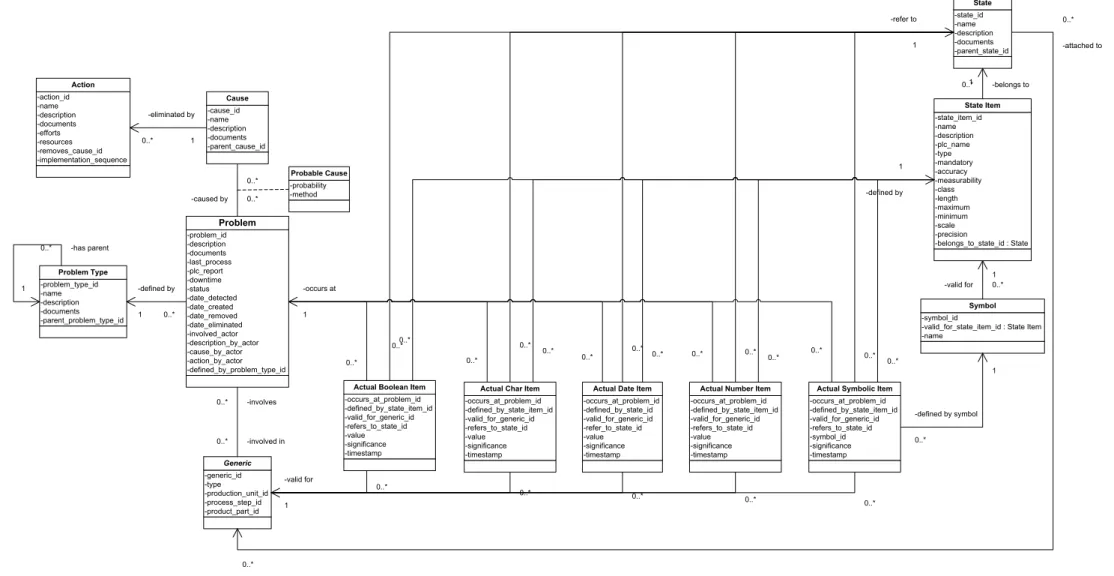
FIGURE 2.3. OVERVIEW OF MODEL‘S DYNAMIC KNOWLEDGE. -problem_id -description -documents -last_process -plc_report -downtime -status -date_detected -date_created -date_removed -date_eliminated -involved_actor -description_by_actor -cause_by_actor -action_by_actor -defined_by_problem_type_id Problem -generic_id -type -production_unit_id -process_step_id -product_part_id Generic -problem_type_id -name -description -documents -parent_problem_type_id Problem Type 1 -has parent 0..* 1 -defined by 0..* -involves 0..* -involved in 0..* -cause_id -name -description -documents -parent_cause_id Cause -action_id -name -description -documents -efforts -resources -removes_cause_id -implementation_sequence Action 0..* -eliminated by 1 -occurs_at_problem_id -defined_by_state_item_id -valid_for_generic_id -refers_to_state_id -value -significance -timestamp
Actual Boolean Item
-occurs_at_problem_id -defined_by_state_item_id -valid_for_generic_id -refers_to_state_id -value -significance -timestamp
Actual Char Item
-occurs_at_problem_id -defined_by_state_id -valid_for_generic_id -refer_to_state_id -value -significance -timestamp
Actual Date Item
-occurs_at_problem_id -defined_by_state_item_id -valid_for_generic_id -refers_to_state_id -value -significance -timestamp
Actual Number Item
-occurs_at_problem_id -defined_by_state_item_id -valid_for_generic_id -refers_to_state_id -symbol_id -significance -timestamp
Actual Symbolic Item
-state_id -name -description -documents -parent_state_id State 0..* -attached to 0..* -state_item_id -name -description -plc_name -type -mandatory -accuracy -measurability -class -length -maximum -minimum -scale -precision
-belongs_to_state_id : State State Item
1 -belongs to 0..*
-symbol_id
-valid_for_state_item_id : State Item -name
Symbol -valid for 0..*
1 -occurs at
1
0..* 0..* 0..* 0..*
0..*
-defined by symbol 0..* 1 -valid for 1 0..* 0..* 0..* 0..* 0..* 0..* -refer to 1 -defined by 1 0..* 0..*
0..* 0..* 0..* 0..*
A problem represents the occurrence of abnormal temporary situations. A problem is defined using a series of attributes including identifier, description, documents, last process executed, PLC report (if exists and is relevant), downtime, and status. In addition, there are four date attributes equally important to establish a diagnosis history in the extended enterprise: the date when the problem was detected, the date when the problem was created in the model, the date when the problem was removed, i.e. when the cause was identified, and the date when the problem was eliminated, i.e. when the actions to eliminate the cause were successfully carried out. Each problem is categorised with a relationship to problem type, using the attribute defined by problem type. Since industrial companies place a high value on responsibility and accountability, it is important to record information about actors that were somehow implicated in the process of diagnosing and solving problems. In order to accomplish this, problems include four attributes that establish relations to actors in the extended enterprise: involved_actor records who reported the problem in the first place,
description_by_actor registers who finalised relating the problem with all its characteristics,
cause_by_actorrecords who identified the problem‘s cause, and actions_by_actor registers
who implemented the necessary actions to eliminate the problem.
A very important part of describing a problem is establishing relationships with elements of the extended enterprise, i.e. objects of the static part of the model. One of the most important relationships is establishing where exactly the problem occurred. This connection defines which physical elements of the extended enterprise, i.e. generics, were involved in the problem. This means that it is possible to identify the production units, process steps and product parts implicated in the problem.
Just identifying the generics does not provide a clear description of what may have happened. It is extremely advantageous to have a snapshot of the generics involved, i.e. register any possible measurable characteristics. These measurable characteristics of generics exist in the static part of the model, as state items. In the dynamic part of the model, it is possible to identify specific values for the state items, which are denominated actual state items. Each value can be one of five types: Boolean, date, number, text or symbol. An
actual state item is defined by a state item, refers to a state, is valid for one generic and has occurred during one problem. An actual state item has additionally a timestamp to indicate when exactly the measure was registered.
2.4. MODELLING METHODOLOGY
Gathering, modelling, structuring and storing information are difficult tasks. Industrial companies usually search help for such processes, turning to experts in knowledge and information and communication technologies, frequently designated as knowledge engineers. Knowledge acquisition is the task of gathering information from any source, and knowledge elicitation is the sub-task of gathering knowledge from human experts (Shadbolt and Burton 1989). There are a number of tools to support knowledge acquisition and elicitation, but they require considerable experience to ensure an efficient process.
With the objective of supporting industrial companies in minimising the need for external support, the proposed model is not a stand-alone development. It is accompanied by a comprehensive methodology to help industrial companies in modelling their extending enterprises, with limited support from knowledge modelling experts. The objective of the methodology is to provide industrial actors with guidelines that allow them to identify the relevant information to be modelled within the extended enterprise, and also methods on how to efficiently acquire that information.
There have been several representations of steps or stages for a knowledge acquisition process. Buchanan et al. suggest five stages for knowledge acquisition: identification, conceptualisation, formalisation, implementation and testing (Buchanan, et al. 1983). Rook and Croghan further specify this knowledge acquisition process, by defining seven steps: knowledge framework specification, knowledge resource identification, macro-knowledge extraction, knowledge partitioning, micro-knowledge extraction, knowledge formalisation and knowledge encoding (Rook and Croghan 1989). Grover developed a simplified knowledge acquisition cycle comprehending three phases: domain definition, fundamental knowledge formulation and basal knowledge consolidation (Grover 1983).