UNIVERSIDADE NOVA DE LISBOA
ESCOLA NACIONAL DE SAÚDE PÚBLICA
Who wants to cross borders in the EU for health care? An analysis
of the Eurobarometer data in 2007 and 2014
XIX Mestrado em Saúde Pública
ANDRÉ PERALTA SANTOS
UNIVERSIDADE NOVA DE LISBOA
ESCOLA NACIONAL DE SAÚDE PÚBLICA
Who wants to cross borders in the EU for health care? An analysis
of the Eurobarometer data in 2007 and 2014
Dissertação apresentada para cumprimento dos requisitos necessários à obtenção do grau de Mestre em Saúde Pública, realizada sob a orientação científica do Professor Julian Perelman
Acknowledgments
I would like to thank my former supervisor at the European Commission, Dr. Enrique Terol for opening my mind to the beautiful and delicate world of European Health Policy.
To my thesis supervisor, Professor Julian Perelman, for having the time for me and patience to steer me in the right direction. My thanks to Joana Alves for sharing some Stata codes that made my life easier.
Abstract
BACKGROUND
The EU Directive on cross-border healthcare clarified the entitlements of EU citizens to medical care in other EU Member states. However, little is known about whether EU citizens have been travelling or are willing to travel to receive medical care. The aim of this study was to measure the determinants of cross-border patient mobility and willingness to travel to receive medical care in the EU, before and after the adoption of the Directive.
METHODS
We used individual data from the Eurobarometer 210 (2007) and 425 (2014). In the two years, 54,384 EU citizens were randomly selected for telephone and face-to-face interviews. We performed a logistic regression on the cross-border patient mobility and willingness to travel to other EU countries to use healthcare services as a function of the year (2007 or 2014), adjusting for age, gender, education, self perceived health (SPH), and country size.
RESULTS
In 2007, 3.3% of citizens reported cross-border mobility, and 4.6% in 2014. The odds of cross-border patients’ mobility was 15% higher in 2014, compared to 2007 (OR 1.15, 95%CI 1.05-1.26, p<.001). In addition, mobility was 15% higher in males (OR 1.15, 95%CI 1.05-1.3, p<0.001) and 20% amongst the more educated (OR 1.2, 95%CI 1.1-1.3, p<.001). However, the odds decreased with age (OR 0.9 per decade, 95%CI 0.84-0.92, p<.001), bad and very bad SPH, and country size. In 2014 the willingness to travel decreased by 22% compared to 2007. The other determinants of willingness to travel, namely gender, age, education, SHP, and country size, had a similar effect as in the cross-border mobility model.
CONCLUSIONS
Cross-border patient mobility and willingness to travel are more likely amongst younger, more educated, and healthier patients from smaller countries. The 2011 directive does not seem to have promoted mobility at a large scale among the neediest citizens.
Resumo
INTRODUÇÃO
A diretiva da União Europeia (UE) referente ao exercício dos direitos dos pacientes em cuidados de saúde transfronteiriços clarificou os direitos dos cidadãos da UE. No entanto, pouco se sabe sobre a mobilidade transfronteiriça dos pacientes e a vontade de viajar para receber cuidados médicos. Desse modo, pretendemos estudar os determinantes da mobilidade transfronteiriça dos pacientes e a vontade de viajar para receber cuidados médicos na UE, especialmente após a adoção da diretiva.
MÉTODOS
Utilizamos dados do Eurobarómetro 210 (2007) e 425 (2014). Nos dois anos 54.384 cidadãos da UE foram selecionados aleatoriamente para entrevistas telefónicas e pessoalmente. Aplicámos uma regressão logística à mobilidade transfronteiriça dos pacientes e a vontade de viajar para usar os serviços de saúde noutros países da EU em função do ano (2007 ou 2014), idade, sexo, educação, saúde auto-reportada e tamanho do país.
RESULTADOS
Em 2007, 3,3% dos cidadãos relataram mobilidade transfronteiriça aumentando para 4,6% em 2014. A probabilidade de mobilidade transfronteiriça dos pacientes foi 15% maior em 2014, em comparação com 2007 (OR 1,15, IC 95% 1,05-1,26, p <.001). Além disso, a mobilidade foi 15% maior em homens (OR 1,15, IC 95% 1,05-1,3, p <0,001) e 20% em níveis mais elevados de educação (OR 1,2, 95% CI 1.1-1,3, p <0,001). No entanto, a probabilidade diminuí com a idade (OR 0,9 por década, IC 95% 0,84-0,92, p <0,001), má e muito má saúde auto-reportada e tamanho do país. Por outro lado, em 2014, a vontade de viajar diminuiu 22% em relação a 2007. Os outros determinantes da vontade de viajar, sexo, idade, educação, saúde auto-reportada e tamanho do país tiveram um efeito semelhante ao do modelo da mobilidade.
CONCLUSÕES
Entre 2007 e 2014, houve um ligeiro aumento da mobilidade transfronteiriça dos pacientes, que é, no entanto ainda baixo. A mobilidade transfronteiriça dos pacientes e a vontade de viajar são mais prováveis entre os pacientes mais jovens, mais educados, mais saudáveis, e de países mais pequenos. A diretiva de 2011 não parece ter promovido a mobilidade em grande escala entre os cidadãos mais necessitados.
Table of contents
Acknowledgments ... iii
Abstract ... iv
Resumo ... v
List of tables ... vii
List of abbreviations ... viii
1. Foreword ... 1
2. Background ... 3
3. Methods ... 5
4. Results ... 7
5. Discussion ... 13
6. Conclusion ... 17
7. References ... 19
Annex I – EU Legal framework for patients´ rights in cross-border health care ... 23
List of tables
List of abbreviations
AT Austria NL The Netherlands
BE Belgium OR Odds Ratio
BG Bulgaria PL Poland
CI Confidence Interval PT Portugal
CY Cyprus SE Sweden
CZ Czech Republic SI Slovenia
DE Germany SK Slovakia
DK Denmark SPH Self Perceived Health
EE Estonia UK United Kingdom
EEA European Economic Area WHO World Health Organization EHIC European Health Insurance Card
ES Spain
EU European Union IE Ireland
FI Finland
FR France
GR Greece
HR Croatia
HU Hungary
IT Italy LT Lithuania
LU Luxemburg
1. Foreword
In the midst of increasing nationalism and scepticism over the European Institutions, it is more important than ever to study the impact of European policies. Shedding light on policies that are often labelled as undemocratic and excessively complex (1) can help communities to understand the reasons and implications of policies that fall outside of the usual media focus and attention of the national political arena.
Health is an area in which the European Union (EU) has limited power. Due to the subsidiarity principle the competences remain mainly within the Member-States. Before the Great Recession, citizens demanded the right to access other European Health systems, despite the obstacles by member-sates, those demands were warrantied due to court decisions. The action of courts in this matter urged the political power to act. As a result, the negotiations began for the future Directive 2011/24/EU on patients’ rights in cross-border healthcare. Regardless of the (lack of) ambition to integrate the European Health Systems, the new directive is a milestone in the European Health system landscape. In addition, it can be a powerful instrument to advocate for the relevance of the European Policies, due to the possible effect of increasing access and quality of care among the neediest. This sense of solidarity within the European Union dilapidated by years of austerity (2010-2015) is crucial to maintain intact the pillars of the European Institutions.
However, few studies have assessed the determinants of cross-border mobility or determined the impact of the Directive. This thesis is an attempt to add some knowledge to this field. The thesis was presented at the 2016 European Public Health Conference and nominated for the Ferenc Bojan: Young Investigator Award: It was also submitted for publication in an indexed scholarly journal in the public health field.
2. Background
European Union law guarantees that every citizen is entitled to preventive healthcare and medical treatment (2). Although the provision of healthcare services is mainly assured by national countries, EU Citizens are also legally entitled to seek medical care in another EU country. The movement of EU patients to receive healthcare in another EU country (cross border patient mobility) accounts for more than 9.7bilion Euros in healthcare spending per year (3).
Cross-border patient mobility could redistribute supply and demand in the EU toward better provision of care in terms of safety, quality, and efficiency (4,5,6,7,8). The cross-border patient mobility, can be planned (patient deliberately traveling across the border to obtain health care), or unplanned depending on the reasons that motivated the mobility (9,10), as shown in the table 1.
Table 1. Reasons to seek cross-border medical care in the European Union
Holidays Citizens who need to use the health care services on holidays in another EU/EEA country.
Retirement Citizens who retired to a different country and want to use the healthcare system where they currently live.
Border regions
Citizens who live in border regions and share cultural and linguistic characteristics of the region in another EU country, and who want to use the healthcare service closer to home, which might be on the other side of the border.
Perceived advantages
Citizens who seek cross border healthcare due to perceived advantages of the system in another EU country, related to the price (out of pocket), comprehension of the basket of care, quality of the services, or access (waiting times).
Health System incapacity
Citizens who are sent abroad by their health systems to overcome capacity or expertise shortage at the national system. It concerns mainly smaller countries, or regions with low population density.
Many authors have sought to describe the barriers and facilitators of cross-border patient mobility. The proximity of cross-border services (geographical and language), perceived quality of care, costs of care (co-payments) (9,11), range of the basket of care (12) (13), and responsiveness of the system (e.g., lower waiting times) (14) were mentioned as relevant factors of cross-border patient mobility.
A new EU legislation, to be transposed by Member States by 25 October 2013, has been implemented to facilitate cross-border medical care. Although it did not create new entitlements, this new law clarified the rights of patients to seek reimbursement for healthcare received in another Member State (15). The clarification of the entitlements made the reimbursement of Health expenses in another Member-state more predictable, and clarified the basket of care in the EU countries (16,17,18). The patients with the implementation of the directive had the right to be treated in other Member-states under certain conditions (see Annex I for more clarification), and to be reimbursed for the expenses after the provision of care. Nevertheless, many countries require prior approval of Cross-border health treatments.
3. Methods
STUDY DESIGN AND POPULATION
We used primary data from the flash Eurobarometer 210 (2007) (19) and the special
Eurobarometer 425 (2014) (20) obtained through the Leibniz-Institute for the Social Sciences (GESIS). The Eurobarometer surveys covered participants from the European Union Member States, and each national sample was representative of the population aged 15 years and over. Participants were sampled using a multistage random sampling design based on country specific population size. In 2007, the mode of data collection was mainly through Computerized Assisted Telephone Interview (70% of the sample) the rest was face-to-face interview. For 2014 the mode of data collection was only face-to-face interview by Computer Assisted Personal Interview. All variables were self-reported. The Country of residence was indicated by the interviewer; the study team recoded West and East-Germany into Germany, and England and Northern Ireland into United Kingdom. Detailed methods of the surveys´ methodology can be found elsewhere (21).
STUDY OUTCOMES
EXPLANATORY VARIABLES
Age, gender, education, employment status, country size, and self perceived health were included as explanatory variables, following earlier contributions on patient mobility (4,10,22). Age was measured in years and used as a continuous variable, although for the inferential analysis age was recoded as a categorical variable with 10-year intervals. Education was a three-category variable, which indicated the age at which the person concluded her/his education: “less than 15 years old”, “more than 15 years-old”, or “still studying”. Employment status was divided into “working”, “retired”, and “not working” (unemployed and students) categories. Country size was defined as the population size weight of the country based on the resident population, used by the Eurobarometer Survey, the countries were then aggregated after in population weight tertiles (large, medium and small countries). We used the bad and very bad self perceived health (SPH) data from European Survey on Income and Living Conditions (EU-SILC), for the years 2007 and 2014, as this variable was not assessed by
Eurobarometer. We aggregated this variable by country, age group, gender, and employment status. This aggregate determinant was attributed to each individual observation from the
Eurobarometer according to its country, age group, gender, and employment status.
STATISTICAL METHODS
We used Chi-square tests to compare frequency distributions for categorical variables, and t-tests were used to compare the means of continuous variables (age). All proportions and means were weighted according to sampling weights.
We then pooled the data for 2007 and 2014, and performed a logistic regression on the cross-border patient mobility and willingness to travel to other EU countries. We modelled these outcomes as a function of the year (2007 or 2014), age, gender, education, SPH, and country size.
Age was tested in the model in square root, quadratic, and cubic function to check for non-linear behaviour. The missing data were not incorporated in the models. The population size weighting factors correct for the fact that most countries have almost identical sample sizes (n=1000), no matter how large or small their populations are, these weights were applied to determine percentages and in the multivariate analyses.
4. Results
The sample included a total of 55,096 observations from all the EU countries. After the elimination of observations with missing data, the sample was reduced to a total of 53,439 observations (3% of the sample was removed).
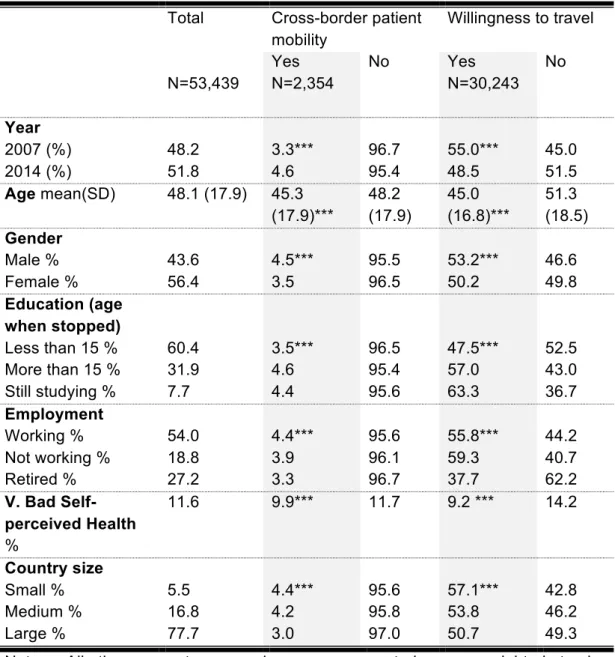
Table 2 shows the baseline characteristics of the population interviewed. The mean age is 48 years old and 56% are female. More than half of the interviewed were working, 11% had a bad or very bad self perceived health, and 77% were from large European Countries. Overall, the interviewees who received medical care abroad (cross-border patient mobility) were younger (mean age 45.3 years), more likely to be male (4.5% versus 3.5% in women), more educated (4.6% stopped studying after 15 years old, versus 3.5% stopped studying before 15 years old), and more likely to report a bad or very bad health (9.9% versus 11.1%). Also, retired interviewees (3.3% versus 4.4% working) and those from large countries (3.0% versus 4.4 in small countries) received less medical care abroad. A very similar pattern was observed for the willingness to travel.
CROSS-BORDER PATIENT MOBILITY
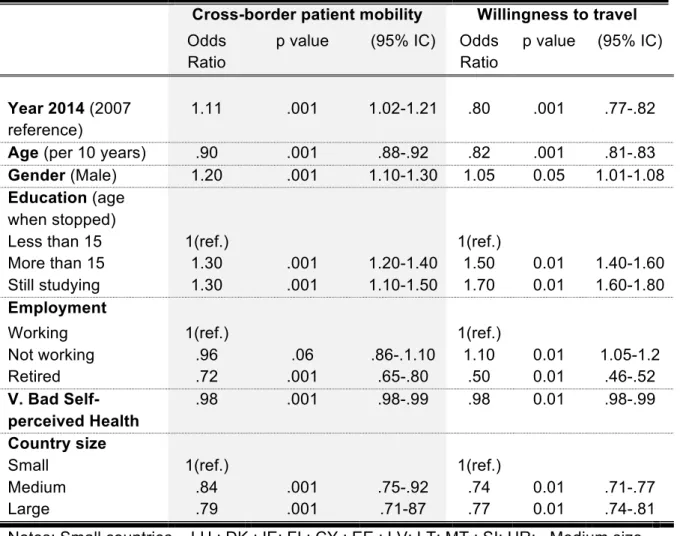
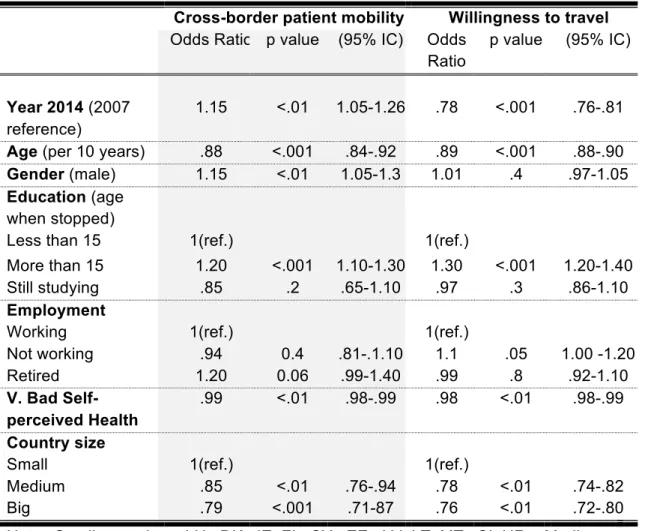
Cross-border patient mobility increased from 2007 to 2014 (3.3% in 2007 versus 4.6% in 2014). Nevertheless, the absolute values remained low. In the unadjusted analysis some factors favoured the cross-border patient mobility, among which gender and education were the most notable (Table 3). In the adjusted analysis males had a 15% increased likelihood of crossing borders when compared to women (OR 1.15 95%CI 1.05-1.3). The EU citizens who stopped studying at age 15 years old or older had a 20% greater likelihood of cross-border patient mobility (OR 1.2 95%CI 1.1-1.3), when compared to those who stopped at 15 years old or younger. In the year 2014, there was a 15% increase in the likelihood to have received medical care abroad when compared to the year 2007 (OR 1.15 95%CI 1.05-1.26).
95%CI 0.75-0.92) or large country (OR 0.79 95%CI 0.71-0.87). The employment status lost its significance in the adjusted model.
WILLINGNESS TO TRAVEL TO RECEIVE MEDICAL CARE
The willingness to travel to receive medical care fell from 2007 to 2014. Contrasting with the cross-border patient mobility low prevalence, the percentage of citizens willing to travel is high (55.0% in 2007 and 48.5% in 2014).
In the unadjusted model, the determinants that favoured the willingness to travel were being male (OR 1.05 95%IC 1.01-1.08), being a non-worker (OR 1.1 95%CI 1.05-1.2), and having stopped studying at 15 years old (OR 1.1 95%CI 1.05-1.2) or being still studying (OR 1.7, 95%CI 1.6-1.8). Nevertheless, most of these determinants lost significance in the adjusted model, except stop studying at age 15 years or older (OR 1.3 95%IC 1.2-1.4) (Table 3).
Some determinants in the adjusted model were barriers to the willingness to travel to receive medical care, such as older age (per 10 years) (OR 0.89 95%IC 0.88-0.90), having a bad or very bad self perceived health (OR 0.98 95%IC 0.98-0.99), and being from a medium (OR 0.78 95%IC 0.74-0.82) or large country (OR 0.76 95%IC 0.72-0.80).
The willingness to travel was significantly lower in 2014, as compared to 2007 (OR 0.80 95%IC 0.77-0.82). In the adjusted model gender and employment status were no longer significant.
Table 2. Baseline characteristics of the sample.
Total Cross-border patient mobility
Willingness to travel
Yes No Yes No
N=53,439 N=2,354 N=30,243
Year
2007 (%) 48.2 3.3*** 96.7 55.0*** 45.0
2014 (%) 51.8 4.6 95.4 48.5 51.5
Age mean(SD) 48.1 (17.9) 45.3 (17.9)*** 48.2 (17.9) 45.0 (16.8)*** 51.3 (18.5) Gender
Male % 43.6 4.5*** 95.5 53.2*** 46.6
Female % 56.4 3.5 96.5 50.2 49.8
Education (age when stopped)
Less than 15 % 60.4 3.5*** 96.5 47.5*** 52.5
More than 15 % 31.9 4.6 95.4 57.0 43.0
Still studying % 7.7 4.4 95.6 63.3 36.7
Employment
Working % 54.0 4.4*** 95.6 55.8*** 44.2
Not working % 18.8 3.9 96.1 59.3 40.7
Retired % 27.2 3.3 96.7 37.7 62.2
V. Bad Self-perceived Health %
11.6 9.9*** 11.7 9.2 *** 14.2
Country size
Small % 5.5 4.4*** 95.6 57.1*** 42.8
Medium % 16.8 4.2 95.8 53.8 46.2
Large % 77.7 3.0 97.0 50.7 49.3
Table 3. Determinants of Cross-border patient mobility and willingness to travel in the EU, unadjusted model
Cross-border patient mobility Willingness to travel
Odds Ratio
p value (95% IC) Odds Ratio
p value (95% IC)
Year 2014 (2007 reference)
1.11 .001 1.02-1.21 .80 .001 .77-.82
Age (per 10 years) .90 .001 .88-.92 .82 .001 .81-.83
Gender (Male) 1.20 .001 1.10-1.30 1.05 0.05 1.01-1.08
Education (age when stopped)
Less than 15 1(ref.) 1(ref.)
More than 15 1.30 .001 1.20-1.40 1.50 0.01 1.40-1.60
Still studying 1.30 .001 1.10-1.50 1.70 0.01 1.60-1.80
Employment
Working 1(ref.) 1(ref.)
Not working .96 .06 .86-.1.10 1.10 0.01 1.05-1.2
Retired .72 .001 .65-.80 .50 0.01 .46-.52
V. Bad Self-perceived Health
.98 .001 .98-.99 .98 0.01 .98-.99
Country size
Small 1(ref.) 1(ref.)
Medium .84 .001 .75-.92 .74 0.01 .71-.77
Large .79 .001 .71-87 .77 0.01 .74-.81
Table 4. Determinants of Cross-border patient mobility and willingness to travel in the EU, adjusted model
Cross-border patient mobility Willingness to travel Odds Ratio p value (95% IC) Odds
Ratio
p value (95% IC)
Year 2014 (2007 reference)
1.15 <.01 1.05-1.26 .78 <.001 .76-.81 Age (per 10 years) .88 <.001 .84-.92 .89 <.001 .88-.90
Gender (male) 1.15 <.01 1.05-1.3 1.01 .4 .97-1.05
Education (age when stopped)
Less than 15 1(ref.) 1(ref.)
More than 15 1.20 <.001 1.10-1.30 1.30 <.001 1.20-1.40
Still studying .85 .2 .65-1.10 .97 .3 .86-1.10
Employment
Working 1(ref.) 1(ref.)
Not working .94 0.4 .81-.1.10 1.1 .05 1.00 -1.20
Retired 1.20 0.06 .99-1.40 .99 .8 .92-1.10
V. Bad Self-perceived Health
.99 <.01 .98-.99 .98 <.01 .98-.99 Country size
Small 1(ref.) 1(ref.)
Medium .85 <.01 .76-.94 .78 <.01 .74-.82
Big .79 <.001 .71-87 .76 <.01 .72-.80
5. Discussion
KEY FINDINGS
We conducted a study seeking to identify the determinants of cross-border patient mobility and the willingness to travel to receive medical care in the European Union using data from interviews of two Eurobarometer surveys. We found that between 2007 and 2014 there was an increase in cross-border mobility and a decrease in willingness to travel to receive medical care. Additionally, older people were less likely to seek medical care across the border (12% decrease per decade) and less willing to receive medical care in another EU country (11% decrease per decade). More educated EU citizens were more likely to seek healthcare abroad (20% increase) and more willing to travel to receive care (30% increase). The larger the country of residence, the less likely the use and willingness to seek medical care abroad. Furthermore, although men and women were equally likely to be willing to seek medical care in another EU country, men engaged more in cross-border medical care (20% increase).
INTERPRETATION
The literature is scarce to compare the figures of cross-border mobility or willingness to travel in the EU. Also, there are no other regions of the globe with similar cross-border healthcare framework. For the United States of America estimates of planned cross-border patient mobility vary between 1% and 1.5% (23), although it can go up to 37% in the Mexican border region (24).
Higher levels of education are not a surprising determinant of cross-border patient mobility and willingness to travel. More years of education entail a better understanding of rights and more demanding expectations of the healthcare system (29).
Interestingly, employment status does not play a role in cross-border patient mobility, nor in willingness to travel. Working people with a steady income were expected to be more likely to afford traveling for care. However, our employment categories were possibly too large and heterogeneous to capture differences in socioeconomic conditions. The “employed” category, in particular, may encompass very different occupations, social positions, and incomes.
The greater mobility by people from smaller countries may be explained by the possibly lower provision of highly-specialized care, which are only profitable in large countries facing a greater demand (30). People in smaller countries also face lower travel distance to reach a neighbour country. The most obvious example is Luxembourg, where 18% people seek care abroad (20). Despite the increase of 1.3% in cross-border patient mobility in 2014, the absolute numbers remain low. Even with the implementation of the Directive, we are far from an EU Health market. One could consider the willingness to travel as the stock of the population that could travel, and one could therefore conclude that only a tenth of those who are willing to travel actually engage in cross-border patient mobility. The small relative increase in the recent years could be influenced by the financial, economic and social crisis in Europe. Cross-border mobility under the new Directive demands considerable out-of-pocket expenditures, because the reimbursement of expenses is done after the provision of services. Adverse economic circumstances could have a negative impact on cross-border patient mobility, as a result.
STRENGTHS
This study is to the best of our knowledge the first to quantify the determinants of cross-border patient mobility and the willingness to travel to receive medical care on a large scale, at the EU level. We were able to demonstrate empirically what was theorized before (9), that citizens from larger countries, which are able to concentrate more health care resources are less likely and willing to seek medical care abroad.
The combination of two years of surveys, before and after an important policy change “Directive on patients’ rights in cross-border healthcare” made it possible to estimate a potential effect of the Directive. The increase in the mobility combined with a decrease in the willingness to travel could mean that some unmet needs were covered by seeking medical care abroad. Some authors claim that cross-border patient mobility could redistribute supply and demand toward a better provision of care in terms of safety, quality, and efficiency (2). In addition, the decrease in the willingness to travel to seek care abroad could mean that unmet needs within the country were reduced. The latter gains more strength as some literature reports that the Directive was an opportunity to implement reforms (10) including legislation on patients' rights (16) (17), a health benefits package, and compulsory indemnity insurance. That entails a positive spill-over of the Directive. Whatever the determinant, the willingness is based on the comparison between the health system of the country of residence and the country of treatment (4, 5).
LIMITATIONS
This study has some limitations. First, the surveys in 2007 and 2014 had some differences in the methodology applied. In 2007, the survey used mainly telephone interviews, which might lead to some selection bias toward participants who spend more time at home (retired, unemployed), with a lower purchasing power, and therefore less likely to seek less medical care abroad. In 2014 all the interviews were done face-to-face. These different methods might overestimate the difference between the two years. Although this might affect the estimate of the “Year” determinant, it is unlikely to influence the other determinants.
Other factors could that we could not measure influence the cross-border patient mobility, such as the unmet medical needs, affordability of care, and perceived medical quality. However, adjusting to these factors could be seen as over adjustment, because those are drivers of cross-border patient mobility and willingness to travel.
Another limitation is related with the inability to stratify the patient mobility into planned and unplanned. In the 2014 survey this stratification was possible, however in 2007 the stratified data were not available. This could be seen as a limitation because planned and unplanned medical care might have different determinants. Hence, planned or unplanned care could act potentially as an effect modifier. The European Commission reports that approximately 40% of all the cross-border patient mobility is planned (31).
important determinant to seek medical care, we used this determinant from another data source. To have a better fit of this variable it was paired by gender, age, country and employment status, thereby, minimizing any distortion in the model.
FUTURE RESEARCH
6. Conclusion
7. References
1. Alexander A. The European Union is Inherently Undemocratic | Oxford Royale Academy. (Online).; 2013 (cited 2017 june 10. Available from: https://www.oxford-royale.co.uk/articles/european-union-undemocratic.html.
2. European Parliament. Charter of fundamental rights of the European Union Parliament TE, editor. Brussels: Official Journal of the European Communities; 2000.
3. European Commission. The European Parliament and Council on the application of patients' rights in cross-border healthcare - Impact Assessment. Brussels:; 2009.
4. Wismar M, Palm W, Figueras J, Ernst K, Ginneken Ev. Cross-border health care in the European Union Mapping and analysing practices and policies European. 1st ed. Policies OoHSa, editor. Brussels: Observatory on Health Systems and Policies; 2011.
5. Glinos I, Baeten R, Maarse H. Purchasing health services abroad: practices of cross-border contracting and patient mobility in six European countries. Health Policy. 2010 May 31; 95(2): p. 103-112.
6. Brand H, Hollederer A, Wolf U, Brand A. Cross-border health activities in the Euregios: Good practice for better health. Health policy. 2010 May 8; 86(2): p. 245-254.
7. Palm W, Baeten R. The quality and safety paradox in the patients’ rights Directive. Eur J Public Health. 2011 Feb 1; 21(3): p. 272-274.
8. Vallejo P, Su-Ol R. MARQulS: quality improvement strategies for European cross-border healthcare. Qual Saf Health Care. 2009 Feb 1; 18(supple1): p. i1-2.
9. Legido-Quigley H, Glinos I, Baeten R, McKee M, Busse R. Analysing arrangements for cross-border mobility of patients in the European Union: a proposal for a framework. Health Policy. 2012 Nov 30; 108(1): p. 27-36.
11. Glinos I, Doering N, Maarse H. Travelling home for treatment and EU patients’ rights to care abroad: Results of a survey among German students at Maastricht University. Health Policy. 2012 April 20; 105(1): p. 38-45.
12. Busse R, Schreyögg , Smith. Variability in healthcare treatment costs amongst nine EU countries–results from the HealthBASKET project.. Health economics. 2007 Jan; 17(S1): p. 1-8.
13. Schreyogg J, Stargardt T, Velasco-Garrido M, Busse R. Defining the "Health Benefit Basket" in nine European countries. Evidence from the European Union Health BASKET Project. Eur J Health Econ. 2005 Nov 1; 6(1): p. 2-10.
14. Brouwer W, Exel Jv, Hermans B, Stoop A. Should I stay or should I go? Waiting lists and cross-border care in the Netherlands. Health Policy. 2003; 63((3)): p. 289-98.
15. Legido-Quigley H, Passarani I, Knai C, Busse R, W WP, Wismar M, et al. Cross-border healthcare in Europe: clarifying patients’ rights. BMJ. 2011; 342(7793): p. 364–7.
16. Azzopardi-Muscat , Aluttis , Sorensen , Pace , Brand. The impact of the EU Directive on patients' rights and cross border health care in Malta. Health Policy. 2015; 119(10): p. 1285-92.
17. Requejo M. Cross-border healthcare in Spain and the implementation of the Directive 2011/24/EU on the Application of Patient's Rights in Cross-border Healthcare. Eur J Health Law. 2014; 21(1): p. 33-45.
18. Vidalis T, Kyriakaki I. Cross-border healthcare: Directive 2011/24 and the Greek law. 2014 Feb 13; 21(1): p. 33-45.
19. European Commission. Flash Eurobarometer 210 (Cross-border Health Services in the EU. The GALLUP Organisation, Brussels. GESIS Data Archive, Cologne. ZA4805 Data file Version 1.0.0. 2007.
Available from: http://www.gesis.org/eurobarometer-data-service/survey-series/flash-eb/sampling-fieldwork/.
22. Glinos I, Baeten R. A Literature review of cross-border patient mobility in the European Union. 2006 Sep.
23. Keckley PH. Medical tourism: Update and implications. Boston: Deloite, Center for Health Solutions; 2009.
24. Su D, Richardson C, Wen M, Pagán J. Cross-Border Utilization of Health Care: Evidence from a Population-Based Study in South Texas. Health services research. 2011 Jun 1; 46(3): p. 859-76.
25. Eurostat. Foreign language learning statistics. (Online). Brussels: European Commission; 2016 (cited 2017 June 10. Available from:
http://ec.europa.eu/eurostat/statistics-explained/index.php/Foreign_language_learning_statistics.
26. Brekke K, Levaggi R, Siciliani L, Straume O. Patient mobility and health care quality when regions and patients differ in income. J Health Econ. 2016; 50: p. 372-387.
27. Busse M, Barslund M. Labour Mobility in the EU: Dynamics, Patterns and Policies. Intereconomics. 2014 May; 49(3): p. 116-58.
28. European Commission. Geographical and labour market mobility | Special Eurobarometer 337. 2014 Dez.
29. Panteli D, Wagner C, Verheyen F, Busse R. Know before you go: information-seeking behaviour of German patients receiving health services abroad in light of the provisions of Directive 2011/24/EU. J Health Serv Res Policy. 2015 Jul; 20(3): p. 154-61.
30. Brekke K, Levaggi R, Siciliani L, Straume O. Patient mobility and health care quality when regions and patients differ in income. J Health Econ. 2016; 50.
31. European Commission. Special Eurobarometer 425. (Online).; 2015 (cited 2017 June
10. Available from:
http://ec.europa.eu/commfrontoffice/publicopinion/archives/ebs/ebs_425_en.pdf.
Annex I – EU Legal framework for patients
´ rights in cross-border
health care
ROUTES FOR PATIENTS’ MOBILITY IN THE EUROPEAN UNION
In the EU countries, patients are entitled to the provision of medical care abroad, these rights may apply to tourists requiring unforeseen care during a temporary stay (via the European Health Insurance Card), EU citizens living abroad (EU), and to citizens that are authorized to get pre-arranged (planned) medical care abroad12.
UNPLANNED MEDICAL CARE
The EU citizens have the right to unforeseen medical care, in an EU Country other than the country of residence. The European Health Insurance Card (EHIC) certifies that the EU citizen is insured. This enables that the provision of care in the country of care follows the same rules applicable to the residents of the country of care. The country of treatment will ask the country of affiliation to reimburse the cost of the treatment. The coordination and cooperation between the different healthcare systems falls under coordination of social security systems regulation.
PLANNED MEDICAL CARE
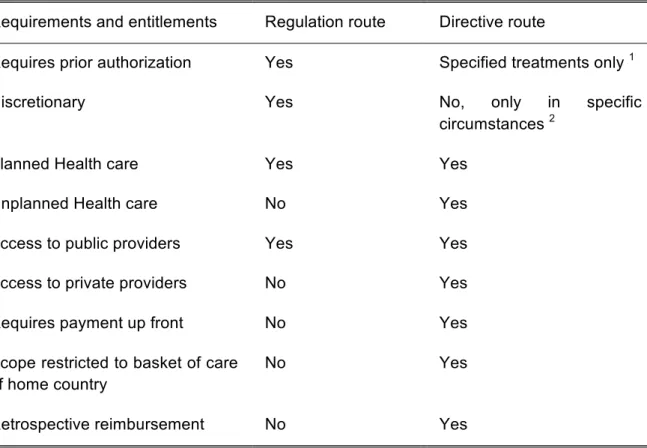
Under the EU legislation, patients can have access to provision of planned care abroad by two main routes. In first route, the patients seek access to treatment abroad by issuing an authorization request to the country of affiliation. If granted, under this route the patient can receive medical care and is not required to pay the service provided abroad. In this case the country of affiliation has the control of whether or not to grant authorization for planned treatment (under the Regulation (EC) Nº 883/2004), except in cases of proven “undue delay”.
1
Regulation (EC) No 883/2004 of the European Parliament and of the Council of 29 April 2004 on the coordination of social security systems
2
Table 5. Annex I - Comparison of requirements and entitlements to patients between
the social security regulation and the patients’ rights on cross-border care directive
Requirements and entitlements Regulation route Directive route
Requires prior authorization Yes Specified treatments only 1
Discretionary Yes No, only in specific
circumstances 2
Planned Health care Yes Yes
Unplanned Health care No Yes
Access to public providers Yes Yes
Access to private providers No Yes
Requires payment up front No Yes
Scope restricted to basket of care of home country
No Yes
Retrospective reimbursement No Yes
Notes: 1 – reasons for prior authorization: hospital accommodation overnight, highly specialized and cost-intensive care, high risk treatments, or providers that raise quality doubts.
Annex II – Variables used in the study
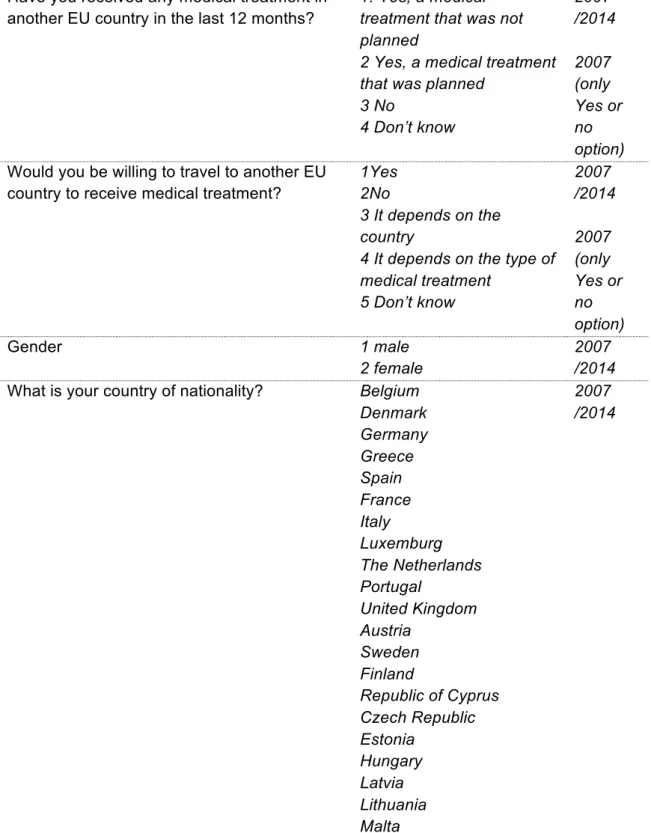
Table 6. Description of the variables used in the study
Question / Variable Classification Year
Have you received any medical treatment in another EU country in the last 12 months?
1. Yes, a medical treatment that was not planned
2 Yes, a medical treatment that was planned
3 No
4 Don’t know
2007 /2014 2007 (only Yes or no option) Would you be willing to travel to another EU
country to receive medical treatment?
1Yes 2No
3 It depends on the country
4 It depends on the type of medical treatment
5 Don’t know
2007 /2014 2007 (only Yes or no option)
Gender 1 male
2 female
2007 /2014 What is your country of nationality? Belgium
Denmark Germany Greece Spain France Italy Luxemburg The Netherlands Portugal United Kingdom Austria Sweden Finland
Poland Slovenia Bulgaria Romania Croatia Other Countries How old were you when you stopped full-time
education?
Years 2007
/2014
How old are you? Years 2007
/2014 Did you do any paid work in the past? What
was your last occupation?
Not working (student, unemployed or temporarily not working, responsible for looking after home) Working (self employed, employed)
Retired or unable to work due to illness
2007 /2014
Population size weighting factor corrects for the fact that most samples are of almost identical size, no matter how large or small the populations are from which they were drawn. These weights ensure that each country as well as each lower level sample (Great Britain and Northern Ireland, East and West Germany) are represented in proportion to its population size within different
country/sample groupings, or according to the historical states of European unification W22 (WEIGHT EU27) includes all 25 member countries after the 2004 enlargement, and the new members as of 2007 (Romania and Bulgaria)
W23 (EU28) refers to the EU 28 countries (EU27 plus Croatia; membership as of July 2013)
Number 2007
/2014
How is your health in general?
From the EU statistics on income and living conditions (EU-SILC)
Very bad and Bad All the others