ISSN 0212-1611 • CODEN NUHOEQ S.V.R. 318
Original
Cross-cultural adaptation of the Portuguese version of the
patient-generated subjective global assessment
J. A. Duarte Bonini Campos1and C. Dias do Prado2
¹Professora Dra. Disciplina de Bioestatística e Metodologia Científica. Departamento de Odontologia Social. Faculdade de Odontologia de Araraquara. Universidade Estadual Paulista-UNESP. Araraquara, São Paulo. Brazil. ²Pos-graduação em Alimentos e Nutrição. Faculdade de Ciências Farmacêuticas. Universidade Estadual Paulista-UNEP. Araraquara. São Paulo. Brazil.
ADAPTACIÓN TRANSCULTURAL DE LA VERSIÓN PORTUGUESA DE LA VALORACIÓN SUBJETIVA
GLOBAL-GENERADA POR EL PACIENTE Resumen
Introducción: la adaptación transcultural del
Patient-Generated Subjective Global Assessment es importante ya que se puede utilizar con confianza en la lengua portu-guesa.
Objetivo: realizar una versión de adaptación
transcul-tural al portugués del Patient-Generated Subjective Glo-bal Assessment y estimar su fiabilidad intra-observador.
Material y métodos: se trata de un estudio de
valida-ción. La validez aparente fue clasificada por 17 profesio-nales sanitarios y 10 lingüistas portugueses. Se analizaron las equivalencias idiomáticas, semánticas, culturales y conceptuales. El cuestionario fue completado por 20 pacientes del Hospital Amaral Carvalho (Jaú, São Paulo, Brasil) con el fin de verificar el Índice de comprensión de cada ítem. Por lo tanto, 27 miembros del comité clasifica-ron cada ítem en “esencial”, “útil pero no esencial”, e “innecesario” con el fin de calcular el cociente de validez del contenido. Después, se aplicó esta versión del cuestio-nario dos veces a 62 pacientes del hospital antes mencio-nado. La fiabilidad intra-observador del estado estado nutricional analizada por el Patient-Generated Subjec-tive Global Assessment se estimó mediante los estadísticos Kappa.
Resultados: la versión portuguesa del
Patient-Genera-ted Subjective Global Assessment presentaba 10 expre-siones incomprensibles. Los ítems “a year ago weight” y “dry mouth symptom” mostraron el menor cociente de validez del contenido. Se observó una fiabilidad intra-observador significativa (k = 0,78, p = 0,001).
Conclusión: La adaptación transcultural de la versión
portuguesa del Patient-Generated Subjective Global Assessment fue sencilla y comprensible para los pacientes brasileños. Por lo tanto, esta versión del Patient-Genera-ted Subjective Global Assessment se consideró un método válido y fiable.
(Nutr Hosp. 2012;27:583-589)
DOI:10.3305/nh.2012.27.2.5634
Palabras clave: Neoplasias. Estado nutricional. Caquexia.
Estudios de validación. Psicometría. Abstract
Introduction: The cross-cultural adaptation of the
Patient-Generated Subjective Global Assessment is important so it can be used with confidence in Portuguese language.
Objective: To perform a cross-cultural adaptation of
the Portuguese version of the Patient-Generated Subjec-tive Global Assessment and to estimate its intrarater reliability.
Material and methods: This is a validation study. Face
Validity was classified by 17 health professionals and 10 Portuguese language specialists. Idiomatic, semantic, cultural and conceptual equivalences were analyzed. The questionnaire was completed by 20 patients of the Amaral Carvalho Hospital (Jaú, São Paulo, Brazil) in order to verify the Comprehension Index of each item. Therefore, 27 committee members classified each item into “essential”, “useful, but not essential” and “not necessary”, in order to calculate the Content Validity Ratio. After, this version of the questionnaire was applied twice to 62 patients of the hospital cited above. The intrarater reliability of the nutri-tional status analyzed by Patient-Generated Subjective Global Assessment was estimated by Kappa statistics.
Results: The Portuguese version of the
Patient-Gene-rated Subjective Global Assessment presented 10 incom-prehensible expressions. The items “a year ago weight” and “dry mouth symptom” presented the lowest Content Validity Ratio. Substantial intrarater reliability (k = 0.78, p = 0.001) was observed.
Conclusion: The cross-cultural adaptation of the
Portuguese version of the Patient-Generated Subjective Global Assessment became simple and understandable for Brazilian patients. Thus, this version of the Patient-Generated Subjective Global Assessment was considered a valid and a reliable method.
(Nutr Hosp. 2012;27:583-589)
DOI:10.3305/nh.2012.27.2.5634
Key words: Neoplasms. Nutritional status. Cachexia
Vali-dation studies. Psychometrics. Correspondence: Corina Dias do Prado.
Pos-graduação em Alimentos e Nutrição. Faculdade de Ciências Farmacêuticas. Universidade Estadual Paulista-UNEP. Araraquara, São Paulo, Brazil. E-mail: [email protected] Recibido: 10-X-2011. 1.ª Revisión: 10-XI-2011. 2.ª Revisión: 18-XI-2011. 3.ª Revisión: 22-XI-2011. Aceptado: 23-XI-2011.
Introduction
Cancer represents a major global public health problem. Worldwide, it accounts for 7.1 million deaths annually.1Estimates predict that, in 2010, there will be
236.240 new cases in men and 253.030 in women in Brazil.2The main cancer symptoms are progressive
and involuntary weight loss, anorexia, asthenia, anemia and immunosuppression.3,4
Malnutrition in patients with cancer is due to a variety of mechanisms involving the tumor, the host response to the tumor and/or anticancer therapies.3
Martín Salces et al.5define malnutrition as a symptom
and a clinical sign of cancer, even prior to diagnosis. Malnutrition in cancer patients can be defined as cachexia, which leads to morbidity and mortality in patients with advanced cancer3,6and it is associated
with longer hospitalization stay, increased number of rehospitalization, increased healthcare costs, increased risk of death and decreased treatment tolerance.5,7,8
To assess nutritional status in surgical patients, specifically the nutritional risk, Detsky et al.9
devel-oped the Subjective Global Assessment (SGA) of Nutritional Status, defining early organic and func-tional disorders.10,11,12
According to some authors, the SGA of Nutritional Status presents the following advantages: easy to use, cost-effective and can be used by any health profes-sional.13,14On the other hand, it seems not to be precise
in detecting small variations, being limited in observing the patient’s evolution.13,14
The Patient-Generated Subjective Global Assess-ment (PG-SGA) was adapted from the SGA of Nutri-tional Status and developed specifically for oncology patients.6 It emphasizes the common symptoms of
treatment and includes the physical examination and the form of defining the result of the original SGA. In practice, the patient is required to complete the first part of the instrument, which includes anthropometric measurements, food intake, symptoms and functional capacity. The remaining sections (diagnosis, metabolic demand, physical examination and nutritional status) are completed by a health professional.6
Examining the psychometric characteristics of this instrument, Bauer et al.15verified an adequate reliability (a
= 0.64), sensibility (0.98) and specificity (0.82), ensuring its validity. Isenring et al.16found values of sensibility and
specificity varying from 1.0 to 0.92, respectively. They also estimated the reproducibility of this method, obtaining an almost perfect concordance (k = 0.83).
The PG-SGA was developed by Ottery,6in English,
and translated into Portuguese by Barbosa-Silva.17
However, once the method for screening has great importance to design the treatment, reliable and valid instruments must be used.18Thus, the cross-cultural
adaptation of the PG-SGA is important so it can be used with confidence in Portuguese.
It is important to clarify that a cross-cultural adaptation involves the literal translation of words and sentences
from one language to another and takes into consideration the cultural context and life style of the target public.19,20
Cross-cultural adaptation can provide further expla-nation and comprehension about communication disorder and its specificities in different languages. Therefore, several steps must be strictly followed so that the instrument can be safely used in different cultural contexts, once the use of foreign instruments inaccurately adapted may put in risk the validity and reliability of the evaluations.20
Therefore, the aim of the present study is to perform a cross-cultural adaptation and to assess the intrarater reliability of the Portuguese version of the PG-SGA.
Materials and methods
Study design and instrument
In this validation study, the Portuguese version of the PG-SGA, by Barbosa-Silva,17developed in English by
Ottery,6was used to classify oncology patients into (a)
well-nourished, (b) moderately or suspected of being malnourished, and (c) severely malnourished.
Once the patient is required to complete the first four sections of the PG-SGA in order to determine the nutri-tional status, the questionnaire must be simple, coherent, and easy to understand. Therefore, the Face and Content Validity are necessary.
Face validity
For face validity, a multidisciplinary group of 17 health professionals (Nutrition and Oncology) and 10 Portuguese-language specialists, high school and college Portuguese teachers (committee A), were recruited. Idiomatic, semantic, cultural and conceptual equivalences were analyzed aiming to obtain concor-dance and consensus of the instrument.
Twenty oncology patients of Amaral Carvalho Hospital (Jaú, São Paulo, Brazil), submitted to treatment in March, 2008, completed the questionnaire. The comprehension of each item of the questionnaire (Comprehension Index) was verified. For that, committee A and patients analyzed each item and indicated the ones which meanings were not clear and suggested new terms for them. When the Comprehension Index was ≤ 80%, the item was reformulated and re-submitted to pretest.20
When the Comprehension Index was > 80%, the content was considered valid.
The number of committee members and patients for the pretest was in accordance with the literature.21,22
Content validity
For content validity of the instrument, other 27 Nutritional and Oncology clinicians (committee B)
were recruited. The items were classified into (a) “essential”, (b) “useful, but not essential”, and (c) “not necessary”, according to Silva & Ribeiro-Filho.22
For each item, the number of professionals classi-fying it “essential” was computed. The item was considered valid when ≥ 50% of the committee classi-fied it essential. The content validity of each item is greater when a larger number of committee members classify it essential. To compute this index, the Content Validity Ratio (CVR) was used as follows:
n –
(
N)
2 CVR = ––––––––––––––– (1) N 2 Where:CVR: Content Validity Ratio
n = number of committee members that classified the item “essential”
N = total number of committee members
The content validity ratio was calculated for each item during the validity process.
The study was approved by the Ethics Committee Research of Amaral Carvalho Hospital (CEPFHAC-01/08) and written consent was obtained from all the participants.
Reliability
To estimate the reliability of the nutritional status screening, the PG-SGA Portuguese version was applied by a single examiner, in two different moments, with 2 days interval between them. In the period of April to August of 2008, 483 oncology patient were assisted in the Infirmary of Clinical
Oncologia of the Amaral Carvalho Hospital (Jaú, São Paulo), and 62 patient over of 18 years of age consented in participating in the research.
Patients in intensive care unit, terminal patients or amputee patients were not included in the sample. The intrarater reliability was estimated by Kappa statistics. The level of significance was 5%.
Results
Face validity and Content validity
The mean age of the patients was 51.20 ± 8.77 (ranging from 35-65 years). Fifty-five percent (11) were male. Twenty percent were single, 45% married, 20% widow, and 15% divorced.
Sixty-five percent of the patients presented incom-plete primary school followed by comincom-plete elementary school or incomplete high school (35%) (low educa-tion). Three patients were diagnosed with breast cancer, 9 gastrointestinal, 7 head and neck and 1 geni-tourinary.
The committee members, composed by physicians, nurses, nutritionists and pharmacists, were all employees of Amaral Carvalho Hospital and work directly with oncology patients.
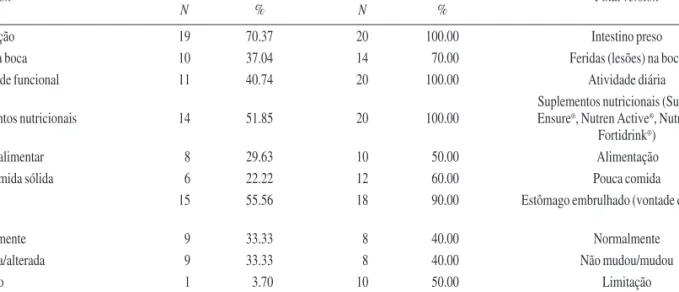
Table I shows the words considered difficult to understand by the committee members and patients, and their substitution options.
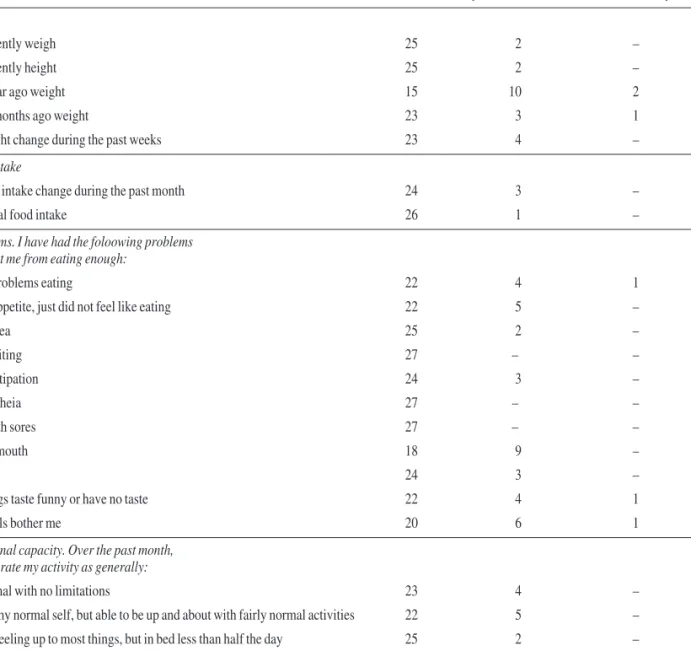
After reformulating the items according to the suggestions presented on Table 1, the instrument was completed again by the same patients. The comprehen-sion index was > 80 to all the items and the Content Validity was performed (table II).
The items “a year ago weight” and “dry mouth symptom” presented the lowest CVR. However, since these items presented some content validity, they were maintained in the questionnaire.
Table I
Frequency of the words considered difficult to understand (translation) and their substitution options (final version)
Translation Committee (n = 27) Patients (n = 20) Final version
N % N %
Constipação 19 70.37 20 100.00 Intestino preso
Lesões na boca 10 37.04 14 70.00 Feridas (lesões) na boca
Capacidade funcional 11 40.74 20 100.00 Atividade diária
Suplementos nutricionais (Sustagen®,
Suplementos nutricionais 14 51.85 20 100.00 Ensure®, Nutren Active®, Nutridrink®,
Fortidrink®)
Ingestão alimentar 8 29.63 10 50.00 Alimentação
Pouca comida sólida 6 22.22 12 60.00 Pouca comida
Náusea 15 55.56 18 90.00 Estômago embrulhado (vontade de
vomitar)
Habitualmente 9 33.33 8 40.00 Normalmente
Inalterada/alterada 9 33.33 8 40.00 Não mudou/mudou
The final version of the questionnaire is shown in figure 1.
Reliability
Sixty-two patients, being 55 (88.71%) men, partici-pated in the study. The mean age was 50.66±9.39 years, ranging between 18 and 65 years. In relation to education, 4(6.45%) presented incomplete primary school, 39 (62.90%), incomplete elementary school, 8 (12.90%) incomplete high school and 11(17.75%) incomplete college degree.
Among them, 31 (50.00%) presented head and neck cancer diagnosis, 22 (35.48%) gastrointestinal, 2 (3.23%) breast cancer, 2 (3.23%) genitourinary, 2 (3.23%) gyne-cological, 1 (1.61%) soft tissue sarcoma, 1 (1.61%)
osteosarcoma, and 1 (1.61%) skin cancer. In relation to treatment, 58 (93.55%) went through chemotherapy, 3 (4.84%) through chemotherapy and radiotherapy sessions and 1 (1.61%) only through radiotherapy.
Table III presents the nutritional risk classification of the patients, analyzed in two different stages.
Using the PG-SGA Portuguese version, a “substan-tial agreement” was obtained23(k = 0.78, p = 0.001).
Discussion
The nutritional status identification in oncology patients is of great importance. On the last years, the use of the PG-SGA, by Ottery,6has increased because
it enables the assessment of nutritional risks using a wide and non-invasive approach.
Table II
Content Validity Ratio (CVR) of the Patient-Generated Subjective Global Assessment (PG-GSA) items
Items Essential Useful, but not essential Not necessary CVR
Weight
Currently weigh 25 2 – 0.8518
Currently height 25 2 – 0.8518
A year ago weight 15 10 2 0.1111
Six months ago weight 23 3 1 0.7037
Weight change during the past weeks 23 4 – 0.7037
Food Intake
Food intake change during the past month 24 3 – 0.7778
Actual food intake 26 1 – 0.9259
Symptoms. I have had the foloowing problems that kept me from eating enough:
No problems eating 22 4 1 0.6296
No appetite, just did not feel like eating 22 5 – 0.6296
Náusea 25 2 – 0.8518 Vomiting 27 – – 1.0000 Constipation 24 3 – 0.7778 Diarrheia 27 – – 1.0000 Mouth sores 27 – – 1.0000 Dry mouth 18 9 – 0.3333 Pain 24 3 – 0.7778
Things taste funny or have no taste 22 4 1 0.6296
Smells bother me 20 6 1 0.4815
Functional capacity. Over the past month, I would rate my activity as generally:
Normal with no limitations 23 4 – 0.7037
Not my normal self, but able to be up and about with fairly normal activities 22 5 – 0.6296
Not feeling up to most things, but in bed less than half the day 25 2 – 0.8518
Able to do little activity and spend most of the day in bed or chair 24 3 – 0.7778
Several authors have used this method as a nutritional assessment tool16,24,25,26,27,28pointing to its high reliability and
validity. Moreover, the American Society of Parenteral
and Enteral Nutrition and the European Society for Clin-ical Nutrition and Metabolism have also recommended the use of the PG-SGA to identify nutritional status.
Fig. 1.—The cross-cultural adaptation of the Brazilian-Portuguese version of the Patient-Generated Subjective Global Assessment (PG-SGA).
Although the PG-SGA alone can not be used to diagnose the nutritional status, it can be useful to detect individuals with nutritional risk. However, it is important to remember that, in order to obtain accurate data, the patient must complete the instru-ment correctly.
Therefore, the questionnaire must be developed considering the cultural context of the patients. Never-theless, there are few methods analyzing all these aspects, limiting the quality of the methods, mainly in epidemiologic studies.29,30
In Brazil, the PG-SGA version translated by Barbosa-Silva17has been used. However, the translation of
ques-tionnaires may not be successful if the linguistic and cultural differences among countries are not consid-ered.31Thus, in the present study an accurate
cross-cultural and content adaptation19,20of the Portuguese
version of the PG-SGA was performed.
The PG-SGA adaptations (table I) enabled an improvement in the comprehension of the items. In this process, the participation of a multidisciplinary committee and oncology patients were important for the substitution of the words considered difficult to understand. Ten expressions were substituted and became understandable for the patients. In the Content Validity (table II), we opted to maintain all the items from the original version.
The PG-SGA reliability can be considered substantial (k = 0.78), indicating concordance in the screening of nutritional status. The two-day period used between evaluations was defined considering that oncology patients are submitted to therapies with significant collateral effects, which could alter fast the clinical status and, consequently, their nutritional status. Abreu et al.32point out that the time interval
between the applications of measurement instru-ments are not necessarily associated with the relia-bility results, since it is chosen adequately according to a study variable.
One of the factors which could interfere the relia-bility of the results is the patients’ understanding of the questionnaire items. Thus, the face validation of the PG-SGA version was performed carefully with low education patients (up to incomplete secondary school). This can have assisted the instrument compre-hension and, consequently, the adequate reliability of
it, since it can be observed that most of the patients presented low education levels.
Among the limitations of this study it is worth to mention the non-probabilistic sampling design. However, validation studies with this type of design are commonly used. Considering that the validity and reliability of an instrument are intrinsically related to the characteristics of the sample, it is expected that this study will contribute to provide an adequate instrument in Portuguese, as well as to the exposure of validation techniques that could be used in future studies with different samples.
Conclusion
The cross-cultural adaptation of the Portuguese version of the Patient-Generated Subjective Global Assessment (PG-SGA) became simple and under-standable for Brazilian patients, presenting idiomatic and cultural equivalences. This version of the PG-SGA was found to be a valid and a reliable method. Future researches are necessary to assess the construction and criteria validity of the instrument.
Acknowledgements
To FAPESP (The State of São Paulo Research), Grant # 2008/00377-9.
References
1. Meyenfeldt MV. Cancer-associated malnutrition: An introduc-tion. Eur J Oncol Nurs 2005; 9 (2): 35-8.
2. Instituto Nacional de Câncer (INCA). Estimates 2010: Inci-dence of Cancer in Brazil [serial online] 2009. [cited 2011 Oct 20]. Available from: URL: http://www.inca.gov.br/estima-tiva/2010/estimativa20091201.pdf
3. Cutsem EV, Arends J. The causes and consequences of cancer – associated malnutrition. Eur J Oncol Nurs 2005; 9 (2): 51-63. 4. Argilés JM, Busquets S, López-Soriano FJ, Figueras M.
Patho-physiology of neoplasic cachexia. Nutr Hosp 2006; 21 (3): 4-9. 5. Martín Salces M, Paz R, Hernández-Navarro F. Therapeutic
recommendations in the oncohematological patient. Nutr Hosp 2006; 21 (3): 379-85.
6. Ottery FD. Definition of standardized nutritional assessment and interventional pathways in oncology. Nutrition 1996; 12 (1): 15-9.
Table III
Nutritional risk classification of the patients studied, analyzed in two different stages Second stage
First stage Severely Moderately or suspected Well- Total
malnourished of being malnourished nourished
Severely Malnourished 5 – – 5
Moderately or Suspected of Being Malnourished 3 18 4 25
Well-Nourished – 1 31 32
7. Read JA, Crockett N, Volker DH, MacLennan P, Choy ST, Beale P et al. Nutritional Assessment in Cancer: Comparing the Mini-Nutritional Assessment (MNA) with the Scored Patient-Generated Subjective Global Assessment (PG-SGA). Nutr
Cancer (abstr) 2005; 53 (1): 51-6.
8. Velasco C, García E, Rodríguez V, Frias L, Garriga R, Álvarez J et al. Comparison of four nutritional screening tools to detect nutritional risk in hospitalized patients: a multicentre study. Eur
J Clin Nutr 2011; 65 (2): 269-74.
9. Detsky AS, McLaughlin JR, Baker JP, Johnston N, Whittaker S, Mendelson RA et al. What is Subjective Global Assessment of Nutritional Status? J Parenter Enteral Nutr 1987; 11 (1): 8-13.
10. Detsky AS, Smalley PS, Chang J. Is this patient malnourished?
JAMA 1994; 271 (1): 54-8.
11. Barbosa-Silva MCG, Barros AJD. Subjective global assess-ment. Part 1 – A review of its validity after two decades of use.
Arq Gastroenterol 2002; 39 (3): 181-7.
12. Dock-Nascimento DB, Aguilar-Nascimento JE, Costa HCBAL, Vale HV, Gava MM. Precision of estimated body weight and height for nutritional assessment in patients with cancer. Rev
Bras Nutr Clin 2006; 21 (2): 111-6.
13. Barbosa-Silva MCG, Barros AJD. Indications and limitations of the use of subjective global assessment in clinical practice: an update. Curr Opin Clin Nutr Metab Care 2006; 9 (3): 263-9. 14. Barbosa-Silva MCG. Subective and objective nutritional assessment methods: what do they really assess? Curr Opin
Clin Nutr Metab Care 2008; 11 (3): 248-54.
15. Bauer J, Capra S, Ferguson M. Use of the scored Patient-Gener-ated Subjective Global Assessment (PG-SGA) as a nutrition assessment tool in patients with cancer. Eur J Clin Nutr 2002; 56 (8): 779-85.
16. Isenring E, Cross G, Daniels L, Kellett E, Koczwara B. Validity of the malnutrition screening tool as an effective predictor of nutritional risk in oncology outpatients receiving chemotherapy.
Support Care Cancer 2006; 14 (11): 1152-6.
17. Barbosa-Silva MCG. Subjective Global Assessment. In: Wait-zberg DL, editor. Oral nutrition, enteral and parenteral in
prac-tice clinic 3nd ed. São Paulo: Atheneu; 2002. v.1, pp. 241-53.
18. Gomes Beghetto M, Koglin G, Daniel de Mello E. Influence of the assessment method on the prevalence of hospital malnutri-tion: a comparison between two periods. Nutr Hosp 2010; 25 (5): 774-80.
19. Guillemin F, Bombardier C, Beaton DE. Cross-cultural adapta-tion of health-related quality of life measures: literature review
and proposed guidelines. J Clin Epidemiol 1993; 46 (12): 1417-32.
20. Beaton DE, Bombardier C, Guillemin F, Ferraz MB. Guide-lines for the process of cross-cultural adaptation of self-report measures. Spine 2000; 25 (24): 3186-91.
21. Carmines EG, Zeller RA. Reliability and validity assessment -Series on quantitative applications in the social sciences. Sage University Paper. Newbury, CA: Beverly Hills: Sage Publica-tions; 1979.
22. Silva JA, Ribeiro-Filho NP. Evaluation and pain measurement. Research, theory and practice Ribeirão Preto: FUNPEC 2006. 23. Lilienfeld DE, Stolley PD. Foundations of Epidemiology 3nd
ed. New York: Oxford University Press; 1994.
24. Ferguson ML, Bauer J, Gallagher B, Capra S, Christie DRH, Mason BR. Validation of a malnutrition screening tool for patients receiving radiotherapy. Australas Radiol 1999; 43 (3): 325-7. 25. Thoresen L, Fjeldstad I, Krogstad K, Kaasa S, Falkmer UG.
Nutritional status of patients with advanced cancer: the value of using the subjective global assessment of nutritional status as a screening tool. Palliat Med 2002; 16 (1): 33-42.
26. Acuña K, Portela M, Costa-Matos A, Bora L, Teles MR, Waitz-berg DL et al. Nutritional assessment of adult patients admitted to a hospital of the Amazon region. Nutr Hosp 2003; 18 (3): 138-46.
27. Laky B, Janda M, Cleghorn G, Obermair A. Comparison of different nutritional assessments and body-composition measurements in detecting malnutrition among gynecologic cancer patients. Am J Clin Nutr 2008; 87 (6): 1678-85. 28. Raslan M, Gonzalez MC, Torrinhas RSMM, Ravacci GR,
Pereira JCR, Waitzberg DL. Complementarity of Subjective Global Assessment (SGA) and Nutritional Risk Screening 2002 (NRS 2002) for predicting poor clinical outcomes in hospitalized patients. Clin Nutr 2011; 30 (1): 49-53.
29. World Health Organization (WHO). Putting women first: ethical and safety recommendations for research on domestic violence against women. Geneva, Switzerland; 2001. 30. Grassi-Oliveira R, Stein LM, Pezzi JC. Translation and content
validation of the childhood trauma questionnaire into Portuguese language. Rev Saude Publica 2006; 40 (2): 249-55.
31. Spilker B, Simpson RL, Tilson HH. Quality of life bibliography and indexes: 1991 update. J Clin Res Pharmacoepidemiol 1992; 6: 205-66.
32. Abreu AM, Faria CDCM, Cardoso SMV, Teixeira-Salmela LF. The Brazilian version of the Fear Avoidance Beliefs Question-naire. Cad Saude Publica 2008; 24 (3): 615-23.