ARC RATINGS
The Periphery Strikes Back
Project submitted as partial requirement for conferral of
Master Thesis in Business Administration
Rafael Almeida Soromenho
Supervisor:
Prof. Rui Alpalhão, Visiting Associate Professor, ISCTE
Business School, Finance Department
Resumo
A crise financeira de 2008 abalou não só os mercados financeiros como também a confiança da população em geral. Existiram vários responsáveis, que devido a decisões algo questionáveis, conduziram à quebra no mercado imobiliário e a toda a sua sucessão de eventos.
A Europa foi fortemente afetada pela crise. Devido ao papel que as Agências de Rating desempenharam no período pós-crise, com constantes “downgrades” no Rating dos países da União Europeia, que agravaram os impactos económicos, criou desconfiança referente às principais agências de rating (Standard & Poor’s, Fitch e Moody’s), todas elas americanas. Surgiram alternativas às mesmas, nas quais se destacam a DBRS e a Dagong Global, como forma de combater os ratings que se desconfiava não serem imparciais. Isto criou uma oportunidade de penetração no mercado de ratings europeu, que até à altura era controlado pelas “Big Three”.
Esta Tese foi desenvolvida segundo o método do caso. Uma empresa portuguesa (Companhia Portuguesa de Ratings) resolveu não desperdiçar a oportunidade, e estabelecendo uma aliança com empresas de rating líderes nos seus mercados, resolveu criar uma nova empresa, ARC Ratings, com sede em Lisboa, em 2013, com o intuito de se estabelecer no mercado europeu. Passados cinco anos da sua criação, a ARC Ratings decide perceber o impacto que a criação da mesma teve no mercado europeu, e também entender se a estratégia utilizada foi a mais indicada, bem como definir os futuros passos. Com a resolução do Caso os alunos serão chamados a formular as respostas a estas questões.
Summary
The 2008 Financial Crisis shook not only the financial markets but also the trust of the general population. There were several actors responsible, whom together, with questionable decisions led to the break of the real-estate market and the well-known succession of events.
Europe was strongly affected. The role of Rating Agencies during the post-crisis period, where they executed constants downgrades of EU’s countries, aggravating the economic impacts, created a feeling of mistrust regarding the Credit Rating agencies, specially (Standard & Poor’s, Fitch e Moody’s), all American. Alternatives to those have emerged, from which we may highlight DBRS and Dagong Global, to contest the ratings issued by the American agencies, which were considered suspicious from being biased.
This created a opportunity for other agencies to penetrate the European market, which had been dominated by the “Big Three”.
This thesis was developed according to the case study method. A Portuguese agency (Companhia Portuguesa de Ratings) didn’t want to miss the opportunity and stablished a joint venture along with credit ratings agencies’ leaders in their respective markets, creating a new agency based in Lisbon with the goal of focusing on the European market, ARC Ratings, on 2013. Five years past from its creation, ARC Ratings wants to evaluate the impact it had in the European market, assess if the strategy implemented could have been better and figure out what should be the next steps for the enterprise. By solving the Case, students will be requested to provide the answers to these questions.
Acknowledgements
I would first like to thank my thesis coordinator Prof. Rui Alpalhão. His door was always open when I had question on my research or my writing, or even in finding the right direction. Also for his patience and extremely helpful inputs that made me questions and reflect about the topics, which allowed me to also step up and also develop my skills while writing it.
I would also like to give a word to my master’s colleagues which whom I shared two years of constant growing and learning, both on the personal and professional areas. Without their help on the not so good moments and their companionship to celebrate the better moments it wouldn’t be the same.
Finally, and most importantly, my family. I want to express my deep gratitude to my parents who gave me all the tools to develop myself and allowed me to be here today, without their education, love and caring I wouldn’t achieve half of the things I did.
To my older and younger brothers just for being who they are, my role models that at the same time pushed me harder to also achieve their accomplishments, made me work to be up to their expectations and where always there for me in my self-doubting moments to show me their unconditional love and help to get through it. I’m very grateful for having their support, and they are the basis of my success.
Index
Resumo ... 2 Summary ... 3 Acknowledgements ... 4 Index ... 5 Exhibits Index ... 7 Case Study... 81. Introduction (Business Situation) ...8
2. Chapter One – The Opportunity Arises ... 11
2.1. Credit Rating Agencies Industry ... 11
2.1.1. Role of Credit Rating Agencies ... 11
2.1.2. Rating Score ... 12
2.1.3. Role of Credit Rating Agencies in capital markets ... 14
2.1.3.1. Role of Credit Rating Agencies in the 2008 Eurozone crisis and their Criticism 14 2.1.3.2. Why do Credit Rating Agencies exist? ... 16
2.1.3.3. “Issuer pays” Model vs Alternative models ... 20
2.1.3.4. Competition among Credit Rating Agencies ... 23
2.1.4. Regulation of Credit Rating Industry ... 26
2.1.4.1. IOSCO CRA Code of Conduct ... 27
2.1.4.2. European Securities and Markets Authority (ESMA) ... 29
3. Restatement of the Case’s issue ... 30
4. Teaching Note ... 31
Chapter Two - The decision making for ARC Ratings, SA ... 31
4.1. Target Audience ... 31
4.2. Learning Objectives ... 31
4.3. Literature Review addressing the Case’s Issue ... 32
4.3.1. Strategic Planning ... 32
5. Chapter Three – The Time has Come ... 37
5.1. Growth/Expansion Strategies ... 37
a. Organic Growth ... 40
b. Inorganic Growth ... 41
b.1. Mergers & Acquisitions (M&A) ... 42
b.2. Joint Venture ... 42
5.2. Bottom-up vs Top-down Structure ... 44
5.2.1. Top-down Approach ... 44
5.2.2. Bottom-up Approach ... 45
... 46
5.4. Set of Analytical tools ... 48
5.5 Case Study Resolution ... 49
6. Answers to Case Study Questions... 51
7. Looking into the future ... 53
8. Appendix ... 54
Appendix AA1... 54
Appendix AA2... 57
Appendix AA3... 57
Exhibits Index
Figure 1 – The Role of Credit Rating Agencies (paper policy) Figure 2 – “Issuer Pays” Model
Figure 3 – “Subscriber Pays” Model
Figure 4 – Government as a Hiring Agent Model Figure 5 – Government Utility Model
Figure 6 – Credit Rating History of Current Nationally Recognized Statistical Rating
Organizations (NRSRO)
Figure 7 – Firm credit ratings distribution differences dependency to high and low
competition on the credit rating industry
Figure 8 – Strategic Planning Diagram Figure 9 – PESTLE Analysis Elements Figure 10 – 5 Forces of Porter
Figure 11 – SWOT Analysis Matrix Figure 12 – Ansoff’s Matrix
Figure 13 – Ansoff’s Matrix with strategic positions goals Figure 14 – Growth Strategies
Figure 15 – Bottom-up vs Top-down Approach
Table 1 – Letter Grading System used from Standard & Poor’s on the rating score Table 2 – Comparison between Moody’s, S&P’s and Fitch Ratings Scales
Table 3 – Outstanding credit ratings reported by NRSROs to the Security Exchange
Commission in 2011.
Table 4 – Number of credit analysts employed by NRSROs as reported to the Security
Exchange Commission in 2011.
Case Study
1. Introduction (Business Situation)
September 2008. The Federal intervention on the two most-known Government-Sponsored Enterprises (Freddie Mac and Fannie Mae), the collapse of Lehman Brothers, the forced acquisition of Merrill Lynch by Bank of America (for half the market valuation it had previously) and the AIG rescue agreement with the Federal Reserve Bank (due to a credit rating downgrade): this sequence of events was as unexpected as it was tragic. The Financial World was shaken. The quick rotation of capitals, high liquidity levels, the exaggerated expectations on price appreciation and the easiness on granting credits with low interest rates led to a market bubble. Almost all the financial players, including banks, insurers, enterprises, hedge funds, sovereign funds and families, had their positions shrunk due to a high depreciation of their assets. The majority of the western enterprises and institutions were close to bankruptcy due to inability to pay their debts. Financial markets suffered one of the worst catastrophes of its history, the kind of event that could reshape principles and mind-sets. The world demanded answers, everyone was asking how this was possible and who were the enablers for such disaster. Along with many others, one of the “guilty parties” was the Credit Rating Agencies and their “easiness” in grating prime rating (AAA+ - Low default probability) to Mortgage Securities, without performing a rigorous due diligence, that were actually packets of “AAA securities” mixed with “CCC securities” (High default risk), Mortgage-backed Securities (“MBS”) owned by individuals with bad credit standing and unable to repay their loans. This led to a relevant and comprehensive mistrust of the investors and markets in the credit rating institutions.
In Portugal the situation was followed closely at Companhia Portuguesa de Ratings, SA (CPR), a company created in 1988 by Prof. Alfredo de Sousa, a highly reputed Portuguese academic. CPR was the first credit rating agency based in Portugal and focused on the Portuguese market. In 1995, CPR was acquired by its competitor, Sociedade de Avaliação
Estratégica e Risco, Lda. (SaeR, Lda.). All the rating activities performed by SaeR, Lda.
José Poças Esteves, a renowned Portuguese economist and a partner at SaeR, Lda. was promptly assigned to manage the future of CPR as its Chief Executive Officer. His strong background in the financial and economic fields, with focus on Strategic Consulting, Risk Assessment or even Competitiveness and Value Creation, aligned with years of professional experience on the sector and proven outstanding performances, made him the best fit to head this challenging project.
In the summer of 2012, while the economy was still recovering from the 2008 disaster, there was still evidence of the markets’ mistrust relative to credit rating agencies, specially the Big Three. Investors started to fear CRA’s judgement, not being completely sure of its methodologies, transparency and perhaps “personal agenda”, losing its trusted guarantee seal. Other agencies worldwide, such as DBRS Ratings Limited, from Canada, or Dagong Global Credit Rating, from China, started to gain market share in the European and the Asian markets.
José Poças Esteves had a vision, this was the moment to take advantage of this mistrust, the opportunity for smaller agencies to improve their market share by regaining the markets’ confidence. Why should CPR keep just operating in the small and limited Portuguese market? This was the question that moved José Poças Esteves to his next step. It was time for CPR to grow and explore the complexity of the global market, to offer a reliable alternative for those misleading CRA that were part of the biggest crisis on the recent financial history. However, a small company as CPR lacked the infrastructures, capital and international know-how to make such a giant step. This had to be overcome, therefore, he put in action a plan, using his vast network built in his years working as auditor and strategic consultant. The final result was revealed to the world on October 7th 2013, when CPR, SA was legally transformed in ARC Ratings, SA and officially registered with the European Securities and Market Authority (ESMA). This was the outcome of a joint venture between five CRA spread over four different continents. The founder partners, along with CPR, SA were: Credit Analysis and Research Limited (CARE), from India; Global Credit Rating Company Limited (GCR), from South Africa; Malaysian Rating Corporation Berhad (MARC), from Malaysia; and SR Ratings, LTDA., from Brazil and a CPR affiliate.
They knew that to generate competitiveness they had to frame a core strategy with an innovative approach to a dynamic and complex new economy, associating not only pioneering rating methods but also having strong global and local expertise referring to
markets and financial matters. These are the pillars that build ARC Ratings, SA, the ambition to provide investors a better outlook on where to invest their capital, through better, more efficient, more precise and adjusted ways to assess ratings both in a global and a local perspective.
ARC Ratings’ challenge will be to acquire the trust of the markets and investors. This is its opportunity to strive in the hard and complex credit rating market, and there won’t be a second one…
2. Chapter One – The Opportunity Arises
2.1. Credit Rating Agencies Industry
2.1.1. Role of Credit Rating Agencies
The actions of rating agencies could be represented as a cycle between four different players (bank, issuer, investor and borrower), the rating agencies being a fifth player that provides meaningful information to the market. The cycle is started by a borrower searching for a loan to finance some business activity (i.e. investment opportunity, buying a house, etc.). The borrower usually goes to institutions such as a bank or government agency, which will grant the loan carrying a certain interest, here happens the first direct transfer of funds. Later those institutions will establish a business relation with the issuer, banks that build securities packages, to whom they sell those loans into the form of debt (i.e. mortgages, corporate debt). Lastly there are the investors, willing to buy those securities’ packages to receive the principal or interest paid on the debt by the borrowers. However, the investors need to know the likelihood of those particular debts being repaid, in total or in part, to understand if it is a viable investment or not. This is the moment in which rating agencies come into action, they provide a credit risk analysis of the assets, calculating the likelihood of a borrower to default. This process is made between the issuer and the rating agencies, through the payment of a fee from the former to the latter. Issuers are willing to initiate this business transaction in order to create value for their assets. A rated asset, with a rating issued by an independent agent, will make their financial instruments (securities’ packages) more appealing to investors. Therefore, it’s possible to verify several kind of transactions throughout the business cycle between the different players, both assets, payments or informational transactions and in direct or indirect relations. All of the interactions stated could be analyzed in the scheme presented in figure 1. This is the most used business model for rating agencies, where the primary clients are the issuers and their assets. Nevertheless, there is a different business model, where the primary clients are the investors. In this particular situation investors would pay rating agencies in order to rate a specific package. Both situations will be approached later in this case.
2.1.2. Rating Score
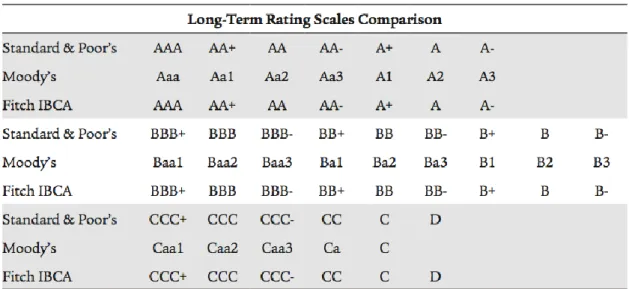
A rating score is the financial outcome from rating agencies’ role. It states, by definition, the likelihood a borrower has to meet its financial obligations to a lender. This assessment of creditworthiness may be done relatively to individuals (credit score), corporations (corporate credit rating), national governments (sovereign credit rating) or financial instruments (i.e. RMBS1, CDO2, CMBS3, etc.) as mentioned previously. The rating score system used by the majority of the rating agencies is based on a letter grade rating (see
1 Residential Mortgage Backed Securities 2 Collateralized Debt Obligations
3 Collateralized Mortgage Backed Securities
Figure 1 – The Role of Credit Rating Agencies (paper policy)
Source: Ekins, McClintock Emily; Calabria, A. Mark. “Regulation, Market Structure, and Role of the Credit Rating Agencies.” Policy Analysis, No.704, 2012.
table 1 and table 2). Each grade represents thus the likelihood of paying the debt within the loan agreement, higher credit rating (AAA), or the likelihood of default, poor credit rating ( BBB- or Baa3).
Table 1 – Letter Grading System used from Standard & Poor’s in the rating score Source: S&P Global Ratings Definitions 2016
2.1.3. Role of Credit Rating Agencies in capital
markets
2.1.3.1. Role of Credit Rating Agencies in the 2008
Eurozone crisis and their Criticism
Some published papers4 argue that the way Credit Rating Agencies conducted the downgrading ratings for European countries was too hasty and intensified the negative repercussions of the financial crisis. Focusing on the downgrading that the PIGS (Portugal, Ireland, Greece and Spain) received by Standard & Poor’s, which weakened the trust of investors and lending institutions, resulted on the unavoidable financial rescue of Greece, in 2010, by the IMF. Moreover this situation collapsed the entire financial sector of the country and brought instability to the European economy5. This started a snowball effect among the EU members, specially the PIGS, causing a shrinking of the
4 Bayar, Yilmaz. 2014. “Recent Financial Crises and Regulations on the Credit Rating Agencies.” Research in World Economy, Vol. 5, No. 1.
Utzig, Siegfried. 2010. “The Financial Crisis and the Regulation of Credit Rating Agencies: A European Banking Perspective.” ABDInstitute, No. 188.
5 CFR Backgrounders. 2015. [ONLINE] Available at: http://www.cfr.org/financial-crises/credit-rating-controversy/p22328.
Table 2 – Comparison between Moody’s, S&P’s and Fitch Ratings Scales Source: Bank for International Settlements, “Long-term Rating Scales Comparison,” http://www.bis.org/bcbs/qis/qisrating.htm.
European economy due to a lack of confidence of the markets. Besides the obvious economic impact, there was also the social aspect of living in uncertainty. This aspect also contributed to an acceleration of the crisis due to a lack of knowledge about the steps to follow. People, in general, were afraid of putting their money in the banks, which intensified the situation and created an even bigger hole in the financial system.
These events generated an environment of uncertainty surrounding CRAs, specially on the European markets. The reasons stated for such mistrust were:
the fact that CRAs are not legally responsible for their ratings, they state that “they are merely issuing “opinions”6;
the oligopoly of the Big Three American agencies (Standard & Poor’s, Fitch and Moody’s), which creates a suspicion of preference for higher ratings in American enterprises;
the model “issuer pays” that brings a conflict of interests, opening a door for a model “pay more, rate more”7.
Moreover, the fact that is so easy for these agencies to avoid legal responsibilities and just hide behind the First Amendment8, may let one think if it’s a good option to invest money on an “opinion” of agencies that do not want to be held responsible for it afterwards.
Secondly, but equally problematic, is the oligopoly in the credit rating industry where the so called Big Three control 94% of the global market. Many discussion papers argue9 that
6 SWP Berlin/John Ryan. 2012. The Negative Impacts of Credit Rating Agencies and proposals for better
regulation. [ONLINE] Available at:
https://www.swp-berlin.org/fileadmin/contents/products/arbeitspapiere/The_Negative_Impact_of_Credit_Rating_Agencies _KS.pdf.
7 CFR Backgrounders. 2015. [ONLINE] Available at: http://www.cfr.org/financial-crises/credit-rating-controversy/p2232.
8 Nagy, T, 2009. Credit Rating Agencies and the First Amendment. Minnesota Law Review, [ONLINE]. 94:140, 140-167. Available at: https://www.minessotalawreview.org/wp-content/uploads/2011/08/Nagy_MLR.pdf.
9 SWP Berlin/John Ryan. 2012. The Negative Impacts of Credit Rating Agencies and proposals for better regulation.
the ratings may be biased due to the fact of all the agencies being incorporated in the American market. Therefore, an upgrading evaluation for that market would benefit them, generating a conflict of interest. “Some European leaders have blamed for aggravating the sovereign debt crisis with erratic and “subjective” ratings decisions…including rating agencies amplifying “contagious effects” though “subjective biases”, and “arbitrary” downgrades that are poorly explained, triggering “significant investor over-reactions”10. In order to address these factors the EU decided to give ESMA (European Securities and Markets Authority) the power to regulate ratings. However ESMA doesn’t have the capability to issue ratings, it can only vet ratings that appear not proper11.
The problems and conflicts stated before arise an important question: why do credit rating agencies exist?
2.1.3.2. Why do Credit Rating Agencies exist?
In 1909, John Moody issued ratings for the U.S. railroad bonds, which originated Moody’s Investors Service (1914). In 1941, Standard Statistics Company (1922) joined Poor’s Publishing Company (1916), establishing Standard & Poor’s Corporation. It published sovereign debt, corporate and municipal bonds ratings. Finally, in 1913, the Fitch Publishing Company was founded. It implemented the AAA through D rating system, in 1924, which is used nowadays throughout the industry as the rating basis. It was the birth of what are known today as the Credit Rating Agencies (CRA). These agencies specialized on assessing the ability that a given debtor has to pay back loans, which may be governments, companies or even sovereign nations, its creditworthiness. CRA’s issue ratings depending on the likelihood of default by the debtor (“default risk”). The market analysis, performed by CRA’s, allows investors to be aware of the investment risk meanwhile efficiently allocating their capital. Due to the U.S. market liquidity and strengthened regulatory requirements, which established strong entry barriers for
10 SWP Berlin/John Ryan. 2012. The Negative Impacts of Credit Rating Agencies and proposals for better
regulation. [ONLINE] Available at:
https://www.swp-berlin.org/fileadmin/contents/products/arbeitspapiere/The_Negative_Impact_of_Credit_Rating_Agencies _KS.pdf.
11 ESMA's supervision of credit rating agencies and trade repositories. 2015. www.esma.europa.eu. [ONLINE] Available at: https://www.esma.europa.eu/sites/default/files/library/2016-234_esma_2015_annual_report_on_supervision_and_2016_work_plan.pdf.
competitors, the three agencies stated previously (aka The Big Three) created an oligopoly controlling 90% of the global market share.
Credit Rating agencies’ origins date back to the beginning of the 20th century, as stated previously in this case, when Moody’s and Standard & Poor’s were founded (Partnoy, 1999). According to literature, CRAs12 were built to have two basic functions, that prevails as the reason for their existence:
i. Correction of the information asymmetry between issuers and investors (Boot et al., 2006; Listokin and Taibleson, 2010);
ii. Reduction of the costs of regulation (Partnoy, 1999; Macey, 2006; Listokin and Taibleson, 2010).
The first role is comparable to the “lemon” problem (Akerlof, 1970). This states that higher quality borrowers will be driven out of the market due to higher rates imposed by creditors, trying to protect themselves against lower quality borrowers (“lemon” borrowers). Rating agencies would solve this issue by acting as an independent intermediary, providing new information and verifying information on the borrowers’ creditworthiness. However, some authors argue that the CRA role in this matter is not essential, since it doesn’t add much new information to the market (Macey, 2006; Fitzpatrick and Sagers, 2009). If credit rating is just an output of financial analysis publicly available, this argument is valid. Furthermore, there is no evidence that information asymmetry would inevitably lead to a “lemon” market of borrowers, which could be prevented by due diligence, credit history or independent analysis from investors.
The second purpose for its existence is to regulate bond investments by financial institutions (Partnoy, 1999; Macey, 2006; Listokin and Taibleson, 2010). The US government gave the NRSRO (Nationally Recognized Statistical Rating Organization) status to some rating agencies in order to outsource some aspects of regulation, specifically in the area of investments and capital structure of financial institutions. This
action was intended to reduce the net costs of regulation, primarily the necessity of creating an analytical structure to evaluate bond investments, transferring it from investors to rating agencies.
Some authors argue that Credit Rating Agencies serves mostly as a public function, but not only as a regulator. The market rational reason for the existence of rating agencies could be explained by their role performing a sorting of information (Coffee, 2011; Rhee, 2013b; Rhee, 2015). The authors go further by arguing that rating agencies would exist as market players, even without its regulatory function.
The main evidence for this theory is the credit market volume and number of issuers, which would present a complication in the absent of an entity to sort, organize and make the information available.
Table 3 - Outstanding credit ratings reported by NRSROs to the Security
Exchange Commission in 2011. Source: U.S. Securities and Exchange Commission, 2011.
S&P Moody’s Fitch Others
NRSROs Total Financial instructions 54,000 61,581 61,550 32,207 209,338 Insurance companies 8,200 4,540 1,657 5,391 19,788 Corporate issuers 44,500 30,285 13,385 11,116 99,286 Asset backed securities 117,900 101,546 64,535 18,480 302,461 Government Issuers 965,900 841,235 363,897 14,694 2,185,726 Total 1,190,500 1,039,187 505,024 81,888 2,816,599
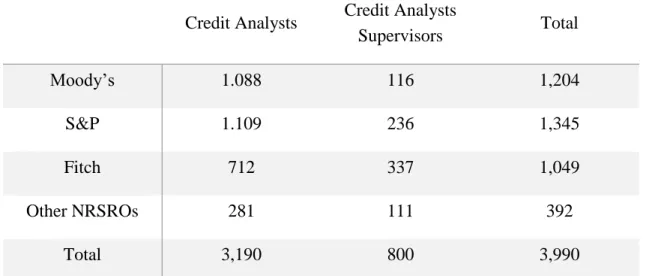
The data in table 2, shows the enormous number of issues rated by several NRSROs. Even considering that it has to be adjusted, due to the fact that is a common practice to be rated by at least two different rating agencies, the number is overwhelming. This fact aligns with the authors theory, that CRA are needed due to the enormous amount of information to be processed, the larger scale of the fixed income securities requires an efficient allocation of research resources that would be difficult to obtain by individual investors. Moreover, associating the data from table 2 with the data from table 3, which shows the number of credit analysts and supervisors employed by several NRSROs, we may find an even stronger evidence for this matter. Analyzing the data, it’s possible to conclude that it would be unbearable, in terms of cost allocation, for investors to compete with ratings agencies, whom have more than 3500 credit analysts at their disposal. This cost would translate on a lower budget to allocate resources into equity analysis and new investment opportunities assessment, for investors and firms, an essential tool for players in the equity market.
Table 4 - Number of credit analysts employed by NRSROs as reported to the
Security Exchange Commission in 2011 Source: U.S. Securities and Exchange Commission, 2011.
An unrealistic alternative would to pursue cooperation among investors. This solution would raise few problems, such as the amount of research and resources each one should deliver or loosing competitive advantage towards competitors. The first aspect leads to the possibility of free-riders, meanwhile the second carries problems related to sharing market intelligence or receiving misleading information from competitors deliberately. The rational conclusion is that the rating agencies are the most cost-effective solution for the credit market sorting of information problem.
Credit Analysts Credit Analysts
Supervisors Total Moody’s 1.088 116 1,204 S&P 1.109 236 1,345 Fitch 712 337 1,049 Other NRSROs 281 111 392 Total 3,190 800 3,990
2.1.3.3. “Issuer pays” Model vs Alternative models
Nowadays, the business model most used by NRSROs, is the “issuer pays” model. As stated previous, this presents a clear conflict of interests that generates suspicion and mistrust in the markets. However, the question is if there are better alternatives and if those are adequate to be put in action.
I. “Issuer pay” Model
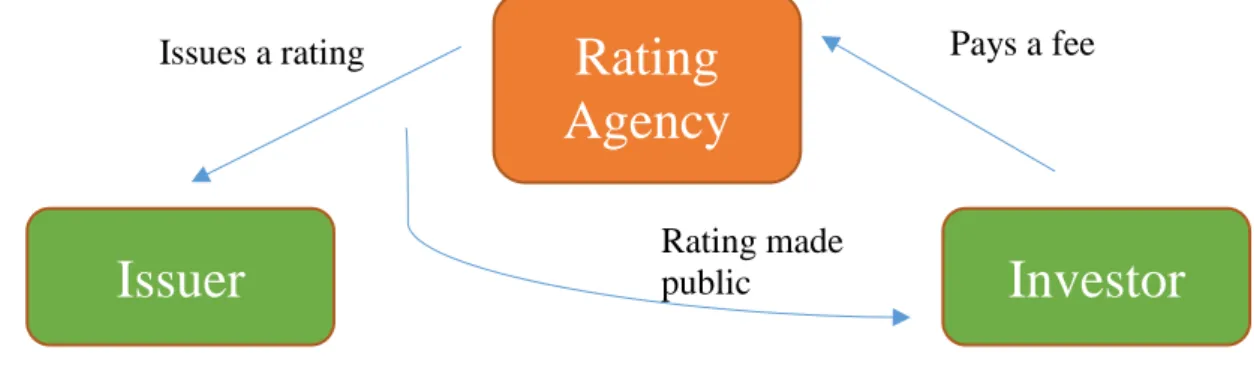
Firstly, is important to understand the model, which is fairly simple and is explained in the figure 2. This model relies on the issuers’ willingness to pay, in order to increase their value through the perception of being a desirable investment asset and to access public debt markets. However, it triggered the discussion whether rating agencies weren’t receiving incentives in order to inflate the ratings for their clients, in order to retain or even charge higher fees. This question is usually addressed with the nature of the credit rating agencies market, which is relatively closed but is built on the grounds of reputation. Therefore, the argument is that rating agencies would not be willing to lose their market position by accepting to overstated rates for issuers. It is an arguable assumption, once if all the agencies would agree to do it, the reputation damaged would not affect a single agency alone, thus opening a gray area.
Rating
Agency
Issuer
Investors
Pays a fee
Issues rating
Figure 2 – “Issuer pays” Model
Rating made public
II. “Subscriber pay” Model:
An alternative model is the “subscriber pay” Model, which is depicted in figure 3. Nevertheless, for the reasons stated in the previous section, it is not a valid option.
III. Government as Hiring Agent Model
This is a more complex model, which states that the selection of the rating agency, to be used by an issuer, would be given to an independent agency. This basically means that the issuer would not be able to choose which rating agency would rate it, preventing thus a possible agreement between issuer and agency. It states that the initial rater would be chosen by a Board (Credit Agency Review Board), being afterwards the issuer free to not disclose the rate publicly or to hire additional rating agencies. The Board would be established under the Security Exchange Commission, being also responsible to set a “ceiling fee” in order to avoid overcharging or bribery. This Model was suggested in 201013, adding to the Dodd-Frank Act14, under the Franken Amendment. This model remains a possibility for the future, but still has to overcome some studies about its feasibility.
The Model is, in a simple version, depicted in figure 4.
13 OECD, 2010. “Competition and Credit Rating Agencies.”.
14 The Dodd-Frank Act will be discussed later on the section Regulation of Credit Rating Industry.
Rating
Agency
Issuer
Investor
Issues a rating
Figure 3 – “Subscriber pays” Model
Pays a fee
Rating made public
IV. Government Utility Model
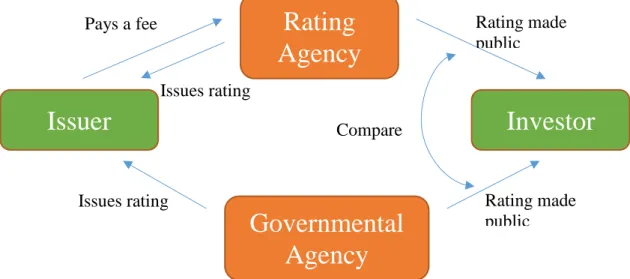
This model sustain that a Governmental rating agency should be created in order to allow a term of comparison against the traditional rating agencies. This option is unrealistic in the sense that it would be an insupportable cost for the governments to sustain such an entity, that would most likely not be used in the private market.
Rating
Agency
Issuer
Investor
Pays a fee
Issues rating
Figure 5 – Government Utility Model
Rating made public Compare Issues rating
Governmental
Agency
Rating made publicRating
Agency
Issuer
Investor
Pays a fee Issues ratingFigure 4 – Government as Hiring Agent Model
Rating made public
Credit Agency
Review Board
Assigns Establish a ceilingThus, throughout the analysis of the several alternatives, it’s possible to reach the conclusion that the current used model (“issuer pay” model) is the most suited option for the rating agencies market. However, it should be revised, in order to implement improvements and regulations, playing an active part in the prevention of future complications on the financial markets, such as the tragic events in 2008.
2.1.3.4. Competition among Credit Rating
Agencies
There are evidences, not only in the literature but also empirical ones, that credit rating agencies operate in an oligopolistic market. This designation is given to an industry where few firms detain the majority of the market share, with high entry barriers for new firms, which can be natural or artificial impediments. An oligopolistic market differs from a competitive market in the sense that in the last, new firms will enter the market and compete with existing firms to gain/capture economic profits. However, in an oligopoly this is prevented through the barriers to entry. The outcome from the former is a market that strives with few firms, experiencing an increase in prices, being though less interested on finding or improving new tools on the credit risk assessment, which ultimately may reduce the quality of the information accessible by investors.
The natural barriers appear throughout reputational factors, that influence issuers and investors while choosing an agency to issue their rating. This moves the market towards a natural concentration, not only because of the reputational references already stated but also resulting from network effects. Lawrence White explains this phenomenon, where the same rating agency is used in order to achieve consistency across rating categories15. The reputational factor is explained by Langohr and Langohr16, who argue that “a small number of CRAs with the highest reputation for quality and independence will always dominate”. Still, the dominant agencies failing on issuing accurate ratings, shown by the 2008 crisis, aligned with the suspected conflict of interests, due to the business model
15 White, Lawrence J., 2010. "Markets: The Credit Rating Agencies." Journal of Economic Perspectives,24(2): 211-26.
16 Langohr, Herwig, and Patricia Langohr. 2008.“The Rating Agencies and Their Credit Ratings: What They Are, How They Work, and Why They Are Relevant.” Chichester Wiley.
used in the industry (“issuer-pays”), without losing its market dominance, reveals that beside the natural barriers, there must also be regulatory barriers.
The greater barrier to new entrants was the NRSRO designation. This regulation, that will be further observed in more detail on the Regulations chapter, conceded privileges to several rating agencies by giving them a “regulatory license” status. It was a “seal of guarantee” from the SEC, stating that a particular rating agency was complying with a minimum quality standard. This became a major advantage for NRSRO’s rating agencies since some investors were legally obliged to invest in NRSRO’s CRAs rated products. This created a core market advantage for NRSRO’s rating agencies, once both issuers and investors were incentivized to invest their money in order to achieve a regulatory privilege. It stands as a government regulatory barrier because the process to achieve a NRSRO designation is long and unclear. Some rating agencies, such as Egan-Jones, DBRS or AM Best, state the extensive and shady process they have been through in order to obtain their “place” in the market17. On figure 6 is possible to see the timeframe comparison between their existence and the NRSRO designation of different rating agencies.
17 Sean Egan, Managing Director, Egan-Jones Rating Company, 2005.“The Role of Credit Rating Agencies in the Capital Markets,” Testimony before the Senate Committee on Banking, Housing and Urban Affairs (Washington: 2005), 1–12.
Langohr and Langohr, 2008. “The Rating Agencies and their Credit Ratings.” J. Wiggins, 2002. “A Chance to Step into the Light,” Financial Times (London).
Thus, resulting from a lower competitive threat and a high demand, NRSRO CRAs may have most likely reduced the quantity and quality of information supplying the market. The primary focus was to work for higher rates instead of innovation and following the market needs for better credit risk assessment due to more complex financial instruments. It finally ended up in an industry incentivized to be more complacent with its methodologies and looking up for market share retain instead of quality information. Therefore, we may argue that opening access to the NRSRO designation would be beneficial and improve the credit risk assessment quality. However, Becker and Milbourn18 explains that it still reduce the methodology efficiency within the regulatory framework. Their findings are in accordance with the conflict of interest stated previously on the case, where CRAs seeking to meet their clients’ needs, tend to inflate their ratings19. This matter is observed in figure 7, which shows that investment rating grades was higher with high competition than with low competition. Moreover, opening the market without overcoming this issue would not be enough to create new methodologies
18 Becker, Bo, and Todd Milbourn. How Did Increased Competition Affect Credit Ratings?, Harvard Business School, 2010.
19 Becker, Bo, and Todd Milbourn. How Did Increased Competition Affect Credit Ratings?, Harvard Business School, 2010.
Figure 6 – Credit Rating History of Current Nationally Recognized Statistical Rating Organizations (NRSRO)
Source: Securities and Exchange Commission, Action Needed to Improve Rating
Agencies Registration Program and Performance-Related Disclosures (Washington:
by CRAs. This problem needs to be addressed in order to build a framework that will incentivize rating agencies to comply with a constant innovation in their processes. Thus, resulting from a lower competitive threat and a highly demand, NRSRO CRAs are most likely to have reduced the quantity and quality of information supplied to the market.
2.1.4. Regulation of Credit Rating Industry
As a consequence of several events, such as the bankruptcy of Enron Corporation in 2001 or the collapse of Lehman Brothers in 2008, which were followed by the financial crisis, the CRA industry has been subjected to regulation procedures trying to prevent this kind of incidents in the future. Regarding this concern, both the US and the EU agreed on a series of principles that CRAs should implement as a code of conduct in order to commit to a more accurate and transparent process, offering a better service to the public. In the
Figure 7 – Firm credit ratings distribution differences dependency to high and low competition on the credit rating industry
US this was “accomplished” by the IOSCO20 CRA Code of Conduct and the SEC, meanwhile in the EU was formed the ESMA21, whose role was to supervise the rating grades and assure that they were proper.
2.1.4.1. IOSCO CRA Code of Conduct
It was firstly drawn and enforced in December 2004, after the Enron Corporation collapse in 2001. It was later revised in 2008, when the financial crisis occurred. The US government was urged to devise a more precise method for the industry due to the fact that Enron and Lehman were still on an investment grade level one day before their collapse, which showed the industry’s weakness. In this sense the IOSCO Code of Conduct raised the following regulatory issues:
1. CRA transparency in the rating process; 2. Independence and conflict of interest; 3. CRA industry and competition.
To address these issues the Code of Conduct, reformed in 2008, stated the following principles that CRAs should comply with:
i. The decision-making process should be objective on the reviewing of current ratings, which could be obtained by using separated teams to assess an initial rating and further to monitor that rating;
ii. A rating should be periodically reviewed, taking into consideration new methodologies and approaches that may be significant for the business;
iii. The measures and procedures used to assess a rating should contain sufficient quality to have a credible support. If this point is not complied with, then the CRA must state its limitations;
20 International Organization of Securities Commissions 21 European Securities and Market Authority
iv. CRAs should allocate adequate resources to the monitoring of significant changes in the business behind a particular rating, in order to be able to procced for an appropriate update, both in information and time, of that rating;
v. A CRA should monitor its employees and establish procedures to prevent an analyst involved in a rating process to leave the CRA and join the issuer of the financial instrument he was working on;
vi. A CRA should disclose if any client represents more than 10% of the CRA’s annual revenue;
vii. CRA’s should encourage a public disclosure of all the relevant information regarding a structured financial instrument, in order to allow investors to perform their own due diligence if they find it suitable;
viii. A CRA should publish verifiable historical information of their performances that allow investors to perform a comparison between different CRA’s;
ix. A CRA should states its symbology across different structures of financial products and clearly identify and apply it in the same manner for similar products;
x. A CRA should disclose the methodology used to determine a rating for a specific financial product.
In addition to the IOSCO Code of Conduct, there is also the SEC designation of NRSRO as we explained previously in this case. The role of the SEC is to supervise CRAs, and one of its mainly requirements to obtain the so desired nomination of NRSRO is the compliance with the IOSCO Code of Conduct.
Furthermore, in 2010, the US Congress passed the Dodd-Frank Act. The Act aimed to empower the principles of the IOSCO Code of Conduct, by introducing rules for internal monitoring, managing conflicts of interest, improving rating quality and incentivizing periodical reviews of ratings. Under the Dodd-Frank Act, the SEC received higher
responsibilities on the overseeing of CRAs, being now responsible for conducting an annual examination of each NRSRO, issuing a public report stating its performance. If a NRSRO fails on providing reliable ratings, accordant with the IOSCO Code of Conduct, its NRSRO license may be suspended or revoked. Moreover, under the Act, CRA’s started to be accountable for their ratings, if its provable that they failed on verifying the basis of the rating.
2.1.4.2. European Securities and Markets
Authority (ESMA)
The global crisis, in 2008, that affected the sovereign debt ratings in Europe, made the European Union move towards a CRA regulatory framework. In 2009, the Regulation (EC) No 1060/2009, was approved by the European Parliament and the European Council. It was not only to reinforce the IOSCO Code of Conduct, but also to move from a self-regulatory system to a government-regulated framework. However, this Regulation suffered an Amendment, in 2010, proposed by the European Commission. This new proposal created the ESMA (European Securities and Markets Authority), which is nowadays responsible for the registration and supervision of CRA in the EU. Therefore, ESMA works as a regulatory “third-party” that has the role to supervise, approve and endorse the rating methods and the rating grades, both coming from CRA outside and inside the EU. Moreover, ESMA will only accept rating agency grades from regions with similar legal requirements. These actions have strengthened the European financial system, nevertheless the European Commission stresses that ratings should always be supervised thoroughly by investors.
3.
Restatement of the Case’s issue
In conclusion, José Poças Esteves identified a unique business opportunity that could generate a comeback to Companhia Portuguesa de Ratings. In order to undertake this bold vision, he negotiated with several rating agencies all across the world, establishing a joint venture that could allow a newly created rating agency (ARC Ratings) to penetrate a fragile European Market.
As stated, this is a unique opportunity that won’t appear twice, therefore it is crucial to have a strong and well planned strategy. ARC Ratings put into motion its strategy and started operating on the European Markets on 2013. The Board of Directors decided to evaluate the enterprise performance since its launching, and to do so they decided to hire a financial/strategic consultant to evaluate the actions they took for the past 5 years and to measure the impact that the expansion strategy had on their value.
As ARC Ratings’ consultant, your job will be to evaluate if its strategy was the best one taking into consideration the rating European rating market in 2013, measure its performance since then and finally propose a path to go in the future.
In order to support your decision, prepare a presentation where you will deliver your findings to ARC Ratings’ Board of Directors.
4.
Teaching Note
Chapter Two - The decision making for ARC
Ratings, SA
4.1. Target Audience
Bachelor and Master students on the fields of Financial Markets and Strategical and Operational Management.
4.2. Learning Objectives
The learning objectives aimed at for this Case could be stated as:
a) Familiarize the addressees of the Case with the Credit Rating Agencies Business Model/Market and the role Rating Agencies played on the 2008 financial crisis and remember that besides the scrutiny they underwent on that time; the rating remains one of the major (if not the major) economic indicator of the “financial health” of a country (sovereign) or an enterprise (private);
b) Alert for the importance of the design a well-structured and informed strategy in order to succeed, which could be on an international or market based expansion, as well as highlight the factors enterprises need to take into consideration to build their growth strategy;
c) Finally provide an understanding that the financial and business world, in general, is not a steady environment, things may change in a fraction of a second, and it’s a trait of a good manager to be able to adapt to these changes. As stated, Companhia Portuguesa de Ratings was no a prosperous business, however José Poças Esteves took advantage of an adverse situation to strengthen his company. Therefore, one of the objectives is to emphasize this
kind of mindset that addresses can benefit from in their future professional life.
4.3. Literature Review addressing the Case’s Issue
4.3.1. Strategic Planning
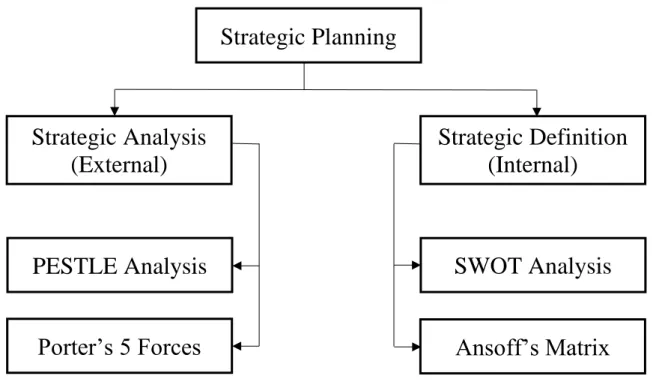
As stated in the case, defining a well-structured strategy is a key success factor. In order to achieve an informative and defined approach, today’s companies need to understand not only their internal strengths and limitations, but also the business environment surrounding them. “Strategy is the direction and scope of an organization over the long term, which achieves advantage in a changing environment through its configuration of resources and competences” (Johnson et al. 2009). In this sense, a strong strategic planning is constituted by an internal (SWOT Analysis and Ansoff’s Matrix) and an external analysis (PESTLE Analysis and Porter’s 5 Forces) analysis:
Strategic Planning
Strategic Analysis
(External)
Strategic Definition
(Internal)
PESTLE Analysis
Porter’s 5 Forces
Ansoff’s Matrix
SWOT Analysis
Figure 8 – Strategic Planning Diagram
Source: Adapted from Team FME; PESTEL Analysis: Strategy Skills; ISBN 978-1-62620-998-5
4.3.1.1. PESTLE Analysis
When performing an external analysis, it is critical to understand the environment factors that could affect the enterprise’s operations. These factors could be Political, Economic, Social, Technological, Legal and Environmental (PESTLE):
Political: It is advisable to be cautious about policies and governments in the geographical area an enterprise is willing to operate, because an unstable government may have a significant impact on day-to-day operations. For instance, operating in the European Union area, with few trade restrictions won’t be the same as trading in the Middle East, where operations may be much more regulated and costly;
Economic: It is crucial to have a macro-economic understanding of the geographical region an enterprise is operating in. Factors such as unemployment, employees’ education, wages and working practices or labor trends have a significant impact on day-to-day operations and profitability. It is therefore important to have a deep knowledge, which can be obtained by research, in financial news on the region and use of official economic indicators, such as GDP;
Social: From the Social point of view, it is important to have a good knowledge about the demographics and level of education in the geographical areas a company is targeting, which will produce a better cross-cultural communication in order to promote its business;
Technological: In this field it is important to be aware of technological breakthroughs that may impact companies’ business models. For instance, if there will be an innovative way to achieve the outcome your enterprise is delivering with significantly less costs or even a completely new manner that could make your services obsolete;
Legal: In terms of Legal issues, is important to understand if there are laws that could be an impediment for the companies’ operations, or even if there is the
possibility of new laws to be implemented in the near future. For instance, in the European financial market, the European Central Bank (“ECB”) is a major regulator which imposes certain regulations to companies in order to operate on the EU;
Environmental: Environmental issues have gained a preponderant role in today’s society. Therefore, companies’ must be attentive and sensitive to this kind of issues, especially specific local regulations, in order to avoid either environmental fines as well as local boycotts of their goods and services.
4.3.1.2. Porter’s 5 Forces
Just as a PESTLE analysis, Porter’s 5 Forces are also an external analysis. However, PESTLE is an analysis of the external environment, meanwhile this analysis is specific for obtaining an understanding of the attractiveness of an industry. It’s important to fully understand that on this analysis we start narrowing our information, we already know the environment we’re facing, now we need to understand the attractiveness of the specific
Figure 9 – PESTLE Analysis elements
Source: Team FME; PESTLE Analysis: Strategy Skills; ISBN 978-1-62620-998-5
market we want to get into. In this sense, Porter identified five elements, that combined can give companies an outlook of the costs and profitability of entering in a new market22:
Competition among competitors: This includes different types of competition, such as price discounting, services improvements, etc. Basically it means to analyze if the market is already saturated with too many players or if demand will still stimulate the growth rate of the industry. One example is to analyze the market share of the competitors and understand if the market is monopolized or if its shared among the players;
Bargaining Power of Suppliers: This element is related to the risk of suppliers threatening the companies with higher costs for goods and services. For instance, an industry with fewer suppliers may be more susceptible to increasing demands from suppliers, since there are no alternatives;
Bargaining Power of Buyers: Is very similar to the previous point, however in the other side of the coin. If buyers have a wider range of choice (several suppliers of that good or service) between which they may switch easily, looking for the better offer, this will decrease prices and therefore decrease the revenue;
Threat of Substitutes: This element addresses the possibility of creating new products that will fulfill the same needs of the company’s product, with less costs or in a new way that could be more appealing to consumers, which would turn the current offers obsolete to the market. An example of this was MP3 that turned CD Players obsolete and eliminated then from the market;
Threat of New Entrants: Is related to the possible market entry barriers for new companies. Those entry barriers limit the number of competitors, which will also reduce the competition among them. These barriers could be affected by product differentiation, capital requirements, access to distribution channels, economies of scale or even government policies.
4.3.1.3. SWOT Analysis
On this point we start to evaluate the internal aspects that will be relevant to stablish a strategy. A SWOT Analysis correspond to an understanding of the Strengths, Weaknesses, Opportunities and Threats of the enterprise. By combining them into a four entries matrix, management is able to identify the points to be improved, as well the opportunities and threats the company will face when pursuing a course of action.
4.3.1.4. Ansoff’s Matrix
For further information regarding this topic address point 5.1 of the note.
Figure 10 – Porter’s 5 Forces
Source: https://www.business-to-you.com/porters-five-forces/, accessed on September 19th, 2018
Figure 11 – SWOT Analysis Matrix
Source: https://academicjournals.org/article/article1380639652_Ommani.pdf, accessed on September 19th, 2018
5.
Chapter Three – The Time has Come
After identifying a market opportunity, there is the phase of selecting the adequate strategy to make the most out of it. In order to stablished the better path to grow it’s extremely important to have internal and external factors into consideration, such as capital/personal/in-house limitations or macro-environment factors, etc. All of those components will merge on a “formula”, that is not a guarantee of success but a better chance on the pursuit of it.
5.1. Growth/Expansion Strategies
According to Penrose (2006) any enterprise has an expansion limit, which means that there is a growing point from where it starts decreasing its profits. Nevertheless, Penrose also states that this limit point could be overcome through an internal adaptation and development of new products or new opportunities.
Thus, taking in consideration Penrose’s conclusions, we may conclude that the limits of an enterprise are set from market opportunities and/or management decisions.
We may therefore argue that the growth strategy of an enterprise is correlated with both new market opportunities identified and the decision of upper management on how to react to them, which may be influenced by the market sector analysis, new products or services to explore and even prospects of increasing market share.
Taking all of the previous points stated into consideration, management has to decide a best outcome strategy to follow, which can be divided in four paths to undertake, Chandler (1962):
i. Volume Expansion: An increase on the sale’s volume of the enterprise on the market;
ii. Geographic Dispersion: An increase on the locations that the enterprise offers its services or goods;
iii. Vertical Integration: Consists on the integration of new services that complement the present offer of the enterprise, which will increase the supply chain valor. It could be done by adding a supplier of goods (backwards) or acquiring a retailer of its goods (forward);
iv. Goods or Services Diversification: Consists on the development of new products or services to be offered by the enterprise.
As stated previously in this note, the market and internal analysis (which together may show new potential opportunities) are essential to define the growth strategy (Ansoff, 1957).
According to Ansoff’s matrix, we may argue that depending on the position of the enterprise on the market segment, it should focus on a specific strategy, which could be one of the following23:
v. Market Development: penetration of new markets with existing goods or services;
vi. Market Penetration: obtaining market share on an already stablished market; vii. Diversification: penetrating on new markets with innovative goods or services: viii. Product Development: developing new goods or services in an already
established market.
23 Navarra, Daniela and Scaini, Luca; Improvements In The Strategic Use Of The Marketing Matrices Applying Dynamics Parameters Based On Time: A Better Analysis Of Prospect; European Scientific Journal April 2016 edition vol.12, No.10 ISSN: 1857 – 7881 (Print) e ISSN 1857 - 7431
Figure 12 – Ansoff’s Matrix
However, a paper written in 201624, suggest some improvements that could be made to Ansoff’s classic Matrix, due to it being a two axis basic matrix, by adding for instance the kind of strategy that the enterprise may be aiming.
Therefore, this new approach may add relevant information for the future position of an enterprise taking into consideration the strategy it wants to put in action. According to the paper, there are three macroeconomic environments that can be achieved25:
ix. Multinational: focusing on approaching and developing new markets, leaving innovation as a secondary roll;
x. Blue Ocean Strategies: Main focus on developing new goods and services and entering new markets;
xi. Multiproduct: focusing on acquiring innovative goods or services as a competitive strategy on stablished markets.
24,24Navarra, Daniela and Scaini, Luca; Improvements In The Strategic Use Of The Marketing Matrices
Applying Dynamics Parameters Based On Time: A Better Analysis Of Prospect; European Scientific Journal April 2016 edition vol.12, No.10 ISSN: 1857 – 7881 (Print) e ISSN 1857 - 7431
Figure 13 – Ansoff’s Matrix with strategic positions goals
Source: Paper Improvements In The Strategic Use Of The Marketing Matrices Applying Dynamics Parameters Based On Time: A Better Analysis Of Prospect
This “internal introspection” of the position of the enterprise on the market, aligned with the market analysis done previously, permits to understand and predict in which direction the market is moving, allows upper management to take a more robust and sustained decision about with strategy they are going towards.
The next step to go through is how will the enterprise raise the necessary capital, both monetary and human, to undertake this new path?
There are two different approaches to face this issue, Internal or Organic Growth and External or Inorganic Growth. There isn’t a right one “per say”, the implementation of one rather the other will depend on the financial assets that the enterprise has access to, the time-setting for the strategy to work and finally the extensive research done previously in order to locate the enterprise on the market segment. Both of them have advantages and disadvantages that are needed to take into consideration when taking the decision. We will analyze the differences between the two of the in the next paragraph26:
a. Organic Growth
Organic or Internal Growth is often the most used model by enterprises. This strategy consists of expanding the business’s volume or entering new markets using only the company financial assets (e.g. revenue from previous periods), new funding from shareholders and unused debt capacity. This organic growth may be achieved through pursuing new markets, developing new technologies, trying to approach new segments of customers (niches segments) or just by increasing production and building an economy of scale (Bruner, 2004). Therefore, this approach is more suited for companies that aim to growth with a controlled risk. It has advantages and disadvantages regarding inorganic growth27,28:
26,26 Berg, Jean; Three growth models; http://www.estin.com/pdf/publications/ThreeGrowthModels.pdf, accessed on September 13th, 2018
27 http://www.iisjaipur.org/iiim-current-09/OORJA-May-August-2009/03Infocus.pdf, accessed on September 14th, 2018
a.1. Advantages
The most relevant is the ability to maintain the processes in-house, which provides the opportunity to growth without losing the company’s “identity”. By focusing on their own assets, the management is aligned with the company’s mission and values, which allows a more centric point of view on the value proposition meant to be delivered to customers. Moreover, there is a clear view from everyone on the company about what they aim to achieve, which may allow a higher efficiency in pursuing the objective.
a.2. Disadvantages
The main disadvantage of this model is a possible overinvestment when compared to competitors. The cost of growth is likely to be higher than the returns it brings, on the short run, therefore an ineffective allocation of resources may result on an absorption of all the benefits, making the growth obsolete.
b. Inorganic Growth
On the other hand, Inorganic or External Growth consists on acquiring or entering into strategic alliances with other companies, in order to obtain more human capital, new production facilities or even access to innovative technologies that support the desired expansion. As advantages, this strategy allows to reduce competition on the market through the merging of two or more competitors, in the long run builds economies of scale, may bring new ideas to upper management, allows to enter new markets in different geographies and also reduces the time-to-market factor, which could be relevant in the market segment. As disadvantage, one finds the loss of company’s identity and the possibility of the two firms not having their values and mission aligned, which could bring problems in the long term and how the customers relate with the new enterprise. We may argue that an Inorganic Growth may be subdivided into two different categories29:
29Chari, Latha; Inorganic growth strategies: Na empirical analysis of who benefits from them?; https://www.researchgate.net/publication/237229177, accessed on September 14th, 2018
b.1. Mergers & Acquisitions (M&A)
There are different forms of merger and acquisitions. A merger could relate to an absorption, when the acquiring enterprise maintains its identify and the acquired enterprise is terminated, or to a consolidation where both enterprises cease to exist, and a new firm is created (Damodaran, 2002). There are different types of mergers30:
Horizontal Merger: Between two firms in the same line of business, usually occurs to add a new technology or to reduce the competitors and gain market share; Vertical Merger: Between two firms in different stages of the supply chain,
usually occurs in order to add value to the customer;
Conglomerate Merger: Between firms on different lines of business, usually occurs when a company wants to penetrate on new markets.
Regarding acquisitions, there could an acquisition of assets, where all the assets of an enterprise is acquired gaining control over it, or acquisition of stocks, which implies purchase enough shares to gain board seats and power of control on the management decisions of the acquired enterprise (Damodaran, 2002).
b.2. Joint Venture
A joint venture corresponds to a strategic consolidation between two or more enterprises in order to share resources, risk and profits. As advantages, this model allows a faster and less costly access to foreign markets (which may also have regulatory factors attached), access to distribution channels and know-how from a local perspective that may be critical to enhance the success of the venture and also a possible complementarity between enterprise’s business that could allow a maximization of the services provided. In the downside, if the strategies are not correctly aligned it may create a certain resistance that could drive the venture to an unsuccessful path31.
30 Chari, Latha; Inorganic growth strategies: Na empirical analysis of who benefits from them?; https://www.researchgate.net/publication/237229177, accessed on September 14th, 2018
31D.Maugh, Ryan and R. Stewart, Milton; International Joint Ventures, a practical approach;
https://www.dwt.com/files/Publication/1b841dbe-3453-4983-97cd-
d6f5b44e5b2f/Presentation/PublicationAttachment/47d38fc0-1cc3-4c3e-b91f-d8aacd2ce6d1/International%20Joint%20Ventures%20Article_Stewart.pdf, accessed on September 14th, 2018
We may find examples in the literature32 of the most successful enterprises on the world pursuing different strategies. For instance, Apple is a good example of organic growth, throughout product innovation, the company build its own success by investing its sales’ revenues in innovation and repeating the process over and over. On the other hand, Microsoft is a good example of inorganic growth, since it has been successfully acquiring more than 100 enterprises since 1986, in order to add value to its value chain and also having access to new technologies then implemented on its products. We may also find examples of joint ventures, such as the joint venture between General Motors and Toyota, in order to share resources and knowledge, decreasing the cost on R&D that both companies would incur to produce a new car. In conclusion, as stated previously on this note, there isn’t a right or a wrong answer, there is a more suitable strategy that depends on where the enterprise is positioned on the market, on its resources and most importantly on the goal it proposes to aim.
32 Jacob, Miriam; 2006; “Organic vs Inorganic Growth: A Case Study”,
https://www.academia.edu/1996738/Organic_Vs_Inorganic_Growth_A_Case_Study, accessed on June 21st, 2019
Meierkord, Tim; 2016; “Analysis of growth strategies. Organic vs, inorganic growth”, Munich, GRIN Verlag
Growth Strategies
Organic Growth Inorganic Growth
M&A Joint Venture
Vertical Merger Acquisition of stocks Acquisition of assets Conglomerate Merger Horizontal Merger Asset replication New Customers New Technologies New Markets
Figure 14 – Growth Strategies
Source: Adapted from article: Inorganic growth strategies: An empirical analysis of who benefits from them?