DOI: 10.1590/1807-57622016.0906
Strategic management promoting teaching and service integration: multidisciplinary
residency deployment in Onco-Hematology
Leila Maria de Abreu Jaggi(a)
Simone Travi Canabarro(b)
Eliane Goldberg Rabin(c)
Rita Catalina Aquino Caregnato(d)
(a, b, d) Mestrado Profissional em Ensino na Saúde, Universidade Federal de Ciências da Saúde de Porto Alegre (UFCSPA). Rua Sarmento Leite, 245, Centro Histórico. Porto Alegre, RS, Brasil. 90050-170. [email protected]; [email protected]; [email protected]
(c) Departamento de Enfermagem, UFCSPA. Porto Alegre, RS, Brasil. [email protected]
In this paper we share details about the planning and implementation of a health education product deployed in a multi-professional residency in onco-hematology, using strategic management as the theoretical framework. The study represents an applied intervention that integrates teaching and service provision, based on processes established by the Project Management Institute. The study took place at a Brazilian Federal University in partnership with a center for high complexity oncology. Planning for the program began in 2014, based on the strategic management of the institutions involved, and implementation started in 2015. The residency provides an opportunity for professional training, with eight places made available each year. The product was the result of work carried out in the
Professional Master’s for Health Teaching that is financed by the Brazilian Federal Government. The academic institution and the service provider joined forces to promote collective actions that meet societal needs and are aligned with public policies that place a priority on cancer care, based on guidelines laid out by the Brazilian National Health System (SUS).
Keywords: Education. Teaching. Health Management. Non-medical Internship; Health.
Introduction
Due to the increasing speed of technological evolution, the area of health has been continuously incorporating new procedures, examinations and therapies, providing qualified healthcare and other benefits for society. This requires that institutions and governments constantly improve processes to face the market dynamics1,2.
Planning in a strategic way means using the available resources efficiently to increase productivity, and defining decision-making processes and priorities3,4. Advances in the society’s
demands, in technological progress and in knowledge improvement require qualified professionals5.
Cancer is responsible for more than seven million deaths across the world per year, which represents 12% of total deaths, according to data provided by the Union for International Cancer Control6.
The Multiprofessional Residency in the area of Health is a specialization (postgraduate) program in the modality of service education that enables students to experience different practice scenarios. It is an education device in the area of health that focuses on strategies, management, education and social control, and aims to develop health workers’ competences to work in Brazil’s National Healthcare System (SUS)8-14.
When one of the authors of this paper started a Professional Master’s Program in Education in the area of Health, this triggered the construction of an educational product with potential for qualifying healthcare. As the author works at a hospital that assists oncological patients, she wished to construct an educational product that contributed to qualify health professionals, promoting effective transformations both in the praxis of the Higher Education Institution and in the service. To define the product to be created, a reflection centered on four pillars was carried out. The pillars were named A, B, C and D.
Pillar “A” was supported by one of the authors’ experience in daily professional management and practice at a hospital specialized in oncological care, as she identified the need to integrate education and service in order to qualify professionals to work in the RAO (Oncology Care Network).
Pillar “B” represented the CACON (High Complexity Oncology Center), a specific nomenclature for hospitals that offer specialized and comprehensive care for cancer patients. Such hospitals provide services like prevention, early detection, diagnosis and treatment. Guideline no. 140, published on February 27, 2014 by the Ministry of Health, redefined criteria and parameters for the organization, planning, monitoring, control and assessment of institutions that provide specialized oncological care, defining structure, functioning and human resources conditions for them to be included in the scope of the SUS15.
Pillar “C” was the hospital’s strategic planning from 2011 to 2015, in which one of the strategic themes was “innovation” and the strategic aim was “to increase the hospital’s capacity for teaching and research”. There was the need to develop projects aiming to qualify health professionals and their evidence-generating scientific production.
Pillar “D” referred to the PDI (Institutional Development Plan) of a Federal University, whose Axis named Goal-Setting Plan recommended the institution’s sustained expansion, based on the guideline “increasing the number of courses, programs and students in undergraduate and postgraduate programs”.
When we noticed that there was an effective alignment among the parties involved towards developing projects to integrate education and service, we decided that our guiding question would be to develop a Multiprofessional Residency (MR) with emphasis on Oncology and Hematology, through a partnership between a large hospital and a federal university, thus promoting an integration between education and service. The aim of this paper is to describe the planning and implementation of an
educational product in the area of health, in the modality of Multiprofessional Residency in Oncology and Hematology, based on the strategic management theoretical framework.
Method
the studied reality to modify it, [...] not only does it propose solutions to problems, but it also participates effectively in their resolution”16 (p. 43).
Intervention research stimulates researcher and subjects to ask questions and take actions that enable to reduce the distance between academia and practice, with the aim of producing transformations in healthcare scenarios17-19. Some of the principles that guide intervention research are taking daily social
realities into account and having an ethical and political commitment to produce innovative practices20.
This modality “brings the researcher closer to the subject in a singular way, in an activity in which both get to know each other, learn, transform and are transformed”21 (p. 28). Interventions in the
area of Education “involve planning and implementing interferences (changes, innovations) whose purpose is to produce advances, improvements in the learning processes of the subjects who participate in them” 22:58.
The development of interventions enables to create spaces for knowledge production based on reality, and contributes to solve problems in the subjects’ daily routine, promoting transformations in the environments16,22.
The objectives defined in strategic planning are fulfilled by means of projects, which promote product development and produce results aligned with the institution’s objectives4,23.
To develop the educational product Multiprofessional Residency (MR) with emphasis on Oncology and Hematology, we used the Project Management Body of Knowledge (PMBOK) as a guide, and we followed the five process groups recommended for the construction of a project, which are named: 1) Initiating; 2) Planning; 3) Executing; 4) Monitoring and Controlling; and 5) Closing24.
The institutions involved were chosen because they provide, respectively, healthcare and teaching in health professionals’ education. The hospital, which is a nationwide reference, has been providing oncology care for four decades. It is a private law foundation whose philanthropic nature is targeted at teaching and social work. It is recognized as a CACON (High Complexity Oncology Center). The Higher Education Institution is a federal university that offers undergraduate and postgraduate programs exclusively in the area of health. Both are located in the city of Porto Alegre, southern Brazil.
The subjects involved in the process of development of the educational product, that is, in the MR with emphasis on oncology and hematology, were ten professionals and nine teachers from the areas of nursing, physiotherapy, speech-language pathology and audiology and nutrition, working, respectively, as preceptors and tutors, as well as fifteen teachers for the theoretical disciplines.
To construct the educational product, institutional documents related to the strategic
management of the institutions involved were analyzed, as well as the laws referring to MR in the health area and oncological care. In addition, the researcher observed practice scenarios in which oncological care is provided, and the managers of both institutions formalized their consent in writing.
The project was approved by the Ministry of Education and Culture (MEC), which authorized the Program’s implementation and granted eight scholarships to professionals from the requested areas of knowledge.
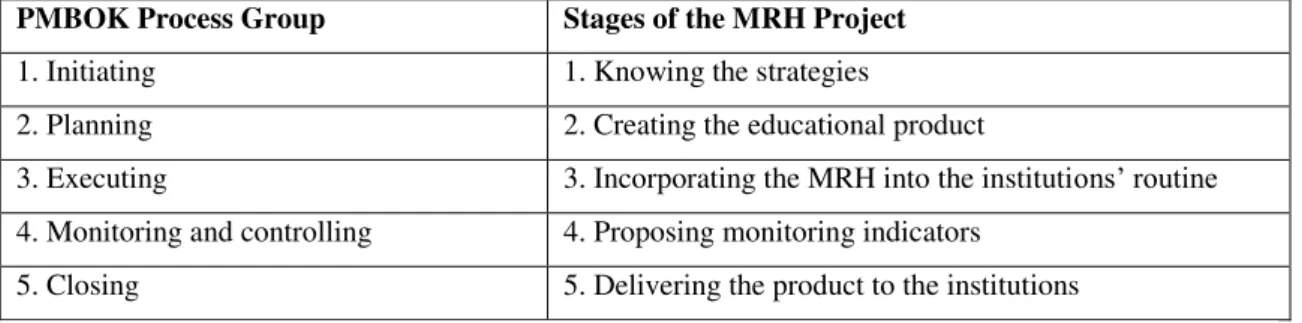
To create or improve a product or service, it is necessary to apply the existing knowledge, skills and tools. Usually, organizations use projects to conduct the unfolding of the established strategic objectives. In this project, the recommendations of PMBOK were followed, according to what is presented on Table 1.
Table 1. PMBOK process groups related to the construction stages of the Project of Multiprofessional Residency in Health (MRH)
PMBOK Process Group Stages of the MRH Project
1. Initiating 1. Knowing the strategies
2. Planning 2. Creating the educational product
3. Executing 3. Incorporating the MRH into the institutions’ routine
4. Monitoring and controlling 4. Proposing monitoring indicators
5. Closing 5. Delivering the product to the institutions
Source: Developed by Jaggi, L.M.A, 2016
Initiating: Knowing the strategies
The first stage, named “knowing the strategies”, explored the strategic planning of the institutions involved. This investigation showed that the institutions’ strategies utilized the analysis of market scenarios, identifying the existing opportunities to align their strategic objectives with society’s demands.
The stage of scenario analysis is fundamental to subsidize the definition of an organization’s paths25. The analysis showed that the market needed new and innovative products in the area of health
teaching, as it was revealed by the strategic planning of both institutions. Oliveira4 argues that
organizations are influenced by oscillations of the surrounding environment, and it is fundamental to understand the external environment.
The documental analysis consolidated the possibility of enabling the creation of the educational product, as both institutions had the same focus. At this moment, we established that the project’s scope would be a program of Mutiprofessional Residency in Health (MRH) with emphasis on Oncology and Hematology. This educational product was constructed in the perspective of a collaborative innovation, as it joined observations and actions both of the educational institution and the service institution. It is important to connect academic knowledge and knowledge built from teams’ practice and experiences26.
Collaborative relations among organizations enable knowledge production for the creation and improvement of their services and products27,28.
Planning: Creating an educational product
In the planning stage, the project of the educational product for teaching in the area of health was developed, with the objective of innovating by incorporating products into its portfolio.
Residency in the area of Health”, in 2014, stimulating federal universities to enroll their projects in order to start new MRH programs in 2015. This notice prioritized some health areas to grant scholarships, and one of them was oncological care. The PNAO guides oncological care in Brazil and establishes the responsibilities of different segments in the line of care provided for oncological patients7.
Considering that in 2015 the National Cancer Institute29 estimated 600 thousand new cases of
cancer in Brazil for the 2016-2017 biennium, it is necessary to look at the epidemiological demands, which corroborates the relevance of preparing professionals to work in this area. The possibility that emerged with the published notice enabled us to investigate whether the Higher Education Institution and the hospital were interested in developing a MRH program with emphasis on Oncology and Hematology. Based on favorable manifestations on the part of the institutions’ managers, we proceeded with the development of the Pedagogical Project (PP) of the proposed program.
This stage required an articulation with the areas of academic knowledge and service knowledge with the purpose of obtaining adherence to the project. As there has been an ongoing MR program with emphasis on Intensive Therapy since 2012 through a partnership between the institutions involved, the new proposal was submitted to the appraisal of the NDAE (Structuring Healthcare Teacher Nucleus), to investigate the areas of knowledge that were interested in participating in the new proposal. The members of this nucleus are “the program’s coordinator and one representative of teachers, tutors and preceptors of each concentration area” 30 (p. 24). The areas that wanted to participate in the development of the project
were nursing, physiotherapy, speech-language pathology and audiology, and nutrition. To be considered a Multiprofessional Residency in Health, the program must encompass at least three professions in the area of health30.
For the functioning of the MRH, it is necessary to have teachers, tutors and preceptors in all the areas of knowledge involved in the program. Teachers are “professionals linked to the educational and executive institutions that participate in the development of theoretical and theoretical-practical activities in the PP”; tutors are responsible for the “academic supervision of preceptors and residents”; and
preceptors “are professionals responsible for supervising the practical activities performed by residents in the health services’’ 30 (p. 25).
Dallegrave31 argues that the players involved in the educational work of the MRH should be
constantly evaluating it; furthermore, there must be rules for the functioning of this modality of education in the area of health to maintain the commitment to forming teams for an integrated provision of care.
An MRH program must offer care in all levels of complexity, which requires that the resident should have experience also in the primary care network. Thus, we contacted the Municipal Health Department of Porto Alegre to ask if they were interested in participating in the program. The Municipal Health Council and the Secretary wrote a letter formalizing the Municipal Health Department’s
commitment to supporting the activities of the MRH with emphasis on Oncology and Hematology, allowing to carry out activities in the Primary Care Network with the aim of preparing professionals to provide cancer care.
implemented. The PP of the new program was developed aiming to integrate different health professions to work in a multiprofessional team with an interdisciplinary work proposal, included in a field and nucleus of knowledge and practices, with permanent articulation, and targeted at the integration among teaching, research, service, management of the SUS, and social control.
The MRH enables the critical education of professionals in the area of health to act in different scenarios of care provision for users. This pedagogical strategy, defended by Freire32, promotes critical
education and integrates players in the teaching and learning process. Thus, it contributes to social transformations.
The PP of the program was organized in practical, theoretical-practical, and theoretical disciplines. According to Resolution no. 5 of the CNRMS (National Committee for Multiprofessional Residencies in the area of Health), published in 2014, practical educational strategies, which correspond to 80% of the program’s number of hours, are developed in healthcare areas, enabling in-service practical training, supervised by preceptors33.
Knowledge is better constructed when students experience theoretical and practical activities that have coherence and allow a reflective exercise. This strengthens the components of education and stimulates professionals to question their own actions. Each player of the education process undergoes a global growth, and the teaching program in the area of health is the driving force that leads to
transformation34.
Theoretical educational strategies are learning activities developed in formal classes, group studies, seminars and individual studies33. They areguided and supervised by teachers from the different
areas of knowledge. Theoretical-practical educational strategies are carried out by means of the study of clinical cases, students’ work in social control spheres, collective health activities and educational actions. They are supervised by healthcare teachers33. The MRH contributes to the development of professional
knowledge, as it provides a theoretical background for the performance of practices12,14.
The program contains disciplines belonging to an axis common to all emphases, with contents of common and interdisciplinary interest, namely: Public Health Policies in Brazil; Interdisciplinarity, Comprehensiveness and Social Control; Research Planning; Patient Safety; and Ethics. The specific disciplines were: Multiprofessional Approach to the Oncology-Hematology Patient I (Diagnosis Principles, Oncology Health Policies); Organizational Management and Teamwork; Multiprofessional Approach to the Oncology-Hematology Patient II (Education and Health in Psycho-oncology and Context of Oncological Care); and Principles in Oncology and Hematology I (Physiopathology of cancer,
Oncogenetics, Cancer Surveillance, Registry and Prevention).
To enable learning in all scenarios, the field of practices was defined as hospitalization units, cancer prevention outpatient clinic, oncology specialties outpatient clinic, chemotherapy unit, radiotherapy service, Intensive Care Unit (ICU), Surgical Center, diagnosis services, hospital-based cancer registry, and bone marrow transplant unit. Complementing the line of oncological care, residents experience and develop multidisciplinary activities involving the Higher Education Institution’s teachers and primary care professionals in units established by the Municipal Health Department.
Therefore, the total number of hours that the resident spends in primary care and hospital care is 5,760, in accordance with the legislation in force33.
The function of coordination of the MRH program must be performed by a professional who has, at least, a Master’s degree and a minimum of three years’ professional experience in the area of health education, healthcare or health management21. This professional must register the project in the System of
the National Committee for Multiprofessional Residencies in the area of Health (SisCNRMS), of the Ministry of Education and Culture, and monitor the program’s development. The coordinator of the MRH with emphasis on Oncology and Hematology was chosen in a meeting with members of the COREMU (Multiprofessional Residency Committee). A teacher from the Higher Education Institution was designated, based on her history in healthcare and research in the oncological area.
In September 2014, after the project was approved by COREMU and by the Higher Education Institution, it was registered in the SisCNRMS. The disclosure of the results and the authorization to open the Program occurred in November 2014, when the Ministry of Education and Culture published the list of institutions and programs approved for the year of 2015.
Executing: Incorporating MRH into the institutions’ routine
The execution stage of a project is the materialization of planning35. The project is innovative
because it introduces a new product; innovation is a process of change in which new or improved processes are added to the organization36. It is considered a collaborative innovation, as it integrates a
teaching institution and a service institution in the development of the product 27,28.
The selection process of residents for the first class started in November 2014. The Higher Education Institution was in charge of it and it occurred in two stages: 1) a specific knowledge test; and 2) a structured interview. A total of 22 professionals were enrolled and disputed the eight available places. The residents approved for the first class were admitted in March 2015.
Activities in accordance with the MRH implementation plan were carried out by the program’s coordinator in partnership with the project manager, representing the Higher Education Institution and the service institution, respectively. The activities involved teachers, tutors, preceptors and other
professionals from the field of practice. According to the PMBOK, the execution stage of a project implies coordinating the planned actions, involving people in its fulfilment24.
Monitoring the execution of a project presupposes continuous evaluations and updates. It is possible to include or change actions that were envisaged during the planning stage24. The
implementation process is monitored by means of systematic meetings involving the coordination, tutors and preceptors to evaluate the ongoing stages.
Innovations in educational interventions enable subjects to undergo a learning process22. Authors
emphasize the relevance of stimulating subjects to questionings, aiming to reduce the distance between academia and practice18,19.
was the inclusion of physiotherapists, nutritionists and speech-language pathologists and audiologists. Up to that moment, these professionals had not existed in the primary care offered to users in the health district in which the residents were included. The theoretical disciplines, developed simultaneously, approached public policies, health and disease process, interdisciplinarity, comprehensive care and social control.
Oliveira4 emphasizes that reflecting on the reality of healthcare with the help of the theoretical
framework transforms professionals and their critical and investigative sense, allowing them to overcome technicism.
The healthcare experiences in the hospital sphere were structured in plans of practical activities, organized by sector and area of knowledge, so that residents could share knowledge in the daily routine of the care units. The structuring in multidisciplinary rounds became part of the routine and enabled the discussion and complementation of the players’ knowledge.
Freire32 argues that the educational process presupposes a search for research and critical
reflection, in an environment of exchanges between student and teacher. This process must extrapolate the technical-scientific domain and be extended to the structuring aspects of the relationships and practices that are relevant to society.
There is a strong movement that advocates that academia should discard its rigid and
compartmentalized structures and open itself to an interdisciplinary view37. The MRH with emphasis on
Oncology and Hematology mobilized the academia and service professionals, as it proposed an innovative model that developed theoretical classes with specific contents from the oncological area, organized in a linear and multidisciplinary way. The professionals of the four areas of knowledge that form the MRH have access to theoretical contents in an integrated way; all of them have contact with the themes regardless of the areas of knowledge, unifying and potentializing knowledge.
Monitoring and controlling: Proposing monitoring indicators
Residents participate effectively in the program’s monitoring process, making suggestions for continuous improvements that, together with tutors’ and preceptors’ contributions, make the co-creation process be a reality in the development of this program. A product needs to be monitored constantly; the involvement of the end user in the creation process contributes to a continuous improvement28.
The first year of functioning of this program was of collective construction, as education and health require the sum of academic knowledge and common sense knowledge, constructed in the experiences of groups26,32.
on Oncology and Hematology, scientific production increased. The residents produced 25 works, with the support of tutors and preceptors, to be presented in national and international events. In addition, eight Residency Completion Assignments are currently being developed, with specific themes of the areas of knowledge. The number of scientific works produced by residents during the specialization period is one of the performance indicators of the residency program. It shows a renovation in knowledge and an enhancement in hearing in all spheres, including the management of the residents’ workplace.
Closing: Delivering the product to the institutions
This educational product is considered innovative because it was produced as a thesis in the Professional Master’s Program in Education in the area of Health, and resulted in a teaching product in the area of health. The university has advanced as, beyond the institutional walls, it has entered into a scenario of practices that needed to be oxygenated to create strategies, leading to a form of care guided by many angles of observation, always accompanied by the management’s view of the entire picture. If the process was, in the near past, crystallized, today it is possible to state that there is a permanent
oxygenation. According to Freire32, “teaching does not mean transferring knowledge; rather, it means
creating possibilities for its production or construction” (p. 12).
One of the main innovative results of the MRH with emphasis on Oncology and Hematology is that it was able to join the university’s teachers with the hospital’s professionals. They developed partnerships and shared the recognition of health as a universal right, the understanding of the social determination of the health and disease process, and the commitment to health education based on collective proposals for tackling complex problems38. In addition, patients/users began to have a recycled
team that provides orientations and visualizes new forms of providing comprehensive care on a daily basis, despite the complex limitations imposed by Brazil’s healthcare system.
At the end of the project, an MRH Program with emphasis on Oncology and Hematology was delivered, constructed in a collaborative way. This product is now part of the institutions’ portfolio. It is the materialization of the Teaching-Service Integration in the Education of Human Resources for Healthcare. Therefore, the contemporary need of integrating the university, the health service and the community to qualify health professionals working in different contexts of service, in all levels of care, through the articulation of specific knowledge32,39,40 has become a reality.
In the era of information and interdisciplinarity, we are witnessing an increase in the demand for professionals educated with an amplified view of care, capable of sharing knowledge, to meet the needs that emerge with the evolution of the healthcare process.
Final remarks
oncology services in their organizational and functional aspects, in different healthcare scenarios. Academia and the service potentialized efforts to promote collaborative actions, meeting social needs, aligned with the State policies that prioritize cancer care, grounded on the SUS’ guidelines.
New opportunities of investigation emerge, with the aim of identifying the impact produced by graduates of the MRH with emphasis on Oncology and Hematology on user care.
Acknowledgements
We would like to thank the hospital Irmandade da Santa Casa de Misericórdia de Porto Alegre for their support to
the development and implementation of the Multiprofessional Residency Program in Oncology and Hematology, as well as the professionals who were involved in the project.
Collaborators
Leila Maria de Abreu Jaggi and Rita Catalina Aquino Caregnato participated in the conception, writing, discussion, revision and approval of the final version of the article. Simone Travi Canabarro andEliane Goldberg Rabin
participated in the article’s writing, discussion and revision.
References
1. Spiller ES, Senna AM, Santos JF, Vilar JM. Gestão dos serviços de saúde. Rio de Janeiro: FGV; 2011.
2. Bedin DM, Scarparo HBK. Gestão em saúde, experiências de campo e pesquisa com inserção social. Porto Alegre: Sulina; 2013.
3. Moysés-Filho J, Kestelman HN, Becker-Júnior LC, Torres MCS. Planejamento e gestão estratégica em organizações de saúde. Rio de Janeiro: FGV; 2011.
4. Oliveira DPR. Planejamento estratégico. São Paulo: Atlas; 2012.
5. Pierantoni CR, Vianna ALA. Educação e saúde. São Paulo: Hucitec; 2010.
6. União Internacional Contra o Câncer (UICC). World Cancer Leaders’ Summit [Internet]. 2013 [citado 15 Abr
2016]. Disponível em: http://uicc.org/sites/main/files/ private/ WCLS2013_Report.pdf.
7. Ministério da Saúde (BR). Portaria GM/MS n. 2.439, de 8 de dezembro de 2005. Institui a Política Nacional de Atenção Oncológica: promoção, prevenção, diagnóstico, tratamento, reabilitação e cuidados paliativos a ser
implantada em todas as unidades federadas, respeitadas as competências das três esferas. Brasília (DF): Ministério da Saúde; 2005.
8. Gerlack LF. Saúde do idoso: residência multiprofissional como instrumento transformador do cuidado. Rev Cienc Saude. 2009; 2(2):104-8.
9. Rosa SD, Lopes RE. Residência multiprofissional em saúde e pós-graduação Lato Sensu. Rev Trab Educ Saude. 2009; 7(3):479-98.
10. Nascimento DDG, Oliveira MAC. Competências profissionais e o processo de formação na residência multiprofissional em Saúde da Família. Saude Soc. 2010; 19(4):814-27.
11. Ceccim RB. Prefácio. In: Fajardo AP, Rocha CMF, Pasini VL, organizadores. Residência em saúde, fazeres e saberes na formação em saúde. Porto Alegre: Evangraf; 2010. p. 17-23.
12. Lobato CP, Melchior R, Baduy RS. A dimensão política na formação dos profissionais de saúde. Physis. 2012; 22(4):1273-91.
14. Silva RMO, Cordeiro ALAO, Fernandes JD, Silva LS, Teixeira GAS. Contribuição do curso de especialização, modalidade de residência para o saber profissional. Acta Paul Enferm. 2014; 27(4): 362-6. 15. Ministério da Saúde (BR). Portaria Ministerial nº 140, de 27 de fevereiro de 2014. Brasília (DF): Ministério da Saúde; 2014.
16. Vergara SC. Projetos e relatórios de pesquisa em Administração. 14a ed. São Paulo: Atlas; 2013.
17. Damiani MF. Sobre pesquisas do tipo intervenção. In: Encontro Nacional de Didática e Prática de Ensino, Anais do XVI Encontro Nacional de Didática e Prática de Ensino. Campinas: UNICAMP; 2012.
18. Zambenedetti G, Silva RAN; Pesquisa-intervenção: uma perspectiva ética na relação entre universidade e serviço de saúde. In: Scarparo HBK, Bedin DM. Gestão em saúde, experiências de campo e pesquisa com inserção social. Porto Alegre: Sulina; 2013.
19. Rossi A, Passos E. Análise institucional: revisão conceitual e nuances da pesquisaintervenção no Brasil. Rev EPOS. 2014; 5(1):156-81.
20. Moreira MIC. Pesquisa-intervenção: especificidades e aspectos da interação entre pesquisadores e sujeitos da pesquisa. In: Castro LR, Besset VL, organizadores. Pesquisaintervenção na infância e juventude. Rio de Janeiro: Trarepa; 2008.
21. Castro LR, Besset VL, organizadores. Pesquisa-intervenção na infância e juventude. Rio de Janeiro: Trarepa; 2008.
22. Damiani MF, Rochefort RS, Castro RF, Dariz MR, Pinheiro SS. Discutindo a Pesquisa do tipo Intervenção Pedagógica. Cad Educ. 2013; 45:57-67.
23. Cavalieri A. A estrutura e a norma de gerenciamento de projetos. In: Dinsmore PC, Cavalieri A. Como se tornar um profissional de gerenciamento de projetos. Rio de Janeiro: Qualimark; 2009.
24. Project Management Institute. Um guia do conhecimento em gerenciamento de projetos (Guia Pmbok - Guide to the Project Management Body of Knowledge). 5a ed. São Paulo: Saraiva; 2014.
25. Ghemawat P. A estratégia e o cenário de negócios. Porto Alegre: Bookman; 2007.
26. Rangel M. Educação e saúde: uma relação humana, política e didática. Rev Educ. 2009; 32(1):59-64.
27. Huizingh EKR. Open innovation, state of the art and future perpectives. Technovation. 2011; 31(1):2-9.
28. Bueno B, Balestrin A. Inovação colaborativa: uma abordagem aberta no desenvolvimento de novos produtos. Rev Adm Empres. 2012; 52(5):517-30.
29. Instituto Nacional do Câncer. Incidência de câncer no Brasil [Internet]. Brasília (DF): INCA; 2016 [citado 15 Abr 2016]. Disponível em: http://www.inca.gov.br/ estimativa/2016/index.asp?ID=2.
30. Ministério da Educação (BR). Resolução CNRMS nº 2, de 13 de abril de 2012. Dispõe sobre Diretrizes Gerais para os Programas de Residência Multiprofissional e em Área Profissional de Saúde. Diário Oficial da União; abr. 2012. Seç I, p. 24-5.
31. Dallegrave D, Ceccim RB. Expressões do processo de governamentalização nas residências em saúde. Interface (Botucatu). 2016; 20(20):377-88.
32. Freire P. Pedagogia da autonomia saberes necessários à prática educativa. 43a ed. Rio de Janeiro: Paz e Terra; 2011.
33. Ministério da Educação (BR). Resolução n. 05, de 7 de novembro de 2014. Dispõe sobre a duração, carga horária, avaliação e frequência nos Programas de Residências Multiprofissionais. Diário Oficial da União; 2014 nov. 10. Seç 1, p. 34.
34. Hatlevik I, Katrine R. The theory-practice relationship: reflective skills and theoretical knowledge as key factors in bridging the gap between theory and practice in initial nursing education. J Adv Nurs. 2011; 68(4):868-77.
35. Vargas R. Manual prático do plano de projeto utilizando o Pmbok Guide. 5a ed. Rio de Janeiro: Brasport; 2014.
36. Tidd J, Bessant J, Pavitt K. Gestão da inovação. Porto Alegre: Bookman; 2008.
39. Lopes R, Tocantins FR. Promoção da saúde e a educação crítica. Interface (Botucatu). 2012; 16(40):235-4.
40. Pereira RCA, Rivera FJU, Artmann E. O trabalho multiprofissional na Estratégia Saúde da Família: estudo sobre modalidades de equipes. Interface (Botucatu). 2013; 17(45):377-40.
Translated by Carolina Ventura