RESEARCH
J. res.: fundam. care. online 2014. dez. 6(supl.):176-186
176
Papanicolau no olhar de mulheres idosas Pap smears in eldery women look
Prueba de papanicolaou en la mirada de las mujeres mayores
Luipa Michele Silva1, Nychela Junaan Marques Coutinho2, Elita Rozendo do Nascimento Santos3, Júlia
Solange Dantas Moreira4, Carmem Silvia Laureano Dalle Piagge5, Antonia Oliveira Silva6
Objective: to know the social representations of older women on the Pap smear. Method: exploratory
qualitative approach, conducted with 30 women attending the Family Health Unit Maria de Nazaré in the city of João Pessoa / PB. Data were analyzed with the help of the Alceste software. Results: analysis by Alceste pointed six classes or categories, covering both positive and negative associated with this examination, as images relating to the examination; positioning of older front of the examination; indications of the exam; exam; beliefs about the examination and justification for noncompliance. Conclusion: the social representations about Papanicolaou Test for elderly enables to offer health education actions that try to minimize socio-cultural barriers of these older, greater adherence of women to screening test considering the social context and their livings. Descriptor: Elderly, Papanicolaou test, Social representations, Health.
Objetivo: conhecer as representações sociais de mulheres idosas sobre o exame Papanicolau. Método: pesquisa
exploratória de abordagem qualitativa, realizada com 30 idosas atendidas na Unidade de Saúde da Família Maria de Nazaré do município de João Pessoa/PB. Os dados foram analisados com o auxilio do software Alceste.
Resultados: análise realizada pelo Alceste apontou seis classes ou categorias, contemplando tanto negativos
quanto positivos associados ao referido exame, como: imagens associadas ao exame; posicionamento das idosas frente ao exame; indicações do exame; realização do exame; crenças sobre o exame e justificativas para não adesão. Conclusão: conhecer as representações sociais sobre o exame Papanicolau para idosas possibilita se oferecer ações educativas de saúde que procure minimizar barreiras socioculturais dessas idosas, para uma maior adesão da mulher ao exame preventivo considerando o contexto social e suas vivencias. Descritores: Idosas, Teste de papanicolaou, Representações sociais, Saúde.
Objetivo: conocer las representaciones sociales de mujeres mayores en las pruebas de Papanicolaou. Método:
enfoque cualitativo exploratorio, realizado con 30 mujeres que acuden a la Unidad de Salud de la María de familia de Nazaret en la ciudad de João Pessoa / PB. Los datos fueron analizados con la ayuda del software Alceste. Resultados: El análisis por Alceste señalaron seis clases o categorías, que abarcan tanto positivos como negativos asociados con este examen, como imágenes relativas al examen; posicionamiento del frente anterior del examen; indicaciones del examen; examen; creencias sobre el examen y la justificación para el incumplimiento. Conclusión: las representaciones sociales acerca de las pruebas de Papanicolaou para ancianos permite ofrecer acciones de educación en salud que tratan de minimizar las barreras socio-culturales de estos mayores una mayor adherencia de las mujeres, a prueba de cribado teniendo en cuenta el contexto social y sus vivencias. Descriptores: Ancianos, Prueba de Papanicolaou, Representaciones sociales, Salud.
1Nurse, PhD student at the Graduate Nursing UFPB Program, Scholarship of CAPES, João Pessoa / PB, Brazil,
email:[email protected]. 2 Physiotherapist, master, participant of the research group GIEPERS linked to the
Graduate Program in Nursing UFPB, João Pessoa - PB, Brazil, e-mail:[email protected]. 3Dentist of the Family
Health Program. Student of Specialization Course Health Care and Aging MS / UFPB, João Pessoa - PB, Brazil, e-mail: [email protected]. 4Dentist of the Family Health Program. Student of Specialization Course Health
Care and Aging MS / UFPB, João Pessoa - PB, Brazil, e-mail: [email protected]. 5Dentist, Professor at
the Federal University of Paraíba, Researcher of the International Group of Aging and Social Representations (GIEPERS) of PPGENF / UFPB, João Pessoa - PB, Brazil, e-mail: [email protected]. 6Nurse, Full Professor of
UFPB, João Pessoa - PB; CNPq Researcher; Leader of the International Group of Aging and Social Representations (GIEPERS) of PPGENF / UFPB; Scholarship Senior CAPES, e-mail:[email protected].
*Original article of the Project: HEALTH CONDITION, QUALITY OF LIFE AND SOCIAL REPRESENTAÇOES ELDERLY IN THE FAMILY HEALTH UNITS, funded by FAPESQ and FNS / MS: report of unprecedented scientific research and complete.
ABSTRACT
RESUMO
J. res.: fundam. care. online 2015. 2014. dez. 6(supl.):176-186
177
A
ging is a world phenomenon, however, he comes up against great social inequalities between developed countries and those that are under development, as the case of Brazil, where the incidence of some types of cancer remains high, because it is directly related to conditions socioeconomic and environmental precarious, just like the cervical cancer.1
That cancer can be detected and prevented from Pap smears, this screening strategy is adopted by the Public Health System (SUS) and it has presented great acceptability by the female population and health professionals. Studies indicate that the choice of method of prevention depends on their socioeconomic status, educational level, professional status and their health and well-being with family and herself.2,3
In Brazil are adopted the criteria recommended by the World Health Organization (WHO) regarding age and the frequency of Pap smear, the target population are women who have started their sexual life, or have aged between 25 and 59 years old. The examination carried out on an annual basis, and after two achievements to negative its recurrence can be made in a range of three years. The test as a prevention is responsible for the decrease in cervical cancer mortality rates, especially in developed countries, if performed correctly and with a view to minimum quality of testing.4-6
Despite the importance of this test, older women do not realize or slow to realize it due to numerous factors, from the socio-cultural health to itself, because it is only recommended up to 59 years, many find it unnecessary to its realization. Therefore, the absence of which is comprised in the service.1
It is known that the elderly have many difficulties to deal with that examination by this refer directly to their sexuality even the preventive approach that is emphasized. It is thought that these women associate negative images and concepts have focused on representations of their own sexuality and the body, with important meanings to non-adherence to examination, expressed symbolic order of ambiguous ways in which thoughts, actions and attitudes that reflect the representations social of the issue, in particular, their sexuality can interfere with adhesion, in other words, determinants of health practices or social.7
Social representations are defined as a set of values, ideas and practices that establish an order, enabling people to orient themselves in their material and social world, and control it; and collaborates for communication between members of a community, providing them with a code to name and classify, without ambiguity, the various aspects of their world and of their individual and social history.8
Therefore, the attitude of older women across the Pap smear is influenced by culture, race, experiences, beliefs, life expectations and preconceived ideas built throughout his life. Overcome the barriers to adhesion of older women to the screening test is necessary to observe the accounts and experiences of these.
J. res.: fundam. care. online 2015. 2014. dez. 6(supl.):176-186
178
METHOD
A little exploration of this theme in research which aims to identify the social representations about Pap smear built by older women raised our interest in this study to know what they think about this examination and from there to propose educational activities with interventions discussing the importance in the prevention of the increase in the incidence of cervical cancer in vulnerable subgroups.
Thus, the social representations about Pap smear for older women as forms of knowledge / information built and shared in their belongings groups is important to be contextualized actions focusing on their experiences, beliefs, life expectancies built throughout his life. There is no question that the social representations about Pap smear built by older women to understand the adhesion of these out that assessment.
Thus, this study aims to understand the social representations of older women on examination of the Pap smear.
It's a survey of exploratory qualitative approach conducted with thirty elderly registered and attended the healthcare team of said in the Family Health Unit, Maria de Nazaré, in the city of João Pessoa, Paraíba, who attended the following criteria inclusion: having more than 60 years, are registered to the unit, have cognitive conditions to answer an interview and accept participate.
This research is attached to the project Assistive Technologies for Seniors assisted in Health Units Family / Health Conditions, Quality of Life and Social Representations of elderly patients in the Family Health Units in the city of João Pessoa (approved by the Ethics Committee of the University Hospital Lauro Wanderley - No 261/2009 protocol). The data were collected from April to July 2011. Through interviews scheduled in the housing of elderly and performed as their availability, the consent and signature of the free and informed consent form, as recommended by Resolution 196/96 of the Brazilian Council National Health.9
Those that fulfilled the inclusion criteria were informed in the unit on the study objectives, ensuring the confidentiality and as autonomy, that at any moment the interviewee could ask shutdown of the research.
Data collection was performed from a semi-structured interview in which the first part contained questions relating to the profile of interviews and the second part with questions about dimensions of the theoretical framework of social representations to grasp the object of study - the Pap smear.
The profile data was subjected to a simple statistical analysis with the aid of the Statistical Package for Social Sciences SPSS version 19.0 for Windows. Meanwhile, data obtained from semi-structured interviews were analyzed with the help of the software Alceste (Lexical Analysis by Context of a Text Segments Set) with an analysis of textual data10 faciliting the exploration of the structure and organization of the speeches of social
J. res.: fundam. care. online 2015. 2014. dez. 6(supl.):176-186
179
RESULTS AND DISCUSSION
actors, and allows access to the relations between the quantitative lexical universes considering the word as corpus unit formed by the number of questionnaires / tests, corresponding in this study 30 UCE's.
The Alceste program features each class of their characteristic vocabulary and its variables that contributed to the production of UCE's of the respective classes, which are selected from the chi-square value (x2) and often presented in the results emerging from the thematic structure of the RS about the Pap smear, showing the dynamics of the texts of UCE's most characteristic of each class and its context. The six classes/categories.
The elderly women of the study had an average of 67.7 ± SD 4.7; with a median of 66 years; 70% of them reported having education as the elementary school; 56.7% said they had performed the Pap smear throughout life, however, only 43.3% of older conducted our examination in the year preceding the survey.
Regarding the realization of the last examination period, the value found was well below those studies with younger women in Brazil. In Feira de Santana, Bahia; 71.2% of women reported having had a Pap test for a year or less of the interview period.11 In São
Luís, 65.8% of respondents also refer to a short interval between the exam and the interview.12
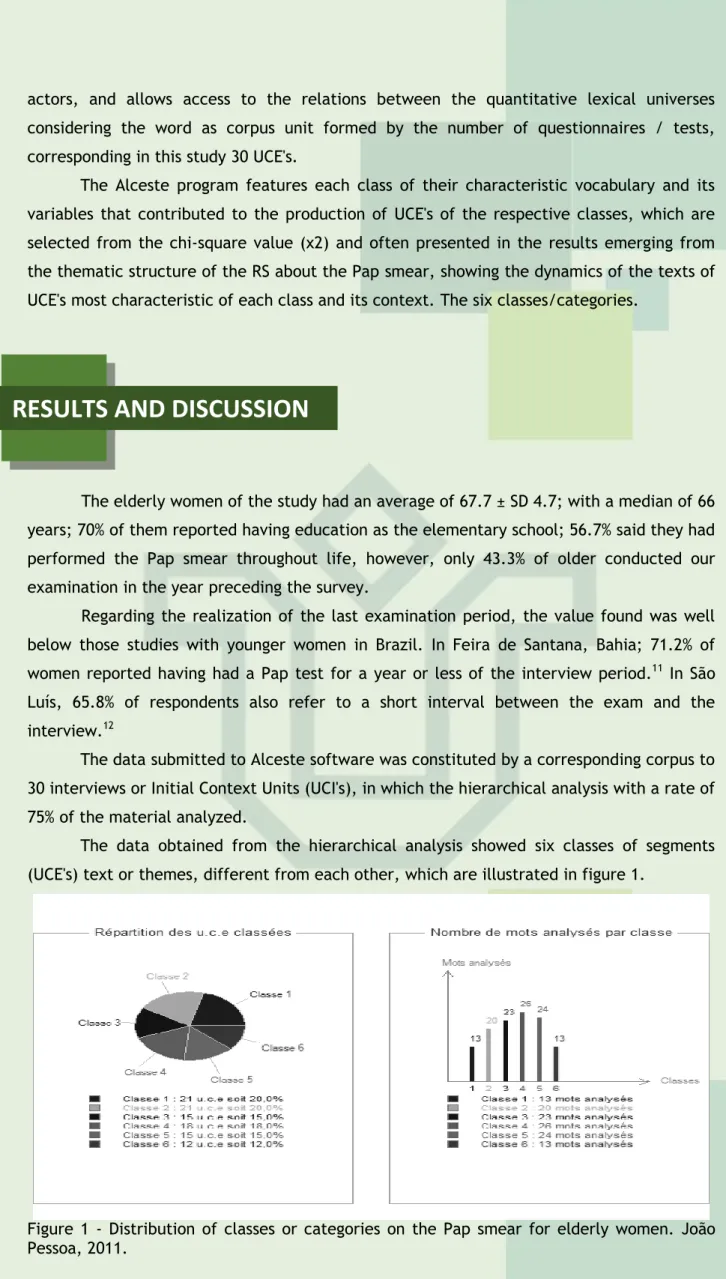
The data submitted to Alceste software was constituted by a corresponding corpus to 30 interviews or Initial Context Units (UCI's), in which the hierarchical analysis with a rate of 75% of the material analyzed.
The data obtained from the hierarchical analysis showed six classes of segments (UCE's) text or themes, different from each other, which are illustrated in figure 1.
Figure 1 - Distribution of classes or categories on the Pap smear for elderly women. João Pessoa, 2011.
J. res.: fundam. care. online 2015. 2014. dez. 6(supl.):176-186
180
The contents present in these classes are indicative of social representations. In them you can focus on the dimensions of the representations as images or field social representations, position or attitude and knowledge or information about the Pap smear by the elderly women of the study. What will indicate whether they are social representations is their content and its relation with factors related to the general plan of each search.10
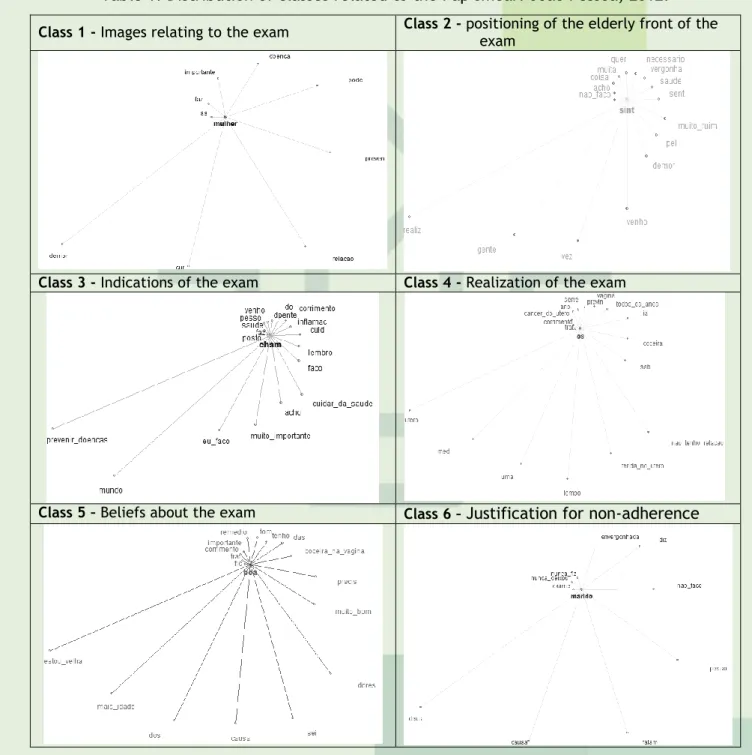
Such representations are present in images or contemplated representation field and its contents, distributed in classes: images relating to the exam; positioning of the elderly front of the exam; indications of the exam; realization of the exam; beliefs about the exam and justification for non-adherence, below in Table 1, where you can view each class.
Table 1. Distribution of classes related to the Pap smear. João Pessoa, 2012.
Class 1 - Images relating to the exam Class 2 - positioning of the elderly front of the exam
Class 3 - Indications of the exam Class 4 - Realization of the exam
Class 5 – Beliefs about the exam Class 6 – Justification for non-adherence
The class / category one - images relating to the exam, in which the elderly women represent the Pap smear as an important test indicated for women capable of preventing disease caused by sexual intercourse and it should not take do.
In a study conducted in Argentina was found that the practice of taking the exam depends on many factors, some are related to the health system and its professionals and others with the women themselves. For the argentines women the main barrier for not
J. res.: fundam. care. online 2015. 2014. dez. 6(supl.):176-186
181
performing the examination is the failure to request examination by a doctor or other health professional, generating two situations: many women do not feel they have the right to carry it out, or do not have enough knowledge to require the exam during the consultations in health services.13
In Feira de Santana / Bahia, non-adherence to the examination results are factors such as older age (40-59 years), color black / brown skin, low education, no partner (separated / divorced / separated / widowed) and family income below or equal to the minimum wage.11 As well as the lack of information and access are also factors that lead
many of these women not preventive examinations.14
In class / category two - positioning of the elderly front of the exam in which the elderly women report that despite being the exam necessary for health, it is too bad because it causes shame leading to many women linger to take the test or do not realize because of discomfort it causes.
The cytological exam usually creates the woman a sense of shame, a fear to have their privacy invaded and the fear of being undervalued by society.15 In older women,
especially widows, is constant speech that they no longer need to make any exam because they are no longer having sex.
Another factor that may cause inhibition of women is when it is done by a professional are male, because for many elderly husband is the one who can have access to their intimacy. When the examiner is male the women can feel ashamed and retracted, creating a barrier to the preventive examination and no continuity care.15 This situation is
dangerous for health, because it ends up causing many just seek the service after the appearance of symptoms that bother them.
Many women also complain about the lack of attention that some health professionals give when they have a need to report their complaints give the complaints are not sensitive and welcoming in a moment so delicate and intimate for them. What ends up causing them to seek a trusted professional, and when they cannot simply stop doing the routine monitoring.16
With regard to the class / category three - indications of the exam; the elderly women indicate the exam for the world diseases such as vaginal discharge and inflammation. It is important to take care of health, preventing disease, reason to look for a health post to do it.
Although an exam that causes discomfort or shame it to be performed can detect other diseases that affect women. According to a study conducted in João Pessoa - Paraíba, the main vulvovaginites detected in SUS users, are those caused by Candida albicans, Gardnerella vaginalis and Trichomonas vaginalis.17
The Pap smear is an essential tool for the recognition of infectious and inflammatory changes of the female genital tract. Currently, it is one of the main allies of doctors, nurses and users of primary care in the early detection of precursor lesions of cervical cancer, enabling immediate treatment with satisfactory results and minimizes the appearance of possible complications. As a rule the Ministry of Health recommends that the cytological is held annually in women 25-60 years of age, and after two consecutive negative annual
J. res.: fundam. care. online 2015. 2014. dez. 6(supl.):176-186
182
reviews, the woman just need to repeat it every three years.18 Therefore excluding the
users above 60 years because their examination is optional.
Non-adherence to the examination justified by the old part of a lot is emphasized by people of a suitable age the exam. In this sense, the social representations by having psychosocial functions (guidance on communication, training ducts, identity and justifying), can influence the lives of individuals / groups involved in the phenomenon in focus. Thus, communications and behaviors can influence the direction and the process of social interaction of individuals who symbolically transform objects / phenomena represented. This is because the health and aging are enrolled in an active context, dynamic, participating in community life as an extension of their behavior, becoming responsible for a quality of life for others.19
With regard to the class / category four - indications for the exam, the exam for the elderly women is for prevention of cancer of the uterus, treats itching, discharge, wound in the uterus and should be done every year; many claim not to do the test because I do not have sex.
This class/category includes the notion of the importance that women have about the exam, its preventive aspect; although even with this knowledge, many women do not adhere to its realization. In Jamaica beyond the precariousness of health services, there is a cultural issue, which features taboos about the female body and its exposure.3
In other countries, other methods are used for the detection of the cervical cancer. In the United States 20 women have been submitted to blood tests for early detection of any
cancer cell, genes or hormonal irregularities. In Chile campaigns occur so there is adherence of women vaccination against Papilloma Virus Human (HPV).21
All countries have invested in the realization of Pap smears for prevention, since if it is carried out effectively and its implementation is used as a kind of screening, the results are efficient as there are significant declines in the incidence of cervical cancer and mortality.22
Studies have shown that the Pap smear is best known and used in women with higher level of education, as they may present a greater awareness and because of this benefit of preventive medicine, have autonomy and a view over cultural issues.22
The class / category five - beliefs about the exam includes content in the elderly say that I am old for this reason use medicine to treat discharge and pain when they need it.
For the elderly women, age is the main barrier for not performing the examination, differing from younger women, who have the reasons: the lack of gynecological complaint, carelessness with their health, fear and shame when you go the examination, access to health services, poor in jobs, and finally the lack of medical and other health professionals.23
The age range is important for establishing strategies and promotion, prevention and early detection of cervical cancer. However, it cannot be exclusive, in that should encourage women to sexually active to seek the service and cover all the health actions.24
Not performing of the Pap smear is more acceptable to elderly women with 65 years of age, who have presented normal results in previous years and that a routine follow-up
J. res.: fundam. care. online 2015. 2014. dez. 6(supl.):176-186
183
CONCLUSION
was done. A study in Minas Gerais showed that there is a reduction from 60 years of age at mammography and Pap test.2
This approach contradicts the International Agency for Research on Cancer (IARC) as countries in Latin America and the Caribbean, the results of studies have shown that there is a high incidence of cervical cancer and the most advanced stages of the tumor, the group of older women compared to younger women.25
In class/category six - reasons for non-adherence, elderly women reported that they felt ashamed to do pap smears and ask God for protection for fear because they have never done; they say they do not, because other talk that causes discomfort and her husband left never perform pap smears.
In the present study, the findings are similar to previous studies, when he says that single women with an active sex life, has made the test more often when compared to elderly women married.1
It is known that menopause changes the sensitivity of the female body, so it is essential that health professionals have a more helpful approach, special care during the examination, as for the elderly this procedure can be painful, uncomfortable and very embarrassing. Depending on the cultural background of this woman will be harder still to undergo this type of examination.26
The findings of the study prove the existence of taboos to be overcome by the elderly, especially in relation to your body and its need to seek a health service with unprepared professionals to meet these elderly women, although with a favorable structure and some professionals willing to help, lacking a commitment of the entire team in making these women feel encouraged to seek the service. Many older studies reported making indiscriminate use of drugs without any medical indication for shame, which could damage their health problem.
This study aimed to know the social representations about pap smears that are evident both negative and positive content associated with this examination.
The psychosocial difficulties associated with gynecological care to elderly women in health facilities should be alert to investigations and effective proposals that can provide preventive health practices that improve their quality of life. Knowing what they think the elderly on Pap smears is important to understand how the elderly adopt healthy health practices and stack up against the very health of the elderly woman.
Deal with social representations therefore implies considering that, to adapt to its own particular social situation and, more specifically, for older women prepare, plan and manage their behavioral strategies regarding their sexuality, it is expected that they do not
J. res.: fundam. care. online 2015. 2014. dez. 6(supl.):176-186
184
REFERENCES
use only the information captured in women's health, but already available in their daily lives, which are triggered whenever necessary socially.
This study suggests that older women associated to the Pap smear senses with cultural content not related to sexually life itself. In this sense, the female aging should favor reflections directed public health policies, in particular, to cervical cancer, in order to prioritize preventive care in universal character, with incentives for realization of Pap smears, regardless of the woman's age and the implementation of a routine secondary prevention, based on early diagnosis and prompt and effective treatment.
This study has limitations as regards the results because they were only 30 women and the interviews were conducted at the residence of the elderly, and there is thus a reliable support, as the records of the same, in which the answers could be given as to the veracity. On the other hand, to be interviewed in their own residence, a fair place, elderly felt more comfortable talking about it and to position themselves in order to say how they feel welcomed by health facilities nearby; besides being the study of a small sample of elderly.
1. Freitas MCM, Ribeiro LC, Vieira MT, Teixeira MTBM, Bastos RR, Leite ICG. Fatores associados à utilização do teste de Papanicolaou entre mulheres idosas no interior do Brasil. Rev Bras Ginecol Obstet. 2012;34(9):432-7.
2. Lima-Costa MF. Influência da idade e da escolaridade no uso de serviços preventivos de saúde: Inquérito de Saúde da Região Metropolitana de Belo Horizonte, Minas Gerais, Brasil. Epidemiol Serv Saúde. 2004;13(4):209-215.
3. Bourne PA, Charles CAD, Francis CG, South-Bourne N,Peter R. Perception, attitude and practices of women towards pelvic examination and Pap smear in Jamaica. N Am J Med Sci. 2010 October; 2(10): 478–486.
4. Albuquerque KM, Frias PG, Andrade CLT, Aquino EML, Menezes G, Szwarcwald CL. Cobertura do teste de Papanicolaou e fatores associados à não-realização: um olhar sobre o Programa de Prevenção do Câncer do Colo do Útero em Pernambuco, Brasil. Cad Saúde Pública. 2009; 25(Supl 2):S301-9.
5. Vale DBAP, Morais SS, Pimenta AL, Zeferino LC. Avaliação do rastreamento do câncer do colo do útero na Estratégia Saúde da Família no Município de Amparo, São Paulo, Brasil. Cad Saúde Pública. 2010; 26(2):383-90.
6. Andrade JM. Limitações para o sucesso do rastreamento do câncer de colo no Brasil. Rev Bras Ginecol Obstet. 2012;34(6):245-247.
7. Sevalho G. Uma abordagem histórica das representações sociais em saúde e doença. Cad Saúde Pública. 1993;9(3):349-61.
8. Moscovici S. Representações sociais: investigações em psicologia social. Petrópolis(RJ): Editora Vozes; 2003.
J. res.: fundam. care. online 2015. 2014. dez. 6(supl.):176-186
185
9. Ministério da Saúde (BR). Conselho Nacional de Saúde, Comissão Nacional de Ética em Pesquisa. Resolução N. 196 de 10 de outubro de 1996: diretrizes e normas regulamentadoras de pesquisa envolvendo seres humanos. Brasília (DF): MS; 1996.
10. Camargo BV. Alceste: Um programa informático de análise quantitativa de dados textuais. In: Moreira ASP, Jesuino JC, Camargo BV, organizadores. Perspectivas teórico-metodológicas em representações sociais. João Pessoa(PB): Editora Universitária da UFPB; 2005.
11. Andrade MS, Almeida MMG, Araújo TM, Santos KOB. Fatores associados a não adesão ao Papanicolau entre mulheres atendidas pela Estratégia Saúde da Família em Feira de Santana, Bahia, 2010. Epidemiol Serv Saúde. 2014; 23(1): 111-20.
12. Oliveira MMHN, Silva AAM, Brito LMO, Coimbra LC. Cobertura e fatores associados à não realização do exame preventivo de Papanicolau em São Luís, Maranhão. Rev Bras Epidemiol. 2006 set;9(3):325-34.
13. Gamarra CJ, Paz EPA, Griep RH. Conhecimentos, atitudes e prática do exame de Papanicolaou entre mulheres argentinas. Rev Saúde Pública. 2005;39(2):270-276.
14. Fernandes JV, Rodrigues SHL, Costa YGAS, Silva LCM, Brito AML, Azevedo JWV, et al. Conhecimentos, atitudes e prática do exame de Papanicolaou por mulheres, Nordeste do Brasil. Rev Saúde Pública. 2009; 43(5): 851-58.
15. Sampaio LRL, Diógenes MAR, Jorge RJB, da Cruz Mendonça FA, Sampaio LL. Influência do gênero do profissional na periodicidade do exame papanicolau. Rev Bras Em Promoção Saúde. 2012; 23(2):181–7.
16. Greenwood SA, Machado MFAS, Sampaio NMV. Motivos que levam mulheres a não retornarem para receber o resultado de exame Papanicolau. Rev latino-am enfermagem. 2006, 14(4):503-9.
17. Andrade SSC, Silva BL, Silva FMC, Pereira AS, Gomes GB, Melo FA. Vulvovaginites evidenciadas no papanicolau em Unidade de Saúde da Família no Município de João Pessoa. Nursing. 2012, 15(171):445-50.
18. Ministério da Saúde (BR). Secretaria de Atenção à Saúde. Departamento de Atenção Básica. Controle dos cânceres do colo do útero e da mama. Brasília (DF): MS; 2006.
19. Paiva MLG, Rodrigues TP, Moreira MASP, Matos MYC, Ferreira OGL, Silva LM. Old in the look of the elderly: social representations. R Pesq Cuid Fundam Online. 2011;(Ed.Supl.):122-131.
20. Ganesh SK, Chasman DI, Larson MG, Guo X, Verwoert G, et al. Effects of long-term averaging of quantitative blood pressure traits on the detection of genetic associations. T Am J of Hum Gen. 2014;95(1):49-65.
21. Fica A. Prevención del cáncer cérvico-uterino en Chile: mucha vacuna y poco Papanicolau. Rev Chil Infectol. 2014;31(2):196-203.
22. Soneji S, Fukui N. Socioeconomic determinants of cervical cancer screening in Latin America. Rev Panam Salud Publica. 2013;33(3):295-7.
23. Silva MRB, Silva LGP. Knowledge, attitudes and practice in the prevention of cervix câncer among basic health unit west- RJ. R Pesq Cuid Fundam Online. 2012. jul./set. 4(3):2483-92.
J. res.: fundam. care. online 2015. 2014. dez. 6(supl.):176-186
186
24. Silva BL, Santos RNLC, Ribeiro FF, Anjos UU, Ribeiro KSQS. Prevenção do câncer de colo uterino e a ampliação da faixa etária de risco. Rev Enferm UFPE on line. 2014;8(6):1482-90. 25. Reyes-Ortiz CA, Velez LF, Camacho ME, Ottenbacher KJ, Markides KS. Health insurance and cervical cancer screening among older women in Latin American and Caribbean cities. Int J Epidemiol. 2008;37(4):870-8.
26. Fonsêca W, Godoi SDC, Silva JVB. Papanicolaou na terceira idade: conhecimento e atitude das idosas cadastradas em uma estratégia de saúde da família da cidade de Itaporã-MS. RBCEH. 2012;7(3):357-69.
Received on: 01/08/2014 Required for review: No Approved on: 01/12/2014 Published on: 20/12/2014
Contact of the corresponding author: Luipa Michele Silva João Pessoa - PB – Brasil Email:[email protected]