FUNDAÇÃO GETULIO VARGAS
ESCOLA DE ADMINISTRAÇÃO DE EMPRESAS DE SÃO PAULO
MATEUS FERREIRA
CONSUMER ENGAGEMENT ON SOCIAL MEDIA: Analysis of scales and its multiple role in a nomological network
SÃO PAULO 2017
MATEUS FERREIRA
CONSUMER ENGAGEMENT ON SOCIAL MEDIA: Analysis of scales and its multiple role in a nomological network
Tese apresentada à Escola de Administração de Empresas de São Paulo da Fundação Getulio Vargas, como requisito para a obtenção do Título de Doutor em Administração de Empresas.
Campo do conhecimento: Administração Mercadológica
Orientador: Prof. Dr. Felipe Zambaldi
SÃO PAULO 2017
Ferreira, Mateus.
Consumer engagement on social media : analysis of scales and its multiple role in a nomological network / Mateus Ferreira. - 2017.
151 f.
Orientador: Felipe Zambaldi
Tese (doutorado) - Escola de Administração de Empresas de São Paulo. 1. Mídia social. 2. Comportamento do consumidor. 3. Consumo (Economia). I. Zambaldi, Felipe. II. Tese (doutorado) - Escola de Administração de Empresas de São Paulo. III. Título.
MATEUS FERREIRA
CONSUMER ENGAGEMENT ON SOCIAL MEDIA: Analysis of scales and its multiple role in a nomological network
Tese apresentada à Escola de Administração de Empresas de São Paulo da Fundação Getulio Vargas, como requisito para a obtenção do Título de Doutor em Administração de Empresas.
Campo do conhecimento: Administração Mercadológica
Orientador: Prof. Dr. Felipe Zambaldi
Data de aprovação: 27/06/2017
Banca examinadora:
Prof. Dr. Felipe Zambaldi (Orientador) FGV/EAESP
Prof.ª Dra. Eliane Pereira Zamith Brito FGV/EAESP
Prof. Dr. Francisco José da Costa PPGA/UFPB
Prof. Dr. José Afonso Mazzon FEA/USP
Dedico este trabalho à minha esposa, Ellen Sampaio Cordeiro, pelo amor e dedicação, ao nosso recém-chegado filho, Bernardo Cordeiro Ferreira, e aos meus pais, Maria Aldair Ferreira e Luiz Airton Wesz Ferreira, pelo apoio e referência de dedicação ao trabalho.
AGRADECIMENTOS
Meu agradecimento especial ao professor Felipe Zambaldi, orientador e amigo que nestes 6 anos de mestrado e doutorado é fonte de inspiração e referência. Sempre me instigando a ir além do que eu imaginava ser capaz, sua confiança me motivou e tornou esta tese possível.
Agradeço aos professores que aceitaram participar da minha banca de defesa, Eliane Pereira Zamith Brito, Francisco José da Costa e José Afonso Mazzon, e aos demais professores do departamento, Delane Botelho, Juracy Gomes Parente e Tania Modesto Veludo de Oliveira.
Agradeço ainda aos meus colegas da FGV, Adriana, André, Benjamin, Bruno, Caê, Carla, Carol, Cristiano, Gustavo, Josélia, Ricardo, Victor e Viviane, especialmente aos amigos do Apt138, Alexandre, Bruno, Diego, Elias, Emílio, Fernando, Jannsen, Juliano, Júnior, Márcio, Rodolfo e Thales. Meu muitíssimo obrigado à Farah Diba Braga, e sincero agradecimento à Ramona De Luca, amiga incondicional e excelente parceira de pesquisa, cujo companheirismo e dedicação tornou o doutorado mais fácil.
Agradeço à minha esposa, Ellen Sampaio Cordeiro, que apesar da distância sempre me apoiou e esteve incondicionalmente ao meu lado, aos meus pais, Alda e Luiz, que me incentivaram nestes 29 anos de vida e estudo, e aos demais familiares e amigos, que me acompanharam e me auxiliaram de diferentes formas e durante diferentes períodos.
Agradeço também à Coordenação de Aperfeiçoamento de Pessoal de Nível Superior (CAPES), pelo fomento durante meu curso de doutorado, e a Vidi Shopper, pelo fornecimento da base de dados para realização desta tese.
RESUMO
Pesquisa acadêmicas sugerem que as mídias sociais podem melhorar a sua reputação corporativa, vendas, retorno sobre o investimento, boca-a-boca positivo e criar valor para os consumidores. Desempenhando o papel central neste processo relacional, o engajamento do consumidor ou cliente (usados como sinônimos neste contexto), emergiu como um dos principais construtos que explicam o sucesso ou fracasso de marcas nas mídias sociais. Considerando o engajamento como um construto multidimensional composto por dimensões cognitiva, afetiva e comportamental que varia de acordo com o sujeito (ex. consumidor ou empregado), objeto focal (ex. marca, produto ou propaganda) e contexto (ex. varejo ou online), nesta tese nós fazemos um corte mais específico do campo e para discutir o engajamento do consumidor (sujeito) com marcas (objeto no Artigo 2 e 3) ou com a comunidade de marca (objeto no Artigo 1) em mídias sociais (contexto). Como objetivo geral da tese, nós analisamos o engajamento do consumidor em diferentes redes nomológicas, priorizando seus antecedentes e papel mediador (Artigo 1), ou consequentes e sua relação com outra medida de engajamento (Artigo 3), além de realizar uma análise comparativa de diferentes escalas desenvolvidas para medi-lo (Artigo 2). No Artigo 1, nós mostramos que a escala de engajamento do consumidor da Vivek, Beatty, Dalela e Morgan (2014), originalmente desenvolvida para aplicação em múltiplos contextos, também pode ser aplicado a múltiplos objetos. Nós validamos esta escala em uma rede nomológica com homofilia percebida e envolvimento com marca como antecedentes e reputação corporativa como consequente. Nossos resultados mostram que além de ter efeito positivo direto na reputação corporativa, o engajamento do consumidor tem um forte papel mediador. No Artigo 2, o nosso objetivo é comparar algumas das principais escalas desenvolvidas para medir o engajamento do consumidor: Dessart, Veloutsou e Morgan-Thomas (2016), Hollebeek, Glynn e Brodie (2014) e Vivek et al. (2014). Para fazer isso, nós propomos um procedimento para análise comparativa de escalas que envolve i) a seleção, ii) padronização e iii) análise das medidas. Nós replicamos três escalas selecionadas com um mesmo objeto (marca) e contexto (social media), considerando que a maioria das escalas desenvolvidas foram aplicadas para este mesmo objeto e contexto. Baseado nas análises da Teoria Clássica dos Testes (TCT) e na Teoria de Resposta ao Item (TRI), nossos resultados mostram similaridades, diferenças e vantagens da aplicação de cada escala. No Artigo 3 nós analisamos conjuntamente duas correntes de estudo do engajamento do consumidor ao considerar engajamento com marca no autoconceito (BESC) como uma medida de engajamento com marcas em geral (Sprott,
Czellar, & Spangenberg, 2009) e engajamento do consumidor com uma marca específica (Vivek et al., 2014), e como o último impacta no valor percebido dos consumidores e na reputação corporativa. Por meio da análise multigrupo com amostragens realizadas no Brasil e Estados Unidos, nossos resultados mostraram que além de excelente ajuste, tanto no nível do modelo como no nível de caminho não houve diferença entre os grupos, o que indica a invariância intercultural dos grupos no modelo estrutural. Por fim, no Capítulo 5 nós sintetizamos as conclusões da dissertação.
Palavras-chave: Engajamento do consumidor, Engajamento com Marca, Engajamento com Comunidade de Marca, Mídias Sociais, Comparação de Escalas.
ABSTRACT
Academic research has suggested that social media can improve corporate reputation, sales, return on investment, positive word-of-mouth and create value for consumers. Playing the central role in this relational process, consumer or customer engagement (used interchangeably in this context), emerged as one of the main constructs explaining the success and failure of brands on social media. Considering engagement as a multidimensional construct composed of cognitive, emotional and behavioral dimensions that varies according to the subject (e.g., customer or employee), focal object (e.g., brand, product or advertising), and context (e.g., retail or online), in this dissertation we make a specific field cutting in order to discuss consumer engagement (subject) with brands (object in Article 2 and 3) or brand communities (object in Article 1) on social media (context). As a general aim of the dissertation, we analyze consumer engagement in different nomological networks, prioritizing its antecedents and mediating role (Article 1) or consequences and its relationship with another measure of engagement (Article 3), in addition to perform a comparative analysis of different scales developed to measure it (Article 2). In the Article 1, we show that the Vivek, Beatty, Dalela, and Morgan (2014) consumer engagement scale,originally developed for application in multiple contexts, can also be applied to multiple objects. We validate this scale in a nomological network with perceived homophily and brand involvement as antecedents and corporate reputation as consequence. Our results show that besides having a direct positive effect on corporate reputation, consumer engagement has a strong mediating role. In the Article 2, our goal is to compare some of the main scales developed to measure consumer engagement: Dessart, Veloutsou, and Morgan-Thomas (2016), Hollebeek, Glynn, and Brodie (2014) and Vivek et al. (2014). To do this, we propose a procedure for the comparative analysis of scales that involves i) the selection, ii) standardization and iii) analysis of measures. We replicate three selected scales with the same object (brand) and context (social media), considering that most of the developed scales were applied to the same object and context. Based on the Classical Test Theory (CTT) and Item Response Theory (IRT) analysis, our results show similarities, differences, and advantages of applying each scale. In Article 3 we jointly analyze two streams of consumer engagement studies by considering brand engagement in self-concept (BESC) as a measure of engagement with brands in general (Sprott, Czellar, & Spangenberg, 2009) and consumer engagement with a specific brand Vivek et al., 2014), and how the latter impacts the perceived value of consumers and corporate reputation. By means of the multigroup analysis with samplings carried out in
Brazil and the United States, our results showed that in addition to excellent adjustment, both at the model level and at the path level there was no difference between the groups, which indicates the cross-cultural invariance in the structural model. Finally, in Chapter 5 we synthesize the conclusions of the dissertation.
Keywords: Consumer Engagement, Brand Engagement, Brand Community Engagement, Social Media, Comparison of Scales.
LIST OF TABLES
Table 2.1. Scales for constructs measurement and descriptive statistics... 37
Table 2.2. Correlation Matrix, reliability, convergent and discriminant validity. ... 39
Table 2.3. Hypothesis testing results. ... 41
Table 2.4. Result of mediation hypotheses. ... 43
Table 3.1. Concepts, definitions and engagement objects. ... 52
Table 3.2. Measurement of engagement in empirical researches. ... 55
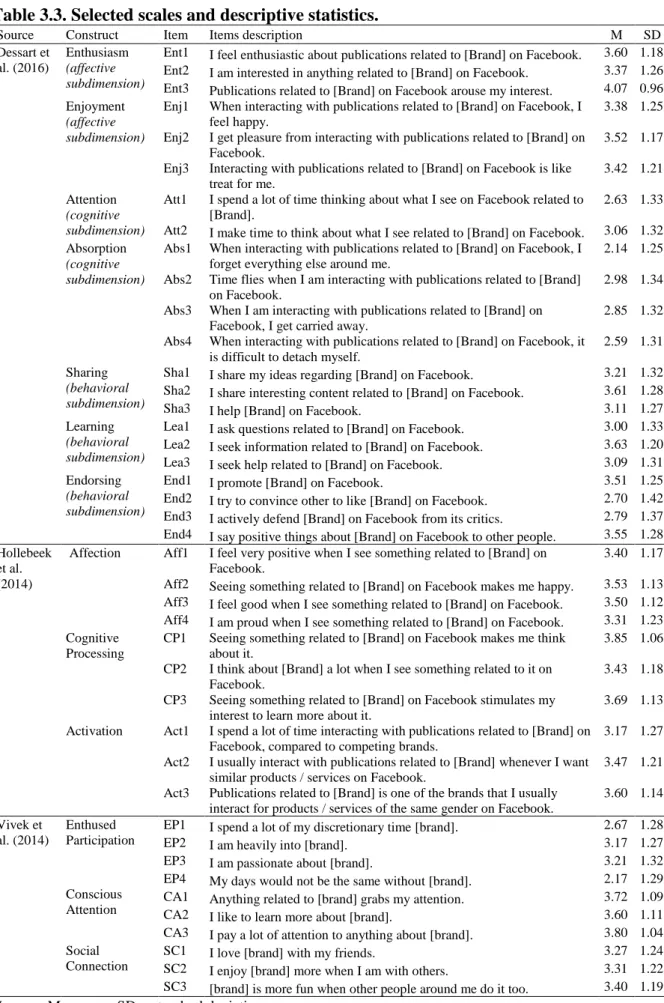
Table 3.3. Selected scales and descriptive statistics. ... 64
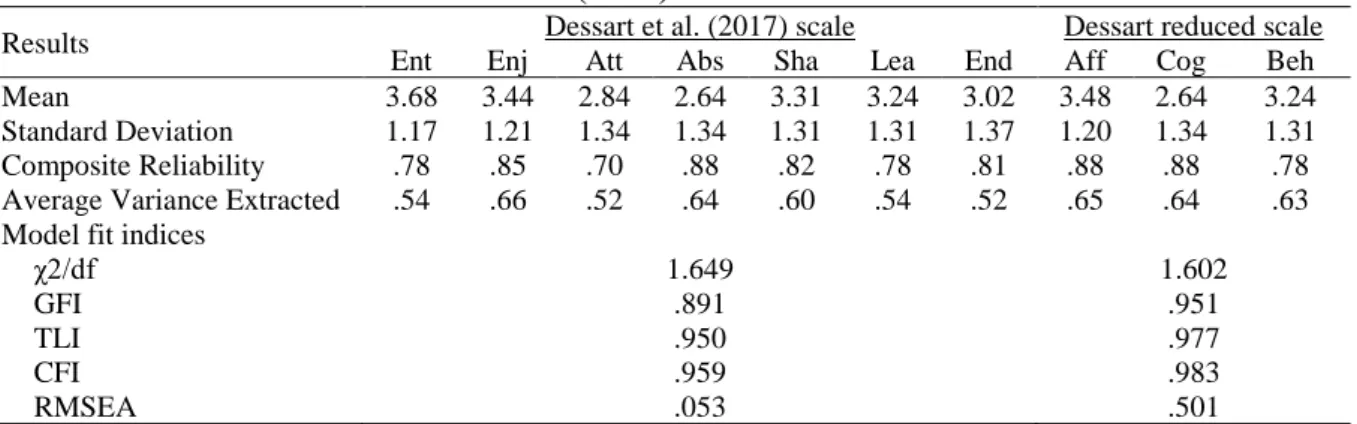
Table 3.4. Results of the Dessart et al. (2016) scale. ... 65
Table 3.5. Results of the Hollebeek et al. (2014) scale. ... 67
Table 3.6. Results of the Vivek et al. (2014) scale. ... 68
Table 3.7. Factor loading and parameter estimation of the Dessart et al. (2016) scale by MIRT. ... 70
Table 3.8. Factor loading and parameter estimation of the Dessart reduced scale by MIRT... 72
Table 3.9. Factor loading and parameter estimation of the Hollebeek et al. (2014) scale by MIRT. ... 73
Table 3.10. Factor loading and parameter estimation of the Vivek et al. (2014) scale by MIRT. ... 74
Table 3.11. Summary of model fit indices, reliability and validity of the scales. ... 77
Table 4.1. Scales for constructs measurement and descriptive statistics... 96
Table 4.2. Correlation Matrix, reliability, convergent and discriminant validity (sampling with Americans)... 98
Table 4.3. Correlation Matrix, reliability, convergent and discriminant validity (sampling with Brazilians). ... 100
Table 4.4. Hypothesis testing results (correlations). ... 102
Table 4.5. Hypothesis testing results. ... 102
LIST OF FIGURES
Figure 2.1. Conceptual model... 33
Figure 2.2. Hypothesized structural model. ... 40
Figure 3.1. CFAs of the Dessart et al. (2016) scale (right side) and a reduced scale (left side). ... 66
Figure 3.2. CFA of the Hollebeek et al. (2014) scale. ... 67
Figure 3.3. CFA of the Vivek et al. (2014) scale... 69
Figure 3.4. ICCs of the Dessart et al. (2016) scale. ... 71
Figure 3.5. IIFs of the Dessart et al. (2016) scale. ... 71
Figure 3.6. ICCs and IIFs of the Dessart reduced scale. ... 73
Figure 3.7. ICCs and IIFs of the Hollebeek et al. (2014) scale. ... 74
Figure 3.8. ICCs and IIFs of the Vivek et al. (2014) scale. ... 75
Figure 4.1. Conceptual model... 91
Figure 4.2. Hypothesized structural model (sampling with Americans). ... 99
Figure 4.3. Hypothesized structural model (sampling with Brazilians). ... 101
SUMMARY
1. CHAPTER 1 – DISSERTATION INTRODUCTION ... 14
2. CHAPTER 2 – ARTICLE 1 ... 19
2.1. Introduction ... 19
2.2. Literature review ... 22
2.2.1. Corporate reputation ... 24
2.2.2. Community engagement ... 25
2.2.3. Customer brand involvement ... 27
2.2.4. Perceived homophily ... 28
2.3. Theoretical framework and hypotheses ... 29
2.3.1. Relation between perceived homophily and brand involvement ... 29
2.3.2. Relation between perceived homophily and consumer engagement ... 30
2.3.3. Relation between brand involvement and consumer engagement ... 30
2.3.4. Relation between consumer engagement and corporate reputation ... 31
2.3.5. Mediating role of consumer engagement ... 31
2.4. Method ... 33
2.4.1. Sample ... 33
2.4.2. Measures... 34
2.4.3. Pretests ... 35
2.4.4. Analysis and Procedure ... 36
2.5. Results and discussion ... 36
2.5.1. Sample description ... 36
2.5.2. Result for each construct ... 38
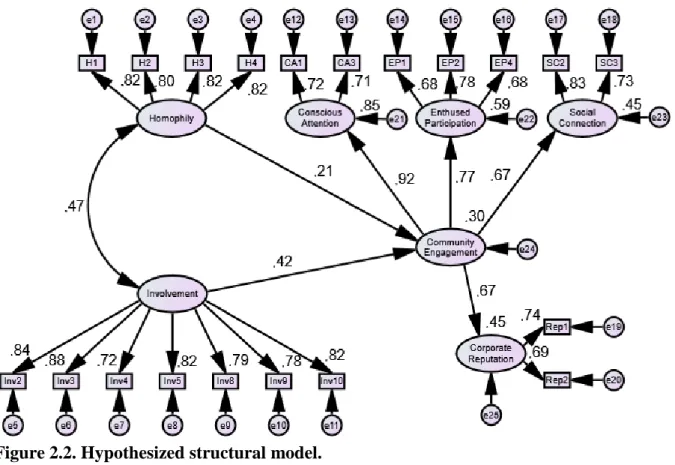
2.5.3. Result of the structural model ... 39
2.5.4. Hypothesis test ... 40 2.6. Conclusion ... 43 3. CHAPTER 3 – ARTICLE 2 ... 46 3.1. Introduction ... 46 3.2. Literature review ... 49 3.2.1. Definitions ... 49 3.2.2. Measurement ... 51
3.2.2.1. Procedures for comparative analysis ... 53
3.2.2.2. Measures... 54
3.3. Method ... 58
3.3.1. Sample ... 58
3.3.2. Measures... 58
3.3.3. Analyzes by CTT ... 59
3.3.4. Item Response Theory (IRT)... 60
3.3.5. Analyzes by MIRT ... 61
3.3.6. Pretest ... 62
3.4. Results and discussion ... 62
3.4.1. Sample description ... 62
3.4.2. Results by CTT... 63
3.4.2.1. Dessart et al. (2016) scale ... 63
3.4.2.2. Hollebeek et al. (2014) scale ... 66
3.4.3. Results by MIRT ... 69
3.4.3.1. Dessart et al. (2016) scale ... 69
3.4.3.2. Hollebeek et al. (2014) scale ... 72
3.4.3.3. Vivek et al. (2014) scale ... 74
3.5. Conclusion ... 75
4. CHAPTER 4 – ARTICLE 3 ... 80
4.1. Introduction ... 80
4.2. Literature review ... 82
4.2.1. Consumer engagement and brand engagement in self-concept (besc) ... 82
4.2.2. Corporate reputation ... 85
4.2.3. Perceived value ... 86
4.3. Theoretical framework and hypotheses ... 87
4.3.1. Relation between consumer engagement with a specific brand and brand engagement in self-concept ... 87
4.3.2. Relation between consumer engagement and corporate reputation ... 88
4.3.3. Relation between consumer engagement and perceived value ... 89
4.3.4. Relation between corporate reputation and perceived value ... 90
4.4. Method ... 91
4.4.1. Sample ... 91
4.4.2. Measures... 92
4.4.3. Pretests ... 93
4.4.4. Analysis and Procedure ... 94
4.5. Results and discussion ... 94
4.5.1. Sample description ... 94
4.5.2. Result for each construct ... 97
4.5.3. Result of the structural model ... 98
4.5.4. Hypothesis test ... 101
4.5.5. Cross-cultural validation ... 103
4.6. Conclusion ... 104
5. CHAPTER 5 – DISSERTATION CONCLUSIONS ... 107
REFERENCES ... 113
APPENDICES ... 121
Appendix 1 - scales translation and adaptation for the pretest and survey (Article 1) ... 121
Appendix 2 - pretest 1 (Article 1) ... 122
Appendix 3 - pretest 2 and final research instrument (Article 1) ... 126
Appendix 4 - 13 measures of engagement (Article 2) ... 130
Appendix 5 - scales translation and adaptation for the pretest and survey (Article 2) ... 137
Appendix 6 - pretest and final research instrument (Article 2) ... 139
Appendix 7 - scales translation and adaptation for the pretest and survey (Article 3) ... 143
Appendix 8 - pretest and final research instrument with Americans (Article 3) ... 144
1. CHAPTER 1 – DISSERTATION INTRODUCTION
DISSERTATION INTRODUCTION
Virtual social media became a major tool of interaction and dissemination of goods and services between consumers and businesses (Mangold & Smith, 2012). As a result, companies and researchers seek to measure the success of social media marketing efforts and create an optimized strategy. Academic research has also suggested that by creating brand page on social media, brands can improve their corporate reputation (Dijkmans, Kerkhof, & Beukeboom, 2015), increase sales, return on investment and positive word-of-mouth (Kumar, Bhaskaran, Mirchandani, & Shah, 2013), and create value for consumers (Wirtz et al., 2013).
Playing the central role in this relational process (Brodie, Ilić, Jurić, & Hollebeek, 2013), consumer or customer engagement (used interchangeably in this context) has emerged as one of the main constructs that explain the success and failure of brands on social media. Although a relatively new concept, there is a consensus that consumer engagement is a consumer's positive level of cognitive, emotional and behavioral investment with a focal object (Hollebeek, 2011b; Brodie, Hollebeek, Jurić, & Ilić 2011; Hollebeek, Glynn, & Brodie, 2014), in specific direct (Hollebeek, 2011a) or indirect interactions (Mollen & Wilson, 2010).
For most academics, the engagement is a construct that varies according to the subject (e.g., customer, employee, student), focal object (e.g., brand, product, advertising), and context (e.g., online, off-line) (Brodie et al., 2011; Brodie et al., 2013; Hollebeek, 2011a, Vivek, Beatty, Dalela, and Morgan, 2014). In this dissertation, we make a specific field cutting and discuss consumer engagement (subject) with brand (object in Article 2 and 3) or with brand community (object in Article 1) on social media (context). Composed of three distinct but related articles, we separate articles by chapters with a limited length according to the guidelines of the journals. Although this model facilitates the publication, it may have some redundancy between the articles when we discuss the concept and measurement of consumer engagement with the same subject, object, and context.
As a general aim of the dissertation, we intend to analyze consumer engagement in different nomological networks (Article 1 and 3) and perform a comparative analysis of different scales developed to measure it (Article 2).
More specifically, in the Article 1 (Chapter 2), our aim is to replicate the Vivek et al. (2014) validated scale of brand engagement to measure the consumer engagement with brand community in a nomological network with other relational concepts.
Other studies have also examined the nomological validity of engagement with other relational concepts (e.g., Dessart, Veloutsou, & Thomas-Morgan, 2016; So, King, & Sparks, 2014), but no previous studies have examined jointly the relational antecedents by using factors related to brand (customer brand involvement) and other consumers (perceived homophily with other members) and their impact on corporate reputation.
The literature of homophily suggests that individuals can perceive homophily with groups and organizations (McPherson, Smith-Lovin, & Cook, 2001) through the personification of the brand or your brand community (Brown, Broderick, & Lee, 2007), while other research have shown that brand involvement (Brodie et al., 2011; Brodie et al., 2013; Hollebeek 2011a; 2011b; Hollebeek et al., 2014; Vivek, Beatty, & Morgan, 2012; Vivek et al., 2014) has a positive association with consumer engagement.
In this theoretical model, we also included corporate reputation as a consumer engagement consequence (Dijkmans et al., 2015; Li, Berens, & Maertelaere, 2013) to verify the benefit of this engagement for the brand. Therefore, in Article 1 we verified the impact of perceived homophily and brand involvement antecedents on consumer engagement with brand community, and their impact on corporate reputation.
As our results showed that in addition to the high association between consumer engagement and corporate reputation, engagement also fully mediates the relationship between perceived homophily and brand involvement with corporate reputation, we also contribute to the theory by showing the central role of consumer engagement in the context of social media.
Although there are validated scales to measure consumer engagement (subject) with brand community (object) (Algesheimer, Dholakia, & Herrmann, 2005; Baldus, Voorhees, &
Calantone, 2015; Dessart et al., 2016), we opted to use Vivek et al. (2014) brand engagement scale. It was originally developed for application in various contexts (such as social media, see Aragão, 2016) and to measure the engagement with brands (a specific object). As a methodological contribution, we used it to measure engagement with the brand page (another object) showing that in addition to working in multiple contexts, this scale could be adapted to measure engagement with multiple objects.
Doing this, while the engagement literature suggests that its definition and measurement vary according to the subject, object and context in which it is used, we argue that the existence of validated scales with multiple contexts or objects indicates that keeping the subject constant (e.g., consumer) there can be a more comprehensive definition and more flexible scale that reduce the trend of fragmentation of the area. We also confirmed the reliability and validity of the scale and showed a good fit of the construct.
In the Article 2 (Chapter 3), we show that the engagement definition as a construct that varies according to the subject, focal object, and context, has been used to justify the coexistence of various definitions and scales. However, several scales of consumer engagement (subject) with similar object and context have been launched, when could be adopted an already validated scale. Also, there are engagement scales that have been validated to be applied to multiple contexts (Vivek et al., 2014) and objects (Dessart et al., 2016), making hard for researchers to define the main criterion for choosing the appropriate scale.
So, our argument is that maintaining the subject (customer) constant, a single scale can be used to measure the engagement with different objects and contexts. With the aim to compare some of the main scales developed for consumer engagement, in this article we also define a procedure for i) selection, ii) standardization and iii) comparative analysis of these measures. Through this, we select the Dessart et al. (2016), Hollebeek et al. (2014) and Vivek et al. (2014) scales, and replicate these measures in relation to brands (object) in social media (context) considering that most scales were applied to the same object and/or context. To analyze the selected measures, in addition to the model fit indices, reliability and validity of the scales provided by the Classical Test Theory (CTT), we also consider the discrimination, difficulty, and information provided by the items and dimensions by Item Response Theory (IRT).
Our results showed that scales have similarities and differences concerning the CTT and IRT. On the one hand, while one scale has greater reliability and convergent validity, others are characterized by the discriminating between constructs or by possessing items with greater capacity to discriminate individuals with different traits (levels of engagement). On the other hand, both scales showed to be more efficient in discriminating individuals with an average trait, not having the same efficiency for weakly and strongly engaged individuals.
In addition to the methodological contribution of establishing a process of comparison of measures, our results provide a range of options for social media brand managers by validating three measures in this context. In analyzing the selected measures, we show practitioners the specific advantages of each one of the tested scales, making it easier to choose the one that best suits its purpose. Theoretically, we also offer a complement to the study of Brodie et al. (2011), who sought to give a more general definition to engage consumers without indicating an instrument to measure it with various objects and contexts.
If in Article 1 we gave more attention to analyzing antecedents and the mediating role of consumer engagement, considering the results of scales comparison on Article 2, in Article 3 (Chapter 4) we finally analyze especially its consequences, considering aspects that benefit the consumers (perceive value) and companies (corporate reputation).
In this article, we jointly analyze two streams of study of consumer engagement by considering brand engagement in self-concept (BESC) as a measure of engagement with brands in general (Sprott, Czellar, & Spangenberg, 2009) and consumer engagement with a specific brand (Vivek et al., 2014). According to the literature (Goldsmith & Goldsmith, 2012), these are distinct and positively correlated constructs, and we propose that BESC, a generalized tendency to engage with brands in general, is an antecedent that increases consumer engagement with a specific brand.
To validate this nomological network, we conducted a study in Brazil and the United States and used multigroup analysis to check the cross-cultural group invariance of the structural model. Our results showed that in addition to excellent adjustment, both in the model level and in the path level there was no difference between the groups, which indicates the cross-cultural nomological validity of the structural model.
As a contribution, our results also showed that consumer engagement with a specific brand has a strong impact on the perceived value, in which the engaged consumer considers their interaction with a brand in social media as a positive experience. In the same way, we confirmed that consumers engaged with brand on Facebook generate benefits for companies by improving their corporate reputation among consumers.
Finally, on Chapter 5 we synthesized the conclusions of the dissertation. More specifically, we report the findings of the three articles and show how they are related and contribute to the theory, as well as methodological and managerial implications of consumer engagement in social media.
2. CHAPTER 2 – ARTICLE 1
ARTICLE 1
THE MEDIATING ROLE OF CONSUMER ENGAGEMENT WITH THE BRAND COMMUNITY AND ITS EFFECT ON CORPORATE REPUTATION
Abstract
Considering the central role of consumer engagement in social media, our objective in this article is to test the proposed theoretical model to check the impact of perceived homophily and brand involvement on the consumer engagement with brand community, and the effect the latter on corporate reputation. Our results showed that in addition to the high association between consumer engagement and corporate reputation, engagement also fully mediates the relationship between perceived homophily and brand involvement with corporate reputation. While the engagement literature suggests that its definition and measurement vary according to the subject, object, and context in which it is used, we argue that the existence of replicated scales in multiple contexts or with multiple objects indicates that keeping the subject constant (e.g., consumer) there can be a more comprehensive definition and more flexible scale that reduce the trend of fragmentation of the area. In this way, we propose that the consumer engagement scale of Vivek, Beatty, Dalela, and Morgan (2014) assumes this role. Because the scale has been validated in different contexts, we now adapt it to measure engagement with a different object. We confirmed the reliability and validity of the scale and show a good fit of the construct when measuring consumer engagement with the brand community.
Keywords: consumer engagement, brand community, corporate reputation, perceived homophily, brand involvement.
2.1. Introduction
2.87% in 2000 to 40.65% of the population in 2010 (World Bank, 2015). According to Deloitte’s (2015) report, new technologies such as social media not only affect sales in digital channels, but also have a much broader impact on in-store sales and in-store consumer behavior. The report addresses that Hispanic and Latin American (and the Millennial age group - between 18 and 34 years old) correspond to the groups that most often use social media to gather inspiration or shop, being more influenced and spend more (Deloitte, 2015).
Academic research has also suggested that creating brand community or page on social media improves the corporate reputation (Dijkmans, Kerkhof, & Beukeboom, 2015), increases sales, returns on investment, positive word-of-mouth (Kumar, Bhaskaran, Mirchandani, & Shah, 2013) and was associated with brand equity (Aaker, 1996), leading most of the Fortune Global 100's companies (87%) to be active on at least one social media (Burson-Marsteller, 2012). In such a context, Brazilian companies also have created communities, called fan pages on Facebook, for their brands to promote closer relationships with consumers. These fan pages are spaces on social networks where "businesses, organizations and brands share their stories and connect with people" (Facebook, 2017), and aim to broadcast great information in an official, public manner, to people who choose to connect with them (Zaglia, 2012).
As a result of the interest of companies and researchers, the term engagement (Mollen & Wilson (2010) is frequently used to represent the relationships between brands/companies and consumers in social media, playing a “central role in the process of relational exchange, where other relational concepts (e.g., participation, involvement) act as engagement antecedents and/or consequences in dynamic engagement processes occurring within the brand community” (Brodie, Ilić, Jurić, & Hollebeek, 2013, p. 107).
Previous studies have investigated consumer engagement in a nomological network with other relational concepts. For example, Vivek, Beatty, Dalela, and Morgan (2014) developed a scale for consumer engagement and tested its relationship with other four relational outcomes: “value perceptions, benevolence perceptions (i.e. a dimension of trust), future patronage intent (i.e. a behavioral loyalty concept), and affective commitment toward the organization” (p. 412). In the context of social media, Hollebeek, Glynn, and Brodie (2014) also developed a scale and tested brand engagement with social media and three other relational concepts: consumer brand involvement as antecedent; and self-brand connection and brand usage intent as consequences.
Although other studies have also examined the nomological validity of community engagement with other relational concepts (e.g., Dessart, Veloutsou, & Thomas-Morgan, 2016; So, King, & Sparks, 2014), we did not find studies that examined jointly relational antecedents by using drivers related to brand and other members of the brand community. Our literature review indicated that brand and followers of the brand community (Baldus, Voorhees, & Calantone, 2015) are vectors of interaction between brand and consumers in social media (Dessart et al., 2016). Thus, we consider consumer brand involvement (related to brand) and perceived homophily with other members (related to other members) as community engagement antecedents in social media.
Literature indicates that homophily (Alkhateeb, Moussa, & Alli, 2012; Tukachinsky & Tokunaga, 2013), and involvement (Brodie et al., 2013; Hollebeek et al., 2014; Leckie, Nyadzayo, & Johnson, 2016; Li, Berens, & Maertelaere, 2013; Mollen & Wilson, 2010; Vivek, Beatty, & Morgan, 2012) may have impacts on consumer engagement, which in turn can also lead to a better corporate reputation (Dijkmans et al., 2015; Li et al., 2013).
Considering the inter-relations of these concepts, this work aims to test the proposed theoretical framework to check the impact of perceived homophily and brand involvement on the community engagement, and its impact on corporate reputation. Considering the central role of engagement, we also propose that the relationship between perceived homophily and brand involvement with corporate reputation is mediated by community engagement.
As a theoretical contribution, we tested this theoretical model that considers different community engagement drivers. While other studies have found that communication channel, company and consumer aspects as drivers of engagement (Li et al., 2013), we showed that brand (brand involvement) and other community members (perceived homophily) aspects are also important predictors of community engagement.
While the literature suggests that consumer (specific subject) engagement is a construct that varies according to the object and context in which it is analyzed, we also advanced methodologically by adapting the Vivek et al. (2014) brand engagement scale to measure the community engagement. Originally developed for application in various contexts and to measure the engagement with brands (a specific object), this scale is here applied and validated in the social media (another context) with brand community (another object).
We suggested that in addition to multiple contexts, this scale could be adapted to measure engagement with other objects, such as the brand community. With this, we approach the literature of brand and community engagement, while offering a shorter multidimensional instrument to measure community engagement, facilitating its validation in a nomological network, since most of the scales have between 6 and 11 dimensions.
As a managerial contribution, although brand-related aspects have greater potential than perceived homophily to improve brand community engagement, we found that managers should attract followers with similar characteristics. This suggests that just as products are developed for a specific audience, companies and managers should create brand communities thinking about a specific audience rather than focusing on the number of followers and eventually reducing perceived homophily.
We found that community engagement has a doubly important role for companies, because besides we verify a strong positive association with corporate reputation, it is also a full mediator of the relationship between perceived homophily and brand involvement with corporate reputation. Considering that reputation positively influences the profitability of companies (Fombrun, 2001), these results provide important managerial contributions.
In the following sections, we present a literature review of the concepts and formulate hypotheses to investigate the relations among constructs. Next, we describe the data collection and analysis procedure, followed by the presentation and discussion of our results, as well as conclusions and suggestions for future research.
2.2. Literature review
The brand management becomes even more complex with the emergence of social media and review sites. Corporate reputation, a valuable asset for companies, for example, is more difficult to control (Dijkmans et al., 2015) in the era in which consumers have changed their way of seeking information.
traditional media (Nielsen, 2012), it is increasingly important that companies develop brand communities or pages to interact with people online, creating shareable content, addressing negative content found online, and following up on ideas that are shared through social media (Dijkmans et al., 2015).
Who first defined these brand community (BC) in marketing were Muniz & O’Guinn (2001), as “a specialized, non-geographically bound community, based on a structured set of social relationships among admirers of a brand” (p. 412). From this sociological perspective, Muniz and O’Guinn (2001) found three traditional markers of these communities: i) shared consciousness, an intrinsic connection that members feel toward one another, and the collective sense of difference from others not in the community; ii) rituals and traditions, that perpetuate the community’s shared history, culture, and consciousness; and iii) a sense of moral responsibility, which is a felt sense of duty or obligation to the community as a whole, and to its individual members.
However, more suitable for this research and adopting a value perspective that considers both interests of consumers and companies, Wirtz et al. (2013) defined BCs “as the network of relations between providers and brand consumers who attach to certain value to engaging in a relationship with both the provider and with the brand's other consumers” (p. 224).
Wirtz et al. (2013) also identified four key dimensions that significantly shape a BC: i) brand orientation, that can be the brand itself, a wider shared interest, or both; ii) internet-use: offline, online or both; iii) funding, that can range from being funded by the brand, to being fully funded by the community of enthusiasts; and iv) governance, that can be governed entirely by the brand or entirely by the BC at the other.
Considering this categorization, this study analyzes the online brand communities that are oriented both to the brand itself and to a wider shared interest, and which in general are more funded and governed by the brand.
According to Algesheimer, Borle, Dholakia, and Singh (2010), the positive experiences of interactions in these communities may strengthen the relationship of consumers with the brand. About this brand-consumer interaction, Fournier (1998) suggests that brand may be one of a legitimate partner, an active object that contributes to a dyad. This definition is legitimated by
the understanding that a brand can be animated, humanized, or somehow, personalized. A brand may act as a 'close friend' and interacts with consumers by means of personification, thus behaving as an active member in a relationship (Fournier, 1998). As well as consumers may attribute traits of human personality to brands (Aaker, 1997), Brown, Broderick, and Lee (2007) argue that online social networks themselves (e.g., brand fan pages) can also act as primary actors and serve as a proxy for individual identification who follow them.
These studies recognize many actors in these pages that contribute to attract followers, such as the manager of these pages (e.g., blogger or brand manager) and other members / followers of these communities (Brown et al., 2007; Zanette, 2012). For example, consumers can engage with brand community, other followers and/or social media itself (Baldus et al., 2015).
Although there are different vectors of engagement in social media, the literature of online brand community indicates that brand and the community are the most relevant focus (Brodie et al., 2013; Dessart, Veloutsou, & Thomas-Morgan, 2015; 2016). Here we analyze consumer engagement with brand community itself, in addition to discuss different drivers and how this improves corporate reputation. Next, we discuss concepts and present our hypotheses and theoretical framework.
2.2.1. Corporate reputation
Corporate reputation is a concept studied by several fields, such as economics, psychology, sociology, management, organizational theory and marketing (Fombrun, 1996). This multidisciplinarity creates confusion even for academics who define and operationalize this construct. For example, in management, reputation can be understood as either a resource, transaction cost or social status research (Bergh, Ketchen, Boyd, & Bergh, 2010).
While for economists the reputation is related to price and product quality (Nguyen & Leblanc, 2001), in the strategy literature it is considered an intangible asset that may contribute to a competitive advantage (Walsh & Beatty, 2007) and, thus, can be managed. In management, corporate reputation was initially studied among those who have ties to the firm (Nguyen & Leblanc, 2001), representing “a snapshot that reconciles images of a company held by all its constituencies” (Fombrun, 1996, p. 72).
Although there are several definitions, it is a consensus that corporate reputation is a valuable and intangible asset that influences consumer buying decisions (Ponzi, Fombrun, & Gardberg, 2011), results from past company actions (Nguyen & Leblanc, 2001), and is a collective phenomenon and includes direct and indirect interaction experiences (Walsh & Beatty, 2007).
In marketing literature, Walsh and Beatty (2007) conceptualize it as an attitude-like evaluative judgment of firms. This judgment involves two key points: i) attributes (Herbig & Milewicz, 1993) and i) stakeholders (Wartick, 1992). A firm can have several reputations related to each attribute such as product, price or quality, as well as a global reputation. In the same way, the evaluation of a company can be done by different stakeholders, such as clients, employees or suppliers (Nguyen & Leblanc, 2001).
While recognizing that corporate reputation is formed by the assessment of different stakeholders, the importance of clients has stood out from the others (Walsh & Beatty, 2007), evidenced in the number of studies that access reputation only through this group. Walsh and Beatty (2007), for example, developed a scale to measure customer-based corporate reputation.
There is also no consensus on the measurement of corporate reputation, with studies validating one-dimensional (e.g., Li et al., 2013; Nguyen & Leblanc, 2001; Ponzi et al., 2011) and multidimensional scales (e.g., Fombrun, Gardberg, & Sever, 2000; Walsh & Beatty, 2007; Walsh, Beatty, & Shiu, 2009). Although one-dimensional scales represent a simplification of the construct, items such as ‘company has a good overall reputation’ or ‘reputation of company is better than other companies’ have presented satisfactory results and are indicated for nomological validations, as in our research.
2.2.2. Community engagement
In the virtual environment research, the study of consumer engagement has gained strength over other relational concepts. Customer (Bowden, 2009; Brodie, Hollebeek, Jurić, & Ilić, 2011) and consumer engagement (Brodie et al., 2013) are interchangeable terms and a recent term in the relationship marketing literature (Hollebeek, 2011a), especially in the context of virtual communities or brand fan pages, replacing concepts such as involvement and participation (Brodie et al., 2011). Consumer engagement differs from involvement and participation because it has an interactive focus on experiences with an object and occurs within an
interactive process that co-creates value (Brodie et al., 2011).
Although being a recent and under construction concept (Brodie et al., 2013), consumer engagement has many definitions (Brodie et al., 2011; Hollebeek et al., 2014). In marketing, Algesheimer, Dholakia, and Herrmann (2005) defined brand community engagement as a positive force for user identification with brand community through the consumer’s intrinsic motivation to interact/co-operate with community members, measuring it through emotional, social and utilitarian aspects. More recently, Mollen and Wilson (2010) considered cognitive and affective aspects as part of online engagement, defined “as a cognitive and affective commitment to an active relationship with the brand” (as personified by the website) (p. 12), while van Doorn et al. (2010) defined customer engagement behaviors “as the customers’ behavioral manifestation toward a brand or firm, beyond purchase, resulting from motivational drivers” (p. 254).
One of the first to aggregate these different cognitive, emotional and behavioral elements, Hollebeek (2011a) defined customer brand engagement as “the level of an individual customer’s motivational, brand-related and context-dependent state of mind characterized by specific levels of cognitive, emotional and behavioral activity in direct brand interactions” (p. 790). Accordingly, consumer engagement definition of Vivek et al. (2014), was adopted as the most appropriate for this research, “goes beyond the purchase and is the level of the customer's (or potential customer's) interactions and connections with the brand or firm's offerings or activities, often involving others in the social network created around the brand/offering/activity” (p. 406). By its breadth, this definition also applies to the context of brand communities, having already been applied in the context of social media (Aragão, 2016).
As engagement is also related to a particular object, such as brand, product or organization, in a specific context, such as retail or brand community (Vivek et al., 2014, Dessart et al., 2016), there are several scales to measure engagement as both, one-dimensional (Algesheimer et al., 2005; Sprott, Czellar, & Spangenberg, 2009) or multidimensional construct (Baldus et al., 2015; Calder, Malthouse, & Schaedel, 2009; Hollebeek et al., 2014; Vivek et al., 2014).
Among those who used multidimensional scales, there is a big difference in the used constructs: cognitive processing, affection and activation (Hollebeek et al., 2014); conscious attention, enthused participation and social connection (Vivek et al., 2014); familiarity and following
activities (Dijkmans et al., 2015), or others. Despite differences, most multidimensional (and one-dimensional) scales include aspects of cognitive, emotional and/or behavioral engagement (Dessart et al., 2016; Hollebeek et al., 2014; Vivek et al., 2014). For example, Dessart et al. (2016) used seven dimensions: enthusiasm and enjoyment, as emotional dimensions; attention and absorption, as cognitive dimensions; and sharing, learning and endorsing as behavioral dimensions; Hollebeek et al. (2014) used three dimensions: cognitive processing (cognitive), affection (emotional), and activation (behavioral); and finally, Vivek et al. (2014) also used three dimensions: conscious attention (cognitive), enthused participation (behavioral and emotional) and social connection.
Among these scales, Vivek et al. (2014) developed a scale for multiple contexts and Dessart et al. (2016) for multiple objects. Although the scale of Dessart et al. (2016) has been developed to be applied to the social media context and to analyze engagement with brand or brand community (objects), it contains seven dimensions and 22 items, making it difficult to use in a wide nomological network.
With ten items, three dimensions and validated in the context of product brand and retail context, the scale of Vivek et al. (2014) is one of the most used, and it has been replicated in several contexts. As suggested by the authors, this scale was also validated in the context of social media (see Aragão, 2016), but the focal object of engagement has remained constant when analyzing engagement with brand or product brand.
Here, we propose that in addition to being suitable for several contexts, the scale of Vivek et al. (2014) can be used with multiple objects, such as brand community. In addition to proposing a wide use of scale, its validation with other objects facilitates the nomological validation of consumer engagement as a multidimensional construct, especially since the scales for measuring engagement with the brand community have 7 (e.g., Dessart et al., 2016) or 11 dimensions (e.g., Baldus et al., 2015). Thus, we chose to replicate the scale of Vivek et al. (2014) to measure brand community engagement.
2.2.3. Customer brand involvement
The literature suggests that a person can be involved with different objects, such as advertisements, products or purchase decisions, which lead to different responses
(Zaichkowsky, 1985). Moreover, involvement has been measured in marketing studies with different instruments, thus far (Mittal, 1995).
Usually, involvement is defined as the perceived personal relevance or importance of a product or brand (Coulter, Price, & Feick 2003; Mittal, 1995; Zaichkowsky 1985; 1994), related but different of consumer engagement, in the way that involvement is a more passive allocation of mental resources (Mollen & Wilson, 2010).
In the brand-consumer relationship literature, consumer brand involvement has gained wide attention as one of the key concepts to explain the personal level of interest and relevance attributed to a brand (Hollebeek et al., 2014). Much of the articles, theoretical or empirical, indicated brand involvement as one of the main antecedents of consumer engagement (e.g., Brodie et al., 2011; Brodie et al., 2013; Hollebeek 2011a; 2011b; Hollebeek et al., 2014; Vivek et al., 2012; 2014), while brand community involvement is a consequence (Vivek et al., 2012; 2014).
The four main scales of involvement used in the marketing area were evaluated in a comparative analysis by Mittal (1995). Among these, the most often cited and replicated was elaborated by Zaichkowsky (1985), the personal involvement inventory scale, revised and reduced from 20 to 10 items most recently (Zaichkowsky, 1994). As previous research related this scale to consumer engagement on social medias (e.g., Hollebeek et al., 2014), we also used the customer brand involvement scale of Zaichkowsky (1994).
2.2.4. Perceived homophily
The first studies on homophily date from the 1920s and focus on small groups, analyzing how demographic characteristics (such as age, gender, ethnicity and education) and psychological characteristics (such as intelligence, attitudes and aspirations) influence the association among similar people (McPherson, Smith-Lovin, & Cook, 2001).
According to McPherson et al. (2001), homophily refers to the degree to which interacting individuals are similar to each other in relation to attributes such as beliefs, values, education and social status, demographic factors and behaviors. Homophily holds the principle that interaction with similar people occur more frequently than with different people (McPherson et
al., 2001). Brown and Reingen (1987) consider it as a fundamental principle of human interaction, since people tend to interact with those who are like them. The similarity of attributes can occur between people, organizations or entities on a network. Although studies have focused more on sociodemographic characteristics, psychology literature points out that homophily affects attraction and that cognitive processes make communication between similar actors to be more likely (Huston & Levinger, 1978; McPherson et al., 2001).
McCroskey, Richmond, and Daly (1975) developed a scale to measure the perceived homophily. Although the scale has two dimensions, attitude and background, the background dimension loses sense in the context of social media (Chu & Kim, 2011). Chu and Kim (2011), for example, measured only the attitudinal dimension to represent the perceived homophily.
2.3. Theoretical framework and hypotheses
2.3.1. Relation between perceived homophily and brand involvement
Wheeless (1974), in an article in the area of communication, found that receivers who selectively seek (versus reject exposure to) information have significantly more positive attitudes toward the sources. In this case, both involvement and perceived homophily with the source predicted selection-rejection information. The greater perceived homophily and involvement with the source, the greater the willingness to seek information.
Knoke (1990) also related homophily and involvement in the political context and found that homophily of political behavior and practice predicts more behavioral involvement, especially in voluntary associations (McPherson et al., 2001). More recently, Burgoon, Stoner, Bonito, & Dunbar (2003) also studied interaction involvement and perceived homophily by comparing different communication modalities (text, audio, audiovisual and face-to-face).
These studies suggest the existence of a relationship between these two constructs, and although it has no strong theoretical support, we propose that in brand communities these constructs are correlated. For example, the high degree of involvement with the brand may be perceived as an element of homophily between community members, which leads us to propose that:
H1: Perceived homophily with other members is correlated with brand involvement in brand communities.
2.3.2. Relation between perceived homophily and consumer engagement
There are little studies about homophily and consumer engagement in social media context, but Tukachinsky and Tokunaga (2013) found that homophily with characters may result in higher involvement or engagement with entertainment media.
A similar result was found in the context of exchange of ideas, opinions, and information, in which Alkhateeb et al. (2012) verified that homophily also determines consumer engagement in viral marketing. Considering the existence of empirical support, we expect that homophily in social media influences consumer engagement.
H2: Perceived homophily is positively associated with consumer engagement with brand community.
2.3.3. Relation between brand involvement and consumer engagement
The relationship between involvement and engagement has great theoretical and empirical support. Most of the theoretical or qualitative researches that discussed the definition of engagement indicated that it is different but closely related to the involvement, in which many authors consider involvement as antecedent of the engagement (Brodie et al., 2011; Brodie et al., 2013; Hollebeek 2011a; 2011b; Hollebeek et al., 2014; Vivek et al., 2012; 2014).
Among the studies that have empirically tested the engagement and involvement, Li et al. (2013) found no direct significant relationship, but verified a significant positive three-way interaction effect: such that i) company involvement in the channel is high; ii) the corporate Twitter channel has a specific purpose (versus generic purpose); and iii) the corporate Twitter channel has a high degree of depth, the degree of engagement with the community is increased.
However, Hollebeek et al. (2014) confirmed the three hypotheses drawn to the relationship between consumer engagement dimensions and involvement. Leckie et al. (2016), which replicated the scale of Hollebeek et al. (2014) have also empirically verified that the
involvement positively influences on each consumer engagement dimensions, which leads us to hypothesize that:
H3: Brand involvement is positively associated with consumer engagement with brand community.
2.3.4. Relation between consumer engagement and corporate reputation
Theoretical articles already suggested that corporate reputation represents a consequence of the customer engagement behavior (e.g., van Doorn et al., 2010), being one of the main benefits for brands. The online brand community literature also suggested that the improvement in corporate image (different, but related to corporate reputation) is a consequence of consumer engagement in this context.
Empirically, Dijkmans et al. (2015) showed that the engagement in company's social media activities is positively related to corporate reputation, especially among non-customers. Similarly, Li et al. (2013) identified that user engagement is positively related to firms’ reputation in social media, which leads us to hypothesize that:
H4: Consumer engagement with brand community is positively associated with corporate reputation.
2.3.5. Mediating role of consumer engagement
The theoretical framework of Van Door et al. (2010) suggested that antecedents based on customer, firm and context can benefit consumers or businesses through customer engagement behavior. Similarly, Wirtz et al. (2013) proposed an implicit relationship by means of online brand engagement, in which brand, social and functional drivers create value for consumers and companies.
Besides these theoretical works indicate that the consumer engagement plays the central role, Hollebeek et al. (2014) identified that the consumer brand engagement with the social media itself has an important mediating role between consumer involvement with consumer self-brand connection and brand usage intent.
Likewise, Berger, Schlager, Sprott, and Herrmann (2017) found that the effect of gamified interactions on self-brand connections is mediated by emotional and cognitive brand engagement. Finally, Leckie et al. (2016) also found that consumer engagement on mobile phone service providers context is a mediator of the relationships between consumer participation and self-expressive brand on brand loyalty. Together, these studies have shown that consumer engagement has a strong mediating role in the context of brand-consumer interaction.
Taking into account the central role of engagement and the lack of previous evidence of a direct relationship between perceived homophily and brand involvement with corporate reputation, we propose that engagement is an important mediator of this relationship. Consequently, we expect the indirect (mediated) relationship to be stronger and we propose the following hypotheses:
H5: Consumer engagement with brand community significantly mediates the relationship between perceived homophily and corporate reputation.
H6: Consumer engagement with brand community significantly mediates the relationship between brand involvement and corporate reputation.
In Figure 2.1 we summarize the model we test in this research, showing the constructs, their dimensions and hypothetical relationships.
Figure 2.1. Conceptual model.
2.4. Method
2.4.1. Sample
We performed a survey with followers of different brand pages. As a filter, we asked for the respondents if they have Facebook, if they follow brands and on their recent frequency of use. Those who do not have Facebook profile, do not follow brands and/or do not have a good frequency of access on Facebook were excluded from the sample.
As a final check, we verified the pages indicated by respondents and deleted those that indicate inactive or low interaction pages (as Ridings, Gefen, & Arinze, 2002). We considered inactive or low interaction pages those with less than seven brand posts in the last week. Those that pass through these filters correspond to our sample / population of interest.
+H2, H5
Consumer Engagement with brand community
Enthused Participation Conscious Attention Social Connection Perceived Homophily Corporate Reputation +H4, H5, H6 Brand Involvement +H1
2.4.2. Measures
First, we translate and adapt scales (DeVellis, 2003; Netemeyer, Bearden, & Sharma, 2003). We translate all scales (see Appendix 1) for Portuguese following a collaborative and interactive approach to instrument translation (Douglas & Craig, 2007). First three Ph.D. students with different skills translated items and a professor with knowledge of questionnaire design and linguistic skills acted as an adjudicator to solve conflicting translations. To standardize the scales used, we decided to use five-points for Likert and semantic differential scales.
Homophily. McCroskey et al. (1975) developed the most used scale to measure homophily, but
McCroskey, Richmond, and Richmond (2006) reviewed and reduced the construct from 4 to 2 dimensions: attitude and background. As background (social class, status, economic situation, geographic region, and others) does not apply to brand-consumer relationship, we follow Chu and Kim (2011) and use only the attitude dimension.
Consumer Involvement. Following Hollebeek et al. (2014), that consider consumer involvement
related but different from consumer engagement, we understand that involvement includes the level of interest and personal relevance of individuals in relation to a focal object in terms of values, goals and self-concept (Mittal 1995; Zaichkowsky, 1994). We measure it with the semantic differential scale developed by Zaichkowsky (1994).
Consumer Engagement. Among the main scales developed and validated to measure consumer
engagement, those of Dessart et al. (2016), Hollebeek et al. (2014), and Vivek et al. (2014) appear as the most appropriate to be applied to this research. Of these, the scale of Vivek et al. (2014) was tested in several contexts and presented good statistical indexes (such as factor loading, reliability, convergent and discriminant validity), besides contemplating the multidimensionality predicted by the definition of the construct with its ten items. Considering our objective to prove that this scale can also be adapted to several objects, we decided to measure consumer engagement with the brand community through the scale of Vivek et al. (2014), which is composed of the conscious attention (cognitive), enthused participation (behavioral and emotional) and social connection (social aspects) dimensions.
one-dimensional or multione-dimensional construct. In the absence of a consensus on the valid scales for this construct and considering that this study aims to analyze this construct in a nomological network, we opted for a one-dimensional scale. Analyzing different instruments of research, we decided to use the three items developed by Nguyen and Leblanc (2001) to measure the corporate reputation.
2.4.3. Pretests
We did two pretests. First, 53 followers of active football pages answered the link of the questionnaire developed in Qualtrics. They were accessed by convenience through for convenience among our friends on Facebook and answered the questionnaire based on the brand that he/she more interacts on Facebook (see Appendix 2). As this first pretest aimed specifically to verify whether the writing of the items was appropriate, we asked respondents to indicate only the official football club page they usually followed.
As a result, this first pretest led us to delete two items of customer brand Involvement scale. These items (unimportant / important; mundane / fascinating) have also been excluded by Hollebeek et al. (2014), suggesting that they should not fit for the social media context (Varki & Wong, 2003). Three other items that used the word 'interaction' for different constructs presented problems. These have been later modified to facilitate the understanding of what we believe to represent the user interaction to each item. No other problems were found, indicating the validity of the data.
As we analyze the community engagement with brands in general, we conducted a second pretest to check if different types of brands (e.g., beverage, media, sports, electronics, retailers, industries, among others) do not hinder the understanding of respondents (see Appendix 3). We send this survey through Vidi Shoppers database, a national online database that was also used in the final research.
From 51 valid responses, most were women (70.6%), married (43.1%), with higher education level (43.1% complete and 19.6% incomplete), income between R$ 3,520.01 and R$ 8,800.00 (43.1%) and with a mean age of 35.2 (9.78) and 45 different brands were indicated. Most of these brands belonged to sectors such as hygiene and cosmetics (10), automotive (7), fashion (6), technology (4) and retail (4). As our analysis of the questionnaire showed that the items
had a good adaptability for the various types of brands mentioned, we maintained the instrument for the final research.
2.4.4. Analysis and Procedure
We analyzed the data using covariance-based Structural Equation Modelling (CB-SEM) using Amos 22.0 software, more recommended if the goal is “theory testing, theory confirmation, or comparison of alternative theories” (Hair, Ringle, & Sarstedt, 2011, p. 144).
We conducted the analysis in two stages. At first, for each construct, we realize tests of reliability and construct (convergent and discriminant) validity using the confirmatory factorial analysis. We followed Fornell and Larcker (1981) to test for the composite reliability, convergent and discriminant validity of the constructs. Lastly, we analyzed the structural model considering the chi-square per degree of freedom (χ2/df), GFI, TLI, CFI and RMSEA indices for the model fit, providing a good background for assessing the suitability of the estimated model. Usually, χ2/df < 5.0 indicate good fit, and the literature also recommends cutoff value above to .90 for GFI (Hair, Black, Babin, & Anderson, 2009), cutoff value close to .95 for TLI and CFI (Hu & Bentler, 1999), and cutoff value close to .06 for RMSEA (Hu & Bentler, 1999).
As this phase included a primary data collection, we also perform the Harman single factor test (Podsakoff & Organ, 1986) to check the common method variance and verify if respondents tended to answer all the questions under the influence of a unique trace.
2.5. Results and discussion
2.5.1. Sample description
Our final collection obtained 658 responses, of which 277 were valid. We excluded answers with the same degree of agreement or incomplete, respondents who did not follow brands (or followed pages with low interaction) and who answered erroneously the questions that checked the respondent's attention. 54 outliers have been changed to the minimum not discrepant.
Our sample consisted mostly of women (62.5%), married (50.9%), with higher education level (33.5% complete and 26.5% incomplete), income between R$ 3,520.01 and R$ 8,800.00 (39%)
and with a mean age of 35.2 (9.78). There were 166 different brands cited, showing a wide variety of sectors and sizes of companies and brand communities. The most cited brands were Samsung (16), Nike (12), Flamengo (9), Apple (6), Adidas (5), Dafiti (5) and Fiat (5), while the sectors that stood out were technology, hygiene and cosmetics, sports, automotive, fashion, retail, food and beverage.
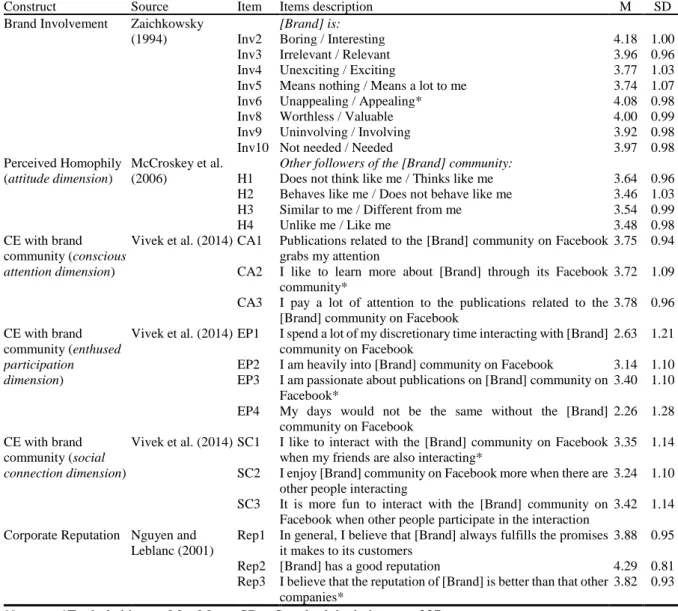
Regarding the items of the scales, Table 2.1 shows the means and standard deviations. The average brand community engagement (3.27) is slightly above the middle of the scale, being higher for conscious attention (3.75) and smaller for dimension enthused participation (2.85). This result is similar to that found by Vivek et al. (2014), in which the cognitive engagement is greater than the behavioral, affective and social.
Table 2.1. Scales for constructs measurement and descriptive statistics.
Construct Source Item Items description M SD
Brand Involvement Zaichkowsky (1994)
[Brand] is:
Inv2 Boring / Interesting 4.18 1.00
Inv3 Irrelevant / Relevant 3.96 0.96
Inv4 Unexciting / Exciting 3.77 1.03
Inv5 Means nothing / Means a lot to me 3.74 1.07
Inv6 Unappealing / Appealing* 4.08 0.98
Inv8 Worthless / Valuable 4.00 0.99
Inv9 Uninvolving / Involving 3.92 0.98
Inv10 Not needed / Needed 3.97 0.98
Perceived Homophily (attitude dimension)
McCroskey et al. (2006)
Other followers of the [Brand] community:
H1 Does not think like me / Thinks like me 3.64 0.96 H2 Behaves like me / Does not behave like me 3.46 1.03 H3 Similar to me / Different from me 3.54 0.99
H4 Unlike me / Like me 3.48 0.98
CE with brand community (conscious attention dimension)
Vivek et al. (2014) CA1 Publications related to the [Brand] community on Facebook grabs my attention
3.75 0.94 CA2 I like to learn more about [Brand] through its Facebook
community*
3.72 1.09 CA3 I pay a lot of attention to the publications related to the
[Brand] community on Facebook
3.78 0.96 CE with brand
community (enthused participation dimension)
Vivek et al. (2014) EP1 I spend a lot of my discretionary time interacting with [Brand] community on Facebook
2.63 1.21 EP2 I am heavily into [Brand] community on Facebook 3.14 1.10 EP3 I am passionate about publications on [Brand] community on
Facebook*
3.40 1.10 EP4 My days would not be the same without the [Brand]
community on Facebook
2.26 1.28 CE with brand
community (social connection dimension)
Vivek et al. (2014) SC1 I like to interact with the [Brand] community on Facebook when my friends are also interacting*
3.35 1.14 SC2 I enjoy [Brand] community on Facebook more when there are
other people interacting
3.24 1.10 SC3 It is more fun to interact with the [Brand] community on
Facebook when other people participate in the interaction
3.42 1.14 Corporate Reputation Nguyen and
Leblanc (2001)
Rep1 In general, I believe that [Brand] always fulfills the promises it makes to its customers
3.88 0.95 Rep2 [Brand] has a good reputation 4.29 0.81 Rep3 I believe that the reputation of [Brand] is better than that other
companies*
3.82 0.93 Notes — *Excluded items; M = Mean; SD = Standard deviation; n = 227.