og
nor
rin
Betsabé Antezana Poma(1), Wilson Roberto Maluf(2), Beatriz Tome Gouveia(2),
Alisson Marcel Souza de Oliveira(2), Rodolfo de Paula Duarte Ferreira(2) and Regis de Castro Carvalho(1)
(1)Universidade Federal de Lavras (Ufla), Departamento de Biologia, Caixa Postal 3.037, CEP 37200-000 Lavras, MG, Brazil. E-mail:
[email protected], [email protected] (2)Ufla, Departamento de Agricultura, Caixa Postal 3.037, CEP 37200-000 Lavras,
MG, Brazil. E-mail: [email protected], [email protected], [email protected], [email protected]
Abstract – The objective of this work was to evaluate the effects of the mutant alleles alcobaça (norA), ripening inhibitor (rin), and oldgoldcrimson (ogc), in heterozygosity or homozygosity, on the expression of color and on the postharvest quality of fruit of experimental tomato hybrids. Fourteen hybrids with contrasting genotypic constitutions in the norA, rin, and ogc loci were evaluated in a randomized complete block design with four replicates. The following fruit postharvest quality traits were evaluated: firmness in the breaker stage, color, and soluble solids content. The rin+/rin and nor+/norA genotypes increased firmness of tomato fruit at harvest (breaker stage). The rin+/rin genotypes displayed the worst internal fruit color. There was a positive effect of ogc+/ogc in improving the internal color of rin+/rin and nor+/norA fruit, making the color similar to that of the normal genotypes. The combination of the ogc/ogc rin+/rin nor+/norA genes is effective to improve tomato fruit firmness, besides maintaining or improving internal color.
Index terms: Solanum lycopersicum, alcobaça, nonripening, old gold crimson, plant breeding, ripening inhibitor.
Coloração e conservação pós-colheita de frutos de
tomateiro influenciadas pelos alelos
og
c,
nor
Ae
rin
Resumo – O objetivo deste trabalho foi avaliar os efeitos promovidos pelos alelos mutantes alcobaça (norA), ripening inhibitor (rin)e old gold crimson (ogc),em heterozigose ou homozigose, na expressão da coloração e da conservação pós-colheita de frutos de híbridos experimentais de tomateiro. Quatorze híbridos com contituições genotípicas contrastantes entre si nos locos norA, rin e ogc foram avaliados em delineamento em blocos ao acaso, com quatro repetições. As seguintes características de qualidade pós-colheita dos frutos foram avaliadas: firmeza no estádiode amadurecimento incipiente, coloração e teor de sólidos solúveis. Os genótipos rin+/rin e nor+/norA condicionaram a maior firmeza dos frutos de tomate no ponto de colheita (estádiode amadurecimento incipiente). Os genótipos rin+/rin apresentaram as piores colorações internas de frutos. Houve efeito positivo de ogc+/ogc na melhoria da coloração interna dos frutos rin+/rin e nor+/norA, que tornou a coloração semelhante à dos genótipos normais. A combinação dos genes ogc/ogc rin+/rin nor+/norA é eficiente para melhorar a firmeza dos frutos de tomate, além de manter ou melhorar a coloração interna. Termos para indexação: Solanum lycopersicum, alcobaça, nonripening, old gold crimson, melhoramento genético, ripening inhibitor.
Introduction
Tomato (Solanum lycopersicum L.) is one of the most highly consumed vegetable crops in the world. Brazil ranks eighth in the worldwide ranking for tomato production (FAO, 2013). Tomato fruit is highly perishable, with losses of up to 21% after harvest (Rinaldi et al., 2011); it has high-water content, about 90 to 95%, which makes it fragile (Rocha et al., 2009). In tomato breeding programs, the main studied
aspects are yield increase, pest and disease resistance, and the improvement of fruit quality. One of the factors associated with this last aspect is the greater natural conservation of the fruit postharvest, and this conservation may be achieved by the production of
F1-hybrid fruit that is firmer and has better color (Andrade
Júnior et al, 2001).
of mutant genes, such as rin (ripening inhibitor), nor
(nonripening), Nr (never ripe), and norA (alcobaça) (Barry & Giovannoni, 2006). These genes block and retard the maturation process, which lends a longer life to fruit. Currently, most post-harvest long-life tomato hybrids are heterozygous for the genes rin, nor, or norA, which may lead to reduced quality because of the pleiotropic effects on other metabolic pathways
involved in promoting fruit color, flavor, aroma, and texture (Kovács et al., 2009). However, alleles such as
high pigment(hp) and old gold crimson (ogc) increase lycopene production in the fruit, which improves color, and they can be used simultaneously with mutant maturation alleles (Andrade Júnior et al., 2005).
Araújo et al. (2002) have shown that the alcobaça
allele in homozygosity (norA/norA) prolongs the post-harvest shelf life by the reduction of weight loss and
the increase of firmness, and reduces the lycopene
and beta-carotene concentrations, besides increasing the Brix/acidity ratio, mainly in association with the genotypes hp/hp and hp+/hp or with ogc/ogc; however, its external color limits its commercial use.
Cá et al. (2006) in the evaluation of the viability of
simultaneous use of mutant genes, for maturity and for color in tomato hybrids, in the loci norA, rin, ogc, or hp, found that these genotypes exhibited better post-harvest shelf life than the normal genotypes, and concluded that the genotypic constitutions nor+/norA
ogc+/ogc,together with nor+/norA ogc+/ogc hp+/hp, were considered most promising, both for improving post-harvest conservation and for maintaining or improving the internal color of tomato fruit.
Faria et al. (2006) showed that the use of the mutants
ogc or hp, in heterozygosity, improves the color and increases the concentrations of beta-carotene and lycopene of fruit in rin+/rin and rin+/rinnor+/norA long shelf life hybrids. Andrade et al. (2015) concluded that the best combination of high beta-carotene (B) in heterozygosity for the hue angle and chroma depends on the mutant gene ogc in heterozygosity; they also showed that the ogc homozygous genotypes in the absence of high beta-carotene had a significant shift in
the red direction in the placenta and in the columella,
which confirms their effect on improving the internal
color of fruit.
The objective of this work was to evaluate the effects of the mutant alleles alcobaça (norA), ripening inhibitor (rin), and old gold crimson (ogc),in heterozygosity or
homozygosity, on the expression of color and on the postharvest quality of fruit of experimental tomato hybrids.
Materials and Methods
The study was carried out in a greenhouse and in
the field, at the experimental station of HortiAgro
Sementes S.A., in the Palmital farm (21°14'16"S, 45°08'00"W, at 920 m altitude), Ijaci, Minas Gerais state, Brazil, as well as in the Departamento de
Agricultura, of Universidade Federal de Lavras (Ufla),
and in the laboratory of vegetable crop post-harvest, of
Departamento de Ciências dos Alimentos of Ufla.
The experiment in the greenhouse was carried out in a randomized complete block design, with 14 treatments, and four replicates. Homozygous lines for the genes rin, norA, and ogc, from the germplasm bank of HortiAgro Sementes S.A., were used as parent lines for different combinations in the loci rin, norA, and ogc, and the following hybrids were obtained: TEX-432=F1(TOM-667 x TOM-756), TEX-433=F1 (TOM-591 x TOM-756), TEX-434=F1(TOM-714 x TOM-756), TEX-435=F1(TOM-756 x TOM-761), TEX-436=F1(TOM-713 x TOM-761), TEX-437=F1 (TOM-591 x TOM-761), TEX-438=F1(TOM-756 x TOM-762), TEX-439=F1(TOM-713 x TOM-762), TEX-440=F1(TOM-591 x TOM-762), TEX-441=F1 (TOM-763 x TOM-TOM-713), TEX-442=F1(TOM-757 x TOM-713), and TEX-443=F1(TOM-758 x TOM-713). These hybrids, all with determinate growth habit, together with two commercial hybrids as controls ('Giselle' and 'Colono', also of determinate growth habit), constituted 14 treatments that were placed in
five different categories, in relation to their genotypic
constitutions in the loci rin, norA, and ogc (Table 1). The plots consisted of a single row of 10 plants. The 14 genotypes were sown on 04/27/2015, and seedlings were produced in 128-cell expanded polystyrene trays that contained the commercial substrate Topstrato. Plants were thinned to one seedling per cell, at 15 days
after sowing. Seedlings were transplanted in the field at
30 days after sowing. The experiment was conducted
in the field according to the commercial growing recommendations for tomato under field conditions
The plants were pruned up to the height of the first flowering shoot, and from that point on, they were not
pruned. Fertilization at planting and topdressing, and plant health control treatments were also performed,
according to the specific recommendations for the
tomato cropping.
The soluble solids content (°Brix) was evaluated through direct reading in a refractometer. Post-harvest conservation of fruit was evaluated (N m-2) by fruit
firmness collected at the beginning of the maturity
stage, which is characterized by change of the fruit green color to the appearance of slightly red spots in the region of the stem scar – “breaker stage”) using the applanation technique described by Calbo & Nery (1995).
The same samples harvested at the beginning of the
maturity stage for the firmness evaluation were used
for color evaluation. Fruit were stored at 15°C and 60% relative humidity until reaching full maturity. Color readings were made at 4 parts of the fruit – epidermis, pericarp, placenta, and columella – with the Minolta
CR-400 colorimeter in the CIE mode L*, a*, and b*, in which L* (lightness) is the coordinate of brightness (z axis), which ranges from -100 (black) to +100 (white), in which the higher values indicate brighter colors; a* is the hue coordinate (x axis), which ranges from +60 (red) to -60 (green); b* is the hue coordinate (y axis), which ranges from +60 (yellow) to -60 (blue). From the
a* and b* values, the hue angle [defined as arc tg (b/a)]
and chroma or saturation [the square root of (a2+b2)] were obtained. The hue angle is considered from the
‘a’ axis and is expressed in degrees: 0° is defined as
+a (red); 90°, as +b (yellow); 180° as -a (green), and 270° as -b (blue). Mature tomato fruit in general range from 0° (red) to 90° (yellow); the nearer the values are to zero (0°), the redder the fruit; and the nearer to 90°, the yellower the fruit (Konica Minolta, 2014). For saturation or chroma, the values range from 0 to 60. Values equal to zero correspond to the origin center of the coordinates; values near zero indicate less saturated colors, and the value of 60 indicates the maximum saturation (Konica Minolta, 2014).
Data were subjected to the analysis of variance, and means were compared by the Tukey test’s, at 5% probability, by the SAS statistical application (SAS Institute, Inc., Cary, NC, USA). Experimental precision was checked by the estimate of selection accuracy (Resende & Duarte, 2007). Contrasts of interest were also calculated for comparisons between genotypes with different genotypic constitutions in the loci rin,
ogc, and norA.
Results and Discussion
In the evaluated fruit quality characteristics
– firmness, soluble solids content, and fruit color –, significant differences were observed between
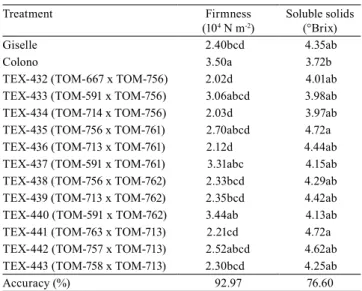
treatments, and all the quality traits showed accuracy higher than 70% (Table 2). Experimental precision was, therefore, considered high, according to Resende & Duarte (2007). The content of soluble solids, in the evaluated genotypes, varied from 3.72 °Brix, for 'Colono', to 4.72 °Brix for TEX-435 and TEX-441, respectively (Table 2). Only the differences between
these extreme values were significant. The other
genotypes, with intermediate °Brix values, did not differ from either of the two extreme values; this indicates that all the hybrids used were satisfactory for soluble solids content, and similar to the controls
Table 1. Description of the treatments.
Treatment Characteristics
Giselle Normal (rin+/rin+ nor+/nor+ ogc+/ogc+)
Colono rin heterozygote (rin+/rin)
TEX-432
(TOM-667 x TOM-756) rin heterozygote (rin
+/rin)
TEX-433
(TOM-591 x TOM-756)
norA heterozygote;
ogc heterozygote (nor+/norA ogc+/ogc)
TEX-434
(TOM-714 x TOM-756) Normal (rin
+/rin+ nor+/nor+ ogc+/ogc+)
TEX-435
(TOM-756 x TOM-761)
rin heterozygote; ogc heterozygote (rin+/rin ogc+/ogc)
TEX-436
(TOM-713 x TOM-761)
rin heterozygote; ogc heterozygote (rin+/rin ogc+/ogc)
TEX-437
(TOM-591 x TOM-761)
norA heterozygote; rin heterozygote;
ogc homozygote (nor+/norA rin+/rin ogc/ogc)
TEX-438
(TOM-756 x TOM-762)
rin heterozygote; ogc heterozygote (rin+/rin ogc+/ogc)
TEX-439
(TOM-713 x TOM-762)
rin heterozygote; ogc heterozygote (rin+/rin ogc+/ogc)
TEX-440
(TOM-591 x TOM-762)
norA heterozygote; rin heterozygote;
ogc homozygote (nor+/norA rin+/rin ogc/ogc)
TEX-441
(TOM-763 x TOM-713) Normal (rin
+/rin+ nor+/nor+ ogc+/ogc+)
TEX-442
(TOM-757 x TOM-713) Normal (rin
+/rin+ nor+/nor+ ogc+/ogc+)
TEX-443
(TOM-758 x TOM-713) Normal (rin
'Giselle' or 'Colono'. Fruit firmness was affected by
both the genotypic constitution in the loci (rin, norA, and og)c and the genetic base (Table 2). The normal
genotypes proved to be less firm at the beginning of
the maturity stage than the heterozygous genotypes
rin (C1, Table 3), ogcand norA (C3), and the genotypes
ogc/ogc rin+/rin nor+/norA (C4); besides, they did not
differ significantly from the genotypes ogc+/ogc rin+/
rin (C2). These results confirmed reports on rin+/rin and nor+/norA as responsible for the shelf life increase of the fruit (Araújo et al., 2002; Faria et al., 2003;
Santos Júnior et al., 2005; Cá et al., 2006). These
reports also showed that the genetic base also plays
an important role in fruit firmness, when considering, for instance, the amplitude of the firmness values
found among the normal genotypes 'Giselle', TEX-434, TEX-441, TEX-442, and TEX-443, among the heterozygous genotypes rin ('Colono', TEX-432), and among the genotypes ogc+/ogc rin+/rin (TEX-435, TEX-436, TEX-438, TEX-439). The ogc allele in heterozygosity seems not to have a direct effect
on firmness, since the heterozygous hybrids ogc and
rin were less firm than the heterozygous genotypes rin alone (C5, Table 3). Heterozygous genotypes ogc and norA were firmer than the heterozygous rin (C6). However, simultaneous heterozygosity in the loci rin
and norA seems to be the most effective combination
for increasing firmness in relation to the presence of
only one of these heterozygotes, when the magnitude
and significance of the contrasts C7, C8, and C9 and of the negative signal (though nonsignificant) of the C10
contrast are considered.
Among the experimental hybrids, TEX-440 had
the firmest fruit, and the fact that it has the genotypic
constitution ogc/ogc rin+/rin nor+/norA confirms the
effectiveness of obtaining firm hybrids through the
homozygous genotype ogc and heterozygous genotypes for both rin and norA.
As to fruit color, differences were observed among the treatments for all the evaluated characteristics (epidermis, pericarp, placenta, and columella) for both hue angle and chroma values (Table 4). The hue angle was affected both by the presence of the mutants rin, norA, and/or ogc and by the genotypic background.
Table 2. Mean values of firmness in the breaker stage and
of soluble solids in tomato (Solanumlycopersicum) fruit(1).
Treatment Firmness
(104 N m-2)
Soluble solids (°Brix)
Giselle 2.40bcd 4.35ab
Colono 3.50a 3.72b
TEX-432 (TOM-667 x TOM-756) 2.02d 4.01ab
TEX-433 (TOM-591 x TOM-756) 3.06abcd 3.98ab
TEX-434 (TOM-714 x TOM-756) 2.03d 3.97ab
TEX-435 (TOM-756 x TOM-761) 2.70abcd 4.72a
TEX-436 (TOM-713 x TOM-761) 2.12d 4.44ab
TEX-437 (TOM-591 x TOM-761) 3.31abc 4.15ab
TEX-438 (TOM-756 x TOM-762) 2.33bcd 4.29ab
TEX-439 (TOM-713 x TOM-762) 2.35bcd 4.42ab
TEX-440 (TOM-591 x TOM-762) 3.44ab 4.13ab
TEX-441 (TOM-763 x TOM-713) 2.21cd 4.72a
TEX-442 (TOM-757 x TOM-713) 2.52abcd 4.62ab
TEX-443 (TOM-758 x TOM-713) 2.30bcd 4.25ab
Accuracy (%) 92.97 76.60
(1)Mean values followed by equal letters, in the columns, do not differ by
the Tukey’s test, at 5% probability.
Table 3. Estimates of contrasts of interest for firmness (2x10⁴ N m-2) in tomato (Solanum lycopersicum) fruit.
Contrast Description Firmness estimate (N m-2)
C1 Normal genotypes vs heterozygous genotypes rin -0.47*
C2 Normal genotypes vs heterozygous genotypes ogc and rin -0.08ns
C3 Normal genotypes vs heterozygous genotype ogc and norA -0.77**
C4 Normal genotypes vs homozygous genotypes ogc and heterozygous rin and norA -1.08**
C5 Heterozygous genotypes rin vs heterozygous genotypes ogc and rin 0.39*
C6 Heterozygous genotypes rin vs heterozygous genotype ogc and norA -0.30ns
C7 Heterozygous genotypes rin vs homozygous genotypes ogc and heterozygous rin and norA -0.61**
C8 Heterozygous genotypes ogc and rin vs heterozygous genotype ogc and norA -0.68**
C9 Heterozygous genotypes ogc and rin vs homozygous genotypes ogc and heterozygous genotypes rin and norA -1.00**
C10 Heterozygous genotype ogc and norA vs homozygous genotypes ogc and heterozygous genotypes rin and norA -0.31ns
ogc, presence of the old gold crimson allele; rin, ripening inhibitor allele; norA, alcobaça allele. ** and *Significant by the Tukey’s test, at 1 and 5%,
Evidence of the effect of the genotypic background can be observed in the difference between the normal
genotypes – 'Giselle' had a significantly greater
hue angle (therefore, lower tendency to red) – in the placenta than the other normal hybrids: TEX-434, TEX-441, TEX-442, and TEX-443.
Differences were detected in the external color (epidermis) and internal color (pericarp, placenta, columella) of the fruit due to the presence of the loci rin, nor, and ogc (Table 5). The heterozygosity in the locus
rin increased the hue angle in relation to the normal
genotypes (C1), in both the external and internal parts of the fruit, which shows the detrimental effect of rin+/
rin on color. The detrimental effects of rin+/rin on internal color of the fruit were however reversed by the presence of ogc in heterozygosity (C2 and C5).
In the present study, it was not possible to measure the effect of the genotype nor+/norA, separately, on the internal and external colors, due to the absence of a heterozygous genotype norA in the absence of
ogc. However, it is clear that this detrimental effect, if it exists, is counterbalanced by the presence of ogc
Table 4. Mean values of hue angle (in degrees) for epidermis, pericarp, placenta, and columella of tomato (Solanum lycopersicum) fruit(1).
Treatment Epidermis Pericarp Placenta Columella
Giselle 38.77ab 38.90abcd 58.63a 39.11ab
Colono 38.34abcd 39.76ab 59.08a 34.81bc
TEX-432 (TOM-667 x TOM-756) 38.58abc 41.02a 55.21ab 34.43bc
TEX-433 (TOM-591 x TOM-756) 33.84e 35.10d 52.99bc 39.09ab
TEX-434 (TOM-714 x TOM-756) 35.32de 36.79bcd 51.31bc 34.73bc
TEX-435 (TOM-756 x TOM-761) 37.89abcd 36.78bcd 50.05c 35.03bc
TEX-436 (TOM-713 x TOM-761) 38.92a 38.65abcd 55.36ab 40.66a
TEX-437 (TOM-591 x TOM-761) 35.81bcde 36.06bcd 49.27c 39.13ab
TEX-438 (TOM-756 x TOM-762) 38.47abc 38.17abcd 52.38bc 32.66c
TEX-439 (TOM-713 x TOM-762) 38.33abc 39.73abc 55.57ab 37.87abc
TEX-440 (TOM-591 x TOM-762) 37.20abcd 37.13abcd 48.89c 37.99abc
TEX-441 (TOM-763 x TOM-713) 35.53cde 35.93cd 51.06bc 36.64abc
TEX-442 (TOM-757 x TOM-713) 36.85abcde 37.55abcd 51.91bc 40.62a
TEX-443 (TOM-758 x TOM-713) 36.68abcde 37.82abcd 52.71bc 38.52ab
Accuracy (%) 89.53 85.03 95.41 85.47
(1)Mean values followed by equal letters, in the columns, do not differ by the Tukey’s test, at 5% probability.
Table 5. Estimates of contrasts of interest for hue angle of the epidermis (EP), pericarp (PE), placenta (PL), and columella (CO) of tomato (Solanum lycopersicum) fruit.
Contrast Description Estimates
EP PE PL CO
C1 Normal genotypes vs heterozygous genotypes rin -1.83** -2.99** -4.02** 3.30**
C2 Normal genotypes vs heterozygous genotypes ogc and rin -1.77** -0.93ns -0.22ns 1.37ns
C3 Normal genotypes vs heterozygous genotypes ogc and norA 2.79** 2.30* 0.13ns -1.16ns
C4 Normal genotypes vs homozygous genotypes ogc and heterozygous genotypes rin and norA 0.12ns 0.80ns 4.04** -0.63ns
C5 Heterozygous genotypes rin vs heterozygous genotypes ogc and rin 0.06ns 2.05** 3.80** -1.93*
C6 Heterozygous genotypes rin vs heterozygous genotypes ogc and norA 4.62** 5.29** 4.15** -4.47**
C7 Heterozygous genotypes (HG) rin vs homozygous genotypes ogc and HG rin and norA 1.95** 3.79** 8.07** -3.94**
C8 Heterozygous genotypes ogc and rin vs heterozygous genotypes ogc and norA 4.56** 3.23** 0.35ns -2.54ns
C9 Heterozygous genotypes (HG) ogc and rin vs homozygous genotypes ogc and HG rin and norA 1.90** 1.74* 4.26** -2.00*
C10 Heterozygous genotypes (HG) ogc and norA vs homozygous genotypes ogc and HG rin and norA -2.67** -1.50ns 3.92** 0.53ns
ogc, presence of the old gold crimson allele; rin, ripening inhibitor allele; norA, alcobaça allele. ** and *Significant by the Tukey’s test at 1 and 5%
in heterozygosity because the combination ogc+/ogc
nor+/norA improved the epicarp and placenta colors in comparison to the normal genotypes (C3, Table 5). The possible detrimental effect of nor+/norA, if it exists, appears to be less than that brought about by rin+/rin
because the beneficial effects of ogc+/ogc are more
accentuated in the first case (C6) than in the second
one (C5).
The simultaneous presence of heterozygosity in rin
and norA besides homozygosity in ogc/ogc provided not only a red color comparable to that of normal genotypes in the epidermis, pericarp, and columella, but also improved it in the placenta (C4, Table 5). Andrade et al. (2015) found that homozygous genotypes ogc did not differ from the normal genotypes for the hue angles in
the epidermis and pericarp, but had a significant shift
in the red direction in the placenta and columella. As to the genotype rin+/rin alone, the combination
ogc/ogc rin+/rin nor+/norA exhibited color closer to red in all the measured points (C7, Table 5), and the same happened in the combination ogc+/ogc rin+/rin (C9). In relation to the genotype ogc+/ogc nor+/norA, the genotypic combination ogc/ogc rin+/rin nor+/norA brought about the best color in the placenta and the worst color in the epidermis (C10). Araújo et al. (2002) reported that the mutants ogc and hp, with a genotypic background 'Floradade', isolated or in combination, in both homozygosity and in heterozygosity, brought
about significant increases in internal and external
colors.
From these results it can be inferred that the allele
ogc, both in homozygosity and in heterozygosity, is able to counterbalance the negative effects of the heterozygotes rin+/rin or nor+/norA in fruit color, mainly in internal color. Similar effects on fruit color
were found by Faria et al. (2003) and Cá et al. (2006).
In fact, the three smallest chromaticity angles (nearest to red) among the studied genotypes were TEX-435 of the genotype ogc+/ogc rin+/rin, and TEX-437 and TEX-440 of the genotype ogc/ogc rin+/rin nor+/norA.
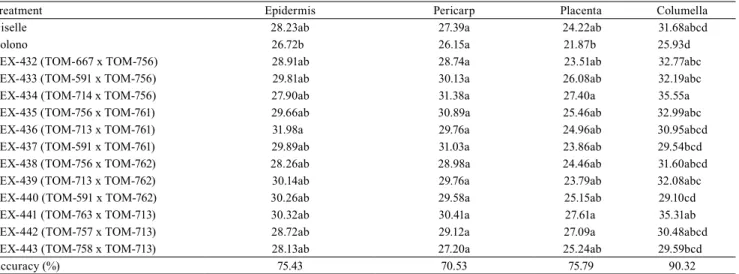
The chroma saturation seems to have been less affected than the hue angle among the studied genotypes (Table 6), particularly in the epidermis, pericarp, and placenta, whereas the normal genotype control 'Giselle' had the lowest numerical chromas among the treatments, and the hybrid TEX-441, which is also of normal genotype, had some of the highest chromas at these points.
The most significant differences in the chromas
occurred in the columella (Table 7). The genotypes rin+/
rin had significantly lower chromas than the normal
genotypes (C1), but due to the magnitude of variation among the normal genotypes themselves, it is possible that this difference arises mainly from the effect of different genotypic backgrounds, and not from the allele rin only. Nevertheless, the effect of the allele ogc in heterozygosity is clear as for the increasing of the chroma of the hybrids rin+/rin, both in the external and internal part of the fruit (C5). Genotypes ogc+/ogcnor+/
norA also showed greater internal chroma than the rin+/
Table 6. Mean values of chroma for epidermis, pericarp, placenta, and columella of tomato (Solanum lycopersicum) fruit.
Treatment Epidermis Pericarp Placenta Columella
Giselle 28.23ab 27.39a 24.22ab 31.68abcd
Colono 26.72b 26.15a 21.87b 25.93d
TEX-432 (TOM-667 x TOM-756) 28.91ab 28.74a 23.51ab 32.77abc
TEX-433 (TOM-591 x TOM-756) 29.81ab 30.13a 26.08ab 32.19abc
TEX-434 (TOM-714 x TOM-756) 27.90ab 31.38a 27.40a 35.55a
TEX-435 (TOM-756 x TOM-761) 29.66ab 30.89a 25.46ab 32.99abc
TEX-436 (TOM-713 x TOM-761) 31.98a 29.76a 24.96ab 30.95abcd
TEX-437 (TOM-591 x TOM-761) 29.89ab 31.03a 23.86ab 29.54bcd
TEX-438 (TOM-756 x TOM-762) 28.26ab 28.98a 24.46ab 31.60abcd
TEX-439 (TOM-713 x TOM-762) 30.14ab 29.76a 23.79ab 32.08abc
TEX-440 (TOM-591 x TOM-762) 30.26ab 29.58a 25.15ab 29.10cd
TEX-441 (TOM-763 x TOM-713) 30.32ab 30.41a 27.61a 35.31ab
TEX-442 (TOM-757 x TOM-713) 28.72ab 29.12a 27.09a 30.48abcd
TEX-443 (TOM-758 x TOM-713) 28.13ab 27.20a 25.24ab 29.59bcd
Accuracy (%) 75.43 70.53 75.79 90.32
rin (C6). Under the simultaneous presence of rin+/rin and nor+/norA, the allele ogc in homozygosity increased the chroma in the epidermis and in the pericarp of tomato fruit (C7).
Conclusions
1. The genotypic constitutions rin+/rinnor+/norA are
responsible for providing greater firmness to tomato
(Solanum lycopersicum) fruit at the time of harvest, and the allele ogc does not have a direct effect on
firmness.
2. Heterozygosity in the locus rin has a detrimental effect on color of the external and internal parts of the fruit. The ogc allele is able to counterbalance the negative effects of the heterozygotes rin+/rin or nor+/
norA on internal color.
3. The genotypic constitutions ogc/ogc rin+/rin
nor+/norA or ogc+/ogc nor+/norA are considered the
most promising ones, improving the firmness and the
internal or external color of tomato fruit.
4. The simultaneous presence of heterozygous alleles rin and norA,associated with ogc/ogc,is effective in developing tomato hybrids with better post-harvest conservation.
Acknowledgments
To Coordenação de Aperfeiçoamento de Pessoal de Nível Superior (Capes), for scholarships granted; to Universidade Federal de Lavras and to HortiAgro
Sementes S.A., for technical personnel help in conducting the experiments, and for permitting the use of infrastructure; and to Fundação de Amparo à Pesquisa do Estado de Minas Gerais (Fapemig) and
to Conselho Nacional de Desenvolvimento Cientifico e Tecnológico (CNPq), for financial support.
References
ALVARENGA, M.A.R. Tomate: produção em campo, casa de vegetação e hidroponia. 2.ed. rev. e ampl. Lavras: UFLA, 2013. 457p.
ANDRADE JÚNIOR, V.C. de; MALUF, W.R.; AZEVEDO, S.M. de; GOMES, L.A.A.; FARIA, M.V. Avaliação do potencial
agronômico e da firmeza pós-colheita de frutos em híbridos de
tomateiro. Ciência e Agrotecnologia, v.25, p.489-502, 2001.
ANDRADE JÚNIOR, V.C. de; MALUF, W.R.; FARIA, M.V.; BENITES, F.R.G.; SANTOS JÚNIOR, A.M. dos. Produção e qualidade de frutos de tomateiros portadores de alelos mutantes de amadurecimento e coloração. Pesquisa Agropecuária
Brasileira, v.40, p.555-561, 2005.
ANDRADE, T.M.; MALUF, W.R.; OLIVEIRA, C.M. de; GOMES, L.A.A.; SANTOS, D.C.; CARVALHO, R. de C.; GONÇALVES, R.J. de S.; GONÇALVES NETO, A.C. Interaction of the mutant genes B, ogc, hp and t in the coloring of tomato
fruit. Euphytica, v.205, p.773-783, 2015. DOI: 10.1007/s10681-015-1405-4.
ARAÚJO, M.L. de; MALUF, W.R.; GOMES, L.A.A.; OLIVEIRA, A.C.B. Intra and interlocus interactions between alcobaça (alc), crimson (ogc) and high pigment (hp) loci in tomato Lycopersicon
esculentum Mill. Euphytica, v.125, p.215-226, 2002. DOI: 10.1023/A:1015809526156.
Table 7. Estimates of contrasts of interest for chroma of the epidermis (EP), pericarp (PE), placenta (PL), and columella (CO) of tomato (Solanum lycopersicum) fruit.
Contrast Description Estimates
EP PE PL CO
C1 Normal genotypes vs heterozygous genotypes rin 0.84ns 1.66ns 3.62** 3.17**
C2 Normal genotypes vs heterozygous genotypes ogc and rin -1.35ns -0.75ns 1.65* 0.62ns
C3 Normal genotypes vs genotypes ogc/ogc nor+/norA -1.15ns -1.03ns 0.23ns 0.33ns
C4 Normal genotypes vs genotypes ogc/ogc rin+/rin nor+/norA -1.42ns -1.20ns 1.81* 3.20**
C5 Heterozygous genotypes rin vs heterozygous genotypes ogc and rin -2.19* -2.41* -1.98* -2.55*
C6 Heterozygous genotypes rin vs heterozygous genotype ogc and norA -2.00ns -2.69* -3.39** -2.84*
C7 Heterozygous genotypes (HG) rin vs homozygous genotypes ogc and HG rin and norA -2.26* -2.86* -1.82ns 0.03ns
C8 Heterozygous genotypes ogc and rin vs heterozygous genotype ogc and norA 0.20ns -0.28ns -1.42ns -0.29ns
C9 Heterozygous genotypes (HG) ogc and rin vs homozygous genotypes ogc and HG rin and norA -0.07ns -0.46ns 0.16ns 2.58*
C10 Heterozygous genotype (HG) ogc and norA vs homozygous genotypes ogc and HG rin and norA -0.26ns -0.17ns 1.58ns 2.87ns
ogc, presence of the old gold crimson allele; rin, ripening inhibitor allele; norA, alcobaça allele. ** and *Significant by the Tukey’s test, at 1 and 5%
BARRY, C.S.; GIOVANNONI, J.J. Ripening in the tomato
Green-ripe mutant is inhibited by ectopic expression of a protein that disrupts ethylene signaling. PNAS, v.103, p.7923-7928, 2006. DOI: 10.1073/pnas.0602319103.
CÁ, J.A.; MALUF, W.R.; GOMES, L.A.A.; NASCIMENTO, I.R. do; FARIA, M.V.; LICURSI, V.; MORETTO, P. Híbridos de tomateiro longa-vida com frutos de maior intensidade de coloração. Pesquisa Agropecuária Brasileira, v.41, p.1377-1384, 2006. DOI: 10.1590/S0100-204X2006000900005.
CALBO, A.G.; NERY, A.A. Medida de firmeza em hortaliças
pela técnica de aplanação. Horticultura Brasileira, v.13, p.14-18, 1995.
FAO. Food and Agriculture Organization of the United Nations.
Faostat: Crops. Rome, 2013. Available at em: ˂http://faostat.fao.
org/site/567/DesktopDefault.aspx?PageID=567#anco˃. Accessed on: Dec. 8 2015.
FARIA, M.V.; MALUF, W.R.; AZEVEDO, S.M. de; ANDRADE-JÚNIOR, V.C.; GOMES, L.A.A.; MORETTO, P.; LICURSI, V. Yield and post-harvest quality of tomato hybrids heterozygous at the loci alcobaça, oldgold-crimson or high pigment. Genetics
and Molecular Research, v.2, p.317-327, 2003.
FARIA, M.V.; MALUF, W.R.; RESENDE, J.T.V. de; ANDRADE-JÚNIOR, V.C.; NASCIMENTO, I.R. do; BENITES, F.R.G.; MENEZES, C.B. de; AZEVEDO, S.M. Mutantes rin, nora, ogc e
hp em diferentes backgrounds genotípicos de tomateiro. Pesquisa
Agropecuária Brasileira, v.41, p.793-800, 2006. DOI: 10.1590/
S0100-204X2006000500011.
KONICA MINOLTA. Precise color communication: color
control from perception to instrumentation. Available at: ˂http:// www.konicaminolta.com/instruments/knowledge/color/pdf/ color_communication.pdf˃. Accessed on: Sept. 23 2014.
KOVÁCS, K.; FRAY, R.G.; TIKUNOV, Y.; GRAHAM, N.; BRADLEY, G., SEYMOUR, G.B.; BOVY, A.G.; GRIERSON, D.
Effect of tomato pleiotropic ripening mutations on flavor volatile
biosynthesis. Phytochemistry, v.70, p.1003-1008, 2009. DOI: 10.1016/j.phytochem.2009.05.014.
RESENDE, M.D.V. de; DUARTE, J.B. Precisão e controle de qualidade em experimentos de avaliação de cultivares. Pesquisa
Agropecuária Tropical, v.37, p.182-194, 2007.
RINALDI, M.M.; SANDRI, D.; OLIVEIRA, B.N.; SALES, R.N.; AMARAL, R.D.A. Avaliação da vida útil e de embalagens para tomate de mesa em diferentes condições de armazenamento.
Boletim CEPPA, v.29, p.305-316, 2011. DOI: 10.5380/cep.
v29i2.25510.
ROCHA, M.C.; GONÇALVES, L.S.A.; SOARES, A.G.; CARMO, M.G.F. do. Caracterização física, físico-química e bioquímica de 12 acessos de tomateiro do grupo cereja produzidos sob manejo orgânico. Horticultura Brasileira, v.27, p.S2899-S2906, 2009.
SANTOS JÚNIOR, A.M. dos; MALUF, W.R.; FARIA, M.V.; ANDRADE JÚNIOR, V.C. de; NASCIMENTO, I.R. do; BENITES, F.R.G.; GOMES, L.A.A. Produção, qualidade e conservação de tomates heterozigotos nos locos alcobaça,
nonripening e ripening inhibitor. Pesquisa Agropecuária
Brasileira, v.40, p.1203-1210, 2005. DOI:
10.1590/S0100-204X2005001200007.