R E S E A R C H
Open Access
Biodegradation of [D-Leu
1
] microcystin-LR by a
bacterium isolated from sediment of Patos
Lagoon estuary, Brazil
Gilmar AF Lemes
1, Luiza W Kist
2, Mauricio R Bogo
2,3and João S Yunes
1*Abstract
Background:Toxic cyanobacterial blooms are recurrent in Patos Lagoon, in southern Brazil. Among cyanotoxins, [D-Leu1] microcystin-LR is the predominant variant whose natural cycle involves water and sediment compartments. This study aimed to identify and isolate from sediment a bacterial strain capable of growing on [D-Leu1] microcystin-LR. Sediment and water samples were collected at two distinct aquatic spots: close to the Oceanographic Museum (P1), in Rio Grande City, and on São Lourenço Beach (P2), in São Lourenço do Sul City, southern Brazil.
Methods:[D-Leu1] microcystin-LR was isolated and purified from batch cultures ofMicrocystis aeruginosastrain RST9501. Samples of water and sediment from Rio Grande and São Lourenço do Sul were collected. Bacteria from the samples were allowed to grow in flasks containing solely [D-Leu1] microcystin-LR. This strain named DMSX was isolated on agar MSM with 8 g L−1glucose and further purified on a cyanotoxin basis growth. Microcystin concentration was obtained by using the ELISA immunoassay for microcystins whereas bacterial count was performed by epifluorescence microscopy. The genusPseudomonaswas identified by DNA techniques.
Results:Although several bacterial strains were isolated from the samples, only one, DMXS, was capable of growing on [D-Leu1] microcystin-LR. The phylogenetic analysis of the 16S rRNA gene from DMXS strain classified the organism as
Pseudomonas aeruginosa. DMXS strain incubated with [D-Leu1] microcystin-LR lowered the amount of toxin from 1μg.L−1 to < 0.05
μg.L−1. Besides, an increase in the bacterial count
–from 71 × 105 bacteria.mL−1to 117 × 105bacteria.mL−1
–was observed along the incubation.
Conclusions:The use of bacteria isolated from sediment for technological applications to remove toxic compounds is viable. Studies have shown that sediment plays an important role as a source of bacteria capable of degrading cyanobacterial toxins. This is the first Brazilian report on a bacterium–of the genusPseudomonas–that can degrade [D-Leu1] microcystin-LR, the most frequent microcystin variant in Brazilian freshwaters.
Keywords:Biodegradation, Microcystin, Sediment, Patos Lagoon, Estuary, Brazil
Background
Cyanobacteria are also known as blue-green algae, be-cause they have characteristics of both algae and bacteria, although they are now classified as bacteria. These organisms are capable of producing toxins,
called cyanotoxins, and their blue-green color comes from the pigments which gives their ability to photosynthesize. In waterbodies used for water supply, cyanobacterial blooms can pose serious threats to animals and humans.
Toxic cyanobacterial blooms have been reported worldwide [1-7]. A serious case of cyanobacterial con-tamination occurred in Brazil. A hemodialysis clinic in the city of Caruaru, in northeastern Pernambuco, used water contaminated with cyanotoxins, which led to more than 60 patient deaths [8,9].
* Correspondence:[email protected]
1Laboratório de Cianobactérias e Ficotoxinas, Instituto de Oceanografia,
Universidade Federal do Rio Grande (FURG), Av. Itália, km 8, Campus Carreiros, Caixa postal 474, Rio Grande RS CEP 96203-000, Brazil Full list of author information is available at the end of the article
In Patos Lagoon, in the southernmost part of Brazil, toxic cyanobacterial blooms have been observed for 18 years [4,10] as seen in Figure 1.
The Patos Lagoon is a large waterbody that covers an area of 10,360 km2. Since several freshwater rivers run into it, it involves an even higher surface area of
200,000 km2 in the Rio Grande do Sul state. The
estuarine area comprises 10% of the lagoon and is fun-damental to fish species, crustaceans and mollusks, supplying food, shelter and reproduction sites (several species come to the estuary to spawn). The economic activities of the area lies on fishery, waterways and recreational places [4,11]. Therefore, toxic cyanobac-terial blooms affect not only estuarine organisms, but also the local economy.
Cyanobacterial blooms in Patos Lagoon are extremely toxic since mouse bioassays detected lethal concentra-tions below 100 μg.kg−1 of body weight [12]. These blooms are associated with pH (7.5-8.0), temperatures (>20°C) and high concentration of nutrients [4]. Among the toxins present in cyanobacterial blooms are micro-cystins and cyclic heptapeptides that have more than 65 structural variants with variable toxicity. Microcystins may trigger tumor development and have been associ-ated with acute and chronic health problems in humans and other animals.
Microcystis aeruginosais the main toxic species found in Patos Lagoon and is known for producing [D-Leu1] microcystin-LR [7,13]. This variant comprises 90% of the total amount of toxins produced intracellularly and is one of the toxins with the highest toxicity [13-15]. Investiga-tion on the biodegradaInvestiga-tion of cyanobacterial toxins have been carried out in laboratories and in fieldwork aiming at avoiding damage caused by these blooms [16-19].
In the south of Brazil, the first study on the biodegrad-ation of [D-Leu1] microcystin-LR was performed with
samples of Patos Lagoon water [20]. Afterwards, another research was conducted to identify a specific strain that is capable of degrading microcystin-LR and [D-Leu1] microcystin-LR originated from the estuary of Patos Lagoon [11].
Since several studies recommend the biodegradation of cyanobacterial toxins as a safe and viable manner to remove toxic compounds from water, the current work aimed to isolate and identify a bacterial strain collected from the sediment of Patos Lagoon which is able to de-grade the toxin [D-Leu1] microcystin-LR [18,21,22].
Methods Cultures
Experiments were carried out with the toxin extracted from cultures of the cyanobacterium Microcystis aerugi-nosa RST9501. The strain was isolated from water col-lected in Patos Lagoon and deposited in the Culture Collection of the Laboratory of Cyanobacteria and Phy-cotoxins. Cultures were maintained in 1 L Erlenmeyer flasks with BG-11 medium [23]. Culture flasks were kept in FANEM 347 growth chambers at 20°C ± 2°C in light– dark cycles of 12 hours. The cell growth was performed in order to yield a major variant of microcystin, [D-Leu1] microcystin-LR, for use in the experiments.
Extraction and purification of microcystin
The toxin [D-Leu1] microcystin-LR was extracted from cells according to Lawtonet al. [24]. Cultures were cen-trifuged (Hermle Z323, Labnet, Germany) at 8,000g for 20 minutes. Afterwards, the centrifuged material was frozen and lyophilized (Edwards MicroModulyo, UK). Then, 250 mL of acetic acid and distilled water (5% v/v) was added for each gram of lyophilized material. The mixture was agitated for an hour and again centrifuged at 8,000g for ten minutes. The supernatant (S1) was stored. The resulting material (pellet) of this centrifuga-tion went through a second centrifugacentrifuga-tion process that was similar to the first one. After the centrifugation at 8,000g for ten minutes, the pellet was discharged and the second supernatant (S2) was added to the previous (S1). Both resulting supernatants (S1+ S2 = 500 mL) were stored in a freezer for 24 hours. After thawing, they were centrifuged at 8,000g for ten minutes and the resulting pellet was discharged.
In the second step, total resultant supernatants were filtered through a peristaltic pump (Millipore Corpor-ation, USA) which was coupled to a Sep-Pak 3 mL/1 g C18 cartridge. The cartridge was previously activated by addition of 10 mL of methanol, followed by 10 mL of distilled water. Afterwards, the supernatants were fil-tered through the cartridges; these containers were fro-zen for 24 hours. After thawing, the cartridges were eluted with 20 mL of methanol (100%). The extracts that
resulted from the passage of methanol through the cartridges were dried in a rotary evaporator with a vacuum system at 40°C. After evaporation, residues were resuspended in 500 μL of methanol (100%) twice
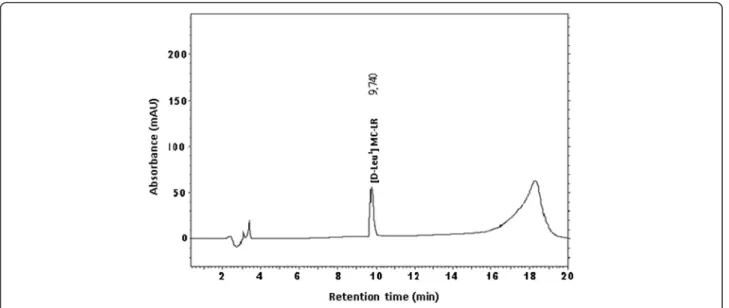
and were then analyzed by high performance liquid chromatography (HPLC–Shimadzu SCL-10Avp, Japan) to determine the concentration of microcystins. The resulting toxin (Figure 2) was used in the biodegradation experiments.
Water and sediment collection
In Patos estuary, water and sediment samples were col-lected at spot P1, near the Oceanographic Museum (32.0246S; 52.1062 W) that belongs to the Federal University of Rio Grande (FURG). This spot was chosen because bacteria able to degrade cyanotoxins had already been found in that environment [11]. In São Lourenço do Sul city (31.3690 S; 51.9620 W), water samples were collected on the beach, at spot P2 (Figure 3), a place where heavy Microcystis blooms were seen, so they also could be the source of heterotrophic bacteria.
Surface water samples were collected in a 1-L plastic bucket and stored in clean plastic bottles. Temperature (Incoterm thermometer, Brazil) and salinity (Quimis salinometer, Brazil) were measured at the site whereas the pH was measured in the laboratory (Digimed pH meter, Brazil).
Sediment was only collected at P1, near the Oceanographic Museum, about 500 g with PVC pipes (75 cm in diameter) stored in clean plastic bottles and taken to the laboratory.
Afterwards, water and sediment samples were stored in styrofoam boxes and taken to the laboratory, where they were disposed in 250 mL minimal salt media
(MSM) and vortexed for 30 minutes. All samples were collected and analyzed in triplicate.
Isolation of bacterial strains
To isolate bacterial strains, water samples were filtered through Whatman filters (7.0 cm, pore 0.45 μm), and,
then, spread on Petri dishes with MSM and addition of 8 g.L−1glucose anhydrous and 15 g L−1agar [25]. Sedi-ment samples were centrifuged (Hermle Z323, Labnet, Germany) at 12,000 rpm for ten minutes and the super-natant was filtered in Whatman cellulose acetate mem-brane filters (7.0 cm, pore 0.45 μm). The remaining
pellet was discharged. Several strains were isolated from the water collected in both spots and from the sediment collected at P2, strains were catalogued and kept in cul-tures for the biodegradation tests (Table 1).
Biodegradation experiment of [D-Leu1] microcystin-LR The biodegradation experiment of [D-Leu1] Microcys-tin–LR was carried out in a first screening basis, with each strain that was isolated from water and sediment samples collected at spots P1 and P2.
The experiment was conducted with 30 mL MSM in each flask, which had previously been autoclaved at 120 kgf/cm2for 30 minutes. Three amber flasks were kept for the treatment and three were kept for control. Eight microliters of [D-Leu1] microcystin-LR at 3.7 μg.L−1was added to each flask, so that the approximate concentration was 1μg.L−1.
Treatment flasks had bacterial samples from the culture dishes whereas control flasks did not have bacterial strains.
The experiment was kept in a microbiological heater Certomat® BS-1 (Germany) at 27°C, in dim light to pre-vent the toxin from degrading due to intense light.
During the experiment, samples were collected for analysis every three days, on average; all handling was done in a microbiological chamber with a Bunsen burner. Total sampling time was 30 days. Medium sam-ples were labeled and stored in a freezer at –20°C for further analysis by ELISA immunoassay.
Selection and isolation of the strain to perform the biodegradation assay
At the end of the experiment with sediment, when the concentration of the toxin [D-Leu1] microcystin-LR
reached “zero”, a sample of this bacterial strain was re-moved from the flasks and inoculated in MSM on a Petri dish with the addition of 8 g.L−1glucose anhydrous and 15 g.L−1 agar. The strain was then denominated DMXS. In order to guarantee the purity of the isolated, the strain was inoculated in Petri plates containing growth media with pure D-Leu microcystin-LR. A pure isolate was considered a colony (single form) which was repeatedly replicated successfully.
Evaluation of toxin [D-Leu1] microcystin-LR concentration by Elisa Immunoassay
Assessment of toxin levels was carried out by ELISA im-munoassay with specific antibodies for microcystins. This test has high sensitivity and detects toxins in con-centrations as low as 0.05 up to 2.5 μg.L−1. The ELISA
kit (Abraxis, USA) was used in accordance with the methodology recommended by the manufacturer.
Bacterial count
Bacterial count was performed through epifluorescence mi-croscopy in a Zeiss Axioplan microscope (Germany) and using the software UTHSCSA Image Tool (Version 3.0) (http://compdent.uthscsa.edu/dig/download.html). Samples were filtered through polycarbonate membranes (Nucle-pore, Whatman, UK; pore 0.2 μm) and colored with
Irgalan black. Samples were then dyed with acridine or-ange in accordance with the methodology proposed by Hobbie et al. [26] to count bacteria in samples fixed with Lugol’s solution [27,28]. This fluorochrome emits green or orangish red fluorescence when it binds to bac-terial DNA or RNA, respectively. We took advantage of the image by dividing the screen in several equal squares. For each screen containing an image divided in more than a 100 squares, we choose randomly a mini-mum of 30 squares to be counted.
Molecular identification
DNA was extracted from 1-mL cell cultures by the Wizard Genomic DNA Purification kit (Promega, USA) in accordance with the supplier’s instructions. Extraction products were visualized on 1% agarose gel with GelRed (Biotium, USA). Primers of 16S segment (forward 5′
-CCTACGGGAGGCAGCAG-3′ and reverse 5′-GAC
TACCAGGGTATCTAATC-3′) were designed as
previ-ously described [29]. DNA sample was amplified through polymerase chain reaction (PCR), which was performed in accordance with Ritchie et al. [29], ex-cept for the primer annealing temperature, which was optimized for 58°C. PCR products (approximately 400-bp long) were analyzed on GelRed-stained 1% agarose gel, with Low DNA Mass Ladder (Invitrogen, Thermo Fisher Scientific, USA) as the molecular weight marker, and then purified by enzymes exonuclease I
Table 1 Bacteria isolated from water samples collected at two spots in Patos Lagoon: P1, in the Patos Lagoon estuary (near the Oceanographic Museum) and P2, on São Lourenço Beach (Rio Grande do Sul state, Brazil)
Bacterial strain Spot Color Source
BM12 P1 Yellow Water
EE1 P1 White Water
EBDE1Br P2 White Water
LPML P1 Orange Water
NOT13 P1 Yellow Water
CEV P1 Red Water
BB0412 P2 Yellow Water
FB0607 P1 Red Water
DMXS P1 Light brown Sediment
and shrimp alkaline phosphatase. Purified PCR prod-ucts were sequenced in both directions by a Mega-BACE 1000 automated sequencer (GE Healthcare, UK). The resulting chromatograms were analyzed and the DNA sequence was identified through the Basic Local Alignment Search Tool (BLAST–GenBank National Center for Biotechnology Information).
The 16S rRNA gene sequences used in the phylogen-etic analysis were retrieved from the GenBank (accession numbers given in parentheses) as follows: P. aeruginosa YL84 (CP007147),P. alcaligenes LMG 1224 T (Z76653), P. citronellolisDSM 50332 T (Z76659),P. stutzeriATCC 17589 (U25432), P. oleovorans DSM 1045 T (Z76665), P. flavescens B62 (U01916) and P. putida DSM 291 T (Z76667), and were aligned through the ClustalX program [30]. An unrooted phylogenetic tree was constructed with the MEGA 6.0 program [31] and the statistical Neighbor-Joining method [32] with proportional (p) distance was used.
All experimental research reported in this manuscript was in compliance with the Brazilian Ethics Committee for Animal tests.
Results
Samples of environmental water and sediment from the Patos Lagoon area including São Lourenço Beach were collected in order to isolate bacterial strains for the study of biodegradation of the hepatotoxin [D-Leu1] microcystin-LR. The analyses of water samples did not show meaningful differences except regarding the temperature; it was a slightly higher at spot P1 for sev-eral days.
Samples of water and sediment enabled the isolation of several strains (Table 1), whose ability for degrading microcystins were tested. However, most of them were not capable of degrading this cyanotoxin, except for the strain called DMXS.
The study of the biodegradation process of the hepato-toxin [D-Leu1] microcystin-LR was carried out in liquid medium. The decrease in the microcystin concentration in the medium is shown in Figure 4.
For the controls, since the samples had been auto-claved and the toxin concentration did not decrease dur-ing the experiment, no physical, chemical or biological degradation was observed. Therefore, the bacterial com-munity was inactivated in the autoclave process.
In the treatment flask containing the DMXS strain, 40% of the total toxin concentration occurred in three days. After 15 days, the toxin concentration was kept stable, around 60%. From the 15th day on, there was a steep decrease: from 60% to 0 in only four days (Figure 4).
The rate of toxin decrease was calculated and b was 0.054579 or 5 μg L−1/day. Half-life was 12.7 days. The
equation used for the half-life rate was developed in ac-cordance with Ozawaet al.[33].
Figure 5 shows the growth of the strain DMXS in par-allel with the uptake of the toxin during the same period of the experiment. The bacterial concentration increased up to the 12th day. The decrease started on the 19th day, when the toxin concentration started to decrease concomitantly.
In the inoculum, the bacterial concentration was 71 × 105bacteria mL−1. It reached the highest concentration, 117 × 105bacteria mL−1, on the 12th day.
In the presence of the toxin, the strain DMXS grew slowly during the experiment. The decrease in the growth started after it had reached its highest concentra-tion, 117 × 105 bacteria.mL−1 when about 80% of the toxin had already been biotransformed.
The identification of the strain able of degrading the toxin was made by genetic sequencing; the total DNA was extracted from the isolated DMXS and the sequence of 16S rDNA was partially determined. The DNA se-quence enabled the identification of the strain as Pseudomonas aeruginosa by the nucleotide BLAST tool
Figure 4Decrease in the concentration of toxin [D-Leu1] microcystin-LR by the bacterial strain DMXS.▲Control, ■Treatment.
(accession number HQ890467) and by the phylogenetic analysis using sequences from other species of the genus (Figure 6).
Discussion
The waters in the hydrographic region of the Patos Lagoon have been studied and monitored regarding the presence and development of toxic cyanobacterial blooms as they are important for the economy and bio-diversity in Rio Grande do Sul state, southern Brazil [10,12]. In an attempt to mitigate harmful effects of toxins on aquatic ecosystems, studies on the degradation and removal of cyanobacterial toxins have been carried out in several countries [11,16,17,34-37].
Biodegradation of the microcystin variant [D-Leu1] microcystin-LR was conducted in the laboratory using a strain isolated from sediment collected in the estuary. The strain DMXS was responsible for the decrease in the concentration of the toxin. It started right after the toxin was added to the experiment and was fast at the beginning. On the 19th day, toxin concentration was close to zero and, from the 24th day on, the toxin could not be identified anymore. The control was intact throughout the experiment; it means that the stability of the toxin was very high and that a possible contaminant bacterial community in the control was inactivated by the autoclave process.
The experiment was apparently stable for some time, from the 3rd to the 15th day, after the beginning of the toxin degradation process. However, degradation was slower only in this period. Other authors, including Chenet al.[18] and Edwards et al.[37], studied micro-cystin degradation and also found some similar results, i.g., some samples were only degraded after 10–20 days. The rate of toxin decrease was calculated and b was 0.054579 or 5μg.L−1/day. Half-life was 12.7 days. Similar or higher values were also reported in other studies [18]. The organism responsible for the degradation of the toxin [D-Leu1] microcystin-LR is a bacterial strain
isolated from sediment collected in the Patos Lagoon area (Rio Grande do Sul state, Brazil) at spot P1. Several studies of microcystin biodegradation have shown that there are bacteria in sediment collected in lakes [38-40]. This was observed both under aerobic [21,22] or anoxic conditions [40].
During the experiment, the bacterial strain DMXS grew slowly even at high temperatures, but having the toxin [D-Leu1] microcystin-LR as its single carbon source. Temperatures between 27°C and 29°C are consid-ered high in comparison with mean temperatures in the place where the strain was isolated. This strain metabolism is low and appropriate to this kind of environment in which temperatures do not vary much. Although there is abundance of bacteria in this place, the specific cell activ-ities of sediment bacteria is low [41].
It is also noteworthy that breaking the cyclic structure of microcystin molecules requires much energy from the bacterial metabolism. This may be a reason for the de-crease on the rate of cell division and bacterial growth, as well.
The waters of Patos Lagoon harbor a vast diversity of bacteria [13]; however, as the present study has proven, the bacterial population capable of degrading cyanotox-ins is small. The present findings agree with other stud-ies that tested ability of bacteria from lake waters and sediment to degrade microcystins in the laboratory. Some have reported that only 17% of the strains are cap-able of carrying out the degradation [35]. An Argentin-ean study evaluated three isolated strains, but only one was capable of biodegrading microcystin-RR [42].
Studies on microcystin biodegradation conducted in China with samples collected in Taihu Lake showed that only 17 out of 96 water samples were capable of carrying out the biodegradation. Twelve out of these 17 samples were collected near the sediment-water interface [18].
The capacity of an aquatic bacterium to degrade microcystins is not common, since only few species have the proper metabolism needed to do it [43]. The genus
Sphingomonas has been pointed by most studies [17,21,44-46], even though other genera are also cap-able of degrading these toxins [11,47,48].
Bacteria from sediment play an important role in the decomposition of organic matter and in geochemical cycles. These microorganisms are adapted to explore dif-ferent sources of energy efficiently [6,49]. Hence, micro-bial degradation has been recommended as an effective process to eliminate microcystins in fresh water [18]. In this sense, the water column and the sediment play an important role in the degradation of microcystins in aquatic environments [18,35,37]. Therefore low levels of microcystins in an environment may be due to bacterial degradation [18].
Nowadays, biotechnological research on toxin biodeg-radation by sediment bacteria through removal of micro-cystins from water involves different techniques including: microorganisms immobilized in polyester resins, sand fil-ters and bioreactors [22,36,50]. These biotechnological ap-plications–employing different aquatic microorganisms that biodegrade microcystins–are considered an efficient process to remove such contaminants from water [50-52].
Conclusion
The use of bacteria isolated from sediment for biotech-nological applications is viable. Research has shown that sediment plays an important role as a source of bacteria capable of degrading cyanobacterial toxins. Results re-ported in this work corroborate previous studies and show that a bacterial strain from the genusPseudomonas aeruginosa isolated from sediment collected in Patos Lagoon, in Brazil, biodegraded [D-Leu1] microcystin-LR in the laboratory.
Competing interests
The authors declare that they have no competing interests.
Authors’contributions
G.A.F. Lemes has performed all tests except molecular identification of bacterial strain. He has also collected and purified the strain and wrote the first draft. L. Kist and M. Bogo performed all the molecular based bacterial identification tests and wrote the text concerned. J.S. Yunes has helped to design all the experiments since the sampling in the environment and wrote, submitted and corrected the paper. All authors read and approved the final manuscript.
Acknowledgments
The authors would like to thank CNPq, CAPES, FAURG for the funding of this research and their personal grants.
Author details
1
Laboratório de Cianobactérias e Ficotoxinas, Instituto de Oceanografia, Universidade Federal do Rio Grande (FURG), Av. Itália, km 8, Campus Carreiros, Caixa postal 474, Rio Grande RS CEP 96203-000, Brazil.2Laboratory of Genomics and Molecular Biology, School of Biosciences, Pontifical Catholic University of Rio Grande do Sul (PUCRS), Porto Alegre, Rio Grande do Sul State, Brazil.3National Institute of Science and Technology for Translational
Medicine, Porto Alegre, Rio Grande do Sul State, Brazil.
Received: 14 April 2014 Accepted: 26 January 2015
References
1. Kotak BG, Kenefick SL, Fritz DL, Rousseaux CG, Prepas EE, Hrudey SE. Occurrence and toxicological evaluation of cyanobacterial toxins in Alberta lakes and farm dugouts. Water Res. 1993;27(3):495–506.
2. Lawton LA, Codd GA. Cyanobacterial (Blue-Green Algal) toxins and their significance in UK and European waters. Water Environ J. 1991;5(4):460–5. 3. Proença LAO, Tamanaha MS, Fonseca RS. Screening the toxicity and toxin
content of blooms of the cyanobacteriumTrichodesmium erythraeum(Ehrenberg) in northeast Brazil. J Venom Anim Toxins incl Trop Dis. 2009;15(2):204–15 [http:// www.scielo.br/scielo.php?pid=S1678-91992009000200004&script=sci_arttext] 4. Yunes JS, Salomon PS, Matthiensen A, Beattie KA, Raggett SL, Codd GA.
Toxic blooms of cyanobacteria in the Patos Lagoon Estuary, southern Brazil. J Aquat Ecosystem Health. 1996;5(4):223–9.
5. Chorus I, Bartram J. Toxic cyanobacteria in water: A guide to their public health consequences, monitoring and management. London: World Health Organization and E&FN Spon; 1999. p. 416.
6. Giovannardi S, Pollegioni L, Pomati F, Rossetti C, Sacchi S, Sessa L, et al. Toxic cyanobacterial blooms in Lake Varese (Italy): a multidisciplinary approach. Environ Toxicol. 1999;14(1):127–34.
7. Matthiensen A, Beattie KA, Yunes JS, Kaya K, Codd GA. [D-Leu1] Microcystin-LR, from the cyanobacteriumMicrocystisRST 9501 and from a Microcystis bloom in the Patos Lagoon estuary, Brazil. Phytochemistry. 2000;55(5):383–7. 8. Jochimsen EM, Carmichael WW, An J, Cardo DM, Cookson ST, Holmes CEM,
et al. Liver failure and death after exposure to microcystins at a hemodialysis center in Brazil. N Engl J Med. 1998;338:873–8.
9. Pouria S, De Andrade A, Barbosa J, Cavalcanti RL, Barreto VT, Ward CJ, et al. Fatal microcystin intoxication in haemodialysis unit in Caruaru. Brazil Lancet. 1998;352(9121):21–6.
10. Yunes JS, Niencheski LF, Salomon P, Parise M, Beattie KA, Raggett SL, et al. Effect of nutrient balance and physical factors on blooms of toxic cyanobacteria in the Patos Lagoon, southern Brazil. Verh Inter Verein Limnol. 1998;26:1796–800.
11. Lemes GA, Kersanach R, Pinto Lda S, Dellagostin OA, Yunes JS, Matthiensen A. Biodegradation of microcystins by aquatic Burkholderia sp. from a South Brazilian coastal lagoon. Ecotoxicol Environ Saf. 2008;69(3):358–65. 12. Matthiensen A, Yunes JS, Codd GA. Ocorrência, distribuição e toxicidade
de cianobactérias no estuário da Lagoa dos Patos. RS Rev Bras Biol. 1999;59(3):361–76.
13. Matthiensen A. Environmental and laboratory studies on the properties and fate of microcystins from the cyanobacteriumMicrocystis. PhD thesis. University of Dundee, UK; 2000:307. [available at University of Dundee Library: http://www.dundee.ac.uk/library/search/].
14. Rinehart KL, Namikoshi M, Choi BW. Structure and biosynthesis of toxins from blue-green algae (cyanobacteria). J Appl Phycol. 1994;6(2):159–76. 15. Sivonen K, Jones G. Cyanobacterial toxins. In: Toxic cyanobacteria in water:
A guide to their public health consequences, monitoring and management. London: World Health Organization, E&FN Spon; 1999. p. 41–111. 16. Cousins IT, Bealing DJ, James HA, Sutton A. Biodegradation of
microcystin-LR by indigenous mixed bacterial populations. Water Res. 1996;30(2):481–5.
17. Bourne DG, Jones GJ, Blakeley RL, Jones A, Negri AP, Riddles P. Enzymatic pathway for the bacterial degradation of the cyanobacterial cyclic peptide toxin microcystin LR. Appl Environ Microbiol. 1996;62(11):4086–94. 18. Chen W, Song L, Peng L, Wan N, Zhang X, Gan N. Reduction in microcystin
concentrations in large and shallow lakes: Water and sediment-interface contributions. Water Res. 2008;42(3):763–73.
19. Ji RP, Lu XW, Li XN, Pu YP. Biological degradation of algae and microcystins by microbial enrichment on artificial media. Ecol Eng. 2009;35(11):1584–8. 20. Matthiensen A, Metcalf JS, Ferreira AHF, Yunes JS, Codd GA. Biodegradation
and biotransformation of microcystin by aquatic microbes in estuarine waters from the Patos Lagoon, RS, Brazil. In: Koe WJ, Samson SA, Van Egmond HP, Gilbert J, Wageningen SM, editors. Mycotoxins and Phycotoxins in perpective at the turn of the Millenium, Proceedings of the 10th Internacional IUPAC. Symposium on Mycotoxins and Phycotoxins Guaruja. Brazil: Posen & Looyen; 2000. p. 527–36.
21. Ishii H, Nishijima M, Abe T. Characterization of degradation process of cyanobacterial hepatotoxins by a gram-negative aerobic bacterium. Water Res. 2004;38(11):2667–76.
23. Stanier RY, Kunisawa R, Mandel M, Cohen-Bazire G. Purification and properties of unicellular blue-green algae (order Chroococcales). Bacteriol Rev. 1971;35(2):171–205.
24. Lawton LA, Edwards C, Codd GA. Extraction and High-performance liquid chromatographic method for the determination of microcystins in raw and treated waters. Analyst (Cambridge, U K). 1994;119:1525–30.
25. Morsen A, Rehm HJ. Degradation of phenol by mixed culture of Pseudomonas putida and Crytococcus elinonii adsorbed on activated carbon. Appl Microbiol Biotechnol. 1987;26:283–8.
26. Hobbie JE, Daley RJ, Jasper S. Use of nuclepore filters for counting bacteria by fluorescence microscopy. Appl Environ Microbiol. 1977;33(5):1225–8. 27. Pomroy AJ. Direct counting of bacteria preserved with Lugol Iodine
solution. Appl Environ Microbiol. 1984;47(5):1191–2.
28. Nishino SF. Direct acridine orange counting of bacteria preserved with acidified Lugol Iodine. Appl Environ Microbiol. 1986;52(3):602–4. 29. Ritchie LE, Steiner JM, Suchodolski JS. Assessment of microbial diversity
along the feline intestinal tract using 16S rRNA gene analysis. FEMS Microbiol Ecol. 2008;66(3):590–8.
30. Larkin MA, Blackshields G, Brown NP, Chenna R, McGettigan PA, McWilliam H, et al. Clustal W and Clustal X version 2.0. Bioinformatics. 2007;23(21):2947–8.
31. Tamura K, Stecher G, Peterson D, Filipski A, Kumar S. MEGA6: molecular evolutionary genetics analysis version 6.0. Mol Biol Evol. 2013;30(12):2725–9. 32. Saitou N, Nei M. The neighbor-joining method: a new method for
reconstructing phylogenetic trees. Mol Biol Evol. 1987;4(4):406–25. 33. Ozawa K, Yokoyama A, Ishikawa K, Kumagai M, Watanabe MF, Park HD.
Accumulation and depuration of microcystin produced by the cyanobacterium Microcystis in a freshawater snail. Limnology. 2003;4(3):131–8.
34. Jones GJ, Bourne DG, Blakeley RL, Doelle H. Degradation of the cyanobacterial hepatotoxin microcystin by aquatic bacteria. Nat Toxins. 1994;2(4):228–35.
35. Lahti K, Niemi RM, Rapala J, Sivonem K. Biodegradation of cyanobacterial hepatotoxins–characterization of toxin degrading bacteria. In: Reguera B, Blanco J, Fernández ML, Wyatt T, editors. Harmful Algae. Santiago de Compostela: Xunta de Galicia and Intergovernmental Oceanographic Commission of UNESCO; 1998.
36. Bourne DG, Blakeley RL, Riddles P, Jones GJ. Biodegradation of the cyanobacterial toxin microcystin-LR in natural water and biologically active slow sand filters. Water Res. 2006;40(6):1294–302.
37. Edwards C, Graham D, Fowler N, Lawton LA. Biodegradation of microcystins and nodularin in freshwaters. Chemosphere. 2008;73(8):1315–21.
38. Rapala J, Lahti K, Sivonen K, Niemelä SI. Biodegradability and adsorption on lake sediments of cyanobacterial hepatotoxins and anatoxin-a. Lett Appl Microbiol. 1994;19(6):423–8.
39. Rapala J, Berg KA, Lyra C, Niemi RM, Manz W, Suomalainen S, et al. Paucibacter toxinivorans gen. nov., sp. nov., a bacterium that degrades cyclic cyanobacterial hepatotoxins microcystins and nodularin. Int J Syst Evol Microbiol. 2005;55(Pt 4):1563–8.
40. Chen X, Yang X, Yang L, Xiao B, Wu X, Wang J, et al. An effective pathway for the removal of microcystin LR via anoxic biodegradation in lake sediments. Water Res. 2010;44(6):1884–92.
41. Haglund AL, Lantz P, Törnblom E, Tranvik L. Depth distribution of active bacteria and bacterial activity in lake sediment. FEMS Microbiol Ecol. 2003;46(1):31–8.
42. Amé MV, Echenique JR, Pflugmacher S, Wunderlin DA. Degradation of Microcystin-RR by Sphingomonas sp. CBA4isolated from San Roque reservoir (Córdoba-Argentina). Biodegradation. 2006;17(5):447–55. 43. Holst T, Jorgensen NOG, Jorgensen C, Johansen A. Degradation of
microcystin in sediments at oxic and anoxic, denitrifying conditions. Water Res. 2003;37(19):4748–60.
44. Harada KI, Imanishi S, Kato H, Mizuno M, Ito E, Tsuji K. Isolation of Adda from microcystin-LR by microbial degradation. Toxicon. 2004;44(1):107–9. 45. Park HD, Sasaki Y, Maruyama T, Yanagisawa E, Hiraishi A, Kato K.
Degradation of the cyanobacterial hepatotoxin microcystin by a new bacterium isolated from a hypertrophic lake. Environ Toxicol. 2001;16(4):337–43.
46. Saito T, Okano K, Park HD, Itayama T, Inamori Y, Neilan BA, et al. Detection and sequencing of the microcystin LR-degrading gene, mlrA, from new bacteria isolated from Japanese lakes. FEMS Microbiol Lett. 2003;229(2):271–6.
47. Hu LB, Yang JD, Zhou W, Yin YF, Chen J, Shi ZQ. Isolation of a Methylobacillus sp. that degrades microcystin toxins associated with cyanobacteria. N Biotechnol. 2009;26(3–4):205–11.
48. Eleuterio L, Batista JR. Biodegradation studies and sequencing of microcystin-LR degrading bacteria isolated from a drinking water biofilter and a fresh water lake. Toxicon. 2010;55(8):1434–42.
49. Nealson KH. Sediment bacteria: who’s there, what are they doing, and what’s new? Annu Rev Earth Planet Sci. 1997;25:403–34.
50. Wang H, Ho L, Lewis DM, Brookes JD, Newcombe G. Discriminating and assessing adsorption and biodegradation removal mechanisms during granular activated carbon filtration of microcystins toxins. Water Res. 2007;41(18):4262–70.
51. Ho L, Gaudieux AL, Fanok S, Newcombe G, Humpage AR. Bacterial degradation of microcystin toxins in drinking water eliminates their toxicity. Toxicon. 2007;50(3):438–41.
52. Ho L, Hoefel D, Saint CP, Newcombe G. Isolation and identification of a novel microcystin-degrading bacterium from a biological sand filter. Water Res. 2007;41(20):4685–95.
Submit your next manuscript to BioMed Central and take full advantage of:
• Convenient online submission
• Thorough peer review
• No space constraints or color figure charges
• Immediate publication on acceptance
• Inclusion in PubMed, CAS, Scopus and Google Scholar
• Research which is freely available for redistribution


![Figure 4 Decrease in the concentration of toxin [D-Leu 1 ] microcystin-LR by the bacterial strain DMXS](https://thumb-eu.123doks.com/thumbv2/123dok_br/15920719.675233/5.892.456.807.852.1052/figure-decrease-concentration-toxin-microcystin-bacterial-strain-dmxs.webp)