I
THE DECISION MAKING PROCESS OF CONSUMERS IN
RELATION TO PRIVATE LABELS – THE SPECIFIC CASE
OF YOGURTS IN PORTUGAL
Pedro Mª da Cunha Policarpo Ferreira Mendes
Dissertation for the MSc in Marketing
Supervisor:
Prof. Ana Oliveira-Brochado, Assistant Professor, ISCTE Business School, Marketing, Operations and General Management Department
II
Acknowledgments
To Professor Ana Oliveira-Brochado for helping me throughout this thesis. I thank her for all the support, availability and, most of all for motivating me to search for more knowledge and continuously improve my work.
To my family, who always believed in me throughout the course of this master program, even in the moments where I doubted myself they gave me strength to follow through. Also, for their unconditional support that led me to the place I’m at today.
To all my friends and colleagues who helped me with the research, especially in the distribution of the questionnaire, and anyone else that contributed for the success of this project.
III
Abstract
Over the last few decades, private labels have grown and become an important competitive force on the marketplace. The general consumer of fast-moving consumer goods has changed his shopping habits and, now worries more about what he buys for the supply of his household. The economic crisis and the great amounts of information retailers provided about these products accelerated the success of these brands. As store brands grew, so did the academic and managerial interest in them. Throughout the past literature we see various researches on the determinants for the success of private labels and the key characteristics consumers take into account when selecting a brand. This study aims to point out the determinant factors that lead consumers to select private label goods in a specific industry, the Portuguese yogurt market. This is a thriving industry for store brands in Portugal, reaching almost half of the total market share.
Resumo
Durante as últimas décadas, as marcas próprias cresceram e tornaram-se numa importante força competitiva no mercado. A generalidade dos consumidores de bens de grande consumo mudou os seus hábitos enquanto comprador e, agora preocupa-se mais com aquilo que compra para a sua casa. A crise económica e as grandes quantidades de informação disponibilizada pelos retalhistas sobre estes produtos acelerou o sucesso destas marcas. Com o crescimento das marcas próprias, cresceu também o interesse académico e administrativo sobre estas marcas. Ao longo da literatura vemos que foram feitos vários estudos sobre quais os determinantes para o sucesso das marcas próprias e as características fundamentais que os consumidores utilizam para seleccionar marcas. Este estudo tem como principal objectivo encontrar os factores determinantes que levam os consumidores a escolher bens de marca própria numa indústria específica, o mercado Português dos iogurtes. Esta é uma indústria próspera para as marcas próprias em Portugal, atingindo quase metade do total de quota de mercado.
IV
Sumário Executivo
Como já foi dito anteriormente, nos últimos anos as marcas do retalhista ganharam muita notoriedade e revolucionaram os mercado de grande consumo um pouco por todo o mundo. Os consumidores mudaram a sua opinião sobre estas marcas. Actualmente, a população em geral tem uma ideia favorável das marcas próprias e começa a utilizar estas marcas regularmente nas compras para a sua casa. Este crescimento tem sido seguido atentamente por variados trabalhos académicos e estudos de mercado que procuram perceber a escalada rápida destas marcas.
Um dos grandes objectivos desta teses passa por contribuir para esta literatura com algo sobre as marcas próprias no nosso país. Esta dissertação caracteriza-se como sendo um estudo exploratório ao sector dos iogurtes em Portugal. A selecção desta indústria deve-se ao facto de deve-ser um dos mercados que melhor espelha o sucesso das marcas próprias. De acordo com dados da AC Nielsen (2010), as marcas do retalhistas representam 40% do mercado dos iogurtes em valor e 48% em volume. Este estudo tem como principal missão analisar quais os principais determinantes que levam os consumidores a escolher as marcas próprias.
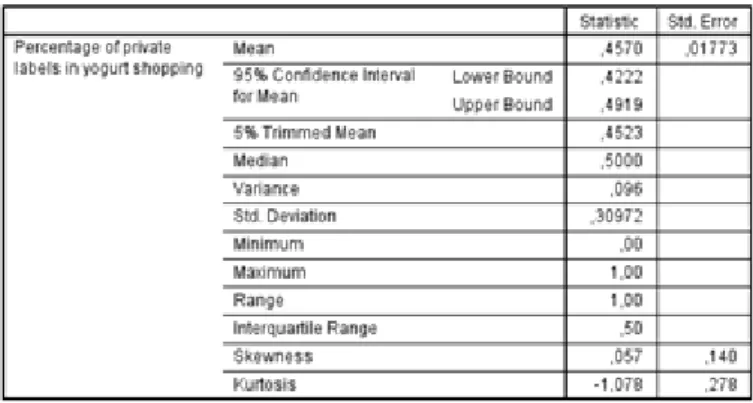
A recolha de dados para este estudo foi feita através de um questionário, dividido em quatro partes principais. A primeira parte tem questões relativas ao comportamento de compra dos inquiridos. O principal objectivo desta fase é perceber os hábitos de compra dos consumidores e com que frequência compram marcas próprias de iogurtes. A realçar desta parte a questão Q8, que nos diz que a média de marcas próprias de iogurtes compradas pelos inquiridos é de 45,7%.
A segunda e terceira partes foram as partes essenciais deste questionário, uma vez que analisam os factores individuais que podem influenciar os consumidores no momento da escolha de um produto. Na última parte do questionário encontravam-se questões demográficas e sócio-económicas, cujo o principal objectivo é criar um perfil da amostra.
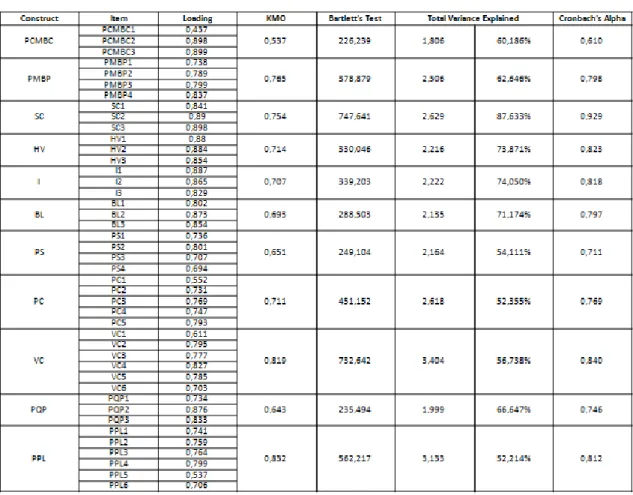
Após esta recolha de dados, recorreu-se à análise factorial exploratória e à análise de regressão para se perceber quais os factores que os inquiridos consideram mais
V
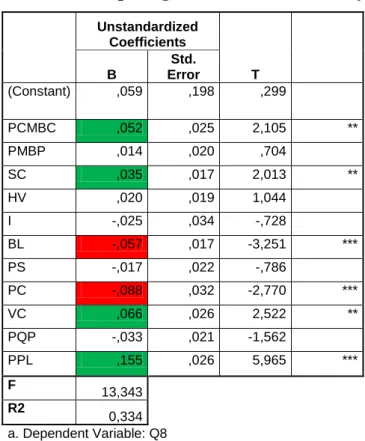
significativos para a adopção de um produto (iogurte) de marca própria. Dos resultados conclui-se que as seguintes variáveis são significativas:
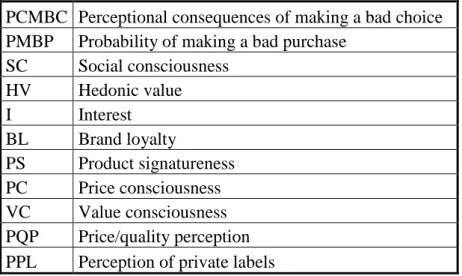
Perception of private labels (PPL) Price consciousness (PC)
Value consciousness (VC) Price/quality perception (PQP)
Perceptional consequences of making a bad choice (PCMBC) Brand loyalty (BL)
Social consciousness (SC)
As conclusões deste estudo serão úteis a todos os agentes económicos do sector dos iogurtes, bem como dos bens de grande consumo em geral. Para além disso, esta análise poderá ser uma referência para estudos futuros sobre este tema.
Keywords
Private Labels, Store Brands, Retailers, Consumers
JEL Classification System M31 - Marketing
VI
Contents
1. Introduction ... 8 1.1 Background ... 8 1.2 Goals ... 9 1.3 Methodology ... 9 1.4 Structure ... 10 2. Literature Review ... 112.1 Consumer shopping behavior – adoption of a product and product preferences ... 11
2.2 Determinants for the adoption of a product ... 13
2.2.1 Individual Factors ... 13
2.2.1.1 Price consciousness………. 13
2.2.1.2 Value consciousness……… 15
2.2.1.3 Price-quality association……… 18
2.2.1.4 Perception of private labels……….... 20
2.2.1.5 Involvement with the product category………. 22
2.2.1.6 Brand Loyalty (loyalty to national brands)……….. 26
2.2.1.7 Product signatureness………. 28
2.2.2 Demographic and Socio-economic Factors ... 29
2.2.2.1 Gender….………... 29 2.2.2.2 Age……….. 29 2.2.2.3 Occupation/Profession……… 30 2.2.2.4 Household Size……….. 31 2.2.2.5 Qualifications……….... 31 2.2.2.6 Marital Status….……….. 32
2.2.2.7 Monthly Income of the Household………. 33
3. Methodology ... 35
3.1 FMCG Sector profile in Portugal ... 35
3.2 Yoghurt sector profile in Portugal ... 35
3.3 Research objectives ... 36
3.4 Data collection methods ... 37
3.4.1 Focus group – Qualitative research ... 37
3.4.2 Questionnaire – Quantitative research ... 38
3.4.2.1 Macro-structure of the questionnaire………... 39
VII 3.4.2.3 Questionnaire distribution……….. 42 3.5 Sample design ... 43 3.6 Statistical methods ... 43 4. Analysis ... 44 4.1 Sample Description ... 44 4.1.1 Socio-demographic description ... 44
4.1.2 Shopping behavior description ... 46
4.2 Exploratory factor analysis ... 49
4.3 Regression analysis ... 52
4.3.1 Objectives of multiple regression ... 52
4.3.2 Model 1 – dependent variable measured in a scale from 1 to 5 (never to always) .... 53
4.3.3 Model 2 – dependent variable measured in percentage (%) ... 54
5. Discussion, conclusions, limitations and implications for future research ... 56
5.1 Discussion ... 56
5.2 Conclusions ... 58
5.3 Limitations and implications for future research ... 59
6. References ... 60
8
1. Introduction
1.1 Background
In recent years, there has been a big increase of academic and managerial interest in private label brands. Private labels, also called store brands, are brands developed by retailers. The motivation behind this rising interest is the increasing presence of store brands throughout the fast-moving consumer goods market (FMCG). Over the last years, sales of store brands have expanded exponentially, which enabled them to become a strong and competitive side against national brands, or brands developed by manufacturers (Ailawadi and Keller, 2004; Batra and Sinha, 2000).
Looking specifically into the Portuguese FMCG industry, we see that it has followed the pattern of the rest of the world, showing significant increase in sales volumes for private labels across the different product categories. This has happened for two main reasons. The first one is that the general consumers of FMCG have changed their opinion about store brands, looking at these products in a favorable way and buying them regularly when they’re out grocery shopping. Initially, consumers didn’t trust retailer’s brands due to the fact that they were associated with low quality, and tended to opt for manufacturer brands. But, private labels stayed on the market, allowing customers to get more knowledge on these products and trying them.
This changed the general population’s opinion, turning private label goods into a good option regarding their good price/quality ratio. This led to the second main reason for the private label success, which is the economic crisis the country is living in. With the unemployment rate at a level never seen before and tax rates registering new maximums, the Portuguese consumers had to rethink the way they were spending their wages. It was important to cut consumption costs and store brands, with their significantly lower prices than national brands, were a great option for families throughout the country.
9
1.2 Goals
Like I previously said, private labels have grown a lot over the past years and the context we live in today shows that there’s still room for them to grow even more. The main reason for their exponential growth is their price, but the truth is that there are many other factors that can influence the consumers when adopting a certain brand. So, the main goals of this thesis are:
Identify the main factors Portuguese consumers take into consideration when selecting a brand;
Identify the main differences that lead to the selection of a store brand over a national brand;
Understand the general consumer’s perception of private label goods.
1.3 Methodology
In order to successfully achieve all the proposed goals above it was necessary to review the literature on the topic. The main goal with this step was to identify and select the main dimensions that consumers take into consideration when selecting a product or brand. The idea was to look at the previous studies and research on the subject, selecting the best scales to reach this study’s objectives and to help with the construction of the questionnaire.
After this initial phase, a first version of the questionnaire was put under examination in a focus group, with participants from the target population of this study. With the insights given by the participants a final version of the questionnaire was developed, with the changes in sentence construction and the language used being the major adjustments. This stage helped me suit the questionnaire for the average person.
In order to analyze the data collected from the questionnaire, the statistical treatment was conducted using SPSS software. Like I have previously said, the main goal was to identify the most important factors consumers take into consideration when selecting private label brands.
10
1.4 Structure
The thesis is divided into four main chapters:
Literature review – Consumer’s determinants for the adoption of a product Methodology
Analysis of the collected data
Discussion of results and final conclusions
The first chapter is a literature review, divided into two main topics: consumer shopping behavior and the determinants for the adoption of a product. The second chapter is the methodology, in which is described how the research was conducted and how it was divided into different stages. The third chapter is the analysis of the data collected for the purpose of this study. This chapter is divided into three parts: sample description, exploratory factor analysis and regression analysis. The final chapter of this thesis is a discussion of the results and outcomes of this study, with the final conclusions.
11
2. Literature Review
2.1 Consumer shopping behavior – adoption of a product and product preferences
Consumer behavior is the study of the processes involved when individual or groups select, purchase, use, or dispose of products, services, ideas, or experiences to satisfy needs and desires (Solomon, 1999). Consumers are constantly confronted with the need to make decisions about products. For Solomon (1999), there are five different stages when making a typical decision (figure 1):
1) Problem recognition: Occurs when the consumer sees difference between the current state and the ideal state. In this pre-purchase phase the customer initially understands the need to act (need recognition). The way a problem is placed (framing) will affect the purchase decision, as well as the fact that the problem is or isn’t placed in terms of gains and losses. Additionally, the people use heuristics to simplify the decision making, in other words, the price is positively related to quality.
2) Information search: This is the process by which we survey the environment for appropriate data to make a reasonable decision. After understanding the problem, the consumer starts the process of searching information in internal (example: memory) and external sources (example: advertising, family, product testing).
3) Evaluation of alternatives: The consumer evaluates several alternatives to how he can get to a solution. In this stage the consumer has to evaluate and try to avoid taking risks.
4) Product choice: After looking at all the alternatives, it’s time for the consumer to form an intention to purchase. In this stage, many factors can affect the act of purchasing, such as the physical environment, the social environment, time factors and prior experiences. The environment where the purchase is made is also crucial in the moment of purchase, with factors such as store image, atmosphere, exhibitors influencing in all the process.
12
5) Outcomes: This phase corresponds to the consumer’s post-purchase behavior, which depends on the level of satisfaction with the end result. The happier a customer, the higher is the probability of making a repeat purchase. The customer’s satisfaction is determined by their overall feeling about the product after the purchase. There are various factors influencing the perception of a quality of a product, such as price, brand and product performance (Solomon, 1999). The satisfaction depends of the performance of a product meeting the consumer’s expectations.
Figure 1 – Stages in consumer decision making
The selection of a store brand over a national brand can be made in the first three stages (problem recognition, information search and evaluation of alternatives) of the decision making process. The other two stages can also be important because we’re talking about a repetitive process, where previous purchases/choices and their outcomes might influence future decision making processes.
13
2.2 Determinants for the adoption of a product
2.2.1 Individual Factors
2.2.1.1 Price consciousness
The concept of price consciousness is defined as the degree to which the consumer focuses exclusively on paying a low price (Lichtenstein et al., 1993). Therefore, price conscious consumers are concerned about searching for a low price in the marketplace, and they derive emotional value and entertainment from shopping for lower prices (Alford and Biswas, 2002).
Consumers who are price conscious verify the money they spend, compare prices of different brands in different stores before they make the final purchase and tend to buy the product with the lowest price (Ghodeswar, 2007). According to Burton et al. (1998), consumers with positive attitudes towards private labels are extremely price conscious and tend to focus almost exclusively in paying low prices, due to the wish to maximize their money, minimizing other factors when evaluating a brand.
This is, obviously, an individual characteristic that varies from consumer to consumer depending on their sensitiveness to the prices. This concept of price sensitivity is, a similar concept to the consciousness one, that can help us better understand this variable. A consumer is price sensitive, when the sales are considerably affected by the changes in price (East, 1997). This author also refers that the consumers can show different sensitivities to price. For Ailawadi et al. (2001), private label consumers are very sensitive to price in opposition to their sensitiveness to quality, and seek variety in their purchases.
Previous studies show that the level of sensitiveness to price increases, when consumers have lower incomes (Gabor and Granger, 1979; Lumpkin et al., 1986). Hoch (1996) verified that consumers with higher incomes show a lower sensibility to price and, therefore, less likely to purchase private label goods. This negative relation is confirmed by Sethuraman and Cole (1999), who said that individuals with higher levels of education and higher incomes are less sensitive to price and more willing to pay high
14
prices for branded goods. In other words, the authors verified the existence of a negative correlation between the level of qualifications and income and the amount of private labels purchased.
Another important concept related with this variable is the perception of price. In the case of private label products, because of their intrinsic lower cost characteristics, their price perception is always marked lower than the branded products by retailers such as hypermarkets and national retailing chain stores (Miranda and Josh, 2003). This constant idea leads to the phenomenon that consumers are willing to pay less for store brands than national brands (Scott Morton and Zettelmeyer, 2004). Hassan and Dilhan (2006) concluded that the consumers are willing to choose a store brand over a national brand, only if it has lower price but equal or higher quality (higher value).
According to Lichtenstein et al. (1993), the price is undoubtedly one of the most important signs from the market. Such influence is due to the fact that the price is present in all purchase situations and, at least, represents to the consumers the amount of economic resources one has to spend in order to make a transaction in the marketplace. If the price is strictly understood this way, higher prices will have a negative impact on the probability of making a purchase.
Nevertheless, some investigators consider the price to be a more complex variable and lots of consumers understand the concept of price in a more embracing way. For example, consumers who use price as a quality indicator, associating high prices with superior quality. Therefore, the higher prices will positively affect the probability of making a purchase (Lichtenstein et al., 1993; Zeithaml, 1988). However, Dick et al. (1997) refer that the consumers with a predisposition to buy store brands don’t really believe in the price/quality relation. In their opinion, the fact you’re paying higher prices doesn’t mean you’re buying a product with superior quality.
In this context, Raju et al. (1995) defends that the private labels can be more successful in product categories where the consumers are more sensitive to the price, thus, a possible explanation for the different market shares of private labels along the different product categories.
15
According Cotteril et al. (2000), price works as a marketing strategy for retailers to compete with the advertising done by the national brands. These authors saw in their study that when a national brand has more visibility on the market and the effect of publicity is effective, the store brands have lower prices. Also, when there are variations in the price of the national brand, there’s a positive effect on the sales of the store brands. With this said, we can conclude that the introduction of a store brand on the market will provoke an increase in the price of the national brand.
More recent studies confirm this idea that price can work as a competitive advantage for the store brands. For this motive, Cardoso and Alves (2008) said that consumers who are more sensitive to price will eventually choose the private label in the moment of purchase.
Throughout the literature there’s enough evidence to conclude that the higher the customer’s sensitiveness to price the higher will be his proneness to buying private labels.
2.2.1.2 Value consciousness
Value consciousness is conceptualized as reflecting a concern for price relative to quality received (Lichtenstein et al., 1993). This is a wider concept than the price consciousness as it relates quality with price. Value consciousness has been defined as the concern for paying low prices subject to some quality constraint, relating the perceived costs and the perceived benefits (Lichtenstein Ridgway and Netemeyer, 1993). In order to study this variable, it is crucial to understand the concepts of perceived quality and perceived value.
It’s through the perceived value of a product that a consumer makes his purchase decision. Kotler (1998) refers that the perceived value is the value that clients attribute to a product or service, according to the relation between the benefits they’re going to receive from it, according to the consumer’s perspective, and the perceived costs of making the purchase, in comparison with the competition. Similarly, product value is often characterized as the ratio of the perceived quality of a product divided by the price paid for that product (Zeithaml, 1988).
16
Quality is a subjective concept, in the sense that it’s directly related to the perception of each individual. Certain factors – such as culture, type of product or service, the needs and expectations – influence the different meanings each one gives to the concept of quality. Perceived quality can be defined as a process of comparison between expectations of the consumer and the performance perception of a certain product or service.
In a more specific definition, Zeithaml (1988) defines quality as the appreciation a consumer has about the global excellence or superiority of a certain product or service. The author refers that perceived quality, which is different from the objective or real quality, involves a high degree of abstraction, instead of representing a specific characteristic of a product. It’s associated with a global evaluation and refers to the appreciation, normally, made by the consumer.
In fact, the perceived quality between store brands and national brands plays a dominant role in the decision making process of consumers when purchasing a certain product or service (Sethuraman, 1992). Throughout the present literature there are many approaches relating these three concepts explained above.
Aggarwal and Cha (1998) say that when the store brands and the national brands have the same price, the perceived value of the national brand is, generally, higher and most consumers will probably purchase the national brand. This is due to the fact that the national brands are perceived as having higher quality. Dick et al. (1995) share the same idea, pointing out that consumers tend to believe that products from store brands are produced with low quality ingredients and for that motive have lower nutritional value, justifying their reluctance and uncertainty towards private labels.
Throughout their study, the researchers also verified that consumers who are prone to buying private labels give a higher value for money, than the consumers who are less prone to buying private labels. In other words, consumers who are predisposed to buying private labels are more sensitive to the price/quality ratio than the consumers who are less keen on purchasing these brands.
17
Dick et al. (1995) concluded that the customers, who are more prone to buying private labels, don’t tend to use the brand as a decisive variable. They also believe that paying high prices doesn’t mean more quality. In this case, the consumers that choose a private label use less extrinsic signals, when evaluating the quality of a product.
Many authors have shown in their literature that private labels have their own qualities and must make the most of these advantages, in order to captivate consumers. Ailawadi et al. (2001) and Burton et al. (1998) believe in the idea that the low prices from store brands can be used as an incentive to improve the image of the store’s prices and to attract consumers who are value conscious. With these two characteristics, it’s possible to verify that the price can have different implications on the perceived value of customers and, therefore, on the perception of quality.
Similarly, Garretson et al. (2002) report, from their studies, that the perceived value influences positively the purchase of private label goods. However, while the perceived value is a common trace for those who look for “price savings”, the perception of price when related with the quality of the product (price as a quality indicator) presents the opposite effect. For these consumers the low average price of private labels turns these products less attractive, associating them with inferior quality.
The promotional messages used by retailers encourage consumers to use private labels, focusing on product value as the determinant attribute, which can be explained by the fact that value conscious consumers are less loyal to national brands and are keener on changing or purchasing store brands (Garretson et al., 2002). Another way to increase their sales is working on continuously building a better quality perception for their own brands. The negative perception consumers have of the quality of store brands works as an obstacle when trying to increase sales.
We can conclude that the various articles analyzed show the existence of a positive association between the attitude towards private labels and the value consciousness.
18
2.2.1.3 Price-quality association
It’s natural for consumers to use the price as an indicator for the quality perception of certain products. Since quality is a subjective concept, consumers aren’t sure about their own quality perceptions and tend to look for signs and information to make better judgments. With this said, we can say that the price has an important role in the customer’s perception of the quality of a product.
The price of a product tends to be a suggestion of its quality always that other information, whether it’s intrinsic or extrinsic cues, on the product is missing. If there is no previous experience or information about the characteristics, the consumers evaluate the quality through extrinsic cues such as price, brand image or the company’s image (Schiffman and Kanuk, 2000).
According to Liechenstein et al. (1993) the perception of price/quality is defined as the generalized belief that the suggested level of price is positively related with the level of quality of a product in all product categories. In other words, consumers tend to associate low prices with low quality and higher prices with superior quality. This means that brands that, in a certain product category, have a lower price are seen has being of inferior quality.
Looking at the two variables defined before (price and value consciousness) and relating them with this price/quality association, Garretson et al. (2002) refers that while the value consciousness is common amongst those who are looking to save on prices, the perception of price in terms of its relation with product quality, has the opposite effect.
For these consumers the, generally, low prices of store brands causes these products to be seen as less attractive, constituting the price a sign for low quality. This will lead to a negative attitude towards private labels. Like Burton et al. (1998) says, low prices are associated with low quality, so low prices in a certain product category are seen as being of inferior quality.
Wolinsky (1987) argues a similar point of view, defending the existence of a direct and negative relation between PLBs and consumers who tend to associate low prices with
19
low quality. Hoch et al. (1996) reached a conclusion to reinforce this idea, saying that consumers perceive store brand products as low quality and inferior goods. So, the attitude towards the private labels is negatively linked with the price/quality perceptions, favoring the national brands. With this being said, the consumers with high price/quality perceptions are faithful to the national brands, which have a higher price.
This can be explained through the attribution theory (Sawyer and Dickson, 1984), which says that a low price for private label brands may be attributed to some problematic aspect of the product, which is then perceived as inferior in the overall level of quality. Also, the continuously low prices combined with the infrequent professionally developed advertising campaigns might offer more evidence for those who associate price with quality that private label brands are undesirable.
Due to all these issues, we’ve recently seen an evolution in the private label’s positioning. Retailers have been changing the positioning of their own private labels focusing more on quality rather than price, with the objective of producing better perceptions and rising consumer’s loyalty to their brands. With investments in packaging design and communication, frequently using imitation strategies from other companies, retailers are hoping to change the customers’ mindsets and creating a better price/quality balance.
This is the only strategy that store chains can adopt when relating price with quality. Since they have lower prices, there will always be the idea in customer’s minds that the product has lower quality. So, private labels must point out their own strengths focusing on the price/quality balance. This concept, like the name says, is based on the idea of balancing out the two concepts rather than using price as an indicator for quality. According to Deveny (1993) and Liesse (1993), it has been suggested that where consumers balance price and quality there’s a more favorable attitude towards private labels.
To sum up, we can expect that there will be a negative relation between the price/quality perception of consumers and the adoption of private labels.
20
2.2.1.4 Perception of private labels
The perception that a consumer has of private labels is directly related with a concept that we’ve previously discussed when looking at the value consciousness variable. The idea a customer has about a certain product or brand can be drawn from the concept of quality. Similarly, to what I’ve said before the perception of quality is a subjective concept as it is directly related to the perception of each individual. Various factors, such as culture, type of product or service, the needs and expectations, influence the idea each individual has of quality. So, it’s fundamental to understand how the consumers evaluate and make decisions.
Consumers can make evaluations using a variety of information signals that they associate to products. The current literature shows that, when assessing the quality of private labels, consumers use either intrinsic cues (Sprott and Shimp, 2004) or extrinsic cues (Bao et al., 2002). Intrinsic cues have to do with any kind of information about product ingredients, how the product is made, or any other physical characteristic of the product – such as color, taste, size and scent.
While extrinsic cues have to do with signs that exist independently of product attributes and physical components, in other words, signs which are external to the product. Extrinsic cues can be a lot of things, such as brand name, price, advertising, package design, manufacturing difficulty, identity of production companies, and quality variance of a product category (Bao et al., 2010; Del Vecchio, 2001; Richardson et al., 1994).
According to the cue utilization theory, consumers tend to rely more on extrinsic cues than intrinsic in quality evaluation of private labels (Richardson et al., 1994). This happens because, most of the time, consumers are not equipped with the tools and knowledge to assess quality using intrinsic cues, such as the ingredient quality of a certain product. In most cases this evaluation can only be done by manufacturers, institutions, companies or specialists who have the necessary skills and equipment (Dick et al., 1997).
So, in the case of not having any previous experience with the product, or information on its characteristics, the consumer evaluates the quality of a product through extrinsic
21
signals, which are easily interpreted, evaluated and assessed, in making quality judgments. Following this idea, quality can be evaluated through the image it transmits to consumers. The idea that national brands have better quality than store brands, is very present in customer’s minds, and is very influenced by publicity and advertising that can help highlight this characteristic. For this motive, consumers feel more confident when choosing branded goods.
For Richardson et al. (1994), consumers don’t choose private labels in situations where there’s a high tendency to be guided by extrinsic cues in product evaluations. In this type of case, the correlation between quality and the acquisition of store brands will be negative.
According to various studies, the consumers have some doubts about buying private labels, when these are associated with low quality. Cunningham et al. (1982) and Richardson et al. (1994) believe private labels are, usually, perceived as being of inferior quality than national brands. Dick et al. (1995) shares the same idea, pointing out that these consumers tend to believe that products from store brands are produced with low quality ingredients and for that motive have lower nutritional value, justifying their reluctance and uncertainty towards private labels.
These quality flaws between both types of brand are, according to Hoch and Banerji (1993), dependent of the technology exigencies in the production of certain products, throughout the different categories. The authors verify that PLBs have a better performance in categories where the quality of the product is high and the variability is low.
In a more recent study, Cardoso and Alves (2008) refer that private label goods are, generally, well accepted by most inquired customers and that quality is one of the determinant factors when making a purchase decision. They also concluded that consumers tend to understand this quality in store brands, when they buy and consume them frequently, eventually understanding that there are no big differences between store brands and national brands.
22
Like I’ve said before, these aren’t the only variables consumers use when making a purchase decision. Analyzing customer’s decisions is far beyond this basic evaluation they make of a certain product. Besides focusing on the effects of different cues on consumer perception of private labels, it’s crucial to pay attention to the interaction between cues and consumer characteristics.
2.2.1.5 Involvement with the product category
The personal involvement with a product is defined by Zaichkowsky (1985) as the perceived relevance the individual gives to the object based on his interests, needs and values. Different individuals don’t have to necessarily show the same level of involvement with a product.
The process of making a purchase decision is, significantly, influenced by the degree of the consumer’s involvement with the product category. The theory about involvement refers that, depending on the level of involvement, the intensity of the search for information, the evaluation of alternatives, the decision to make the purchase and the post-purchase behavior will be different. So, the higher the involvement of the consumer, the more information he will search for and the various alternatives available will be compared before making the purchase decision.
Zaichkowsky (1985), Kapferer and Thoening (1991), Richardson (1997) and Baltas and Doyle (1998) suggest that the personal involvement with the product can help explain some of the reasons why customers buy private labels and, also, why they only do it in some product categories.
The theory suggests that private labels are better accepted by consumers in products that are considered to be of low involvement. With the concept of low involvement we’re talking about products with low monetary value, with weak differentiation when compared with the other available alternatives, subject of little innovation and are generally purchased with frequency. So, consumers perceive their purchase as being low risk (Howard, 1993; Dick et al., 1995).
23
The consumers will show a smaller propensity to purchase private labels in products that are considered to be high involvement. To sum up, this theory refers to the existence of a negative relation between the level of personal involvement with the product and the consumer’s propensity to purchase store brands.
It is also fundamental to relate the product category involvement with the risks that each product category carries. Many researchers consider that the variables related with the product category involvement, concern the determinants of the degree of risk perceived by consumers in a particular product category. For a long time researchers have stated the importance of perceived risk in a product category as a fundamental factor in PLB purchases (Richardson, Jain and Dick, 1996).
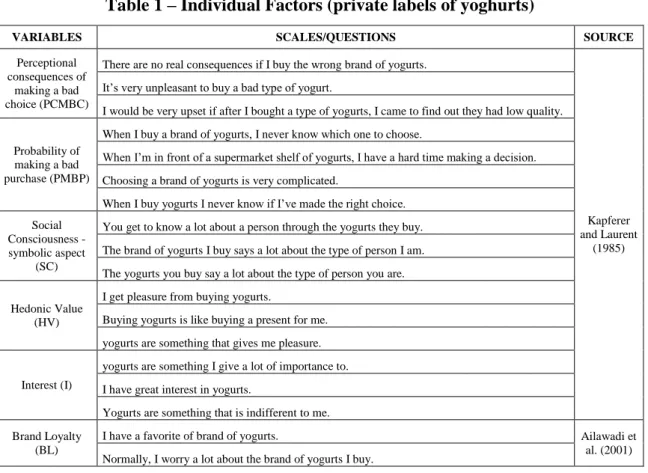
In order to measure this variable, I’ve selected five sub-variables:
Perceptional consequences of making a bad mistake
Laurent and Kapferer give their insight on this variable in their literature on “product category involvement. Other studies on the “degree of inconvenience of making a mistake” state similar conclusions (Narasimhan and Wilconx, 1998; Dunn, Murphy and Skelly, 1986). The consequences of making a bad choice are directly linked with the consumer’s perception of risk and the importance they give to a certain product category.
The purchases of certain product categories such as baby foods should be seen as more risky than the purchase of others, such as most toiletries and groceries. The consequences of making a mistake in baby food products are far more severe. This means that the consumer’s course of action is premeditated and our evaluations will influence the final outcome of the purchase decision.
In addition, purchases that expose the consumer to social ridicule, such as reference or peer groups, can also be seen has high risk even if they are low monetary value (certain types of clothing, or publicly consumed beverages). Livesey and Lennon (1978) argue that social risk inhibits the selection of private label brands. For example, they found
24
that the typical English consumer serves national branded tea to their guests, while consuming less expensive store brand tea themselves.
Probability of making a bad choice
The other half of the “consequences of making a mistake” notion deals not with the actual consequences of making the mistake, but rather with the probability of doing it. The expected value of any decision is the product of its consequences times its likelihood (Dunn, Murphy and Skelly, 1986). This suggests that it’s important to understand the degree of variability of the quality in a certain category. This is different from the perceived PLB quality level, as it is the variability that should create greater uncertainty and doubt and create more perceived risk.
Narasimhan and Wilcox (1998) have argued that the degree of perceived risk increases with the degree of perceived quality variation across brands in that category. Hoch and Banerji (1993) support this theory, as they found that store brands have a lower share in categories where the quality variability between products is high.
For Richardson, Jain and Dick (1996), the perceived quality variation leads to a reduced perceived value-for-money of private labels both directly and via perceived risk. This eventually led to reduced private label brand proneness.
Symbolic aspect (social consciousness)
The symbolic aspect of the brand is the associations that the consumer makes of the brand, or with a certain social status, personal tastes, lifestyle, etc. One of the first authors to talk on this topic was Levy (1959), he believed that the consumer isn’t only influenced by the functional attributes of the product. His behavior is, clearly, affected by symbols that identify the products, which are then associated to personal and social meanings, along with functional attributes. This way, the consumers purchase their products not only for their function, but also for what they represent.
According to Aaker (1992), the associations to a brand correspond to something that creates a link between consumer and brand. These can be situations of use of the
25
product, a combination of characteristics or attributes of the product or even the sensations a product or a brand can provoke on the consumer. In the case of the store brands this rarely happens, since these brands have few or no type of publicity that can incite the customer. This way, the adoption of private labels tends to be low.
Hedonic value
To a product we associate with a utility value or a hedonic value, taking into account the strategic objectives of the brand. Chitturi et al. (2008), as well as other authors, use the term “hedonic benefit” when referring to the aesthetic side of the product, the practical part and the emotional potential it transmits. Ailawadi et al. (2001) refers that this variable is linked with the intangible, experiential and affective attributes.
According to Richins (1994), while some products are consumed for their utility (utility benefits), others are consumed for their capacity to give pleasure (hedonic benefits). With this consumers can attribute high risk to the performance of private labels, in hedonic product categories because they fear that these brands might not give the emotional benefits they desire.
As a result, consumers can pay a higher price for national brands in categories that give high quantities of pleasure when consumed. In this sense, the national brands can maintain their price-premium strategy in categories where the products are purchased with hedonistic purposes and can try to increase the hedonistic value of their brands through emotional communication/advertising.
Consumers use the brand to satisfy their emotional needs and publicity helps to highlight the benefits that the product can bring, rather than its characteristics. However, it’s easier to show the pleasure of consumption in some products, like cookies, than other products that are strictly functional, like toilet paper or detergents (Sethuraman and Cole, 1999).
There are various characteristics of the shopping behavior that can help the understanding of the purchase decisions of private labels. Ailawadi et al. (2001) identifies these characteristics as “hedonic benefits”: the pleasure of buying; innovation;
26
the search for variety; impulsivity; the high involvement and knowledge; and the motivation to resign.
Interest
The literature on this interest variable is similar to what was previously said for the hedonic value. People don’t only buy products for their utility benefits. There are other characteristics that are taken into consideration when making a purchase decision. The interest in a certain product or category can attribute high risk to the performance of private labels, as consumers pay more attention to details and have more knowledge on the topic.
As a result, consumers are willing to pay higher prices for national brands in these categories. This happens because consumers give a lot of importance to these products and want to have their expectations met.
2.2.1.6 Brand Loyalty (loyalty to national brands)
Loyalty to a brand is the intrinsic commitment to make repeated purchases of a certain brand (Peter and Olson, 2002). In other words, brand loyalty is the degree to which a client has a positive attitude towards a brand, showing commitment and that he wants to continue buying it in the future. It’s a bond created between consumer and brand, which is translated in the repeat purchase of the product, throughout a certain period of time.
It is possible to classify consumers in three distinct categories according to their level of loyalty and commitment to brands. Some consumers are totally to a brand, in other words, they always buy the same brand. Other consumers show loyalty to two or three brands in the same product category. The last type of customer is those who don’t show loyalty to any brand. According to Kotler and Armstrong (2001), this last group of individuals always wants something different each time they make a purchase or purchase a brand that’s on sale.
Most studies narrow the classification of consumers according to brand loyalty into two, loyal and not loyal, considering the intermediate category in the segment for loyal
27
customers. Brand loyal consumers display a stronger tendency to purchase the same brands they have always bought and, compared to those who are more likely to seek variety, are less likely to switch to new and unfamiliar brands. In other words, consumers who define themselves as loyal to a specific brand are less keen on choosing a different brand, than the one they are familiarized with.
According to Garretson et al. (2002), consumers who are loyal to brands present a strong tendency to buy the same brands they’ve always bought and, so, it’s less likely they will make a change to a new or unknown brand. Burton et al. (198) also verified that the attitude towards private labels is negatively related to the consumer’s propensity to being loyal to a brand in the different product categories.
In the same direction goes Ailawadi et al. (2001), who refer that customers who are loyal to national brands show a smaller tendency to adopt store brands, since the costs of changing are very high. However, in their study this variable didn’t show great significance in the explanation of the consumer’s consumption of private labels.
In the case of consumers who aren’t loyal to a certain brand, it’s relevant to say that Burger and Schott (1972) believe that buyers of store brands are not loyal to manufacturer brands. While Baltas (1997) defends that a buyer of private labels is a “switcher” by nature and isn’t a loyal customer of a specific brand. This concept of “brand switcher” is based on the idea that some consumers are more likely to change brand due to the fact that they seek variety.
The customers looking for variety, according to Kotler and Armstrong (2001), always want something different each time they make a purchase, frequently going for the brands that have products on sale. This is an opportunity for store brands because, with less loyalty to national brands, consumers tend to opt for store brands.
This desire of seeking variety and looking for new options comes, generally, from the rising concern consumers have with the transactional utility associated with product purchases rather than with the benefits associated with the repetitive purchase of any particular brand. For Cardoso and Alves (2008), consumers are starting to understand
28
more and more about the qualities of private labels, although, they remain faithful to some of the national brands.
To sum up, according to the authors the consumer’s position towards private labels is negatively related with the consumer’s loyalty to brands throughout the different product categories.
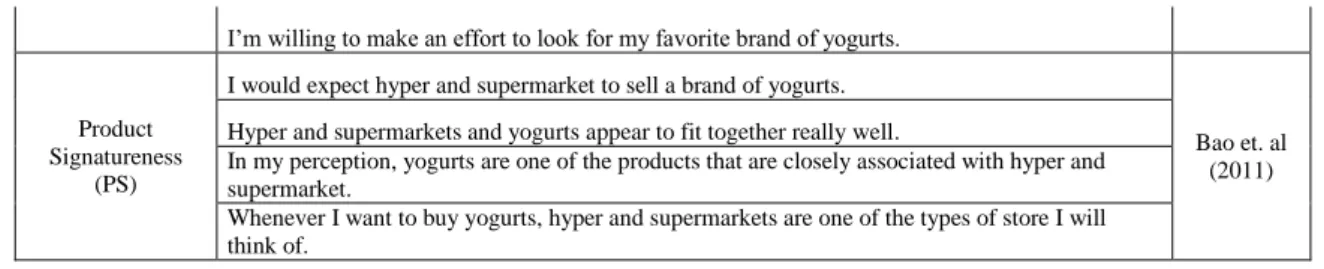
2.2.1.7 Product signatureness
The concept of product signatureness refers to the degree to which a product category is associated with a store in consumers’ minds (Bao et al., 2010; Inman et al., 2004). For example, an over-the- counter analgesic is more a signature product for a retail pharmacy than a consumer staple like milk. This is an external cue commonly associated to another variable, the store image, which is also frequently used in studies on consumer’s quality evaluation of private labels.
While the signatureness refers to a product category, the store image defines the global impression of a retail store. But, it’s important to keep them close together as they can be related. If a store has a low image, the difference between the high and low signatureness level of the different product categories is enlarged. Conversly, if the store image increases, the effect of product signatureness on perceived quality of private labels shrinks.
One of the main ideas behind the selection of this variable is the fact that this is one of the only extrinsic cues that isn’t limited by the marketing functions. Most of these external cues are either not specific to a retailer, or susceptible to change, or harmful to the competitive advantages of private labels. For example, the cues of manufacturing difficulty and quality variance of a product category are independent of store characteristics.
In addition, except for brand name, the marketing mix cues (i.e. price, advertising, and package design) can be easily changed. The non-specificity of a cue makes it difficult to differentiate private labels, while the versatile nature of a cue may generate unstable quality perception and render the signal less diagnostic (Purohit and Srivastava, 2001).
29
The product signatureness cue, like the store image, overcomes these limitations, because it’s not specific to a store or a retail channel, remains stable over time, and isn’t directly built on the marketing mix. Therefore, facilitating market differentiation of private labels, producing a stable diagnostic signal, and serve to maintain the competitiveness of private labels.
There’s another reason that was important for the selection of this variable. In real decision environment, multiple cues interact to influence consumer brand evaluation (Purohit and Srivastava, 2001). According to Purohit and Srivastava’s (2001) product signatureness can be classified as an intransient cue. These types of cue contrast with the transient cues, because they’re more diagnostic of product quality and diagnostic cues are more likely to be used in evaluation of product quality (Purohit and Srivastava, 2001; Dick et al., 1990).
The fact that a signature product epitomizes a retailer’s service and expertise is representative of the product quality associated with the store and the general store image. Thus, when a private label is introduced into a signature category of a store, it should receive a high quality perception from consumers (Bao et al., 2010).
2.2.2 Demographic and Socio-economic Factors
2.2.2.1 Gender
There have been previous studies where some conclusions were drawn about this variable. For example, Ailawadi (2001) and Omar (1996) concluded that women are more prone than men to purchase store brands when selecting their shopping items. However, Burton et al. (1998) believes that the gender effect has no significant impact on the process of purchasing store brands.
2.2.2.2 Age
According to Cole and Balsubramanian (1993), the loyalty to a brand increases as the customers age also increases. With this said, the younger customers are more keen on
30
opting for private labels, due to the fact that their preferences are still not totally defined.
On the other hand, Szymanski and Busch (1998) verified with their studies that age has a small and negative influence in the customers’ propensity to purchase store brands. Burton (1998) shares the same opinion; he believes that the attitude towards private labels isn’t significantly influenced by the age variable.
Dick et al. (1995) and Omar (1996) have shown that older consumers tend to avoid private labels, while the younger individuals tend to frequently buy these brands. Omar (1996) also says that older individuals (45 years old or higher) tend to be more loyal to national brands.
An opposite conclusion was made by Richardson et al. (1996). This author refers that the older the age of the consumer, the higher is the probability of him purchasing store brands. In this sense, consumers with a higher age can use their shopping experience to evaluate the brands and consider store brands as a good alternative to national brands, in different product categories.
Sethuraman and Cole (1999) argue that the younger consumers are more image-oriented and are less familiarized with the private labels, than older consumers. So, younger customers might be more available to pay higher prices for national brands.
2.2.2.3 Occupation/Profession
The professional life of the consumers can, also, have some impact on the adoption of private labels. However, the study of this variable hasn’t been developed. The search for conclusions on this variable lead us to Omar’s study (1996), where he believes that consumers of national brands have a professional activity that requires high academic qualifications, while consumers of store brands exercise professional activities that require less education. For Myers (1967), housewives are more susceptible to choose to buy private labels, than other women with a professional activity.
31
2.2.2.4 Household Size
The size of the household is one of the demographic variables that has been most associated with the consumption of private label goods. Most studies come to the understanding that there is a positive relation between this variable and the adoption of store brands.
Frank and Boyd (1965) believe there’s a positive association between family size and the use of private label products. More recently, in the studies of Dick et al. (1995), the household size has showed to be an important variable in the determination of the brands consumed in the household. According to the authors, families with 5 or more people have a higher chance of purchasing private labels, while families with a smaller dimension tend to purchase branded products. Omar (1996) refers that the typical customer of store brands lives with at least one or two children.
Richardson et al. (1996) also found a positive relation between family size and the proneness to buying store brands. Their results concluded that bigger families have a higher propensity to opt for private labels, since these brands have lower prices and in these conditions the financial resources have to be divided by more people. Hoch (1996) shares the same opinion, referring that families with more people are more sensitive to price and more prone to buying private labels.
2.2.2.5 Qualifications
The degree of qualifications of the customers is another of the variables very associated with the purchase of private labels. However, the studies done on this matter have presented different conclusions over time. According to Omar (1996), the buyer of store brands has a lower level of education than the usual customer of national brands.
For Richardson et al. (1996) the results weren’t conclusive. The authors refer that the relation between the level of education and the propensity to adopting private labels isn’t obvious. On one hand, the authors believe that the higher the level of instruction of the individuals the higher their income is, so they will have more freedom to make their
32
choices since there is less of a financial restriction. It’s expected there will be a negative relation between these two variables.
On the other hand, the same authors believe that the individuals with higher qualifications have more ability than the less instructed individuals to evaluate the differences between store brands and national brands. In this case, it’s expected there will be a positive relation between the two variables.
Other investigators have a more clear idea and believe that there’s a positive relation between the degree of qualifications and the adoption of private labels. Hoch (1996) concludes that there is a significant percentage of private label purchases being made by highly educated individuals. These consumers are, generally, less influenced by price and are better informed about product information and the quality associated with store brands.
Dawar and Parker (1994) refer that consumers with higher qualifications tend to use less external cues, such as the brands, in their purchase decisions. For Burton et al. (1998) these individuals have a positive attitude towards store brands and tend to buy a higher percentage of these products.
To conclude we can say that, although the results aren’t conclusive, there’s a bigger number of investigators tending to the idea that there is a positive relation between the level of education and the predisposition to purchasing store brands.
2.2.2.6 Marital Status
There hasn’t been a lot of investigation and studying on the influence of this demographic variable on the decision to purchase private labels. According to Dick et al. (1995), the social status variable has some influence in this decision. The author states that the married consumers are more prone to opt for store brands than single, divorced or widowers.
33
2.2.2.7 Monthly Income of the Household
The selection of a product is influenced by the economic situation of the customers, in other words, the available income, wealth and the access to credit. For example, in a situation of economic recession, the available income decreases making the consumers more price sensitive and tend to choose cheaper products. But the main conclusion, according to most of the present literature, is that there’s a negative relation between the income of the household and the selection of store brands.
Frank and Boyd (1965) refer that the adoption of a private label is negatively related with the income of a person. More recently, Richardson et al. (1996) and Burton et al. (1998) came to similar conclusions. For Richardson et al. (1996) wealthier families have a smaller tendency to buy private labels, while Burton et al. (1998) refer that individuals with higher income have a less positive attitude towards the private labels.
Dick et al. (1995) found a curvilinear relation between the two variables. Families with incomes lower than $15.000 or higher than $49.000 are less prone to buying store brands than families with middle class incomes. In the case of the households with higher incomes, there’s no doubt that they have the resources to make their own choices and buying national brands, which are usually more expensive. In the case of the consumers who have less economic resources their aversion to store brands can be, according to Dick et al. (1995), the limited knowledge they have in terms of brand choice.
For Hoch and Banerji (1993), the market share of private labels is made of cycles. In times of economic recession, when the income of families decreases, the sales of store brands increase, decreasing the sales of national brands. In periods of economic expansion the opposite occurs, in other words, the sales of national brands increase and the sales of store brands decrease. Cotterill et al. (2000) share a similar perspective, concluding that there’s a negative relation between the income and the market share of store brands and a positive relation between the income and the share of market of the national brands.
34
Another author, Hoch (1996), also agrees with the idea that the two variables are negatively related. He believes in this relation due to the fact that higher incomes allow a smaller financial restriction and a lower sensitivity to price, giving the consumer a bigger freedom to select more expensive products (Ailawadi et al., 2001). With this said, Hoch (1996) agrees to the possibility that purchasing private label products will also decrease.
35
3. Methodology
3.1 FMCG Sector profile in Portugal
Over the last few years, private labels have gained a lot of importance in the Portuguese FMCG market. Every year we see national brands struggling to keep their market shares, and increasing their battle with the very competitive store brands. The general public has changed their mindset, turning their opinion towards private labels around. Currently, the general consumer of FMCG has a favorable opinion towards private labels and has started to include these brands in their household shopping.
Initially consumers feared the low quality associated with the low prices practiced by store brands, and opted to stick with what they know favoring national brands. But, as time went by private labels stayed in the market and consumers were able to get more information and experience these products. With that they were able to realize that these products constitute a good opportunity, due to the fact that they present a very good balance between price and quality. Since then, these products have registered a growth in sales volume and have become a competitive element for the other brands.
In Portugal, private labels have been increasing their market share, reaching market shares of over 40% in some product categories (ACNielsen, 2010). However, there are other product categories where the share is less than 5% (ACNielsen, 2010). In fact, the market share of the private labels varies a lot throughout the different product categories.
3.2 Yoghurt sector profile in Portugal
Due to the fact I mentioned before, I chose to focus on a specific sector, the yoghurt sector. This is a sector that, in Portugal, is known for having very strong private labels. Looking at the market in general, not focusing on the specific types of yoghurt, we can see that according to ACNielsen (2010) store brands represent 40% of the market in value and 48% in volume. While the top 3 national brands (Nestlé, Danone and Lactogal) together represent 54% of the market in value and 45% in volume. These
36
numbers show how much importance private labels have in this market and how comfortable consumers are buying them.
3.3 Research objectives
This study focuses on analyzing the determinants that lead to the choice of private labels, in other words, the study of the factors that have led the way for private labels to grow exponentially and solidify their position on the FMCG market, over the last few years. The importance of understanding the way the market works and the motives behind the decision to purchase store brands, implies knowing the consumers and the variables that interfere with their shopping habits.
With this said, it’s important to analyze the impact store brands have on consumers today, focusing on the consumer’s perception of the product they buy, their shopping behavior and other socio-demographic aspects. Following this idea the research focuses on understanding the consumer’s perceptions and attitudes towards private labels. This means analyzing the degree of relation between each of the determinants and the consumer behavior, and trying to understand the differences between choosing a store brand or a national brand.
For the purpose of this study I chose to focus on a specific product category, due to the fact that there are big variations throughout the different product categories in the FMCG industry. I opted for the yoghurt industry because it’s one of the industries where the store brands have most succeeded. The main reason behind the selection of this category, where the private labels play a dominant role, is the idea of having an industry that can be representative of this massive growth store brands have had a throughout the FMCG market.
Based on the literature review, a research hypotheses model was defined, as shown in figure 2. The first column of the bigger box shows the independent variables defined for the purpose of this study, and the second column of this box shows the type of relation the independent variables have with the dependent variable (i.e., the expected sign for the relationship). The smaller box represents the dependent variable, selection of private label brands, which is defined by questions Q7 and Q8.
37
Figure 2 – Research Hypotheses Model
3.4 Data collection methods
The present study combines both qualitative and quantitative data collection methods.
3.4.1 Focus group – Qualitative research
In the qualitative stage of the search, a focus group was conducted. A focus group is an interview conducted in a non structured and natural manner with a small group of respondents, where the moderator leads the discussion. The main purpose of a focus group is to gain insight by listening to a group of people from the appropriate target market talk about issues of interest to the researcher (Malhotra, 2007).
Before distributing the questionnaire it was essential to get some insight from other people, in order to see if anything was wrong with the final version of the questionnaire. This was an important stage in the preparation of the surveys because it allowed me to get an outside opinion of what I had been preparing. With this I was able to understand what could be improved and changed, if the linguistic used was easy to comprehend and if the questions made sense to someone who was reading the questionnaire for the first time.
In order to have a focus group that could be representative of the target population, I chose to have a total of 9 people, with at least one person per age group (according to what had been defined in the questionnaire): 18 – 25; 26 – 35; 36 – 50; 50 – 64; >= 65.