Computational Trust Model
Maria Joana Malaquias Pires Urbano
Faculty of Engineering, University of Porto
Department of Informatics Engineering
Computational Trust Model
Maria Joana Malaquias Pires Urbano
Supervisor: Professor Doutor Eugénio da Costa Oliveira
Co-Supervisor: Prof. Doutora Ana Paula Rocha
Thesis submitted in partial fulfillment of the requirements for the Doctoral degree in Informatics Engineering.
This work was supported by Fundação para a Ciência e a Tecnologia (FCT) through grant FCT SFRH/BD/39070/2007
Life is made of decisions and deciding to leave my home town and start my PhD at the University of Porto was a wise one. Now it is the time to thank all people that helped to make this a fruitful and pleasant journey. First of all, I would like to thank my supervisors Professor Eugénio Oliveira and Professor Ana Paula Rocha for all the support I have received, for all insightful discussions and guidance; Henrique Lopes Cardoso, with who it was a pleasure to work with, and also, an inspiration; all team of the ANTE project and the people at our Lab room, António Castro, António Pereira and Pedro Brandão, with whom I had the pleasure to share lots of meals and good time, but also Célia, Gustavo, Leonardo, Luís, Sérgio, Jorge, Luís Paulo and Rosaldo. A special thanks to my cousins Filipa and Diana, who have also made me feel at home since the first moment.
However, I cannot forget my Coimbra’s team: my parents, for their continuous and precious support since ever. My siblings and siblings-in-law, my dearest nieces, and all close family. Many thanks to the Direction of ISMT for their institutional support, and to all friends at ISMT, with a special thanks to Sofia. And a word of gratitude to my closest friends, with a special thanks to Jorge and Nuno for always being present. Finally, I would like to thank Gonçalo for (his sometimes nagging way of) encouraging me to do better each day.
The work presented in this document was supported by Fundação para a Ciência e a Tecnologia (FCT), under project PTDC/EIA-EIA/104420/2008 and PhD grant SFRH/BD/39070/2007.
Computational trust modeling is a research field with a fast growing de-velopment since the last decade, mainly in the scientific area of distributed artificial intelligence and multi-agent systems, and its potential applicability spreads from social networks to distributed resource sharing and electronic markets. The earliest approaches to computational trust addressed the de-velopment of algorithms to aggregate the evidence on any given agent under evaluation into an estimated score of this agent’s trustworthiness. More recently, the research on computational trust has shifted to the inclusion of third-party information about the trustee under evaluation, including opinions and reputation. However, one important aspect of computational trust has being neglected all these years by the majority of the scholars on computational trust, with a few relevant exceptions: trust is a social con-struct with a cognitive and an emotional account, and it strongly depends on the relationship existing between the agent that trusts and the one that is trusted.
In this thesis, we address the topic of social trust and its consideration for application in computational trust. We first present a thorough multi-disciplinary view of trust, and derive important propositions that will guide our work throughout the thesis. Based on these propositions, we present the SOLUM model, our proposal to computational trust comprised of two dis-tinct parts. The first part is a general framework of computational trust that is based on two fundamental characteristics of trust: trust is more than trust-worthiness and other important antecedents to trust, such as the truster’s disposition and emotional state, must be considered when estimation the truster’s trust; and trustworthiness is a multi-dimensional construct that includes the ability, integrity, and benevolence dimensions. This framework can be instantiated and applied to a wide range of trust-based problems and applications, and is seen here as the first main contribution of this thesis.
The second part of the SOLUM model includes a set of distinct com-putational components that (partially) instantiate the framework, namely:
mensions of the agents’ trustworthiness from the set of structured evidence available on these agents, which may be scarce. This constitutes an innova-tive view over computational trust, and is the second main contribution of this thesis.
We evaluated our approach through experimental simulation. The re-sults of our experiments allowed us to conclude that it is possible to improve in a relevant way the reliability of the trustworthiness estimations – for the same set of evidence – using the proposed techniques. Consequently, our ap-proach contributes for more informative and secure decisions, in all domains where computer-based trust decisions are needed.
A investigação em confiança computacional tem sofrido um rápido desen-volvimento ao longo da última década, principalmente nas áreas da inteligên-cia artifical distribuída e dos sistemas multi-agente.
As primeiras abordagens à confiança computacional focaram-se no de-senvolvimento de algoritmos capazes de agregar o conjunto de evidências existentes acerca de um determinado agente em avaliação de forma a cal-cular um valor estimado para a confiabilidade desse agente. Mais recen-temente, a investigação nesta área evoluiu para a agregação de evidências utilizando informação de confiança obtida a terceiros, a partir, por exemplo, de opiniões e reputação. Pese embora todos estes avanços, há um aspecto ligado à confiança computacional que tem sido negligenciado pela maior parte dos académicos nesta área, com uma ou duas relevantes excepções: a confiança é um conceito social de construção cognitiva e social, que é forte-mente dependente da relação existente entre o agente que confia e aquele que é objecto de confiança.
Nesta tese, nós endereçamos a confiança como conceito social e a forma como este conceito pode ser transportado para o domínio da confiança com-putacional. Assim, começamos por apresentar uma visão abrangente e multi-disciplinar do conceito de confiança, visão esta que é depois capturada num conjunto de proposições que irão conduzir o nosso trabalho ao longo da tese. Tendo como base estas proposições, apresentamos o modelo SOLUM, que constitui a nossa proposta para um modelo de confiança computacional, e que é constituído por duas partes distintas.
A primeira parte é uma plataforma genérica para a confiança computa-cional, baseada em duas características chave da confiança: confiar é algo mais do que a previsão da confiabilidade do agente avaliado, pelo que avaliar a confiança de um agente noutro agente implica também, por exemplo, esti-mar a prepensão para confiar e o estado mental daquele que confia; da mesma forma, a confiabilidade do agente avaliado deve ser medida tendo em conta a competência desse agente na tarefa em causa, assim como a sua
integri-problemas e aplicações que envolvam, de alguma forma, decisões baseadas em confiança, constituindo, deste modo, um dos contributos mais impor-tantes desta tese.
A segunda parte do modelo SOLUM engloba um conjunto de compo-nentes computacionais que instanciam, ainda que de forma parcial, a nossa plataforma. Estes componentes chamam-se Sinalpha, Contextual Fitness,
Social Tuner e Integrity Tuner. No contexto do desenvolvimento destes componentes, propomos o uso de técnias específicas capazes de extrair in-formação sobre a competência, a integridade e a benevolência do agente avaliado a partir da informação existente acerca desse agente, que normal-mente existe em pouca quantidade e encontra-se representada de forma es-truturada. Esta é uma parte bastante inovadora da nossa tese, e constitui o segundo contributo importante da tese.
A nossa abordagem à confiança computacional foi avaliada por avaliação experimental. Os resultados das experiências efectuadas permitiu-nos con-cluir que é possível melhorar, de forma relevante, a fiabilidade do cálculo da confiabilidade dos agentes, para um mesmo conjunto de evidências, usando as técnicas que propomos. Consequentemente, o nosso trabalho aqui exposto dá um contributo importante para a tomada de decisões mais informadas e seguras em todos aqueles domínios onde são necessárias decisões baseadas em confiança.
Abstract vii Resumo ix 1 Introduction 1 1.1 Contextualization . . . 3 1.2 Research Methodology . . . 4 1.2.1 Research Questions . . . 5
1.2.2 Research Process and Methods . . . 8
1.3 Contributions . . . 9
1.4 Thesis Structure . . . 12
2 A Global View of Social Trust 13 2.1 Introduction . . . 15
2.2 The Nature of Trust . . . 18
2.2.1 The Situationality of Trust . . . 18
2.2.2 The Cognitive, Emotional and Behavioral Accounts of Trust . . . 19
2.2.3 The Degree of Trust . . . 20
2.3 Trust and Its Antecedents . . . 20
2.3.1 Trustworthiness . . . 21
2.3.2 Propensity to Trust . . . 30
2.3.3 Physical and Cultural Characteristics of the Trustee . 32 2.3.4 Emotional State of the Truster . . . 34
2.3.5 Reputation . . . 35
2.3.6 Integrative Models of Trust . . . 36
2.4 Sources of Trust . . . 40
2.4.1 Information Sources . . . 40
2.4.2 Credibility and Relevance . . . 42
2.5.2 Ongoing Relationships and Reciprocity . . . 45
2.5.3 Evolution of Trust – Asymmetry and Perseverance . . 47
2.5.4 Betrayal . . . 48
2.5.5 Promoting Trust . . . 51
2.5.6 Promoting the Trustworthiness of Trustees . . . 51
2.6 Trust and Social Control . . . 52
2.6.1 Trust in Normative and Contract Systems . . . 53
2.6.2 Trust and Opportunism in Business Relationships . . 55
2.7 Concluding Remarks . . . 56
3 Computational Trust 59 3.1 Introduction . . . 59
3.2 Computational Trust Models . . . 60
3.3 Simple Trustworthiness Estimators . . . 61
3.4 Models that Incorporate Trust Dynamics . . . 66
3.5 Situation-aware Trust Models . . . 71
3.6 Social-based Models of Trust . . . 77
3.7 Computational Reputation Models . . . 82
3.8 Concluding Remarks . . . 83
4 SOLUM – Situation-aware Social Computational Trust Model 87 4.1 Introduction . . . 87
4.2 Basic Notation . . . 90
4.2.1 Context of Agreements . . . 91
4.2.2 Outcome of Agreements . . . 93
4.2.3 Application of Our Contextual Representation . . . . 94
4.2.4 Current Situation and Past Evidence . . . 96
4.3 The SOLUM Framework . . . 97
4.3.1 The Ability Evaluation Function . . . 100
4.3.2 The Integrity Evaluation Function . . . 101
4.3.3 The Benevolence Evaluation Function . . . 102
4.3.4 The Trustworthiness Evaluation Function . . . 102
4.3.5 The Trust Evaluation Function . . . 103
4.4 The Sinalpha Component . . . 103
4.4.1 Final Remarks About Sinalpha . . . 106
4.5 The Contextual Fitness Component . . . 108
4.5.1 Application of Contextual Fitness . . . 110
4.6.2 Coefficient of Promises Fulfilled . . . 113
4.6.3 Estimating the Trustee’s Integrity . . . 114
4.6.4 Final Remarks about Integrity Tuner . . . 114
4.7 The Social Tuner Component . . . 115
4.7.1 Coefficient of Benevolent Actions . . . 115
4.7.2 Estimating the trustee’s Benevolence . . . 117
4.7.3 Final Remarks about Social Tuner . . . 118
4.8 Combining Ability, Integrity and Benevolence . . . 118
4.8.1 Function T wx,y – Alternative One . . . 120
4.8.2 Function T wx,y – Alternative Two . . . 121
4.9 Calculating Trust . . . 123
4.10 Concluding Remarks . . . 123
5 Evaluation of the SOLUM Model 127 5.1 Introduction . . . 127
5.1.1 Generic Selection Process . . . 128
5.1.2 Methodology . . . 130
5.2 Evaluation of Sinalpha . . . 130
5.2.1 First Set of Experiments . . . 131
5.2.2 Second Set of Experiments . . . 131
5.3 Evaluation of Contextual Fitness . . . 132
5.3.1 First Set of Experiments . . . 134
5.3.2 Second Set of Experiments . . . 138
5.3.3 Third Set of Experiments . . . 146
5.4 Model of Agents’ Behavior . . . 148
5.4.1 Motivation . . . 149
5.4.2 The Model . . . 151
5.5 Evaluation of Integrity Tuner . . . 155
5.5.1 First Set of Experiments . . . 156
5.5.2 Second Set of Experiments . . . 160
5.5.3 Third Set of Experiments . . . 161
5.6 Evaluation of Social Tuner . . . 162
5.6.1 First Set of Experiments . . . 162
5.6.2 Second Set of Experiments . . . 168
5.6.3 Third Set of Experiments . . . 170
5.7 Evaluation of the T wx,y Approaches . . . 171
5.7.1 First Set of Experiments . . . 172
6 Trust as a Service of the ANTE Platform 177
6.1 Introduction . . . 178
6.1.1 Services of the ANTE Framework . . . 178
6.1.2 Trust-based Establishment of Agreements . . . 179
6.1.3 More About the ctService . . . 181
6.2 The Role of ctService in ANTE . . . 182
6.2.1 Trust-based Pre-Selection of Partners . . . 182
6.2.2 Trust-based Proposal Evaluation . . . 183
6.2.3 Trust-based Drafting of Contracts . . . 184
6.2.4 Generation of Trust-based Evidence . . . 184
6.2.5 Interface to ctService . . . 186
6.3 Experimental Studies in the ANTE Platform . . . 187
6.3.1 Trust at Different Negotiation Stages . . . 187
6.3.2 Joint Use of Trust and Norms . . . 195
6.4 Concluding Remarks . . . 205
7 Conclusions and Future Work 207 7.1 Thesis Summary . . . 207
7.2 Research Contributions . . . 212
7.3 Limitations and Future Work . . . 213
1.1 The SOLUM model. . . 10 2.1 A guide for this chapter. . . 15 2.2 Formation of benevolence. . . 26 2.3 The effect of social categorization and relatedness on trust. . 34 2.4 The relationship between trust, trustworthiness and
propen-sity to trust, as viewed in Mayer et al. (1995)’s integrative model of organizational trust. . . 37 2.5 The socio-cognitive model of trust (adapted from Castelfranchi
and Falcone (2010)). . . 38 2.6 Kelton et al. (2008)’s integrated model of trust. . . 39 2.7 The hysteresis of trust and betrayal . . . 40 2.8 Time dimension of trusting relationships: perception of
trust-worthiness and relevance of individual trusttrust-worthiness dimen-sions. . . 46 3.1 An example of an ontological structure for a good seller. . . . 63 3.2 Representation of categorial reasoning (adapted from Venanzi
et al., 2011). . . 70 3.3 Relation between contexts and aspects in Tavakolifard et al.
(2008)’ model. . . 74 3.4 The context space (adapted from Rehak et al., 2006). . . 75 3.5 The role of context in the Socio-Cognitive Model of Trust
(adapted from Castelfranchi and Falcone, 2010). . . 77 3.6 Formation of belief sources from single beliefs (adapted from
Castelfranchi and Falcone, 2010). . . 81 4.1 The SOLUM framework. . . 98 4.2 Current instantiation of the ability evaluation function, using
Contextual Fitness. . . 101
and of the benevolent actions per past agreements (right). . . 116 4.6 Different combinations of ability, benevolence, and integrity. . 120 5.1 Generic process of selection of partners. . . 128 5.2 Experiments with Sinalpha: testing different values of λ and ω.133 5.3 Results for Contextual Fitness in the first set of experiments. 136 5.4 Results for Contextual Fitness using different trustworthiness
estimators. . . 137 5.5 Results of the comparison of Contextual Fitness with a
dif-ferent situation-aware computational trust approach. . . 140 5.6 Results of the comparison between models SC and RC with
providers’ populations with single-dimensional handicaps. . . 141 5.7 Distances between a new evidence and two distinct reference
contexts. . . 145 5.8 Results obtained with Parochial and Non Parochial
con-sumers. . . 148 5.9 Results (different suppliers and outcomes of type F) from the
evaluation of Social Tuner, per truster type (first set of ex-periments). . . 165 5.10 Results (outcomes of type V and utility of proposals) from
the evaluation of Social Tuner, per truster type (first set of experiments). . . 166 5.11 Results for Social Tuner using different trustworthiness
esti-mators. . . 169 6.1 Sequence diagram for trust-based establishment of agreements
in ANTE. . . 180 6.2 Configuration of a new negotiation by a client in ANTE. . . . 183 6.3 Asynchronous notification of contractual events from
neSer-vice to ctSerneSer-vice. . . 185
6.4 The simple contract of sale . . . 186 6.5 Computational trust: computing trustworthiness assessments
3.1 Comparison of different computational trust and reputation models based on the propositions about social trust derived in Chapter 2. . . 85 4.1 Example dataset. . . 119 5.1 Handicaps of the populations of providers. . . 134 5.2 Configuration parameters (evaluation of Contextual Fitness). 134 5.3 Contractual evidences of a provider (simplified) . . . 142 5.4 Contractual evidences of supplier as (simplified) . . . 144 5.5 Values for the task required effort given its complexity and
deadline. . . 152 5.6 Probability density function of random discrete variable X. . 152 5.7 Satisfaction values given the perspective of continuity and
perception of inequity. . . 153 5.8 Total benevolence of agents. . . 154 5.9 Ability in agreement. . . 154 5.10 Probabilities of denouncing after a breach of agreement. . . . 155 5.11 Configuration parameters (evaluation of Integrity Tuner ). . . 158 5.12 Results of the first set of experiments with Integrity Tuner. . 159 5.13 Results of the second set of experiments with Integrity Tuner. 160 5.14 Results of the third set of experiments with Integrity Tuner. . 162 5.15 Configuration parameters (evaluation of Social Tuner ). . . 163 5.16 Results of the second set of experiments with Social Tuner
(variable F). . . 169 5.17 Results of the third set of experiments with Social Tuner
(variable F). . . 171 5.18 Results of the first set of experiments with T wx,y. . . 172
5.19 Results of the second set of experiments with T wx,y. . . 173
6.3 Results obtained with δ = 0.2 . . . 193
6.4 Results obtained with δ = 1.0 . . . 193
6.5 Value of the relationship. . . 198
6.6 Trustee populations. . . 198
6.7 Configuration parameters (use of trust and sanctions). . . 199
6.8 Betrayal probabilities. . . 199
6.9 Experimental results for Heterogeneous trustee population. . 201
6.10 Experimental results for the Low Integrity population. . . 202
Introduction
With the advent of the digital economy, relationships between business part-ners are increasing in flexibility, and business binds tend to be created when-ever a business opportunity arises. Also, in order to cope with the emergent need for new products and services, with increased quality, short time to market, and low price, enterprises tend to try new, sometimes unknown, suppliers, possibly spread all over the world. This new reality brings new technological, social, ethical, and economical challenges and risks to enter-prises.
In business-to-business (B2B) environments, even the most flexible ap-proaches assume some degree of rigidness and technological commitment in the establishment of interactions between the business partners. In this re-spect, a branch of the distributed artificial intelligence (DAI) community has being developing models and infrastructures aiming at supporting the life-cycle of virtual organizations, i.e., the temporary aggregation of legal and independent organizations that share resources and competencies via a communication network in order to reach a given mission or global objective (Oliveira and Rocha, 2001; Camarinha-Matos et al., 2004). The paradigm of virtual organizations is growing in interest for business players as worldwide markets’ instability claims for means to rapidly explore new opportunities and, at the same time, to easily extinguish the entire operational infrastruc-ture associated with these opportunities when it is no longer needed. This process of creation and dissolution of partnerships is considered by some au-thors as more advantageous within the virtual organization framework than the traditional collaborative models, such as mergings, acquisitions and joint ventures (e.g., Dang, 2004). Also, it allows for a more flexible introduction of new partners, whenever there is the need to provide extra service. Some examples of potential use of virtual organizations include international oil
exploration consortia (Grabowski and Roberts, 1999), high-tech chip indus-try (Haller, 2008), and the construction/building indusindus-try (Karabulut and Sairamesh, 2005). More interesting, this possibility of rapidly configuring a collaborative network with the partners that best fit the network’s mission can be extended to non-business purposes, including incident management and disaster rescuing processes (Camarinha-Matos et al., 2005).
Whether we are talking about virtual organizations or other flexible sourcing paradigm, there is the need to develop ICT (Information and Com-munication Technologies) facilities that provide services and protocols for software agents to meet in a way that can be trusted, efficient and safe. In this context, several authors proposed and followed the concept of electronic institutions, i.e., frameworks that implement interactions conventions and that can offer basic services, such as interaction and negotiation protocols, ontologies, rules and norms for regulating consortia formation and subse-quent joint operation, pro-active contract monitoring services, and compu-tational trust and reputation services (e.g. Dignum and Sierra, 2001; Esteva et al., 2001; Rocha and Oliveira, 2001; Lopes Cardoso and Oliveira, 2005).
More recently, a growing focus is being given to the broader notion of
agreement technologies, that is, technological components, processes and
mechanisms that support the establishment of agreements of socially moti-vated agents in their interaction with others. These components can exist either in the context of electronic institutions or in any other situation where agents need to interact. In this new context, the environment where agents live has an essential role, acting not only as a facilitator (providing commu-nication, organizational and coordination services), but also as a regulator (providing monitoring and enforcement capabilities) and a mediator, i.e., the social medium that is able to influence the agents’ behavior (Oliveira, 2012).
There is currently a lot of work being done in the agreement technologies realm aiming the construction of reliable and efficient agent societies, mainly in the following generic categories:
• Privacy, security and reliability issues, including physical aspects (e.g. cryptography, safe channels, authentication) and semantic ones. • Integration, management and planning of the business processes of all
the members of the virtual community.
• Adaptive decision making in processes such as partners’ selection, ne-gotiation, argumentation, and dynamic scheduling of tasks between the members of the virtual community.
• Trust and reputation mechanisms offering trust-based services to en-hance the social order between the members of the community. • Agreement management, including the processes of creation,
config-uration, management and termination of agreements and contracts between the members of community.
• Normative mechanisms that exert influence and control over the mem-bers of the community.
• Standardization of procedures and technologies, and licensing.
The work presented in this thesis focus on the use of computational trust as an enabler technology for virtual societies and organizations. In the next section, we contextualize this work in the scope of a broader project being developed at the LIACC Laboratory of the University of Porto.
1.1
Contextualization
The theme of this PhD thesis came under the project Electronic Institution, being developed at the LIACC Laboratory of the University of Porto. The Electronic Institution (EI) is a computational agent-based platform that aimed to assist and coordinate the establishment of safe and reliable busi-ness agreements between agents through appropriate electronic contracting services.
When the thesis’ theme was proposed, the EI was supported by two ba-sic components: a multi-round, multi-attribute negotiation protocol (Rocha and Oliveira, 1999; Rocha et al., 2005), and an enforceable normative envi-ronment, enriched with a background normative framework facilitating con-tract establishment and monitoring (Lopes Cardoso, 2010; Lopes Cardoso and Oliveira, 2011). Besides these key services, the EI provided an ontology service and a notary service. It also offered a rudimentary computational trust and reputation service based on the following principles:
• The trust that an agent has on another agent under evaluation is given by a score computed using the past contracts established between both agents. In turn, the reputation of the agent under evaluation is computed using all past contracts established with this agent in the Electronic Institution.
• Trust and reputation scores must increase after the agent under eval-uation fulfills an obligation and must decrease after the agent violates
an obligation. The weights ascribed to either the fulfillment or the violation of an obligation may be different.
• Different agents may have different paces in the formation of their trust on others.
In this context, it was proposed to the PhD student the development of a richer computational trust and reputation model to be integrated as a service in the EI, which would more realistically mirror the trusting process of business entities. Meanwhile, two different circumstances lead to a slight shift in the purpose of this thesis:
1. The EI platform has evolved to the ANTE (Agreement Negotiation in Normative and Trust Enabled Environments) framework, as a result of project PTDC/EIAEIA/104420/2008 sponsored by Fundação para a Ciência e a Tecnologia. As a consequence, it was considered as a desired characteristic of the resulting computational trust model that it would be applicable to other business paradigms than the virtual organization (including dyadic inter-organizational relationships), as well as to other types of social interactions (including those happening in social networks), without substantial adaptation effort.
2. After a preliminary study on trust and reputation, the work team recognized that reputation is a social phenomena per se as complex as trust, and addressing both concepts in the context of this thesis would prevent the deepening of the trust component. Therefore, it was decided that the PhD work should focus on trust rather than on reputation, although the resulting model for trust management should be flexible enough to account for the integration of a future reputation service.
1.2
Research Methodology
The research problem addressed in this work was originally formulated in general terms by the EI (now ANTE) project’s coordination, as follows:
Cur-rent approaches to computational trust are still immature, which prevents their wide acceptance and adoption in real word electronic (social and eco-nomic) relationships. This, in turn, constitutes a barrier to the automation of business relationships in processes such as the selection of partners, as-signment of tasks, and contract drafting, and to the reliance on autonomous software agents for (partial) decision making.
In order to narrow the research problem down and rephrase it in opera-tional terms, we conducted extensive exploratory research that allowed us to gain familiarity with the problem and achieve a thorough understanding of it. Taking into consideration the nature of the problem and the timings and resources available in the scope of the ANTE project, we proceeded with the reviewing of the literature on trust and computational trust; occasionally, we collected qualitative information through interviews to Portuguese associa-tions and firms in the scope of FCT project PTDC/EIAEIA/104420/2008.1 This exploratory study allowed us to narrow the research problem as intended. We verified that most of the approaches on computational trust were not adequately grounded on the multi-disciplinary literature on trust in such aspects as the situation-awareness of trust, the consideration of dif-ferent antecedents of trust and trustworthiness, and the importance of un-derstanding trust as a social concept. Hence, we concentrated our research efforts in these sub-topics of computational trust. In the same way, due to the complexity and scope of the mentioned sub-topics, we excluded from our work other important research trends currently addressed in computa-tion trust. Namely: the (possible) integracomputa-tion of reputacomputa-tion informacomputa-tion in trust assessment, with particular emphasis on the credibility of this type of information; the use of new sources of information, including the argumen-tation about trust; and the represenargumen-tation of trust evidence, with particular emphasis on ontology-based representation.
The research problem at hand was then reformulated into six research questions that remain uncovered in the computational trust community and whose answer is fundamental for the credibility of computation trust models. We address these questions next.
1.2.1 Research Questions
The first question concerns the theoretical definition of trust and the way this definition is translated into a computational model. For instance, most computational trust approaches consider that trust is given by the estimated trustworthiness of the agent under evaluation that results from the aggre-gation of the outcomes of this agent’s past actions with others. Theoretical works on trust, however, demonstrate that trust is more than trustworthi-ness, and hence we may wonder if a computational approach shall consider these other antecedents of trust as well in order to compute reliable esti-mates of the trust of an agent. A related question concerns the antecedents
1Lanidor, S.A., AFIA (Associação de Fabricantes para a Indústria Automóvel),
of trustworthiness. A given agent is generally more or less trustworthy in a given situation due to the conjugation of different factors, such as the ability of the agent in the matter in the specific situation, his integrity or even benevolence toward the agent that is evaluating him. However, most of the existent computational trust approaches does not even consider the existence of different antecedents of trustworthiness. In accordance to what was said in this paragraph, we pose the following research question:
Research Question 1 Shall computational trust models consider other
an-tecedents of trust than trustworthiness? In the same way, does the distinc-tion between the ability, integrity and benevolence of an agent in a situadistinc-tion allow for more reliable estimations of this agent’s trustworthiness?
In the previous research question, we mentioned en passant the impor-tance of the situation in trust and trustworthiness estimation. Some com-putational trust models propose mechanisms to infer the trustworthiness of agents in situations that are related to the current situation under evalua-tion, which is in fact an important quesevalua-tion, especially in dynamic environ-ments where the existing evidence on the agent under evaluation may be scarce. Most of those models, however, use approaches based on ontologies or similarity measures, suggesting a not so good response in these dynamic environments. Moreover, these approaches do not distinguish between the different trustworthiness antecedents, and therefore do not reason about whether each one of them is indeed situational or not. Concerning what we have just said, we pose the following research question:
Research Question 2 Is it possible to develop situation-aware
computa-tional trust models not based on similarity distance functions that give sat-isfactory results even when the evidence available on the agent under evalu-ation is scarce?
In trust theory, there are several references to the dynamics of trust building. For example, the weight of a deceptive event may be stronger than the weight of a positive event, and both weights may be different depending on the trust relationship that exists between the agent that trusts and the one that is trusted. The stage of the relationship between both agents, as well as its evolution with time and situation, is thus very important in trust assessment. However, the existent computational trust approaches do not consider or use the benevolence of agents toward specific partners in trust judgments. This lead us to an additional research question, as follows:
Research Question 3 Does the extraction of the benevolence state of a
given agent toward his evaluator from the available evidence improve the reliability of trust judgments?
A side question concerns the evaluation of the existent computational trust approaches. Taking into consideration that trust has its own dynamics and that the relation between the one that trusts and the one that is trusted is paramount to understand past trusting decisions, we firmly believe that the current experimental approaches used to evaluate computational trust models, which are essentially based on simple distributions modeling the behavior of agents, need to be reformulated in order to capture the evolving behavior of agents and improve the acceptability of the validation of these models. Based on that, we pose the following question:
Research Question 4 Is it possible to build a model of behavior of
inter-acting partners that is simple enough to allow for the fair comparison be-tween different computational trust approaches and still allows for realistic and relational evolving behaviors?
A different question concerns our belief that some of the existent compu-tational trust models work better when there are several individuals items of evidence about the past performance of the agents under evaluation. How-ever, there are several environments where trust decisions have to be taken even when the feedback about the agents under evaluation is scarce. For in-stance, Wathne and Heide (2000) cited an example of the diamond trade in New York, dominated by a close-knit community of traders, where informa-tion about opportunistic behavior spreads rapidly; in this case, opportunists are rapidly excluded and trust decisions are made even before a long set of evidence is available about the agents’ behavior. In this context, we formu-late the following research question:
Research Question 5 How to build robust and reliable trustworthiness
es-timators that work in a satisfactory manner even when the number of indi-vidual items of evidence on the agent under evaluation is small?
Finally, we consider the fact that trust is seen as a fundamental factor to social order. However, not all interactions between individuals and/or collectives happen within the context of trust relationships; in certain cases, other means are necessary to secure these interactions, such as incentives and social control in the form of norms and sanctions, but these means are frequently costly. Ideally, the interplay between trust, norms and sanctions
that exists in society should be transposed to artificial societies. This lead us to our final research question, as follows:
Research Question 6 How to transpose to artificial societies the
comple-mentarity that exists in our society between trust, norms and sanctions?
1.2.2 Research Process and Methods
After redefining the research problem, we proceeded with the common steps of the research process to address the formulated problem. The main meth-ods and techniques we adopted were chosen taking into consideration the applied (problem-oriented) nature of this research. By this, we mean that we are not doing pure research, in the sense that our aim is not just the formalization of a theoretical model. On the contrary, we are pursuing what is sometimes named by ‘instrumentalist’ kind of research, contributing to making human intervention in the real world environments more effective. Following the instrumentalist terminology, which considers two major alter-natives of research (i.e., applied vs. problem-oriented), we consider our work to be problem-oriented. This means that we did not start from known tech-niques and tried to choose the best ones to apply but, instead, we started from the problem formulation and tried to derive an appropriate model and process to cope with it.
We conducted another phase of intense background research through the study of the relevant literature on trust and social trust, from a multi-disciplinary perspective, aiming to achieve new insights on the key concepts associated to each one of the research questions. The main outcomes of this study are presented in Chapter 2 of this thesis. At the end of this study, we analyzed how these concepts could be transposed to a computational trust model, and reviewed the existent computational trust models looking for particular implementations of the concepts; when such models existed, we analyzed them in more detail in order to verify if they adequately fitted the theoretical concept (Chapter 3).
After this first phase of exploratory research, we developed the working hypotheses that guided our research throughout the remaining phases of our work (cf. Section 4.1). We planned to test those hypotheses empirically through simulation, in an artificial environment within which relevant data could be generated. For this, we developed two distinct computational mod-els. The first of these models consisted in a generic framework for situation-, benevolence-based social trust proposed by us that we instantiated into a
computational prototype. The main components of the resulting computa-tional trust model are presented in Chapter 4. The second model emulated the behavior of individuals (or collectives) with different characteristics of ability, integrity and benevolence that establish different benevolent rela-tions based on these characteristics and on mutualistic interests (cf. Section 5.4). This model was based on postulates grounded on the theory of trust, benevolence, and integrity and was also inspired by real data resulting from inquiries made to 127 Portuguese firms selected from the SABI (Iberian Balances Analysis System) firms database, in the scope of the PTDC/EIA-EIA/104420/2008 project (cf. Alves et al., 2012).2
After the creation of the simulation testbed, we performed the experi-ments that enabled us to collect the data through the observation of quan-titative measurements. Then, we proceed to the quanquan-titative analysis of data, where we compared the results obtained with our computational trust model with those obtained with other computational trust models that did not presented the situation-aware and social-based features that we were testing, for the observed measurements. We conducted two-sample t-tests to decide about the significance of the obtained results. Finally, we draw and reported our conclusions about the validity of the constructed hypothesis. The steps associated with data collection and analysis are further described in Chapter 5. The final conclusions about the work developed in this PhD thesis are summarized in Chapter 7.
1.3
Contributions
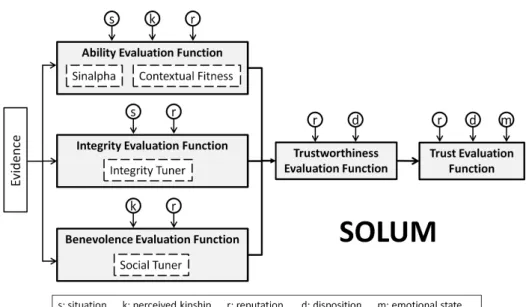
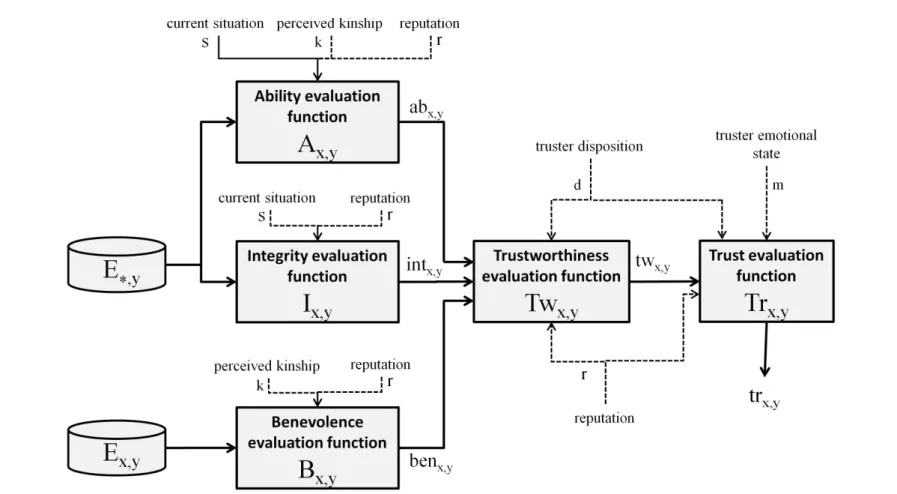
The work of this thesis has three main contributions, that we describe next. The first contribution is the SOLUM (Situational-aware and sOcial com-putationaL trUst Model) framework, a generic framework for social trust, composed of five distinct evaluation functions, which may be instantiated in different models of social-based computational trust. The key elements of this framework were designed taking as a starting point the insights from our thorough multi-disciplinary study on trust as a social construct. They reflect the key topics of our research, such as the estimation of the ability, integrity, and benevolence of agents based on the evidence available on these agents, the current situation, and possibly the agents’ reputation; and also
2
It is worth to note that we considered the use of real data to test the hypotheses; however, this type of data is very hard to obtain in practice. In the same way, the validation of our computational trust model in real scenarios (e.g., within a firm conducting sourcing activities) that would allow for the hypotheses testing was out of the scope of the FCT project supporting this research.
Figure 1.1: The SOLUM model.
the consideration of the disposition and emotional states of agents as other antecedents of trustworthiness and/or trust. The presentation of this study in Chapter 2 is, itself, a side contribution of this thesis. A high-level diagram of SOLUM is given in Figure 1.1, where the main elements of the framework are represented in solid line.
The second contribution of our work is the creation of four different computational trust components used to test the hypotheses derived from the research questions enunciated in Section 1.2, and which constitute our proposal to instantiate the above mentioned framework. These components, which are represented in Figure 1.1 in dashed lines, are:
1. Sinalpha, an estimator of the overall trustworthiness of the agent under evaluation. This component takes into consideration the fact that the perceived trustworthiness of an agent depends on the specific stage of the relationship between this agent and the one that is evaluating him. 2. Contextual Fitness, a component that analyzes the past evidence on the agent under evaluation and detects tendencies on his behavior in particular situations. Hence, it is a component that allows any generic trustworthiness estimator to become situation-aware. The core of this component is the information gain metric (Quinlan, 1986), which we use here as an online process, making it well suited to open and dy-namic environments where the available evidence on any agent may be scarce.
3. Social Tuner, a novel trust-based component that analyzes the past interactions between the one that trusts and the agent under evalu-ation and estimates the benevolence of the latter toward the former, from the outcome of these interactions.
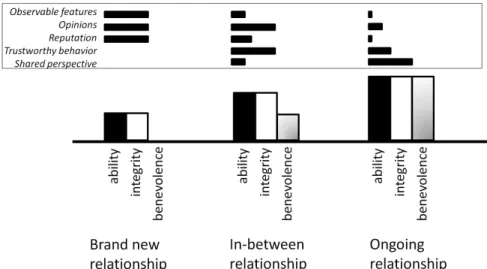
4. Integrity Tuner, a novel trust-based component that analyzes all past evidence on the agent under evaluation and estimates his overall in-tegrity, as related to the consistency of his actions and his ethics. We opted to develop such components as separate and independent mod-ules, allowing them to be added to any existent computational trust model. Another important component of our model is our instantiation of the trust-worthiness evaluation function (cf. Figure 1.1), which is able to weight the contribution of each one of the described components in the final trustwor-thiness score based on the stage of the relationship between the agent under evaluation and his evaluator. We think that this is an important advance over the state-of-the-art on computational trust, in the sense that very few computation trust models address integrity and benevolence as antecedents of trustworthiness, distinguishing them from the general competence of the agent under evaluation, and, to the best of our knowledge, only the Socio-Cognitive Model of Trust (Castelfranchi and Falcone, 2010) implements such a distinction. However, we go one step further when we propose to weight each antecedent based on the stage of the relationship between the interac-tion partners. This is an important aspect of the so called social trust, and the field of computational trust is now eagerly looking for computational versions of social trust.
Finally, the third main contribution of our work lies on the analysis that we conducted about the interplay between trust, norms and sanctions. In or-der to perform the empirical part of this analysis, we adapted the normative environment of the ANTE framework (Lopes Cardoso, 2010; Lopes Cardoso et al., 2012) to allow the automatic drafting of contractual sanctions based on the agents’ estimated trustworthiness, as well as to allow the generation of trust-based evidence from the facts that resulted from monitoring the established contracts.3 The conjugate use of both forms of social control
has received some attention from theoretical literature, but practical imple-mentations of this interplay are rare, despite its well-accepted relevance to the development of reliable and efficient agreement technologies. We believe that our work provide valuable insights into how further work on the matter may be developed.
3This adaption was performed in close collaboration with all the elements of the ANTE
1.4
Thesis Structure
The rest of the thesis is structured as follows:
• Chapter 2 provides an overview of social trust, paying particular atten-tion to the difference that exists between this construct and trustwor-thiness, and to the different perspectives of trust, including its factors, nature, and dynamics. The importance of the relationship that ex-ists between the one that trusts and the one that is trusted becomes evident throughout the chapter.
• Chapter 3 gives a review of existing computational trust approaches, more particularly how they cover the key concepts of social trust dis-cussed in the previous chapter. We show that most of these concepts are partially addressed by some of these models, but few of them ad-dress the distinction between trust and trustworthiness or distinguish between the trustworthiness factors or dimensions. In reality, we show that the great majority of the existing computational models of trust fail to capture the distinct perspectives of social trust.
• Chapter 4 introduces the SOLUM model, which integrates the generic SOLUM framework and our current instantiation of this framework, composed by the Sinalpha, Contextual Fitness, Social Tuner and
In-tegrity Tuner components.
• Chapter 5 presents the evaluation of the SOLUM model. This chapter presents unit tests of Contextual Fitness and Social Tuner, as well as a more elaborated evaluation of the SOLUM model, using dynamic and evolving models of agents’ behavior.
• Chapter 6 describes how our computational trust model is used as a service in the ANTE platform, and how it interfaces with the ne-gotiation and normative environment services. We also present the experimental analysis we have made to the interplay between trust, norms and sanctions.
• Finally, Chapter 7 summarizes the main results we have obtained in this work. In the same way, the main limitations and virtues of this work are pinpointed, and our plans for future work are described.
A Global View of Social
Trust
Trust is a very complex concept to work with. It is omnipresent in our lives, it is said to fuel social relationships and, yet, humans generally do not consciously model it in day life. Trust is ambiguous and illusive both is meaning and usage. As put by Hardin (2004), most research on trust is based on vernacular use of the term, which is, itself, a term of the vernacular. And it is in the domain of the vernacular that we propose to make a preamble to this chapter by analyzing an example of the ambiguity and complexity of the notion of trust, provided by the following excerpt of the lyrics of an old song by the pop band Genesis:1
I need someone to believe in, someone to trust. I’d rather trust a countryman than a townman, You can judge by his eyes, take a look if you can,
He’ll smile through his guard, Survival trains hard.
I’d rather trust a man who works with his hands He looks at you once, you know he understands,
Don’t need any shield, When you’re out in the field.
These lyrics are apparently simple to understand and it is not evident at first sight why one should even care to analyze them. The fictional character uttering such words, which may or may be not the alter ego of the author of the lyrics, trusts simple people that work in the field. We have then strong
1
evidence on the narrator trusting country working people. If someone asks our opinion, we would say that the narrator trusts country people because he told us so. And finally, if we would feed a computational trust system in order to estimate the trust that the narrator put on some field worker, certainly that this utterance would be weighted as strong evidence.
However, if we care to have a deeper thought about the lyrics, some improbable questions would raise. On the one hand, we can question the reasons underlying the strong opinion of the narrator concerning trusting country people. Are they motivated by some dispositional, psychological characteristics of him? Are they the result of a cognitive process resulting from the interaction of the narrator with the environment through his life-time? Is the narrator playing rational over the possible outcomes, hidden in the uttered words? On the other hand, we can question the scope (and the truth) of the illocutionary act itself. In fact, it is not probable, using common sense, that someone blindly trusts a whole category of people (or institutions or things) across all possible situations. Probably the narrator trusts more some country man than other. Probably there is some town man for which the narrator put more trust than a specific country man. Proba-bly our fictional character trusts generally the country man but would trust more a town man to make his (hypothetical) daughter happy in marriage. And probably (as we do not know!), the narrator likes to think he trusts the country man because of political ideals. Finally, when making a trust-based decision about who to risk an interaction in a practical situation, it would be of no surprise if the narrator choose the town man to interact with.
With this small introductory example, we observed several different as-pects of trust showing up confusingly, such as the situationality of trust and the notion of trust as knowledge or act. As we are going to observe through-out this chapter, this fictionary example reflects the current state of research on trust, where different theories appear sometimes to be in opposition, oth-ers simply cannot be included in the same theoretically framework. However, it is not possible to build any coherent computational trust model without knowing and understanding the basic principles of the social phenomenon. In our point of view, so many existent computational trust proposals fail to model trust because they are not grounded on an extensive and exhaustive study of trust as a social concept. Therefore, this chapter presents a detailed description of the theory of social trust. Whenever possible, we capture the theoretical aspects of trust as simple propositions that help to systematize the discussed concepts.
It is important to clarify that not all of the concepts that we address in this chapter are easily translated into a computational model of trust.
Figure 2.1: A guide for this chapter.
In fact, our model of computational trust that we present in later chapters does not implement all the propositions that we derive here. However, by having this broader picture of trust, we have a relative safe guarantee that what we transpose to the computational model is grounded on trust theory. Because we address a wide range of topics, Figure 2.1 provides a roadmap to the contents of this chapter. We start by presenting generic and introduc-tory aspects of trust. Then, in Section 2.2, we focus on the nature of trust, in-cluding the different accounts referred to in literature (cognitive, emotional, and behavioral) and the situation-awareness of trust. Section 2.3 addresses a question of paramount importance to computational trust: which are the antecedents of trust, i. e., based on what an individual forms his trust on a specific object of trust? A related question concerning the different sources of information that can provide information for trust reasoning is addressed in Section 2.4. In Section 2.5, we overview the dynamics of trust creation and maintenance, addressing relevant topics such as how trust forms, how is the path that the object of trust have to run in order to be considered highly trustworthy, and what is the effect of betrayals on trust. Section 2.6 is devoted to the relation between trust other forms of social control, such as contractual norms. Not only this is a relevant topic on the study of trust by itself, but also it is fundamental for the work we are doing at LIACC in the aim of our funded research project. Finally, Section 2.7 presents the concluding remarks for the section and refers advanced topics on trust that were not overviewed in this chapter.
2.1
Introduction
Trust is a social construct that is present in the day-to-day routine of hu-mans. In fact, every time a person (hereafter named truster2) needs to interact with, delegate to or rely on an action of another individual, group or thing (hereafter named trustee), a decision about trust is made.
2
Trust is of particular interest in social and economic exchange relation-ships.3 Both, in a way, imply uncertainty, normally associated to informa-tion asymmetry regarding the attributes and acinforma-tions of the partner (Wathne and Heide, 2000), which, in turn, increase the vulnerability of the actors that engage in particular interactions (Heimer, 2001). Although the definition of trust varies throughout the trust literature, we start this section with the definition presented in Mayer et al. (1995), where trust is both a positive ex-pectation that the trustee will act as expected, and a willingness or intention to accept vulnerability.
In the same vein, uncertainty and vulnerability increase the risk of op-portunism between the interacting partners (Wathne and Heide, 2000). In order to reduce uncertainty and vulnerability, different mechanisms may be used, such as control, monitoring, and incentives (Wathne and Heide, 2000). However, these mechanisms are generally costly and some authors propose the use of trust as an alternative governance structure (Sako, 2002).
Hence, due to the vital role that trust plays in the society – and to the disturbing effect of its counterpart, distrust –, it is of no surprise that it has been receiving increased attention from researchers in several areas, includ-ing sociology, economics, management, political science, psychology, ethics and philosophy (e.g. Macy and Skvoretz, 1998; Dasgupta, 2000; Hardin, 2001; Kiyonari et al., 2006; Wathne and Heide, 2000; Heimer, 2001; Castel-franchi and Falcone, 2010). More recently, trust management started re-ceiving growing attention from the computer science community, particu-larly from multi-agent systems scholars. The underlying idea is to confer to intelligent agents the ability to estimate the trustworthiness of their inter-acting partners, in order to improve their social interactions (Sabater-Mir and Paolucci, 2007). In this case, we say that agents use computational trust
models based on trust theory to assist their trust-based decisions.
There are several different approaches to the study of trust and its dy-namics and distinct discussions of this social concept are still ongoing. Some approaches, mostly in psychology, consider trust at the individual level, as personality traits or dispositions of the truster that develop at the infancy and remains stable through adulthood (e.g. Rotter, 1967; Cvetkovich et al., 2002; Kiyonari et al., 2006). Some of these studies use questionnaire surveys and other psychometric scaling techniques that ask participants to evaluate their trust on some entity after some suggested event. Others study the
3Following Blau, cited by Colquitt et al. (2007), economic exchanges are contractual
in nature and concerns the exchange of quantities agreed upon beforehand, while social exchange are more diffuse in nature, vaguely defining future obligations that occur over a more open-ended time frame.
behavioral expressions of trust in laboratory settings, using different kinds of trust games, such as the Trust Game, the Dictator Game, the Investment Game and the Faith Game.4 General criticism about these approaches con-cerns the fact that trust cannot be reduced to a trait-like notion, and that individuals would have no need to trust apart from social relationships, so that trust must be understood instead as a multidimensional social real-ity (Lewis and Weigert, 1985; Mayer et al., 1995; Schoorman et al., 2007). Other criticism concerns the methodology used in these studies, where the data resulting from the studies is generally obtained through participation in group activities and do not capture other psychology data than “correlations between measures over time of generalized trust” (Hardin, 2001).
Other approaches, mostly in the area of social psychology and sociol-ogy, study the role of cognition, affection, and values in trust formation and maintenance, in the context of social relationships (e.g., Fitness, 2001; Finkel et al., 2002; Hardin, 2004). This means that trust must be understood as a property of ongoing dyads, groups, and collectivities, and not of isolated individuals (Lewis and Weigert, 1985; Mayer et al., 1995). The sociological view of trust expands to demonstrate the fundamental role of trust across the different social institutions (e.g., Luhmann, 1979; Lewis and Weigert, 1985). Still other approaches assume an economic focus where trust is af-fected by situational factors, such as incentives, norms, institutions, and other governance mechanisms (e.g. Dasgupta, 2000; Williamson, 1979; Ire-land and Webb, 2007; Wathne and Heide, 2000; Sako, 2002). In managerial and organizational research, there is important studies on opportunism and betrayal within and between organizations (e.g., Elangovan and Shapiro, 1998; Wathne and Heide, 2000; Williamson, 1979).
Such a diversity of notions and concepts – where scholars from different disciplines seem to “talk past one another” (Schoorman et al., 2007) – derives from the fact that “trust is somewhat illusive, difficult to define (...) and dif-ficult to measure” (Elofson, 1998). It reveals, in the words of Castelfranchi and Falcone (2010), a “degree of confusion and ambiguity that plagues cur-rent definitions of trust”. This by no means eases the work of computer scientists when they attempt to formalize models of computational trust for assisting the decision making of artificial entities.
A frequent misconception on trust literature concerns the distinction be-tween trust and trustworthiness. This way, we start our study on trust by analyzing the main differences between both concepts and the way they re-late. As we are going to see, they can be decomposed in distinct dimensions,
4
for which contribute different factors. Still in this section, we analyze the important interrelation between trust and context. At the end of the sec-tion, we propose a tentative formalization of the trust concept, taking into consideration its late use in computational models.
2.2
The Nature of Trust
Some time ago, the idea of generalized trust associated with the propensity to trust of humans was popular among some scholars: some individuals were considered to be high trusters and others low trusters. This idea is being abandoned, and there is now a generalized consensus within the trust community that trust is – at least – a ternary relation: the truster trusts the trustee with respect to some matter (Hardin, 2001). In fact, there may be different levels of trust even in the same relationship, not only because the trustee may show different qualities in different domains (Mayer et al., 1995; Kelton et al., 2008), but also because the trust requirements of the truster may change within the relationship. For example, an agent may trust a colleague to do a good job collaborating on a research project but not teaching his class in his absence (Schoorman et al., 2007). A much more evident example is given by Marsh (1994), when he says that an agent may trust his brother to drive him to the airport, but not to fly the plane.
Another characteristic of trust is that it is not necessarily mutual: the truster may trust the trustee, but the latter may not trust the former (Schoor-man et al., 2007).
2.2.1 The Situationality of Trust
A consensual notion in the studies on trust is that it is situational, in the sense that persons have different incentives, competences and abilities to be trustworthy on different occasions (Marsh, 1994; Dasgupta, 2000; Dim-itrakos, 2002). For instance, a person can trust his neighbor to have the key of his house in “normal circumstances” but stop trusting if the neighbor is detected an alcoholic problem; or I can trust my friend to drive in hot summer but not in snowing conditions; my trust on my business partner may diminished if he is having problems with his logistics.
Proposition 1 Trust as a quaternary relation: Trust is a property
of the truster in relation to the trustee with respect to some matter and in a given context.
2.2.2 The Cognitive, Emotional and Behavioral Accounts of Trust
Trust is a cognitive process. It is an assessment of the trustworthiness of the object of trust, being it a person, group, or institute, and this assessment is based on evidence; it is up to individuals to choose whom to trust, and in which circumstances (Lewis and Weigert, 1985; Mayer et al., 1995; Hardin, 2004; Castelfranchi and Falcone, 2010). Castelfranchi and Falcone, followed by Herzig et al. (2010), consider that to trust implies to have a goal, which can be accomplished by an action of the trustee, and that trust forms in a complex cognitive construction based on beliefs and meta-beliefs about the trustee (Castelfranchi and Falcone, 1998; Castelfranchi et al., 2003; Castel-franchi and Falcone, 2010).
Complementary to its cognitive base, trust is also constructed on an emotional base. On the one hand, participants in ongoing close relation-ships create an emotional bond between them (Lewis and Weigert, 1985; Mayer et al., 1995; Castelfranchi and Falcone, 2010); on the other hand, emotional states, even when unrelated to the trustee or situation, may affect trust (Dunn and Schweitzer, 2005; Schoorman et al., 2007). These emotions influence the mental attitude and perceptions of the relevant virtues that are needed for relying on the trustee (Schoorman et al., 2007; Castelfranchi and Falcone, 2010).
Proposition 2 Cognitive and emotional content of trust: Trust
is a cognitive process that involves the estimation of the trustworthiness of a trustee based on the evidence available on the trustee. Complementary to its cognitive content, trust has an emotional content, which is particularly relevant in close and ongoing relationships and strong emotional states.
Schoorman et al. (2007) refer that emotions may create a temporary ‘irrationality’ about the cognitive assessment of ability, integrity and bene-volence, but do not discriminate in which ways each one of these antecedents of trust are affected. Moreover, these authors suggest that after a violation of trust the perceptions may gradually return to a rational perspective, al-though they question if the emotional account of the evaluation completely dissipates or in some way remains with time. We think that the authors re-fer to the dissipation of affect after a betrayal; as we are going to see later in this chapter, other emotions (e.g., sadness, rage) raise after a betrayal, and, in our opinion, these other emotions will also create a temporary ‘irrational-ity’ about the cognitive assessment of the above mentioned antecedents of trustworthiness.
Proposition 3 Effect of Positive Emotions on Trust: Affect and
bond creation have a positive influence on the perception of the antecedents of trust. This influence dissipates after a (mild) violation of trust.
Apart from the cognitive and emotional content of trust, some scholars consider that trust includes the behavioral enactment of trust (Luhmann, 1979; Lewis and Weigert, 1985; Castelfranchi and Falcone, 2010), which means that trust is also a decision and an act of relying on, counting on, depending on the trustee, and that the cognitive, emotional, and behavioral dimensions are united over a common structure. Other authors, however, refute this behavioral account of trust, referring that trust is just a piece of knowledge, which can eventually be translated into a willingness to take risk (e.g. Mayer et al., 1995; Hardin, 2001), while trusting behavior is the actual assuming of risk.
Proposition 4 Behavioral content of trust: Some authors consider
that trust has a behavioral content; some others consider that the notion of trust does not include the decision and act of relying on the trustee.
2.2.3 The Degree of Trust
In the same way, trust is a matter of degree (e.g. Hardin, 2001; Bhattacharya et al., 1998). As mentioned by Castelfranchi and Falcone, “only a trust deci-sion eventually is a yes/no choice, and clearly needs some threshold” (Castel-franchi and Falcone, 2010). The authors introduce the degree of believing as the basis for the degree of trust.
Trust has a strength related to the confidence that the truster has on his trust (e.g. Bhattacharya et al., 1998; Huynh et al., 2006; Patel, 2006).
Proposition 5 Degree of trust: Trust is a matter of degree.
2.3
Trust and Its Antecedents
In order to model trust, the way it forms and its dynamics, we need to identify and characterize its antecedents. This is an underrated question in computational trust, where most of the existing approaches (with important exceptions, that we identify later) model trust as the direct reflex of the trustee’s trustworthiness. 5
5The outcomes of trust, such as risk taking and job performance, are out of the scope
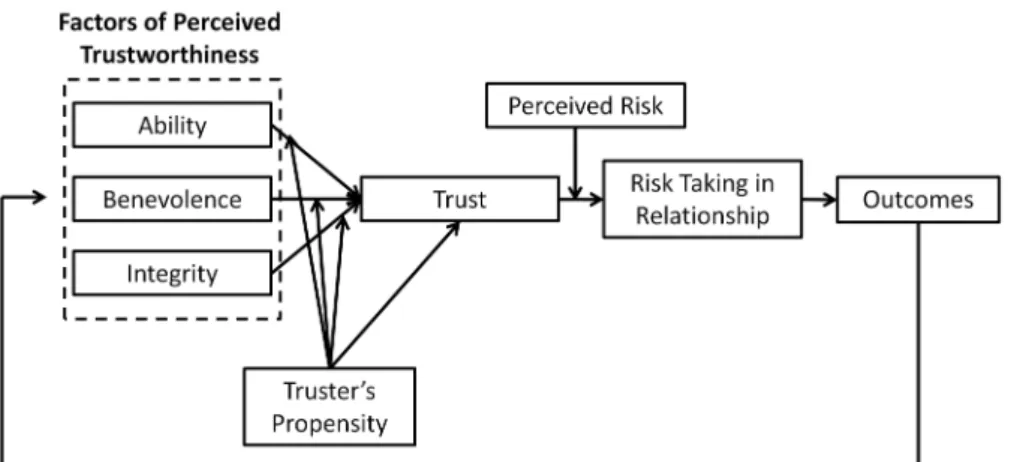
Although trustworthiness is an important antecedent of trust, it does not explain all trust dispositions and decisions. Other factors must be con-sidered, such as the propensity to trust of the truster (Mayer et al., 1995; Kiyonari et al., 2006; Colquitt et al., 2007; Castelfranchi and Falcone, 2010), his emotional state (Schoorman et al., 2007), the physical and cultural char-acteristics of the trustee (Kelton et al., 2008), and (for some scholars) repu-tation (e.g., Jøsang and Ismail, 2002; Kelton et al., 2008; Castelfranchi and Falcone, 2010). We analyze each one of these antecedents with more detail next.
Proposition 6 Antecedents to Trust: The trustee’s trustworthiness,
his physical and cultural characteristics, and the truster’s propensity to trust and his emotional state, all are antecedents to trust. Some authors also refer reputation as another antecedent to trust.
2.3.1 Trustworthiness
Trust and trustworthiness are two distinct concepts: trust is a property of the truster in relation to the trustee, while trustworthiness is a character-istic of the latter (e.g. Hardin, 2002; Kiyonari et al., 2006; Colquitt et al., 2007; Castelfranchi and Falcone, 2010), i.e., a multifaceted construct that captures the trustee’s competence and character (Colquitt et al., 2007). A trustworthy entity is the one worthy of confidence, it normally would present high values of competence, integrity and benevolence in the situation in as-sessment, and its behavior would be predictable in this situation.6 To para-phrase Hardin (2004), “if, on your own knowledge, I seem to be trustworthy to some degree with respect to some matter, then you trust me with respect to that matter”.
Proposition 7 Trustworthiness as Multi-Dimensional:
Trustwor-thiness is a multi-dimensional construct that captures the trustee’s compe-tence and character.
The trustworthiness of the trustee in a given situation is objective; how-ever, the trusting agent may make a wrong evaluation of the trustee’s re-liability – possibly by conducting an insufficient or deficient gathering of data on the trustee –, which may lead to a misplacement of the truster’s trust. This means that trusting agents deal with the perceived or evaluated trustworthiness, which is subjective (Castelfranchi and Falcone, 2010).
6Schoorman et al. (2007) apply this definition to either interpersonal, intergroup, and
Next, we take a closer look at the three dimensions (or factors) of trust-worthiness proposed by Mayer, Davis, and Schoorman (1995), and followed by other scholars (e.g. Elangovan and Shapiro, 1998; Colquitt et al., 2007): ability, benevolence, and integrity.
Ability
Ability, also referred to as competence, relates to the potential ability of the evaluated entity to do a given task, and is one of trustworthiness dimension most mentioned by trust scholars (e.g. Mayer et al., 1995; Hardin, 2002; Levin et al., 2004; Xie and Peng, 2009; Castelfranchi and Falcone, 2010; Adali et al., 2011). It translates into a set of qualities that makes the trustee able for the task, such as skills, know how, expertise knowledge, general wisdom, self-esteem, interpersonal skills, self-confidence, and leadership. A trustee that shows some or all of these qualities is contributing for the truster’s perception that he has the ability to perform the task. The perception of these attributes by the truster is mainly a cognitive process and less of an emotion-based process (Colquitt et al., 2007). Also, ability is domain specific; for example, a given trustee can master some technical issue and still show little aptitude in interpersonal communication (Mayer et al., 1995). Certain attributes are sensitive to context. For instance, Hardin (2002) refers that experience and age are desired characteristics in babysitting ac-tivities. In the marketing area, Xie and Peng (2009) show that informational recovery efforts (e.g. presenting sufficient or persuasive information about the events) in trust repair activities of a firm (e.g. following negative pub-licity) improve perceptions of organizational competence. In general, we can state that the competence dimension is a major issue in contexts where specialized abilities are at issue (Hardin, 2002).
Proposition 8 Ability: Individuals have different abilities in performing
different tasks, which are related to their inherent qualities.
Proposition 9 Perception of Ability: Individuals that show the
qual-ities required to perform the task at hand are perceived by others as having ability in that matter. Moreover, the physical and cultural characteristics manifested by these individuals may increase or decrease the perception of their ability in the matter by others.
Benevolence
Benevolence is considered by several scholars as a key element of close rela-tionships and trust relations (e.g. Mayer et al., 1995; Elangovan and Shapiro,