Leveduras como aditivo nutricional para cavalos em treinamento
Adalgiza Souza Carneiro de Rezende1, Pablo Trigo2, Ângela Maria Quintão Lana3, Juliano Martins Santiago3, Vinicius Pimentel Silva3, Francisco Castejón Montijano2
ABSTRACT
This research analyses the yeast supplementation effect on the digestibility of nutrients and metabolic performance in training horses. Twelve horses were assigned into 2 groups: Pr (20 g of probiotics daily per horse) and control. The diet consisted of roughage (haylage) and commercial rations and all horses were trained for 6 weeks. LIPE® indicator was used during 7 days and feces
collected for five days to determine nutrient digestibility. DM, CP, DE, P, NDF, ADF, HCEL and lignin were determined. All horses were subjected to incremental ergospirometry test before and at the end of training. Horses that received live yeast showed an increase (p<0.05) of 4.1% in the digestibility of HCEL. After training, both horse groups presented higher tolerance to fatigue, with an increase in AT and VO2max. The training improved animal performance, hemicellulose digestibility and DE was higher in Pr, but these increases did not improve the performance of these animals.
Index terms: Nutritional additives, equine, exercise, probiotics.
RESUMO
O trabalho avaliou o efeito da suplementação com leveduras na dieta de equinos em treinamento, sobre a digestibilidade dos nutrientes e o desempenho metabólico dos animais. Doze equinos foram distribuídos em 2 grupos: Pr (equinos que receberam 20 g de probióticos diariamente) e Controle. A dieta foi composta de volumoso (haylage) e concentrado comercial e todos os equinos foram treinados durante 6 semanas. A digestibilidade dos nutrientes foi avaliada utilizando o indicador LIPE® (7 dias) e a coleta de fezes foi
realizada durante cinco dias. Foi analisado MS, PB, DE, P, FDN, FDA, HCEL e lignina. Antes e após o treinamento, todos os cavalos foram submetidos a um teste incremental ergoespirométrico. Os equinos que receberam leveduras vivas apresentaram um aumento (p <0,05) de 4,1% na digestibilidade da HCEL. Após o treinamento, ambos os grupos apresentaram maior tolerância à fadiga, com um aumento na AT e no VO2max. O treinamento melhorou o desempenho dos animais, e a digestibilidade da hemicelulose e DE foi maior no grupo Pr, mas esses aumentos não melhoraram o desempenho desses animais.
Termos para indexação: Aditivos nutricionais, equino, exercício, probióticos.
(Received in march 30, 2012 and approved in april 30, 2012)
1Universidade Federal de Minas Gerais/UFMG – Departamento de Zootecnia – Avenida Antônio Carlos – 6627 – Campus Pampulha – Cx. P. 567 – 30161-970 – Belo Horizonte – MG – Brasil – [email protected]
2Universidad de Córdoba – Córdoba – Espanha
3Universidade Federal de Minas Gerais/UFMG – Belo Horizonte – MG – Brasil
INTRODUCTION
The effects of nutritional additives on animal species have been studied by many nutrition companies, as well as research institutions. Probiotics have been used in the equine industry as a nutritional strategy to improve diet assimilation, performance and to encourage growth, among other things (BIEL et al, 1990; GLADE; CAMPBELL, 1990; ART et al, 1994; MOURA et al, 2009, MOURA et al, 2011). However, there are few studies evaluating its effects on the horse athlete.
Probiotics are live microorganisms that can be added to the diet to improve the intestinal environment, specifically the balance of microflora. Horse feed stuff is rich in fiber, and to digest it, the digestive tract depends on the action of microorganisms in the caecum. It is believed that, the addition of live yeast to horse diets improves the microbial balance
in the large intestine, stimulating the development and activity of cellulolytic bacteria and, consequently, better utilization of fibrous feed (LOSADA; OLLEROS, 2002).
Kim et al. (1991) observed: high digestibility of dry matter (DM), crude protein (CP), neutral detergent fiber (NDF), hemicellulose, acid detergent fiber (FDA) and phosphorus (P) in horses supplemented with yeast. According to these authors, the P increased use may be due to increased microbial activity, leading to increased production of phytase and releasing P from phytate.
probiotics led to a reduction in the variation of lactic acid and intestinal pH, making the animals more tolerant to this feeding pattern.
Fiber digestibility improvement is especially important for horses fed high-forage diets to increase energy intake. According to White (2011), probiotic supplementation stabilized equine large-intestine microbial population, allowing better fiber digestion and producing more volatile fatty acids (VFAs), which are absorbed and used as energy source for these animals. However, the yeast usage benefits in sport athlete performance are not well understood.
Glade and Campbell (1990) found that probiotic supplemented horses showed heart rates 15% to 20% lower than non-supplemented animals, after moderate exercise. Art et al. (1994) concluded that probiotics added to training horse diets improved carbohydrate usage for aerobic metabolism, but this effect only occurred when the animals were in training and active. These researchers used a probiotic compound with no live microorganisms. However, Art et al. (1994) supplemented horses in training with live microorganisms, concluding that these additives improved glycogen usage by aerobic pathways.
Different research results and the lack of studies demonstrating the potential probiotic benefits in sport horse athletic performance motivated this research, which aimed evaluate the effects on nutrient usage and cardiorespiratory performance by adding yeast to the diet of horses during training.
MATERIAL AND METHODS
The experiments were performed at the Equine Sports Medicine Centre (CEMEDE), and were developed in two stages. The first (adaptation) lasted 21 days, and the second (training) was developed in 49 day period. 12 male Andalusian horses that had never been trained and were raised in pastures, were used. At the beginning of the study period, horses had between 24 to 34 months of age and weighed between 404.0 to 469.5 kg.
The horses received a diet composed of packaged haylage, produced with Lolium perenne grass (Natural Grass Agrocoeli SI) and commercial concentrate (Pro-Mix Horse Cargill SLU). In the adaptation stage, the animals gradually became accustomed to the diet, to the treadmill (Mustang, Kagra, Suiza), to the automatic walker (Le Galop Agrobroker), to spirometry with a facemask (MetaVet 1.0, Cortex Biophysik, Germany) and to the training routine that was developed in the second stage.
On the last day of the adaptation period and on the last day of the experimental period, a maximal incremental
treadmill test was performed. The test protocol consisted of: warm up (5 min walk at 1.6 m/s and 5 min trot at 3.5 m/s, without slope), and exercise (3 min at 4 m/s and then increasing 1 m/s at every 3 min, on a 3% sloped treadmill). The test was continued according to the protocol until horses failed to maintain pace on the treadmill or developed an uneven gait, and cool-down (5 min trot at 1.6 m/s and 5 min walk at 3.5 m/s, without slope).
Oxygen consumption -VO2(electrochemical cell), carbon dioxide production -VCO2 (single-beam non-dispersive infrared sensor), respiratory frequency, and tidal volume (ultrasound flow sensor), were measured continuously using a metabolic gas analyzer, and the data were averaged over 10-sintervals, but only the last 50 s of each step were used for analysis. The analyzer had a transducer attached to the rostral part of the mask, on which the ultrasonic flow sensor, the infrared sensor and the entrance hole for the samples of air and for CO2 determination were located.
Ambient temperature and barometric pressure were recorded continuously. VO2 and VCO2 were corrected to standard temperature and pressure, dry (STPD). VO2 max was confirmed in all horses by demonstrating no increase in VO2 between the final two steps of the exercise test. The coefficient of variation for repeated determinations of VO2 max was 4.3%. AT, aerobic and anaerobic thresholds were determined from ventilation and gas exchange (AUNOLA; RUSKO, 1986).
The heart rate (HR) was monitored using a frequency counter (Polar Equine), and the time to fatigue was measured in seconds, beginning the counting at 4 m/ s and continuing until the speed at which the animal demonstrated inability to continue galloping.
Throughout the training period, half of the horses received 20 g of the yeast probiotic (Sc 47 Biosaf® - Feed
Additives Lesaffre, Marcq-en-Baroeul, Nord-Pas-de-Calais, France: a minimum of g: 1 x 10¹⁰ cfu of S. cerevisiae) mixed with the concentrate and offered at 13:00 h. The animals were paired according to a combination of weight, age, body condition and maximum heart rate obtained in test 1. One member of each pair was randomly assigned to one of the two dietary groups: Pr (Probiotics) and C (Control).
The experimental period was 42 days. All horses performed 30 minutes of treadmill work every two days at an 80% aerobic threshold (calculated for each animal). They rested on Sundays (6 days), and for other three days, they exercised for one hour on the automatic walker at a speed of 1,6 m/sec.
An external digestibility indicator LIPE® (500 mg/
animal/day) was given to the horses with the concentrate offered at 13:00 h, during the last six days of the training period, before the exercise tests (LANZETTA et al., 2009). This treatment with LIPE® was initiated 2 days before
beginning the feces sample collection. In order to obtain adequate adaptation of the animals and prevent the elimination of feces indicators, sample collection was performed directly in the rectum, in the afternoon, once per day for five days. Fecal samples, taken daily from each horse, were placed in plastic bags, identified and immediately frozen until processing. A sample of forage and concentrate were obtained periodically to evaluate the diet chemical composition.
The forage, concentrate and feces samples were packed in trays and placed in a forced-air oven at 55° C for 72 hours in the Animal Nutrition Laboratory at the University of Cordoba. After drying, the residues were ground in a mill-type Willey (Retsch), with a 1 mm sieve, and were packed. The diet nutrient digestibility was determined at the School of Veterinary Medicine of UFMG - Brazil. The samples were processed according to Association of Official Analytical Chemistry - AOAC (1995) and Van Soest et al. (1991) to determine: dry matter, crude protein, gross energy, phosphorus and fiber. The indicator LIPE® was determined
by infrared spectroscopy (VASCONCELLOS et al., 2007) at the School of Chemical Engineering of UFMG.
The content of LIPE® in feces was determined to
estimate faecal output as described by Saliba (2002): Table 1 – Rations chemical composition (dry matter basis).
Feed DM (%) CP (%) DE Mcal/kg NDF (%) ADF (%) HCEL (%) Ca (%) P (%)
Haylage1 77.32 6.57 4.12 57.06 32.26 24.80 0.51 0.40
Concentrate2 89.39 15.00 4.15 36.02 16.38 19.64 1.56 0.54
1 Natural Grass Agrocoeli S,I. 2 Pro Horse Mix-Cargill S,L,U.
PF (kg) = LIPE® provided (g) x 100 ,
(Ai / MStotal )
where:
PF = Fecal output;
Ai = Logarithmic ratio of the intensities of absorption bands of wavelengths to 1050 cm-1 / 1650 cm-1; MS total = total
faecal dry matter; Ai was calculated using the formula: Ai = A1050 / A1650, Since: A = log I0, where I0>intensity and I<intensity.
In this test, the indicator LIPE® was used to estimate
faecal output, and this amount combined with the food “in vitro” digestibility, estimated the consumption of forage (haylage). The total diet consumed was calculated adding the value obtained with the average concentrate ration taken:
DMI = PF , (1- DIVMS/100)
where:
DMI: dry matter intake; PF = Fecal output; DIVMS = Dry Matter In vitro digestibility.
Calculating DMI, the digestibility of nutrients could be evaluated using the following formula:
DA (%) = (Nutrient intake) – (Nutrient excreted in feces) x 100 (Nutrient intake)
The DM digestibility of food was determined, according to Moura et al. (2009), by using the “In vitro” digestibility, the values of faecal output (FOR) and the estimated in vitro dry matter intake (CMSLIPE) of the provided forage for the animals.
A completely randomized, two treatment (group C and group Pr) design was used to analyze the diet nutrient
gain, haylage intake, DM intake estimated by the marker LIPE® and nutrient digestibility. The averages were
compared using Student Newman Keuls (5%) through Systems Analysis Statistics and Genetics program (SISTEMA DE ANÁLISE ESTATISTICA - SAEG, 2000).
The distance to fatigue was the distance travelled by each animal during the test. The experimental design was completely randomized in a split-plot design. The plots were represented by two groups, the group being supplemented with probiotics and the control group. The subplots were formed by progressive exercise tests on the treadmill, performed before (test 1) and after training (test 2), with the split represented by the samples collected in each test.
The results of the distance to fatigue and heart rate were tested for data normality and homoscedasticity between treatments. The results were subjected to variance analysis. The mean distance to fatigue and aerobic and anaerobic thresholds were compared by Tukey test at a 5 % probability level. Heart rate data were submitted to the quadratic equation, using the same computer program used for statistical analysis (SAEG, 2000).
RESULTS AND DISCUSSION
In table 2, the average apparent digestibility of dry matter, crude protein, digestible energy, neutral detergent fiber, hemicelluloses, acid detergent fiber and phosphorus of the supplemented and control animals is shown.
The probiotic action in improving the usage of the diet fibrous portion was confirmed. Animals that received live yeast (Pr) showed 4.1% HCEL digestibility increase (p<0.05), providing more digestible fiber, which probably contributed to improve 1% DE digestibility (p<0.05). Lewis (2000) stated that the fibrous portion of the diet can be used in horses as an energy source provided by its microbial fermentation in the large intestine.
The Pr group positive results agreed with Glade and Biesik (1989), Kim et al. (1991), Moore et al. (1994), Morgan et al. (2007) and Moura et al. (2011). Better fiber
digestibility in horses supplemented with yeast was also observed, suggesting that this additive improves digestion of the diet.
Moura et al. (2009, 2011) found that an improvement in feed efficiency and the hemicellulose digestibility when S. cerevisiae yeast was added to foals diet. According to the authors, this probiotic beneficial effect on food fibrous portion may have been achieved by reducing the redox potential of the intestinal environment. Newbold et al. (1996) suggested this effect when they studied S. cerevisiae yeast action mode in ruminants. They concluded that yeast respiration was beneficial for the cellulolytic bacteria in the rumen, because it caused oxygen concentration reduction, which is toxic and inhibits anaerobic bacteria growth.
The probiotic usage in sport horses had focused
on improving the performance of these animals.
Assessments of heart rate in athletic horses during exercise have been used to describe the work intensity, to assess
fitness and to study the effects of training in these animals (EVANS, 1994).
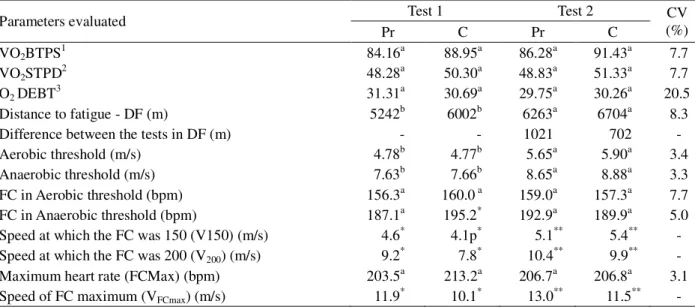
No significant differences were detected in the studied parameters between group Pr and group C before or after training. After training, both horse groups presented a higher tolerance to fatigue, as shown by the longer exercise time to fatigue (5622 m before and 6484 m after training), with increases in the aerobic threshold (AT) and VO2max (Table 3).
Training resulted in 5% increase in VO2max, without significant differences between the groups. Training also induced 0.87 m/s increases and 1.13 m/s in AT in both groups Pr and C, respectively. Reported increasesin VO2
max with training have ranged from 5% (KNIGHT et al. 1991)
to 29% (TYLER et al. 1996). Despite these findings, the effect of training on VO2 max seems to be somewhat controversial, probably because of the variability of the designs, horse breeds and exercise tests used in the different studies. Increasesin VO2 max have been shown to occur during the first training weeks (KNINGHT et al. 1991).
Table 2 – Mean coefficients of apparent dry matter digestibility (DM), crude protein (CP), digestible energy (DE), neutral detergent fiber (NDF), acid detergent fiber (ADF), hemicellulose (HCEL) and phosphorus (P) in the Pr (probiotic) and C (control) groups.
Means followed by different letters in a column are different by the SNK test (p<0.05).
Groups MS (%) PB (%) DE Mcal/kg FDN (%) HCEL (%) FDA (%) P (%)
Pr 76.52 80.10 76.70a 66.56 76.25ª 58.57 67.57
C 75.22 75.34 75.12b 65.84 73.27b 57.83 61.68
Horses trainedat a constant exercise load for 6 weeks at different intensities had a 10% increase in VO2 max at eachintensity after 2 training weeks, but after that, there were nofurther increases (KNIGHT et al. 1991). Likewise, horses trained for 7 or 34 weeks with an increasing exercise load, underwent a 23% increase in VO2 max (EVANS; ROSE 1988) and 29% increase in VO2 max, atthe end of training (TYLER et al. 1996). Most of these researchers have used training speeds over aerobic thresholds. The results obtained in the present research are consistent with the data reported previously in the literature, with training resulting in an enhancement of the aerobic potential, as shown by VO2 max. The reduced change in VO2 max in relation to the data reported by other authors (EVANS; ROSE, 1988; TYLER et al. 1996) probably reflects the low intensity of the training and the absence of changes in the training protocol used in this study. However, if training intensities were higher than the aerobic threshold, changes in VO2 max might have been more significant.
Although probiotics improved the usage of dietary
energy in the Pr group, this increase in energy intake did not improve cardiorespiratory performance or distance to
fatigue. However, the difference in distance to fatigue
between the two tests was higher in the Pr group (1020 m) compared with the C group (702 m).
In contrast with the results found in this work, Glade and Campbell (1990) found better performance in horses supplemented with culture yeast and suggested that the increased aerobic capacity of supplemented animals was a result of the improvement in nitrogen balance, inducing
an increase in muscle mass and metabolic efficiency by increasing muscle vascularity and, consequently,
cardiovascular capacity. The results of this study also differed from those of Art et al. (1994), who observed an
increase in aerobic energy generation in horses
supplemented with probiotics. According to Poole and Erickson (2008), better aerobic energy usages were
accompanied by improvement in heart response, with
increases in O2 supply to the muscles, metabolism end product removal and were directly related to exercise intensity.
The probiotic nutritional effect positive influence on horse performance of this study may not have been evidenced by the fact that animals from both groups were trained properly.
Table 3 – Average performance parameters evaluated under (test 1) and before the training (test 2) of the control and probiotic groups.
Parameters evaluated Test 1 Test 2 (%) CV
Pr C Pr C
VO2BTPS1 84.16a 88.95a 86.28a 91.43a 7.7
VO2STPD2 48.28a 50.30a 48.83a 51.33a 7.7
O2 DEBT3 31.31a 30.69a 29.75a 30.26a 20.5
Distance to fatigue - DF (m) 5242b 6002b 6263a 6704a 8.3
Difference between the tests in DF (m) - - 1021 702 -
Aerobic threshold (m/s) 4.78b 4.77b 5.65a 5.90a 3.4
Anaerobic threshold (m/s) 7.63b 7.66b 8.65a 8.88a 3.3
FC in Aerobic threshold (bpm) 156.3a 160.0 a 159.0a 157.3a 7.7
FC in Anaerobic threshold (bpm) 187.1a 195.2* 192.9a 189.9a 5.0
Speed at which the FC was 150 (V150) (m/s) 4.6* 4.1p* 5.1** 5.4** -
Speed at which the FC was 200 (V200) (m/s) 9.2* 7.8* 10.4** 9.9** -
Maximum heart rate (FCMax) (bpm) 203.5a 213.2a 206.7a 206.8a 3.1
Speed of FC maximum (VFCmax) (m/s) 11.9* 10.1* 13.0** 11.5** -
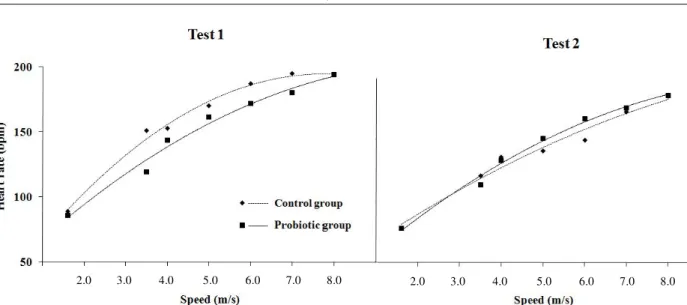
* Values obtained from the regression curves: y = -2.7715x2 + 42.926x + 28.562 (R2 = 0.9880). ** Values obtained from the regression curves: y = -1.4365x2 + 30.754x + 38.75 (R2 = 0.9638).
Means in rows followed by different small letters differ between tests 1 and 2 using a Tukey test (p<0.05).
1 VO
2 corrected for body temperature and pressure, saturated. 2 VO
2 corrected for standard temperature pressure and dry. 3 Debt of O
In Glade and Campbell (1990) study, culture of live yeast added to horse diet led to lactate and heart rate reduction in trained animals. Art et al. (1994) concluded that probiotics only improved aerobic usage capacity for reserve carbohydrates in trained horses but not in inactivity periods. According to Food and Agriculture Organization/World health Organization -FAO/WHO (2002), the nutritional additive used by these researchers cannot be considered probiotic because it was composed of dead yeast and did not contain live microorganisms.
Different responses observed in studies using probiotics in horses may be due to differences in the amount of live yeast supplement given to the animals, as there are no studies suggesting the ideal dose to be used. While Medina et al. (2002) provided 10 g of yeast to horses fed diets with high amounts of fiber and starch, and they found no effect on nutrient digestibility, Moura et al. (2011), in a study developed with foals on pastures that received a supplemental concentrate with 5 g yeast addition, found an increase in the diet fibrous portion digestibility. Likewise, Moore et al. (1994) evaluated 10 g yeast addition in ponies fed diets containing 65% grass hay and 35% concentrate, and they observed a positive influence of probiotics on fiber digestibility. Moreover, Hall et al. (1990) tested various yeast doses in horse diets (0, 10, 20 and 40 g/animal) and did not find any significant effect on nutrient usage. Furtado et al. (2010) also found no probiotic influence on dietary fiber usage in horses with daily 15 g yeast supplementation. However, Agazzi et al. (2011) found an improvement in DM, OM, NDF and ADF usage in the diet when horses were supplemented with 50 g of yeast. Another factor to be considered was that animal diets from both groups were balanced and provided the necessary nutrients for horses undertaking moderate activity (NRC, 2007).
If animals were receiving low-fiber and low-nutrient diets, performance would have been affected. It should be noted, too, that the horses in this study had relatively constant body weight (median change 4.2 kg), indicating that dietary energy requirement during the training program was adequately met by adjustments in the diet, following the weekly assessment of animal body conditions. This
suspicion agreed with Furtado et al. (2010) who concluded that the yeast use may be beneficial in the diet of horses that are fed a low-quality diet.
Test 2 the aerobic and anaerobic threshold arrived at faster speeds compared to test 1 in two treatments (p<0.05), and the aerobic threshold was reached by animal groups C and Pr at speeds of 4.72 and 4.82 m/s (p.0,05) in test 1 and to 5.65 and 5.9 m/s (p>0.05) in test 2 , respectively. Because the anaerobic threshold was reached by groups C and Pr at velocities of 7.62 and 7.66 m/s (p>0.05) in test 1, and in the second test, this threshold moved to 8.65 and 8.88 m/s (p>0.05) in the supplemented (Pr) and the control groups (C), respectively.
These results demonstrate that the training protocol used was adequate for inducing an increase in the aerobic markers, with positive consequences for animal performances.
CONCLUSION
Under these working conditions, dietary supplementation with live yeast for horses in training, improved hemicellulose and GE usage in the diet, but higher energy afforded by this improvement did not influence the cardiorespiratory performance of horses. However, training improved performance.
REFERENCES
AGAZZI, A. et al. Evaluation of the effects of live yeast supplementation on apparent digestibility of high-fiber diet in mature horses using the acid insoluble ash marker modified method. Journal of Equine Veterinary Science, New York, v.31, p.13-18, 2011.
ART, T. et al. Cardio-respiratory, hematological and biochemical parameter adjustments to exercise: Effect of a probiotic in horses during training. Veterinary Research, France, v.25, p.361-370, 1994.
ASSOCIATION OF OFFICIAL ANALYTICAL CHEMISTRY –AOAC. Official Methods of Analysis. 16.ed. Arlington AOAC International, 1995. 1025p.
AUNOLA S.; RUSKO H. Aerobic and anaerobic threshold determined from venous lactate or from ventilation and gas exchange in relation to muscle fiber
composition. International Journal of Sports Medicine, New York, v.7, n.3, p.161-166, 1986.
BIEL, M. et al. Effect of yeast culture supplementation on exercising horse. Journal of Animal Science, Champaign, v.68, p.375, 1990.
BOFFI, F.M., Principios de entrenamiento. In: BOFFI F.M. Fisiologia del Ejercicio em Equinos.Buenos Aires: Inter-Médica, p.223-241, 2007.
CAROL, C. L.; HUNTINGTON, P. J. Body condition scoring and weight estimation of horses. Equine Veterinary Journal, Cambridgeshire, v.20, p.41-45, 1988.
CLAYTON, H.M. Conditioning Sport Horses. Mason: Sport Horse Publications, 1991, 242p.
EVANS, D.; ROSE, R. J. Cardiovascular and respiratory responses in thoroughbred horses during treadmill exercise. Journal of Experimental Biology, Cambridge, v.134, p.397-408, 1988.
EVANS, D.L. Exercise testing in the field. In:
HINCHCLIFF, K.W.; KANEPS, A.J.; GEOR, R. J. Equine Sports Medicine and Surgery. Philadelphia: Saunders, p.19-31, 2004.
Figure 1 – Average heart rate in beats per minute (bpm) of control (n = 6) and probiotic (n = 5) groups during the test 1 and 2. Test 1 control group (y = -2.7715x2 + 42.926x + 28.562 / r2 = 0.9880) and probiotic group (y = -1.4365x2 + 30.754x
+ 38.75 / r2 = 0.9638). Test 2 control group (y = -0.8527x2 + 24.159x + 44.523 / r2 = 0.9735) and probiotic group (y = -1.3924x2
+ 30.739x + 30.392 / r2 = 0.9864).
EVANS, D.L. The cardiovascular system: anatomy, physiology, and adaptations to exercise and training. In: HODGSON, D.R.; ROSE, R.J. The Athletic Horse. Philadelphia: Saunders, 1994, p.129-144.
ASSOCIATION OF OFFICIAL ANALYTICAL
CHEMISTRY - FAO/WHO. Guidelines for the Evaluation of Probiotics in Food. London: Ontario, 2002.
FURTADO, C.E. et al. Uso de levedura em equinos alimentados com dietas compostas de fenos de
diferentes qualidades nutricionais. Revista Brasileira de Zootecnia, Viçosa, v.39, p.2194-2199, 2010.
GLADE, M.J.; BIESIK, L.M. Enhanced nitrogen retention in yearling horses supplemented with yeast culture. Journal of Animal Science, Champaign, v.62, p.1635-1640, 1989.
GLADE, M.J.; CAMPBELL T. M. Effects of dietary Yeast culture supplementation during the conditioning period on equine exercise physiology. Equine
Veterinary Science, Cambridgeshire, v.10, p.434-443, 1990.
HALL, R.R. et al. Influence of yeast culture
supplementation on ration digestion by horses. Equine Nutrition Physiology Society, Savoy, v.10, p.130-134, 1990. KIM, S.M.; KIM, C.M.; LEE, H.K. Evaluation of nutrient values of some feedstuffs, and the effects of yeast culture supplementation on digestibilities of nutrients and blood parameter in horse. Korean Journal of Animal Nutrition Feeding, Seoul, v.15, p.272-280, 1991.
KNIGHT, P.K.; SINHA, A.K.; ROSE, R.J. Effects of training intensity on maximum oxygen uplake. In: PERSSON, S. G. B.; LINDHOLM, A.; JEFFEOLL, L. B. Equine Exercise Physiology. Davis: ICEEP Publications, v.3, p.77-82, 1991.
LANZETTA, V.A.S. et al. Validação do Lipe como método para determinar a digestibilidade dos nutrientes pelos eqüinos. Brazilian Journal of Animal Science, Viçosa, v.1, p.69-74, 2009.
LEWIS, L.D. Alimentação e cuidados dos eqüinos para desempenho atlético. In: _______. Nutrição Clínica Equina. São Paulo: Roca, p.293-348, 2000.
LOSADA, M.A.; OLLEROS, T. Towards a healthier diet for the colon: the influence of fructooligosaccharides and lactobacilli on intestinal health. Nutrition Research, v.22, p.71-84, 2002.
MEDINA, B. et al. Effect of a preparation of
Saccharomyces cerevisiae on microbial profiles and fermentation patterns in the large intestine of horses fed a high fiber or a high starch diet. Journal of Animal Science, Champaign, v.80, p.2600-2609, 2002. MOORE, B.E.; NEWMAN, K.E.; SPRING, P. Cecal fermentation in the horse. Effect of yeast culture (Yea-Sacc1026) on microbial populations and digestion in the
cecum and colon of the equine. Journal of Animal Science, Champaign, v.72, p.252-253, 1994.
MORGAN, L.M. et al. Effect of yeast culture
supplementation on digestibility of varying forage quality in mature horses. Journal of Equine Veterinary Science, New York, v.27, p.260-265, 2007.
MOURA, R.S. et al. Feed efficiency in Mangalarga Marchador foals fed diet supplemented with probiotics or phytase. Revista Brasileira de Zootecnia, Viçosa, v.38, p.1045-1050, 2009.
MOURA, R.S. et al. Digestibilidad aparente de dietas suplementadas con probióticos o fitasa para potros Mangalarga Marchador. Archivos de Zootecnia, Córdoba, v.60, p.193-203, 2011.
NATIONAL RESEARCH COUNCIL - NRC. Nutrients Requirements of Horses. Washington: National Academy of Science, 2007, 341p.
NEWBOLD, C.J.; WALLACE, R.J.; MCINTOSH, F.M. Mode of action of the yeast Saccharomyces cerevisiae as a feed additive for ruminants. British Journal of Nutrition, Cambridge, v.76, p.249-261, 1996. POOLE, D.C.; ERICKSON, H.H. Cardiovascular function and oxygen transport: responses to exercise and training. In: HINCHCLIFF, K.W.; GEOR, R.J.; ANDRIS, J.K. Equine exercise physiology: the science of exercise in the athletic horse. Philadelphia: Saunders, p.212-245, 2008.
SALIBA, E.O.S. et al. Lignina isolada da palha de milho utilizada como indicador em ensaios de digestibilidade aparente - Estudo comparativo. Arquivo Brasileiro de Medicina Veterinária e Zootecnia, BeloHorizonte, v.54, n.1, p.52-56, 2002
TYLER, C.M. et al. Changes in maximum oxygen uptake during prolonged training, overtraining, and detraining in horses. Journal of Applied Physiology, Bethesda, v.81, n.5, p.2244-2249, 1996.
VAN SOEST, P.J.; ROBERTSON, J.B.; LEWIS, B.A. Methods for dietary fiber, neutral detergent fiber and
nonstarch polysaccharides in relation to animal nutrition. Journal of Dairy Science, Champaign, v.74, p.3583-3597, 1991.