Rabies infection and specific effect of
vaccination in mice selected for high
and low immunobiological parameters
1Departamento de Apoio, Produção e Saúde Animal, Curso de Medicina Veterinária,
Universidade Estadual Paulista, Araçatuba, SP, Brasil
2Laboratório de Imunogenética, Instituto Butantan, São Paulo, SP, Brasil
L.H. Queiroz-da-Silva1,
M. De-Franco2 and
O.A. Sant’Anna2
Abstract
Innate and acquired resistance to rabies infection was investigated in mice genetically selected for high (H) or low (L) antibody responsive-ness from selections I, III and IV and in mice selected for maximal (AIRmax) or minimal (AIRmin) acute inflammatory reaction. These mouse lines were infected intramuscularly with different virus dilu-tions and the LD50 was determined. The HIII and HIV mouse lines
were more susceptible than the LIII and LIV lines and the HI line showed a discrete but higher resistance than the LI line. Analysis of the interline (H x L) F1 hybrids from selections III and IV indicated different dominance effects on the “resistant” and “susceptible” phe-notypes when the route of vaccination was changed. No differences were observed between the AIRmax and AIRmin mice, suggesting that inflammation plays a minor role in the resistance to rabies virus. The comparison of LD50 in mice vaccinated by distinct routes showed
that the highest interline difference occurred after intramuscular vac-cination (250-fold between H and L and 800-fold between F1 and L). These results indicate that different mechanisms may participate in acquired antirabies resistance.
Correspondence
L.H. Queiroz-da-Silva
Departamento de Apoio, Produção e Saúde Animal
Curso de Medicina Veterinária UNESP
Caixa Postal 533 16050-680 Araçatuba, SP Brasil
O.A. Sant’Anna and M. De-Franco were supported in part by CNPq. Publication supported by FAPESP.
Received October 18, 1996 Accepted September 25, 1997
Key words
•Rabies •Antibody •Vaccination
•High and low antibody responder mice
Rabies is a viral disease caused by a rhabdovirus which has been known for many centuries. Experimental infections in mice have been developed after their susceptibil-ity to rabies virus was demonstrated, with different levels of mortality (1). Several ex-periments have been carried out to study the susceptibility and resistance of mice to ra-bies infection (2) and isogenic mice have been used to demonstrate that resistance to rabies virus infection is genetically controlled by at least two genes (3,4). The resistance to rabies virus was positively correlated with serum neutralizing antibody in two distinct
mouse models, i.e., inbred (5) and geneti-cally selected (6) hyper- and hyporesponder mice.
Investigation of the genes controlling an-tibody production against rabies virus was recently approached in genetically selected mice, showing that 3 independent loci were involved (7). Production of these lines en-dowed with maximal or minimal antibody response and inflammatory reaction traits by selective breeding has proved to be useful in studies of host-infection interactions.
response to erythrocytes (selection I), flagel-lar (selection III) and somatic (selection IV)
Salmonella antigens (8) and for maximal (AIRmax) or minimal (AIRmin) acute in-flammatory reaction to polyacrylamide beads (9) in order to investigate the eventual par-ticipation of innate and/or acquired resis-tance to rabies virus using different vaccina-tion routes. It was observed that L mouse lines from selections III and IV were more resistant than H mice. However, H mice were more resistant than L mice when previ-ous vaccination was performed. F1 hybrids showed distinct dominance effects.
Genetically selected mice from selections I, III and IV and their (H x L) F1 hybrids and from AIR selection, aged 2-4 months, were used. Swiss albino mice, aged 21 days (11-14 g), from the outbred colony of the Instituto Biológico (São Paulo) were used for
stan-dard virus titration.
Stock virus of the CVS (challenge virus standard) strain of rabies virus maintained by passage in suckling mice was used with a titer of 107.5 mouse intracerebral 50% lethal
doses (MICLD50) in 0.03 ml, as calculated
by the method of Reed and Muench (10). Mice were infected intramuscularly (im) with 10-2 to 10-5 virus dilutions in a volume
of 0.2 ml (0.1 ml in each leg) and observed for 21 days. During this time clinical symp-toms and mortality were recorded daily. Groups of 5 to 16 mice were used for each dilution and the MICLD50 were obtained by
the method of Reed and Muench (10). Three groups of 16 to 18 mice of the HIII and LIII lines and their F1 hybrids received two injections of 0.5% suckling mouse brain Fuenzalida and Palacios (11) rabies vaccine containing 0.6 IU/ml, 2 days apart, by the intraperitoneal (ip), im and subcutaneous (sc) routes. Fourteen days after the first in-jection each group was challenged intracere-brally with 0.03 ml of CVS diluted 10-2 to 10-4
for H mice and F1 hybrids and 10-4 to 10-7 for
L mice. Groups of 6 non-vaccinated mice from the same mouse lines received 10-5 to
10-7 virus dilution in a volume of 0.03 ml
intracerebrally. All animals were observed for 21 days and mortality was recorded.
The standard error of the 50% lethal doses (LD50) was determined by Pizzi’s formula as
described in Ref. 12 based on the number of dead mice for each virus dilution and the Student t-test was used to show the signifi-cance of difference in LD50 at P<0.05. The
dominance effect is reported as the d/a ratio, where a is the additive effect (a = LD50 H
-LD50 L/2) and d is the global dominance (d =
LD50 F1 - [LD50 H + LD50 L/2]).
Innate resistance was investigated in the H and L mice and in their F1 hybrids from selections I, III and IV as well as in AIRmax and AIRmin mice, and the LD50 for CVS
strain rabies virus inoculated im was deter-mined. The results of LD50, their standard
error and the dominance effect are shown in
Table 1 - Fifty percent lethal dose (LD50) of rabies virus (CVS strain) in non-vaccinated mice inoculated intramuscularly.
Mice were infected with 10-2 to 10-5 virus dilution in a volume of 0.2 ml and observed for 21 days for clinical symptoms and mortality. d/a = Dominance effect; d = global dominance; a = additive effect. n.s., Nonsignificant.
Selections Line No. of animals -log LD50/ml P d/a
I H 12 3.3 ± 0.20
>0.02<0.05 -1.00
L 12 3.5 ± 0.24
F1 12 3.5 ± 0.23
III H 16 4.2 ± 0.16
<0.001 -1.33
L 16 3.6 ± 0.23
F1 10 3.5 ± 0.20
IV H 12 4.0 ± 0.24
<0.001 0
L 11 3.4 ± 0.25
F1 10 3.7 ± 0.24
AIR AIRmax 5 3.7 ± 0.40
n.s.
Table 1. LIII and LIV mice were more resist-ant than HIII and HIV mice (P<0.001) and the interline differences were discrete for selection I (0.02<P<0.05) or absent for se-lection AIR. A complete dominance of the susceptibility trait in F1 hybrids from selec-tion I, overdominance of the resistance trait in selection III and codominance in selection IV were noted.
Considering the antibody production and its importance for the modulation of innate resistance, the results observed in selection I were in accordance with those obtained by Consales et al. (13) and Nilsson et al. (6). The H and L antibody responder mice dif-fered widely in basal serum immunoglobu-lin concentration with significantly higher levels of IgM, IgA, IgG3, IgG1, IgG2b and IgG2a isotypes in H than in L mice (14). The same pattern of differences was observed in the isotype distribution against flagellar and somatic Salmonella antigens, which were the selection immunogens for H and L mouse lines from selections III and IV, respectively. That pattern was also observed for the isotype distribution of antibody responses to heter-ologous erythrocytes in H and L mice from
selection I developed for responsiveness to this immunogen (15).
These data suggest that there were no restrictions in isotype or epitope recognition in these selections, although it should be considered that macrophages have a higher catabolic activity in LI than in HI mice, a fact that would determine differences between these lines (16). In selections III and IV, there was no difference in the catabolic ac-tivity of macrophages, and therefore the higher resistance of L mice may be explained by intrinsic genetic factors. In these mice a larger number of virus receptors have prob-ably accumulated by genetic drift, in the same manner as determined for heparin (17) and MMTV integration (18).
In the AIR selection, where mice differ only in acute inflammatory responsiveness but not in antibody production (Ribeiro OG, personal communication), there was no dif-ference in the sensitivity to rabies virus, suggesting a small participation of neutro-phils and local inflammatory proteins in in-nate resistance to rabies.
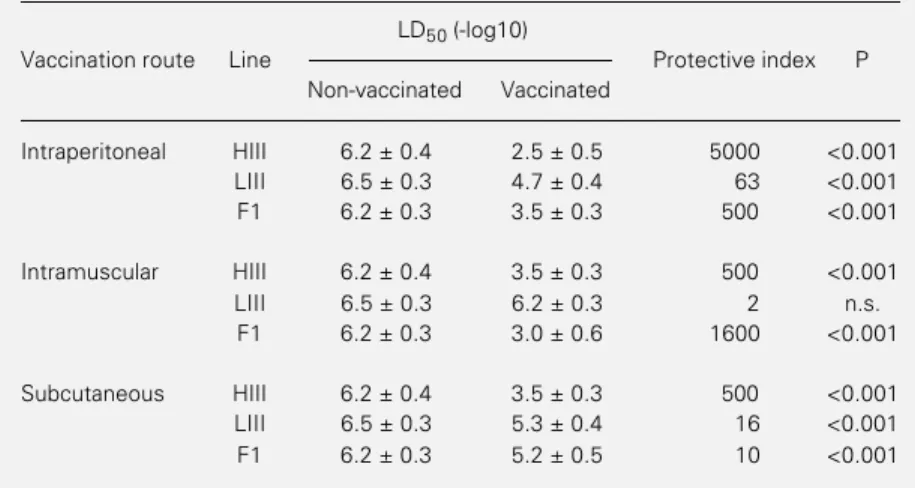
Table 2 shows the LD50 values for both
vaccinated and non-vaccinated
intracere-Table 2 - - - - - Fifty percent lethal dose (LD50) of rabies virus (CVS strain) in mice vaccinated by different routes and challenged intracerebrally.
Mice received two vaccine injections 2 days apart and were challenged 12 days after the second immunization by the intracerebral route. The number of mice in each group was 18. The protective index is the antilog of subtraction of the LD50/0.03 ml values for control and vaccinated mice. n.s., Nonsignificant.
LD50 (-log10)
Vaccination route Line Protective index P
Non-vaccinated Vaccinated
Intraperitoneal HIII 6.2 ± 0.4 2.5 ± 0.5 5000 <0.001
LIII 6.5 ± 0.3 4.7 ± 0.4 63 <0.001
F1 6.2 ± 0.3 3.5 ± 0.3 500 <0.001
Intramuscular HIII 6.2 ± 0.4 3.5 ± 0.3 500 <0.001
LIII 6.5 ± 0.3 6.2 ± 0.3 2 n.s.
F1 6.2 ± 0.3 3.0 ± 0.6 1600 <0.001
Subcutaneous HIII 6.2 ± 0.4 3.5 ± 0.3 500 <0.001
LIII 6.5 ± 0.3 5.3 ± 0.4 16 <0.001
brally challenged groups of mice from selec-tion III and the protective index (pi) calcu-lated by the difference between them. In mice vaccinated ip, a significant difference (P<0.001) was observed between H and L mice (80-fold), H and F1 (10-fold) and be-tween F1 and L mice (8-fold) in relation to the protective index. L mice did not present any protection when vaccinated im; there-fore, this route gave the maximal interline separation with a highly significant differ-ence (P<0.001) between H and L (250-fold) and between F1 and L (800-fold). The low-est interline difference in protective index was observed for subcutaneous vaccination with a statistically significant (P<0.001) dif-ference between H and L (32-fold) and be-tween H and F1 mice (50-fold) but almost no difference was observed between L and F1 (1.6-fold).
These results indicate that the intraperi-toneal route was the most immunogenic, probably due to the ip protocol employed during the selective process (8). In this case, the selective pressure may have been ex-pressed at the presenting cell level and/or at the level of their interactions with effector lymphocytes, as seen for other antigens (16). When vaccination was performed by the intraperitoneal and intramuscular route, F1 hybrids from selection III showed a behavior similar to that observed for HIII mice, while after subcutaneous vaccination, the LD50 was
similar to that obtained for L mice with a low but significant protective index.
The higher interline difference was
ob-tained after vaccination by the intramuscular route, since LIII mice did not show any response to the vaccine (pi = 2). F1 hybrids were more resistant than H mice after chal-lenge with the CVS strain (pi = 1,600). On the basis of the LD50 results for F1 hybrids, it
could be observed that there were distinct dominance effects on the “resistant” or “sus-ceptible” phenotypes which changed accord-ing to the route of inoculation, suggestaccord-ing the relevance of enviromental factors for the expression of these traits.
The present results suggest that the in-nate and acquired resistance against rabies virus involves genetic traits other than anti-body responsiveness or inflammatory apt-ness. In spite of the importance of the hu-moral response (7), we cannot exclude dif-ferences at the cellular level such as the effector role of macrophages, interferons and specific T lymphocytes in this infection. Thus, future investigations of these factors using the genetically selected mouse model will be important to determine host-infection inter-actions and some aspects of immunotherapy and vaccination efficacy.
Acknowledgments
References
1. Johnson HN & Charles NL (1940). Com-parative susceptibility of different strains of mice to rabies virus. American Journal of Hygiene, 32B: 38-45.
2. Baer GM, Cleary WF, Diaz AM & Perl DF (1977). Characteristics of 11 rabies virus isolates in mice: titers and relative inva-siveness of virus, incubation period of in-fection and survival of mice with sequel. Journal of Infectious Diseases, 136: 336-345.
3. Lodmell DL (1983). Genetic control of re-sistance to street rabies virus in mice. Journal of Experimental Medicine, 157: 451-460.
4. Lodmell DL & Chesebro B (1984). Murine resistance to street rabies virus: genetic analysis by testing second-backcross progeny and verification of allelic resis-tance genes in SJL/J and CBA/J mice. Journal of Virology, 50: 359-362. 5. Templeton JW, Holmberg C, Garber T &
Sharp RM (1986). Genetic control of se-rum neutralizing antibody response to ra-bies vaccination and survival after a rara-bies challenge infection in mice. Journal of Vi-rology, 59: 98-102.
6. Nilsson MR, Sant’Anna OA, Siqueira M, Nilsson TT & Gennari M (1979). Rabies virus immunity in genetically selected high and low responder lines of mice. Infection and Immunity, 25: 23-26. 7. De Franco M, Massa S, Vassão RC,
Siqueira M & Sant’Anna OA (1996). Poly-genic control of antibody production and correlation with vaccine induced resis-tance to rabies virus in high and low anti-body responder mice. Archives of Virol-ogy, 141: 1397-1406.
8. Siqueira M, Bandieri A, Reis MH, Sant’Anna OA & Biozzi G (1976). Selec-tive breedings of mice for antibody re-sponsiveness to flagellar and somatic an-tigens of Salmonellae. European Journal of Immunology, 6: 241-249.
9. Ibanez OM, Stiffel C, Ribeiro OM, Cabrera WK, Massa S, De Franco M, Sant’Anna OA, Decreusefond C, Mouton D, Siqueira M & Biozzi G (1992). Genetics of nonspe-cific immunity: I. Bi-directional selective breeding of lines of mice endowed with maximal and minimal inflammatory re-sponsiveness. European Journal of Im-munology, 22: 2555-2563.
10. Reed LJ & Muench H (1938). A simple method of estimating fifty percent end-points. American Journal of Hygiene, 27: 493-497.
11. Fuenzalida E & Palacius R (1955). Suck-ling mouse brain vaccine. Boletin del Instituto Bacteriológico de Chile, 8: 3-10. 12. Schwerdt CE & Merrel M (1952).
Preci-sion of measurement of Lansing virus in-fectivity in cotton rats. American Journal of Hygiene, 55: 268-275.
13. Consales CA, Mendonça RZ, Luchiari MA, Vassão RC & Pereira CA (1990). Macro-phage activity in rabies virus infection of genetically selected high and low antibody lines of mice. Research Virology, 141: 57-67.
14. Sant’Anna OA, Mouton D, Ibanez OM, Bouthillier Y, Mevel JC, Reis MH & Biozzi G (1985). Basal immunoglobulin serum concentration and isotype distribution in relation to the polygenic control of anti-body responsiveness in mice. Immuno-genetics, 22: 131-139.
15. Sant’Anna OA, Bouthillier Y, Mevel JC, De Franco M & Mouton D (1991). Isotypic distribution of antibody responses in lines of mice selected for high and low immu-noresponsiveness. Brazilian Journal of Medical and Biological Research, 24: 407-416.
16. Biozzi G, Mouton D, Stiffel C & Bouthillier Y (1984). A major role of the macrophage in quantitative genetic regulation of im-munoresponsiveness and anti-infectious immunity. Advances in Immunology, 36: 189-233.