Novel splice-affecting variants in
CYP27A1
gene in two Chilean patients
with Cerebrotendinous Xanthomatosis
Susan V. Smalley
1*, Yudith Preiss
1,2*, José Suazo
1,3, Javier Andrés Vega
1, Isidora Angellotti
1,
Carlos F. Lagos
4, Enzo Rivera
5,6, Karin Kleinsteuber
7,8, Javier Campion
9, J. Alfredo Martínez
9,
Alberto Maiz
1and José Luis Santos
11
Department of Nutrition, Diabetes and Metabolism, School of Medicine,
Pontificia Universidad Católica de Chile, Santiago, Chile.
2
School of Medicine, Universidad Diego Portales, Santiago, Chile.
3
Institute for Research in Dental Sciences, Faculty of Dentistry, Universidad de Chile, Santiago, Chile.
4
Department of Endocrinology, School of Medicine, Pontificia Universidad Católica de Chile,
Santiago, Chile.
5
Faculty of Medicine, Universidad de Valparaíso, Valparaíso, Chile.
6
Department of Neurology, Hospital Carlos Van Buren, Valparaíso, Chile.
7
Faculty of Medicine, Universidad de Chile, Santiago, Chile.
8
Clínica Las Condes, Santiago, Chile.
9
Department of Food Sciences and Physiology, Universidad de Navarra, Pamplona, Spain.
Abstract
Cerebrotendinous Xanthomatosis (CTX), a rare lipid storage disorder, is caused by recessive loss-of-function muta-tions of the 27-sterol hydroxylase (CYP27A1), producing an alteration of the synthesis of bile acids, with an accumu-lation of cholestanol. Clinical characteristics include juvenile cataracts, diarrhea, tendon xanthomas, cognitive impairment and other neurological manifestations. Early diagnosis is critical, because treatment with
cheno-deoxycholic acid may prevent neurological damage. We studied theCYP27A1 gene in two Chilean CTX patients by
sequencing its nine exons, exon-intron boundaries, and cDNA from peripheral blood mononuclear cells. Patient 1 is a compound heterozygote for the novel substitution c.256-1G > T that causes exon 2 skipping, leading to a prema-ture stop codon in exon 3, and for the previously-known pathogenic mutation c.1183C > T (p.Arg395Cys). Patient 2 is homozygous for the novel mutation c.1185-1G > A that causes exon 7 skipping and the generation of a premature stop codon in exon 8, leading to the loss of the crucial adrenoxin binding domain of CYP27A1.
Keywords: Cerebrotendinous Xanthomatosis, splicing, mutation, exon skipping.
Received: March 13, 2014; Accepted: October 10, 2014.
Introduction
Cerebrotendinous xanthomatosis (CTX) [MIM #213700] is an autosomal recessive disease caused by mu-tations in theCYP27A1gene, which encodes the mitochon-drial enzyme 27-sterol hydroxylase (EC 1.14.13.15) in-volved in bile acid synthesis. The primary bile acids cholic acid (CA) and chenodeoxycholic acid (CDCA) are synthe-sized by two complementary chemical pathways: the clas-sic “neutral pathway”, considered as the main producer of bile acids (approximately 50% CA and CDCA) and an
al-ternative “acidic pathway” leading to CDCA synthesis. The 27-sterol hydroxylase encoded byCYP27A1catalyzes the initial step in the acidic pathway, with the C27-hydroxy-lation of cholesterol oxidation of the side chain sterol inter-mediates in bile acid formation (Sundaramet al., 2008). As a consequence of inherited genomic defects inCYP27A1, there is an alteration of the production of bile acids, mainly decreasing CDCA production. The immediate conse-quence of this genetic defect is the compensatory increase in the activity of the rate-limiting enzyme in the neutral bile acid synthesis pathway, cholesterol 7a-hydroxylase, lead-ing to the accumulation of 7a-hydroxylated bile acid pre-cursors, in particular 7a-hydroxy-4-cholesten-3-one. This molecule is a precursor of cholestanol, which is elevated in the plasma of CTX patients, as well as an increase in
Send correspondence to José Luis Santos. Department of Nutri-tion, Diabetes and Metabolism, School of Medicine, Pontificia Uni-versidad Católica de Chile, Alameda 340, Santiago, Chile. E-mail: [email protected].
plasma cholestanol/cholesterol ratio (Björkhem and Hans-son, 2010). Consequently, these molecules are abnormally deposited in different tissues such as central nervous sys-tem (CNS) and crystalline lens (Khanet al., 2013).
CTX diagnosis is based on clinical grounds. Re-cently, an Italian group of experts in CTX has proposed a suspicion index for early diagnosis (Mignarriet al., 2014). Elevated levels of cholestanol levels in serum, high bile al-cohol levels in urine and genetic testing, confirm the diag-nosis. According to the literature, there is no established genotype-phenotype correlation pattern in CTX. (Leeet al., 2001).
At early stages of CTX, symptoms are childhood di-arrhea and bilateral cataracts, which are usually diagnosed during the first or second decade of life (Cenedella, 1996; Moghadasianet al., 2002; Pilo-de-la-Fuenteet al., 2011). In more advanced stages, the disease is characterized by tendom xanthomas as well as the presence of progressive neurologic dysfunction signs that usually occur during the second and the third decade of life. Less frequently, the presence of seizures, coronary heart disease and early ath-erosclerosis has been also described (Dottiet al., 2000).
Although the prevalence of the disease has been roughly estimated in 1/50,000 (Salenet al., 1983), this fig-ure varies by ethnicity and geographic location. In popula-tions of Sephardic Jews of Moroccan origin, a prevalence of 1/108 has been described (Berginer and Abeliovich, 1981), while in Caucasian populations of the United States of America, the estimated prevalence is approximately 3-5/100,000 (Lorinczet al., 2005). There are, so far, more than 50 different CYP27A1 mutations published (http://www.hgmd.org). In Chile, two CTX patients have been previously reported (Filippiet al., 2009; Huijgen et al., 2012). The aim of the present report is to describe the genetic, molecular and clinical characteristics of two Chil-ean CTX patients.
Subjects and Methods
Clinical description of patients
This study was approved by the Ethical Review Board of the School of Medicine of the Pontificia Universidad Católica de Chile. Written informed consent was signed by patients and relatives.
Patient 1: female, 42 years old. No history of consan-guinity. History of unexplained chronic diarrhea and bilat-eral cataracts diagnosed at age of 5 and operated in child-hood. Since age of 28 she developed paraparesis and progressive difficulty to walk.Neurological examination in that moment showedbilateral pyramidal syndrome, cere-bellar syndrome and deep sensory deficit in lower extremi-ties. Brain magnetic resonance imaging (MRI) showed involutive signs incerebellar and bilateral frontal regions, with white matter involvement bulb and cerebellum. An electrophysiological study of the lower extremities showed
signs of chronic sensorymotorpolyneuropathy. Laboratory tests showed negative results for HIV, HTLV-1, and VDRL. Plasma B12 and folic acid levels were normal. Thy-roid function was normal. The patient showed a normal lipid profile,exceptfor slightly elevated high density lipo-protein cholesterol (HDL-C) (74.6 mg/dL). At age of 31, CTX was suspected, although without presenting typical tendinous xanthomas. This patient showed a concentration of 64mmol/L of plasma cholestanol reported from an exter-nal laboratory (normal values: 2-12.6mmol/L). At the mo-ment of recruitmo-ment for this study, the patient isprostra-ted,with a severe spastic tetraparesis, flexor pattern of the four limbs, severe dysphagia that required installation of a percutaneous endoscopic gastrostomy. There is no clinical data of her bone condition at the moment of diagnosis. Due to her clinical condition, it was not possible to perform a bone densitometry at the moment of the recruitment.
Patient 2: male, 17 years old. Patient was adopted at age of 5 months and no data of his biological parents are available. He was hypotonic at infancy, without feeding or respiratory impairments. He had motor and developmental delay, with independent walking after 2.5 years old and lan-guage (phrases) after 2 years old. Mother refers frequent stools (twice daily with low consistency by periods) since toddler. Difficulties in visual acuity were noticed at the age of 10 years. Miopic astigmatism and bilateral cataracts were diagnosed at 13 years old. On neurologic examina-tion, the following signs were evident: macrocephaly, dys-morphic signs with mild facial hypomimia, distal hypotrophy in lower limbs; xanthomas on Achilles tendons (both) and one on left triceps tendon. He had speaking, reading, writing and drawing difficulties and distal paresis with hyperreflexia with no spasticity in lower limbs. Fine hands tremor; difficulty in walking on heels and subtle in-stability in turns were evident. Brain MRI revealed T2 sig-nal abnormalities on cerebellar hemispheric white matter. Thyroid function was normal. Bone densitometry showed low bone mineral mass in both hips and normal spine val-ues (Left femoral neck Z-score -3.3; right femoral neck Z-score -3.2). Levels of 25(OH) vitamin D were 14.2 ng/mL (normal values: 20-60 ng/mL). Plasma choles-tanol levels were analyzed in an external laboratory yield-ing a result of 2.6 mg/dL (normal values 0.17±0.12 mg/dL, for children 3-16 years), thus confirming the diagnosis.
Molecular and bioinformatic methods
Genomic sequence variation was described according to the guidelines of the Human Genome Variation Society (Den Dunnen and Antonarakis, 2000).
To assess the possible impact of the amino acid sub-stitution p.Arg395Cys on protein structure and function, we used the Polyphen-2 and PROVEAN (v1.1) programs (Adzhubeiet al., 2010; Choiet al., 2012). The two novel intronic mutations found in our patients (Table 1) disrupt the canonical splicing 3’ acceptor site. Subsequently, we used the Human Splicing finder (HSF) software (Desmetet al., 2009), which predicts the effect of the splice affecting variants with high accuracy based on position weight matri-ces. Natural splice sites (5’and 3’), branch points and exonic splice enhancers among others are assigned with consensus values. A delta Consensus Value (DCV) of the splice sites strength > 10% is likely to have an impact on splicing (Desmetet al., 2009). When mutations affecting intron positions -1,-2, +1 or +2 occur, the probability of exon skipping, the use of pseudo 3’ or 5’ splice sites, reten-tion of the mutated intron or cryptic splice sites, among oth-ers, is higher (Faustino and Cooper, 2003).
Results
We found three different mutations in theCYP27A1
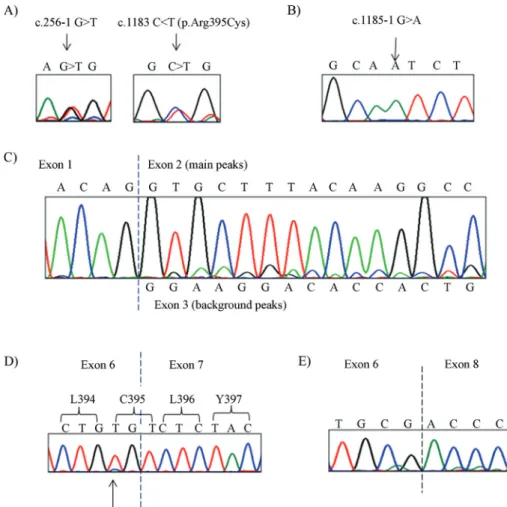
gene, listed in Table 1. Patient 1 is a compound hetero-zygote harboring the novel mutation c.256-1G > T and the previously described missense mutation c.1183 C > T (p.Arg395Cys), shown in Figure 1A. Patient 2 is homozy-gous for the novel mutation c.1185-1G > A, shown in Fig-ure 1B. We have registered the newCYP27A1mutations in the Leiden Open Variation Database with accession num-bers as following c.256-1G > T: # DB_ID:CYP27A1_00069, and c-1185-1G > A: # DB_ID:CYP27A1_00068. The third mutation c.1183C > T or p.Arg395Cys (patient 1) has accession number: # DB_ID:CYP27A1_00004 (http://www.lovd.nl/3.0/home), is shown in Figure 1A.
The analysis of the novel mutation c.256-1G > T on the splicing process, using the HSF program, predicted that the nucleotide T lowers the strength (DCV -32.9%) of the natural splicing acceptor 3’ site (AG > AT) and also seems to swop the 3’ site to a 5’ donor site with aDCV -14.0. This would predict a highly plausible skipping of exon 2 (191 nucleotides long). This imprecise splicing may shift the reading frame creating a new amino acid sequence of 30 residues containing a premature stop codon (GRTPLVPAAPGSEPAVAEASGSSALYGCFQ*).
In order to demonstrate the effect of the mutations found in patient 1, we reverse transcribed total RNA ex-tracted from leukocytes of peripheral blood. The cDNA was amplified and sequenced in two segments: exon 1 to 4, and exon 5 to 9. The sequence was concordant with the compound heterozygote genotype found in the genomic DNA, as both mutations were present. The cDNA sequence Table
of exon 1 to 4 of showed the extended haplotype sequence containing the intronic mutation c.256-1G > T and the nor-mal haplotype. The main peaks correspond to the nucleo-tide sequence of exon 2, while the weak background peaks of the sequence correspond to the nucleotide sequence of exon 3 (Figure 1C). This result indicates that exon 2 is in-correctly spliced and exon 1 is joined to exon 3 in the ex-tended haplotype carrying the c.256-1G > T mutation. Thus, we have demonstrated the existence of exon skip-ping, which was previously predicted by the HSF program. The mutation c.256-1G > T has been named as p.Val86Glyfs30Ter (Table 1).
Patient 1 cDNA also carry the c.1183C > T (p.Arg395Cys) variant, which is located in the cDNA se-quence corresponding to a TGT codon, codifying for cysteine, as shown in Figure 1D. The first two nucleotides of this codon come from exon 6 and the third nucleotide co-mes from exon 7, with the c.1183C > T mutation thus being located in the penultimate site of exon 6. The cDNA se-quence analysis showed that there is no splice defect de-rived from this mutation, given that exon 6 is correctly
joined with exon 7. On the other hand, the c.1183C > T mu-tation generates a change in the amino acid sequence (p.Arg395Cys) previously known to be pathogenic. Ac-cording to bioinformatics predictions, Polyphen-2 showed that p.Arg395Cys was “probably damaging” with the high-est score possible of 1.0 (range 0.0 to 1.0). The tridimen-sional model of CYP27A1 (±A) shows that Arg395 interacts with Phe438 by pi-cationic interaction and is also involved in h-bond interactions with the carboxyl group of Glu392 and the main-chain nitrogen from Pro441 (Figure 2B upper panel).
We found the novel mutation c.1185-1G > A in the “-1” site of intron 6 in homozygous state in patient 2 (Fig-ure 1B). The analysis of this mutation using HSF software showed a decrease in the strength of the 3’ splice site (DCV -30.7%) and MaxEnt revealed a DCV of -119.7% in strength variation. Both values can be considered strong ev-idence to predict a splice defect. Following the same proce-dure used in Patient 1, we reverse transcribed total RNA and amplified and sequenced the cDNA from patient 2. The cDNA sequence of exon 5 to exon 9 of CYP27A1 of patient
Figure 1- Genomic and cDNA sequences showing case 1 and case 2 mutations.A) Case 1 genomic sequence showing heterozygote mutations. Black
2 shows that exon 6 is joined to exon 8 (Figure 1E), demon-strating that the homozygous mutation did affect normal splicing of exon 7. We expect that the mutated protein loses 136 amino acids of the original sequence and only pre-serves sequence identity up to Arg395, after this position there is a new sequence of 28 amino acids (PSLCSATMWCPGTPLPSLSLKASSPTAG*), which fi-nalizes with a premature stop codon, generating a predicted truncated protein of 423 amino acids. The nomenclature for this mutation is p.Leu396ProfsTer28 (Table 1).
Discussion
As a consequence of the metabolic impairments ob-served in Cerebrotendinous xanthomatosis, it has been pro-posed that the primary treatment of this disease would be oral CDCA administration, which is reported to decrease plasma cholestanol levels (Sundaramet al., 2008). Statins may also produce a synergistic effect by lowering the cho-lesterol pool and improving the clinical response (Wattset al., 1996; Verripset al., 1999; Federico and Dotti, 2003).
Patient 1 is a compound heterozygote for two
CYP27A1variants: c.256-1G > T and the missense tion c.1183C > T (p.Arg395Cys). The c.256-1G > T muta-tion has not been previously reported in other case series. We show here molecular evidence based on cDNA analysis that such a mutation leads to a splice defect, also supported by bioinformatics analysis. In this context, the c.256-1G > T mutation causes exon 2 skipping and a premature stop codon in exon 3 (p.Val86Glyfs30Ter). The second muta-tion found in patient 1 (c.1183C > T), alters the protein
se-quence (p.Arg395Cys). This mutation (also termed p.Arg362Cys) is the most common mutation found in CTX patients of Spanish origin (Pilo de la Fuenteet al., 2011). It is very likely that its presence in Chile is derived from mi-grations from Spain, one of the main population contribu-tors to the current Chilean population. It was shown by Cali
et al.(1991) that the p.Arg395Cys mutation dramatically reduces enzyme activity. In our study, we provide support to this observation using bioinformatics tools. According to our tridimensional protein model, position 395 is located within the ERR triad, which may act as a folding motif, sta-bilizing heme binding and redox partner binding (Prosseret al., 2006). It is predicted that mutation in Cys395 may in-crease distances and the loosened interactions may favor misfolding, thus affecting adrenoxin (ADX) binding (Fig-ure 2B lower panel).
It is worthy of note that the mutation c.Arg395Ser is located in the same genomic position (penultimate nucleo-tide of exon 6) as the c.Arg395Cys (codon CGT to TGT; c.1183C > T) (Chenet al.(1998). Given the special loca-tion of this mutaloca-tion in the exon-intron boundary, Chenet al.(1998) proposed that the c.Arg395Ser mutation may af-fect normal splicing and gene expression efficiency, imply-ing that this specific genomic DNA position may also affect gene expression in other mutations located in the same genomic site. As far as we know, there are no reports as-sessing the possible impact of the mutation c.1183C > T on gene expression or the splicing process. Although we have not determined whether c.1183C > T affects gene expres-sion efficiency, we show here that the sequence containing the c.1183C > T mutation is fully transcribed (Figure 1D).
Figure 2- CYP27A1 modeling. A) Tridimensional model of wild type protein CYP27A1 showing HEM group and position of Arg395. B (upper panel):
Therefore, it is very likely that the sole effect of the amino acid change generated by the amino acid change c.Arg395Cys is sufficient to impair enzyme activity and cause CTX (Caliet al., 1991).
Regarding the c.1185-1G > A mutation found in ho-mozygous state in patient 2, we also show bioinformatic and molecular evidence supporting a role in theCYP27A1
splicing process. We show that this mutation causes exon 7 skipping and the generation of a premature stop codon in exon 8. As a consequence, the protein lacks the two binding domains for its cofactors adrenodoxin (ADX) and ADX reductase, as well as relevant residues for HEM coordina-tion such as Cys476. It is also possible that this patient lacks the CYP27A1 protein, as the stop codon generated by exon skipping is located > 55 nucleotides upstream of the most 3’ exon-exon junction, possibly leading the activation of the Nonsense-Mediated mRNA Decay (NMD) surveillance pathway (Karamet al., 2013).
It is necessary to emphasize the importance of clinical and biochemical CTX screening in young patients with early disease signs, such as neonatal cholestatic jaundice, childhood diarrhea, and congenital or juvenile bilateral cat-aracts, given that a treatment with CDCA is available. In the absence of national screening programs, ophthalmolo-gical findings in patients with CTX are interesting since they are one of the first signs of the disease, often before di-agnosis of CTX is made. It is important to emphasize that early treatment during childhood and before CNS deposits appear, may avoid progression of the disease.
In conclusion, we have reported herein the genetic, molecular and clinical characteristics of two Chilean CTX cases, showing two novel splice-affecting variants in the
CYP27A1gene. Since CTX is a treatable disease, we pro-pose to screen new CTX cases among children with early disease signs, such as bilateral cataracts, followed by test-ing their plasma cholestanol levels and searchtest-ing mutations in theCYP27A1gene in the patients who are positive for biochemical screening.
Acknowledgments
Supported by Dirección de Investigación (School of Medicine, Pontificia Universidad Católica de Chile) and the Department of Nutrition, Diabetes and Metabolism (School of Medicine, Pontificia Universidad Católica de Chile). We would like to thank patients and their parents for their collaboration.
References
Adzhubei IA, Schmidt S, Peshkin L, Ramensky VE, Gerasimova A, Bork P, Kondrashov AS and Sunyaev SR (2010) A method and server for predicting damaging missense muta-tions. Nat Methods 7:248-249.
Berginer VM and Abeliovich D (1981) Genetics of cerebro-tendinous xanthomatosis (CTX) an autosomal recessive trait
with high gene frequency in sephardic of moroccan origin. Am J Med Genet 10:151-157.
Björkhem I and Hansson M (2010) Cerebrotendinous xantho-matosis: An inborn error in bile acid synthesis with defined mutations but still a challenge. Biochem Biophys Res Com-mun 396:46-49.
Cali JJ, Hsieh CL, Francke U and Russell DW (1991) Mutations in the bile acid biosynthetic enzyme sterol 27-hydroxylase un-derlie cerebrotendinous xanthomatosis. J Biol Chem 266:7779-7783.
Cenedella RJ (1996) Cholesterol and cataracts. Surv Ophthalmol 40:320-337.
Chen W, Kubota S, Ujike H, Ishihara T and Seyama Y (1998) A novel Arg362Ser mutation in the sterol 27-hydroxylase gene (CYP27): Its effects on pre-mRNA splicing and enzyme ac-tivity. Biochemistry 37:15050-15056.
Choi Y, Sims GE, Murphy S, Miller JR and Chan AP (2012) Pre-dicting the functional effect of amino acid substitutions and indels. PLoS One 7:e46688.
Den Dunnen JT and Antonarakis SE (2000) Mutation nomencla-ture extensions and suggestions to describe complex muta-tions: A discussion. Hum Mutat 15:7-12.
Desmet FO, Hamroun D, Lalande M, Collod-Beroud G, Claustres M and Beroud C (2009) Human Splicing Finder: An online bioinformatics tool to predict splicing signals. Nucleic Acid Res 37:e67.
Dotti MT, Federico A, Garuti R and Calandra S (2000) Cerebro-tendinous xanthomatosis with predominant Parkinsonian syndrome: Further confirmation of the clinical heterogene-ity. Mov Disord 15:1017-1019.
Faustino NA and Cooper TA (2003) Pre-mRNA splicing and hu-man disease. Genes Dev 17:419-437.
Filippi J, Irarrázaval S, Peredo P and Mellado P (2009) Cerebro-tendinous xanthomatosis: Report of one case. Rev Med Chile 137:815-820.
Huijgen R, Stork AD, Defesche JC, Peter J, Alonso R, Cuevas A, Kastelein JJ, Duran M and Stroes ES (2012) Extreme xanthomatosis in patients with both familial hypercholester-olemia and cerebrotendinous xanthomatosis. Clin Genet 81:24-28.
Karam R, Wengrod J, Gardner LB and Wilkinson MF (2013) Reg-ulation of nonsense-mediated mRNA decay: Implications for physiology and disease. Biochim Biophys Acta 1829:624-633.
Khan AO, Aldahmesh MA, Mohamed JY and Alkuraya FS (2013) Juvenile cataract morphology in 3 siblings not yet diagnosed with cerebrotendinous xanthomatosis. Ophthalmology 120:956-960.
Lee MH, Hazard S, Carpten JD, Yi S, Cohen J, Gerhardt GT, Salen G and Patel SB (2001) Fine-mapping, mutation analy-ses, and structural mapping of cerebrotendinous xantho-matosis in U.S. pedigrees. J Lipid Res 42:159-169. Lorincz MT, Rainier S, Thomas D and Fink JK (2005)
Cerebro-tendinous xanthomatosis: Possible higher prevalence than previously recognized. Arch Neurol 62:1459-1463. Mignarri A, Gallus GN, Dotti MT and Federico A (2014) A
suspi-cion index for early diagnosis and treatment of cerebro-tendinous xanthomatosis. J Inherit Metab Dis 37:421-429. Moghadasian MH, Salen G, Frohlich JJ and Scudamore CH
Pilo-de-la-Fuente B, Jimenez-Escrig A, Lorenzo JR, Pardo J, Arias M, Ares-Luque A, Duarte J, Muñiz-Pérez S and Sobri-do MJ (2011) Cerebrotendinous xanthomatosis in Spain: Clinical, prognostic, and genetic survey. Eur J Neurol 18:1203-1211.
Prosser DE, Guo Y, Jia Z and Jones G (2006) Structural mo-tif-based homology modeling of CYP27A1 and site-directed mutational analyses affecting vitamin D hydroxylation. Bio-phys J 90:3389-3409.
Salen G, Shefer S and Berginer VM (1983) Familial diseases with storage of sterols other than cholesterol: Cerebrotendinous xanthomatosis and sitosterolemia with xanthomatosis. In: Stanbury JB, Wyngaarden JB, Fredrickson DS, Goldstein JL and Brown MS (eds) The Metabolic Basis of Inherited Dis-ease. 5thedition. McGraw-Hill, New York, pp 713-730.
Sundaram SS, Bove KE, Lovell MA and Sokol RJ (2008) Mecha-nisms of disease: Inborn errors of bile acid synthesis. Nat Clin Pract Gastroenterol Hepatol 5:456-468.
Verrips A, Wevers RA, Van Engelen BG, Keyser A, Wolthers BG, Barkhof F, Stalenhoef A, De Graaf R, Janssen-Zijlstra F, Van Spreeken A,et al.(1999) Effect of simvastatin in ad-dition to chenodeoxycholic acid in patients with cerebro-tendinous xanthomatosis. Metabolism 48:233-238. Watts GF, Mitchell WD, Bending JJ, Reshef A and Leitersdorf E
(1996) Cerebrotendinous xanthomatosis: A family study of sterol 27-hydroxylase mutations and pharmacotherapy. QJM 89:55-63.
Associate Editor: Mara H. Hutz