FREE THEMES
1 Departamento de Odontologia, Centro de Ciências Básicas e da Saúde, Universidade Estadual de Montes Claros. Av. Dr. Rui Braga s/n, Vila Mauricéia. 39401-089 Montes Claros MG Brasil. martins. [email protected] 2 Faculdade de Odontologia de Piracicaba, Universidade Estadual de Campinas. Piracicaba SP Brasil. 3 Departamento de Medicina, Faculdades Unidas do Norte de Minas. Montes Claros MG Brasil.
Is there an association between the presence of dental fluorosis
and dental trauma amongst school children?
Abstract Our objective was to evaluate whether there is an association with the different levels of dental fluorosis and the presence of dental trau-ma amongst school children. A transversal study was conducted amongst school children from the age of 12. Dental examinations were conducted by 24 well trained and fully qualified dental surgeons. Data was collected from 36 randomly selected pub-lic schools amongst 89 schools in a municipality. The criteria used to diagnose dental fluorosis was based on the Dean’s fluorosis Index and for diag-nosing dental trauma we looked for clinical signs of crown fractures and dental avulsions. Multiple descriptive analysis, which was bivariate, was car-ried out. Amongst the 2,755 school children that took part in the study 1,089 (39.6%) were diag-nosed with dental fluorosis and 106 (3.8%) had one tooth or more with dental trauma. We noted a high prevalence of dental fluorosis, independent of the level of severity, amongst individuals with one tooth or more who had dental trauma. This asso-ciation was even more evident where there were severely high levels of fluorosis. We also noted that the presence of fluorosis was greater amongst those that actively paid more attention to discoloration on their teeth and who received treatment from a dental professional at their schools. Nevertheless dental fluorosis was associated with the presence of dental trauma, independent of its severity.
Key words Oral Hygiene, Fluorosis, Dental
trau-ma, Epidemiology Lorenna Fonseca Braga de Oliveira 1
João Gabriel Silva Souza 2
Rafael Inácio Pompeu Mendes 3
Rodrigo Caldeira Nunes Oliveira 1
Carolina de Castro Oliveira 1
Carolina Veloso Lima 2
O
li
v
e
ir
Introduction
Fluoride (fluorine) has been noted as one of the main minerals that prevents and controls
den-tal cavities1,2. The wholesale use of fluoride has
contributed to the exponential decline in dental
related diseases3-5. Notwithstanding the obvious
benefits of fluoride, it is necessary to be attentive to this ion having possible toxic effects in organ-isms if it is used in quantities beyond recom-mended doses. It was highlighted that this toxic effect can be classified as acute and chronic. It is deemed as chronic when, having ingested it on a frequent basis during the period when your teeth
are in development, dental fluorosis occurs6,7.
Dental fluorosis is diagnosed based on the porosity levels in the structure of the teeth
(hy-pomineralization)7. It becoming aesthetically
noticeable depends on the level of doses that the person has taken. Its prevalence in different countries varies widely with percentages ranging
from: 16.7% in Brazil8, 27.2% in Australia9 and
82.0% in India10. Where it exists, the levels of
flu-orosis are generally low. Its potential to harm is based on the concentration of fluoride from the plasma which is influenced by the total ingestion of fluorine. It is also influenced by: the type of ingestion that takes place, the functioning of the
renal system and metabolic activity11. Clinically
speaking, fluorosis can vary in degree from mak-ing the teeth’s enamel appear opaque to more
se-vere cases where brown blotches appear11.
Histologically speaking, fluorite enamel is very porous and hypomineralized. It contents a high level of prosthetic matrix and this becomes particularly evident when the quantity of
fluoro-sis reaches dangerous levels11,12. Aside from this,
teeth with high levels of fluorosis can be more susceptible to deterioration which is probably due to surface irregularities or the loss of the
ex-ternal protective layer11,12. Taking the
aforemen-tioned into consideration, the question remains whether fluorite enamel is not made “more frag-ile” owing to the existence and worsening of inju-ries from different external impacts such as those related to dental trauma.
Up until this moment in time no identifi-cation has been made between the presence of dental fluorosis and dental trauma in epidemio-logical studies done on populations in this area. Therefore this present study sought to investigate if the presence of dental fluorosis at dangerously high levels has any associations with dental trau-ma amongst school children.
Methodology
Details of the Study Parameters and the Sample Used
This transversal study was conducted amongst school children from the age of 12 in Montes Claros (Minas Gerais - Brazil) in a Bra-zilian municipality that has a large population. Information was obtained from the Epidemio-logical Study on the Oral Hygiene of the
popula-tion of Montes Claros (hereafter SBMOC)13 done
in 2010, following the criteria adopted at SB
Bra-zil 2002/200314 and which was recommended by
WHO15. We decided to use children from the age
of 12 since, at the time of this study, this was the age when children finished primary school. Also in many countries it is the last age where it is pos-sible to obtain reliable samples through school
systems15. The dental examinations were done
by highly trained and qualified dental surgeons (Kappa inter-examiners and intra-examiners
and the correlation coefficient intra-class ≥ 0.61)
with the support of interviewers/note takers. It was conducted in a well-lit area that had natural light with the use of a mirror and a CPI sterilized probe.
The first phase of the study was done with school children from the age of 12 (n = 357 school children) in which we identified the prevalence of dental cavities (39.2%) and fluorosis (49.0%). We did our calculations on a representative sam-ple of school children from the age of 12 in the municipality. They were not representatives with
reference to these problems13,16.Data was
collect-ed from 36 randomly selectcollect-ed public schools out of 89 schools in the municipality. This was the number needed to obtain a representative sam-ple. We included in this study school children that were evaluated with reference to the pres-ence or abspres-ence of dental fluorosis.
Evaluated Conditions
Dental fluorosis
We registered the existence of fluorosis through following the recommendations from
the WHO15 by using the Dean’s fluorosis Index.
The index is based on the visual aspects of the dental enamel ranging from
normal/question-able to severe. It has six categories17. In terms of
e C
ole
tiv
a,
21(3):967-976,
2016
WHO15 recommendations. A construction of
the dependent variables was done based on the variable outcome with the presence of fluorosis. Due to uncertain diagnosis, the condition con-sidered normal (without fluorosis) was under-stood through putting together the “normal” and “questionable” scores. This parameter has been
used in other previous studies18,19. Two variable
dependents were made with the first giving con-sideration to the presence of fluorosis based on putting together the “low” and “very low” scores (with fluorosis). For the second, the presence was characterized by putting together the “moderate” and “severe” scores (with fluorosis). Both were compared to the absence of fluorosis (normal/ questionable).
Dental Trauma
An evaluation of dental trauma took into account proposed criteria given by the WHO in
199715 for epidemiological studies in oral health
and it used the SB Brazil 2002/200314. This
in-cluded clinical signs of crown fractures and den-tal avulsions for the top incisors and the bottom permanent ones. Based on the clinical criteria used, we evaluated: the presence of fractures of the enamel (a small loss of a portion of the crown around the enamel), fractures of the enamel and dentine (a loss of the greater part of the crown around the enamel and dentine), fractures of the enamel and dentine with exposure to the pulp (loss of the greater part of the crown around the enamel, dentine and exposure to the pulp) and the absence of a tooth owing to trauma (due to dental avulsion).
In the present study the variable was present-ed in a dichotomous way. This is because for cas-es involving dental trauma on at least one tooth, irrespective of the type of fracture, it was char-acterized as dental trauma on one or more teeth. Where no teeth were affected by dental trauma, this fact was recorded as “absence of dental trau-ma”.
Independent Variables
The rest of the independent variables were put together in four groups, with their respective subcategories namely: personal determinants, health services/health costs, behavior related to health and health outcomes.
The personal determinants were: sex (female, male), race was self-declared (white/Asian, indig-enous(native South American)/black/mix-race) and type of abode (your own or not). The
vari-ables that related to health services/health costs were: the use of odontological services (yes/no), the type of odontological services used (pub-lic, private/business agreement/philanthropy), the reasons for using the odontological services (routine check-ups, booked treatments), access to oral health guidance through odontological services (yes, no) and odontological assistance at school (no, yes). Behavior related to health was evaluated: the frequency of daily oral hygiene care (2 times or more, once), the means used to ensure oral hygiene (brushing teeth and doing other things, just brushing teeth) and rinsing the mouth with fluoride at school (yes, no). In rela-tion to health care outcomes, we considered as a normal condition, the presence of tooth decay (0, 1 or more teeth). The subjective conditions for oral health that were evaluated were: self-percep-tion of the presence of teeth stains (no/yes), the need for treatment (no, yes) and satisfaction with their teeth’s appearance (yes, no).
Statistical Analysis and Ethical Considerations
In order to analyze the data we used the
soft-ware SPSS® Statistics 18.0. Descriptive analysis
was used in order to obtain the absolute and relative (%) frequencies (n) of the variables. Af-ter this, bivariate analysis was done where con-sideration was given for multiple analysis of the variables that presented significant levels (val-ue-p) that were equal to or less than 0.20. We used logistic regression to estimate the odds ratio with the significant level of 5% and confidence intervals at 95% (OR/CI 95%) for the variables associated to the presence of dental fluorosis. This remained in the models for variables with significant levels of up to 5%. The main ethical issues for this study were deemed to be in accor-dance with the National Council Resolution for Health (hereafter CNS) in Brazil number 196/96, under the approval of the Ethics Committee for Research Ethics (hereafter CEP/Unimontes.) All of the participants in the study agreed to take part in the tests and they signed a consent form demonstrating that decided to take part based on their own free will.
Results
O
li
v
e
ir
having dental fluorosis in at least one of the levels (low or severe). With reference to dental trauma, only 106 of the school children had one or more teeth with this condition (3.8%). The majority of the school children were: female (53.2%) and self-declared themselves as being indigenous na-tive South Americans/black/mix-raced (79.3%), who used public odontological services (62.1%) and who did not receive odontological assistance at school (50.6%) (Table 1).
In the bivariate analysis the presence of low/ very low levels of fluorosis was found which was
statistically associated (p ≤ 0,20) with variables
belonging to dental trauma, health services,
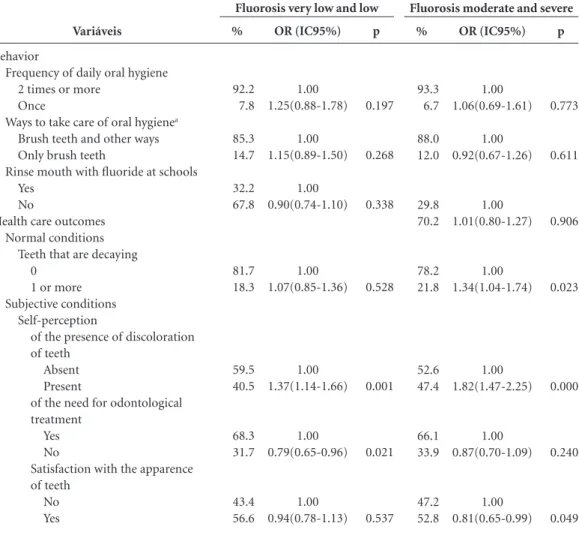
be-havior and health care outcomes. The level of fluorosis being moderate/ severe was different in relation to the other levels being very low or low because there associations were maintained. This was also the case for the personal determinants and the health care outcomes (Table 2).
In the multiple analysis we identified that the presence of dental fluorosis was very low/low and this was the case for school children with one or more teeth with dental trauma (p = 0,029). They had the self-perception of the presence of stains on their teeth (p = 0.001). In relation to fluoro-sis levels being moderate/severe its prevalence was greater amongst school children with one
Variables Dental fluorosis Normal Questionable Very low Low Moderate Severe
Principal independent variable Teeth with dental trauma
0 1 or more Personal determinants
Gender Female Male
Race self-declareda
White
Asian, indigenous (native South American), black and mix-raced Health services / health costs
Use of odontological services Yes
No
The type of odontological service usedb
Public (SUS)
Private/ Business agreement/ Philanthropy
Reason for using odontological serviceb
Routine Check-up
Appointment for prearranged treatment
Access to guidance on oral hygiene at odontological clinicsb
Yes No n 1632 34 448 192 276 173 2649 106 1466 1288 568 2182 2516 239 1562 654 1032 1484 2435 80 % 59.2 1.2 16.3 7.0 10.0 6.3 96.2 3.8 53.2 46.8 20.7 79.3 91.3 8.7 62.1 37.9 41.0 59.0 96.8 3.2
Table 1. The existence of dental fluorosis and the other independent variables amongst school children in
Montes Claros (MG - Brazil) 2008/2009. n = 2755.
Variables
Receive odontological assistance at school
No Yes
Behavior related to health Frequency of daily oral hygiene
2 times or more Once
Ways to take care of oral hygiene Brush teeth and other ways (dental floss, use of mouthwash, clean tongue)
Only brush teeth
Rinse mouth with fluoride at schools Yes
No
Health care outcomes
Normal conditions for oral health Teeth that are decaying 0
1 or more
Subjective conditions for oral health Self-perception of the presence of discoloration of teeth
Absent Present
Self-perception of the need for odontological treatment
Yes No
Satisfaction with the apparence of teeth No Yes n 1395 1360 2569 185 2389 363 842 1913 254 501 1732 1023 1786 106 1190 1565 % 50.6 49.4 93.3 6.7 86.8 13.2 30.6 69.4 81.8 18.2 62.9 37.1 96.2 3.8 43.2 56.8
e C
ole
tiv
a,
21(3):967-976,
2016
or more teeth with dental trauma (p = 0.001). Within the same group they received odontolog-ical assistance at school (p = 0.021) and they had self-perception of the presence of stains on their teeth (p = 0.000) (Table 3).
In relation to the distribution of the presence of dental trauma in accordance with the serious-ness of the dental fluorosis, we noted that mod-erate levels of fluorosis were most prevalent for dental trauma (Graphic 1).
Discussion
The prevalence of dental fluorosis in this study was registered as 39.6% which is a value that was higher than that which was registered in a representative sample of Brazilian children from
the age of 12 (16.7%)8 . However, it was less than
those registered in other countries such as
Aus-tralia9 and India10. Other studies carried out in
the state of Minas Gerais showed variations of
11.4 to 62.7%20,21, however consideration needs
to be given to different regional characteristics of the state and the individuals in the study. The other relevant factor is the need for executing
Variables
Principal independent variable Teeth with dental trauma
0 1 or more Personal determinants
Gendera
Female Male
Race self-declareda
White
Asian, indigenous (native South American), black and mix-raced Health services
Use of odontological services Yes
No
The type of odontological service usedb
Public (SUS)
Private/ Business agreement/ Philanthropy
Reason for using odontological serviceb
Routine Check-up
Appointment for prearranged treatment
Access to guidance on oral hygiene at odontological clinicsb
Yes No
Receive odontological assistance at school
No Yes
Table 2. Bivariate analysis of the factors associated with the presence of dental fluorosis (low/very low and
moderate/severe) amongst school children in Montes Claros (MG - Brazil), 2008/2009.
%
95.3 4.7
55.9 44.1 20.4 79.6
92.7 7.3 63.9 36.1
41.0 59.0
97.1 2.9
50.9 49.1
OR (IC95%)
1.00 1.65(1.04-2.64)
1.00 0.88(0.74-1.06)
1.00 1.07(0.85-1.34)
1.00 0.75(0.53-1.05)
1.00 0.87(0.71-1.06)
1.00 1.03(0.85-1.2)
1.00 0.95(0.54-1.68)
1.00 1.03(0.86-1.24)
p
0.033
0.205
0.550
0.098
0.170
0.709
0.883
0.710 %
93.8 6.2
50.2 49.8 17.9 82.1
92.7 7.3 64.9 35.1
38.0 62.0
95.7 4.3
45.9 54.1
OR (IC95%)
1.00 2.24(1.39-3.61)
1.00 1.11(0.90-1.37)
1.00 1.26(0.96-1.64)
1.00 0.75(0.50-1.11)
1.00 0.83(0.66-1.04)
1.00 1.17(0.94-1.47)
1.00 1.46(0.84-2.56)
1.00 1.26(1.02-1.56)
p
0.001
0.296
0.091
0.152
0.111
0.154
0.177
0.026
Fluorosis very low and low Fluorosis moderate and severe
O
li
v
e
ir
Variáveis
Behavior
Frequency of daily oral hygiene 2 times or more
Once
Ways to take care of oral hygienea
Brush teeth and other ways Only brush teeth
Rinse mouth with fluoride at schools Yes
No
Health care outcomes Normal conditions
Teeth that are decaying 0
1 or more Subjective conditions
Self-perception
of the presence of discoloration of teeth
Absent Present
of the need for odontological treatment
Yes No
Satisfaction with the apparence of teeth
No Yes
Table 2. continuation
%
92.2 7.8 85.3 14.7 32.2 67.8
81.7 18.3
59.5 40.5
68.3 31.7
43.4 56.6
OR (IC95%)
1.00 1.25(0.88-1.78)
1.00 1.15(0.89-1.50)
1.00 0.90(0.74-1.10)
1.00 1.07(0.85-1.36)
1.00 1.37(1.14-1.66)
1.00 0.79(0.65-0.96)
1.00 0.94(0.78-1.13)
p
0.197
0.268
0.338
0.528
0.001
0.021
0.537 a variation in the number n. b considering only the schools that used odontological services.
%
93.3 6.7 88.0 12.0
29.8 70.2
78.2 21.8
52.6 47.4
66.1 33.9
47.2 52.8
OR (IC95%)
1.00 1.06(0.69-1.61)
1.00 0.92(0.67-1.26)
1.00 1.01(0.80-1.27)
1.00 1.34(1.04-1.74)
1.00 1.82(1.47-2.25)
1.00 0.87(0.70-1.09)
1.00 0.81(0.65-0.99)
p
0.773
0.611
0.906
0.023
0.000
0.240
0.049
Fluorosis very low and low Fluorosis moderate and severe
Variables
Principal independent variable Teeth with dental trauma
0 1 or more Health services
Receive odontological assistance at school No
Yes
Subjective conditions
Self-perception of the presence of discoloration of teeth
Absent Present
Table 3. Multiple analysis between the presence of dental fluorosis (low/very low and moderate/severe) adjusted
by variables statistically significant (p ≤ 0,05), amongst school children in Montes Claros (MG - Brazil), 2008/2009.
OR (IC95%)
1.00 1.68(1.05-2.67)
--1.00 1.38(1.14-1.66)
p
0.029
--0.001
OR (IC95%)
1.00 2.28(1.40-3.71)
1.00 1.28(1.03-1.58)
1.00 1.83(1.48-2.26)
p
0.001
0.021
0.000
e C
ole
tiv
a,
21(3):967-976,
2016
and providing information on: the external con-trol of fluoridation of the state’s water, the use of different sources of fluoride and access to tooth-paste with fluoride. Aside from this, considering the relevant role of health education in changing
behaviors and in health care outcomes22-24, such
measures ought to be considered with the inten-tion to avoid the inappropriate use of fluoride.
A worrying result was identified in relation to the existence of fluorosis at severe levels, be-ing 6.3%, when accordbe-ing to the epidemiologi-cal research on oral health for Brazilian (2010), such dangerous levels for children from the age of 12 was considered practically no-existent in
the country8. We noted that these children lived
in regions with fluoridated water (0.74 mg/L de F) where the concentration was within the limits
considered acceptable for Brazil (0,6-0,8 mg/L)25.
Therefore there is a possibility that the ingestion of fluoride occurred through other sources like toothpaste. In studies conducted amongst Bra-zilian children with the intention of estimating the total dosage of fluoride to which children are exposed through their diets (water and food) and toothpaste with fluoride, it was identified an
av-erage of 0.090 mg F/kg body weight/day26. These
were values above normal safe levels for fluorosis to be statistically acceptable (0.05-0.07 mg F/kg
body weight/day)27. However in this study our
findings did not allow us to establish how much exposure to fluoride the children were submitted to. In addition to the results on its registered exis-tence, we identified an association of dental fluo-rosis at various levels with: dental trauma,
odont-ological assistance at schools and the self-percep-tion of the presence of stains on their teeth.
We noted an association with very low/ low levels of fluorosis and the existence of den-tal trauma. Considering the multidimensional character of the risk factors for the existence of
dental trauma28 such as age, sex, body weight,
the closure of the lips, trauma to the deciduous
dentition and the practice of sports29, is it
pos-sible to say that there is an association with den-tal trauma and very low/low levels of fluorosis. This could have occurred by chance as severely higher levels were expected. The above was noted due to there being severely high levels of fluoro-sis with the identification of greater porosity of the enamel and a greater tendency for physical
deterioration11,12. However these factors were not
explored in this study.
The presence of dental fluorosis was at its highest levels amongst school children with at least one tooth that had dental trauma, consid-ering the low/very and moderate/severe degrees. This association was at its highest for the moder-ate/severe levels. This was expected because the highest level of fluorosis increases the porosity of the dental structure and there is an increase in
the possibility of deterioration11. The histological
changes in the fluorite enamel such as very high
levels of porosity11,12, can lead to a reduction in
the mechanical resistance of the dental structure. This can increase the possibility of the existence and worsening of dental trauma. However due to the design and nature of this study, the results need to be taken with caution and can be better
Graphic 1. Distribution of the seriousness of dental fluorosis in relation to dental trauma amongst school
children in Montes Claros (MG) 2008/2009. n = 2755.
Fluorosis
Very low Low Moderate Severe
P
er
ce
ntag
e
0 5 10 15 20 25 30 35 40 45
15.5 15.5 32.8
24.9 20.7
17.5 31.0
41.7
O
li
v
e
ir
evidenced through laboratory studies. We were unable to find relevant journals with epidemi-ological studies that focused on an association with fluorosis and dental trauma.
The existence of fluorosis at moderate/severe levels was must evident amongst school children that received odontological assistance at their schools. Oral health and access to odontological services is a priority for health care officials re-sponsible for children. This has been established
by the Health Ministry in Brazil30. Greater use of
odontological services amongst children from
the age of 12 in Brazil has been identified8,24.Aside
from this, the use of odontological services, albe-it at schools or at other places, can bring walbe-ith albe-it the identification of oral problems such as dental fluorosis that was not detected beforehand. Oth-er dental problems such as tooth decay is asso-ciated with the levels of odontological assistance
amongst children and Brazilian teenagers31,32.
We noted an association between the presence of fluorosis (very low/low and moderate/severe) with self-perception of the presence of blotches on teeth. This was the case with school children. The marks on the teeth may be related to fluoro-sis that have come from other dental problems like tooth decay. A study carried out in India amongst 840 school children showed that in spite of 82.04% of the sample having been diagnosed with dental fluorosis, only 42.3% were aware of
the presence of the disease10. It’s worth noting
that in the field of oral health, self-perception can modify behaviors in relation to health and
the importance given to oral problems33. This can
be very helpful in the search for treatments. Aside from this, moderate and severe levels of fluorosis can lead to a high level of awareness and worry with the presence of dental problems for children
and their parents34.
Amongst the limitations of this transversal study is that it was not possible to establish a re-lationship between cause and effect. Through the use of data from epidemiological research on oral health of the population and not specific data on fluoride ingestion by school children when their teeth are developing, we were not able to investi-gate other factors that could be related to dental traumas. In spite of this, our findings indicate an important association between the presence of fluorosis and dental trauma. This finding has not been greatly explored in scientific journals and thus needs to be investigated in future studies. This association exists at different levels of den-tal fluorosis (very low/low and moderate/severe). An association of the presence of dental fluorosis with variables referring to odontological services was identified as were other subjective questions on oral health. Future studies on the effects of the alterations that occur in the mechanical re-sistance of the dental structure of the fluorite enamel, needs to be done. This may influence the existence of dental trauma.
Collaborations
e C
ole
tiv
a,
21(3):967-976,
2016
Oliveira LFB, Ferreira RC, Oliveira CC, Oliveira MP, Rodrigues CAQ, Dourado MR, Santos-Neto PE, Frei-tas CV, Eleutério NB, Martins AMEBL. Levantamen-to das condições de saúde bucal em escolares de 12 anos no município de Montes Claros, MG. RUC 2012; 14(1):83-98.
Dean HT. Classification of mottled enamel diagnosis. J Am Med Assoc 1934; 21:1421-1426.
Toassi RFC, Abegg C. Fluorose dentária em escolares de um município da serra gaúcha, Rio Grande do Sul, Brasil. Cad Saude Publica 2005; 21(2):625-655. Freitas CHSM, Sampaio FC, Roncalli AG, Moyses SJ. Reflexões metodológicas sobre prevalência da fluorose dentária nos inquéritos de saúde bucal. Rev Saude Pu-blica 2013; 47(Supl. 3):138-147.
Barros SFB, Matos DL. Prevalência de fluorose dentária em escolares de 12 anos de idade, Ouro Preto/MG – 2003. Rev Bras Epidemiol 2005; 8(4):425-431.
Costa SM, Abreu MHNG, Vargas AMD, Vasconcelos M, Ferreira EF, de Castilho LS. Cárie dentária e fluorose endêmica em distritos rurais de Minas Gerais, Brasil. Rev Bras Epidemiol 2013; 16(4):1021-1028.
Al-jundi SH, Hammad M, Alwaeli H. The efficacy of a school-based caries preventive program: a 4-year study. Int J Dent Hygiene 2006; 4(1):30-34.
Martins AMEBL, Souza JGS, Haikal DS, De Paula AMB, Ferreira EF, Pordeus IA. Prevalência de autoe-xame bucal é maior entre idosos assistidos no Sistema Único de Saúde: inquérito domiciliar. Cien Saude Colet 2015; 20(4):1085-1098.
Oliveira RCN, Souza JGS, Oliveira CC, Oliveira LFB, Pelino JEP, Martins AMEBL, Almeida ER. Acesso a in-formações sobre como evitar problemas bucais entre escolares da Rede Pública de Ensino. Cien Saude Colet 2015; 20(1):85-94.
Ramires I, Buzalaf MAR. A fluoretação da água de abastecimento público e seus benefícios no controle da cárie dentária – cinqüenta anos no Brasil. Cien Saude Colet 2007; 12(4):1057-1065.
Lima YBO, Cury JA. Ingestão de flúor por crianças pela água e dentifrício. Rev Saude Publica 2001; 35(6):576-581.
Burt BA. The changing patterns of systemic fluoride intake. J Dent Res 1992; 71(Spec. Issue):1228-1237. Goettems ML, Schuch HS, Hallal PC, Torriani DD, De-marco FF. Nutritional status and physical activity level as risk factor for traumatic dental injuries occurrence: a systematic review. Dent Traumatol 2014; 30(4):251-258.
Goettems ML, Torriani DD, Hallal PC, Correa MB, De-marco FF. Dental trauma: prevalence and risk factors in schoolchildren. Community Dent Oral Epidemiol 2014; 42(6):581-590.
Brasil. Ministério da Saúde (MS). Agenda de Compro-missos para a Saúde Integral da Criança e Redução da Mortalidade Infantil. Brasília: MS; 2004.
16.
17. 18.
19.
20.
21.
22.
23.
24.
25.
26.
27. 28.
29.
30. References
Marinho VC, Higgins JP, Sheiham A, Logan S. Fluoride toothpastes for preventing dental caries in children and adolescents. Cochrane Database Syst Rev 2003; (1):CD002278.
Marinho VC1, Higgins JP, Sheiham A, Logan S. Combi-nations of topical fluoride (toothpastes, mouthrinses, gels, varnishes) versus single topical fluoride for pre-venting dental caries in children and adolescents. Co-chrane Database Syst Rev 2004; (1):CD002781. Bratthall D, Hänsel-Petersson G, Sundberg H. Reasons for the caries decline: what do the experts believe? Eur J Oral Sci 1996; 104(4 (Pt 2)):416-422.
Cury JA, Tenuta LM. How to maintain a cariostatic flu-oride concentration in the oral environment. Adv Dent Res 2008; 20(1):13-16.
Ellwood RP, Fejerskov O, Cury JA, Clarkson B. Fluoride in caries control. In: Fejerskov O, Kidd E, editors. Den-tal caries: The disease and its clinical management. 2nd ed. Oxford: Blackwell & Munksgaard; 2008. p. 287-323. Holloway PJ, Ellwood RP. The prevalence, causes and cosmetic importance of dental fluorosis in the Unit-ed Kingdom: a review. Community Dent Health 1997; 14(3):148-155.
Fejerskov O, Manji F, Baelum V. The nature and mech-anisms of dental fluorosis in man. J Dent Res 1990; 69(Spec No):692-700.
Brasil. Ministério da Saúde (MS). Secretaria de Atenção à Saúde. Departamento de Atenção Básica. Coordena-ção Nacional de Saúde Bucal. Projeto SB Brasil 2010: condições de saúde bucal da população brasileira 2010: resultados principais. Brasilia: MS; 2011.
Do LG, Spencer AJ, Ha DH. Association between dental caries and fluorosis among South Australian children. Caries Res 2009; 43(5):366-373.
Naidu GM, Rahamthullah SA, Kopuri RK, Kumar YA, Suman SV, Balaga RN. Prevalence and self perception of Dental Fluorosis among 15 year old school children in Prakasham district of south India. J Int Oral Health 2013; 5(6):67-71.
DenBesten P, Li W. Chronic Fluoride Toxicity: Dental Fluorosis. Monogr Oral Sci 2011; 22:81-96.
Fejerskov O, Larsen MJ, Richards A, Baelum V. Dental tissue effects of fluoride. Adv Dent Res 1994; 8(1):15-31.
Martins AMEBL, Guimarães ALS, De’Paula AMB, Pires CPB, Haikal DAS, Silva JMS, Silveira MF, Caldeira TCR, Eleutério NB, Silveira AM, Almeida BM, Almeida CM, Freitas CV, Botelho DMM, Chaves KTS, Pereira PMB, Lima RS, Pereira SM, Silva TF, Duarte VM, Silva VEP, Pordeus IA. Levantamento epidemiológico das condi-ções de saúde bucal da população de Montes Claros - Projeto SBMOC. RUC 2012; 14(1):3-14.
Brasil. Ministério da Saúde (MS). Secretaria de Atenção à Saúde. Departamento de Atenção Básica. Coordena-ção Nacional de Saúde Bucal. Projeto SB Brasil 2003. Condições de saúde bucal da população brasileira 2002-2003: resultados principais. Brasília: MS; 2004. Organização Mundial de Saúde (OMS). Oral Health surveys: basic methods. 4ª ed. Geneva: ORH EPID; 1997. 1.
2.
3.
4.
5.
6.
7.
8.
9.
10.
11. 12.
13.
14.
O
li
v
e
ir
Celeste RK, Nadanovsky P, Leon APD. Associação en-tre procedimentos preventivos no serviço público de odontologia e a prevalência de cárie dentária. Rev Sau-de Publica 2007; 41(5):830-838.
Rodrigues LAM, Martins AMEBL, Silveira MF, Ferreira RC, Souza JGS, Silva JM, Caldeira AP. Uso de serviços odontológicos entre pré-escolares: estudo de base po-pulacional. Cien Saude Colet 2014; 19(10):4247-4256. Benyamini Y, Leventhal H, Leventahal EA. Self rated oral health as an independent predictor of self rated general health, self esteem and life satisfaction. Soc Sci Med 2004; 59(5):1109-1116.
Furtado GES, Sousa MLR, Barbosa TS, Wada RS, Mar-tinez-Mier ELA, Almeida MEL. Percepção da fluorose dentária e avaliação da concordância entre pais e filhos: validação de um instrumento. Cad Saude Publica 2012; 28(8):1493-1405.
Article submitted 04/03/2015 Approved 22/07/2015
Final version submitted 24/07/2015 31.
32.
33.