AR
TICLE
1 Departamento de Monitoramento e Fiscalização (DMF) do Sistema Carcerário e do Sistema de Execução de Medidas Socioeducativas, DMF do Conselho Nacional de Justiça. Pça. Três Poderes/ Supremo Tribunal Federal/ Anexo I/Sala 361, Zona Cívico-Administrativa. 70175-900 Brasília DF Brasil. mardenfilho@ gmail.com
2 Secretaria da Criança e do Adolescente, Governo do Distrito Federal. Brasília DF Brasil.
Demography, vulnerabilities and right to health
to Brazilian prison population
Abstract This study investigates the latest re-search on the profile of the Brazilian prison popu-lation, its demography and current laws and reg-ulations. It aims in the direction of ensuring the human right to health. Brazilian prison system is a complex universe in which state and federal criminal contexts keep more than 607,000 people in custody. This population is composed of 75% of young and black people, 67% poorly educated and 41% are pre-trial detainees, living in overcrowd-ed prisons and architecturally vandalizovercrowd-ed, with population growth of around 575% in 24 years, making this environment a major focus of pro-duction of diseases. The prison becomes the ob-ject of differentiated intervention by public bodies linked to the executive and the judiciary – it is worth remarking that the data show the high level of inequalities and health vulnerabilities among the prison population, whose needs involve a set of cross-sector of transverse public policies actions towards penal execution.
Key words Prison system, Health, Demography, Vulnerability
Marden Marques Soares Filho 1
So
ar
es Filho MM,
B
ue
no PMMG
Introduction
The demographic profile of the Brazilian prison population is a reflection of the historical mar-ginalization of the relationship between citizens and the State, the lack of inclusive public poli-cies, low education, poor perspective of future and culture of violence1. The iniquity in access
to public policy is a problem that leverages vul-nerabilities that, added to the punitive view, en-hances the power of domination of the State over the bodies of the convicts who are under their responsibility2.
In this Foucauldian vision, it is understood that these institutions totals were created to be true “human tanks” of stigmatized and segregat-ed people from public goods and services, as well as the social conviviality, extending the punish-ment beyond the penalty applied by the judicia-ry2.
The 7.210/1984 law, which deals with Penal Execution Law (or Lei de Execução Penal - LEP) guarantees that individuals in State custody have their fundamental rights assured3, in this sense,
the 1988 Federal Constitution4 offers a range of
rights through actions and public services for all Brazilians or foreigners in Brazilian territory, in such a way that they are not excluding people in situation of deprivation of liberty.However, for numerous factors, such as socio-cultural, finan-cial ones and those for the organization of pub-lic structures in territories, among others, these people are “timidly seen” by the Brazilian public policies, particularly those related to health, in such a way that state bodies which are respon-sible for criminal enforcement (departments of Justice, Citizenship, Prison Administration, Pub-lic Security)had to get organized in order to offer health services untied to SUS (Brazilian Public Health System), to the territories and to the cur-rent guidelines proposed systematics.It is possi-ble to envision more clearly the potential path-ways to promote the effective implementation of the health rights and the provision of medical assistance to the prison system, as opposed to deficiencies in the resocialization process itself through the discussion of the demographics of the prison system, the profile of prisoners and the vulnerabilities and inequities identified.
Demographics and Brazilian prison population vulnerabilities
It can be affirmed that the Brazilian prison pop-ulation lives below the minimum dignity level. Their fundamental rights are not assured, despite the fact that they are proclaimed; in particular, one that could provide them with a healthy co-existence in an “existential minimum” plan. That happens because of the legislative vacuum, the difficulty of articulation of the Executive with the Judiciary and with what regards to the existence and implementation of public policies based on the needs of persons deprived of their liberty.This statement is based on the results of inspections of the National Justice Council (CNJ), which ex-poses that the prison environment is, in the great majority of the cases, highly precarious and un-healthy. They showed architectural structures in ruins; overcrowded, humid and dark cells; bad nutrition; sedentary lifestyle; widespread use of drugs. Besides, the lack of hygiene favors prolifer-ation of epidemics, and the development of dis-eases and mental illness. There is a considerably high prevalence of cases of transmissible diseases, in addition to non-transmissible diseases among the Brazilian population deprived of freedom5.
According to the Ministry of Justice, in Latin American countries with serious economic and socio-political challenges, prison becomes urgent and indispensable. That is because the selectivity of the penal system is exercised, mostly, over the economic and socially underprivileged popula-tions, in accordance with the National Peniten-tiary Census data 95% of the customers of the system are poor prisoners6.
According to Goffman7, added to the
con-aúd
e C
ole
tiv
a,
21(7):1999-2010,
2016
tributed to the mass imprisonment, on the other, the Executive Power, through the prison units, lack physical and financial means to provide the minimum required by the current laws, in this way leading to violation of human rights. The result of this dyad is a big deficit of vacancies in the prison system, whose overcrowding blights much of the actions of the existing public poli-cies, and generates iniquities, making the prison population more vulnerable.Foucault points out that in the same way that the prison had become an obsolete form of brutal physical punishments, the phenomenon of the imprisonment would eventually become no more than a mere
con-trol peripheral instance within the framework of a disciplinary method, diffuse and dispersed in society2.
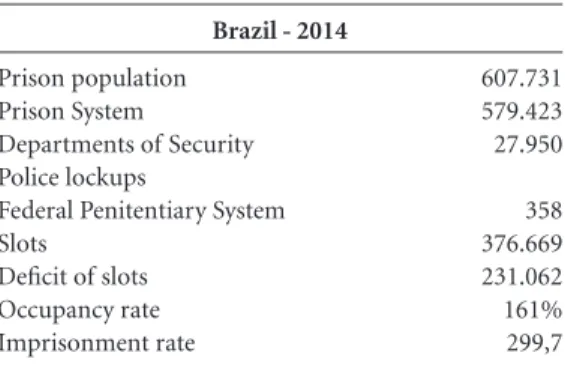
The dyad can be observed in the historical se-ries of incarceration that shows us that in 24 years the population deprived of freedom has grown 575%, jumping from about 90 1000 prisoners at the beginning of the 90’s, for more than 607,731 prisoners in 2014, as the Graph 1 demonstrates, making Brazil the world’s fourth biggest coun-try in terms of incarcerated population, behind The United States with 2,228,424, China, with 1,657,812, and Russia, with 673,818 convicts, re-spectively8. As regards female incarceration, it is
important to emphasize that Brazil drops to fifth place, but the absolute population of women in-carcerated in the prison system grew 567% be-tween 2000 and 2014, with approximately 37,380 women (6.4% of the prison population), where-as the male convicts’ growth wwhere-as 220% over the same period9.
The incarceration rate in these countries is 698 (United States), 119 (China), 468 (Russia) and the incarceration rate in Brazil is 300. When we look at the rate of people deprived of their liberty by Federation Unit, as seen in Graph 2, below, the rates in Mato Grosso do Sul, São Paulo and Federal District are higher and lower in Ma-ranhão, Piauí and Bahia8.
When we look at the rate of people deprived of their liberty on the Graph 2 and at the
oc-Brazil - 2014
Prison population Prison System
Departments of Security Police lockups
Federal Penitentiary System Slots
Deficit of slots Occupancy rate Imprisonment rate
Table 1. Prison population, number of slots,
occupancy rate and rate of imprisonment.
607.731 579.423 27.950
358 376.669 231.062 161% 299,7
Source: Infopen8.
Graph 1. History of prison population.
Source: Infopen8. 700,0 600,0 500,0 400,0 300,0 200,0 100,0 0,0
1990 1992 1993 1994 1995 1997 1999 2000 2001 2002 2003 2004 2005 2006 2007 2008 2009 2010 2011 2012 2013 2014 90,0114,3 126,2
129,3148,8 170,6194,1
232,8 233,9 239,3 308,3336,4
361,4
401,2422,4 429,4 473,6456,3
514,6549,8 581,5607,7 increase of
So
ar
es Filho MM,
B
ue
no PMMG
cupancy rate per unit of the Federation, which shows the proportion of people imprisoned by slot on the Graph 3, overcrowding is a “rule” in all Brazilian States.
The national occupancy rate is 161%. Per-nambuco leads with 265%, but, the rate of im-prisoned people is lower if compared to the States of MS, SP, DF, AC, RO, ES and AP. Maranhão has the lowest occupancy rate, 121%, showing also the lowest rate of people deprived of their liberty per 1000 inhabitants, as mentioned above8.
Overcrowding, observed in the analysis of the rate of people deprived of their liberty and the occupancy rate becomes even more dramatic when it is contrasted with the number of persons deprived of their liberty without conviction, that is, the percentage of temporary prisoners, which reaches 41% throughout Brazil. In some States of the Northeast region, such as Maranhão, Piauí, Bahia and Sergipe the percentage of temporary prisoners reaches high levels, 60% to 73%. The States of Rondônia, Acre, Santa Catarina and Mato Grosso do Sul have lower indicators, 16% to 29%8 (Graph 4).
The phenomenon of imprisonment can also be observed through the types of crime attempt-ed or consummatattempt-ed by which persons deprivattempt-ed of liberty have been convicted or are awaiting trial in Brazil. It is possible to see on Graph 5 be-low, in first place, drug trafficking with 27%, then theft, burglary and handling of stolen goods with 37% respectively and, finally, domestic violence with 1%. Only about 17% of people deprived of their liberty have committed crimes against per-sons, namely, homicide and robbery (robbery followed by death)8.
It is important to highlight that this incarcer-ation in mass, which has been produced by the judiciary for decades, has also contributed to the current scenario of overcrowding in the prison system, and is evidenced by the huge mass tem-porary prison and the large percentage of arrests for theft, handling of stolen goods, burglary and even drug trafficking. The latter type of crime deserves more attention and will be better dis-cussed in the following pages.In this sense, the ju-diciary realized that the arrests made in flagrante and the first hours of detention are identified as
Graph 2. Prison population per 1000 inhabitants - Federation Units.
Source: Infopen8.
Infopen
8569 497 497 441 436 418 353 340 324 321 296 266 259 250 246 243 239 216 208 203 194 192 174 164 102 101 89 MS
SP DF AC RO ES AP PE RR MT MG SC PR RS CE PB RJ TO RN GO SE AM AL PA BA PI MA
450 to 569 300 to 450 220 to 300 110 to 220 50 to 110
aúd
e C
ole
tiv
a,
21(7):1999-2010,
2016
an opportunity to evaluate whether the person should be kept in prison, whether they could be released on bail, whether a punitive measure of
educational character is needed – as, for example, electronic ankle monitors – or even whether they should be released10.
Graph 3. Occupancy rate per unit of Federation.
Source: Infopen8.
265% 223% 220%
188% 185%
185% 168% 167% 164% 157% 156% 154% 152% 149% 149% 144% 142% 140% 139% 132% 127% 126% 125% 121% 121% PE
AL AM MS DF PI BA CE SP SE MG RN GO AC PB RR PR PA TO AP RJ SC RO ES MT RS MA
200% to 270% 165% to 200% 150% to 164% 135% to 149% 120% to 134% Occupancy rate.
Proportion of prisoners for slots
216% 215%
Graph 5. Crimes tempted/consummated by which
people were convicted or are awaiting trial.
Source: Infopen8.
27% Drug trafficking
Gangs Burglary Theft Possession of stolen goods Homicide Robbery followed by death Disarmament Domestic violence Others
2%
21% 11% 3%
14% 3%
7% 1%
11%
Graph 4. Persons deprived of their liberty by regime
type or procedural situation in Brazil.
Source: Infopen8.
41% No condemnation
Sentenced - closed regime Sentenced - semi-open regime
Sentenced - open regime Security measure - detention Security measure - outpatient treatment
41%
15%
3%
0%
So
ar
es Filho MM,
B
ue
no PMMG
This moment of evaluation is called “custo-dy hearing”, which provides the citizen caught in flagrant the right to have their case reviewed by a judge, who will see the legality of their arrest within 24 hours and guaranteeing personal con-tact, as established in the pacts and international treaties in which Brazil is a signatory10.
Criminal recidivism, phenomenon related to the lack of public policies for former convicts and to the social stigma associated with the “ex-cons”, is another factor that contributes to the over-crowding of the prison system, reaching the aver-age figure of 70% in the country, according to the IPEA (Instituto de Pesquisa Econômica Aplicada, or Institute of Applied Economic Research), in a study requested by the Department of Strategic Affairs of the Presidency of Republic of Brazil11.
One last example that contributes to the growth of the prison population is Brazilian law number 11.343/2006, which established that the SISNAD (Sistema Nacional de Políticas Públicas sobre Drogas, or National System of Public Poli-cies on Drugs). Since 2005, the prison population jumped from 11% to 27% of the total detainees for crimes related to drug trafficking.As for the female detainees, that number reaches 60%. This law does not provide objective criteria about drug possession, leading the police authority to imprison users as drug dealers based on subjec-tive criteria12.
The demography presented reflects the pro-file of the Brazilian detainees, which has been the same for years among black and less educat-ed young population: 75% are between 18 to 34 years of age; 67% have incomplete primary
ed-ucation; 67% are black8, a greater number than
it was indicated by the IBGE (Instituto Brasileiro de Geografia e Estatística, or Brazilian Institute of Geography and Statistics) Census 2010. In this study the self-declared black population repre-sented 51% of the Brazilian population13. Profile
data can be seen in the Graph 6, 7 and 8.The de-mographics and profile of prisoners presented in this study clearly demonstrate the failure of the Brazilian prison system and appoint to the need for a paradigm shift, arranging cross-sec-tor efforts and investments in penal alternatives, and political strategies for the former inmate. That alternative would reduce expenses on new buildings, hiring of new staff and would increase the possibility of reintegrating these individuals back in society. The LEP (Lei de Execução Penal
or Penal Execution Law) establishes, in your first article, that penal execution aims to carry out the sentence provisions or criminal decisions and provides conditions for the harmonious social integration of convicts and detainees. This is a statement that comes as an imperative to human-ize the criminal sanction, with the prescription of concrete mechanisms and penal services to guarantee rights and create favorable conditions to “repair” the parolees, with consequent positive social reintegration in their lives post-prison3.
LEP also states, in articles 10 and 11, that assistance to convicts and detainees is the State
31% 25% 19% 17%
Graph 6. Persons deprived of their liberty by age
group.
Source: Infopen8. 18 to 24 years old 25 to 29 years old 30 to 34 years old 35 to 45 years old 46 to 60 years old 61 to 70 years old 71 years old or more
7% 1% 0%
Graph 7. Persons Deprived of Liberty by level of
education.
Source: Infopen8. 100%
90% 80% 70% 60% 50% 40% 30% 20% 10% 0%
Post Graduate Graduate
Incomplete Higher Education Undergraduate
aúd
e C
ole
tiv
a,
21(7):1999-2010,
2016
duty, aimed at preventing crime and guiding the reintegration in society3.
Much more than the ideal of social reinte-gration, which means the ideology of treatment, the concept of social integration implies a pro-cess of communication between prison and so-ciety, aiming at an identification between the free community values with the prison and vice versa, otherwise LEP would be nothing. The idea here is to instigate the debate on the viability of the effective range of social integration of those who have been convicted14.
This is the spirit of cross-sector actions and the inclusion of interdisciplinary public policies into criminal policy. For that, there should be a closer approximation and consequent involve-ment of all public managers and the community, in order to search for solutions of social conflicts. In this sense, the participation of society in penal policy can resolve the situation of violation of human rights of the deprived of liberty per-sons, since the State disrespects, with impunity, national and international rules of which Brazil is a signatory.
Federal Constitution of 1988; Penal Execu-tion Law of 1984; UN Minimum Standards for
the Treatment of Prisoners, adopted on August 31, 1955 by the First United Nations Congress on the prevention of Crime and the treatment of Of-fenders; Minimum Standards for the treatment of prisoners in Brazil; Resolution Number 14, CNPCP (Conselho Nacional de Política Criminal e Penitenciária, or National Council of Criminal and Penitentiary Policy)15, of 11 November 1994
(DOU, or Union Official Journal 02.12.94); the Body of Principles for the Protection of all Per-sons under Any Form of Detention or Impris-onment – resolution 43/173,General Assembly of the United Nations – 76th Plenary Session of
9 December 1988; Basic Principles for the Treat-ment of Prisoners, adopted by the UN General Assembly, seeking humanization of criminal jus-tice and protection of human rights; Principles of Medical Ethics applicable to the role of health personnel, particularly physicians, in the protec-tion of prisoners or detainees against torture and other cruel, inhuman or degrading treatment or punishment; Resolution 37/194, General Assem-bly of the United Nations, of 1982.
Given this scenario of violation of funda-mental rights of persons deprived of liberty - even with the existence of successful experienc-es in the field of assistance in a few prisons, but without any direction or Hobbesian planning of social chaos – cross-sector actions were thought for criminal policy, such as, health, education and labor policies, instituted in the posts of fed-eral, state and municipal executive responsibility, on an interfederal and collaborative basis16.
The right to health of persons deprived of freedom in prison system
The history of health actions in the prison system began with religious entities, as it happened with other total institutions such as the asylums, for example. With the emergence of AIDS in Brazil, in the 80’s, some health professionals, especially those physicians who were sensitive to the de-spair settled in prison, began health prevention actions and treatment of this disease.
Some years after, on September 9, 2003, PNS-SP (Plano Nacional de Saúde no Sistema Peni-tenciário, or National Health Plan for the Prison System) was set up, through the Interministe-rial Ordinance number 1777, the Ministries of Health and Justice. The plan was responsible for making more consistent criminal legislation and SUS, giving some visibility to population in cus-tody within the national health policy17.
Graph 8. Persons deprived of liberty by color/race/
ethnicity.
Source: Infopen8.
0% 1%
1% 31%
67%
So
ar
es Filho MM,
B
ue
no PMMG
In Brazil, 100% of the states and the Federal District are qualified to the National Health Plan for the Prison System (PNSSP). That represents 271 health teams, qualified and active, in the pris-on system (CNES, 2013), in 239 basic units of prison health in prisons, in 154 municipalities18.
This total teams are considered eligible to PNSSP and can guarantee access to approximate-ly 30% (200,000) of the total number of people in custody in Brazil.
It is important to note that the datum “100% of eligible states” is political, i.e., the states got politically interested by PNSSP strategy and signed an agreement with the Ministry of Health. However, “health coverage” is a technical datum, since it depends on the speed of activation and deployment of services and health teams in the prison system.
With the process of redesigning the PNSSP, which occurred from 2011 to 2014, a new Inter-ministerial Ordinance number 1 was published on January 2, 2014. It established that PNAISP (Política Nacional para Atenção Integral à Saúde da Pessoa Privada de Liberdade no Sistema Prision-al, or National Policy for Comprehensive Health Care for the Persons in Prison) under SUS respon-sibility, would ensure the effective and systemat-ic access of the population that is in the custody of the State to the actions and services of Health, with the mobilization of more significant finan-cial resources, as well as the allocation of manage-ment strategies and strengthening local capacity19.
With this new policy every prison unit en-abled by SUS will be a point of attention of the
Rede de Atenção à Saúde (Health Care Network), offering primary care actions to all prisoners throughout the prison itinerary, ranging from pre-trial detainees in police stations and provi-sional detention centers to convicted prisoners in state and federal prisons.
Health teams in prisons now hold just over 37% of units with health modules, as Graph 9 shows, below. However, data obtained through inspections of the National Council on Criminal and Penitentiary Policy (NSCLC) showed the ex-istence of health spaces, although precarious, in units without health modules, comprising medi-cal, dental, psychosocial care rooms, where there is available space in the prison unit20.
It is also relevant to point out that profession-als from different areas and different labor rela-tionship work in the health spaces: either they are servants of the Penitentiary Administration (or related), the State Department or Municipal Health, or they are outsourced.
This way, we understand it is necessary to in-crease the budget agenda of the executive power, in order to ensure appropriate financial incen-tives for structuring basic units of prison health and to the cost of services and teams, especially to the creation of more favorable (environmental, wage, instrumental, strategic and operational) conditions, so that, in fact, the Health Care Net-work, both local and regional strengthen their capacities and the population in custody can be cared for, in a universal, comprehensive, resolute and continuous way.
Some projects of the Federal Government, in partnership with international organizations and non-governmental organizations, had a positive impact on the structure of some Basic Units of Prison Health (UBSp) as complementary spaces that go beyond the traditional model of prima-ry care – labs for diagnosis, X-Ray rooms, “bed-cells” for observation or isolation.
One issue that deserves attention and health concern is the low number of medical consulta-tions. Just as it happens in small towns and specif-ic areas such as Native Brazilian and river-dwell-ing populations, there is also a huge deficit of doctors in the prison system, mostly because of the stigma related to the prison population, low
Graph 9. Infrastructure of the UBSp (Unidade Básica
de Saúde Prisional, or Basic Units of Prison Health).
Source: Infopen8. 462 - 37%
796 - 63%
Units with health modules
aúd
e C
ole
tiv
a,
21(7):1999-2010,
2016
wages, and working conditions. This deficit can be solved by means of the Government Program “More Doctors” (Mais Médicos), which allow physicians to move from their Basic Health Units (UBS) in the territory and carry out visits in pris-ons with up to 100 perspris-ons deprived of liberty. The Ministry of Health is currently studying the possibility of future public notice to call these doctors to give assistance to more densely pop-ulated prisons21.
According to the study entitled “Epidemio-logical analysis of the health situation of prison-ers in Brazil: databases for information” held by the Federal University of Espírito Santo (UFES), supported by the Ministry of Health, the order of cases reported in prison units by illness and year of notification in Brazil between 2007 and 2014, bring in first place tuberculosis, followed by dengue, HIV / AIDS, viral hepatitis, acquired syphilis, human anti-rabies care, leprosy, male urethral discharge syndrome, acute Chagas dis-ease, violence, leptospirosis, among others22.
The emergence of “human anti-rabies care” sixth in UFES study might have two meanings: first, the large number of domestic animals, espe-cially dogs and cats, cohabiting the prisons, sec-ond, dogs that are used to guard prisons and may have attacked the prisoners for several reason, including for torture (emphasis added).
Either way, these data point to the lack of health promotion, disease prevention and com-prehensive care, as determined by primary care, and reveals the strong presence of a model that still works along the lines of LEP, an outpatient model that meets only spontaneous demands without proper planning and health mappings.
In this sense, SUS should be responsible for the prison primary care actions through PNAISP, involving the responsibility of SUS Health Care Attention Networks in an ministerial, inter-federal and tripartite way as well as sanitary sur-veillance and epidemiological monitoring.
Clearly, SUS, through the Health Care Net-works, must ensure the sustained and standard-ized assumptions by the rules in its scope. The management of the entire Health Care Network of the states, Federal District and municipalities, as well as the offer of more complex services to all prisoners, is responsibility of this network (whether in the states, regions or municipalities, depending on the qualification of the services SUS offers and contractualization forms defined)23.
Suggested evidence that SUS has not yet reached the prisoners is based on the
underre-ported information of the databases of the Min-istry of Justice through the Prison Information System8, but mainly on the database of UFES,
which conducted a research at SINAN (Sistema de Informação Nacional de Agravos de Notificação, or National Information System database for No-tifiable Diseases, in the Ministry of health)22.
The professionals who work in basic units of prison health (UBSp) do not use the SUS infor-mation systems, and submit compulsory notifi-cations to municipalities, which can cause loss of information, reinforcing the underreporting. Another important information system not used is the electronic SUS records: e-SUS or Informa-tion System Health for Primary Care (SISAB), causing the Health Care Network to ignore as-sistance procedures carried out by the teams of primary care prison24.
According to INFOPEN/2014, the informa-tion on the quantitative of people with trans-missible diseases in prisons have the following sequence: first, HIV / AIDS, then Syphilis, Hep-atitis, Tuberculosis, and others8.
Such information, dissonant with the SUS systems, show the health gap and at the same time point the way to be followed by PNAISP to guarantee the right to health for all persons de-prived of liberty in the prison system.
This policy meets the basic principles of SUS, universal access, attention comprehensive-ness and equity in health, bringing the prison unit, through its UBSp, as attention point of the Health Care Network, offering health promotion, disease prevention and treatment through Pri-mary Health Attention, also demonstrating that the mainstreaming of public policies for the pris-on system is the pris-only way to correct the historical health abandonment.
This political environment that provides guarantees is the right moment to the emergence of public policies that seek the rights, once violat-ed, for the segments that have not had the same level of opportunities guaranteed to the vast ma-jority.
So
ar
es Filho MM,
B
ue
no PMMG
Final comments
Based on the above considerations, it was per-ceived that there is a need for increasing of invest-ment in the executive and judiciary powers for judges and managers of the prison system with the primary aim to change the culture of confine-ment, seeking to adopt actions and cross-sector strategies especially in the field of criminal alter-natives, restorative justice, conciliation and cus-tody hearings, in order to gradually reduce the deficit prison that alarms Brazil and the world.
The actions of criminal alternatives to incar-ceration should primarily reduce the number of pre-trial detainees through the adoption of alter-native judicial measures in custody hearings, or, for example, through the use of technology such as electronic anklets. These actions combined with a State policy oriented to the prison system egress may stop the mass incarceration.
In this sense, the vulnerabilities and inequi-ties of the prison population can be understood from the view of their demographics pointing to the structural problems of the prison system.
Currently, the judiciary send individuals to prisons that are not only extremely overcrowd-ed, but are mostly old structures that demand reforms. These indicators show how far the ac-cess of the prison population to proper, just and dignified assistance is.
The amount of human resources working in prisons is not only poorly trained to work in transversal public policies of the prison system but also, it will not be able to meet the growth of the prison population.
Few human resources, especially among pen-itentiary officers, has negative impact on security of prisons, with constant rebellions, violence or threats, making the workplace an unhealthy envi-ronment. This scenario also reflected on the pris-on populatipris-on due to lack of escort for health, education, labor, religious assistance.
In the field of public health, prisons are un-derstood as places of major health challenge, but not yet viewed by much of the health managers as intervention spaces, even after the publication of prison health standards of 2003 and 2014, which establish the close relationship between SUS and the prison system.
The health control of the prison population injuries must involve especially primary care ac-tions, given the young profile of the detainees, who are productive and assumed to be healthy, aiming at solving many of their health problems. If the illnesses of the prison population are un-der control, the citizens who routinely visit their loved ones will be protected, too.
During these visits, the families might have contact with transmissible diseases such as tuber-culosis and sexually transmitted infections (STI) / HIV / AIDS, either acquired externally or be-cause of the vulnerable confinement conditions and could transmit them to the community of visitors.
In addition, late treatment of these diseases overburden municipal management through emergency door and emergency health equip-ment of ambulatory and hospital network, as well as pharmaceutical care.
We can consider that the vulnerability of the prison population also makes the city vulnerable and the managers must take this demand for epi-demiological and health surveillance as a priority. Control diseases in the prison system becomes a necessity of health emergency, since it is not diffi-cult to control the population of prison territory.
aúd
e C
ole
tiv
a,
21(7):1999-2010,
2016
Collaborations
MM Soares Filho was responsible for the research and writing of the article and PMMG Bueno was responsible for the methodology and final review. Finally, we must increase investments,
So
ar
es Filho MM,
B
ue
no PMMG
Brasil. Conselho Nacional de Política Criminal e Peni-tenciária (CNPCP). Resolução n.º 14, de 11 de novem-bro de 1994. Diário Oficial da União 1994; 2 dez. 16. Hobbes T. Leviatã. São Paulo: Nova Cultura; 1977. Brasil. Ministério da Saúde (MS). Plano Nacional de Saúde no Sistema Penitenciário. 2ª ed. Brasília: MS; 2005.
Brasil. Ministério da Saúde (MS). Sistema Cadastro Nacional de Estabelecimentos de Saúde. [Online]. 2013 [acessado 2016 mar 29]. Disponível em: http://cnes. datasus.gov.br/.
Brasil. Ministério da Saúde (MS). Política Nacio-nal de Atenção Integral à Saúde das Pessoas Privadas de Liberdade no Sistema Prisional (PNAISP). [Onli-ne]. 2014 [acessado 2016 mar 29]. Disponível em: http://bvsms.saude.gov.br/bvs/saudelegis/gm/2014/ pri0001_02_01_2014.html.
Brasil. Ministério da Justiça (MJ). Relatório de Inspeções do CNPCP. [Online]. 2014 [acessado 2016 mar 29]. Disponível em: https://www.justica.gov.br/seus-direi-tos/politica-penal/cnpcp-1/relatorios-de-inspecao-1/ relatorios-de-inspecao-2014-1.
Brasil. Ministério da Saúde (MS). Programa Mais Mé-dicos. [Online]. 2014 [acessado 2016 mar 29]. Disponí-vel em: http://maismedicos.gov.br/.
Miranda AEB. Análise epidemiológica da situação da saúde na população privada de liberdade no Brasil: dados de bases de informação. Vitória: Editora da UFES; 2015. Brasil. Ministério da Saúde (MS). As Redes de Atenção à Saúde. [Online]. Brasília; 2010 [acessado 2016 mar 29]. Disponível em: http://dab.saude.gov.br/portaldab/ smp_ras.php.
Brasil. Ministério da Saúde (MS). Sistema de Informa-ção em Saúde para a AtenInforma-ção Básica (SISAB). [Online]. 2016. [acessado 2016 mar 29]. Disponível em: http:// sisab.saude.gov.br/.
Article submitted 14/10/2015 Approved 11/04/2016
Final verson submitted 13/04/2016 15.
16. 17.
18.
19.
20.
21.
22.
23.
24. References
Castel R. A dinâmica dos processos de marginalização: da vulnerabilidade à “desfiliação”. Caderno CRH 1997; 10(26):19-40.
Foucault M. Vigiar e Punir. Petrópolis: Vozes; 1977. Brasil. Presidência da República. Institui a Lei de Exe-cução Penal. Diário Oficial da União 1984; 13 jul. Brasil. Constituição da República Federativa do Brasil de 1988. Diário Oficial da União 1988; 5 out.
Brasil. Conselho Nacional de Justiça. Dados das Ins-peções nos Estabelecimentos Penais. [Online]. 2014 [acessado 2016 mar 29]. Disponível em: http://www. cnj.jus.br/inspecao_penal/mapa.php.
Brasil. Conselho Nacional de Política Criminal e Peni-tenciária. Censo Penitenciário Nacional: nível socioeco-nômico da clientela dos sistemas. Institucional. Brasília: Ministério da Justiça, Departamento Penitenciário Na-cional; 1994.
Goffman E. Estigma: notas sobre a manipulação da iden-tidade deteriorada. 4ª ed. Rio de Janeiro: Zahar; 1982. Brasil. Ministério da Justiça (MJ). Levantamento Na-cional de Informações Penitenciárias - INFOPEN 2014. Brasília: MJ; 2015.
Brasil. Ministério da Justiça (MJ). Levantamento Na-cional de Informações Penitenciárias - Infopen Mulheres 2014. Brasília: MJ; 2015.
Evangelista I. Jusbrasil: Você sabe o que é – e como funciona – a Audiência de Custódia? [Online]. 2015 [acessado 2016 abr 6]. Disponível em: http://jurisrael. jusbrasil.com.br/artigos/218131081/voce-sabe-o-que -e-e-como-funciona-a-audiencia-de-custodia. Instituto de Pesquisa Econômica Aplicada (IPEA). Reincidência Criminal no Brasil. [Online]. 2015 [aces-sado 2016 mar 29]. Disponível em: http://www.ipea. gov.br/portal/images/stories/PDFs/relatoriopesqui-sa/150611_relatorio_reincidencia_criminal.pdf. Brasil. Presidência da República. Sistema Nacional de Políticas Públicas sobre Drogas (Sisnad). [Online]. 2006 [acessado 2016 mar 29]. Disponível em: http:// www.planalto.gov.br/ccivil_03/_ato2004-2006/2006/ lei/l11343.htm.
Instituto Brasileiro de Geografia e Estatística (IBGE). Censo Demográfico. [Online]. 2010 [acessado 2016 mar 29]. Disponível em: http://www.ibge.gov.br/home /estatistica/populacao/censo2010/default.shtm. Teixeira C. Educação e inclusão social? Os limites do debate sobre o papel da escola na sociedade. [Online]. 2005 [acessado 2016 mar 29]. Disponível em: www.sb-sociologia.com.br/portal/index.php.
1.
2. 3. 4. 5.
6.
7. 8.
9.
10.
11.
12.
13.