TEMAS LIVRES FREE THEMES
1 Departamento de Enfermagem, Faculdade de Enfermagem e Obstetrícia, Universidade Federal de Pelotas. R. Gomes Carneiro 1, Porto. 96010-610 Pelotas RS Brazil. carlos-treichel@ hotmail.com
Clustering of minor psychiatric disorders and burden
among family caregivers of individuals with mental illness
Clusterização
de transtornos psiquiátricos menores e sobrecarga
entre familiares cuidadores de pessoas com transtornos mentais
Resumo Este estudo transversal objetiva analisar a relação entre os Transtornos Psiquiátricos Me-nores, sobrecarga e outros fatores associados em familiares cuidadores de pessoas com transtorno mental. O estudo foi realizado com 1164 familia-res de usuários de Centros de Atenção Psicossocial do Sul do Brasil e utilizou para rastreamento de Transtornos Psiquiátricos Menores a escala Sel-f-Reporting Questionnaire (SRQ20) tendo como base a validação brasileira da escala que adotou como ponto de corte 6/8. Embora estudos prévios tenham apontado a sobrecarga advinda do cuida-do como protagonista na apresentação de Trans-tornos Psiquiátricos Menores, uma clusterização baseada em Verossimilhança de Log pelo critério Bayesiano de Schwarz conduzida nesse estudo apontou que sobrecarga não seria o único preditor possível para o adoecimento emocional/psíquico, sugerindo que outros fatores permeiam essa rela-ção. Sendo assim, análises bivariadas foram con-duzidas, pelas quais se podem observar influência de variáveis como problemas de saúde, questões de trabalho entre outras nos diferentes grupos
dispos-tos pelo cluster.
Palavras-chave Transtornos Psiquiátricos
Meno-res, CuidadoMeno-res, Serviços comunitários de saúde
mental, Sobrecarga,Cluster
Abstract The objective of this cross-sectional study is to analyze the relationship between minor psychiatric disorders, burden and other associat-ed factors among family caregivers of people with mental disorders. The study was conducted with 1164 relatives of users of the Centers for Psycho-social Care in southern Brazil, and for screening of minor psychiatric disorders, the Self-Reporting Questionnaire (SRQ20) scale was used, based on its Brazilian validation with an adopted cutoff point of 6/8. Even though previous studies have appointed the burden arising from care as pro-tagonist in the presentation of minor psychiatric disorders, a clustering based on log-likelihood by Bayesian Information Criterion conducted in this study found that burden is not the only possible predictor for emotional/mental illness, suggest-ing that other factors permeate this relationship. Thus, bivariate analyzes were conducted, in which the influence of variables such as health problems, work issues, among others, can be observed in
dif-ferent groups arranged by the cluster.
Key words Minor psychiatric disorders, Caregiv-ers, Communitary mental health services, Bur-den, Cluster
Carlos Alberto dos Santos Treichel 1
Vanda Maria da Rosa Jardim 1
Luciane Prado Kantorski 1
Mariana Luchese Vasem 1
T
re
ic
he
Introduction
Given the process of psychiatric deinstitutional-ization experienced by Brazil in recent decades, several changes occurred in regard to the factual process of care provided to people with mental disorders. The individual in psychological dis-tress, previously segregated and excluded from social contact, is brought out of the asylum, and reinserted in society1.
Among the framework of changes caused by this process, the difference in the perception of the family is without doubts one of the main changes in this scenario. During the history of psychiatry, the family was either seen as the cause of this disease, reinforcing the need for isolation, or seen as an accomplice, allowing the institu-tionalization of the patient2.
However, understanding that the care is only possible when considering the environment and existing resources to care for the patient3,4, the
family is inserted in the care and now features as one of its protagonists.
As caregivers, the relatives encounter multi-ple and challenging tasks every day, ranging from the acceptance of the diagnosis, administration of family conflict and the reprogramming of the future – facing the disruption of the family struc-ture caused by the possible modification of social roles5,6. It should also be noted, that the family
is often not prepared to deal with the situation of disease in one of its members. And even with their positive feelings towards the family, cannot deal with their emotions when facing a reality of doubts and uncertainties4,7.
Because of that, many relatives may experi-ence feelings of depression and anxiety, causing negative consequences in the context of family, social relations and work8.
These cases of anxiety and depression can be classified as minor psychiatric disorders (MPD), once they do not meet all the criteria of mental illness according to the International Classifica-tion of Diseases (ICD-10). Expanding this un-derstanding, we can say that the MPD relate to health conditions involving non-psychotic psy-chiatric symptoms, such as insomnia, fatigue, irritability, depression, anxiety, forgetfulness and difficulty concentrating9.
The MPD among family caregivers have been addressed by previous works5,6,8, which most
of-ten feature associations of MPDs and burden arising from the caregiver role. However, consid-ering the magnitude of the aspects that permeate the care relationship, it is necessary to constantly
rethink the root of such problems, since these caregivers are individuals who also demand at-tention from the health care network, that should be capable to act and intervene effectively.
Thus, this paper aims to analyze the relation-ship between the MPD, burden and other associ-ated factors among family caregivers of individ-uals with mental disorders in order to establish a more accurate picture of this scenario.
Methodology
This is a cross-sectional study carried out with 1164 relatives of people with mental disorders, clipping of a community-based mental health service evaluation research in southern Brazil, entitled CAPSUL II and held in 2011.
In order to determine the prevalence of mi-nor psychiatric disorders in the sample, this study considered the Self-Reporting Question-naire (SRQ20) scale for screening. Developed by Harding et al.10 and validated in Brazil by Mari
and Williams11, this instrument was proposed by
the World Health Organization for the detection of minor psychiatric disorders in the population.
The scale consists of twenty questions with yes/no answers, and according to Harding et al.10,
the cut-off point, number of positive questions that determine the presence of a minor psychi-atric disorder, has a considerable variation from 5/6 to 10/11, depending on the cultural context in which it is applied, including place and time. This study used as model the Brazilian valida-tion, in which Mari and Williams11 found a
sensi-tivity and specificity of 83% and 80% respective-ly when used as cut-off point 6/8, being the first number the cutoff point for men and the second for women.
Considering the review of literature and the borders of study theme, some variables of socio-demographic data, health conditions and caring aspects were included in this research. In par-ticular, the feeling of burden, which was set as important defining cause of minor psychiatric disorders.
aúd
e C
ole
tiv
a,
21(2):585-590,
2016
The data went through double entry in the software EPI-INFO,differences between infor-mation were compared and evaluated. The same database was used for corrections when needed.
The study protocol was approved under tech-nical opinion No. 176/2011, by the Ethics Com-mittee of the Faculty of Nursing of the Federal University of Pelotas following the Standards and Guidelines for the Regulation of Research Involving Human Beings – CNS Resolution 196/96, the aspects this study also conform to the CNS 466/2012 resolution. Ethical principles were secured by: informed consent; guarantee of the right not to participate in the study and confi-dentiality of information.
Data analysis was performed using the soft-wares STATA 11 (Stata Corp., College Station, USA) and IBM SPSS Statistics. Given the relation-ship established in literature between the burden and the outcome of minor psychiatric disorders in order to classify the sample according to their behavior in relation to these characteristics, the relatives were divided into 4 groups arranged by clustering based on log-likelihood by Bayesian Information Criterion. Bivariate analyzes were conducted to characterize the groups, with sta-tistical significance assessed by Chi-square test, adopting as significant a p-value ≤ 0.05.
Results
The clustering of the sample according to the feeling of burden and the presence of minor psychiatric disorders has split it into 4 groups as shown in Table 1.
Analyzing Table 1, it is possible to point out that the two largest groups generated represent similar proportions of the sample, they are the groups 1 and 4 that constitute 32.4% and 32.1% of relatives respectively.
Group 1 is characterized by individuals who did not have feelings of burden and were not screened as minor psychiatric disorder cases, on the other hand, Group 4 consists of individuals who presented burden and were screened posi-tive for minor psychiatric disorders.
Groups 2 and 3 are made of a minor propor-tion of the sample, however, it is worth menpropor-tion- mention-ing that they represent different conditions. The first, corresponding to 20.7% of relatives that feel burdened but do not have a minor psychiatric disorder, and the latter, consisting of the other 14.8% of the sample, representing the subjects that screened positive for a minor psychiatric disease even if not feeling burdened.
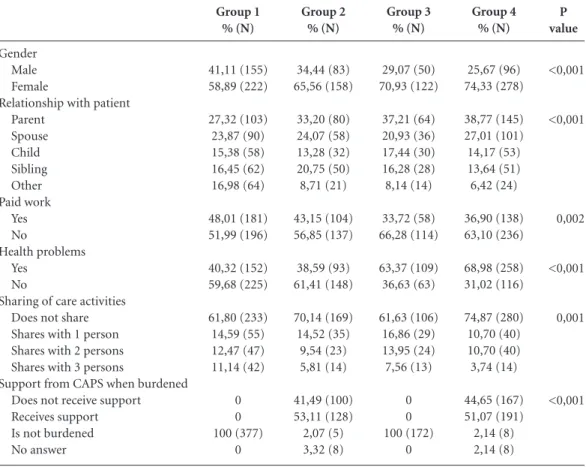
The results of the bivariate analysis conduct-ed to raise possible explanations for the different associations between feelings of burden and mi-nor psychiatric disorders expressed in the group, are shown in Table 2.
It is observed that there was a statistically significant difference between groups in all the selected variables, suggesting that the average response for each variable was different in each group, thus validating the cluster found.
Among the groups in which individuals were screened as positive cases of minor psychiatric disorder – Groups 3 and 4 – women accounted for 70.93% and 74.33% of subjects respectively. The results regarding the individual’s family tie to the patient expressed association between the proximity of the bond and the outcomes Burden and MPD. Comparing Groups 1 and 4, which in theory would be the most distant groups due to their different behavior for both burden and mi-nor psychiatric disorder, it is observed that the Group 4 – more affected – tend to have the clos-est affiliation with the patient.
It is possible to observe that Groups 3 and 4, where the minor psychiatric disorders are present, not having a paid work appeared more strongly than in other groups.
The proportion of health problems had an inverse relationship between Groups 1 and 4, which correspond to the least and most affect-ed individuals respectively. In Group 1 where no manifestation of MPD and burden were found, most of the sample (59.68%) did not have a health problem. On the other hand, Group 4, which has both burden and minor psychiatric disorders, the majority (68.98 %) of the relatives presented health problems. As to Group 3, it is possible to point out that even if not expressing feelings of burden, the individuals in this group were screened as positive case of minor psychiat-Group
Group 1 Group 2 Group 3 Group 4
Feeling of Burden
Absent Present Absent Present
MPD
Absent Absent Present Present
Table 1. Distribution of the sample according to the
grouping defined by the likelihood ratio of burden and minor psychiatric disorder.
Source: CAPSUL, 2011. % (N)
T
re
ic
he
ric disorder. In this group, a portion correspond-ing to 63.37% of family caregivers reported hav-ing health problems.
Although in the four groups there are indi-viduals who take care of their ill relative alone, the groups where caregivers have feelings of bur-den have the greater proportions of this charac-teristic. In Group 4, 74.84% of subjects are the only caregivers of the patient, in the same sense, in Group 2, individuals who do not share the care activities correspond to 70.14%.
Individuals who reported burden were asked about the support they receive from CAPS (Cen-ters for Psychosocial Care) when they feel bur-dened, being so, only individuals from Groups 2 and 4 answered this question. Among the in-dividuals in Group 2, 53.11% reported receiving support, as to the Group 4, those who received support accounted for 51.07% of the subjects.
Discussion
A number of studies have explored the minor psychiatric disorder as one of care’s implications. In general, this approach is related to the burden, which in some studies assume the role of related factor8,12,13 and in others of possible causal
fac-tor5,14.
In order to understand this relationship, it is possible to observe in this study that the burden alone is not sufficiently explanatory as the cause of minor psychiatric disorders. Because if it were so, burdened individuals would necessarily present disorders while not burdened people would not. However, this study also confirms the existence of family members that even being burdened, did not have the disorders. And others still not pre-senting themselves with burden, demonstrated the presence of minor psychiatric disorders.
Having characterized the sample according to the outcome of burden and minor psychiatric disorders, it can be seen that 32.4% (377) of fam-ily caregivers had neither outcomes. In this group
P value <0,001 <0,001 0,002 <0,001 0,001 <0,001 Gender Male Female
Relationship with patient Parent Spouse Child Sibling Other Paid work Yes No Health problems Yes No
Sharing of care activities Does not share Shares with 1 person Shares with 2 persons Shares with 3 persons
Support from CAPS when burdened Does not receive support Receives support Is not burdened No answer Group 1 % (N) 41,11 (155) 58,89 (222) 27,32 (103) 23,87 (90) 15,38 (58) 16,45 (62) 16,98 (64) 48,01 (181) 51,99 (196) 40,32 (152) 59,68 (225) 61,80 (233) 14,59 (55) 12,47 (47) 11,14 (42) 0 0 100 (377) 0
Table 2. Behavior of groups arranged by clustering according to selected variables for comparison.
Group 2 % (N) 34,44 (83) 65,56 (158) 33,20 (80) 24,07 (58) 13,28 (32) 20,75 (50) 8,71 (21) 43,15 (104) 56,85 (137) 38,59 (93) 61,41 (148) 70,14 (169) 14,52 (35) 9,54 (23) 5,81 (14) 41,49 (100) 53,11 (128) 2,07 (5) 3,32 (8) Group 3 % (N) 29,07 (50) 70,93 (122) 37,21 (64) 20,93 (36) 17,44 (30) 16,28 (28) 8,14 (14) 33,72 (58) 66,28 (114) 63,37 (109) 36,63 (63) 61,63 (106) 16,86 (29) 13,95 (24) 7,56 (13) 0 0 100 (172) 0 Group 4 % (N) 25,67 (96) 74,33 (278) 38,77 (145) 27,01 (101) 14,17 (53) 13,64 (51) 6,42 (24) 36,90 (138) 63,10 (236) 68,98 (258) 31,02 (116) 74,87 (280) 10,70 (40) 10,70 (40) 3,74 (14) 44,65 (167) 51,07 (191) 2,14 (8) 2,14 (8)
aúd
e C
ole
tiv
a,
21(2):585-590,
2016
there was a higher presence of males in compar-ison to other groups, in addition to an increased presence of individuals who have a more distant bond to the user than first degree. Proportionally, it was the group that included most individuals who work and individuals who share the care with other caregivers.
On the other hand, in the group that concen-trated individuals who manifested both burden and minor psychiatric disorders, these character-istics appeared virtually opposite. In this group it can be observed a greater presence of women among the relatives, as well as a greater concen-tration of individuals who have first-degree ties to the user. Family members of this group also corresponded to those who proportionately least shared the care activities and had most health problems.
It can also be pointed out that in the group where individuals were burdened and had MPD, the proportion of individuals receiving support from CAPS when burdened was lower than in the group whose relatives even if overloaded, did not show minor psychiatric disorders. It is inferred then that the support from CAPS in burden can make a difference in the outcome of minor psy-chiatric disorders.
However, it must be noted that there are oth-er charactoth-eristics that diffoth-erentiate these groups. In the group whose relatives did not have minor psychiatric disorders even if burdened, there is a higher prevalence of men and individuals who have a paid work.
The burden in this group can be attributed to the fact that the second group where family members least share the care. Nevertheless, this was the group where subjects received most support from CAPS, and maybe could cope bet-ter with the care activities, without getting sick emotionally/psychologically. This was the group where individuals had proportionally the least health problems, different from the group where subjects showed minor psychiatric disorders even if not burdened.
In the group where individuals had no feel-ings of burden, but appeared as positive cases of minor psychiatric disorder is possible to high-light the high prevalence of females, with first de-gree bonds. However, the absence of overload in this group can be attributed to the fact that this was the group that had individuals who propor-tionally most shared the care.
Yet, it is emphasized that this is the group where many subjects had health problems and fewer had a paid work. Assuming that there is a relationship between these two variables, this is an outcome that can be understood as a source of frustration for those family members, who de-veloped a minor psychiatric disorder.
Considering these findings, it is emphasized that the profile of caregivers, issues related to employment, health, care and support, seem to permeate minor psychiatric disorders as well as burden. Thus, suggesting that the burden is not the only possible predictor for emotional/mental illness.
Collaborations
T
re
ic
he
Harding TW, de Arango MV, Baltazar J, Climent CE, Ibrahim HH, Ladrido-Ignacio L, Murthy RS, Wig NN. Mental disorders in primary health care: A study of the frequency and diagnosis in four developing countries. Psychol Med 1980; 10(2):231-241.
Mari JJ, Williams PA. Validity study of a psychiatric screening questionnaire (SRQ-20) in primary care in the city of Sao Paulo. BJP 1986; 148:23-26.
Gavrilova SI, Ferri CP, Mikhaylova N, Sokolova O, Ba-nerjee S, Prince M. Helping carers to care--the 10/66 dementia research group’s randomized control trial of a caregiver intervention in Russia. Int J Geriatr Psychia-try 2009; 24(4):347-354.
Morais HC, Soares AM, Oliveira AR, Carvalho CM, da Silva MJ, de Araujo TL. Burden and modifications in life from the perspective of caregivers for patients after stroke. Rev Lat Am Enfermagem 2012; 20(5):944-953. Quadros LC, Gigante DP, Kantorski LP, Jardim VM. Minor psychiatric disorders in family caregivers of users of Psychosocial Care Centers in southern Brazil. Cad Saude Publica 2012; 28(1):95-103.
Artigo apresentado em 26/03/2015 Aprovado em 16/06/2015
Versão final apresentada em 18/06/2015 10.
11.
12.
13.
14.
References
Jorge MS, Pinto DM, Quinderé PH, Pinto AG, Sousa FS, Cavalcante CM. Promotion of Mental Health – Technologies for Care: emotional involvement, recep-tion, co-responsibility and autonomy.Cien Saude Colet 2011; 16(7):3051-3060.
Camatta MW, Schneider JF. The work of the staff of a Center for Psychosocial Care in the family perspective. Rev esc enferm USP 2009; 43(2):393-400.
Brazil. Ministry of Health (MH). Department of Health Care. Department of Programmatic Strategic Actions. Mental health in SUS: the centers for psychosocial care. Brasília: MH; 2004.
Oliveira RMP, Loyola CM. Psychiatric Patient family: a conspicuous unknown portrait. Acta Scientiarum. He-alth Sciences 2004; 26(1):213-222.
Silva CF, Passos VMA, Barreto SM. Frequency and im-pact of the burden on family caregivers of elderly with dementia. Rev bras geriatr Gerontol 2012; 15(4):707-731.
Marques AK, Landim FL, Collares PM, de Mesquita RB. Social support in the family caregiver experience.Cien Saude Colet 2011; 16(Supl. 1):945-955.
Pinto JMS, Nations MK. Care and chronic illness: fami-ly caregiver’s viewpoint in Northeast Brazil.Cien Saude Colet 2012; 17(2):521-530.
Bandeira M, Calzavara MCP, Castro I. Burden of care in relatives of psychiatric patients: Validity study of the Family Burden Interview Scale. J bras Psiquiatr 2008; 57(2):98-104,
Tavares JP, Beck CLC, Magnago TSBS, Greco PBT, Prestes FC, Silva RM. Scientific production on the mi-nor psychological distress from the Self-report ques-tionnaire. Rev Enferm UFSM 2011; 1(1):113-123. 1.
2.
3.
4.
5.
6.
7.
8.