Annals of the University of Petroşani, Economics, 11(3), 2011, 69-84 69
STUDYING THE RELATIONS OF ORGANIZATIONAL
LEARNING WITH EMPLOYEE EMPOWERMENT:
A CASE STUDY AT TEHRAN SOCIAL SECURITY
ORGANIZATION
HASSAN DARVISH, MALIHE NOROZI
*ABSTRACT: This article is dealing with the study of Organizational Learning and Employees' impowerment and assessment of the rate of employees' empowerment feeling and specifying context of Security Organization in view of organizational learning. To do so, two learning and empowerment standard questionnaires have been used. Statistical society of this research includes 500 managers, experts and employees of Social Security Organization of Tehran city. Statistical sample of the research was estimated to be 220 persons. Nevertheless, 240 questionnaires were distributed and 220 questionnaires were analyzed. The results showed that there is a significant relation between learning on empowerment. Based on data analysis and the conclusions extracted, Social Security organization's staff are equipped with required empowerment and the following criteria including feeling of work meaningfulness, feeling of deserving forcefulness, feeling of choice, feelings of effectiveness and feeling of trusting on colleagues, are founded in the employees of social security organization, among which feeling of deserving competence gains the higher grade and feeling of choice and trusting on colleagues, the lowest grade. Context of Social Security Organization was determined in regard to organizational learning and it was found that there is a gap between desirable context of organizational learning and current status of company based on data analysis and extracted results. Among fourfold factors perspective, organizational learning and then organizational culture have obtained the lowest degree needing to further overview.
KEY WORDS: Employee Empowerment, Organizational Learning, Social Security
Organization, Iran
JEL CLASSIFICATION: D23, H55, M00
Darvish, H.; Norozi, M.
70
1. INTRODUCTION
Changes are taken place through quick steps within today business environment. Organizations are undertaken, in the arena of competition in worldwide job environment, to show whether a desirable interaction in regard to continuous changes or lose power. Business world is changing from capital dominance to knowledge superiority. To be dominant over other organizations, an organization must develop human resources and increase available information and knowledge ratio. Employees and their possessed knowledge are valuable resources for organization. Knowledge and quality of gaining information in regard to organization's strategic resources must be managed and developed. Therefore, organizational learning and knowledge production have been taken into consideration during the last several years (Hornstein, 2006, Otala, 2000; Paajanen & Kantola, 2008). Organizational learning is an active process enabling organization to be adapted to change quickly. This process includes production of new knowledge, skills and behaviors. Organizational learning is principal way to create knowledge work and efficiency improvement of organization. Therefore a successful organization must be active in learning (Zhang et. al, 2009).
Empowerment means making employees empowered, i.e. to help them to promote feeling of confidence and overcome feeling of disability or frustration and make them powerful and motivated to perform activities (Whetten & Cameron, 1998). In Empowerment, employees are permitted to have more space concerning autonomy, freedom of action and decision-making responsibility. In other words vertical enrichment and other similar methods to increase employees' autonomy is called empowerment as well (Huczynski & Buchanan, 2001).Organizational dimensions in view of Senge(2000) consist: joint perspective, personal dominance, mental patterns-team learning- system thought. However, in view of Marquardt(2002), newest dimensions of organizational learning to promote learning, as are used in this research, consist the four variables of perspective, organizational culture, strategy and its organizational structure (Marquardt, 2002).
In view of Blanchard and others (1999), empowerment dimensions consist: sharing information – creating self-autonomy through specifying limits- substitution of self-regulatory groups by hierarchy, and in view of Scott and Jeff (1991) development of partnership–leadership relations facilitates making empowered groups. Thomas and Volt House (1990) believe that psychological empowerment is the process of job internal motivation increase consisting the four cognitive area of feeling of competency, feeling of independency, feeling of deserving forcefulness and feeling of meaningfulness. "Trust" was added to the above-said dimensions through Mishra’s studies (1992) and five dimensions of psychology, used in this research, were formed as such.
71 Studying the Relations of Organizational Learning with …
employees' empowerment have been dealing as an independent subject in previous researches, yet, in this research, the two subjects are studied as two subjects related together. In other words, this research is carried out to study relationship between organizational learning and empowerment of social security organization's staff of Tehran city as a new research. The principles presented in this essay make a powerful organization based on organizational learning including how to create a space for exceptional activities besides a feeling of trust and empathy in persons and how to fulfill actual collaboration in group works. Answering the following questions, the present research is also evaluating relationship of learning independent variable and fivefold dimensions of empowerment dependant variables:
Whether organizational learning influences on feeling of competence, independency, effectiveness, meaningfulness and truest among Social Security Organization's staff? Is there a significant relationship between empowerment dimensions with organizational learning of Social Security Organization's staff?
Therefore, at first instance, theoretical fundamentals of the research are summarily reviewed. Then research methodology is expressed in form of subject matters of research methodology, data gathering means, statistical society, statistical sample, validity and reliability of the research. After that statistical assumptions test is dealt with in form of title of the discussion, finally conclusion and recommendations of the research will be presented herein.Taking into account title of the research, key subject matters of empowerment and organizational learning are dealt with in this part.
2. LITERATURE REVIEW AND HYPOTHESES
2.1. Empowerment
Now, empowering employees is unavoidable owning to active attendance of organization in the arena of competition, technology, occurrence of new jobs and the necessity for multi-skilful employees. Empowerment is a modern and effective technique to promote organization's productivity through enjoying employees' power. Employees possess a hidden power, having been gained through their knowledge, experience and motivation, to be released actually through empowerment. This technique provides for potential capacities to enjoy human ability source and recommends, in an organizational safe milieu, a balanced method through implementation of quiet control by management and quite autonomy by employees. Work capacities are increased through delegation of authority, responsibility increase, dependence in decision making and feeling of self-efficiency resulting in promotion of productivity and effectiveness of organization.
Darvish, H.; Norozi, M.
72
empowerment as a form of lack of concentration requiring delegation of the authority to make essential decisions, to subordinates (Rue & Byars, 2003). Empowerment, enables employees to participate in management (Lussier, 2002) and is a term broader than self-control. Thomas and Volt House (1990) believe that psychological empowerment is a process of raising job intrinsic motivation consisting feeling of competence, effectiveness, meaningfulness and feeling of choice. The dimension of "Trust" was added to the above-said dimensions through Mishera's studies (1992) and five dimensions of empowerment psychology were formed as follows:
Feeling of Competence. While people become empowered, they feel a sense of self-efficacy or a sense of sufficient capability and proficiency to fulfill a work successfully. Empowered people feel not only a sense of competence but also a sense of confidence regarding fulfilling a work efficiently. They feel a sense of personal-mastery and believe that can learn and grow to face with new challenges (Beniss and Nanoos, 1985). Some writers believe that this characteristic is the most significant element of empoweredness, since possessing a sense of competence specify whether people will try to do a hard and difficult work assiduously or not. According to Bandoura (1986) " strong people's belief about their effectiveness may impact on whether they endeavour to overcome critical situations". When feeling themselves capable of organizing those situations to be threatening to them if failing to do so, people will be engaged in the activity confidently, "efficacy expectations" will specify how much they will endeavor to cope with obstacles and incompatible experiences and how long they resist (Bandoura 1986) .
Feeling of Choice. Empowered people, also, feel a sense of self-determination. "To be self-determined", means experiencing feeling of choice by a person to administer and organize her/his activities (Bowen et al., 1992). When people desire to engage in a job voluntarily instead of doing it compulsorily or stopping it, they feel a sense of choice. Their activities are consequence of freedom and personal authority. Empowered people hold themselves responsible against and have a sense of possession in regard to their activities (Mishra, 1988). Feeling of choice about methods to be used for task fulfilment, quantity of attempt to be done, work speed and time framework the work is to be done within which are directly connected to each other. , Since empowered people can specify quality of working and the speed by which the works will be terminated, they have a feel of possession over their works (Benet et. al, 2008).
73 Studying the Relations of Organizational Learning with …
Feeling of Meaningfulness. Empowered people have a sense of meaningfulness. They think highly of purpose of aims or activities they are engaged in. Their aims and criteria are dissimilar to whatever they are fulfilling. Practicing in their value system is very important and they are careful regarding whatever they are producing and believe it as well. They invest their mental and moral force to do the forgoing and gain a sense of personal significance because of their engagement and employment. Because of exercising that activity, they experience personal connection and interconnection. Therefore, in one view, meaningfulness is an oriented value. (Beniss and Nanus, 1985).
Feeling of Trust in others. Finally, empowered people possess a sense of trust. They are sure that they will be treated fairly and equitably. They preserve this confidence, so that their works will be resulted in justice and fairness not loss and injury, even in regard to subordinates. It usually means they are sure that officers of powerful centres or authorities will not injure them and they will be treated impartially. However, even in conditions where empowered persons are not flexible, empowered people preserve a sense of personal trust in somehow; In other words, trust means possessing a sense of personal safety. Trust also indicates implicitly that people will find themselves in a susceptibility situation. Yet, empowered people believe that no damage will be happened to them because of trust (Mishra, 1992).
2.2. Organizational Learning
In 21st century, organizations are continuously faced with change. To make them empowered in regard to efficient competition in competitive markets, the key point is how to learn to produce new knowledge. Organization's survival and growth in today changeable world requires ability to react on-time and appropriately against environmental subsequent changes. Only those organizations could predict emergencies and environmental changes on-time and continue their survival in a permanent variable environment which emphasize and concentrate on organizational learning. Learning is required that people should apply knowledge gained by them through their organization in their behavior. Learning has three stages: recognition (learning new concepts), behavior (development of new skills and abilities) and performance (actual work fulfillment). According to Garvin's view (1993), organization requires for five skills consisting: problem solving, gaining experience, learning from their own experience and history, learning from others and transfer or execution (Bennet & Bennet, 2008). Dimensions of organizational learning in Marquardt's view consist:
Joint perspective. Converting joint perspective to learner's organization is important for two reasons: first, since it provides concentration and power for learning and second, the perspective channels persons to act. The perspective indicates their desires and wishes and makes them meaningful. Third, having a tension toward a higher appropriate aim confront force governing current situation. Joint perspective brings about a final aim and encourages risk-taking and innovation. Fourth, values and common meanings , are important in specification of type of knowledge to be stored and transferred by organization (Marquardt, 2002).
Darvish, H.; Norozi, M.
74
have taken acts regarding learning unconsciously. They are not only different concerning theorization, learning and problem-solving, but also have a similar basic process from different point of views.
3. RESEARCH METHODOLOGY
The objective of the present research is applied and the method of which to gather information is descriptive of correlation type. The independent variables in this research are meaningfulness, competence, choice, effectiveness, trusting to others and the dependent variable is organizational learning. Library resources, essays, and required books have been used to gather information. A questionnaire has been used to gather and analyze data and information from statistical universe under question. The questionnaire has been compiled based on variables under study which have been classified in the following table. Likert five-choice scale, as one of the most current evaluation scales, has been used to design this section.
After compilation of preliminary draft of the questionnaire, the efforts were made to specify reliability and validity of the questionnaire. Test reliability in this research has been calculated using Cronbach's Alpha Measure. To do this, one preliminary draft consisting 30 questionnaires was pretested and then the rate of confidence coefficient was calculated using Cronbach's Alpha Measure through data obtained from these questionnaires, with aid of Spss statistical software. As a result number 0.831 was obtained indicating that the questionnaire under usage has required dependability or reliability, in other words.There are various methods to determine validity of the questionnaire, one of which is content validity. Content validity of a test is to be determined usually by experts in the field of the subject matter under question. Therefore, content validity of the questionnaire has been certified and confirmed to be of required validity by guiding professor, consultant and some theorists.
3.1. The Sample
Statistical universe in this research are directors, experts and employees of Social Security Organization of Tehran city. Simple accidental sampling method has been used in this research. To calculate required sample volume, the following relation is used:
N=
3.2. Measurement
75 Studying the Relations of Organizational Learning with …
- Binomial test: This test has been used to determine existence or lack of each one of
parameters related to empowerment and organizational learning.
- Friedman variance analysis: This test is used when statistical data would be ordinal
and it could be possible to arrange them in two-side classification according to their ordinal concept. By aid of this test, it could be possible to rank variables available in research.
- Correlation coefficient: It shows intensity and type of relation (direct or reverse)
between two variables. As long as research data are of quantitative type, Pierson correlation coefficient has been used to test the relationship between them.
- Structural equations model: Many efforts have been done consistently in the latest
decay to study causative relationships between variables, one considerable method, among others, is structural equations model or multi-variable analysis with latent variables. The term, ignoring its numerous title or concept, refers to a set of general models consisting of Confirmatory Factor Analysis, Classical Simultaneous Equation Models, Path Analysis, Multiple Regression and ANOVA and other statistical methods.
4. ANALYSIS OF HYPOTHESES AND PRESENTATION OF FINDINGS
4.1. Binomial test
This test is used to determine existence or lack of each one of parameters related to employees' empowerment and organizational learning in Social Security Organization of Tehran city.
Test of hypotheses related to binominal test. Generally speaking, the results obtained from Test of hypotheses related to binominal test are summarized as follows:
Table 1. the results obtained from binominal test
Variable Sig. Level Test Ratio Observed Ratio for Theory Results Organizational Learning Less than 0.01 0.6 0.7 Social Security Organization does not have
organizational learning processes as expected Empowerment Less than 0.01 0.6 0.2 Social Security Organization does not have
empowerment learning processes
Feeling of Job Meaningfulness Less than
0.01 0.6
0.2 There is feeling of meaningfulness in
employees of Social Security Organization
Feeling of Competence Less than 0.01 0.6 0 There is Feeling of Competence in
employees of Social Security Organization
Choice Less than
0.01 0.6
0.4 There is Feeling of Choice in employees of
Social Security Organization
Feeling of Effectiveness Less than 0.01 0.6 0.4 There is Feeling of Effectiveness in
employees of Social Security Organization
Trust to Colleagues Less than 0.01 0.6 0.4 There is Trust to Colleagues in employees
Darvish, H.; Norozi, M.
76
4.2. Correlation Coefficient Test
Pierson correlation coefficient is used to study the relationship between empowerment and organizational learning in social security organization.
4.3. Test of Hypotheses
Main Hypothesis: There is a significant relationship between employee's empowerment and organizational learning in Social Security Organization.
Table 2. Test of Pierson Correlation coefficient between empowerment and organizational learning
Variables Correlation Coefficient
Sig Significant Relationship
Empowerment Organizational Learning .456
0 yes
- 1st hypothesis: There is a significant relationship between feeling of job meaningfulness and organizational learning in employees of Social Security Organization.
- 2nd hypothesis: There is a significant relationship between feeling of competence and organizational learning in employees of Social Security Organization.
- 3rd hypothesis: There is a significant relationship between feeling of choice in affairs and employees' occupations and their organizational learning in Social Security Organization.
- 4th hypothesis: There is a significant relationship between feeling of effectiveness in job and organizational learning in employees of Social Security Organization.
- 5th hypothesis: There is a significant relationship between feeling of trust to colleagues and organizational learning in employees of Social Security Organization.
The results obtained from Pierson Correlation Test between organizational learning and factors related to employees' empowerment are summarized as follows:
Table 3. Results obtained from Pierson Correlation Test between organizational learning and factors related to employees' empowerment
Factors related to employees' empowerment Correlation
coefficient Sig.
Number Results
Feeling of job meaningfulness 0.436
0 There is a significant relationship
Feeling of competence 0.142
0.35 There is a significant relationship
Feeling of choice in affairs and employees' occupations 0.465
0 There is a significant relationship
Feeling of job Effectiveness 0.304
0 There is a significant relationship
feeling of trust to colleagues 0.414
0 There is a significant relationship
77 Studying the Relations of Organizational Learning with …
4.4. Freidman Variance Analysis Test
Freidman variance test was used to rank each one of the factors related to empowerment (Feeling of job meaningfulness, feeling of competence, feeling of choice in affairs and occupations, feeling of job effectiveness, feeling of trust to colleagues) and organizational learning (organizational structure, organizational culture, perspective strategy).
Table 4. Ranks' mean in Freidman Test to study factors related to employees' empowerment
Factors related to employees' empowerment Rank Mean
Feeling of job meaningfulness 3.57
Feeling of competence 4.16
Feeling of choice 2.30
Feeling of job Effectiveness 2.54
feeling of trust to colleagues 2.44
Table 5. Freidman Test Significance
Calculated Values Statistical Indices
220 Items
256.240 x²
4 degree of Freedom
Less than 0.01 Significance number
Upon the above-mentioned table, the highest rank is related to feeling of competence and the lowest one to feeling of choice in affairs.
Table 6. Ranks' mean in Freidman Test to study factors related to organizational learning
Factors related to organizational learning Rank Mean
Organizational structure 2.62
Organizational culture 2.51
Strategy 2.75
Perspective 2.15
Table 7. Freidman Test Significance
Calculated Values Statistical Indices
220 items
28.20 x²
3 degree of Freedom
Less than 0.01 Significance number
Darvish, H.; Norozi, M.
78
4.5. Lizrel Test
Laser software was used to study accurateness and inaccurateness of recommended model. In this section, recommended model and its components are studied and analyzed separately.
Study of Basic Model. As Lizrel software output shows, presented basic model is as follows in which relationships between variables and their coefficients. Basic question posed is whether the model is appropriate? To answer the question statistics x² and other fitting appropriateness criteria of the model concerned must be studied. Taking into consideration laser output estimated x² value equals to 76.50, low x² indicates fitting appropriate to model. The lower the value of x² the more appropriates the model. According to the following results obtained from laser software output:
P- Value= 0.000, RMSEA= 0.094.
The above model p-Value and low RMSEA has an appropriate fitting.
Figure 1. Basic Model of Empowerment and Organizational Learning
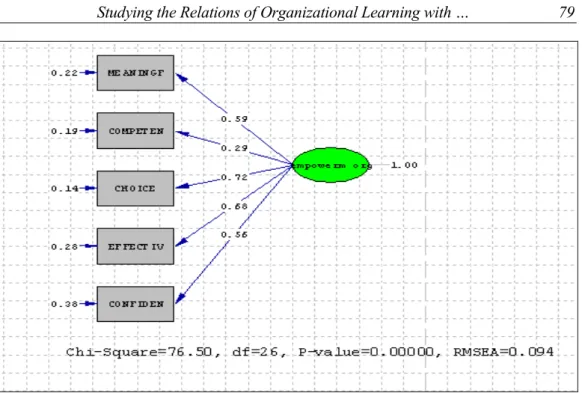
Study of Factors related to Empowerment. Another output of laser software studies and analyzes factors related to employees' empowerment and their reciprocal impact on employees' empowerment, to be called as X- Model.
Value of p-value, X² and calculated RMSEA is low, taking into account the following results having obtained from laser software output:
79 Studying the Relations of Organizational Learning with …
Figure 2. Model of Studying Factors in relation to Empowerment
Study and Analysis of Factors related to Organizational Learning. Another output of laser software studies and analyzes factors related to organizational learning and their reciprocal impact they may have on each other which is titled as Y- Model.
Darvish, H.; Norozi, M.
80
Value of calculated p- value and X² is low, taking into account the following results having obtained from laser software output:
X² = 76.5 and df = 26 and p – Value = 0 and RMSEA = 0.094.
Study of the Model related to Empowerment and Organizational Learning. As laser software output ascertains this output studies the impact of and relationship between empowerment and organizational learning entitled as Structural Model.
Value of p- value and calculated X² is low, taking into account the following results having obtained from laser software output:
X² = 76.5 and df = 26 and p – Value = 0.00 and RMSEA = 0.094.
Therefore Structural Model presented has an appropriate fitting.
Figure 4. Model of Empowerment and Organizational Learning
5. CONCLUSION AND RECOMMENDATION FOR FUTURE RESEARCH
5.1. Conclusion
81 Studying the Relations of Organizational Learning with …
organizational structure, experience and organizational culture, strategy and perspective, were extracted upon theorists' consensus.
Factors related to employees' empowerment were specified including job appropriateness, feeling of competence in job, feeling of choice in affairs and occupations, feeling of effectiveness in job and feeling of trust to colleagues.
Empowerment rate of employees of Social Security Organization of Tehran city was measured, the employees have necessary empowerment based on data analysis and extracted results and indices of sense of job meaningfulness, sense of competence, sense of choice in affairs, sense of effectiveness and trust to colleagues are found in the employees, among which sense of competence has the highest degree and sense of selection/choice and trust to colleagues the lowest one, respectively.
Status of Social security Organization of Tehran city was determined in view of organizational learning and there is a gap between appropriate situation of organizational learning and current status of the organization and perspective and organizational culture, respectively, have the lowest degree, among four-fold factors of organizational learning, and need to further retrospection.
Empowerment and organizational learning in Social Security Organization of Tehran city had a positive and significant relationship which was posed in form of a theoretical model and then confirmed owning to fitting appropriateness using laser software.
Both main and subsidiary assumptions were confirmed based on studying research assumptions, i.e there is a positive and significant relationship between employees' empowerment and organizational learning and employees' empowerment indices, one by one, and organizational learning in Social Security Organization of Tehran city.
5.2. Recommendations relating to Organizational learning Improvement
As specified in conclusion section, appropriateness of organizational factors will result in employees' empowerment. Therefore, rewarding system, organizational structure, accessibility to resources and specifying straightforward objectives, as organizational conditions, must be designed in a way that would make employees to become empowered.
Bureaucratic organizational structures are not in charge, in an expeditious-evolving, competitive world and turbulent media. Further, employees' specialty is one factor, among other things, which threatens bureaucracy phenomenon. Professional employees must not be engaged in bureaucracy's bends and turns in a way that they fail to use their creativity. Strategies regarding controlling bureaucracy include rules and regulations, procedures, instructions, policies and authority hierarchy, and making affairs standardized to unify and coordinate behaviours which make the employees to fail in stating their opinions and thoughts and facilitate injustice in power distribution resulting in employees' incapability. So that organizational structure must be proportionate to organizational objectives and empowerment level of employees.
Darvish, H.; Norozi, M.
82
employees to specify their direction. Organizational missions and strategies to be executed in this way specify type of work to be done by employees in organization. Challenging objectives motivate employees especially when they have been participated in specifying objectives. Therefore, organizational goals must be expressed accurately and organization's end be specified in a manner that the goals would be accomplishable, coordinated and attainable.
Using strategies and actions such as providing information, authority delegation, partnership management, team formation, and empowering employees, directors must provide beds and conditions to fulfil organizational tasks in a manner that employees would accomplish whatever they desire with intrinsic intention and motivation. Directors must reduce controlling actions and limitations and use absorption strategies instead of pushing and forcing ones.
Using absorption strategies, directors shall form organizational environment so that keep the employees eager intrinsically to perform their tasks and duties. So long as empowerment is a personal and internal process, i.e. whenever persons desire they may be empowered, therefore, directors must play the role of facilitators and facilitate conditions for empowering employees using management techniques and strategies.
REFERENCES:
[1]. Appelbaum, S.H.; Hongger, K. (1998) Empowerment: acontrasting overview of organizations in general and nursing in particular - an examination of organizational factors, managerial behaviors, job design and structural power, Journal of Empowerment in Organization v6 N 2.pp.29-50
[2]. Argyris, C. (1999) Organizational learning (2th end), Blackwell Publisgers Inc.
[3]. Baber, B. (1983) The logic and limits of trust, New Brunswich, N.J.: Rutgers University Press [4]. Bandura, A. (1986) Social foundations of thought and action: A social cognitive theory,
Prentice-Hall, Englewood Cliffs
[5]. Baron, J.N.; Hannan, M.T.; Burtoon, M.D. (2001) Labor pains: changing in organizational models and employee turnoverin young , high tech firms, American Journal of Socoliogy [6]. Bennet, A.; Bennet, D. (2008) The partnership between organizational learning based on
knowledge management
[7]. Bennis, W.; Nanus, B. (1985) Leaders: The strategics for taking charge, New York: Harper and Row
[8]. Blanchard, K.; Carlos, J.P.; Randolph, A. (1999) The 3 keys to empowerment, P: 58-59-65-93-116
[9]. Bowen, D.E.; Lawler III, E.E. (1992) The empowerment of service workers: What, why, how and when, Sloan Management Review, 33(3): 31-39
[10]. Conger, J.A.; Kanungo, R.N. (1988) The empowerment process, Academy of Management Review 13:471-482
[11]. Esmaeeli, V. (2006) Organizational learning based on creation a learning organization, Journal of Knowledge Management, in Persian
[12]. Gangne, M.; Deci, E.L. (2005) Self-determination theory and work motivation, Journal of Organizational Behavior Vol. 26, pp. 331- 362
[13]. Garvin, D.A. Building a Learning Organization, Harvard Business Review, 71, no.4 (JulyAugust1993): 7891
83 Studying the Relations of Organizational Learning with …
[15]. Geus, A.D. (1997) The living company boston, Harward Business School Press
[16]. Ghahramani, M. (2006) Leading in learning organization, Journal of Management and Development. N, 31, in Persian
[17]. Greenberger, D.B.; Stasser, S.; Cmmings, L.L; Dunham, R.B. (1989) The impact of personal control on performance and satisfaction, Organizational Behavior and Human Decision Processes 43:29-51
[18]. Hornstein, H. (2006) Empowerment as a way to facilitate change
[19]. Huczynski, A.; Buchanan, D. (2001) Organizational behavior, Fourth Edition, Prentice Hall [20]. Lussier, R. (2002) Human relations in organizations, Fifth Edition, McGraw-Hill companies.
P: 308
[21]. Mann, S. (2000) Give a little, gain a lot, Professional Manager, Mar. P: 32
[22]. Marquardt, M. (2002) Building the learning organization, New York: McGraw- Hill [23]. Marquardt, M.; Kearsley, G. (1999) Technology-based learning, Boca Raton, FL: St. Lucie [24]. Mishra, A.K. (1992) Organizational response to crisis: The role of mutual trust and top
management teams, Ph.D. dissertation, University of Michigan
[25]. Mishra, A.; Spreitzer (1997) Gretchenm, survivor responses to downsizing: the Mitigating Effect of Trust and empowerment, Southern California Studies Center
[26]. Mishra, A.K.; Spreitzer, G.M. (1998) Explaining how survivors respond to downsizing: The role of trust, empowerment, justice, and work redesign, Academy of management Review, 23 (3): 568-588
[27]. Nasr Esfehani, A. (2007) Empowerment mystery, Journal of Management and Development Planing, (in Persian)
[28]. Neefe, D.O. (2001) Comparing levels of organizational learning maturity of colleges and universities participating traditional and non-traditional (academic quality improvement project) accreditation processes
[29]. Otala, L. (2000) Oppimisen etu: Kilpailukykya muutoksessa, porvoo: WSOY
[30]. Paajanen, P.; Kantola, J. (2008) Ph.D, Applaying systems thinking in the evaluation of oranizational learning and knowledge creation
[31]. Rapport, J. (1984) Studies in empowerment: Introduction to the issue, Prevention in Human Services, 3, 1-7
[32]. Rue, L.; Byars, L. (2003) Management, 10th edition, Mc Graw-Hill. P: 150
[33]. Ruohotie, P.; Honka, J. (1997) Osaamisen kehittaminen organisaatiossa, Seinajoki: Consulting team
[34]. Ryan, R.; Deci, E. (2000) Self- determination theory and facilitation of intrinsic motivation, Social Development and Well-Being, American Psychologist Vol .55 No. 1, pp.68-78 [35]. Sajedi, F.; Omidvary, A. (2007) Empowerment staff and today organization, Journal of
Tadbir, (in Persian)
[36]. Scott, C.; Jaffe, D. (1991) Empowerment, First Edition, crisp
[37]. Senge, P. (1990) The Fifth Discipline: The art and practice of learning organization, Doubleday Dell; New York
[38]. Spritzer, G.; Kiziols, M.A. (1997) A dimensional analysis of the relationship between psychological empowerment and effectiveness, satisfaction and starin, Journal of Management, vol. 23, Issue. 5, p. 679- 682. Passim & , p. 480- 482, passim
[39]. Tubbs, S. L., & Moss, S. (2000). Human communication: principles and contexts, 9th ed.New York: McGraw Hill
[40]. Vecchio, R.P.; Griffeth, R.W.; Hom, P.W. (1986) The predictive utility of the vertical dyad linkage approach, Journal of Social Psychology; 126(5), pp.617-625
Darvish, H.; Norozi, M.
84
[42]. Whetten, D.; Cameron, K. (1998) Developing management skills, 4th edition, Reading, MA: Addison-Wesley
[43]. Whetten, D.; Cameron, K. (2002) Developing management skills, 5th edition,New York: Harper Collins College Publishers