M a i l i n g A d d r e s s : J u l i o C e s a r V i e i r a B r a g a Ć 5 X D 5 R V D G R V 9 H Q W R V ă ă 6 D O Y D G R U % $ % U D ] L O
(PDLOMXOLREUDJD#FDUGLROEU 5HFHLYHGRQĆ$FFHSWHGRQ
Influence of Gender on the Prognostic Value of
Troponin I After Elective Percutaneous Coronary
Interventions
Julio Cesar Vieira Braga, Almir Galvão Vieira Bitencourt, Marianna Deway Andrade, Roque Aras Junior, José Péricles Esteves
Hospital Português - Salvador, BA - Brazil
O
BJECTIVETo evaluate the association between troponin I concentrations (TnI) in patients submitted to elective percutaneous coronary interventions (PCI) and adverse coronary events (ACE) during a six month follow-up period
M
ETHODSOne hundred and eleven patients who had been submitted to an elective PCI were consecutively selected during a one year timeframe. The patients had stable angina (SA), unstable angina (UA) or silent ischemia (SI) and were asymptomatic for at least 72 hours before the procedure. TnI concentrations were measured between 8 and 24 hours after the PCI. Each patient was contacted by telephone six months later and interviewed regarding ACE which were defined as death, myocardial infarction, new revascularization and recurrent ischemia.
R
ESULTSTwenty-four patients showed elevated concentrations of TnI (21.6%) after the PCI regardless of clinical characteristics or procedure complications. Those who presented elevated TnI concentrations had higher event rates: 66.7 vs. 42.5% (RR=1.57; CI 95%=1.08-2.28). This risk seems to be higher in the subgroups of females and patients with a previous diagnosis of unstable angina. Multivariate analysis confirmed that gender was the only effect modifying co-variable associated with ACE risk, which is higher for females with elevated TnI concentrations (OR=7.22; CI 95%=1.4 -36.9) and unaltered for males (OR=1.26; CI 95%=0.35-4.55).
C
ONCLUSIONElevated TnI concentrations were a common occurrence after PCI and is a factor related to the development of ACE in the mid term. However, when adjusted for other variables, this effect is only maintained in female patients.
K
EY WORDSTroponin, percutaneous coronar y inter vention, prognosis.
Percutaneous coronary intervention procedures are frequently associated with the development of minimal myocardial necrosis or silent myocardial infarctions which generally speaking are only detected by the elevated serum levels of cardiac necrosis
biochemical markers1-5. These small heart attacks
are usually caused by micro-embolization during the
procedure6,7.
Results documented in recent publications are controversial regarding the prognostic value of these minimal myocardial lesions in relation to the occurrence
of events after a PCI 8-10 . Conversely, the prognostic
value of elevations, even though minimal, of the cardiac necrosis biochemical markers for acute coronary
syndromes (ACS) has been well demonstrated11.
Previous studies have shown that elevated levels of the creatine kinase-MB (CK-MB) cardiac isoform after a PCI are relevant for prognosis purposes, but only when the levels are at least three times higher than
the normal value12,13. The specificity and sensitivity
of cardiac troponins (TnI and TnT) are considered
to be higher than CK-MB13-15 and are elevated in
approximately 13 to 48% of the patients submitted
to PCI7,16,17. The elevation or re-elevation of TnI after
PCI in ACS is associated with a higher risk to develop
cardiovascular events in the mid to long terms5,10,18.
Nevertheless, in the case of elective PCI this association
is still questionable19-21.
The objective of this study is to evaluate whether or not TnI concentrations after elective PCI are associated with adverse cardiac events (ACE) which are defined as death, acute myocardial infarction, new revascularization procedures or recurrent ischemia during a six month follow-up timeframe after hospital discharge.
M
ETHODSPatients admitted to a coronary care unit after elective PCI surgery were consecutively selected between July 2000 and August 2001. All patients had been previously diagnosed with stable angina (SA), silent myocardial ischemia (SI) or unstable angina (UA) and had been asymptomatic for at least 72 hours before the procedure. Patients who had suffered an AMI within 15 days of the procedure or presented elevated TnI concentrations within 48 hours of the procedure were excluded from the study. The PCI procedures were performed by a team of professionals with extensive experience in this area, who were also responsible for the stent implant indications.
TnI concentrations were taken on all individuals between 8 and 24 hours after the PCI procedure. The measurements were taken using chemiluminescence (DPC - Diagnostics Products Corporation, Los Angeles, California, USA). When more than one measurement was taken the highest value was used as the reference. TnI elevations above 1.0 ng/dl were considered abnormal, based on the manufacturer’s
recommendation for AMI diagnostic criteria.
A standard questionnaire, detailing clinical characteristics, was filled out for each patient in the study. The angiographical data were analyzed by a single observer who was unaware of the patients’ clinical and laboratorial characteristics. Lesions angiographically evaluated before the intervention that presented an image indicative of thrombi, dissection or branch arter y involvement, were considered complex PCI lesions. After the procedure, the following complications were obser ved: acute occlusion, dissection and branch occlusions. Patient follow-up was conducted by a trained interviewer via telephone. All patients consented to participate in the study by telephone. ACE information for one, three and six months after the PCI was supplied by the patient or a representative familiar with the situation. Documented myocardial ischemia was considered when recorded by an ischemic test or Holter monitoring. All other adverse cardiac events, including death, AMI and new myocardial revascularization, whether a new PCI or myocardial revascularization surgery, were based on the information supplied by the person interviewed.
Statistical analysis - Elevation of TnI was evaluated as the main independent variable and adverse coronary events evaluated as the main dependent variable.
Based on theoretical data, gender, age and immediate procedure complications were evaluated as possible effect modifiers. In addition to these factors, stent implantation, lesion complexity and a diagnosis of unstable angina before the PCI were evaluated as possible confounding factors.
The age variable did not present a normal distribution and was transformed into a categorical variable, described in ratios. The association between TnI and co-variables was evaluated using the chi-square test.
The association between TnI elevation and cardiovascular events within six months was calculated for all patients by estimating the gross (not adjusted) risk ratio (RR) and using stratification in subgroups of interest. In this stage, interaction evaluations were calculated using the Mantel-Haenszel homogeneity test; if p was less than 0.20 the co-variable would be included in the logistic regression model.
Multivariate analysis with nonconditional logistic regression was used to estimate the odds ratio (OR) between TnI elevation and events within six months. Interaction analysis was conducted using the verisimilitude rate test (log likelihood ratio test) to compare models with and without interaction terms. Confounding analysis was conducted using the OR alteration of the variable in focus (percent change in effect), eliminating variables with the backward stepwise strategy.
The significance level adopted for two tailed hypotheses was 5%. The data collected were processed using the computer program STATA 7.
R
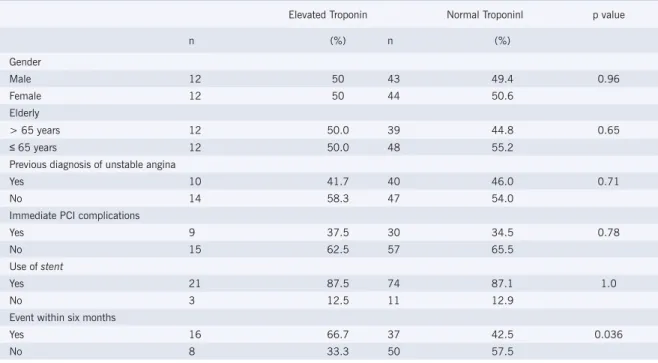
ESULTSThe study population was comprised of 111 patients and 24 presented elevated TnI concentrations (21.6%). Stents were used in 86.4% of the interventions and did not present an association with TnI elevations. Table 1 shows the distribution of the co-variables gender, age, diagnosis before the PCI, use of stents, immediate procedure complications and the main six month event outcome variable according to troponin values (normal or elevated).
Males did not represent the highest percentage of patients with elevated TnI concentrations (50 versus 49.4% of the patients with normal troponin, p=0.96), DJH\HDUVYHUVXVS DSUHYLRXV diagnosis of unstable angina (41.7 versus 46.0%, p=0.71), stent implants (87.5 versus 87.7%, p=1.0) or immediate procedure complications (37.5 versus 34.5%, p=0.78). The development of ACE within six months was more frequent in those with elevated TnI concentrations (66.7 versus 42.5%, p=0.036). Comparison of the ACE within the six month timeframe between the patients who had elevated TnI
concentrations and those who did not revealed: death (4.3 versus 0%, p=0.22); heart attack (17.4 versus 2.5%, p=0.02); new revascularization procedure (8.7 versus 20.0%, p=0.35); ischemia recorded during an ischemic test (50% versus 31.3%, p=0.07).
Table 2 shows the risk levels associated with elevated TnI concentrations. The gross estimate shows a higher relative risk to develop events in those with elevated TnI concentrations (RR=1.57; CI 95%=1.08-2.28). Initially this risk appeared to be higher in the female subgroups when compared to males (RR=2.04 versus 1.13; MH=0.12) and in those with a previous diagnosis of unstable angina (RR=2.15 versus 1.26; MH=0.17). After analysis using logistic regression models only gender was confirmed as a effect modifying co-variable.
As shown in Table 3, the odds ratio obtained by logistic regression for events in those that presented elevated TnI concentrations was 2.70 (CI 95%=1.05-6.98). By applying the logistic regression model, gender was identified as an effect modifier and no other confounding variables were associated with troponin and events.
Table 1 - Population characteristics according to troponin value.
Elevated Troponin Normal Troponinl p value
n (%) n (%)
Gender
Male 12 50 43 49.4 0.96
Female 12 50 44 50.6
Elderly
> 65 years 12 50.0 39 44.8 0.65
65 years 12 50.0 48 55.2
Previous diagnosis of unstable angina
Yes 10 41.7 40 46.0 0.71
No 14 58.3 47 54.0
Immediate PCI complications
Yes 9 37.5 30 34.5 0.78
No 15 62.5 57 65.5
Use of stent
Yes 21 87.5 74 87.1 1.0
No 3 12.5 11 12.9
Event within six months
Yes 16 66.7 37 42.5 0.036
No 8 33.3 50 57.5
D
ISCUSSIONThis study, conducted in a single center, confirms that the elevation of cardiac troponins is a common condition after PCI and is an important prognostic
factor for ACE in the mid-term5. This elevation was
not related to the angiographic characteristics or immediate procedure complications; findings that to
date are controversial issues1-4,6,7,12. The mechanisms
that confirm a greater necessity of subsequent revascularization due to elevated TnI concentrations
after the procedure have not yet been discovered16.
During patient follow-up after the PCI, the combination of events including cardiovascular death, AMI, new revascularization procedures and recurrent myocardial ischemia has been used often. Different criteria are used to define recurrent ischemia which include recurrent angina, hospital admission for angina or ischemia recorded during
an ischemic test22. Ischemic tests are more dependable
than the presence of angina and were used to increase the reliability of the results in this study.
The results of recent studies are still controversial regarding the importance of elevated CK-MB and troponin concentrations to predict mortality in the
Table 2 - Stratified analysis using the homogeneity test for the association between troponin and cardiovascular events within six months.
n RR CI 95% p value*
Gross association 111 1.57
1.08-Gender
Male 55 1.13
0.59-Female 56 2.04
1.32-Adjusted 1.57
1.08-M-H # 0.12
Age
\HDUV 48 1.63
0.85-< 65 years 63 1.52
0.98-Adjusted 1.59
1.10-M-H # 0.92
Diagnóstico de anginia
Yes 50 2.15
1.18-No 61 1.16
0.78-Adjusted 1.55
1.06-M-H # 0.17
Lesão complexa
Yes 82 1.38
0.84-No 29 1.94
1.03-M-H # 1.56 1.06- 0.41
Complicação
Yes 39 1.19
0.59-No 72 1.82
1.18-Adjusted 1.56
1.08-M-H # 0.31
RR- risco relativo; IC 95%=intervalo de confiança de 95%; # método de Mantel-Haenszel pelo STATA com intervalo de confiança e teste de homogeneidade; *valor de p para teste de homogeneidade: através do método de Mantel-Haenszel pelo STATA.
Tabela 3 - Associação entre troponina elevada e eventos com seis meses.
n OR IC 95% Valor de p
Risco relativo 111 1,57 1,08-2,28* 0,036 Odds ratio* 111 2,70 1,05-6,98 0,04 Sexo feminino 56 7,22 1,41-36,96 0,017 Sexo masculino 55 1,26 0,35-4,55 0,72 *obtido através de regressão logística.
mid and long term. Even though troponins are more sensitive markers in the detection of myocardial
necrosis23 than CK-MB, some authors have not found an
association between elevated troponin concentrations and increased mortality rates in the mid and long term. However, these authors relate that the elevation of CK-MB is an independent predicting mortality factor
for these patients24,25. There are still controversies
regarding definite cut-off points for cardiac enzyme levels to determine clinically important cardiac necrosis and whether or not a minimal elevation of these markers
has prognostic relevance26-28.
In this study, TnI elevation after elective PCI was associated with the development of cardiovascular events in the following six months, which could justify a differentiated approach for these patients in terms of both more aggressive treatments and more attentive follow-up that could include routine ischemic tests. This investigation could be beneficial in preventing more serious events such as death and recurrent AMI in the long term. In the short term, there is no indication that the risk of death is associated with these minimal
myocardial necrosis marker elevations29.
The findings of this study should be considered with limitations that have also been encountered by other
studies covering this topic15. Even though all the patients
with a history of unstable angina and AMI underwent basal troponin concentration assessments the stable patients did not, and therefore it is possible that patients with stable symptoms and elevated basal troponin concentrations were included in the study. Nevertheless, it does not seem justifiable to routinely assess these concentrations before the procedure. Furthermore, the use of a categorized value, in our case 1.0 ng/dl, could
be questioned since there is no definite data for an exact cut-off value. There was also no differentiation among the groups for the degree of troponin elevation, gender or race and troponin concentrations could be different in
these subgroups30. Even though an association between
troponin concentrations after PCI and adverse events within six months of the procedure has been reported, a causal relation cannot be determined from these data alone. Further studies are necessary to confirm this relationship and to determine a possible relationship in the long term.
The increased risk associated with TnI elevations in female patients could be related to the fact that this
subgroup has lower TnI values than men30. Since we
used the same cut-off point for both genders, we could be including men with proportionately lower values in the elevated troponin subgroup. Considering an arbitrary value for TnI elevation, in our case above 1.0 ng/dl, the treatment for women should be more attentive than for men; a fact to be confirmed in studies directed towards this specific objective.
We concluded that TnI elevations, a common occurrence after PCI, indicating silent myocardial infarctions caused by micro-embolization, are an important predicting factor for ACE in the mid term. Consequently, this type of lesion after iatrogenic coronary manipulation should be systematically predicted, assessed and if detected the doctors should be advised of the risk profile of these
patients27. Further studies are required to evaluate the
efficacy of secondary prevention strategies for mid and long term prognosis in these cases.
Potential Conflict of Interest
No potential conflict of interest relevant to this article was reported.
R
EFERENCES1. Johansen O, Brekke M, Stromme JH et al. Myocardial damage during percutaneous transluminal coronary angioplasty as evidenced by troponin T measurements. Eur Heart J 1998;19:112-7.
2. Saadeddin SM, Habbab MA, Sobki SH, Ferns GA. Minor myocardial injury after elective uncomplicated successful PTCA with or without stenting: detection by cardiac troponins. Catheter Cardiovasc Interv 2001;53:188-92.
3. Abbas AS, Glazier JJ, Wu AH et al. Factors associated with the release of cardiac troponin T following percutaneous transluminal coronary angioplasty. Clin Cardiol 1996;19:782-6.
4. Ricchiuti V, Shear WS, Henry TD et al. Monitoring plasma cardiac troponin I for the detection of myocardial injury after percutaneous transluminal coronary angioplasty. Clin Chim Acta 2000;302:161-70.
5. Cantor WJ, Newby LK, Christenson RH et al. Prognostic Significance of Elevated Troponin I After Percutaneous Coronary Intervention. J Am Coll Cardiol 2002;39:1738-44.
6. Erbel R, Heusch G. Coronary microembolization- its role in acute coronary syndromes and interventions. Herz 1999;24:558-75. 7. Mongiardo A, Ferraro A, Ceravolo R et al. Mechanism of troponin and
CK-MB release after percutaneous coronary interventions. Ital Heart J 2002;3(3Suppl):270-4.
8. Garbarz E, Iung B, Lefevre G et al. Frequency and prognostic value of cardiac troponin I elevation after coronary stenting. Am J Cardiol 1999; 84:515-8.
9. Fuchs S, Kornowski R, Mehran R et al. Prognostic value of cardiac troponin-I levels following catheter-based coronary interventions. Am J Cardiol 2000; 85:1077-82.
10. Fuchs S, Gruberg L, Singh S et al. Prognostic value of cardiac troponin I re-elevation following percutaneous coronary intervention in high -risk patients with acute coronary syndromes. Am J Cardiol 2001;88:129-33.
11. Callif RM, Abdelmeguid AE, Kuntz RE et al. Myonecrosis after revascularization procedures. J Am Coll Cardiol 1998;31:241-51. 12. Antman EM, Tanasijevic MJ, Thompson B et al. Cardiac-specific
troponin I levels to predict the rsk of mortality in patients with acute coronary syndromes. N Engl J Med 1996;335:1342-9.
13. Attali P, Aleil B, Petitpas G, DePoli F et al. Sensitivity and long-term prognostic value of cardiac troponin-I increase shortly after percutaneous transluminal coronary angioplasty. Clin Cardiol 1998;21:353-6.
14. Bertinchant JP, Polge A, Ledermann B et al. Relation of minor cadiac troponin I elevation to late cardiac events after uncomplicated elective successful percutaneous transluminal coonary angioplasty for angina pectoris. Am J Cardiol 1999; 84:51-7.
15. Shyu KG, Kuan PL, Cheng JJ et al. Cardiac troponin T, creatine Kinase, and its isoform release after successful percutaneous transluminal coronary angioplasty with or without stenting. Am Heart
16. Ricciardi MJ, Davidson CJ, Gubernikoff G et al. Troponin I elevation and cardiac events after percutaneous coronary intervention. Am Heart J 2003;145:522-8.
17. Saadeddin SM, Habbad MA, Sobki SH et al. Biochemical detection of minor myocardial injury after elective, uncomplicated, successful percutaneous coronary intervention in patients with stable angina: clinical outcome. Ann Clin Biochem 2002;39:392-7.
18. Nageh T, Sherwood RA, Harris BM et al. Cardiac troponin I for risk stratification following percutaneous coronary artery intervention in acute coronary syndromes. Catheter Cardiovasc Interv 2002;55:37-42.
19. Wu CJ, Liang HL, Chiou KR et al. Significance of cardiac troponin I and creatine kinase release after coronary intervention. Zhonghua Yi Xue Za Zhi 2001;64:343-50.
20. Herrmann J, Von Birgelen C, Haude M et al. Prognostic implication of cardiac troponin T increase following stent implantation. Heart 2002;87:549-53.
21. Kiser JR, Muttrej MR, Matthai WH et al. Role of cardiac troponin T in the long-term risk stratification of patients undergoing percutaneous coronary intervention. Eur Heart J 2003;24:1314-22.
22. Mehta SR, Yusuf S, Peters RJG et al. Effects of pretreatment with clopidogrel and aspirin followed by long-term therapy in patients undergoing percutaneous coronary intervention: the PCI-CURE study. Lancet 2001; 358: 527–33.
23. Nageh T, Sherwood RA, Harris BM et al. Cardiac troponin T and I and creatine kinase-MB as markers of myocardial injury and predictors of outcome following percutaneous coronary intervention. Int J Cardiol 2003;92:285-93.
24. Cavallini C, Savonitto S, Violini R et al. Impact of the elevation of biochemical markers of myocardial damage on long-term mortality after percutaneous coronary intervention: results of the CK-MB and PCI study. Eur Heart J 2005;26:1494-8.
25. Kini AS, Lee P, Marmur JD et al. Correlation of postpercutaneous coronary intervention creatine kinase-MB and troponin I elevation in predicting mid-term mortality. Am J Cardiol 2004;93:18-23. 26. Okmen E, Kasikcioglu H, Sanli A et al. Correlations between cardiac
troponin I, cardiac troponin T, and creatine phosphokinase MB elevation following successful percutaneous coronary intervention and prognostic value of each marker. J Invasive Cardiol 2005;17:63-67. 27. Cavallini C, Rugolotto M, Savonitto S. Prognostic significance of
creatine kinase release after percutaneous coronary intervention. Ital Heart J 2005;6:522-529.
28. Ioannidis JP, Karvouni E, Katritsis DG. Mortality risk conferred by small elevations of creatine kinase-MB isoenzyme after percutaneous coronary intervention. J Am Coll Cardiol 2003;42:1406-11. 29. Stone GW, Mehran R, Dangas G et al. Differential impact on survival of
electrocardiographic Q-wave versus enzymatic myocardial infarction after percutaneous intervention: a device-specific analysis of 7147 patients. Circulation 2001; 104:642-7.
30. Apple FS, Quist HE, Doyle PJ, Otto AP, Murakami MM. Plasma 99th percentile reference limits for cardiac troponin and creatine kinase MB mass for use with European Society of Cardiology/ American College of Cardiology Consensus Recommendation. Clinical Chemistry 2003;49:1331-6.