The small estuarine dolphin, Sotalia guianensis (Van Bénéden, 1864) of coastal and estuarines waters of Central and South America is common from southern Brazil (27º35’S, 48º35’W – SIMÕES-LOPES 1988) to Nicaragua (14º35’N, 83º14’W) and may be found as far north as Honduras (15º58’N, 79º54’W – CARR & BONDE 2000). This species has been found at a total of 49 published locations in Brazil (BOROBIAetal. 1991, AZEVEDO & VAN SLUYS 2005, ROSSI-SANTOS & PODOS 2006). While abundant along the South American coast, information about this dolphin is considered insufficient by the International Union for Conser-vation of Nature and Natural Resources (IUCN 2006) for conser-vation purposes, particularly with respect to population dynam-ics, ecology, residence patterns, habitat and social interactions. This species is difficult to study in nature due to its small size, its tendency to avoid approaching humans, its preference for dark estuarine waters and lack of sexual dimorphism. To overcome such problems, photo-identification methods are
of-ten used to identify individual animals in mark-recapture stud-ies. With a library of photographs and sighting information, individuals can be recognized by natural and unique skin pat-terns and scars (WÜRSIG & JEFFERSON 1990). Population size (HAMMONDetal. 1990), residence and movement patterns within an area (WÜRSIG & WÜRSIG 1977, SCOTTetal. 1990, WEIGLE 1990), and group structure (BIGGetal. 1990, WELLS 1991) have all been studied with this method. In Brazil, photo-identification as a tool to study site fidelity in S. guianensis is relatively recent (FLORES 1999, SANTOSetal. 2001, AZEVEDOetal. 2004, ROSSI-SANTOS etal. 2007).
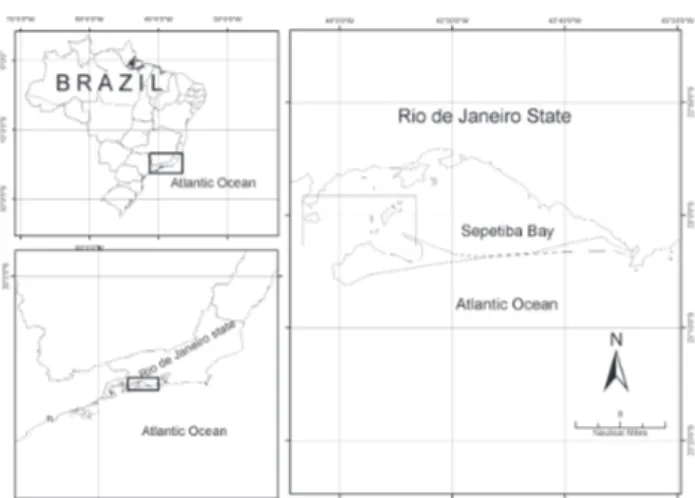
Since 1994, our group has studied this dolphin in Sepetiba Bay (state of Rio de Janeiro, Brazil; 22º35’S, 44º03’W, Fig. 1), in part to create a visual database for the study of the ecology and the behaviour of estuarine dolphins. Sepetiba Bay is a semi-closed coastal lagoon complex with an area of 519 km² with diverse environments including beaches, peninsulas, islands,
in Sepetiba Ba
in Sepetiba Ba
in Sepetiba Ba
in Sepetiba Ba
in Sepetiba Bay
y
y
y
y,,,,, Rio de J
Rio de J
Rio de J
Rio de Janeir
Rio de J
aneir
aneiro,
aneir
aneir
o,
o,
o, Br
o,
Br
Br
Br
Brazil
azil
azil
azil
azil
Mariana F. Nery
1, 2; Mariana de A. Espécie
2& Sheila M. Simão
21 Instituto de Ecología y Evolución, Universidad Austral de Chile. Casilla 567, Valdivia, Chile. E-mail: [email protected] 2 Departamento de Ciências Ambientais, Instituto de Florestas, Universidade Federal Rural do Rio de Janeiro. Rodovia BR 465, km 7, 23890-000 Seropédica, Rio de Janeiro, Brasil. E-mail: [email protected], [email protected]
ABSTRACT. Estuarine dolphins, Sotaliaguianensis (Van Bénéden, 1864), were identified in Sepetiba Bay (22º35’S, 44º03’W), state of Rio de Janeiro, Brazil, between February 1994 and July 2006 using the photo-identification method. A total of 72 surveys resulted in the identification and cataloguing of 217 individual dolphins. Seventy-nine (36%) were resighted at least once during the study period. The average interval between resightings was 40,6 ± 31,1 months. Large numbers of mother-and-calf pairs were recorded during the 12 years and new individu-als were frequently encountered in the photographic records. These results suggest that part of the dolphin population is more consistently found in Sepetiba Bay, probably for feeding and reproduction, while other individuals use the Bay only sporadically.
KEY WORDS. Estuarine dolphin; habitat use; photo-identification.
RESUMO. FFFFFidelidade de áridelidade de áridelidade de áridelidade de áridelidade de área de ea de ea de ea de ea de SotaliaSotaliaSotaliaSotaliaSotalia guianensisguianensisguianensisguianensisguianensis (Cetacea: (Cetacea: (Cetacea: (Cetacea: (Cetacea: Delphinidae) na Baía de Sepetiba, Delphinidae) na Baía de Sepetiba, Delphinidae) na Baía de Sepetiba, Delphinidae) na Baía de Sepetiba, Delphinidae) na Baía de Sepetiba, Rio de J Rio de Janeir Rio de J Rio de J Rio de Janeiraneiraneiraneiro,o,o,o,o, Br
BrBr Br
Brasil.asil.asil.asil. Indivíduos da população dos golfinhos estuarinos, asil. Sotalia guianensis (Van Bénéden, 1864), da Baía de Sepetiba (22º35’S, 44º03’W) Estado do Rio de Janeiro, sudeste do Brasil, foram catalogados pelo método de foto-identificação durante o período de fevereiro de 1994 a julho de 2006. Foram conduzidas 72 expedições de barco, resultando na identificação e catalogação de 217 botos. Destes 79 (36,4%) foram recapturados pelo menos uma vez durante o período de estudo; o intervalo médio entre as recapturas foi de 40,6 ± 31,1 meses. A presença de pares de mães-filhotes foi numerosa ao longo dos 12 anos de estudo e novos indivíduos foram constantemente identificados na área. Os resultados sugerem que parte desta população depende substancial-mente do habitat fornecido pela Baía de Sepetiba, tanto para alimentação quanto para fins de reprodução, apesar de haver indivíduos que pouco se utilizam desta área.
rocky cliffs, and mangrove and inter-tidal swamps. Much of the inlet complex is shallow (~6 m in depth), but in some ar-eas, for example, between islands, may reach 47 m (MUEHE & VALENTINI 1998).
The bay suffers from extensive anthropic activities. More than 400 factories (chemical, metal, rubber and printing) sur-round this ecologically important area (MUEHE & VALENTINI 1998). Industrial and agricultural wastes, together with pollution from a nearby and expanding port, are constant inputs into the bay and constitute a grave threat to the local wildlife (MARQUESet al. 2002).
In this paper, we present information gathered over a 12-year period of observation of S.guianensis population (sensu MAYR 1977) inhabiting Sepetiba Bay. The results presented herein provide an insight into site fidelity and population dy-namics of the estuarine dolphin that should be important in the design of future conservation projects.
MATERIAL AND METHODS
Site fidelity is defined as the tendency of an animal to occupy an area or to return to a previously occupied area over some period of time (WHITE & GARROT 1990). To examine fidel-ity, boat surveys were conducted in the Sepetiba Bay from Feb-ruary 1994 to August 2006. Photographs of the dorsal region, including the dorsal fin, of estuarine dolphins were taken to allow individual identification. The sampling effort was not equally distributed throughout the study period. Field work was carried out from a seven meters boat that cruised at four knots during favourable conditions. Favorable conditions were at the state of the sea < 3 on the Beaufort scale, and no surveys ocurred when the state of the sea was ⭓ 3, when photography is difficult or impossible (Simão et al. 2000). Survey teams com-prised a vessel operator, a data recorder and one or two experi-enced photographers. The boat moved randomly until one or
more groups of dolphins were sighted.. The geographical posi-tion of the dolphins was marked and subsequently plotted on a nautical chart. Pictures were taken using 35 mm cameras (Nikon N80 with a Nikon AF 70-300 mm zoom lens, or Canon EOS with a Canon EF 75-300 mm zoom lens). Color and black/ white films of speed 100 or 400 ASA were used depending on the light. Only photos that allowed clear identification of in-dividual animals were used (in focus, un-obscured, with the dorsal fin relatively perpendicular to the plane of the photo-graph, with the dorsal fin large enough to identify small notches). Selected photographs were compared visually by at least two experienced researchers in matching dorsal fins pho-tographs, following DEFRANetal. (1990).
Two error types are most common with photoidenti-fication. First, false negatives, when two sightings of different individuals are classified as one. Second, false positives, when two images of the same individual are classified as two differ-ent animals; both resulting in population estimations biased (GUNNLAUGSSON & SIGURJÓNSSON 1990, STEVICKetal. 2001). We be-lieve that we minimized or eliminated those potential errors by the use of high quality photographs and two researchers examing those photographs.
RESULTS
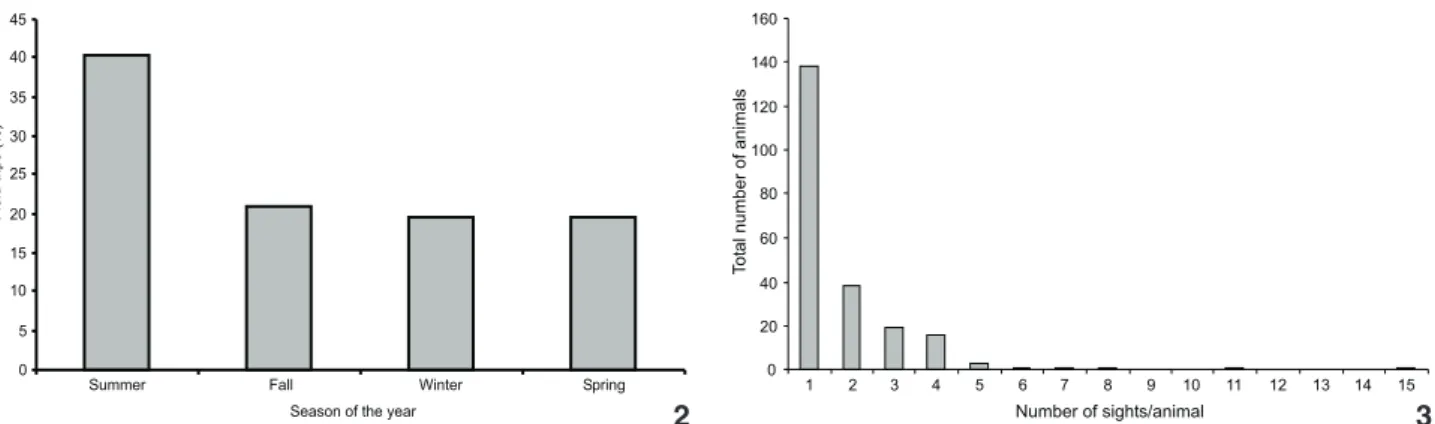
A total of 72 surveys during the 12 years (excluding 1996) found that estuarine dolphins inhabit Sepetiba Bay area throughout the year (Tab. I, Fig. 2). Dolphins were found within only 28% of the bay, an area of roughly 145 km² area (Fig. 1). Dolphins were seen during every expedition and were found in groups ranging from 2 to 200 (80.5 ± 51.1) individuals. Indi-viduals were observed performing aerial, hunting, social behaviour, or travelling (SIMÃOetal. 2000). Groups with
mother-Figure 1. A map of Sepetiba Bay (Southeastern Brazil) showing the area most used by the estuarine dolphins.
Table I. Number of surveys, and catalogued and resighted Sotalia
guianensis dolphins in Sepetiba Bay between February 1994 and August 2006.
Years Number of surveys New identifications Resightings
1994 4 7 0
1995 1 16 1
1997 2 17 3
1998 18 65 50
1999 4 11 10
2000 8 17 16
2001 10 26 40
2002 5 3 6
2003 5 35 33
2004 8 14 19
2005 5 4 6
2006 2 2 2
calf pairs were frequent (80%) while those comprising only adults were much less common (20%).
A total of 217 animals were identified and catalogued, with 186 resightings. Each of these was clearly recognized from the silhouette of the dorsal fin and/or from scars of other visibile features near the dorsal fin. Annual resighting was correlated with the number of surveys carried out each year (Spearman rs = 0.755, n = 12, p = 0.011).
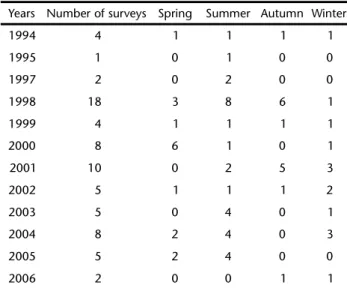
Seventy nine animals (36%) were resighted at least once during the 12 year study period, while the remaining 138 (64%) were never seen again (Fig. 3). The minimum interval between the first and the last sighting of an individual animal was nine days. Twenty two animals (Tab. II) were resighted for the last time more than five years after the first sighting. One indi-vidual resighting maximum interval was 11.25 yr, two at ~9 yr, two at ~8 yr, three at ~7 yr, nine at ~6 yr and five at ~5 yr. The average length of time between the first and the last sighting was 40.6 (± 31.1) months (Fig. 4).
DISCUSSION
Dolphins were found during all surveys and seasons (Tab. III, Fig. 2) and so we found no apparent seasonality in the way the animals use this habitat. The 145 km2 area used by the
animals is more similar to oceanic waters than the inner reaches of the bay (saltier, cooler, less turbid – SIMÃO & POLETTO 2002). This preference may be due environmental conditions or the associated difference in prey abundance (SIMÃO & POLETTO 2002). S.guianensis was found in 42% (137 km2) of Guanabara Bay
(Rio de Janeiro) with an estimated 70 animals (AZEVEDOetal. 2004, 2007). Comparing the two bays, while the area used is similar, Guanabara Bay has fewer individuals than Sepetiba, suggesting that resources are perhaps more limiting at the former. Also, Sepetiba Bay has the second largest concentra-tion of estuarine dolphins in its range (SIMÃOetal. 2000), sug-gesting that resources are plentiful here.
Site fidelity has been studied in a variety of dolphin spe-cies, including Tursiopstruncatus (e.g. BALLANCE 1990, BRISTOW &
REES 2001, SIMÕES-LOPES & FABIAN 1999, SLOOTENetal. 1993), Sousa chinensis (e.g. KARCZMARSKIet al. 1999), Cephalorhyncus hectori (e.g. BRÄGERetal. 2002), Iniageoffrensis (e.g. GONZALEZ 1994) and Stenellalongirostris (e.g. MARTEN & PSARAKOS 1999). In Brazil, site fidelity had been previously studied in four locations for Sotalia guianensis: Guanabara Bay (state of Rio de Janeiro) for a period of eight years between 1995 and 2003 (AZEVEDOetal. 2004), the North Bay of Florianópolis (state of Santa Catarina) for 4.8 years (FLORES 1999), the Cananéia Estuary (state of São Paulo) for four years (SANTOSetal. 2001) and the Caravelas River Estuary (state
0 5 10 15 20 25 30 35 40 45
Summer Fall Winter Spring
Season of the year
Field
trip
s
(%)
Figures 2-3. (2) Distribution of census periods by season for the 12 years of study; (3) distribution of the photo-identified dolphins and the number of sightings for each animal.
0 20 40 60 80 100 120 140 160
1 2 3 4 5 6 7 8 9 10 11 12 13 14 15
Number of sights/animal
T
ot
al
number
of
animals
Table II. Resighting intervals (> 5 yr) of Sotaliaguianensis in
Sepetiba Bay. Year of the first sighting, interval between first and last sightings.
Individual code First sighting Interval between first and
last sighting
# 29 - # 31 - # 115 1998 5 yr. 1 mo.
# 114 1998 5 yr. 2 mo.
# 119 1999 5 yr. 6 mo.
# 20 1995 6 yr.
# 103 - # 98 1998 6 yr. 1 mo.
# 43 1997 6 yr. 2 mo.
# 7 1995 6 yr. 4 mo.
#127 1994 6 yr. 8 mo.
# 71 1998 6 yr. 8 mo.
# 67 - # 81 1998 6 yr. 10 mo.
# 1 1994 7 yr. 4 mo.
# 6 1994 7 yr. 9 mo.
# 28 1997 7 yr. 10 mo.
# 89 1998 8 yr.
# 30 1998 8 yr. 6 mo.
# 10 1995 9 yr. 1 mo.
# 3 1994 9 yr. 5 mo.
# 19 1995 11 yr. 3 mo.
of Bahia) for three years (ROSSI-SANTOSet al. 2007). With our results, Sepetiba Bay seems to offer a particularly high quality habitat, since dolphins are more abundant and found year round. Also, reproduction is common, since amny calves have been observed and photographic images of new individuals are obtained constantly (Fig. 4). Thus, the relatively few resightings (36% of the animals identified) here compared with a greater resighting rate in the other study areas (North Bay – 94%, Cananéia Estuary – 85%, Guanabara Bay – 94%; FLORES 1999, SANTOSetal. 2001, AZEVEDOetal. 2004), may be a conse-quence of the number of field trips conducted which were in-sufficient to cover the entire sample population Residence pat-terns of cetaceans usually consider three parameters: the num-ber of times an individual is resighted, the interval between the first and last sighting, and the average number of days be-tween consecutive sightings of a single animal (BALLANCE 1990). These three parameters must be interpreted carefully to avoid
misinterpretation. Combining the data shown in tables I and II and figure 3 suggests that the residence pattern of dolphins in Sepetiba Bay is variable, i.e., most of the individuals were seen just once whilst some were observed on many occasions. Also, some dolphins were resighted after a short interval of time (i.e., a few days later the first sighting), while others were resighted after a long interval, hence the average interval be-tween resightings and the large standard deviation (40.6 ± 31.1 months). A large variability in resighting interval is expected due to residence patterns that vary between individuals because of individual variation in the way they explore the environ-ment for essential activities such foraging and reproduction (BALLANCE 1990, KARCZMARSKIetal. 1999). Also, non-sightings do not necessarily imply absence, but may often be because the animal could not be photoidentified. This is especially impor-tant to our study because the Sepetiba Bay comprise the largest population of this species.
Group composition in dolphins is important for the evalu-ation of residence patterns. That mothers with calves are found all year round and in all 12 years of study suggest that this bay is an important nursing area and that most of the photo-identi-fied animals are adult females. This and the infrequent exclu-sively adult groups (20%) suggests that Sepetiba Bay is not al-ways used by the entire local population. Females with calves and subadults of both sexes may use this bay until maturation of the offpspring. Once becoming adults, individuals may then move to join other adults in adjacent areas, such as the open ocean or other nearby bays (Fig. 5). As a preliminary test of this prediction, the photo-id catalogues of Sepetiba and Guanabara bays were compared and no common individuals were found, despite the relatively short distance between the two (91 km).
A large population of S.guianensis dolphins is commonly seen in Paraty Bay (LODI & HETZEL 1998, Fig. 5) and dolphins are often observed in ocean waters between Sepetiba and Paraty Bays (Sérgio C. Moreira, Instituto Aqualie, pers. comm.). Since both areas are environmentally similar, offering resources and shelter against predators, it is likely that the habitat of the S.guianensis population includes Sepetiba and the nearby (< 40 km) Paraty Bays. To test this prediction, preparation of a photo-id catalogue of Paraty Bay estuarine dolphins is underway in our lab. We predict that both areas are used by individuals that were recorded in Sepetiba Bay. If so, the conservation concerns for these ani-mals will have to take in account a much larger area. As anthro-pogenic influences rapidly increase in Sepetiba Bay, due to its economic interest for the state of Rio de Janeiro, Paraty Bay may become an important refuge should conditions worsen in Sepetiba.
The residence patterns described here provides prelimi-nary data on the dynamics of the S.guianensis population of Sepetiba Bay. Data suggest that relatively few adults regularly use the bay, due to the long time intervals between resightings, and that those that use the bay are mainly reproducing females. Systematic long-term photo-identification of dolphins in
0 50 100 150 200 250
1994 1995 1996 1997 1998 1999 2000 2001 2002 2003 2004 2005 2006
Year
Cumulative
number
of
animals
captured
Figure 4. Cumulative curve of dolphins photo-identified at Sepetiba Bay.
Table III. Number of censuses by season for each year of study.
Years Number of surveys Spring Summer Autumn Winter
1994 4 1 1 1 1
1995 1 0 1 0 0
1997 2 0 2 0 0
1998 18 3 8 6 1
1999 4 1 1 1 1
2000 8 6 1 0 1
2001 10 0 2 5 3
2002 5 1 1 1 2
2003 5 0 4 0 1
2004 8 2 4 0 3
2005 5 2 4 0 0
Sepetiba Bay with the inclusion of Paraty Bay, should provide a more comprehensive understanding, and result in more ac-curate conclusions regarding the habitat of S.guianensis. The knowledge of the relationship between these cetaceans and the environment will be extremely valuable for the implementa-tion of future conservaimplementa-tion programs.
ACKNOWLEDGMENTS
We wish to thank the Fundação O Boticário de Proteção à Natureza for financial support, as well as the trainee students and Ecovolunteers who took part in the project. Also, thanks to Romildo C. da Silva for his invaluable skill in driving the research boat and especially for his friendship over the years.
LITERATURE CITED
AZEVEDO, A.F. & M. VAN SLUYS. 2005. Whistles of the tucuxi dolphin (Sotaliafluviatilis) in Brazil: comparisons among populations. JournalofAcousticSocietyofAmerica117 (3): 1456-1464.
AZEVEDO, A.F.; J. LAILSON-BRITO JR; H.A. CUNHA & M. VAN SLUYS. 2004. A note on site fidelity of marine tucuxis (Sotalia fluviatilis) in Guanabara Bay, southeastern Brazil. Journal ofCetaceanResearchandManagement6 (1):265-268. AZEVEDO, A.F.; A.M. OLIVEIRA; S.C. VIANA & M. VAN SLUYS. 2007.
Habitat use by marine tucuxi (Sotaliaguianensis) (Cetacea, Delphinidae) in Guanabara Bay, south-eastern Brazil. JournaloftheMarineBiologicalAssociationoftheUnited Kingdon87 (1): 201-205.
BALLANCE, L.T. 1990. Residence patterns, group organization, and surfacing associations of bottlenose dolphins in Kino Bay, Gulf of California, Mexico, p. 267-284. In: S. LEATHERWOOD & R.R. REEVES (Eds). The Bottlenose Dolphin. San Diego, Academic Press, 653p.
BIGG, M.A.; P.F. OLESIUK; G.M. ELLIS; J.K.B. FORD & K.C. BALCOMB. 1990. Social organization and genealogy of resident killer whales (Orcinusorca) on the coastal waters of British Columbia and Washington State, p. 383-405. In: P.S. HAMMOND; S.A. MIZROCH & G.P. DONOVAN (Eds). Individualrecognition of
cetaceans: use of photo-identification and other techniquestoestimatepopulationparameters. Cambridge, International Whaling Commission, special issue 12, 440p. BOROBIA, M.; S. SICILIANO; L. LODI & W. HOEK. 1991. Distribution
of the South American dolphin Sotaliafluviatilis. Canadian JournalofZoology69 (4): 1025-1039.
BRÄGER, S.; S.M. DAWSON; E. SLOOTEN; S. SMITH; G.S. STONE & A. YOSHINAGA. 2002. Site fidelity and along-shore range in Hector’s dolphin, an endangered marine dolphin from New Zealand. BiologicalConservation108 (3): 281-287. BRISTOW, T. & E.I.S. REES. 2001. Site fidelity and behaviour of
bottlenose dolphins (Tursiops truncatus) in Cardigan Bay, Wales. AquaticMammals27 (1): 1-10.
CARR, T. & R.K. BONDE. 2000. Tucuxi (Sotaliafluviatilis) occurs in Nicaragua, 800km North of its previously known range. MarineMammalScience16 (2): 447-452.
DEFRAN, R.H.; G.M. SCHULTZ & D.W. WELLER. 1990. A technique for the photographic identification and cataloging of dorsal fins of the bottlenose dolphin (Tursiopstruncatus), p. 53-55. In: P.S. HAMMOND; S.A. MIZROCH & G.P. DONOVAN (Eds). Individual recognitionofcetaceans:useofphoto-identificationand othertechniques to estimate population parameters. Cambridge, International Whaling Comission, special issue 12, 440p.
FLORES, P.A.C. 1999. Preliminary results of a photo-identification study of the marine tucuxi Sotaliafluviatilis in southern Brazil. MarineMammalScience15 (3): 840-847.
GONZALEZ, F.T. 1994. The use of photo-identification to study the Amazon river dolphin Iniageoffrensis, in the Colombian Amazon. MarineMammalScience10 (3): 348-353. GUNNLAUGSSON, T. & J. SIGURJÓNSSON. 1990. A note on the problem
of false positives in the use of natural marking data and abundance estimation, p. 143-145. In: P.S. HAMMOND; S.A. MIZROCH & G.P. DONOVAN (Eds). IndividualRecognitionof Cetaceans: use of photo-identification and other techniquestoestimatepopulationparameters. Cambridge, International Whaling Commission, special issue 12, 440p. HAMMOND, P.S.; S.A. MIZROCH & G.P. DONOVAN. 1990. Individual recognitionofcetaceans: useofphoto-identificationand othertechniques to estimate population parameters. Cambridge, International Whaling Commission, special issue 12, 440p.
IUCN. 2006. 2006 IUCN Red List of Threatened Species. Available on line at: http://www.iucnredlist.org [Accessed in 12.VII.2007]
KARCZMARSKI, L.; P.E.D. WINTER; V.G. COCKCROFT & A. MCLACHLAN. 1999. Population analyses of Indo-Pacific humpback dolphins Sousachinensis in Algoa Bay, Eastern Cape, South Africa. MarineMammalScience15 (4): 1115-1123. LODI, L. & B. HETZEL. 1998. Grandes agregações do boto-cinza
(Sotalia fluviatilis) na Baía da Ilha Grande, Rio de Janeiro. Bioikos12 (2): 26-30.
MARQUES, A.N.; R.B.C. MORAES & M.C. MAURAT. 2002. Poluição
Marinha, p. 311-334. In: R.C. PEREIRA & A. SOARES-GOMES (Eds). BiologiaMarinha. Rio de Janeiro, Editora Interciência, 382p. MARTEN, K. & S. PSARAKOS. 1999. Long-term site fidelity and possible long-term associations of wild spinner dolphins (Stenellalongirostris) seen off Oahu, Hawaii. MarineMammal Science15 (4):1329-1336.
MAYR, E. 1977. Populações, espéciese evolução. São Paulo, Universidade de São Paulo, 485p.
MUEHE, D. & E. VALENTINI. 1998. OlitoraldoRiodeJaneiro: uma caracterizaçãofísico-ambiental. Rio de Janeiro, FEMAR, 123p. ROSSI-SANTOS, M.R. & J. PODOS. 2006. Latitudinal variation in whistle structure of the estuarine dolphin Sotaliaguianensis. Behaviour143 (3): 347-364.
ROSSI-SANTOS, M.R.; L.L. WEDEKIN & E.L.A. MONTEIRO-FILHO. 2007. Residence and site fidelity of Sotalia guianensis in the Caravelas River Estuary, eastern Brazil. JournalofMarine BiologicalAssociationofUnitedKingdon87 (1): 207-212. SANTOS, M.C.O.; L.B. ACUÑA & S. ROSSO. 2001. Insights on site fidelity and calving intervals of the marine tucuxi dolphin (Sotaliafluviatilis) in south-eastern, Brazil. Journal ofthe MarineBiologicalAssociationoftheUnitedKingdom81 (6): 1049-1052.
SCOTT, M.D.; R.S. WELLS; A.B. IRVINE & B.R. MATE. 1990. Tagging and marking studies on small cetacean, p. 489-514. In: S. LEATHERWOOD & R.R. REEVES (Eds). TheBottlenoseDolphin. San Diego, Academic Press, XVIII+653p.
SIMÃO, S.M. & F.R. POLETTO. 2002. Áreas preferenciais de pesca e dieta do ecótipo marinho do boto-cinza (Sotaliafluviatilis) na Baía de Sepetiba. FlorestaeAmbiente9 (1): 18-25. SIMÃO, S.M.; J.L.A. PIZZORNO; V.N. PERRY & S. SICILIANO. 2000.
Apli-cação da técnica de foto-identifiApli-cação do boto-cinza, Sotalia fluviatilis (Cetacea, Delphinidae) da Baía de Sepetiba. Flo-restaeAmbiente7 (1): 31-39.
SIMÕES-LOPES, P.C. 1988. Ocorrência de uma população de Sotalia fluviatilis (Gervais, 1853) (Cetacea, Delphinidae) no limite sul de sua distribuição, Santa Catarina, Brasil. Biotemas1
(1): 57-62.
SIMÕES-LOPES, P.C. & M.E. FABIAN. 1999. Residence patterns and site fidelity in bottlenose dolphins, Tursiops truncatus (Montagu) (Cetacea, Delphinidae) off Southern Brazil. Re-vistaBrasileiradeZoologia16 (4): 1017-1024.
SLOTEEN, E.; S.M. DAWSON & H. WHITEHEAD. 1993. Associations among photographically identified Hector’s dolphins. CanadianJournalofZoology71 (12): 2308-2311. STEVICK, P.T.; P.J. PALSBOLL; T.D. SMITH; M.V. BRAVINGTON & P.S.
HAMMOND. 2001. Errors in identification using natural markings: rates, sources, and effects on capture-recapture estimates of abundance. CanadianJournalofFisheriesand AquacultureScience58 (9): 1861-1870.
WEIGLE, B. 1990. Abundance, distribution and movements of bottlenose dolphin (Tursiopstruncatus) in lower Tampa Bay, Florida, p. 195-201. In: P. S. HAMMOND; S.A. MIZROCH & G.P. DONOVAN (Eds). Individualrecognition ofcetaceans: use ofphoto-identificationandothertechniquestoestimate populationparameters. Cambridge, International Whaling Commission, special issue 12, 440p.
WELLS, R.S. 1991. The role of long-term study in understanding the social structure of a bottlenose dolphin community, p. 199-223. In: K. PRYOR & K.S. NORRIS (Eds). Dolphin societies: discoveries and puzzles. Berkeley, University of California Press, 397p.
WHITE, G.C. & R.A. GARROT. 1990. Analysisofwildlife radio-trackingdata. New York, Academic Press, 383p.
WÜRSIG, B. & M. WÜRSIG. 1977. The photographic determination of group size, composition, and stability of coastal porpoises (Tursiopstruncatus). Science198 (4318): 755-756.
WÜRSIG, B. & T.A. JEFFERSON. 1990. Methodology of photo-identification for small cetaceans, p. 43-52. In: P.S. HAMMOND; S.A. MIZROCH & G.P. DONOVAN (Eds). Individualrecognition of cetaceans: use of photo-identification and other techniquestoestimatepopulationparameters. Cambridge, International Whaling Commission, special issue 12, 440p.