Arquivos Brasileiros de Cardiologia - Volume 86, Nº 4, April 2006
245
Editorial
Editorial
Sirolimus-Eluting Stents for the Treatment of Stenoses
in Small Coronary Arteries: What Have We Learned?
Ricardo A. Costa, MD and Alexandra J. Lansky, MD
Cardiovascular Research Foundation and Columbia University Medical Center - Nova York, NY, USAM a i l i n g A d d r e s s : R i c a r d o A . C o s t a • 5 5 E a s t 5 9 t h S t r e e t , 6 t h F l o o r , N e w Y o r k , U S A , 1 0 0 2 2
E-mail: [email protected] Received on 02/22/06 • Accepted on 02/22/06
Percutaneous coronary intervention (PCI) in small vessels (broadly defined as stenosis in vessel with reference diameter <2.75-2.80mm, or <3.00mm)1,2, have been historically associated with high rates of restenosis (18-52%) and vessel revascularization (up to 27%)1,3-5. Prior to drug-eluting stents (DES), a strong correlation between restenosis and vessel size was recognized, with an inverse association between vessel size and angiographic restenosis; this was attributed to the disproportionately greater amount of neointimal hyperplasia (NIH) relative to the vessel caliber in smaller vessels1,3. This phenomenon seemed to be aggravated in diabetics who often present “small” arteries because of diffuse coronary disease and exaggerated neointimal proliferative response4. Several studies had attempted to demonstrate the effi cacy of stenting versus balloon angioplasty in small vessels, but results were controversial. However, a recent meta-analysis of 11 randomized trials (2,971 patients) comparing bare metal stents (BMS) versus balloon angioplasty in vessels 2.22-2.60mm, demonstrated that restenosis was improved by stent implantation (p=0.003), with relative risk of 0.77 (95% confi dence interval 0.65, 0.92)1.
With the introduction of sirolimus-eluting stents (SES), many expected that the similar effectiveness of SES for preventing restenosis in uncomplicated lesions would extend to high risk subsets such as small vessels. In this issue of the Arquivos Brasileiros de Cardiologia, Devito et al6 reports the outcomes of 80 patients enrolled in a prospective, non-randomized comparison between SES (Cypher® stent) versus a BMS (ML-Pixel® stent), for the treatment of de novo coronary lesions in vessels 2.20-2.75mm in diameter. All stents were implanted successfully and fi nal luminal dimensions were similar in both groups. (It is important to note that in this investigation, patients were consecutively enrolled at two different time points, and even though baseline clinical demographics were comparable, the two groups were not perfectly matched according to some important criteria,
including lesion complexity and stent size.) At follow-up, late lumen loss (LLL), restenosis and NIH area were signifi cantly reduced with SES; also, a 3.5-fold decrease in target lesion revascularization (TLR) was found in SES compared to BMS, a difference that did not reach statistical signifi cance.
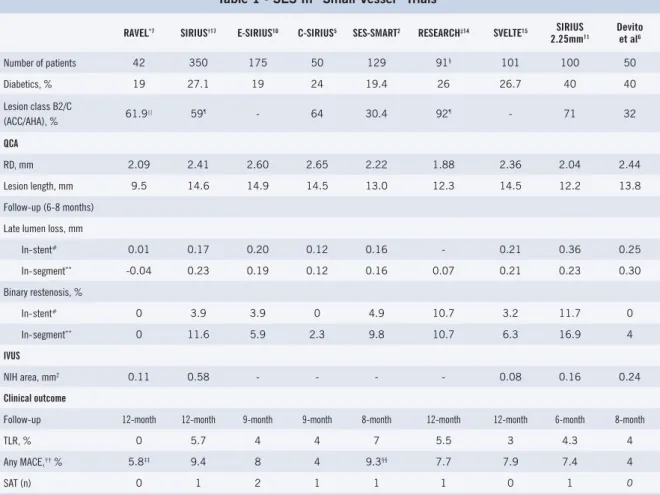
The performance of SES in small vessels has been evaluated in several randomized clinical trials and registries (Table 1). LLL, a surrogate of NIH, was signifi cantly decreased with SES compared to BMS in “small vessels” by 98.7%, 78.8%, 81%, 88.2%, and 82.2% in RAVEL, SIRIUS, E-SIRIUS, C-SIRIUS, and SES-SMART, respectively2,5,7-10. In Devito’s study, LLL was decreased by 77.5%, p<0.0016. A slightly higher in-stent LLL (0.36mm) was found in SIRIUS-2.25 compared to the other studies (0.01-0.21mm) (Table 1). SIRIUS-2.25 had increased rates of diabetics (40%) and complex lesions (71% B2/C) 11. Diabetics have been demonstrated to have higher LLL compared to non-diabetics12,13. In Devito’s analysis, which also had 40% of diabetes but less complex lesions, LLL was 0.25mm6. Overall, these LLL were comparable to the LLL found in lesions in larger vessels treated with SES7-9,14, and were considerably lower compared to BMS (0.80-1.05mm)2,5,7,10, confi rming the consistency and effectiveness of SES in preventing NIH, despite differences in diabetes rates, vessel size and lesion characteristics.
Arquivos Brasileiros de Cardiologia - Volume 86, Nº 4, April 2006
246
“medium”, and small vessels, respectively. In SIRIUS-2.25, restenosis rates were comparable to SIRIUS “small vessel” tertile, and was associated with stent length, diabetes and number of stents implanted11. In Devito’s report, there was no in-stent restenosis and only 4% in-segment restenosis with SES compared to 33.3% in-stent and 36.7% in-segment restenosis with BMS (p<0.001)6. Similar results were found in RAVEL, E- and C-SIRIUS, and SVELTE5,7,10,15. In RESEARCH, vessel size was considerably smaller compared to the other studies (Table 1), and restenosis (only in-stent) occurred mostly after treatment of ostial lesions14. Importantly, in the SES-SMART sub-analysis in diabetics, SES was associated with signifi cant decrease in LLL and restenosis compared to BMS; however, when considering only insulin dependents (35%), restenosis with SES rose to 40%12. These data convey some considerations regarding SES in small vessels, including: 1) small vessels experience higher restenosis rates compared to larger vessels; 2) restenosis appears to increase according to lesion severity
and stented length; 3) diabetics may experience higher rates of restenosis. This may be related not only to the hyperproliferative and aggressive vascular response often observed, but also to suboptimal stent deployment (incomplete lesion coverage, inadequate stent expansion, see below), since diabetics frequently present with long and diffuse disease (as mentioned before); and 4) the higher “in-segment” restenosis (compared to “in-stent”) observed in the majority of studies (Table 1) may be refl ecting incomplete lesion coverage and/or injured segment during PCI. This situation has been recognized8,16 and improvement in the “DES” technique – minimize peri-lesion trauma using short pre-dilatation balloons, complete lesion/injured segment coverage, short post-dilatation balloons (positioned within the stented area to prevent injury outside of the stent edges), and overlap multiple stents avoiding gaps, may be critical to optimize results in small vessels.
Previous studies with IVUS demonstrated that fi nal luminal dimensions in vessels <2.75mm predict vessel SIROLIMUS-ELUTING STENTS FOR THE TREATMENT OF STENOSES IN SMALL CORONARY ARTERIES: WHAT HAVE WE LEARNED?
Table 1 - SES In “Small Vessel” Trials
RAVEL*7 SIRIUS†17 E-SIRIUS10 C-SIRIUS5 SES-SMART2 RESEARCH‡14 SVELTE15 SIRIUS
2.25mm11
Devito et al6
Number of patients 42 350 175 50 129 91§ 101 100 50
Diabetics, % 19 27.1 19 24 19.4 26 26.7 40 40 Lesion class B2/C
(ACC/AHA), % 61.9
|| 59¶ - 64 30.4 92¶ - 71 32
QCA
RD, mm 2.09 2.41 2.60 2.65 2.22 1.88 2.36 2.04 2.44 Lesion length, mm 9.5 14.6 14.9 14.5 13.0 12.3 14.5 12.2 13.8 Follow-up (6-8 months)
Late lumen loss, mm
In-stent# 0.01 0.17 0.20 0.12 0.16 - 0.21 0.36 0.25
In-segment** -0.04 0.23 0.19 0.12 0.16 0.07 0.21 0.23 0.30
Binary restenosis, %
In-stent# 0 3.9 3.9 0 4.9 10.7 3.2 11.7 0
In-segment** 0 11.6 5.9 2.3 9.8 10.7 6.3 16.9 4
IVUS
NIH area, mm2 0.11 0.58 - - - - 0.08 0.16 0.24
Clinical outcome
Follow-up 12-month 12-month 9-month 9-month 8-month 12-month 12-month 6-month 8-month
TLR, % 0 5.7 4 4 7 5.5 3 4.3 4
Any MACE,†† % 5.8‡‡ 9.4 8 4 9.3§§ 7.7 7.9 7.4 4
SAT (n) 0 1 2 1 1 1 0 1 0
Arquivos Brasileiros de Cardiologia - Volume 86, Nº 4, April 2006
247
revascularization17. Similar results were found with SES. In the IVUS sub-study of the SIRIUS trial, a fi nal minimum stent area >4.5mm2 for vessels <2.8mm (by QCA) was found to be a threshold that predicted an “adequate” IVUS lumen at follow-up (>4.0mm2). The positive predictive value of the IVUS stent dimensions was 90%18. In addition, Takebayashi et al reported a series of patients with target vessel failure post-SES implantation where the majority of failures (especially in-stent restenosis) were associated with stent underexpansion19. This is expected as once an effective drug, (in this case, sirolimus), inhibited most of the NIH (Table 1), the main cause of in-stent restenosis became stent underexpansion. At last, a larger reference percentage of plaque area and a larger edge stent area/reference minimum lumen area were associated with edge stenosis with SES in SIRIUS20. These evidences suggest that successful SES is relied upon a combination of SES’ ability to prevent NIH formation and optimal stenting technique. In the context of small vessels, IVUS guided PCI for SES implantation should be especially considered and even recommended, as it: 1) allows accurate assessment of vessel size and lesion length before the procedure, helping operators to selected the proper device and technical approach
to achieve full lesion coverage and proper stented segment matching; and 2) may identify inadequate stent expansion, permitting the operator to post dilate the stent to achieve optimal stent expansion.
Finally, implantation of SES in small vessels has been associated with a high procedural success rate (>95%) and sustained safety (comparable to larger vessels treaded with SES), refl ected by the low incidence of stent thrombosis and MACE during the mid- and long term follow-up (Table 1)2,5,6,8,10,11,14,15. In addition, SES led to a 70% to 81% relative reduction of TLR compared to BMS in “small vessel” randomized trials2,5,10. Importantly, both TLR and MACE rates with SES (Table 1) were remarkably low in all studies (<10%), especially given the high-risk lesions treaded and the high-risk population. These results confi rm the dramatic impact and overall benefi ts of SES compared to BMS and historical controls of PCI in small vessels. Nevertheless, despite the impressive progress obtained in the fi eld, small vessel is still predictive of restenosis after SES implantation8; therefore, continued efforts, including optimize DES technique and development of novel DES technologies specifi cally designed for small vessels, are still needed to improve outcome.
R
EFERENCES1. Moreno R, Fernandez C, Alfonso F, Hernandez R, Perez-Vizcayno MJ, Escaned J et al. Coronary stenting versus balloon angioplasty in small vessels: a meta-analysis from 11 randomized studies. J Am Coll Cardiol. 2004;43:1964-72.
2. Ardissino D, Cavallini C, Bramucci E, Indolfi C, Marzocchi A, Manari A et al. Sirolimus-eluting vs uncoated stents for prevention of restenosis in small coronary arteries: a randomized trial. JAMA. 2004;292:2727-34.
3. Holmes DR Jr, Kereiakes DJ. The approach to small vessels in the era of drug-eluting stents. Rev Cardiovasc Med. 2005;6 Suppl 1:S31-7. 4. Saucedo JF, Popma JJ, Kennard ED, Talley JD, Lansky A, Leon MB et al. Relation of coronary artery size to one-year clinical events after new device angioplasty of native coronary arteries (a New Approach to Coronary Intervention [NACI] Registry Report). Am J Cardiol. 2000;85:166-71.
5. Schampaert E, Cohen EA, Schluter M, Reeves F, Traboulsi M, Title LM et al. The Canadian study of the sirolimus-eluting stent in the treatment of patients with long de novo lesions in small native coronary arteries (C-SIRIUS). J Am Coll Cardiol. 2004;43:1110-5.
6. Devito FS, Sousa AGMR, Feres F, Abizaid A, Staico R, Mattos LAP et al. Comparative Analysis of Intimal Hyperplasia After Sirolimus-Eluting Stent and Thin-Strut Bare Metal Stent Implantation in Small Coronary Arteries. Arq Bras Cardiol. 2006;86:268-75.
7. Regar E, Serruys PW, Bode C, Holubarsch C, Guermonprez JL, Wijns W et al. Angiographic fi ndings of the multicenter Randomized Study With the Sirolimus-Eluting Bx Velocity Balloon-Expandable Stent (RAVEL): sirolimus-eluting stents inhibit restenosis irrespective of the vessel size. Circulation. 2002;106:1949-56.
8. Moses JW, Leon MB, Popma JJ, Fitzgerald PJ, Holmes DR, O’Shaughnessy C et al. Sirolimus-eluting stents versus standard stents in patients with stenosis in a native coronary artery. N Engl J Med. 2003;349:1315-23.
9. Popma JJ, Leon MB, Moses JW, Holmes DR Jr, Cox N, Fitzpatrick M et al. Quantitative assessment of angiographic restenosis after
sirolimus-eluting stent implantation in native coronary arteries. Circulation. 2004;110:3773-80.
10. Schofer J, Schluter M, Gershlick AH, Wijns W, Garcia E, Schampaert E et al. Sirolimus-eluting stents for treatment of patients with long atherosclerotic lesions in small coronary arteries: double-blind, randomised controlled trial (E-SIRIUS). Lancet. 2003;362:1093-9. 11. Nikolsky E, Moses JW, Cambier P, Bachinsky B, O’ Shaughnessy
C, Mehran R et al. Results from the 2.25mm Sirolimus-Eluting BS Velocity Stent Registry in Patients with Native Coronary Artery Lesions. Am J Cardiol. 2005;96 (Suppl 7A):179H.
12. Ortolani P, Ardissino D, Cavallini C, Bramucci E, Indolfi C, Aquilina M et al. Effect of sirolimus-eluting stent in diabetic patients with small coronary arteries (a SES-SMART substudy). Am J Cardiol. 2005;96:1393-8.
13. Moussa I, Leon MB, Baim DS, O’Neill WW, Popma JJ, Buchbinder M et al. Impact of sirolimus-eluting stents on outcome in diabetic patients: a SIRIUS (SIRolImUS-coated Bx Velocity balloon-expandable stent in the treatment of patients with de novo coronary artery lesions) substudy. Circulation. 2004;109:2273-8.
14. Lemos PA, Arampatzis CA, Saia F, Hoye A, Degertekin M, Tanabe K et al. Treatment of very small vessels with 2.25-mm diameter sirolimus-eluting stents (from the RESEARCH registry). Am J Cardiol. 2004;93:633-6.
15. Sousa JE. SVELTE: Multicenter, Controlled Study of Sirolimus-Eluting Stents in Small Vessels. Transcatheter Cardiovascular Therapeutics (TCT), Washington, DC [presentation]. http://www.tctmd.com/ csportal/appmanager/tctmd/main?_nfpb=true&_pageLabel=TCTM DContent&hdCon=814312. 2004.
16. Lemos PA, Saia F, Ligthart JM, Arampatzis CA, Sianos G, Tanabe K et al. Coronary restenosis after sirolimus-eluting stent implantation: morphological description and mechanistic analysis from a consecutive series of cases. Circulation. 2003;108:257-60.
17. Iakovou I, Mintz GS, Dangas G, Abizaid A, Mehran R, Lansky AJ et al. Optimal final lumen area and predictors of target lesion
Arquivos Brasileiros de Cardiologia - Volume 86, Nº 4, April 2006
248
revascularization after stent implantation in small coronary arteries. Am J Cardiol. 2003;92:1171-6.
18. Sonoda S, Morino Y, Ako J, Terashima M, Hassan AH, Bonneau HN et al. Impact of fi nal stent dimensions on long-term results following sirolimus-eluting stent implantation: serial intravascular ultrasound analysis from the sirius trial. J Am Coll Cardiol. 2004;43:1959-63. 19. Takebayashi H, Kobayashi Y, Mintz GS, Carlier SG, Fujii K, Yasuda
T et al. Intravascular ultrasound assessment of lesions with target vessel failure after sirolimus-eluting stent implantation. Am J Cardiol. 2005;95:498-502.
20. Sakurai R, Ako J, Morino Y, Sonoda S, Kaneda H, Terashima M et al. Predictors of edge stenosis following sirolimus-eluting stent deployment (a quantitative intravascular ultrasound analysis from the SIRIUS trial). Am J Cardiol. 2005;96:1251-3.