Arq Bras Cardiol volume 74, (nº 1), 2000
Mion Jr et al Sphygmomanometer accuracy and their physical conditions
3 5
Faculdade de Medicina e Escola de Enfermagem da Universidade de São Paulo. Mailing address: Angela M. G. Pierin Av. Dr. Enéas de Carvalho Aguiar, 419 -05403-000 - São Paulo, SP - Brazil.
Received on 1/13/99 Accepted on 5/12/99
Objective - To evaluate the sphygmomanometers
calibration accuracy and the physical conditions of the cuff-bladder, bulb, pump, and valve.
Methods – Sixty hundred and forty five aneroid
sphygmomanometers were evaluated, 521 used in private practice and 124 used in hospitals. Aneroid manometers were tested against a properly calibrated mercury ma-nometer and were considered calibrated when the error was ≤3mm Hg. The physical conditions of the cuffs-blad-der, bulb, pump, and valve were also evaluated.
Results - Of the aneroid sphygmomanometers tested,
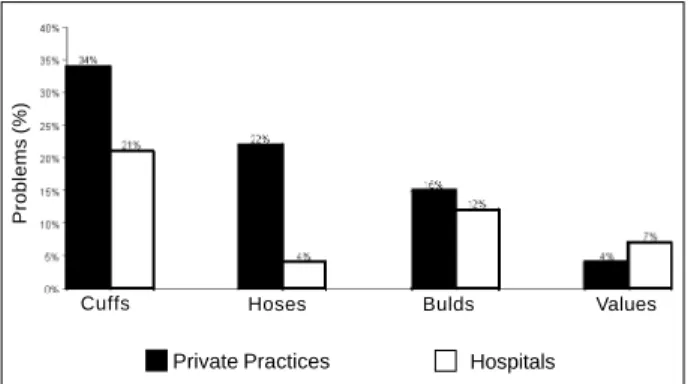
51% of those used in private practice and 56% of those used in hospitals were found to be not accurately calibrated. Of these, the magnitude of inaccuracy ranged from 4 to 8mm Hg in 70% and 51% of the devices, respectively. The problems found in the cuffs - bladders, bulbs, pumps, and valves of the private practice and hospital devices were bladder damage (34% vs. 21%, respectively), holes/leaks in the bulbs (22% vs. 4%, respectively), and rubber aging (15% vs. 12%, respectively). Of the devices tested, 72% revealed at least one problem interfering with blood pressure measurement accuracy.
Conclusion - Most of the manometers evaluated,
whether used in private practice or in hospitals, were fo-und to be inaccurate and unreliable, and their use may jeopardize the diagnosis and treatment of arterial hyper-tension.
Key words: blood pressure measurement; sphygmoma-nometers, calibration accuracy
Arq Bras Cardiol, volume 74 (nº 1), 35-38, 2000
Décio Mion Jr, Angela M. G. Pierin, Débora Cristina Alavarce, José Henrique da Cunha Vasconcellos
São Paulo, SP - Brazil
The Results of the Campaign for Evaluating
Sphygmomanometers Accuracy and their Physical Conditions
Original Article
Indirect blood pressure measurement using sphygmo-manometers and the auscultatory method is a routine pro-cedure in the diagnosis of hypertension. Therefore the accuracy of the values obtained is essential, since errors may deprive hypertensive patients of the benefits of hypertension treatment and expose normotensive patients to unnecessary treatment 1-5.
Although several factors are important for accurate blood pressure measurement, the most crucial factor to obtain accurate values is to use adequately calibrated devices. Problems related to the calibration of the mano-meter as well as damage of the bladder, rubber bulbs, pump and valve of the system which allow the inflation and deflation of the cuff can lead to errors in the readings ob-tained, thus jeopardizing the accuracy of the measurement. In Brazil, as in most countries, little is known about the calibration accuracy of devices used for indirect blood pressure measurement, whether such devices are used in private practice or hospitals. It occurs especially because health-care professionals are not used to checking the calibration of such devices. Therefore, we decided to investigate this problem in order to contribute to increase health-care professionals awareness of the importance of calibration by the Campaign for Checking the Calibration of Blood Pressure measuring Devices conducted by the Hy-pertension League of the General Hospital, Nephrology Dis-cipline of the Medical School, University of São Paulo in Brazilian congresses from 1995 to 1997.
Methods
3 6
Mion Jr et al
Sphygmomanometer accuracy and their physical conditions
Arq Bras Cardiol volume 74, (nº 1), 2000
their blood pressure measuring devices; and 2) hospital aneroid sphygmomanometers (n=124) from two public hospitals in the city of São Paulo. The Campaign for Checking the Calibration of Blood Pressure Measuring Devices was conducted by the Hypertension League of the General Hospital, Nephrology Discipline of the Medical School, University of São Paulo in Brazilian congresses from 1995 to 1997, and was sponsored by the Brazilian Cardiology Society, Brazilian Hypertension Society, Brazilian Nephrology Society, Cardiology Society of the State of São Paulo and Hypertension League of the State of Bahia and was encouraged by the National Institute of Metrology. The doctors, who attended these events, received a letter before the event, inviting them to take their sphygmomanometers to the event so that they could be evaluated. The evaluation of the devices was performed in the following events: 16th Congress of the Cardiology
Society of the State of São Paulo, Cardiology Society of the State of São Paulo, held in Campinas, SP, 1995; 4th Congress
of the Brazilian Hypertension Society, Brazilian Hyperten-sion Society, held in Recife, PE, 1995; 5th Congress of the
Brazilian Hypertension Society and Latin-American Mee-ting on Hypertension of the Inter-American Hypertension Society, Brazilian Hypertension Society, held in São Paulo, SP, 1996; 51st Congress of the Brazilian Cardiology Society,
Brazilian Cardiology Society, held in Salvador, BA, 1995; 18th
Brazilian Congress of Nephrology, Brazilian Nephrology Society, held in São Paulo, SP, 1996; 18th Congress of the
Cardiology Society of the State of São Paulo, Cardiology Society of the State of São Paulo, held in Campos do Jordão, SP, 1997; 6th Congress of the Brazilian Hypertension
Society, Brazilian Hypertension Society, held in Rio de Ja-neiro, RJ, 1997; 53rd Congress of the Brazilian Cardiology
Society, Brazilian Cardiology Society, held in São Paulo, SP, 1997; 1st Annual Symposium of the Hypertension and
Arteriosclerosis League of the State of Bahia, held in Salva-dor, BA, 1996; and 2nd Annual Symposium of the
Hyperten-sion and Arteriosclerosis League of the State of Bahia, held in Salvador, BA, 1997.
Of the 645 sphygmomanometers evaluated, 171 (47 from private offices and 124 from hospitals) were exclusively from the City of São Paulo whereas 273 were from events held in the State of São Paulo and the city of Rio de Janeiro. Of the remaining 201 devices, 149 were evaluated in events held in Salvador and 52 in Recife. Thus, 69% of the devices were evaluated in the southeastern region and 31% in the northeastern region.
The evaluation tests were conducted by a technician of the Specialized Service Shop for Evaluation and Repair of the University of São Paulo General Hospital, Medical School and by an undergraduate student, studying at the Nursing School of the University of São Paulo. These individuals were properly trained under the supervision of the preceptors of this study.
The data collected were recorded on a special form, furnishing information about the following items: identifica-tion of the devices, including manufacturee’s data and
device’s origin, evaluation of manometer calibration; and evaluation of the physical conditions of the cuff, bulbs and and valves.
To evaluate the calibration, the aneroid manometer was tested against a mercury manometer, using a Y- shaped connector according to the following procedure: to connect the aneroid manometer to be tested, the mercury manometer and the rubber pump to the three ends of the Y-shaped connector; then inflate the system until it exceeds 250mm Hg, open the rubber pump valve slowly to reduce pressure, check the correspondence of values between the two mano-meters at the levels of 250, 200, 150, 100, 50 and 0 mm Hg, and identify the magnitude of error in mm Hg in the corres-pondence of values at each level. The aneroid manometers were considered accurately calibrated when the error was
≤3mm Hg, what corresponds to 1% of the total scale6.
Evaluation of the physical conditions of the device was carried out. The cuff - rubber bladder and bulbs, pump and valve - were all examined for rubber aging, leaks, and holes.
Results
The first feature to be evaluated was the calibration of the aneroid sphygmomanometers tested. The data in Figure 1 show that 51% of aneroid devices used in private practice by Brazilian doctors and 56% of those used in the two public hospitals in the city of São Paulo were uncalibrated. For 70% and 51% of the private practice and hospitals manome-ters, respectively, the magnitude of error in the uncalibrated devices ranged from 4-8mm Hg (fig. 2). Most of the diffe-rences (76%) observed were towards lower values. Howe-ver, it was at the highest level of the test (250mm Hg) that the differences were statistically significant (p< 0.05), (fig. 3).
Fig. 1 - Calibration of aneroid sphygmomanometers used in hospitals and private practice.
Hospitals (n=124) Private Practice (n=389)
Miscalibrated Calibrated
Fig. 2 - Calibration and magnitude of miscalibration of the devices.
Hospitals Private Practice
Arq Bras Cardiol volume 74, (nº 1), 2000
Mion Jr et al Sphygmomanometer accuracy and their physical conditions
3 7
The second evaluated feature was the physical con-ditions of the rubber bladder, bulbs, pump, and valve. The data in Figure 4 show the problems found in the cuff -rubber bladder and bulb, pump, and valve of private and hospital devices. The most frequent defects were bladder damage (34% / 21%), holes/leaks in the bulbs (22% / 4%), and rubber aging aging (15% / 12%), respectively. Most of the sphygmomanometers evaluated (72%) revealed at least one problem related either to calibration or the physical conditions of the cuff - rubber bladder, bulb pump, and valve that interfere with blood pressure measurement accuracy.
Discussion
The main result of the present study is that approxima-tely 50% of the aneroid devices used to measure blood pres-sure were uncalibrated, which could lead to errors in blood pressure measurement. Moreover, 70% of the sphygmoma-nometers evaluated revealed at least one problem related either to calibration or to the physical conditions of the cuff - bladder, bulb, pump, and valve, what is very important as it can also cause blood pressure measurement error.
The fact that the needle of an aneroid manometer coin-cides with the zero level on the scale does not mean that the device is properly calibrated. As this fact is not generally known by most health-care professionals, it may explain the high percentage of uncalibrated aneroid manometers. Moreover, the unawareness that checking for aneroid
devices calibration is not a simple, since it requires testing the aneroid manometer against a mercury one by using a Y-shaped connector can be an additional factor to this rate of uncalibration.
Inaccurate calibration is easily identified in mercury manometers since it is considered calibrated when the meniscus does not coincide with zero, however, they are not easy by transported.
Few studies have analyzed the percentage of calibra-tion error in equipment for measuring arterial blood pres-sure. Bailey et al 6 tested 230 aneroid manometers and found
that 35% were not adequately calibrated; Burke et al 7 also
conducted a study to evaluate the conditions of manome-ters and found that 30% of the aneroid devices had a magni-tude of error >4 mm Hg vs. only 2% of the mercury devices. In Brazil, a study that also evaluated calibration conditions of blood pressure measuring devices reported that 58% of the aneroid manometers and 21% of the mercury mano-meters were not well calibrated 8. It is of course possible that
much of the lack of calibration found in the present study may have been due to the methodology used. As the doc-tors were invited to bring their equipment for evaluation, it is possible that they intentionally brought the ones they suspected to be uncalibrated. Regarding private practice and hospital manometers, we expected hospital devices to have a much higher percentage of inaccurate calibration, however, it was only slightly higher than that of private practice manometers (51% vs. 56%). Despite the fact that all 124 sphygmomanometers tested were obtained from only two teaching hospitals, the results suggest unsatisfactory conditions of the equipment. Regarding the source of the manometers, Gomes et al 9 observed that the aneroid
mano-meters used in outpatient clinics had errors ranging from 2 to 2.8mm Hg whereas those found in hospital first-care areas had a range of error of 5.5 to 6.8mm Hg. When the specific origin of the equipment was considered, 69% of the sphyg-momanometers were evaluated in the southeast and the others in the northeast. The fact that most of the sphygmo-manometers evaluated in this study presumably come from the city of Rio de Janeiro and the state of São Paulo, is remarkable since these are places where the best health-care services of Brazil are located.
Another finding that draws attention in the present study is the magnitude of inaccurate calibration. Nearly 30% of the devices used in private practice and 50% of those used in hospitals were not accurately calibrated, with magnitude of error >10mmHg. These data are similar to those obtained by McKay et al 10, who found 40% of the
aneroid sphygmomanometer in outpatient clinics to be inadequately calibrated, considering that 30% of them had a magnitude of error >10mm Hg. Jones et al. 11 also found 34%
of the aneroid devices to be out of calibration, and of those, 10% had errors higher than 8mm Hg. Likewise, in the study carried out by Baley et al., 35% of the manometers evaluated deviated by more than 3mm Hg.
It should be emphasized that most of the deviations found (76%) were in the downward direction. This blood Fig. 3 - Degree of miscalibration and standard deviation of manometers.
Difference (mmHg)
Fig. 4 - Problems with cuffs, hoses, bulb pumps and valves of equipment evaluated.
Problems (%)
Cuffs Hoses Bulds Values
3 8
Mion Jr et al
Sphygmomanometer accuracy and their physical conditions
Arq Bras Cardiol volume 74, (nº 1), 2000
pressure underestimation implies a false normotension for people with blood pressure readings higher than the one considered normal. This failure to diagnose hypertension is thus depriving them of the benefits of treatment and may contribute to greater damage to target organs.
Another aspect that must be emphasized is that the grater magnitudes of error were found at the highest level (250mm Hg). Other studies also showed that the errors occur distinctly at the different levels of the evaluation. Fisher observed differences exceeding 3mm Hg in 22% of the devices at 60mm Hg, in 25% at 120mm Hg, in 29% at 180mm Hg, and in 34% at 240mm Hg 12. Cady et al 13 analyzed 150
sphygmomanometers in an emergency unit and found that 28% of them were not adequately calibrated at 90mm Hg.
Not only the manometers, but also the physical conditions of the cuff - rubber, bulb, pump, and valve must also be evaluated. Rubber bladder damage due to holes/ leaks and rubber aging observed in approximately a third of the devices can easily lead to errors in measurement, and suggests lack of maintenance of the equipment, whereas better maintenance could provide adequate conditions of use. The presence of holes in the bulbs and leaks in the valves jeopardize the inflation and deflation system. Leaks in the control valves make inflation of the rubber bladder difficult, and the speed of deflation difficult to control. This can cause erroneous readings with underestimation of the systolic pressure and overestimation of the diastolic pressure. Similar problems, associated with aging were also observed for rubber bulbs and pumps in the evaluation of the devices. Replacement or cleaning of the valve of the inflation-deflation system and the exhaust valve of the rubber pump, however, should eliminate these problems.
Thus, numerous possibilities for error due to the lack of maintenance of such equipment were found and point to the importance of a periodic evaluation. Surprisingly,
several guides concerned with blood pressure measurement have been published, aiming at unifying the procedure and warn health-care practitioners about potential errors that can jeopardize the results obtained. Yet these books fail to stress the importance of checking regularly the calibration of the equipment used 1-5. In the medical area, the National
Institute of Metrology has established guidelines for equipments used to measure blood pressure so that only equipment with the seal of this organization should be authorized for use. Considering all of the problems identified in the present study, whether in relation to the calibration of the manometer or the physical conditions of the rubber bladders, hoses, bulbs and pumps, it was observed high incidense of inaccurate devices, since 72% out of the total sample had problems that jeopardize blood pressure measurement accuracy.
Although the ideal interval for maintenance checkups has to be determined, yet a checkup of the calibration of the sphygmomanometer should by carried out every six mon-ths to reduce the high incidence of problems in these devices.
Therefore, blood pressure measurement using the manometer and auscultatory method is a simple and easily executed procedure that provides reliable results, as long as certain basic premises are respected, among these the adequate physical conditions of the devices involved. Decisions in relation to the diagnosis of hypertension and what therapeutic treatment should be adopted are based on the results of blood pressure measurement. Given the results of this study, it is extremely important that institu-tions involved with health-care carry out campaigns to furnish health-care professionals with information and update them about this issue, emphasizing how important a six-month check-up of the devices is to guarantee blood pressure measurement accuracy.
1. National Institute of Health, National Heart, Lung, and Blood Institute. The Sixth Report of the Joint Nacional Committee on Prevention, Detecti-on,Evaluation, and Treatment of High Blood pressure, 1997; 153p: 154-83. 2. Sociedade Brasileira de Hipertensão, Sociedade Brasileira de Cardiologia,
Sociedade Brasileira de Nefrologia. III Consenso Brasileiro de Hipertensão Arterial, 1998: 1-5.
3. Zanchetti A, Chalmers JP, Arakawa K, et al. The 1993 Guideliness for the manage-ment of mild hypertension: memorandun from WHO/ISH meeting. Hypertension 1993; 22: 392-403.
4. Perloff D, Grim C, Flack J, et al. Human blood pressure determination by sphyg-momanometry. Circulation 1993; 88: 2460-70.
5. Frohlich E, Grim C, Labarthe DR, et al. Recomendations for human blood pressure determination by sphigmomanometers. Circulation 1988; 77: 5OlA-5l4. 6. Bailey RH, Knaus VL, Bauer JH. Aneroid Sphygmomanometers. Arch lntern
Med 1991; 15 I: 1409-12.
References
7. Burke Mj, Towers HM, O’Malley K, Fitzgerald DJ, O’Brien ET. Sphygmomano-meters in hospital and family practice: problems and recomendations. Br Med J 1982; 285: 469-71.
8. Mion Jr D, Pierin AMG. How accurate are sphygmomanometers? J Hum Hyper-tens 1998; 12: 245-8.
9. Gomes V, Bedirian R, Araújo PH, Oigman W. Uso freqüente de manômetros do tipo aneróide, um erro a mais na leitura da pressão arterial. Arq Bras Cardiol 1995; 65(supl. I): 8.
10. McKay DW, et al. Clinical Assessment of blood pressure. J Hum Hypertens 1990; 4: 639-45. 11. Jones JS, Ramsey W, Hetrick T. Accuracy of prehospital sphygmomanometers. J
Emer Med 1987: 5: 23-7.
12. Fisher HW. The aneroid sphygmomanometer: an assessment of accuracy. Med Cardiovasc 1978; 3: 769-71.