REVISTA
PAULISTA
DE
PEDIATRIA
www.rpped.com.br
ORIGINAL
ARTICLE
Experiences
of
adolescents
seropositive
for
HIV/AIDS:
a
qualitative
study
Eliana
Galano
a,
Egberto
Ribeiro
Turato
b,
Philippe
Delmas
c,
José
Côté
d,
Aida
de
Fátima
Thomé
Barbosa
Gouvea
a,
Regina
Célia
de
Menezes
Succi
a,
Daisy
Maria
Machado
a,∗aEscolaPaulistadeMedicina,UniversidadeFederaldeSãoPaulo(EPM-Unifesp),SãoPaulo,SP,Brazil bFaculdadedeCiênciasMédicas,UniversidadeEstadualdeCampinas(Unicamp),Campinas,SP,Brazil cInstitutetHauteEcoledelaSantéLaSource(HES-SO),Lausanne,Switzerland
dUniversitéduQuébecàMontréal(UQAM),Montreal,Canada
Received25May2015;accepted16August2015 Availableonline2March2016
KEYWORDS
HIVinfection/ psychology;
Life-changingevents; Qualitativeresearch; Adolescent
Abstract
Objective: Explorethemeaningsattributedbyyoungindividualsabout‘‘livingasanadolescent withHIV’’inagroupofpatientsthatacquiredtheinfectionatbirthandtheelementsinvolved withtheadherencetoantiretroviraltreatment.
Methods: Qualitativestudy,involving20subjects(aged13---20years),followedatservices spe-cializedinthetreatmentofpediatricAIDSinSãoPaulo,Brazil.Semi-structuredinterviewswere carriedoutofwhichscriptconsistedofquestionsabouttheirpersonalhistories,experiences anddifficultiestheymustfacewhilelivingwithHIV/AIDS.
Results: Being‘‘normal’’and‘‘different’’werecentralissuesvoicedbytheparticipants. How-ever,anormallifesituationisguaranteedbybeingresponsiblewithone’shealth,thecondition thatthediagnosisbekeptsecretandconcernsaboutHIVtransmissionanddisseminationtoa sexualpartner.Theanswersabouttreatmentshow thatadherenceisadynamic processand involvesmomentsofgreaterorlesserinterestinrelationtocareforone’shealth.The adoles-centshaveplansandprojectsandalthoughHIVisconsideredastressor,positiveperspectives forthefutureprevailed.
Conclusions: ToliveasanadolescentwithHIVinvolvessubtledimensionsthatneedtobe rec-ognizedandlegitimizedbyprofessionalswhofollowthetrajectoryoftheseyoungindividuals. Itisnecessarytoallowaspaceinwhichtheadolescentscanreflectandfindsupportregarding issuesrelatedtotheconstructionoftheirsexualityandcareofone’sownbody.
©2015SociedadedePediatriadeSãoPaulo.PublishedbyElsevierEditoraLtda.Thisisanopen accessarticleundertheCCBYlicense(https://creativecommons.org/licenses/by/4.0/).
∗Correspondingauthor.
E-mail:[email protected](D.M.Machado).
http://dx.doi.org/10.1016/j.rppede.2015.08.019
2359-3482/©2015SociedadedePediatriadeSãoPaulo.PublishedbyElsevierEditoraLtda.ThisisanopenaccessarticleundertheCCBY
PALAVRAS-CHAVE
Infecc¸ãopelo HIV/psicologia; Acontecimentosque mudamavida; Pesquisaqualitativa; Adolescente
VivênciasdosadolescentessoropositivosparaHIV/Aids:estudoqualitativo
Resumo
Objetivo: Explorarossignificadosatribuídospelosjovensa‘‘viveraadolescênciacomoHIV’’ emumgrupodepacientesqueadquiriuainfecc¸ãoaonascimentoeoselementosimplicados naadesãoaotratamentoantirretroviral.
Métodos: Pesquisadenaturezaqualitativa,com20sujeitos(13a20anos),acompanhadosem servic¸osespecializadosnotratamentodaAidspediátricaem SãoPaulo,Brasil.Foramfeitas entrevistassemidirigidascujoroteirofoicompostoporquestõessobresuashistóriaspessoais, dificuldadeseexperiênciasqueenfrentamdiantedainfecc¸ãopeloHIV/Aids.
Resultados: Ser ‘‘normal’’ e ‘‘diferente’’foram questões centrais no discurso dos partici-pantes.Entretanto,acondic¸ãodeumavidanormalégarantidamediantearesponsabilidade comasaúde,aressalvadequesejamantidoosegredododiagnósticoeaspreocupac¸õescom atransmissãodovírusedivulgac¸ãodoHIVaoparceirosexual.Asrespostassobreotratamento apontamqueaadesãoéumprocessodinâmicoeenvolvemomentosdemaioroumenor inter-esseemrelac¸ãoaoscuidadoscomasaúde.Osadolescentestêmplanoseprojetose,apesar deoHIVserconsideradoumagenteestressor,prevaleceramperspectivaspositivasdiantedo futuro.
Conclusões: ViveraadolescênciacomoHIVenvolvedimensõesdelicadas,quenecessitamser reconhecidase legitimadas pelosprofissionais que acompanhama trajetória desses jovens. Trata-se de possibilitarum espac¸o no qual o adolescente possa refletir e encontrar apoio para asquestõesrelacionadasàconstruc¸ão desuasexualidade ecuidadoscomseu próprio corpo.
©2015SociedadedePediatriadeSãoPaulo.PublicadoporElsevierEditoraLtda.Esteéumartigo OpenAccesssobalicençaCCBY(https://creativecommons.org/licenses/by/4.0/deed.pt).
Introduction
Inthe third decade of thehuman immunodeficiency virus (HIV)epidemic,healthprofessionals,researchersand care-giversarefacedwiththefirstgenerationofyoungindividuals whobecame infected throughvertical transmission. Over theyears,one sought toensure accesstotreatment that would allow increased life expectancy of these children andcontemplatestheir psychosocial needs.The appalling demandsofanewlydescribeddiseasedidnotallowthe pro-fessionalswhotreatedthesechildrentosuspectthatthey couldreachadolescence,withall thechallenges that are associatedwithit.Thispopulationgrouphasdistinct char-acteristicsfromadultoryoung individualsthatcontracted the disease during adolescence.1 Manyof them have lost
their parents as a resultof the human immunodeficiency syndrome(AIDS ---AcquiredImmuneDeficiencySyndrome), whichresultsinearlybereavement,disruptionofaffective bondsandfamilyrearrangements.2
In addition to adolescence, a stage of life permeated bychanges,discoveries,searchforidentityandautonomy, theyhave adiseasefullofstigmatizing attributesandthe complex legacy of secrets involving families affected by HIV. Qualitativestudies have identifiedthatthe main dif-ficultiesreportedbyHIV-positiveyoungindividualsincluded diagnostic disclosure to third parties, interpersonal rela-tionships, adherence to treatment and the psychological burden of living with a chronic illness associated with death,prejudiceandsocialexclusion.3,4Researchsuggests
thatthechallengesrelatedtoHIV-infectedadolescentsare
constant and therefore need tobe identified and further investigated.5,6
Forprofessionalsseekingtocarefortheirpatientsinall their dimensions, it is critical to identify the particulari-ties, desires and difficulties, from the perspective of the adolescentsthemselves.Theobjectiveofthisstudywasto explore, through the qualitative methodology, the mean-ingsattributedbyyoungindividualstothephenomenonof ‘‘living the adolescence withHIV’’ in a group of patients whoacquiredtheinfectionthroughverticaltransmissionand theelementsinvolvedintheadherencetotheantiretroviral treatment.
Method
Qualitative research, carried out through interviews with open questions, comprising situations found in the expe-riences of young individuals in the presence of HIV/AIDS: (1)Lifehistory;(2)Adolescenceandseropositivityand(3) Healthcareandtreatment.
group byincluding boysand girls, at leastone fromeach of the participating centers, at different ages and a his-toryofcomplianceornon-compliancewiththeantiretroviral treatment.Toattainsubjectenrollment,professionalsfrom different departmentsidentified the adolescents that did nothavedifficultiestoverbalizetheirneedsandexperiences ofbeinganHIV-positiveadolescent.
Themeetingswiththeyoungindividualswerepreviously scheduledandcarriedoutinaprivateplace.The discontin-uation ofnew subjectenrollment occurredby theoretical saturation,thatis,whenweobservedaredundancyinthe speechinthelastinterviews,sothattheaddingofnew infor-mationwouldnotalterthe understandingofthe obtained material.7,8
Theinterviewswererecordedwiththeapproval/consent oftheparticipantsandtutorsandverbatimtranscribed.As anoption,inordertofacilitatedataorganization,theNvivo 9software(QualitativeSolutionsandResearchPtyLtd, Aus-tralia,1994)wasused.
Theresearchersusedatheoreticalframeworkbasedon thebasicconceptsofhealthpsychology,comprisingits con-textual determinants and adaptive responses to adverse situationsintheparticipants’lifeexperiences.Thus,during several exploratory data analyses, categories for discus-sion emerged from the meaning core of the performed interviews.Toensuretheaccuracyoftheanalysisprocess, the material content was independently coded by three researchersandsubsequently validatedbyan experienced professionalinqualitativeinterviewencoding.
The study was approved by the regulating agenciesof eachofthecollaboratingcentersandtheNationalResearch EthicsCommittee(Conep), N.15693.All participantswho were18yearsandthetutorsofthoseyoungerthan18years oldsignedtheinformedconsentformafterbeinginformed about the benefits and possible risks of the study.In the caseofthoseyoungerthan18years,inadditiontothelegal tutors,therespondentsalsoreadandsignedtheinformed consentform.
Results
Thesampleconsistedof11girlsand9boyswithameanage of17 years.Table1 describesthesociodemographic char-acteristicsofadolescentswhoparticipatedinthisphaseof thestudy.
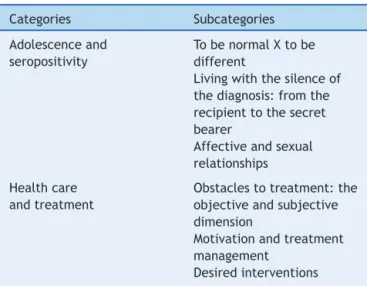
Theanalysisofthematerialfromtheinterviewsallowed the development of two major categories with six sub-categories,asshowninTable2.Thecategory‘‘Adolescence andseropositivity’’’isrelatedtothemain experiencesof being a seropositive adolescent for HIV/AIDS, originating thesubcategoriesthatinvolved‘‘beingnormal’’and‘‘being different’’, to ‘‘living with the silence of the diagnosis’’ andthediseaseimplicationson‘‘affectiveandsexual rela-tionships’’.Thesecond categoryreferstohealthcare and treatment and includes subcategories associatedwith the mainobstacles,motivationsanddesiredinterventions.
Adolescenceandseropositivity
‘‘Beingnormal’’and‘‘beingdifferent’’werecentralissues thatpermeatedthe speechofthestudy participants.The
Table1 Distributionofsociodemographic characteristics ofadolescents.
Characteristics Population
(n=20)
Gender
Female 11
Male 09
Agerange(years)
13---15 08
16---18 08
19---20 04
Educationallevel(yearsofschooling)
5---8 07
9ormore 13
Ethnicity/skincolor(self-reported)
White 08
Black 01
Mixed-race 11
Religion
Yes 18
No 02
Liveswith
Fatherand/ormother 12
Otherrelatives 06
Non-familymembers 01
Institution 01
Father 04
Mother 08
Orphaned
Fatherandmother 03
referencetonormalitywasdemonstratedbynarrativesthat comparetheirdailylives toother adolescentswhodonot live with chronic diseases: they work, study, go out and interactwithfamilyandfriends.
Table 2 Categories and subcategories created basedon theanalysisoftheinterviews.
Categories Subcategories
Adolescenceand seropositivity
TobenormalXtobe different
Livingwiththesilenceof thediagnosis:fromthe recipienttothesecret bearer
Affectiveandsexual relationships
Healthcare andtreatment
Obstaclestotreatment:the objectiveandsubjective dimension
Motivationandtreatment management
Normal,itdoesnotchangeanything!It’sthesamething. Iplayball,Iwalk,Idoeverything!It’stoogood...(Male, 14)
However,theconditionof‘‘havinganormallife’’is guar-anteedbytheresponsibilityofhealthcareandthecondition thatthediagnosismustbekeptinsecret.
They do not know about my problem, never! Every-one thinks I’m a perfect person ... When you take treatmentseriously,youcanleadanormallife.(Male, 18years)
Sometimesmentioningthedifferenceisclearlyaccepted byrespondentsandisbased,particularly,ontherestrictions imposedbylivingwithachronicdisease,suchastheuseof medicationsandfrequentmedicalconsultations.
You are different from the others, you will take medicine,you willundergoa treatmentandgo tothe doctor for the rest of your life ... you feel different becauseyouhaveasecret!(Female,14)
For most participants in this study, ‘‘coexistence and maintaining the secret’’ regarding HIV is something that wasunquestioningly incorporated into their lives. It con-cerns the privatelife domain andtalking about the virus canbringdiscomfort,embarrassmentandriskofrejection duetothestigmaassociatedwithHIV.Inthissense,several phrasesbytherespondentsreproducethesemessagesthat werelearnedthroughoutlife.
Ineverhadthecouragetotell,thereisnoneed,Ilearned that!(Female,18years)
Thenarrativesofrespondentsshowthattheknowledge aboutHIVremainsreservedforthenuclearfamilyortrusted relativesandveryclosefriends.Still,issuesrelatedtothe diseasearenotsharedevenamongthosewhoknowabout theinfection.
[WhoknowsaboutHIV?]Mymomanddad,nooneelse! ForthemandformeitislikeifIdidnothavethedisease! (Male,18years)
Inthecaseof‘‘romanticrelationships’’,young individ-uals describe strong concerns about the transmission of infectiontothesexualpartner,evenamongthosewhohave notyethadromanticorsexualexperiences.However,there wasaconsensusthathavingsexmust bedone responsibly andwithextremecare,considerationsthatarenotshared withthepeopleclosetothem.
When you think you are going to have sex, you are afraidoftransmittingtheHIV.[Doyouthinktoomuch aboutit?]EveryonewhohasHIVthinksaboutit!(Female, 15years)
Fromtheperspectiveoftheparticipants,the confiden-tiality surroundingthe disease is no longer compatiblein thecontext of loving relationshipsand, regardless of age orgender, theyconsiderthatthe disclosureof their sero-positivitymustbemadesometimeduringtherelationship. However,toknowthebesttimetodoitanddecidewhothey shouldtrusttotellarequestionsaccompaniedbyanxieties andworries.The main reporteddifficulties arerelatedto thefearof abandonment due toprejudiceand thebelief
Table3 Healthcareandtreatment---obstacles.
Obstacles
Objectivedimension
Obstacles
Subjectivedimension
Interferencewith dailyactivities: sleepdisruption
Depressivemoods, irritability,nervousness andstress
Undesirableeffects: nausea,stomach painandmalaise
Feelingsofrebellionand non-acceptanceofthe disease
Medication characteristics: palatabilityand numberofingested tablets
Familyconflicts
Beliefthat
antiretroviraldrugs causehealth hazards
Takingthemedicationis areminderofthe HIV-status,acondition theywishtoforget
thatthe secret,when entrustedtoanotherperson,might notbekeptbythisindividualovertime.
Totellyourboyfriend,Youhavetobewithhimforsome time, makesure helovesyou ...ifpeople knew,they wouldprobablynotstaywithme.(Female,20)
Healthcareandtreatment
The biggest discomfort (‘‘obstacle’’) to the treatment is relatedtotheinflexibilityregardingthemedication sched-ule,whichimposesrestrictionstoactivitiessuchastripsor partieswithfriends.Frequently,thesleepcycleofthe ado-lescentsisinterrupted,astheyneedtogetupearlyorsleep latetotakethemedication.
OnvacationsorwhenIdon’thaveclasses,Ihavetowake up at3:30 totake the medicationandthen Ican’t go backtosleep...(Male,17years)
Undesirable effects such as nausea, stomach pain, malaise and bad taste and amount of ingested tablets/ pills, were reported as barriers to good treatment adherence.
Depressivemoods,irritability,anxiety,stress,family con-flicts and feelings of anger caused by not accepting the diseasewerealsoassociatedwithmisseddosesordrug treat-mentdiscontinuation.
Ifeelangry,veryangrywithmylifeandwitheveryone. Youknow,ifitisformetodie,Iwilldiesoon...Mylife isliketwoseparatethings...[Separatehow?]Bybeing awareofwhatislikehavingHIV.(Female,17)
Table 3 shows the summary of the main obstacles to treatment adherence. Fear of becoming ill, which is connected to the desire of having a healthy lifestyle in order to work, study and make plans, was the main ‘‘motivation’’mentioned bytheparticipantstoadhereto treatment.
Table 4 Health care and treatment --- motivations and interventions.
Motivations Suggested
interventions
Fearofbecomingill Updatedinformation Tohaveaccompanied
formernegative experiences
Groupactivitiesand individual
psychologicalsupport Recognizetheirrole
inreducing transmissionrisks
Consultationsto strengthenand encouragetreatment withoutan
overbearingattitude Needtoobtain
approval
contributedtoagoodtreatmentadherence.Similarly, the recognitionofitsimportancetoreducetheriskof transmis-sion,especiallytosexualpartners,showedstronginfluence oncontinuityofcare.
Itisgoodwhenyouhaveadoctortreatingyousinceyou weresmall,whoyoutrust.Thismotivatesmetonever thinkaboutstopping...(Female,15years)
Finally, among the ‘‘desired interventions’’, the ado-lescents qualify the guidance, the explanations and informationthatareroutinelyprovidedbytheservice pro-fessionalsaspositive.
Theclosecontactandthetrustestablishedwiththeteam that accompanies them from early childhood were men-tionedaskeyaspectstoagoodresponsetotheadherence. Theimportanceofgroupactivitiesorspacestomeetother peoplelivingwithHIVwerealsoemphasizedbyrespondents, as it encourages discussion and coping with experiences involvingtheHIV-positiveadolescent.
I think it’s cool to have lectures, groups. I wanted
to know a lot of people who have HIV! (Female,
16years)
Moreover,theywanttohaveupdatedknowledgeonthe scientificadvancesandsuggestthatissuesbeaddressedthat coverfutureconcerns,suchasmarriageandwaystoprevent HIVtransmissiontopeoplewholivewiththem.
Prevention, medication, family ... They are the most importantissues.Totalk,learnmoreaboutthescientists whoareseekingthecure...(Male,17years)
While for some young people, motivate, insist and rememberthemedicationsareexpressionsofconcernand affection, for others, the insistence of professionals for perfectadherencecausesdiscomfortandfeelingsofbeing disrespectedregardingtheirrightsoftransitoryinterruption ornotofthetreatment.Therearetimeswhentheywould ratherlietoavoidthereactionsofirritationor disappoint-mentbydoctorsandrelatives(Table4).
Give us a break, because it is a lot of pressure ... The doctor, the psychologist pushing us, saying that you have to take it, or you’ll die. Also try very hard to understand... Why, why? Because I do not want to
get in touch with reality, because I’m afraid! (Male, 17years)
Discussion
This research helped us to understand the psychosocial experiences of the first generation of young individuals who acquired HIV through vertical transmission, through reports of their life stories and obstacles faced in the context of living with a chronic disease, in order to prepare health professionals to better care for their patients.
Intheseveraldimensionsofdailylife,suchas participa-tioninsocial activities,schoolandwork, theadolescents’ speechmakereferencestoanormallife,thatis,commonor equaltootheryoungindividualswhoarenotinfected.The effortofHIV-positiveadolescentsinsearchingfornormality hasbeendescribedbydifferentresearcherswhostudiedthe needsofyoungindividualslivingwithHIV.9,10
As can be observed, the perception of normality and the feeling of equality are justified by the absence of symptoms or physical characteristics of a diseased body, factors that, in turn, can negatively influence treatment adherence.10 However,feelingsof ambivalence
are observed when these young individuals are faced with the need to undergo care that involves an end-lesstreatmentandroutinemedicalconsultations.Another exceptionregardingnormalityisrelatedtoliving withthe secret of the diagnosis and the possibility of transmit-tingthevirus, findingsthat arealsoconsistent withother studies.5,9
Animportantissuethatdeservesspecialattention con-cerns the dynamics of the secrecy surrounding patients infected by HIV/AIDS. The disclosure of the diagnosis to othersisnotasimpleprocess,becauserevealingone’sHIV statuscanleavetheindividualvulnerabletosocialstigma, prejudiceanddiscrimination,aspectsthatarewidely iden-tified in the adult population living with HIV/AIDS.4 The
results of this study suggest that the silence about the HIV-positivestatus remains restrictedtofamilieswholive withthe infectionand, fromthepoint ofview of respon-dents,thereasonsthatjustifythisbehaviorwereassociated withfearof prejudice,rejection and social isolation.11---14
Nevertheless,theadolescents’speechshows thatthe dis-closure of HIV diagnosis should be shared at some point, withcurrent or future sexualpartners, a decision-making thatis surrounded by fearsand ambivalence.Even in the absence of clear and defined parameters for the disclo-sure of the infection, it is necessary to trust someone to talk about it, to be assured that the other will keep the secret and, in some situations, use some type of survey to identify the concepts their peers have on the disease.15
Whenitcomestomattersofsexualityandromantic rela-tionships, in additionto the challenge of disclosing one’s HIVstatustoasexualpartner,therearelegitimatestrong concerns about transmission of the virus to the partner, alsomentionedby otherauthors.4,16,17 Stillin thecontext
Regardinghealthcareandtreatment,theresultsofthis study suggest that adherence to the medication regimen is a dynamic process, and involves subjective and objec-tivedimensionsand momentsofgreater orlesserinterest in relation to clinical monitoring. Despite the weariness regardingtheuseofmedicationsandsometimesthedesire todiscontinue the treatment, most of the young individ-ualsin this study showed tobe aware that following the prescribed recommendations is a necessary condition to maintain good quality of life. The findings of this study were consistent with other studies, which described that adherenceisfavoredbythebeliefinmedicationefficacy19
and when health care becomes a priority in their lives. Theacceptance ofthe HIVstatus andacknowledgmentof death, which come withthe maturity, were also decisive factorsformaintainingadequatetreatment.Theconnection between patient and health care professionaland family supportpromotethemotivationtofacethehealthand dis-easeprocesses.20 On theother hand,someadolescentsdo
notliketofeelpressuredandconsiderthatoverbearing atti-tudes by caregivers violate their rights and autonomy to make decisionsonthe treatment. As for the barriersand obstaclestofulladherence,theparticipantsmentionedthe adverseeffectsofthedrugsandtheirinterferenceindaily activities. In the subjective dimension, moments of sad-ness,stressoreventhesimpledesiretolivinglifewithout remindingoneselfofthevirusjustifyinterruptions,evenif momentary,ofthetreatment.
Regarding the desired interventions, young individuals stated that they are satisfied with the care received in thepediatricsetting,surroundedbyattentionand demon-strationsofaffectionfromprofessionals.Nevertheless,they wantmoredetailedinformationonwaystoprevent trans-mission of the virus, with discussion of topics related to technological advances, as well as the dilemmas experi-encedbyyoungindividualsinthecontextofseropositivity.In somecases,thegroupactivitiesarerecommended,because theyfavortheidentificationwithpeersandthus,the main-tenanceofthefeelingofnormality.
Thisstudyhaslimitationsbecauseitsresultsarenot gen-eralizableandpartiallyshowthecomplexityoftheprocess of living adolescent experiences in the context of HIV-positive status. Longitudinal studies are recommended to explorethe socialconditions andemotional risksinvolved in this trajectory. In addition, the qualitative methodol-ogyis still little familiar tothe scientific communityand pediatriciansinvolvedwiththecare ofthesechildrenand adolescents.
Itcanbeconcludedfromthereportsthat‘‘livingasan adolescentwithHIV’’involvesdelicatedimensions,suchas silenceand secrets, search for normality, findingthe dif-ferences, virus transmission dilemmas and also the drug treatmentmanagement.Recognizingtheseaspectscanbe usedtoguidetheworkofthemultidisciplinaryteam, espe-cially pediatricians, whose care transcends the physical controlofthediseaseandviralreplication.
Funding
Fundac¸ão de Amparo à Pesquisa do Estado de São Paulo (Fapesp),ProjectN.2010/08302-8.
Agence Nationale de Recherche sur le Sida et les Hépatitesviral(ANRS),ProtocolN.12238.
Conflicts
of
interest
Theauthorsdeclarenoconflictsofinterest.
References
1.NaswaS, MarfatiaYS.AdolescentHIV/AIDS: issuesand chal-lenges.IndianJSexTransmDis.2010;31:1---10.
2.FerrandRA,LuethyR,BwakuraF,MujuruH,MillerRF,Corbett EL. HIV infection presenting in older children and adoles-cents:acaseseriesfromHarare,Zimbabwe.ClinInfect Dis. 2007;44:874---8.
3.Paiva V, Ayres JR, Segurado AC, Lacerda R, Silva NG, Silva MH,et al. A sexualidade de adolescentes vivendo com HIV: direitos e desafios para o cuidado. Cienc Saude Coletiva. 2011;16:4019---210.
4.HosekSG,HarperGW,DomanicoR.Psychologicalandsocial dif-ficultiesofadolescentslivingwithHIV:aqualitativeanalysis.J SexEducTher.2000;25:269---76.
5.AyresJR.AdolescentesejovensvivendocomHIV/AIDS:cuidado epromoc¸ãodasaúdenocotidianodaequipemultiprofissional. SãoPaulo:EnhancingCareInitiative;2004.
6.Li RJ, Jaspan HB, O’Brien V, Rabie H, Cotton MF, Nattrass N.Positivefutures:a qualitativestudyontheneedsof ado-lescentsonantiretroviraltherapy inSouthAfrica.AIDS Care. 2010;22:751---8.
7.Morse JM. The significance of saturation. Qual Health Res. 1995;5:147---9.
8.Turato ER. Tratado da metodologia da pesquisa clínico-qualitativa:construc¸ãoteórico-epistemológica,discussão com-parada eaplicac¸ão nasáreas da saúde ehumanas. 5thed. Petrópolis:EditoraVozes;2003.
9.MarquesHH,SilvaNG,GutierrezPL,LacerdaR,AyresJR,Della NegraM,etal.Arevelac¸ãododiagnósticonaperspectivados adolescentesvivendocomHIV/AIDSeseuspaisecuidadores. CadSaudePublica.2003;22:601---29.
10.Kourrouski MF, Lima RA. Adesão ao tratamento: vivências de adolescentes com HIV/AIDS. Rev Lat Am Enfermagem. 2002;17:947---52.
11.MichaudPA,SurisJC,ThomasR,GnehmHE,CheseauxJJ,Swiss HIVMother+ChildCohortStudy(MoCHiV). CopingwithanHIV infection.AmulticenterqualitativesurveyonHIVpositive ado-lescents’perceptionsoftheirdisease,therapeuticadherence andtreatment.SwissMedWkly.2010;140:247---53.
12.AtekaGK.HIVstatusdisclosureandpartnerdiscordance:a pub-lichealthdilemma.PublicHealth.2003;120:493---6.
13.KadowaI,NuwahaF.FactorsinfluencingdisclosureofHIV pos-itive status in Mityana, district of Uganda. Afr Health Sci. 2002;9:26---33.
14.FernetM, WongK,Richard ME, OtisJ, Lévy JJ,LapointeN, etal.Romanticrelationshipsandsexualactivitiesofthefirst generation of youth living with HIV since birth. AIDS Care. 2011;23:393---400.
15.SiuGE,Bakeera-KitakaS,KennedyCE,DhabangiA,Kambugu A.HIV serostatusdisclosureand livedexperiencesof adoles-centsattheTransitionClinicoftheInfectiousDiseasesClinic inKampala,Uganda:aqualitativestudy.AIDS Care.2012;24: 603---11.
17.MichaudPA,SurisJC,ThomasLR,KahlertC,RudinC,Cheseaux JJ.Tosayornottosay:aqualitativestudyonthedisclosure oftheircondition byhumanimmunodeficiency virus-positive adolescents.JAdolescHealth.2002;44:356---62.
18.PaivaV,SeguradoAC,FilipeEM.Arevelac¸ãodasoropositivadade porhomensbissexuaiseheterossexuaisparaparceirossexuais: umdesafioparaocuidadoeaprevenc¸ãodoHIV/AIDS.CadSaude Publica.2011;27:1699---710.
19.MurphyDA,WilsonCM,DurakoSJ,MuenzLR,BelzerM, Ado-lescent Medicine HIV/AIDS Research Network. Antiretroviral medicationadherenceamongtheREACH HIV-infected adoles-centcohortintheUSA.AIDSCare.2001;04:27---40.