ABSTRACT
BACKGROUND AND OBJECTIVES:Peripheral nerve stim-ulation to treat chronic pain is a neurosurgical armamentarium used for a long time, being indicated to treat neuropathic painful syndromes together with other types of nerve stimulation: dorsal column electric stimulation and deep cerebral stimulation. his study aimed at analyzing the relevance of peripheral nerve stimu-lation to treat chronic painful syndromes.
CONTENTS: Primary indication is severe chronic neuropathic pain refractory to conservative treatment. However, the afected area needs to have a deined anatomic distribution and related to the peripheral nerve to be stimulated. One should also notice signs of objective involvement of the nerve. A nerve stimulation test shall be performed from 7 to 10 days prior to the inal im-plant and pain must improve at least 50% according to speciic evaluation scales. here are two methods to implant electrodes in peripheral nerves: direct surgical approach and percutaneous technique. After the test, the implant with permanent generator is performed.
CONCLUSION: Peripheral nerve stimulation to treat chronic painful syndromes has shown promising results. he develop-ment of new materials is extremely necessary for the technical evolution and treatment of chronic painful syndromes. In this sense, new prostheses are being developed and one feature of a more feasible implant to be used in the peripheral nervous sys-tem would be a low proile prosthesis with already implanted and rechargeable battery.
Keywords: Chronic neuropathic pain, Chronic painful syn-drome, Pain evaluation scales, Peripheral nerve stimulation.
Peripheral nerve stimulation to treat chronic painful syndromes*
Estimulação de nervos periféricos no tratamento das síndromes dolorosas crônicas
Tiago da Silva Freitas1, Alessandra Vasconcelos da Silva Paiva2, Kátia Crys Moura Ogliari2, Lucas Garcia de Souza Godoy2, Fernanda Albernaz Valente2
*Received from the University Hospital of Brasília. Brasília, DF, Brazil.
1. University Hospital of Brasília, Base Hospital of Federal District, Pain Institute of Brasília, Brasília, DF, Brazil.
2. Superior School of Health Sciences, Brasília, DF, Brazil.
Submitted in April 05, 2013.
Accepted for publication in July 02, 2013. Conlict of interests: None.
Correspondence to:
Alessandra Vasconcelos da Silva Paiva
SGAN 912 MD D Bloco D Un. 120 - Ed. Park Ville 70790-120, Brasília, DF, Brasil.
E-mail: [email protected]
© Sociedade Brasileira para o Estudo da Dor
RESUMO
JUSTIFICATIVA E OBJETIVOS: O uso da estimula-ção elétrica de nervos periféricos para o tratamento da dor crônica constitui um armamentário neurocirúrgico utiliza-do há bastante tempo, senutiliza-do uma modalidade indicada no tratamento das síndromes dolorosas de caráter neuropático, juntamente com outras formas de neuroestimulação: estim-ulação elétrica da coluna dorsal e a estimestim-ulação cerebral pro-funda. O objetivo deste estudo foi analisar a relevância da estimulação nervosa periférica no tratamento das síndromes dolorosas crônicas.
CONTEÚDO: A principal indicação é a dor neuropática crônica, intensa, refratária ao tratamento conservador. Apre-senta, contudo, necessidade de a área acometida ter uma distri-buição anatômica deinida e relacionada ao nervo periférico no qual se deseja realizar a estimulação. Deve-se perceber também sinais de comprometimento objetivo do nervo. É necessária a realização de teste de neuroestimulação entre 7 e 10 dias previa-mente ao implante deinitivo e deve-se obter melhora de pelo menos 50% da dor em escalas de avaliação especíicas. Existem duas formas de implante de eletrodo em nervos periféricos: abordagem cirúrgica direta e técnica percutânea. Após o teste ser completado, é realizado o implante do sistema de gerador permanente.
CONCLUSÃO: O uso da estimulação de nervos periféricos no tratamento das síndromes dolorosas crônicas tem mostrado resultados promissores. O desenvolvimento de novos materiais é extremamente necessário para a evolução da técnica e o trata-mento dessas síndromes dolorosas crônicas. Nesse sentido, no-vas próteses estão sendo desenvolvidas e uma das características de implante mais viável para uso no sistema nervoso periférico seria uma prótese de baixo peril, com bateria já implantada com os eletrodos e recarregável.
Descritores: Dor neuropática crônica, Escalas de avaliação da dor, Estimulação nervosa periférica, Síndrome dolorosa crônica.
INTRODUCTION
an-tiquity1, but it was with the publication of the Gate heory by Melzack & Wall in 1965 that appeared a new idea about peripheral circuits function and that several experiments with electric stimulation have become feasible to treat chronic pain syndromes.
Although several aspects of the gate theory pathophysiology have succumbed, this theory provided the scientiic basis for peripheral nerve stimulation to treat chronic pain: the stimula-tion of large ibers activated with lower threshold as compared to small ibers, at enough intensity to produce paresthesia, should also relieve pain2.
he irst experiments with peripheral nerve stimulation were published in 19673,4 when infraorbital foramen was stimulated in eight patients who presented signiicant pain improvement while the stimulation was working. Authors have also suggested in this study the idea of an implantable stimulator. At the same time, a study was started about dorsal column nerve stimula-tion with early results leading to the development of implant-able systems, being the irst battery-powered system developed by Cordis in 1976 (cited for Rossi)5.
In following years, several studies were carried out using pe-ripheral nerve stimulation6-21. Unfortunately, early results of such studies were not very promising: in 1976 a global im-provement rate of 26% was reported. In 1982, the reported success rate was 53%14.
Due to described results, to reports of peripheral nerve injury by the placement of the electrode and the broader dissemination of dorsal column stimulation to treat chronic pain syndromes, peripheral nerve stimulation has become less attractive. his was also relected in the development of speciic devices for peripheral nerve stimulation, which were very restricted, with just one device approved by the Food and Drug Administration (FDA).
Peripheral nerve stimulation to treat chronic pain reappeared with a study describing a technique of percutaneous implant of electrodes in the occipital nerve to treat occipital neuralgia. Several studies have followed using stimulation both for oc-cipital nerves and the combined use in supraorbital branches to treat chronic migraine headache and other autonomic head-aches23-29. From then on, reports on the use of implants in tri-geminal nerves30, their use to control post hernia repair chronic pain (inguinal nerve), and the use of paraspinal electrodes to treat post-herpetic neuralgia, sacroiliitis and coccydynea have returned to PNS stimulation to treat chronic neuropathic pain syndromes31-34.
INDICATIONS
hey follow the same patterns of spinal neuromodulation hav-ing as major indication chronic severe neuropathic pain afect-ing patients’ functionality and refractory to conservative treat-ment (drugs, physiotherapy, local anesthetic and sympathetic blocks, transcutaneous electric stimulation, botulinum toxin, etc.)19-21. However, the afected area has to be a well deined anatomical area and related to the peripheral nerve where stim-ulation is to be performed. One should also notice signs of
objective peripheral nerve involvement (hypoesthesia, hyper-pathia, hyperesthesia, allodynia, etc.)19-21.
Conirmation of the respective “target” nerve involvement through local anesthetic block is a stage often recommended by the literature21; however, there are no evidences that such parameter is a factor for better prognosis.
Nerve stimulation test before the deinitive implant through externalization of electrodes is mandatory. It is performed in a speciic period (between 7 and 10 days) and there shall be pain improvement of at least 50% according to speciic pain evalu-ation scales19-21.
Speciic indications
A- Post-herpetic neuralgia;
B- Post-traumatic neuropathic pain; C- Postoperative neuropathic pain; D- Facial neuropathic pain;
E- Clinically untreatable occipital neuralgia or occipital cervi-cogenic pain;
F- Transformed migraines with continuous occipital and hemi-cranial pain;
G- Complex regional pain syndrome; H- Cluster headache.
CONTRAINDICATIONS
hey encompass: use of anticoagulants or patients with coagu-lation disorders, patients with active infection on probable sur-gical area, patients with major cognitive problems, untreatable depression or with neuropsychological evaluation indicating major personality disorder19.
Another contraindication is patient needing routine follow up with MRI due to the limitations of these exams with such ma-terials21.
SURGICAL TECHNIQUE
General aspects
Electrode implant follows well-deined recommendations. here are basically two types of peripheral nerve implants: direct surgical approach, involving direct nerve exposure and placement of “plaque” electrodes on the nerve to one side or on both sides (“Sandwich” technique). Optionally, the electrode may be placed by the percutaneous technique through a needle inserted perpendicularly to the nerve pathway.
Types of electrodes are:
• For the percutaneous technique, cylindrical electrodes with 4 or 8 poles are used: Pisces-Quad Compact, Pisces-Quad, Oc-tad, Quad plus or Quad Compact from Medtronic or Quat-trode, Octrode from ANS/St. Jude.
• For the open surgical technique plaque electrodes with 4, 8 or 16 poles are used:Resume, Resume II, On-Point PNS, Re-sume TL, Specify, Specify 2x8 from Medtronic or the models Lamitrode S4, Lamitrode 44C, Lamitrode S8, Lamitrode 88C from ANS/St. Jude.
electrode to prevent migrations and shifts. Depending on the technique, this may be done in the entry area of the electrode (for example, by the percutaneous occipital nerve stimulation technique) or through direct ixation of the electrode in subcu-taneous and fascia/periosteum planes in open incisions. he implant protocol requires pain control eicacy test. So, after the implant, the electrode has to be tunneled and con-nected to an external test extensor associated to an external generator. It is important to assure, before pain evaluation, that the painful area is covered with the sensation of pares-thesias/numbness. Painful area coverage may be tested in the intraoperative or immediate postoperative period. During the test period, patients are usually covered with antimicrobi-als (although their use does not demonstrably decrease the chance of infection).
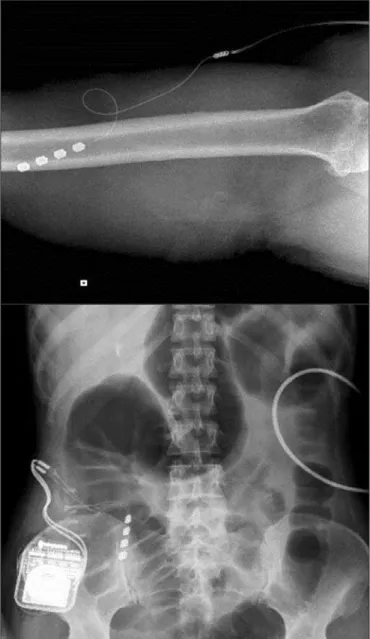
After test completion (mean of 7 to 10 days), the permanent generator system is implanted in the operating center, under general anesthesia, because the insertion of subcutaneous tun-nelers is painful. Most frequent implant sites are gluteus region, abdominal wall or infraclavicular region. Regardless of the cho-sen site, inal generator implant site shall be deep enough to avoid bedsores and shall be located in reduced mobility regions (Figures 1 and 2).
Speciic aspects of percutanous implants
Occipital, supraorbital and infraorbital nerve implant:
Electrodes are almost routinely inserted under radioscopy. here are parameters for implants placement: infraorbital fora-men and orbit base for the infraorbital nerve, limit and supra-orbital foramen for the suprasupra-orbital nerve, C1 arch and mid-line for occipital nerve.
Electrodes may be placed from medial to lateral or vice-versa, depending on surgeon’s experience. Electrodes with 4, 8 or 16 contacts may be used, crossing below the epifascial plane but above the muscles. Electrode placement pattern should cross the sense of the nerve for it to be stimulated by at least two electrode contacts.
Trigeminal nerve implant
he electrode is inserted by Hartel’s tecnique35, crossing the oval foramen, under radioscopy. It is then tunneled and ixed
Figure 1. Example of plaque electrode model On-Point PNS
(Medtro-nic) placement
Figure 2. Electrode in radial nerve and femoral nerve
by its entry hole to the skin, being taken subcutaneously to the masseter and subauricular region.
RESULTS
With regard to neuropathic pain syndromes (regional complex pain syndrome, traumatic or postoperative neuropathy), most studies show 50% improvement in pain scales for an average of 60-70% of patients submitted to the procedure with follow-up of more than 3 years36,37.
For percutaneous stimulation for facial pain syndromes, re-sults are similar to those described above, especially for oc-cipital neuralgia, with 50% improvement in pain scales for an average of 65% of patients with follow-up from 1 month to 3 years30.
here are several new indications for peripheral nerves stimu-lation: cluster headache, migraine, daily chronic headache and ibromyalgia38. Preliminary results were:
Migraine
A case series involving occipital nerve stimulation was reported in 200323. Eighty-eight percent of patients had 50% decrease in pain scales and incidence of headache.
A retrospective case series described in 200724 has shown 8 pa-tients treated with occipital nerve stimulation in 3 years follow-up. here has been more than 50% improvement in pain scales for half the patients.
he irst study including a control group in the ONSTIM25. he occipital stimulation group had improvement in 39% of patients in a 3-month follow-up. Other prospective, random-ized and controlled occipital nerve stimulation studies have been produced, however still without published results.
Hemicrania continua
A case series with six patients submitted to occipital nerve stimu-lation has been described. Four out of six patients had more than 50% improvement in pain scales26.
Cluster headache
Two prospective studies with 8 patients each were published. In the irst27, stimulation was unilateral and 5 out of 8 patients had more than 50% decrease in the frequency of crises. In the second group, stimulation was bilateral and only three patients had this level of improvement.
A case series with four patients was described using bilateral occipital stimulation to treat cluster headache28. hese patients were followed-up for six months and two had more than 50% improvement in severity and number of headache crises.
Combined supraorbital and occipital nerves stimulation
Migraine
A case series with seven patients was described in the literature29. Six out of seven patients have reported 90 to 100% decrease in pain scales and ive had no need for drugs in a follow-up of up to 35 months.
CONCLUSION
Peripheral nerves stimulation to treat chronic pain syndromes has shown promising results. he development of new materials, bet-ter adapted to peripheral nerve stimulation, with low proile, is extremely needed for the development of the technique and the management of these chronic pain syndromes. In addition, new prostheses are being developed and one feature of a more feasible implant to be used in the PNS would be a low proile prosthesis with rechargeable battery already implanted with the electrodes.
REFERENCES
1. Beck AH. he Flexner report and the standardization of Americcan medical educa-tion. JAMA. 2004;291(17):2139-40.
2. Melzack R, Wall PD. Pain mechanisms: a new theory. Science. 1965;150(3699):971-9. 3. Wall PD, Sweet WH. Temporary abolition of pain in man. Science. 1967;155(3758):108-9. 4. White JC, Sweet WH. Pain and the neurosurgeon: a forty-year experience. Springield
IL: homas; 1969: 894-9p.
5. Rossi U. he history of electrical stimulation of the nervous system for the control of pain. In: Simpson BA, (editor), Electrical Stimulation and relief of Pain. Amsterdam: Elsevier; 2003. 5-16p.
6. Cauthen JC, Renner EJ. Transcutaneous and peripheral nerve stimulation for chronic pain states. Surg Neurol. 1975;4(1):102-4.
7. Kirsch WM, Lewis JA, Simon RH. Experiences with electrical stimulation devices for the control of chronic pain. Med Instrum. 1975;9(5):217-20.
8. Picaza JA, Cannon BW, Hunter SE, Boyd AS, Guma J, Maurer D. Pain suppression by peripheral nerve stimulation: Part II. Observations with implanted devices. Surg Neurol. 1975;4(1):115-26.
9. Campbell JN, Long DM. Peripheral nerve stimulation in the treatment of intractable pain. J Neurosurg. 1976;45(6):692-9.
10. Sweet WH. Control of pain by direct stimulation of peripheral nerves. Clin Neuro-surg. 1976;23:103-11.
11. Nashold BS Jr, Mullen JB, Avery R. Peripheral nerve stimulation for pain relief using a multicontact electrode system. Technical note. J Neurosurg. 1979;51(6):872-3. 12. Law JD, Sweet J, Kirsch WM. Retrospective analysis of 22 patients with chronic pain
treated by peripheral nerve stimulation. J Neurosurg. 1980;52(4):482-5.
13. Long DM, Erickson D, Campbell J, North R. Electrical stimulation of the spinal cord and peripheral nerves for pain control: a 10-year experience. Appl Neurophysiol. 1981;44(4):207-17.
14. Nashold BS Jr, Goldner JL, Mullen JB, Bright DS. Long-term pain control by direct peripheral- nerve stimulation. J Bone Joint Surg Am. 1982;64(1):1-10.
15. Waisbrod H, Panhans C, Hansen D, Gerbershagen HU. Direct nerve stimulation for painful peripheral neuropathies. J Bone Joint Surg Br. 1985;67(3):470-2.
16. Long DM. Stimulation of the peripheral nervous system for pain control. Clin Neu-rosurg. 1986;33:323-43.
17. Iacono RP, Linford J, Sandyk R. Pain management after lower extremity amputation. Neurosurgery. 1987;20(3):496-500.
18. Racz GB, Browne T, Lewis R Jr. Peripheral stimulator implant for treatment of causal-gia caused by electrical burns. Tex Med. 1988;84(11):45-50.
19. Heavner JE, Racz G, Diede JM. Peripheral nerve stimulation: current concepts. In: Waldman SD, Winnie AP, (editors). Interventional pain management, 1st ed. Phila-delphia: WB. Saunders; 1996. p. 423-5.
20. Hassenbusch SJ, Stanton-Hicks M, Schoppa D, Walsh JG, Covington EC. Long-term results of peripheral nerve stimulation for relex sympathetic dystrophy. J Neurosurg. 1996;84(3):415-23.
21. Stanton-Hicks M, Salamon J. Stimulation of the central and peripheral nervous sys-tem for the control of pain. J Clin Neurophysiol. 1997;14(1):46-62.
22. Weiner RL, Reed KL. Peripheral neurostimulation for control of intractable occipital neuralgia. Neuromodulation. 1999;2(3):217-21.
23. Popeney CA, Aló KM. Peripheral neurostimulation for the treatment of chronic, disa-bling transformed migraine. Headache. 2003;43(4):369-75.
24. Schwedt TJ, Dodick DW, Hentz J, Trentman TL, Zimmerman RS. Occipital ner-ve stimulation for chronic headache--long-term safety and eicacy. Cephalalgia.
2007;27(2):153-7.
25. Saper JR, Dodick DW, Silberstein SD, McCarville S, Sun M, Goadsby PJ; OSTIM Investigators. Occipital nerve stimulation for the treatment of intractable chronic mi-graine headache: ONSTIM feasibility study. Cephalalgia. 2011;31(3):271-85. 26. Burns BL, Watkins L, Goadsby PJ. Treatment of hemicrania continua by occipital
nerve stimulation with a bion device: long-term follow-up of a crossover study. Lancet Neurol. 2008;7(11):1001-12.
27. Burns B, Watkins L, Goadsby PJ. Treatment of medically intractable cluster heada-che by occipital nerve stimulation: long-term follow-up of eight patients. Lancet.
28. de Quintana-Schmidt C, Casajuana-Garreta E, Molet-Teixidó J, García-Bach M, Roig C, Clavel-Laria P, et al. [Stimulation of the occipital nerve in the treatment of drug-resistant cluster headache]. Rev Neurol. 2010;51(1):19-26. Spanish.
29. Reed KL, Black SB, Banta CJ 2nd, Will KR. Combined occipital and supraorbital neurostimulation for the treatment of chronic migraine headaches: initial experience.
Cephalalgia, 2010;30(3):260-71.
30. Slavin KV, Burchiel KJ. Use of long-term nerve stimulation with implanted electrodes in the treatment of intractable craniofacial pain. J Neurosurg. 2000;92:576. 31. Stinson LW Jr, Roderer GT, Cross NE, Davis BE. Peripheral subcutaneous
electros-timulation for control of intractable post-operative inguinal pain: a case report series. Neuromodulation. 2001;4(3):99-104.
32. Paicius RM, Bernstein CA, Lempert-Cohen C. Peripheral nerve ield stimulation for the treatment of chronic low back pain: preliminary results of long-term follow-up: a
case series. Neuromodulation. 2007;10(3):279-90.
33. Yakovlev AE, Peterson AT. Peripheral nerve stimulation in treatment of intractable postherpetic neuralgia. Neuromodulation. 2007;10(4):373-5.
34. Kothari S. Neuromodulatory approaches to chronic pelvic pain and coccygodynia. Acta Neurochir Suppl 2007;97(Pt 1):365-71.
35. Hartel F. Die Leitungsanãsthesie und Injektionsbehanlung des Ganglion Gasseri und der Trigemenisstãne Arch Klin Chir, 1912;100:193-292.
36. Eisenberg E, Waisbrod H, Gerbeshagen HU. Long term peripheral nerve stimulation for painful nerve injuries. Clin J Pain. 2004;20(3):143-6.
37. himineur M, De Ridder D. C2 area neurostimulation: a surgical treatment for ibro-myalgia. Pain Med. 2007;8(8):639-46.