ABSTRACT
BACKGROUND AND OBJECTIVES:Considering the scar-city of studies addressing cryotherapy to treat peripheral nervous injuries, this study aimed at evaluating nociception and edema in an experimental sciatic nerve compression model with Wistar rats treated with cryotherapy.
METHODS: Forty-two rats were randomly distributed in groups: G1 – control, euthanized in the 15th postoperative day; G2, G3 and G4 – submitted to sciatic nerve compression and euthanized in the 3rd, 8th and 15th postoperative day, respectively; G5, G6 and G7 – submitted to sciatic nerve compression and treated with cryotherapy, euthanized in the 3rd, 8th and 15th post-operative day, respectively. Nociception evaluation at injury site and plantar region, and observation of edema were performed before injury, in the 2nd postoperative day and in the day cor-responding to euthanasia of each injured group. Mixed ANOVA was used for statistical analysis, considering signiicant 5%. RESULTS:here has been decreased pain threshold at injury site in injured groups, however there has been increase in the same groups with regard to evaluations in the 8th and 15th post-operative days. Nociception in the plantar region was similar to previous one, however threshold has not increased. With regard to edema, there has been signiicant diference in evaluations in the 3rd and 2nd postoperative days corresponding to G1, G4 and G7, which had higher values as compared to pre-injury.
CONCLUSION: Cryotherapy has not increased nociceptive threshold or decreased the edema.
Keywords:Cold therapy, Edema, Immersion, Nociception, Pe-ripheral nerve trauma.
Evaluation of nociception and edema in experimental sciatic nerve
compression model in Wistar rats treated with cryotherapy
Avaliação da nocicepção e edema em modelo experimental de compressão do nervo isquiático
em ratos Wistar tratados com crioterapia
Jhenifer Karvat1, Camila Mayumi Martin Kakihata1, Lizyana Vieira1, Juliana Sobral Antunes1, Lucinéia de Fátima Chasko Ribeiro1,
Gladson Ricardo Flor Bertolini1
1. Universidade Estadual do Oeste do Paraná, Departamento de Biociências e Saúde, Cas-cavel, PR, Brasil.
Submitted in February 04, 2016. Acepted for publication in June 21, 2016.
Conlic of interests: none – Sponsoring sources: Fundação Araucária. Coordenação de Aper-feiçoamento de Pessoal de Nível Superior (CAPES).
Correspondence to:
Rua Universitária, 2069. Jardim Universitário 85819-110 Cascavel, PR, Brasil.
E-mail: [email protected]
© Sociedade Brasileira para o Estudo da Dor
RESUMO
JUSTIFICATIVA E OBJETIVOS: Considerando a carência de estudos a respeito da crioterapia como tratamento de lesão ner-vosa periférica, este estudo teve como objetivo avaliar a nocicep-ção e o edema em modelo experimental de compressão do nervo isquiático em ratos Wistar, tratados com crioterapia.
MÉTODOS: Foram utilizados 42 ratos separados aleatoria-mente nos grupos: G1 - controle, eutanasiado no 15º de pós-operatório; G2, G3 e G4 - submetidos à compressão do ner-vo isquiático, eutanasiados no 3º, 8º e 15º de pós-operatório, respectivamente; G5, G6 e G7 - submetidos à compressão do nervo isquiático e tratados com crioterapia, eutanasiados no 3º, 8º e 15º de pós-operatório, respectivamente. As avaliações da nocicepção no local da lesão e na região plantar, e a veriicação do edema aconteceram nos momentos pré-lesão, 2º dia de pós-operatório e no dia correspondente a eutanásia de cada grupo lesionado. A análise estatística foi pela ANOVA mista, com nível de signiicância de 5%.
RESULTADOS: No local da lesão houve diminuição do limiar doloroso nos grupos lesionados, entretanto, apresentou aumento do mesmo nos grupos relacionados às avaliações do 8º e 15º de pós-operatório. Já a nocicepção realizada na região plantar foi se-melhante à anterior, porém o limar não aumentou. Com relação ao edema, houve diferença signiicativa na avaliação realizada no 3º e no 2º dias de pós-operatório correspondentes ao G1, G4 e G7, que apresentaram valores maiores comparadas com a pré-lesão. CONCLUSÃO: A crioterapia não auxiliou no aumento do lim-iar nociceptivo e redução de edema.
Descritores: Edema, Imersão, Nociceptividade, Terapia por frio, Traumatismo do nervo periférico.
INTRODUCTION
Peripheral nerves are target for crush, compression and transec-tion injuries. Among most common lower limb nervous in-juries there is sciatic nerve injury which leads to functional, sensory and motor loss, eliciting permanent impact on patients and their functional capacity to perform daily activities1-3. In addition, soon after nervous injury there is inlammatory response, chemotaxis to immune system cell site and produc-tion of chemical substances which contribute to changes in vascular patency, increased local blood low, edema and hy-peralgesia4,5.
Aiming at accelerating injured peripheral nerves recovery, diferent treatments have been proposed. Cold therapy is therapeutic application of cold, which decreases blood low, metabolism and nervous conduction velocity, resulting in de-creased inlammatory reaction, pain and delayed edema for-mation6,7.
Cold therapy may be applied with ice packets, massage with ice, sprays and immersion. Immersion, however, cools down a larger area as compared to other modalities. Cold therapy for approximately 20 minutes is efective to reach therapeutic efects7.
Cold therapy, however, applied in areas of supericial nerves may induce temporary injuries6. On the other hand, there are also few studies on the use of cold therapy to treat peripheral nervous injuries.
In light of the above, this study aimed at evaluating noci-ception and edema in an experimental model of sciatic nerve compression in Wistar rats treated with cold therapy.
METHODS
his is a quantitative, experimental and randomized study. Sample was made up of 42 Wistar male rats, mean weigh of 327±24.84g and mean age of 10 weeks, obtained from the Central Vivarium, Universidade Estadual do Oeste do Paraná
(UNIOESTE), and maintained in the sectorial Vivarium,
Laboratório de Estudo das Lesões e Recursos Fisioterapêuticos
(LELRF), in standard polypropylene boxes, in temperature of 23±1ºC, with photoperiod of 12h, receiving free food and water.
Animals were randomly distributed in seven groups:
• Group 1 (G1, n=6) – control, made up of animals not sub-mitted to nervous compression and cold therapy, euthanized in the 15th day of the experiment;
• Group 2 (G2, n=6) – submitted to nervous compression with no treatment and euthanized in the 3rd postoperative day (PO);
• Group 3 (G3, n=6) – submitted to nervous compression with no treatment and euthanized in the 8th PO day;
• Group 4 (G4, n=6) – submitted to nervous compression with no treatment and euthanized in the 15th PO day; • Group 5 (G5, n=6) – submitted to nervous compression and treated with cold therapy, euthanized in the 3rd PO day; • Group 6 (G6, n=6) – submitted to nervous compression and treated with cold therapy, euthanized in the 8th PO day; • Group 7 (G7, n=6) – submitted to nervous compression and treated with cold therapy, euthanized in the 15th PO day.
Experimental model of sciatic nerve compression
Animals were initially kept in LELRF for two weeks to adapt to the study site. Before surgical procedure, animals were weighed and anesthetized with intraperitoneal ketamine hydrochloride (95mg/kg) and xylazine hydrochloride (12mg/kg). After an-esthesia and observation of animals’ consciousness status (ob-served by the lack of motor response to tail and interdigital folds clipping), animals were placed in the prone position and
trichotomy was performed at surgical procedure site.
hen, an incision was made parallel to femoral biceps muscle ibers, exposing left pelvic limb sciatic nerve, with subsequent compression with haemostatic clamp for 30 seconds. Clamp-ing pressure was standardized for all animals and carried out by the same individual, using as reference the closing of the second rack tooth8. Finally, external suture was performed with Catgut 4.0 thread, iodine was applied on the incision and animals were lodged in the same pre-surgical conditions, separated according to their experimental group.
Treatment protocol
Animals were manually contained and right pelvic limb was immersed in a 1440cm3 container (20cmx12cmx6cm) with water and ice at a temperature of 5±2ºC, for 20 minutes9. Groups G5, G6 and G7 were treated soon after surgical pro-cedure. So, G5 has received a single treatment session and for G6 and G7 treatment went on from the 3rd to the 7th PO day. G2, G3 and G4 animals were also positioned according to the treatment protocol, however container had no water and ice.
Nociception evaluation
Nociception was evaluated with a digital Von Frey ilament10. Test was performed with animals manually contained and the tip of the equipment applied to surgery site on right pelvic limb. Polypropylene tip was applied perpendicularly to the area, with gradual pressure increase and as soon as the animal linched, the test was interrupted to record linching thresh-old. Stimulation was also applied to plantar region of the af-fected limb and, for such, animals were maintained in a raised box with screen loor. So, the ilament was positioned and local pressure was applied until right pelvic limb linching. his evaluation was performed in the following moments: pre-injury, 2nd PO day and in the day corresponding the eu-thanasia of each injured group, being that G1 was evaluated in the same moments as groups submitted to injury, however with euthanasia in the 15th day after beginning of experiment. Flinching threshold data were presented based on mean of animals of the same group.
Edema evaluation
Edema was evaluated by luid volume change by means of In-sight® brand paw hydroplestimometer. In this test, right pelvic limb was placed in a container with water until complete im-mersion of ankle joint, and water displacement was measured. his evaluation was performed soon after nociception evalua-tion in the same moments.
Statistical analysis
Project was approved by the Ethics Committee for the Use of Animals (CEUA), UNIOESTE (07/15/2014).
RESULTS
Nociception at injury site
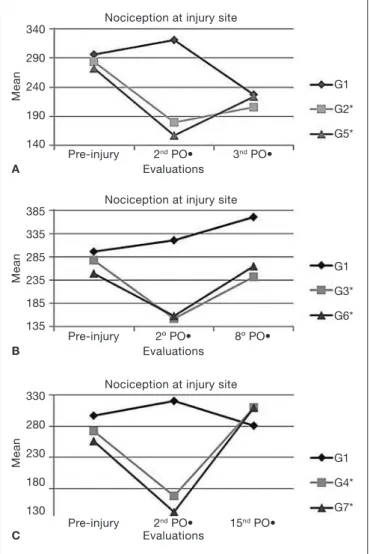
Nociception at injury site shows signiicant diference among G1, G2 and G5 [F(2;30)=40.2;p<0.001], being linching threshold value for G2 and G5 lower than for G1. here has also been dif-ference among evaluations: those performed in the 2nd and 3rd PO day had lower thresholds as compared to pre-injury (Figure 1A). G1, G2 and G6 had also statistical diference [F(2;30)=18,8;p<0,001], being that G3 and G6 had lower values as compared to G1. In addition, pre-injury evaluation has shown higher threshold as compared to 2nd PO day, while this had lower threshold as compared to euthanasia day (8th PO) (Figure 1B). With regard to G1, G4 and G7 there has been statistical dif-ference [F(2;30)=33,7;p<0,001], being that G4 and G7 had lower thresholds as compared to G1. here has been signii-cant diference in pre-injury evaluation, which has shown
higher values as compared to 2nd PO day, and this with lower values as compared to evaluation in the euthanasia day (15th PO) (Figure 1C). Such results show no antinociceptive efects for treated groups.
Nociception at plantar region
According to nociception in the paw, G1, G2 and G5 had dif-ference [F(2;30)=22,6;p<0,001]. G2 and G5 thresholds were statistically lower than G1, the same being true for evaluation on the 2nd and 3rd PO day as compared to pre-injury (Figure 2A). In comparing G1, G3 and G6 values there has also been diference [F(2;30)=43,4;p<0,001], where G3 and G6 had lower thresholds as compared to G1, and evaluations of the 2nd and 8th PO day had lower thresholds as compared to pre-injury (Figure 2B).
In analyzing G1, G4 G7 and pre-injury evaluations, 2nd PO day and euthanasia day (15th PO), it has been observed that G4 and G7 had lower thresholds as compared to G1, as well as evaluations of the 2nd and 15th PO day which had lower thresholds as compared to pre-injury [F(2;30)=23.6;p<0.001] (Figure 2C). Again, no efects of cold therapy were observed.
Nociception at injury site 340
290
240
190
140
Pre-injury 2nd PO• 3nd PO•
G1
G2*
G5*
Evaluations
Mean
A
Nociception at injury site 385
335
285
235
185
135
Pre-injury 2º PO• 8º PO•
G1
G3*
G6*
Mean
Evaluations B
Nociception at injury site 330
280
230
180
130
Pre-injury 2nd PO• 15nd PO•
G1
G4*
G7*
Mean
Evaluations C
Paw nociception 80
60
40
20
0
Pre-injury 2nd PO• 3nd PO•
G1
G2*
G5*
Evaluations
Mean
A
Paw nociception 80
60
40
20
0
Pre-injury 2nd PO• 8nd PO•
G1
G3*
G6*
Mean
Evaluations B
Paw nociception 80
60
40
20
0
Pre-injury 2nd PO• 15nd PO•
G1
G4*
G7*
Mean
Evaluations C
Figure 1. Evaluation of linching threshold at injury site using digital Von Frey ilament
* signiicant difference as compared to G1, • signiicant difference as compared to pre-injury evaluation, and • difference as compared to evaluation in 2nd PO day.
Figure 2. Flinching evaluation in plantar region using digital Von Frey ilament
Edema
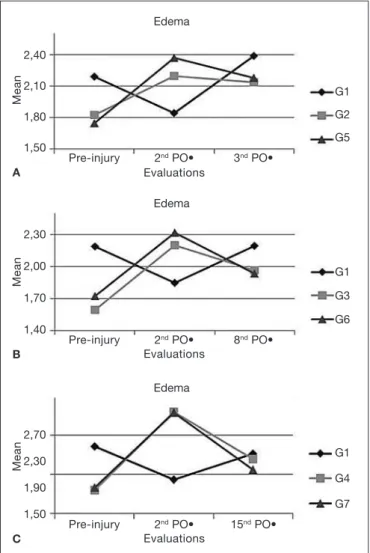
According to edema evaluation performed in G1, G2 and G5, there has been signiicant diference [F(2;30)=4.3;p=0.023] in 3rd PO day evaluation which had higher values as compared to pre-injury (Figure 3A).
Results of G1, G3 and G6 have shown no signiicant difer-ence between groups and between evaluations, with statistical signiicance [F(1.7;30)=3.3;p>0.05] (Figure 3B).
With regard to G1, G4 and G7 data, there has been statistical diference in 2nd PO day evaluation which had higher values as compared to pre-injury evaluation F(2;30)=8.5;p=0.01] (Figure 3C), with no efects of cold therapy in decreasing edema (Figure 3).
in human nerves11.
With regard to nociception, cold therapy could have helped analgesia due to decreased nervous conduction velocity in-hibiting pain signals transmission to spinal cord posterior horn, in addition to acting as contra-irritating mechanism, by which pain transmission to the central nervous system is blocked12-14; however, such results were not observed in this study.
With regard to edema evaluation, studies show that cold therapy may decrease it in cases of injury. In an experi-mental study with rats submitted to right knee synovitis and treated with immersion cold therapy for 20 minutes at 5oC, edema was evaluated with metal caliper rule and nociception by flinching time, being that treatment was effective to decrease edema and nociception of animals9. In a different study, edema was induced in the paw of fe-male rats and was treated both by Bernard diadynamic cur-rents (BDC) and cold therapy. Hydropletismography has shown that both treatments were significantly effective to decrease edema, with no difference between them15. How-ever, injuries were not caused by peripheral nerve compres-sion, as in our study.
In our study, nervous compression model has produced ede-ma in groups evaluated in the 3rd PO day, showing that G2 and G5 had higher luid volume change as compared to pre-injury, and cold therapy was not efective to minimize edema. In addition, 15th PO day groups also had edema at 2nd PO day evaluation, being that G4 and G7 had similar behavior dur-ing evaluations. However, it is suggested that there has been decrease at inal evaluation because values have decreased even not being signiicant which could have also helped in-creasing nociceptive threshold at injury site, since decreased edema may induce anagelsia6.
With regard to groups G3 and G6, they has similar behav-ior in all moments, without signiicant diference. It has to be stressed that initially, although without diferences among groups, G1 had higher means as compared to other groups, but such variation was occasional, and may have occurred just by diferences in animals’ limbs volume, or by technical dif-iculties to perform the evaluation, since animals (except at injury time and before euthanasia) were not anesthetized, that is, they moved being just lightly contained by hand, including during cold therapy treatment.
However, although this study has not shown efect of cold therapy on peripheral nervous injury, no similar studies were found in the literature aiming and helping the discussion. So, we suggest new studies, addressing histological and molecular analyses, to check the eicacy of cold therapy on nervous in-jury, bringing basis for studies and treatments with humans.
CONCLUSION
Nervous compression has decreased nociceptive threshold and has generated momentary increase in paw volume, being that cold therapy has not produced efects both in nocicep-tion and edema.
Edema
2,40
2,10
1,80
1,50
Pre-injury 2nd PO• 3nd PO•
G1
G2
G5
Evaluations
Mean
A
Edema
2,30
2,00
1,70
1,40
Pre-injury 2nd PO• 8nd PO•
G1
G3
G6
Mean
Evaluations B
Edema
2,70
2,30
1,90
1,50
Pre-injury 2nd PO• 15nd PO•
G1
G4
G7
Mean
Evaluations C
Figure 3. Evaluation of edema by hydropletismometry
• signiicant difference as compared to pre-injury evaluation.
DISCUSSION
ACKNOWLEDGMENTS
Coordenação de Aperfeiçoamento de Pessoal de Nível Supe-rior (CAPES), for the master course scholarship and Funda-ção Araucária de Apoio ao Desenvolvimento Cientíico e Tec-nológico, for inancial resources to the project.
REFERENCES
1. Craig A. Entrapment neuropathies of the lower extremity. PM&R. 2013;5(5 Sup-pl):31-40.
2. Wood MD, Kemp SW, Weber C, Borschel GH, Gordon T. Outcome measures of peripheral nerve regeneration. Ann Anat. 2011;193(4):321-33.
3. Faroni A, Mobasseri SA, Kingham PJ, Reid AJ. Peripheral nerve regeneration: experi-mental strategies and future perspectives. Adv Drug Deliv Rev. 2015;82-83:160-7. 4. Dubový P. Wallerian degeneration and peripheral nerve conditions for both axonal
regeneration and neuropathic pain induction. Ann Anat. 2011;193(4):267-75. 5. Rocha AP, Kraychete DC, Lemonica L, de Carvalho LR, de Barros GA, Garcia JB, et
al. [Pain: current aspects on peripheral and central sensitization]. Rev Bras Anestesiol.
2007;57(1):94-105. English, Portuguese.
6. Gutiérrez Espinoza HJ, Lavadi Bustamante IP, Méndez Pérez SJ. Revisión sistemática
sobre el efecto analgésico de la crioterapia en el manejo del dolor de origen músculo esquelético. Rev Soc Esp Dolor. 2010;17(5):242-52.
7. Hanks J, Levine D, Bockstahler B. Physical agent modalities in physical therapy and reha-bilitation of small animals. Vet Clin North Am Small Anim Pract. 2015;45(1):29-44. 8. Bridge PM, Ball DJ, Mackinnon SE, Nakao Y, Brandt K, Hunter DA, et al. Nerve
crush injuries - a model for axonotmese. Exp Neurol. 1994;127(2):284-90. 9. Moreira NB, Artifon EL, Meireles A, Silva LI, Rosa CT, Bertolini GR. A inluência
da crioterapia na dor e edema induzidos por sinovite experimental. Fisioter Pesqui. 2011;18(1):79-83.
10. Vivancos GG, Verri WA Jr, Cunha TM, Schivo IR, Parada CA, Cunha FQ, et al. An electronic pressure-meter nociception paw test for rats. Braz J Med Biol Res. 2004;37(3):391-9.
11. Savastano LE, Laurito SR, Fitt MR, Rasmussen JA, Gonzalez Polo V, Patterson SI. Sciatic nerve injury: a simple and subtle model for investigating many aspects of ner-vous system damage and recovery. J Neurosci Methods. 2014;227:166-80. 12. Corti L. Nonpharmaceutical approaches to pain management. Top Companion Anim
Med. 2014;29(1):24-8.
13. Barrot M. Tests and models of nociception and pain in rodents. Neuroscience. 2012;211(1):39-50.
14. Gosling AP. Mecanismos de ação e efeitos da isioterapia no tratamento da dor. Rev Dor. 2012;13(1):65-70.