ABSTRACT
BACKGROUND AND OBJECTIVES:Cancer pain is com-mon in patients under chemotherapy and there is the need for a multiprofessional therapeutic plan, especially for nursing assis-tance, in the attempt to control it. his study aimed at evaluating qualitative pain characteristics of cancer patients under chemo-therapy, by means of the McGill Pain Questionnaire.
METHODS: his is a quantitative, descriptive and cross-sec-tional study made up of 23 participants under chemotherapy with cancer pain. Data were collected by means of McGill Pain Questionnaire in a High Complexity Assistance Unit of a city of Minas Gerais.
RESULTS: Most participants were females, Caucasian, with ba-sic education, afected by more advanced breast cancer. Burning and sore were the most prevalent descriptors in sensory pain cat-egory. Among afective descriptors, tiresome and sickening were the most prevalent. Troublesome pain has prevailed as evaluative characteristic and for miscellaneous descriptors, most prevalent were radiating and nauseating.
CONCLUSION:Scales to evaluate qualitative pain aspects fa-vor nursing assistance, providing tailored assistance aimed at the complaint of each patient. heir competences allow the use of this tool aiming at increasingly qualifying its practice, thus im-proving quality of life of patients or, at least, decreasing their distress.
Keywords: Cancer, Evaluation in Nursing, Nursing, Pain, Pain measurement.
Pain evaluation in patients under chemotherapy: application of McGill
pain Questionnaire
Avaliação da dor em pacientes em tratamento quimioterápico: utilização do questionário McGill
Ludmila de Oliveira Ruela1, Yeda Maria Antunes de Siqueira2, Clícia Valim Côrtes Gradim1
1. Universidade Federal de Alfenas, Escola de Enfermagem, Alfenas, MG, Brasil. 2. Universidade Federal de Alfenas, Instituto Federal do Sul de Minas, Passos, MG, Brasil. Submitted in December 15, 2016.
Accepted for publication in April 17, 2017.
Conlict of interests: none – Sponsoring sources: Coordenação de Aperfeiçoamento de Pes-soal de Nível Superior (CAPES).
Correspondence to:
Rua Gabriel Monteiro da Silva, 700 – Centro 37130-000 Alfenas, MG, Brasil.
E-mail: [email protected]
© Sociedade Brasileira para o Estudo da Dor
RESUMO
JUSTIFICATIVA E OBJETIVOS: A dor oncológica é uma queixa comum em pacientes em quimioterapia e há a necessi-dade da elaboração de um plano terapêutico multiproissional, em especial para a assistência do enfermeiro, na tentativa de controlá-la. Este estudo teve como objetivo analisar as caracter-ísticas qualitativas da dor de pessoas com câncer em tratamento quimioterápico, por meio do Questionário de Dor de McGill.
MÉTODOS: Estudo quantitativo, descritivo, transversal, com-posto por 23 participantes em tratamento quimioterápico com queixa de dor oncológica. A coleta de dados ocorreu por meio da aplicação do Questionário de Dor de McGill em uma Unidade de Assistência de Alta Complexidade de um município mineiro.
RESULTADOS: A maioria dos participantes era mulheres, brancas, com ensino fundamental, acometidas pela neoplasia da mama em estágios mais avançados. Os descritores queimação e dolorida foram os mais prevalentes na categoria sensorial da dor. Entre os descritores afetivos, cansativa e enjoada foram os mais encontrados. Dor que incomoda prevaleceu como característica avaliativa do sintoma e para os descritores miscelânea, destacar-am-se dor que irradia e dá náusea.
CONCLUSÃO: O uso de escalas que avaliam os aspectos quali-tativos da dor favorece o atendimento do enfermeiro, o que proporciona que a assistência seja individualizada, voltada para a queixa de cada paciente. Suas competências permitem a uti-lização desse instrumento com o objetivo de qualiicar cada vez mais sua prática e, desse modo, melhorar a qualidade de vida dos pacientes ou, pelo menos, diminuir seu sofrimento.
Descritores: Avaliação em Enfermagem, Dor, Enfermagem, Mensuração da dor, Neoplasias.
INTRODUCTION
Cases of cancer in Brazil have been increasing in recent years, becoming a serious public health problem, mainly, due to the deicient structure of health services to meet this demand. his growth makes the professionals of the area deal with some alterations presented by patients during the treatment, being pain one of the symptoms most frequently reported1,2. Cancer pain is a complex symptom, where usually the patient experiences diferent types of pain, in varied intervals and intensity, with simultaneous sensations of acute and chronic pain and potential reduction in quality of life3. Many times, the sufering caused by this symptom makes patients fear it more than the disease itself4.
Cancer pain has multifaceted aspects, which takes into con-sideration not only the conditions of the disease but also the treatment, psycho-emotional and socio-economic factors, the habits of life and the experiences of each patient, becoming a challenge for the healthcare team5.
Even in an attempt to control pain, its prevalence is high, and approximately 55% of patients experience it during cancer treatment2. his has led to greater attention to this symptom, especially in recent years. Despite the various methods avail-able to manage it, the relief of pain, however, is insuicient, not reaching acceptable levels, which shows that its control is still lawed and the symptom is recurrent6.
In this context, the assessment of cancer pain must be a prior-ity action, involving all the multi-professional team for the qualitative measurement of this symptom, since this action helps in the choice of treatment and more complex and asser-tive decision making7.
he assessment and the qualitative perception of pain in cancer patients, even having little attention in recent times8, should be encouraged, mainly because of the variation in pain intensity, its etiology, and location9.
In practice, pain complaint is frequent, and health profes-sionals must be careful in its evaluation, always on the ba-sis of scientiic evidence. his approach will allow all care to be planned and provide the adequate relief of this symp-tom. However, professionals use only quantitative assessment methods of the pain, as the verbal numerical rating scale (VNRS), neglecting qualitative methods such as the McGill Questionnaire (MPQ), treating only the unidimensional as-pects of pain during care10.
It is pointed out that the nurse, the professional of the multidis-ciplinary team who is in close contact with the patient, should be trained to use multidimensional pain measurement tools for the development of the most appropriate therapeutic plan. hus, this study aimed to analyze the qualitative characteristics of pain in cancer patients undergoing chemotherapy treatment.
METHODS
Quantitative, descriptive, cross-section study carried out from December 2015 to May 2016. he convenience sample was based on the dynamics of the healthcare service and on the char-acteristics of the patients in that service. herefore, 23 patients with malignancy who received chemotherapy treatment at the High-complexity Care Unit (UNACON) of Casa de Caridade Nossa Senhora do Perpétuo Socorro - Santa Casa de Alfenas, a municipality located to the South of Minas Gerais participated in the study. he inclusion criteria were: be in chemotherapy treatment and mentally oriented; have pain; being followed by the hospital oncology sector and be 18 years old or more. hose with pain in the terminal stage of the disease were excluded. MPQ was applied for the qualitative assessment of pain. his is a multidimensional tool that was created in 1975 by Melzack, at McGill University in Canada, and translated to Portuguese and validated in 1996. he tool evaluates sensorial, emotional and painful phenomenon qualities being one of the world’s
most used questionnaires in practice and in qualitative assess-ment of cancer11,12.
MPQ is composed of four groups of descriptors (sensorial, emotional, evaluative and miscellaneous), in a total of 78 words. hese four groups are organized into 20 subgroups ac-cording to the pain sensation. Subgroups from 1 to 10 refer to the sensorial characteristic of pain, subgroups from 11 to 15 to emotional characteristics of the pain symptom, subgroup 16 refers to the evaluative dimension of pain, and the other sub-groups (17 to 20) comprise of miscellaneous descriptors. Each of these subgroups contemplates 2 to 6 similar descriptors, but difering in magnitude11.
In this study, the tool was applied verbally by a trained surveyor and participants were guided to choose the word that better rep-resented their pain, with the possibility of choosing only one word or none for each subgroup. In addition to responding the questionnaire, participants were characterized by means of an instrument elaborated by the surveyor who assessed the socio-economic variables and those related to the diagnosis and treat-ment. he stage of the disease, the chemotherapy protocol, and the medical records of the participants were analyzed to conirm the type of cancer,
his study was approved by the Research Ethics Committee of UNIFAL-MG, under the opinion number 1.330.960 and Cer-tiicate of Submission to the Ethics Assessment (CAAE) number 49341715.0.0000.5142 and with the signature of the Free and Informed Consent Term (FICT).
Statistical analysis
After collection, the data was stored and tabulated in an electronic spreadsheet and then analyzed by the Statistical Package for Social Sciences (SPSS), version 20.0 and used descriptive statistics (aver-age, standard deviation), frequency (f ) and percentages (%) with the purpose of delineating the general characteristics found.
RESULTS
Participants presented the following characteristics: 78.3% (n=18) were female and the average age was 55±9.3 years; 73.9% (n=17) of these self-declared white and 56.5% (n=13) had primary education (Table 1).
Table 1. Characterization of participants
Variables Frequencies %
Gender Female 18 78.3
Male 5 21.7
Self-declared color
White 17 73.9
Pardo 5 21.7
Yellow 1 4.4
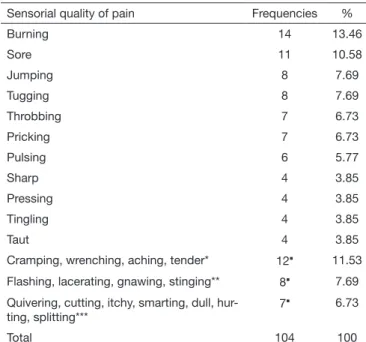
When asked about the clinical data of the disease, 52% (n=12) of the participants said they had breast neoplasm. 82.6% (n=19) had the disease in more advanced stages (stages III and IV) and 47.8% (n=11) underwent weekly chemotherapy (Table 2). After applying the MPQ we saw that of the 78 cited descrip-tors, 50 have been reported by the participants, of which 26 were sensorial qualities of pain, 10 were emotional, four represented the evaluative descriptors and 10 miscellaneous descriptors. Adding all the descriptors reported by the 23 participants, it was found that the sensorial descriptors were found 104 times (mean±SD: 4.5±2.8). Emotional descriptors
appeared 40 times (1.7±1.6). Evaluative descriptors of pain were cited 19 times (0.8±0.3), while miscellaneous descrip-tors appeared 25 times (1±1.2). herefore, 188 descripdescrip-tors reported by participants were evaluated (8.1±5.3).
When analyzing the sensorial characteristics of the pain symp-tom, the burning descriptor was most mentioned, followed by
sore, jumping, and tugging, as shown in table 3.
Concerning the emotional characteristics of pain, tiring
(20%), sickening (20%) and frightful (15%) were reported more times by participants (Table 4).
he descriptor troublesome was the most reported to qualify pain in relation to the evaluative characteristic. he descrip-tors, annoying (n=3), intense (n=3) and unbearable (n=3) were also found in this group (Table 5).
It was also observed that when asked about the descriptors of the miscellaneous group, participants mentioned a radiating
(20%) and nauseating (20%) pain as those that better repre-sent the quality of their pain (Table 6).
Table 2. Characteristics related to clinical data of the disease
Variables Frequencies %
Types of cancer Breast 12 52.0
Lung 3 13.0
Uterus 2 8.7
Intestine 2 8.7
Pancreas 1 4.4
Melanoma 1 4.4
Ovaries 1 4.4
Liver 1 4.4
Cancer Stage II 4 17.4
III 10 43.5
IV 9 39.1
Chemotherapy protocol
Weekly 11 47.8
Fortnightly 2 8.7
21-day interval 6 26.1 28-day interval 4 17.4
Table 3. Sensorial descriptors of pain reported by the participants of the study
Sensorial quality of pain Frequencies %
Burning 14 13.46
Sore 11 10.58
Jumping 8 7.69
Tugging 8 7.69
Throbbing 7 6.73
Pricking 7 6.73
Pulsing 6 5.77
Sharp 4 3.85
Pressing 4 3.85
Tingling 4 3.85
Taut 4 3.85
Cramping, wrenching, aching, tender* 12 11.53 Flashing, lacerating, gnawing, stinging** 8 7.69 Quivering, cutting, itchy, smarting, dull,
hur-ting, splitting***
7 6.73
Total 104 100
*Reported by three participants. **Reported by two participants. ***Reported by one participant. Sum of descriptors.
Table 4. Emotional descriptors of pain reported by the participants of the study
Emotional quality of pain Frequencies %
Tiring 8 20
Sickening 8 20
Frightful 6 15
Punishing grueling, fearful, blinding*
12 30
Exhausting, cruel, wretched** 6 15
Total 40 100
*Reported by three participants; **Reported by two participants; Sum of the descriptors.
Table 5. Evaluative descriptors of pain symptom reported by the par-ticipants of the study
Evaluative quality of pain Frequencies %
Troublesome 10 52.63
Annoying 3 15.79
Intense 3 15.79
Unbearable 3 15.79
Total 19 100
Table 6. The miscellaneous group descriptors reported by the parti-cipants of the study
Miscellaneous descriptors of pain Frequencies %
Radiating 5 20
Nauseating 5 20
Numb 3 12
Nagging 3 12
Spreading. drawing, sharp* 6 24 Penetrating, squeezing, tearing** 3 12
Total 25 100
All the 20 subcategories were cited by the participants. Of the 28 descriptors that were not reported, 16 belonged to the follow-ing subgroups: sensorial flickering, beating, pounding, shooting,
boring, drilling, stabbing, lancinating, pinching, crushing, pulling,
hot, scalding, searing, heavy, rasping). Four related to the emo-tional qualities of the pain symptom: suffocating, terrifying, vi-cious, killing), one describes the evaluative characteristic of pain (miserable) and seven were described in the miscellaneous group (piercing, tight, cold, freezing, agonizing, dreadful, torturing).
DISCUSSION
In the present study, cancer was most reported by white people (73.9%) and females (78.3%), who had, in general, more than seven years of education and the average age of 55 years. hese data are similar to some general characteristics of the popula-tion proile in the region and the indings of other studies, only difering in the educational level that was higher8,13. Moreover, the age is in accordance with 77% of the population that has a diagnosis of cancer in this age bracket14.
It is important to point out that the disparity in the socio-economic characteristics of the population directly inluence the vulnerability of the cancer diagnosis and the painful ex-perience since it changes the way people look after care at healthcare centers and the acceptance of pain as part of the disease process8.
he type of cancer most reported in this study was breast can-cer (52%). his data is consistent with the epidemiology of cancer in Brazil, where breast cancer is the higher incidence in the female population1.
When analyzing the data on cancer stage, it was noticed that 19 participants (82.6%) had the disease in more advanced stages (stages III and IV). his variable is crucial to know the propor-tions of the disease1. he delay in the diagnosis and in the begin-ning of the treatment can cause a tumor progression and more advanced stages, requiring more aggressive treatments, which generates bad prognostic and reduction in patient’s survival15. In the context of more advanced stages, the pain symptom can be more prevalent since there is the possibility of other body structures be afected during the treatment as a result of sur-gery, chemotherapy or radiation therapy and the presence of metastases, which stresses the importance of evaluating this symptom qualitatively.
he antineoplastic protocols used during the treatment have var-ied purposes, such as cure and supportive care, and the outcome is better when applied in high doses and smaller intervals16. With that, 47.8% (n=11) of participants were in the weekly chemo-therapy protocol, that is with short intervals between sessions in order to reduce the risk of worsening. However, this data can also be justiied by the treatment of breast cancer, which involved most of the sample and, usually, includes paclitaxel in its treat-ment routine - an antineoplastic used in treattreat-ments of this kind of neoplasia, with weekly administration16.
Regarding the qualitative assessment of pain, studies12,17-19 show that there is a variation in the words used by patients to describe how they perceive their pain. Some authors18,19 apply
the MPQ dividing it into three categories: sensorial, evaluative and emotional, and thus there were variations in the interpreta-tions of these categories. Moreover, when analyzing such stud-ies, we notice that the size of the samples varied between 2012,18, 7517 and 15919 participants, being the number of participants in the present study (23) in accordance with some studies12,18. When applying the MPQ, the words burning and sore, pres-ent in the sensorial category, were cited by 14 (60.9%) and 11 (47.8%) participants in this study, respectively, being the ones that presented the highest percentages. Silva et al.19 also found in their study a great number of patients (75%) who selected the word burning. However, the word sore was not reported. In Costa and Chaves’ study17, only 30.76% described burning, and 34.62% characterized their pain as sore.
he description of troublesome pain (n=10), present in the evaluative category, was the third most found in this study (43.5%), in alignment with other studies12,17-19. Followed by
jumping (34.8%) and tugging (34.8%), in the sensorial group;
tiring (34.8%), sickening (34.8%) and frightful (26.1%), in the emotional group; annoying (13%), intense (13%) and
unbear-able (13%), in the evaluative category; and radiating (21.7%)
and nausea (21.7%) in the miscellaneous category, were the
most cited in this study.
In the study carried out by Barbosa et al.12, jumping (11.5%)
and tugging (8.6%) were the most reported sensorial
charac-teristics and intense (27.8%) was among the most prevalent in evaluative. Jumping (65.38%) was also among the most men-tioned words in another study17, as well as sickening (76.92%) and tiring (73.07%). he descriptors radiating, tugging, sicken-ing, annoying and tiring were the most prevalent in their respec-tive categories in other studies18,19.
In this study, the throbbing (30.4%) and pricking (30.4%) de-scriptors, that fall in the sensorial group, were cited seven times each, being representative also in other studies12,18.
One of the most prevalent descriptors in this study, nauseating, cited by 21.7% participants, was reported by men and women. his fact did not occur in Costa and Chaves study17, where men did not cite this descriptor even once. Moreover, several words not cited in this study, such as flickering, beating, pounding,
shooting, lancinating, gnawing, scalding, among others, match with other studies where these words have not been found12,17. In this context, facing the variety of qualitative characteris-tics expressed by the cancer patient to describe his/her pain, the multidimensional strategy approach provides a personal-ized care using methods that assess pain, both in the quantita-tive and qualitaquantita-tive terms. he treatment and the evaluation of these patients should not be an incidental action. he care given to the cancer patient should be systematic as a way to en-sure the treatment success, especially because it is a subjective symptom and with multiple associated factors that can vary throughout the treatment process9.
CONCLUSION
individualized treatment and improve the quality of care re-ported by patients.
ACKNOWLEDGMENTS
he Coordination for Improvement of High Education Per-sonnel (CAPES) for funding this study.
REFERENCES
1. Brasil. Ministério da Saúde. Instituto Nacional de Câncer-INCA: Estimativa 2016: incidência de câncer no Brasil. Rio de Janeiro, 2015. Disponível em: http://www.inca. gov.br/estimativa/2016/estimativa-2016-v11.pdf.
2. Everdingen, MH, Hochstenbach LM, Joosten BE, Tjan-Heijnen VC, Janssen DJ. Update on prevalence of pain in patients with cancer: systematic review and meta--analysis. J Pain Symptom Manage. 2016;51(6):1070-90.
3. Conselho Internacional de Enfermeiros – CIE. Classiicação Internacional para a Prá-tica de Enfermagem – CIPE® Versão 2013 – Português do Brasil. 2014.
4. Carvalho MW, Nóbrega MM, Garcia TR. Processo e resultados do desenvolvimento de um Catálogo CIPE® para dor oncológica. Rev Esc Enferm USP. 2013;47(3):1061-8.
5. Varghese C, Carlos MC, Shin HR. Cancer burden and control in the Western Paciic region: challenges and opportunities. Ann Glob Health. 2014;80(5):358-69. 6. Webber K, Davies AN, Zeppetella G, Cowie MR. Development and validation of
the Breakthrough Pain Assessment Tool (BAT) in cancer patients. J Pain Symptom Manage. 2014;48(4):619-31.
7. Ripamonti CI, Santini D, Maranzano E, Berti M, Roila F. Management of câncer pain: ESMO Clinical Practice Guidelines. Ann Oncol. 2012;23(Suppl 7):S139-54. 8. Ham OK, Chee W, Im EO. he inluence of social structure on cancer pain and
quality of life. West J Nurs Res. 2016;4(1):1-20.
9. Pergolizzi JV, Zampogna G, Taylor R, Gonima E, Posada J, Rafa RB. A guide for pain management in low and middle income communities. Managing the risk of opioid abuse in patients with cancer pain. Front Pharmacol. 2016;7(42):1-9.
10. Cunha FF, Rego LP. Enfermagem diante da dor oncológica. Rev. Dor. 2015;16(2):142-5. 11. Santos CC, Pereira LS, Resende MA, Magno F, Aguar V. Aplicação da versão brasileira do
questionário de dor Mcgill em idosos com dor crônica. Acta Fisiatr. 2006;13(2):75-82. 12. Barbosa IM, Sales DS, Oliveira LMS, Sampaio DV, Milhome AG. Caracterização
da dor em pacientes onco-hematológicos e sua associação com a analgesia. Rev Dor. 2016;17(3):178-82.
13. Oliveira MM, Malta DC, Guauche H, Moura L, Silva Ga. Estimativa de pessoas com diagnóstico de câncer no Brasil: dados da Pesquisa Nacional de Saúde, 2013. Rev Bras Epidemiol. 2015;18(Suppl 2):S146-57.
14. American Cancer Society. Cancer Facts & Figures, 2003. Atlanta, 2003. Disponível em: http://whyquit.com/studies/2003_acs_cancer_facts.pdf.
15. Raphael MJ, Biagi JJ, Kong W, Mates M, Booth CM, Mackillop WJ. he relationship between time to initiation of adjuvant chemotherapy and survival in breast cancer: a systematic review and meta-analysis. Breast Cancer Res Treat. 2016;160(1):17-28. 16. Bonassa EMA, Gato MIR, (editores). Terapêutica Oncológica para Enfermeiros e
Far-macêuticos. 2ª ed. São Paulo: Atheneu; 2012. 644p.
17. Costa AI, Chaves MD. Dor em pacientes oncológicos sob tratamento quimioterápico. Rev Dor. 2012;13(1):45-9.
18. Silva VR, Gradim CV. Avaliação da dor em mulheres com câncer de mama submetidas à exérese da rede linfática axilar. Cogitare Enferm. 2010;15(4):646-51.