Epidemiology of strabismus surgery in a public
hospital of the Brazilian Federal District
Epidemiologia da cirurgia de estrabismo em um
hospital público de Brasília, Distrito Federal.
Juliana Tessari Dias Rohr
1, Cassiano Rodrigues Isaac
2, Cristiano dos Santos Correia
31 Hospital de Base do Distrito Federal, Brasília, DF, Brasil 2Hospital Regional da Asa Norte, Brasília, DF, Brasil
3Fellow de estrabismo - oftalmopediatria da Unifesp, São Paulo, SP, Brasil
A
BSTRACTPurpose: to determine the prevalence of different types of strabismus submitted to a surgical procedure in a public hospital in the Bra-zilian Federal District. Methods: Retrospective cross-sectional review of medical records of patients who underwent strabismus surgery performed by the same surgeon from 2004 to 2014. Incomplete records were excluded from the study. Variables included sex, age, type of strabismus, type of surgery, and re-surgeries. Strabismus was classified into three main types (esotropia, exotropia, and pure vertical deviation), and their subtypes. The type of surgery was determined by the number of muscles operated on (up to two, or more than two), the involvement of oblique and vertical rectus muscles, and muscle displacement. Results: 563 patients were reviewed and 531 were included in the study. The average age was 12.7 years, and females accounted for 54.4% of total patients. Esotropia was the most frequent type of strabismus (74%), followed by exotropia (23.7%) and pure vertical deviation (2.3%). The most frequent subtype of esotropia was infantile (49.1%), with 16.1% of these surgeries performed before the age of 2. Constant exotropia was the most frequent subtype of exotropia (27.8%). The prevalence of esotropia decreased with age, whereas that of exotropia increased. 52.3% of surgeries involved more than two muscles. An association between different types of deviation was found in 58.9% of patients. In cases of paralytic strabismus, the sixth nerve was the most affected (46%). Re-surgeries accounted for 10.7% of total surgeries. Conclusions: Esotropias were the most common types of strabismus, especially infantile esotropia. Most cases were associated with other types of deviation, and needed more complex surgeries, involving more than two muscles. This study expects to contribute to the planning of health measures that may effectively improve the assistance provided to the population.
Keywords: Strabismus/epidemiology; Strabismus/surgery; Esotropia; Exotropia
R
ESUMOObjetivo: Determinar a prevalência dos diferentes tipos de estrabismo submetidos a intervenção cirúrgica em um hospital público de Brasília, Brasil. Métodos: Estudo retrospectivo de corte transversal de prontuários médicos dos pacientes submetidos a cirurgias de estrabismo por um mesmo cirurgião, de 2004 e 2014. Foram excluídos prontuários incompletos. Variáveis pesquisadas incluíram sexo, idade, classificação do estrabismo, tipo da cirurgia e reoperações. Os estrabismos foram classificados em três tipos principais (esotropia, exotropia e desvio vertical puro) e seus subtipos. Avaliação do tipo da cirurgia considerou o número de músculos operados (intervenção em até 2 ou em mais músculos), o envolvimento de músculos oblíquos, retos verticais e transposição muscular. Resul-tados: Foram avaliadas 563 pacientes e 531 foram incluídas na análise. A média de idade foi 12,7 anos e o sexo feminino respondeu por 54,4%. A esotropia foi o tipo de estrabismo mais frequente (74%), seguido pela exotropia (23,7%) e desvio vertical puro (2,3%). O subtipo de esotropia mais frequente foi o infantil (49,1%), com 16,1% destas cirurgias realizadas antes dos 2 anos de vida. A exo-tropia constante foi o subtipo mais observado (27,8%) de exoexo-tropia. A proporção de esoexo-tropia diminuiu com a idade, enquanto a de exotropia aumentou. 52,3% das cirurgias envolveram mais de dois músculos. Associação de diferentes tipos de desvio foi observada em 58,9% dos pacientes. Dentre os estrabismos paralíticos, o VI nervo foi o mais acometido (46%). Reoperações corresponderam a 10,7% do total. Conclusão: As esotropias foram os estrabismos cirúrgicos mais comuns, especialmente a esotropia infantil. A maioria dos casos estava associada a outras formas de desvio e necessitaram de cirurgias mais complexas, envolvendo mais de 2 músculos. Espera-se que dados do estudo possam contribuir no planejamento de ações de saúde efetivas para melhorar a assistência à população.
Descritores: Estrabismo/epidemiologia; Estrabismo/cirurgia; Estropia; Exotropia
I
NTRODUCTIONT
reatment for strabismus may be either clinical, optical, or involving an association of techniques, and its purpose is to preserve and ensure adequate visual development, recover binocular vision, and establish ocular parallelism.(1)Improving versions, expanding the visual field without diplopia, and promoting ocular alignment in the primary position of gaze have also been reported as some of the chief reasons to perform strabismus surgeries .(2, 3) Considerations as to the psychosocial
impact have also been pointed out as important factors when deciding in favor of the surgical treatment for strabismus. It has been found that children with strabismus are viewed negatively, and that surgery could lead to psychosocial benefits, even when there is no hope of improving visual function. (3) It has been
reported that strabismus is more than a mere cosmetic issue, negatively affecting a series of aspects in childhood, adolescence and adult life.(4)
The prevalence of strabismus varies among the studies conducted with different populations, ages, diagnostic criteria and methods used. The global medical literature found frequen-cies ranging from 0.12% to 9.86%.(5, 6) A cross-sectional study
involving 10,994 individuals from cities in the State of São Paulo, Brazil, found a prevalence of strabismus of 1.4%, with no diffe-rence between the sexes and with esotropias (ET) accounting for 46.3% of total cases.(7) Generally speaking, ET has been
reported as the most common type of strabismus, being up to five times more frequent than exotropia (XT), and affecting mainly children.(8, 9)
Even though socioeconomic status is not a risk factor for strabismus, it may be a determinant of access to adequate clinical or surgical treatments. (7) Obtaining information regarding the
demands and types of surgeries is important for the organization of healthcare services. The purpose of this study is to determine the prevalence of the different types of strabismus submitted to surgical procedures in a public hospital of the Brazilian Federal District.
M
ETHODSThis study is in compliance with the Declaration of Helsinki and has been approved by the Research Ethics Committee of the Foundation for Education and Research in Health Sciences of the Brazilian Federal District. A retrospective cross-sectional study was conducted by reviewing medical records of patients submitted to surgeries to correct strabismus by the same surgeon (CRI), in the Hospital Regional da Asa Norte – HRAN (North Wing Regional Hospital), in Brasilia, between January of 2004 and December of 2014.
Patients submitted to surgical procedures to correct stra-bismus (including those with application of botulinum toxin) were included in the study, regardless of age or sex. Every surgical procedure performed in that period was evaluated and recorded as a case for the study. Patients whose medical records did not possess all the necessary information were excluded from the research.
The researched variables included sex, age at the time of surgery, type of surgery and classification of strabismus.
Strabismus was classified into three main types: ET, XT, and pure vertical deviation. Their subtypes are presented in Ta-ble 1. The definitions used in the study followed proposals made by several authors.(10-12) Other types of deviations, considered as
being associated with the deviations described in table 1, were: hypertropia, hypotropia, “A” pattern anisotropy, “V” pattern anisotropy and dissociated vertical deviation (DVD).
The type of surgery was determined by the number of muscles operated on (intervention in up to two muscles, or inter-vention in more than two muscles). The involvement of oblique and vertical rectus muscles, the displacement of the rectus muscle, and the number of re-surgeries were also considered.
Patients were grouped into age brackets according to their ages at the time of surgery, and following the same division em-ployed in the study of Curtis et al.(13) up to 10 years of age, between
10 and 20 years of age, and over 20 years of age. (13)
The data were transferred to Microsoft Excel 2013 (Redmond, WA, USA). A descriptive statistical analysis was conducted through the use of frequency distribution tables for each variable studied.
Infantile Esotropia (congenital esotropia): Infantile onset (first 6 months), constant, large angle esotropia, unresponsive to plus lenses, neurologically intact children.
Accommodative esotropia: Patients with an acquired constant or intermittent deviation that was corrected or reduced 10 PD or more after wearing hyperopic spectacles.
Acquired nonaccommodative esotropia: Patients whose deviation was not associated with accommodative effort and developed after 6 months of age.
Esotropic children with a CNS disease: Patients with esotropia associated with congenital or acquired developmental or neurologic disorder regardless of the age at onset or form of strabismus.
Late onset esotropia (adult esotropia): Patients with an acquired deviation developed after 8 years of age with constant diplopia. Sensory esotropia: Patients with a unilateral or bilateral ocular condition that prevented normal fusion.
Paralytic esotropia: Non-comitant esotropia with evidence of cranial nerve dysfunction.
Postoperative Consecutive Esotropia: Previously exotropic patients with esotropia associated to surgical hypercorrection. Esotropia with myopia: Associated to high myopia (> 10 diopter).
Other esotropias: Cyclic esotropia, co-contractive retraction syndrome (Duane syndrome), associated to neuromuscular or orbital disease, not included in previous categories.
Intermittent exotropia: Onset usually greater than 1 year of life, intermittent, moderate angle deviation at both distance and near, usually normal vision both eyes and good stereopsis with bifixation, healthy eye and child.
Constant Exotropia (Basic exotropia): Comitant constant exotropia, onset after infancy in a healthy child with no eye or brain disease.
Table 1
The type of surgery was determined by the number of muscles operated on (intervention in up to two muscles, or intervention in more than two muscles). The involvement of oblique and vertical rectus muscles, the displacement of the rectus muscle, and the number of re-surgeries were also considered.
Patients were grouped into age brackets according to their ages at the time of surgery, and following the same divi-sion employed in the study of Curtis et all.(13) up to 10 years
of age, between 10 and 20 years of age, and over 20 years of age (13). The data were transferred to Microsoft Excel 2013
(Redmond, WA, USA). A descriptive statistical analysis was conducted through the use of frequency distribution tables for each variable studied.
Infantile Exotropia (congenital esotropia): Neurologically intact children with a constant deviation that developed by 6 months of age. Exotropic children with a CNS disease: Patients with esotropia associated with congenital or acquired developmental or neurologic disorder regardless of the age at onset or form of strabismus.
Sensory exotropia: Patients with a unilateral or bilateral ocular condition that prevented normal fusion. Paralytic exotropia: Non-comitant esotropia with evidence of cranial nerve dysfunction.
Postoperative Consecutive Exotropia: Previously exotropic patients with esotropia associated to surgical hypercorrection.
Other exotropias: Contractive retraction syndrome (Duane syndrome), associated to neuromuscular, restrictive or orbital disease, or not included in previous categories.
Pure vertical deviation: Vertical deviation (hypertropia, hypotropia or DVD) without horizontal deviation > 10 PD.
PD= prism diopter; CNS= central nervous system; DVD= dissociated vertical deviation.
Adapted from: Mohney BG. Common forms of childhood esotropia. Ophthalmology. 2001;108(4):805-9.(10); Mohney BG, Huffaker RK. Common
forms of childhood exotropia. Ophthalmology. 2003;110(11):2093-6.(11); National Eye Institute. A classification of eye movement abnormalities and
strabismus (CEMAS). Report Of A National Eye Institute-Sponsored Workshop [Internet]. Bethesda: National Eye Institute; 2001. p.1-56. [cited 2017 Aug 30]. Available from:http://www.nei.nih.gov/news/statements/cemas.pdf.(12)
Ninety percent (90%) of ET patients were included into three main subtypes: infantile ET (49.1%), accommodative ET (22.6%) and acquired nonaccommodative ET (18.3%) (Table 3).
Among the surgeries for correction of infantile esotropia, 31 (16%) were performed before the children were 2 years old, and 162 (84%) were performed when patients were over 2 years old.
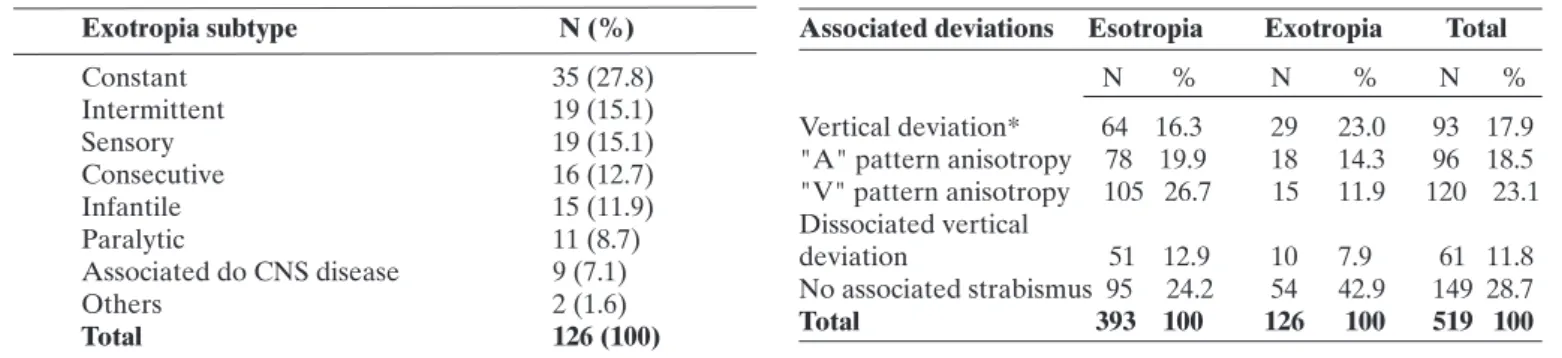
Constant XT was the most common (27.8%) among exode-viations. The same number of patients presented with intermittent and sensorial XT (15.1%) (Table 4). The intermittent/constant XT ratio was 0.5:1.
An association with at least one more type of deviation was seen in 58.9% of patients. In ET patients, associations with “V” pattern anisotropies (26.7%) and “A” pattern anisotropies (19.9%) were the most common. Among XT patients, vertical deviations (23.0%) and “A” pattern anisotropies (14.3%) were the most frequent (Table 5).
Table 2
Proportion of strabismus by classification and age group
Strabismus
classification ≤ 10 years > 10 and ≤ 20 years > 20 years
N % Diagnosis % Age group N % Diagnosis % Age group N %Diagnosis %Age group
Esotropia 281 71.5 82.2 70 17.8 72.9 42 10.7 45.1 Exotropia 52 41.3 15.2 24 19 25 50 39.7 53.8 Pure vertical
deviation 9 75 2.6 2 16.7 2.1 1 8.3 1.1 Total 342 64.4 100 96 18.1 100 93 17.5 100
R
ESULTS563 surgeries were performed in the period under study. 531 patients were included, and 32 (5.7%) were excluded for having incomplete or imprecise data. The average age was 12.7 years (ranging from 0.6 to 85.0 years), and female patients accounted for 54.4% of total patients.
ET was the most frequent type of strabismus (74%). XT accounted for 23.7%, and pure vertical strabismus represented 2.3% of total cases. The ET/XT ratio of the entire population was 3.1:1. Among the patients who underwent surgery before they were 10 years old, that ratio was 5.4:1; for patients between 10 and 20 years old, it was 2.9:1; and for patients who were over 20 years old, it was 0.8:1 (Table 2).
N = number.
Table 3
Percentages of patients with each esotropia subtype
Esotropia subtype N (%) Infantile 193 (49.1) Accommodative 89 (22.6) Acquired nonaccommodative 72 (18.3) Paralytic 11 (2.8) Associated to CNS disease 10 (2.5)
Sensory 10 (2.5)
Late onset 3 (0.8)
Others 3 (0.8)
Consecutive 1 (0.3) Associated to myopia 1 (0.3) Total 393 (100)
D
ISCUSSIONIt is difficult to compare the findings of the present study to other research, due to the methodological variability across the studies, to the fact that few studies investigated surgical strabismus alone, (13, 14), and to the lack of standardization in the
classification of strabismus. Furthermore, most of the research is either population-based, or limited to a specific age bracket (13,14).
Generally speaking, the ET/XT ratio has been lower in Asian populations when compared to European.(15, 16) In Brazil, the data
are similar to those of other western populations, pointing to ET as the most common type of strabismus.(7) This study showed an
ET/XT ratio of 3.1:1 (having reached 5.4:1 in those patients who underwent surgery up to the age of 10), which is higher than the ratio found in the other aforementioned Brazilian studies. A pos-sible explanation for this difference may be the fact that surgery is not recommended for several cases of intermittent XT, which are, however, still accounted for in population-based studies. This hypothesis is corroborated by the similarity between the results of this study and those of another study conducted in Saudi Arabia, which also investigated only surgical strabismus and found an ET/ XT ratio of 2.57:1, also pointing to a decrease of this ratio as the age of the population under study increased.(13) This variation may be
explained by a few intermittent XT cases that begin in childhood but only present decompensation after several years, and become eligi-ble for surgery when patients have already reached adulthood.(17)
The four most common ET subtypes found in this research were also pointed out as being the most frequent in other studies, albeit with different distributions. (11, 13, 18, 19)
Infantile ET was the main subtype found in this study, accou-nting for nearly half of the surgical ET cases. Although infantile ET is classically indicated as the most common type of esotropia among
Table 4
Percentages of patients with each exotropia subtype
Exotropia subtype N (%)
Constant 35 (27.8)
Intermittent 19 (15.1)
Sensory 19 (15.1)
Consecutive 16 (12.7)
Infantile 15 (11.9)
Paralytic 11 (8.7)
Associated do CNS disease 9 (7.1)
Others 2 (1.6)
Total 126 (100)
Table 5
Deviations associated to esotropias and exotropias
N = number; CNS= central nervous system
Associated deviations Esotropia Exotropia Total
N % N % N %
Vertical deviation* 64 16.3 29 23.0 93 17.9 "A" pattern anisotropy 78 19.9 18 14.3 96 18.5 "V" pattern anisotropy 105 26.7 15 11.9 120 23.1 Dissociated vertical
deviation 51 12.9 10 7.9 61 11.8 No associated strabismus 95 24.2 54 42.9 149 28.7 Total 393 100 126 100 519 100
N = number; * = including hypertropia and hypotropia.
Table 6
Percentages of patients with surgeries in more than 2 extraocular muscles: oblique muscles, horizontal rectus muscle, transposition and reoperation
From the 22 cases of paralytic strabismus, the sixth cranial nerve was affected in 10 (46%), the fourth nerve in 6 (27%) and the third nerve also in 6 (27%).
Table 6 shows the frequency of surgeries with intervention in more than two muscles, in oblique muscles, in vertical rectus muscles, muscle displacements and re-surgeries.
More than 2 muscles Oblique muscle Vertical rectus Horizontal rectus transposition Reoperations N % N % N % N % N %
278 52.3 249 46.9 25 4.7 89 16.8 57 10.7
N = number.
children, in recent studies this high prevalence has not been found .(11, 13, 18, 19) The present study’s findings are probably due to the fact that
infantile ET usually presents with large deviations, and as such are more easily perceived by the parents, who immediately seek an ophthalmo-logical evaluation. Additionally, most cases of accommodative ET may be corrected with plus lenses (11, 19) and do not need surgery, therefore
not being widely represented among the subjects of this study (11,19)
Regarding XT subtypes, we found trends similar to those found in other studies. (12, 13, 18, 20) However, as a large portion of intermittent
XT cases are nonsurgical, the prevalence of the latter was a little lower. In addition, the study found a high rate of sensorial XT (15.1%), which may be explained by the fact that sensorial strabismus is often acquired at an older age (13), and this study included adult patients (13).
Among the cases of paralytic strabismus, the most affected cranial nerve was the sixth, corroborating the data found in the literature.(21, 22)
We found that only 10% of surgeries corresponded to re-sur-geries. This number is lower than the one seen in the literature(23-25),
which might be due to good results obtained by the first surgery, to a difficulty faced by patients in following up on their treatments due to socioeconomic issues, or to lower standards regarding esthetic results among the population under study (23-25). New studies will
be necessary in order to clarify this finding.
Most surgical cases showed associated deviations, which ren-ders programming and performing the surgery more complex. This has also contributed to the fact that over half the surgeries needed interventions in more than two extraocular muscles. As previously demonstrated, surgeries performed in more than two muscles take longer than those performed in up to two muscles, (14), decreasing the
number of surgeries that may be performed in the same period (14).
16. Teoh GH, Yow CS. Prevalence of squints and visual defects in Malay-sian primary one school children. Med J Malaysia. 1982;37(4):336-7. 17. Hiles DA, Davies GT, Costenbader FD. Long-term observations on
unoperated intermittent exotropia. Arch Opthalmol. 1968;80(4):436-42. 18. Mohney BG. Common forms of childhood strabismus in an incidence
cohort. Am J Opthalmol. 2007;144(3):465-7.
19. Greenberg AE, Mohney BG, Diehl NN, Burke JP. Incidence and types of childhood esotropia: a population-based study. Ophthalmology. 2007;114(1):170-4.
20. Govindan M, Mohney BG, Diehl NN, Burke JP. Incidence and types of childhood exotropia: a population-based study. Ophthalmology. 2005;112(1):104-8.
21. Tiffin PA, MacEwen CJ, Craig EA, Clayton G. Acquired palsy of the oculomotor, trochlear and abducens nerves. Eye (Lond). 1996;10 (3):377-84.
22. Kodsi SR, Younge BR. Acquired oculomotor, trochlear, and abdu-cent cranial nerve palsies in pediatric patients. Am J Opthalmol. 1992;114(5):568-74.
23. Birch EE, Stager DR, Sr. Long-term motor and sensory outcomes after early surgery for infantile esotropia. J AAPOS. 2006;10(5):409-13. 24. Helveston EM, Neely DF, Stidham DB, Wallace DK, Plager DA,
Sprunger DT. Results of early alignment of congenital esotropia. Ophthalmology. 1999;106(9):1716-26.
25. Christiansen SP, Chandler DL, Holmes JM, Bacal DA, Birch E, Donahue SP, et al. The relationship between preoperative alignment stability and postoperative motor outcomes in children with esotro-pia. J AAPOS. 2009;13(4):335-8.
26. Crespi-Flores VG, Minguini N, Temporini ER, Carvalho KM. Stra-bismus surgery learning for ophthalmology residents of university service. Arq Bras Oftalmol. 2012;75(3):188-91.
27. Simonsz HJ, Kolling GH, Unnebrink K. Final report of the early vs. late infantile strabismus surgery study (ELISSS), a controlled, prospective, multicenter study. Strabismus. 2005;13(4):169-99.
Corresponding Author:
José Faustino Cavalcanti
700, Pedro Gondim, João Pessoa, Paraíba, Brazil. Postal code: 58031180.
Phone: +55 83 88082328. E-mail: [email protected].
displacement techniques. These surgeries require a more elaborated planning and are technically more difficult. This observation may demonstrate the importance of the surgeon being prepared to perform different techniques in several extraocular muscles. Pro-fessionals with a less specific training in the treatment of strabismus may feel that they are only able to operate the simplest cases, usually involving rectus and horizontal muscles only.(14) More opportunities
to perform surgeries, training in experimental surgeries and ade-quate supervision may all lead to an improvement in the learning of strabismus surgery by ophthalmology residents.(26)
Several studies suggest that the early surgery for correction of infantile esotropia may help preserve and even restore binocular vision in these individuals.(23, 27) This study found that the percentage of children
who underwent surgery before 2 years of age was only 16.1%. This may either reflect a difficulty in gaining quick access to healthcare services, or a lack of qualified professionals and resources to perform an earlier sur-gery; further research is needed for a better understanding of this issue.
We expect that this study’s findings may contribute to the planning of health measures that will effectively improve the healthcare provided to the population, including increased offers and an easier access to specialized services, training of qualified professionals, and dissemination of information regarding the possibility and the need for treatment of strabismus patients.
R
EFERENCES1. Kac MJ, Freitas Júnior MBd, Kac SI, Andrade EPd. Freqüência dos tipos de desvios oculares no ambulatório de motilidade ocular extrínseca do Hospital do Servidor Público Estadual de São Paulo. Arq Bras Oftalmol. 2007;70(6):939-42.
2. Abbasoglu OE, Sener EC, Sanac AS. Factors influencing the success-ful outcome and response in strabismus surgery. Eye (Lond). 1996;10 ( Pt 3):315-20.
3. Uretmen O, Egrilmez S, Kose S, Pamukcu K, Akkin C, Palamar M. Negative social bias against children with strabismus. Acta Ophthal-molo Scand. 2003;81(2):138-42.
4. Satterfield D, Keltner JL, Morrison TL. Psychosocial aspects of strabismus study. Arch Opthalmol. 1993;111(8):1100-5.
5. Matsuo T, Matsuo C, Matsuoka H, Kio K. Detection of strabismus and amblyopia in 1.5- and 3-year-old children by a preschool vision--screening program in Japan. Acta Med Okayama. 2007;61(1):9-16. 6. Maul E, Barroso S, Munoz SR, Sperduto RD, Ellwein LB. Refrac-tive Error Study in Children: results from La Florida, Chile. Am J Opthalmol. 2000;129(4):445-54.
7. Shimauti AT, Pesci Lde T, Sousa RL, Padovani CR, Schellini SA. Estrabismo: detecção em uma amostra populacional e fatores de-mográficos associados. Arq Bras Oftalmol. 2012;75(2):92-6. 8. Donnelly UM, Stewart NM, Hollinger M. Prevalence and outcomes of
childhood visual disorders. Ophthalmic Epidemiol. 2005;12(4):243-50. 9. Friedman Z, Neumann E, Hyams SW, Peleg B. Ophthalmic screening of 38,000 children, age 1 to 2 1/2 years, in child welfare clinics. J Pediatr Ophthalmol Strabismus. 1980;17(4):261-7.
10. Mohney BG. Common forms of childhood esotropia. Ophthalmology. 2001;108(4):805-9.
11. Mohney BG, Huffaker RK. Common forms of childhood exotropia. Ophthalmology. 2003;110(11):2093-6.
12. National Eye Institute. A classification of eye movement abnormali-ties and strabismus (CEMAS). Report Of A National Eye Institute--Sponsored Workshop [Internet]. Bethesda: National Eye Institute; 2001. p.1-56. [cited 2017 Aug 30]. Available from:http://www.nei.nih. gov/news/statements/cemas.pdf.
13. Curtis TH, McClatchey M, Wheeler DT. Epidemiology of surgical strabismus in Saudi Arabia. Ophthalmic Epidemiol. 2010;17(5):307-14. 14. Rocha MM. Strabismus surgical treatment: technical-economic
evaluation. Arq Bras Oftalmol. 2005;68(1):61-9.
15. Matsuo T, Matsuo C. The prevalence of strabismus and amblyopia in Japanese elementary school children. Ophthalmic Epidemiol. 2005;12(1):31-6.
ERRATA
In the scientific article “Epidemiology of strabismus surgery in a public hospital of the Brazilian Federal District”, with the number of DOI 10.5935 / 0034-7280.20170052, published in the Brazilian Journal of Ophthalmology, volume 76, number 5, September / October 2017; p. 250-4, on page 250, an error was not included in the names of two authors and their affiliations.
Where to read:
Juliana Tessari Dias Rohr1
Read:
Juliana Tessari Dias Rohr1, Cassiano Rodrigues Isaac2,
Cristiano dos Santos Correia3
Where to read:
1Hospital de Base do Distrito Federal, Brasília, DF
Read:
1Hospital de Base do Distrito Federal, Brasília, DF 2Hospital Regional da Asa Norte, Brasília , DF
3Fellow de estrabismo/ oftalmopediatria da Unifesp, São