Copyright © 2014 Revista Latino-Americana de Enfermagem This is an Open Access article distributed under the terms of the Creative Commons Attribution Non-Commercial License (CC BY-NC).
This license lets others distribute, remix, tweak, and build upon your work non-commercially, and although their new works must also acknowledge you and be non-commercial, they don’t have to license their derivative works on the same terms.
DOI: 10.1590/0104-1169.2980.2401
www.eerp.usp.br/rlae
Corresponding Author: Gabriel Rodríguez
Universidad Andres Bello. Facultad de Enfermería Av. República, 237
Centro
26618476, Santiago, Chile E-mail: [email protected]
Gabriel Rodríguez
1Luz Angélica-Muñoz
2Luiza Akiko Komura Hoga
31 PhD, Professor, Facultad de Enfermería, Universidad Andrés Bello, Santiago, Chile. 2 PhD, Full Professor, Facultad de Enfermería, Universidad Andrés Bello, Santiago, Chile.
3 PhD, Associate Professor, Escola de Enfermagem, Universidade de São Paulo, São Paulo, SP, Brazil.
Objective: to explore the cultural experiences of nurses who immigrated to Chile. The study´s
theoretical framework was the Purnell Model for Cultural Competence. Method: Leininger’s
Observation-Participation-Reflection method was developed at two hospitals in the city of Santiago,
and ethnographic interviews were held with 15 immigrant nurses. Results: among Purnell’s 12
domains, the following were identified: Overview/heritage, Communication, Workforce issues,
Family roles and organization, Biocultural ecology and Health-care practices. The difficulties were
related to the language and its semantic meaning, the new responsibilities and the difficult
relationship with colleagues. “In search of better horizons – the decision to immigrate”, “Gaining
confidence and establishing a support network – employability and professional performance”
and “Seeking for people´s acceptance – professional adaptation in a new cultural scenario” are
cultural themes that represent their experiences. Conclusions: the competence to offer cultural
care demands the development of public policies and continuing education programs at health
institutions, specifically focused on immigrant nurses.
Descriptors: Nurses; Emigration and Immigration; Qualitative Research; Anthropology, Cultural;
Nursing Staff, Hospital.
Rev. Latino-Am. Enfermagem 2014 Mar.-Apr.;22(2):187-96.
Introduction
Studies focusing on the experiences of the nurses
who migrated to countries like Australia, the United
States and Canada identiied cultural barriers such as marginalization, language dificulties, devaluation
of professional skills and development of limited and
stressful relations with colleagues(1-3).
In an unpublished multicenter research concluded
by the Pan American Health Organization (PAHO)
entitled “Migración de Enfermeras de América Latina:
Área de América de Sur”, published in the Series No. 60
of Human Resources for Health(4), some experiences of
professionals in countries in the region were analyzed.
According to the same study, the most frequent
emigration reasons for the nurses who traveled to Chile
were related to family, politics, insecurity, economy,
cultural conditions and personal development.
The poor economic situation, lack of employment
and professional development opportunities and lack of
beneicial work policies for the general population, which
directly affect the nursing professionals, are the main
reasons that characterize the central phenomenon of
these professionals’ migration.
Personal development, economic stability and
working in satisfactory professional conditions are
their aspirations, but signaled dificult employability. In addition, they identiied three moments in their
migration trajectory: the decision to emigrate, the travel
and the initial establishment in the country of destiny,
and professional and social consolidation(4).
The reasons for nurses to migrate to Argentina
were related to family, economy and professional
development, in order of importance.
The dificulties Brazilian immigrant nurses faced were
the language and the cultural differences. Although nurses
who immigrated to Venezuela expressed satisfaction with
their achievements, regarding their professional life as
well as their life projects, they indicate dificulties to
combine the roles of mother, wife and professionals and
experience feelings of rootlessness, conlicts that make
them feel vulnerable(4). For some time, the immigrant
nursing professionals face dificulties in the employability
process in another country.
In this context, there is a global crisis affecting
the population, which involves the shortage of health
personnel, the lack of experts, the deicit in health
prevention and promotion and the migration of
professionals. This leads towards the marketing of
services at the cost of their professional ideals, the
loss of conidence and the demotivation of health
professionals(5).
The trends in this new post-modern order are
relected in the nursing work and services and efforts
should be made to overcome the status quo, as the
source of all energy to achieve the change derives
from the human capital. This leads us to the social
responsibility universities and health organizations and
services should assume towards the citizens(6).
The health professionals need to promote the
growth, development, communication and preservation
of knowledge inside institutions, so that nursing
management ultimately permits the achievement of
rapid and assertive responses in decision making in
clinical practice(7).
This research was undertaken in view of the
existence of distinct characteristics of nursing
professionals regarding the educative, socio-economic,
family and behavioral aspects, according to the country
and its cultural context. The research question was:
“How do the nurses who migrate to Chile to work have
experienced the new culture found in this country?”.
The study objective was to explore the cultural
experiences of nurses who migrated to Chile to practice
their profession.
The exploration and description of these experiences
can contribute to offer support to immigrant nursing
professionals. They are also essential for the health
institutions who receive them, with a view to planning
actions for the welcoming and integration of the foreign
professionals in the new work context.
Hence, the immigrant nurses urgently need to
be integrated into the new and unknown cultural
environment and to adapt to the standards, beliefs and
values that prevail in the new social and care context.
Method
The explored theme was approached through the
qualitative paradigm. The ethnography was the method
used to discover the cultural symbols permeating the
immigrant nurses’ daily care practices and to permit the
contact with the range of conlicts that will be revealed
in the discovery of their experiences.
The Observation-Participation-Relection (OPR)
Model proposed by Leininger was done(8). The data
collection started with the observation phase and
the impressions were registered in a ield diary,
incorporating aspects of the dynamics, relationship
was gradually replaced by the participation in the daily
activities in the cultural scenarios, which was facilitated
by the fact that the primary author of the study was
a nurse at one of the institutions studied and an
immigrant in Chile.
We used Leininger’s OPR as a methodological
framework, considering its nature and applicability in
this research, to explore and understand the cultural
symbols permeating the nurse´s daily practices.
The Purnell Model for Cultural Competence was
this study´s theoretical framework. The main premise
of this framework is that all care professionals need
to know the culture with a view to providing culturally
competent care(9). According to Purnell, cultural
awareness is developed in a non-linear process that
involves the phases of cultural adaptation, ranging from
unconsciously incompetent for care practice, followed
by the levels of consciousness about the incompetence,
competence, until reaching the level that is considered
ideal, marked by unconscious competence to provide
health care in a way that is considered appropriate
to the predominant beliefs and cultural values in the
new cultural care context(9). This Model is lexible and
applicable to a range of professional areas and contexts
and includes individual, family, community and social
aspects. For its application, it contains 12 related
cultural domains: overview/heritage, communication,
gender roles and family organization, workforce
issues, biocultural ecology, high-risk behaviors,
nutrition, pregnancy, death rituals, spirituality,
health-care practices and health-health-care providers. Figure 1
summarizes these domains.
Purnell’s premises allow us to incorporate the Model
in the experiences of nurses who arrive to work in the
new country.
The study was developed in two cultural contexts,
called Hospital 1 and Hospital 2 in this study. Hospital
1 is one of the largest care centers in the country and
offers the largest number of medical specialties and
subspecialties, attending to a population in the South
of Santiago; health care is provided to hospitalized
patients, who arrive through outpatient clinics as
well as emergency care. Hospital 2 does not deliver
emergency care and provides health care to adult
patients, offering comprehensive care to people
in the Southeast of Santiago. Both hospitals are
afiliated with the public system and are located in the
capital of Chile.
In this study, all foreign nurses hired in both
hospitals were included. Data were collected between
March and May 2010 at Hospital 1 and between June
and August of the same year at Hospital 2.
The criteria for inclusion in the study were: being
an immigrant nurse, graduated in the country of origin,
at least one year of professional practice in Chile, having
a job contract in one of the two cultural contexts and
being willing to cooperate with this study. The 15 foreign
nurses from the two hospitals were invited to participate
in this research and served as key informants(8). None of
them refused to participate.
The contact with the professionals took place on a
date and time scheduled by phone or personally with each
nurse. The primary investigator started the observation
phase when he arrived at the service where the nurses
work. First, it was registered that the professionals
constantly moved around between the nurses’ station
and the patients’ rooms and interacted agreeably with
their colleagues and other care team members, such as
physicians and auxiliary nurses.
The observation phase took place during the
researcher’s stay, while the participation phase was
developed in two parts; in the irst, the researcher
accompanied the nurses in their care activities. During
these moments, the researcher had the impression
that the professionals felt they were being evaluated
while justifying each of their actions and/or procedures.
When the primary investigator has acquired familiarity
with the cultural and work context, he started the
second part of the participation phase, which involved
cooperating in some nursing care activities. In this
phase, the interviews with the research informants
started.
The mean duration of the interviews was 68 minutes,
and descriptive, structural and contrast questions were
used(8). These were fully recorded, listened to in private,
transcribed and stored in an exclusive ile by the primary
investigator. The collected data were complemented by
the written notes taken during the ield observation
process(10).
The study complied with the ethical requisites(11)
and received approval from the Ethics Committee at
Facultad de Enfermería de la Universidad Andrés Bello.
After the research participants in both hospitals had
received clariications, the data collection was started.
Ethical standards were previously informed and complied
with through the signing of the informed consent term
by all professionals.
The data were analyzed by the primary investigator
and the other authors, in accordance with Leininger’s
Rev. Latino-Am. Enfermagem 2014 Mar.-Apr.;22(2):187-96.
The Purnell Model for Cultural Competence
Global Society Global Society Global Society Global Society Community Community Community Community Person Person Person Person Person Person Person Person Person Person Person Person Family Family Family Family Family Family Family Family Family Family Family Family Health-care practitioners
Perceptions of practitionersFolk practitioners Gender & health care
Unconsciously incompetent Consciously incompetent Consciously competent Unconsciously competent
Primary characteristics of culture: age, generation, nationality, race, color, gender, religion
Secondary characteristics of culture: educational status, socioeconomic status, occupation, military status, political beliefs, urban versus rural residence, enclave identity, marital status, parental status, physical characteristics, sexual orientation, gender issues, and reason for migration (sojourner, immigrant, undocumented status)
Unsconsciously incompetent: not being aware that one is lacking knowledge about another culture Consciously incompetent: being aware that one is lacking knowledge about another culture
Consciously competent: learning about the client s culture, verifying generalizations about the client s culture, and providing culturally specific interventions
Unsconsciously competent: automatically providing culturally congruent care to clients of diverse cultures
Model created by Larry D. Purnell, Phd, RN, FAAN. Reprinted with permission. Overview/heritage Origins Residence Topography Economic s Politics Education Occupation Health-care practices Focus on heath care
Traditional pr actices Magicoreligious religious beliefs Responsibilty for health Transplantation Rehabilitation/c hronicity Self-medicationPain/sick role
Mental healthBarriers
Spirituality Religious practices Use of prayer Meaning of life Individual strength Spirituality
& health
Family roles and organization
Head of household
Gender roles Golas & priorities Developmental tasks
Roles of aged Extended family Social status Alternative lifestyles Communicatio n Dominant language Dialects Contextual use Volume/tone Spatial distancing Eye contact Facial expressions Greetings Temporality Time Names Touch W orkforce issues Acculturation Autonomy Language barriers Death rituals Death rituals Bereavement Pregnancy Fertility practices
Viewstoward pregnancy
Pregnancy beliefs Birthing Postpartum
Nutrition
Meaning of food Common foods Rituals Deficiencies Limitations Health promotion High-risk behaviors Tobacco Alcohol
Recreational drugsPhysical activitySafety Biocultura
l
ecolog y
Biological variationsSkin color Heredity Genetics Ecology Drug metabolis
m
License number 337210054442
Figure 1 - The Purnell Model for Cultural Competence, 2002(9)
grouped in Purcell’s involved domains. The collected
data were validated as established in the OPR method(8),
involving four nurses, two from each hospital. As part
of the key informants, they agreed with the data and
cultural themes the investigators had elaborated.
The contents of the cultural themes are supported
and exempliied by small quotes extracted from the nurses’ narratives, who were identiied through ictitious
names and the respective countries of origin, with the
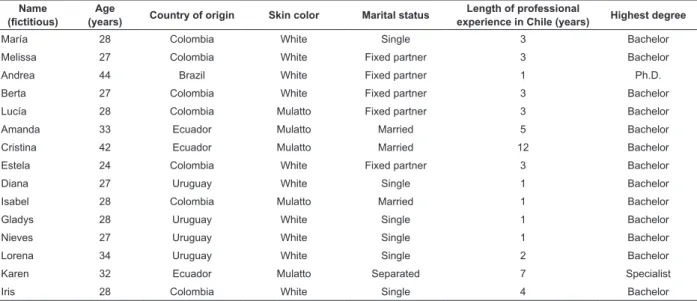
Table 1 – Sociodemographic and professional characteristics of the immigrant nurses in Chile, Santiago, Chile, 2010
Name (ictitious)
Age
(years) Country of origin Skin color Marital status experience in Chile (years)Length of professional Highest degree
María 28 Colombia White Single 3 Bachelor
Melissa 27 Colombia White Fixed partner 3 Bachelor
Andrea 44 Brazil White Fixed partner 1 Ph.D.
Berta 27 Colombia White Fixed partner 3 Bachelor
Lucía 28 Colombia Mulatto Fixed partner 3 Bachelor
Amanda 33 Ecuador Mulatto Married 5 Bachelor
Cristina 42 Ecuador Mulatto Married 12 Bachelor
Estela 24 Colombia White Fixed partner 3 Bachelor
Diana 27 Uruguay White Single 1 Bachelor
Isabel 28 Colombia Mulatto Married 1 Bachelor
Gladys 28 Uruguay White Single 1 Bachelor
Nieves 27 Uruguay White Single 1 Bachelor
Lorena 34 Uruguay White Single 2 Bachelor
Karen 32 Ecuador Mulatto Separated 7 Specialist
Iris 28 Colombia White Single 4 Bachelor
Results
The immigrant nurses were young and came from
Brazil (1), Colombia (7), Ecuador (3) and Uruguay (4).
Their skin color ranged between white and mulatto,
they lived with a ixed partner, most had worked in the country for less than ive years and only one held a
graduate degree.
In Table 1, the sociodemographic and professional
characteristics of the immigrant nurses are presented.
The six cultural domains from the Purnell Model
related to the experiences of the immigrant nurses
in Chile are: Overview/heritage, Communication,
Family roles and organization, Workforce issues,
Biocultural ecology, care practices and
Health-care providers(9), which were grouped in three cultural
themes: “In search of better horizons – the decision to
immigrate”, “Gaining trust and establishing a support
network – employability and professional performance”
and “Seeking people´s acceptance – professional
adaptation in a new cultural scenario”. The immigrant
nurses make great efforts to overcome the different
dificulties, observing that the people are different. For
them, this means making contact as persons in order to
be respected and respect the others.
The immigrant nurses’ approach of the patients
was fundamental for them to feel accepted. The
naturally adopt the “strategy” of seeking the patients’
support as this represents an additional advantage in
their adaptation process to an unknown culture.
The cultural themes
In search of better horizons – the decision to
immigrate to Chile
The existence of many nurses, low remuneration,
insuficient inancial resources to purchase the
goods needed to live and the lack of work for the
great demand of nurses prepared in their countries
of origin are the main reasons to look for a job in
Chile. Professional development aspirations were also
mentioned, in combination with better living conditions
and quality of life as factors to consider in the decision
to migrate. In addition, there are the scarce options
and great dificulties to get access to specialization and
professional development. These aspects act as catalysts
in the decision to seek better professional development
horizons.
Knowing the decision to emigrate and its reasons,
concepts of country, origin, residence, affections and
economic situation are related to Purnell’s concepts
in the domain Overview/heritage. In addition, the
nurses’ dificulties in the domain-Workforce issues were identiied in terms of autonomy and gender role.
Uruguay gave me education, but not work (Lorena.uy);
Colombia is saturated, you get money to survive (Berta.co); The
quality of life was not good (Estela.co); […] the remuneration is
better here and a lot of doors are opened (Maria.co); […] you
get better opportunities […] (Melissa.co).
In addition, their motivations to seek a new option
in life and professional establishment with a view to
gaining a better quality of life, which they did not have
in their countries of origin, correspond to the search for
Rev. Latino-Am. Enfermagem 2014 Mar.-Apr.;22(2):187-96.
Purnell’s domain Gender roles and family organization
is shown in their gender determination to emigrate and
their project as members of a family in order to improve
their lifestyle.
Gaining trust and establishing a support network – employability and professional performance
The nurses signaled many aspects that facilitate
their employability and immediate start in their
professional activities. The facilitators were the
homologation of their degrees as a result of the bilateral
recognition agreements between South American
countries, the shortage of professionals in Chile and
the familiarity with nurses from that country working
at the hospitals. In addition, the nurses’ change and
establishment process was characterized by help from
family members, friends, boyfriends or husbands.
These variables in the nurses’ employability
process, profession and affections it into Purnell’s
domain-Overview/heritage.
Our documentation was facilitated through an agreement
(María.co); […] I arrived and started to work (Melissa.co); I live
with friends, Uruguayans (Gladys.uy).
Upon arrival, the immigrant nurses immediately
start to work because of the need for these professionals
in Chile, which makes them feel very uncertain. The
nursing team at the two hospitals includes auxiliary
nurses, clinical nurses, head nurses and nurse
supervisors. The work shifts vary from service to service.
The foreign nurses are distributed across different
shifts and hospital sectors and are involved in direct
patient care.
In Chile, as from 1997, the nursing profession has
been recognized by law, with three main functions:
care management, execution of actions deriving from
the diagnosis and medical treatment. Ministry of Health
Decree 140, issued in 2004, establishes the Organic
Regulation of Health Services in article 51, determining
that “care management” comprises the actions aimed
at the promotion, maintenance and restoration of
health, the prevention of illnesses or injuries and the
execution of activities deriving from the diagnosis and
medical treatment and the duty to watch over the best
management of patient care resources(12).
In that sense, in their inclusion process, the
immigrant nurses feel privileged for being valued as
professionals, respected by their colleagues, patients and
society as Health-care providers (domain), differently
from their countries of origin, where demotivation was
the dominant feeling.
The similarities in terms of professional education,
particularly the technical aspects of care, facilitate
the development of their professional activities. The
educational level is also part of Purnell’s domain
Overview/heritage, which the immigrant nurses
experience as positive.
[…] it’s all very similar […] (Andrea.br); the care is similar
… (María.co); […] your experience is highly valued, you can
advance and get further training (Estela.co); […] the care is in
accordance with your experiences and skills […] (Karen.ec); your
opinions are respected […] (Nieves.uy); We are acknowledged
by society […] (Berta.co).
They suppose that your way of establishing personal
contact, in a closer and more loving manner, contributes
to the establishment of good relations. They feel that
they are respected and well received by the patients. In
the ield notes, various occasions were registered when
the nurses approached the patients gently and were
corresponded with respect and gratitude in the nursing
care process. The welcoming the patients demonstrate
in response to the immigrant nurses’ kindness helped
to achieve a good professional performance. All aspects
related to the principles of autonomy, acculturation,
assimilation, gender roles and health-care practices are
in accordance with Purnell’s domain Workforce issues,
and identiied through their gentle approach of the
patients.
The relation with the patients is good (Andrea.br); […] we
are loving and gentle to them […] (Berta.co); […] the patients
are grateful for the attention […] (Nieves.uy).
They naturally gain the patients’ trust, establishing
a support network in an unknown context.
Seeking people´s acceptance – professional adaptation in a new cultural scenario
The immigrant nurses had to overcome some
dificulties to get established in their new cultural
and professional space. Their professional adaptation
requires appropriate language in order to establish
effective communication and be able to work. They
look for the best way to do this with a view to getting
accepted at work and avoiding misunderstandings.
They ind it very important in this process to
understand and be understood, with a view to an
effective professional performance, achieved through
appropriate and speciic terms for the technical as well
as the administrative aspects of care.
The semantic differences, expressions, slang, or
changes in the meanings of the words and names of
when they start to work because they hamper the
communication with their local colleagues, patients and
other health team members.
Communication is a great problems for the
professionals and, without face-to-face contact, they
prepare as well as they can to gain their colleagues’
respect. In that sense, it was observed and registered
that the Brazilian nurse got “prepared”, thought about
how she should communicate before talking by phone
with her Chilean colleagues from other hospital services.
The dificulties they presented to express their
thoughts, ideas and feelings to local colleagues and other
health professionals it into Purnell’s cultural
domain-communication, concerning contextual language use
and its variations, such as non-verbal communication.
[…] they talk to you rapidly (Lucía.co); […] I did not
understand them at all […] (Nieves.uy); […] my words were
disrespectful (Diana.uy); […] the words and materials change
[…] (Berta.co); […] I am in doubt about the language to relate
with the nurses (Andrea.br).
The immigrant nurses feel that the local nurses lack
conidence in their professional education and they need
to demonstrate their professional capacity in order to
be accepted. The differences in some responsibilities,
the distant and class-related relationship among health
team members and the dependence on the physicians
are frustrating experiences that demand additional
efforts from the nurses with a view to their professional
self-adaptation, making great effort to adapt in a new
cultural context of work. This adaptation included
overcoming the dificulties characteristic of professional
practice and its cultural barriers(1).
The diversiication in the immigrant nurses’
functions is opposed to the care that is relegated to mere
practice, with the consequent loss of empowerment and
professional proile, while feeling that these practices go
against the expectations of the community receiving the
care. Being a “clinical nurse” hampers their activities and
makes them feel personally dissatisied because of the loss
of professional power they had in their country of origin.
They think that the form of care management negatively
inluences the patients and their family and, consequently,
the health services. These experiences exhaust their
self-esteem and make their professional and family relations
more dificult. They also mention different responsibilities
in some care activities and the existence of a relation of
dependence on the physicians or health-care practices
that differ from their countries of origin.
The characteristics as Health-care providers
(domain), their traditional practices, individual
responsibility related to health, health practices and
health and nursing care barriers are in accordance with
the cultural beliefs in Purnell’s domains.
Care goes beyond technical procedures. The
understanding of how this process is experienced serves
as the background to encourage relection and autonomy
in decision making(13).
They mistrust foreign nurses because of a lack of
knowledge (Berta.co); they see you with constraints, question
what you’ve learned […] responsibilities are delegated, there’s
classism because of distancing in the team (María.co); […] your
hands are tied, I feel frustrated […] (Lucía.co); It’s complicated
[…] (Lucía.co); […] the adaptation is difficult […] (Cristina.ec);
[…] when you just deliver care, care management gets sloppy
and you lose empowerment (Melissa.co).
The aspects that hamper the nurses’ professional
adaptation in Chile include experiences of rejection,
professional relations that are questioned and unfair
from colleagues, as well as vulnerability due to lack of
support, feeling of helplessness and loneliness; overload
and professional stress, discrimination and mistrust, all
of which are frustrating experiences to adapt to the new
job context. These experiences affect the relationship
among people in the professional context and further to
the family context.
Some nurses feel that the behaviors of rejection
and direct or hidden discrimination in the professional
context, such as the relationship between health team
members in Chile and the immigrant nurses, can be
related to the skin color or body height differences.
The domain-Biocultural ecology includes the ethnic and
racial variations that were perceived, such as skin color
and body height differences.
[…] you feel racism, comments that make you quit your
job, there’s rejection (María.co); […] it’s another culture, you
are exposed to suspicion and discrimination (Isabel.co); […]
they are reluctant to foreigners, I’m mulatto and look like a
Peruvian […] (Lucía.co).
Therefore, they resiliently remain silent so as not to
get involved beyond professional issues and avoid going
deeper into conlicts, in the attempt to feel accepted,
which means gaining the natives’ trust.
[…] you create defense, personality, live with it (Berta.co);
[…] I make sure to do my job and not get involved (Karen.ec).
The nurses signaled that, to get established in the
new cultural context, they had to overcome dificulties
like Workforce issues (domain) in their process of
autonomy, acculturation and assimilation, in the attempt
to get accepted by all health team members, which
Rev. Latino-Am. Enfermagem 2014 Mar.-Apr.;22(2):187-96.
Discussion
The nurses who immigrated to Chile manifest
that, in their countries of origin, the job opportunities
are scarce and badly paid with few possibilities for
professional development.
The cultural competence in the processes identiied
in the decision to emigrate, in the employability and
adaption of the nurses to the new culture is determined
by the domains Overview/heritage, Communication,
Workforce issues, Family roles and organization,
Biocultural ecology and Health-care providers(9). They
manifest that their employability and professional
performance are hampered by their need to adapt to the
new culture and new professional context at the same
time. The differences in the professional background,
responsibilities and conceptions of the care management
relationship lead to a loss of empowerment in nursing
and make the immigrant nurses feel uncertain in the
new cultural context.
Furthermore, we perceive that the main dificulty
is related to the cultural barriers, to communication,
marginalization, to the nurses’ need to demonstrate
their skills and to their relationship with colleagues(1-3),
besides the need to combine their different roles with
feelings of rootlessness and the demands characteristic
of a new lifestyle, which make them more vulnerable.
Also, some nurses felt mistrust and discrimination from
their colleagues, in accordance with research indings
from Australia, USA and Canada(1-3). The adaptation
includes overcoming the dificulties characteristic of the
professional practice and its cultural barriers(3,14).
The immigrant nurses in Chile start to work at the
hospitals in a phase unconsciously incompetent cultural
awareness according to the Purnell Model to deliver
care in the framework of the person, family, community
and global society of the new country. Arriving in a new
culture implies experiencing a constant tension due to
the continuous effort to adapt, the burden of getting
adjusted to the new society consciously and voluntarily.
“People seeking acceptance” was the central cultural
theme that emerged from the immigrant nursing who
live and work in Chile. According to them, this represents
a great challenge in their lives, which they cannot face
alone, as they need to conciliate their objectives with the
differences in the cultural environment of their personal
and professional development in the new country.
Cultural competence is the development of a
conscious and non-linear process, resulting from the
adaptation to the care and culture. Cultural awareness
departs from the unconsciously incompetent phase,
without the awareness that one lacks knowledge
about the new culture, until reaching the ideal phase
of unconscious competence, when one automatically
delivers care in accordance with the culture(9).
At the international level, in response to the
nurses’ demands, intervention programs are proposed
to improve the professionals’ competence(2,14-15). In
Ontario, there is a center to prepare and advise nurses
educated abroad(16). In addition, the countries need
to adapt their policies in order to improve the nurses’
job conditions, development bilateral programs to
administer the migrations(17-18).
Theoretical relection is needed about nursing
teaching, departing from the conceptualization of the
globalized world and the repercussions of its paradigms
on man and, consequently, on the nursing students’
learning, validating the relevance of using a
bio-psycho-social-economic model that values care for individuals in
different contexts(19), involving professionals from health
institutions in this cultural change.
This preparation should include institutional
analysis, the psychodynamics of work and the theory
of communicative action. These three areas are distinct
possibilities to consider both professional-user and
professional-professional interactions(20). Great effort
is needed to identify and deine the global health
competences, as these are just beginning(21).
Final considerations
In general, the immigrant nurses in Chile are
satisied with their achievements, related to their
professional life as well as their projects, expressing a
level of conformity with their lifestyles in the achievement
of their property targets.
The process of getting established as a nurse
in the new country is characterized by facilities and
dificulties. The main facilities involved the existence of
job opportunities, some similarities in the professional
education and support from patients. The dificulties
were related to cultural aspects in changing the meaning
of words and the use of slang that entail dificulties to
understand and be understood, as well as the complex
relationship with colleagues, lack of knowledge
about health policies and new responsibilities in care
management.
The professionals clearly need to get integrated
in an unknown cultural environment, with different
context, based on human conducts, communication and
interpersonal relations.
The immigrant nurses in Chile start to work at the
hospitals in a phase unconsciously incompetent cultural
awareness according to the Purnell Model to deliver
care in the framework of the person, family, community
and global society of the new country. Arriving in a new
culture implies experiencing a constant tension due to
the continuous effort to adapt, the burden of getting
adjusted to the new society consciously and voluntarily.
“Seeking people’s acceptance” was the central cultural
theme that emerged from the immigrant nursing who
live and work in Chile. According to them, this represents
a great challenge in their lives, which they cannot face
alone, as they need to conciliate their objectives with the
differences in the cultural environment of their personal
and professional development in the new country.
Further relection is needed, focusing on the
transition of immigrant nurses in Chile with a view to their
professional integration. The health institutions need to
make decisions that promote these educative aspects in
all professionals, with a view to giving competent, fast
and effective answers to their service needs.
This research validates the need to establish an
adaptation period for the nurses who arrive in a new
sociocultural and professional context. Its indings
provide directions for organizational policy strategies for
the sociocultural transition to the job world of nurses
who arrive in Chile from South American countries. We
believe that this study, based on the experiences of
nurses, within a cross-cultural perspective, contributes
to the knowledge about the post-modern paradigm and
about the needs of our professionals in order to promote
the quality of care at health services in the current
context of globalization.
Great efforts have been made globally to deine the
cultural competences of nursing students that need to
be incorporated into the curricula. In that sense, this
study intends to contribute to the knowledge about the
needs of health professionals, in this case nurses, in
the context of inter-country mobility. Moreover, these
research results provide evidence to international
entities, academic researchers, health professionals
and lecturers involved in continuing education at the
institutions.
The professionals need to be offered support
during the irst year of their study, through educative
programs and interventions aimed at achieving progress
in their cultural awareness and at improving their level
of competence.
References
1. Omeri A, Atkins K. Lived experiences of immigrant
nurses in New South Wales, Australia: searching for
meaning. Int J Nurs Studies. 2002;39:495-505.
2. Blythe J, Baumann A, Rhèaume A, McIntosh K.
Nurse migration to Canada: pathways and pitfalls of the
workforce. J Transcult Nurs. 2009;(20):202-10.
3. Hancock PK. Nurse migration: the impact on nursing
education. Int Nurs Rev. 2008;55:258-64.
4. Malvárez SM, Muñoz González LA, Reyes Vidal A, Mandiola
Muñoz E, Reyes Reyes C, Price Romero Y. Migración de
Enfermeras de América Latina. Área de América de Sur.
[Internet]. Washington (DC): Organización Panamericana
de la Salud; 2011. (OPS. Serie Desarrollo de Recursos
Humanos HSR, 60). [acesso 22 nov 2013]. Disponível
em: www.paho.org/hq./index.php?...
5. Boelen C. Social accountability and excellence. Educ Méd.
[Internet]. 2009 Dic [acesso 8 jul 2013]; 12(4):199-205.
Disponível em: http://scielo.isciii.es/scielo.php?script=sci_
arttext&pid=S1575-18132009000500001&lng=es. http://
dx.doi.org/10.4321/S1575-18132009000500001
6. Rocha ESB, Nagliate P, Furlan CEB, Rocha K Jr,
Trevizan MA, Mendes IAC. Knowledge management in
health: a systematic literature review. Rev. Latino-Am.
Enfermagem. 2012;20:392-400.
7. Trevizan MA, Mendes IAC, Mazzo A, Ventura CAA.
Investment in nursing human assets: education and
minds of the future. Rev. Latino-Am. Enfermagem.
2010;18:467-71.
8. Leininger M. Culture care. A major contribution to
advance transcultural nursing knowledge and practices.
J Transcult Nurs. 2002;13:189-92.
9. Purnell LD. The Purnell’s model for cultural
competence. J Transc Nurs. 2002; 13:193-6.
10. Parfitt BA. Using Spradley: an ethnosemantic
approach to research. J Adv Nurs. 1996;24:341-9.
11. Gaudlitz MH. Reflexiones sobre los principios
éticos en investigación biomédica en seres humanos.
Rev Chil Enf Respir. [Internet]. 2008 [acesso 14 fev
2012]; 24(2):138-42. Disponivel em: http://www.
scielo.cl/scielo.php?script=sci_arttext&pid=S0717-73482008000200008&lng=es. http://dx.doi.org/10.4067/
S0717-73482008000200008
12. Milos P, Borquez B, y Larrain AI. La “gestión del cuidado”
en la legislación chilena: interpretación y alcance. Cienc
Enferm. [Internet]. 2010 [acesso 18 fev 2013];16(1):17-29.
Disponivel em: http://www.scielo.cl/scielo.php?script=sci_
arttext&pid=S0717-95532010000100003&lng=es.
Rev. Latino-Am. Enfermagem 2014 Mar.-Apr.;22(2):187-96.
Received: Oct. 23rd 2012 Accepted: Jan. 21st 2014 13. Seima MD, Michel T, Méier MJ, Wall ML, Lenardt
MH. Scientific nursing production and Madeleine
Leininger’s theory: integrated review 1985-2011.
Esc Anna Nery. [Internet]. 2011 [acesso 3 ago
2012]; 15(4): 851-7. Disponível em: http://www.
scielo.br/scielo.php?script=sci_arttext&pid=S1414-81452011000400027&lng=en. http://dx
14. Konno R. Support for overseas qualified nurses in
adjusting to Australian nursing practice: a systematic
review. Int J Evid Based Healthc. 2006;(4):83-100.
15. McElmurry B, Solheim K, Kishi R, Coffia M, Woith
W, Janepanish P. Ethics concerns. Prof Nurs. 22:226–35.
16. Pittman P, Aiken LH, Buchan J. International
migration of nurses: introduction. Health Serv Res.
2007;42(3 Pt 2):1275-80.
17. Malvárez S, Castrillón MC. Panorama de la fuerza
de trabajo en enfermería en América Latina. Segunda
Parte. Rev Enferm IMSS. 2006;14:145-65.
18. Castrillón MC, Pensando en la formación de
profesionales de enfermería en América Latina. Invest
Educ Enferm. 2008;26(2 supl):114-21.
19. Scherer ZAP, Scherer EA. Reflections on nursing
education in postmodernity and the metaphor of a
theory-practice gap. Rev. Latino-Am. Enfermagem.
2007;15(3):498-501.
20. Carvalho BG, Peduzzi M, Mandú ENT, Ayres JRCM.
Work and inter-subjectivity: a theoretical reflection on
its dialectics in the field of health and nursing. Rev.
Latino-Am. Enfermagem. 2012:20(1):19-26.
21. Wilson LL. Preparing nurses for global healthcare.
[Editorial]. Rev. Latino-Am. Enfermagem. 2011;