Prognostic impact of the time of admission and
discharge from the intensive care unit
INTRODUCTION
Mortality in the intensive care unit (ICU) is closely linked to patients’ clinical characteristics and severity. However, there are other factors, such as the time or day of admission to and discharge from the ICU, that impact the prognosis of critical patients.(1,2)
Bell et al.(2) conducted a study in Canada that included the records of
millions of patients and found that the day and time at which ICU admission occurs has an impact on patients’ hospital survival. his timing is related to access to various technological resources for diagnosis.(2-5)
However, other studies did not ind diferences in hospital stay or mortality between patients admitted during the week and those admitted on the weekend, nor were they able to ind diferences according to the time of admission.(6,7)
Although the results remain controversial, the time of ICU admission has been extensively studied. Conversely, although the ICU discharge time may also have a special prognostic impact, this has been much less frequently evaluated
Héctor Eduardo Moreira1, Federico Verga1, Marcelo Barbato1, Gastón Burghi1
1. Intensive Therapy, Hospital Maciel - Montevideo, Uruguay.
Objective: To determine the impact of the day and time of admission and discharge from the intensive care unit on mortality.
Methods: Prospective observational study that included patients admitted to the intensive care unit of the Hospital
Maciel in Montevideo between April
and November 2014.
Results: We analyzed 325 patients with an average age of 55 (36 - 71) years and a SAPS II value of 43 (29 - 58) points. No diferences were found in the mortality of patients in the intensive care unit when time of admission (35% on the weekend versus 31% on weekdays, p = ns) or the hour of entry (35% at night versus 31% in the daytime, p = ns) were
Conflicts of interest: None.
Submitted on July 16, 2016 Accepted November 1, 2016
Corresponding author:
Héctor Eduardo Moreira Terapia Intensiva - Hospital Maciel 25 de Mayo 174 Montevideo 11000 Uruguay
E-mail: [email protected]
Responsible editor: Jorge Ibrain Figueira Salluh
Impacto pronóstico del momento de ingreso y egreso de la unidad
de cuidados intensivos
ABSTRACT
Keywords: Patient admission;
Patient discharge; Prognosis; Mortality; Intensive care units
compared. he time of discharge was associated with higher hospital mortality rates (57% for weekend discharges versus 14% for weekday discharges, p = 0.000). he factors independently associated with hospital mortality after discharge from the intensive care unit were age > 50 years (OR 2.4, 95%CI, 1.1 - 5.4) and weekend discharge (OR 7.7, 95%CI, 3.8-15.6).
Conclusion: his study identiied
the time of discharge from the intensive care unit as a factor that was independently associated with hospital mortality.
in the literature. he deterioration in the quality and quantity of care that occurs when a patient is discharged may play a role in hospital mortality, and the transfer of patients to an area with a reduced capacity for care, as may occur in the hospital room, is among the transitions that carries the greatest risk for patient care.(8) So-called
“of-hour” discharges - those that occur on weekends or at night (after 19:00 or 20:00) - are associated with adverse patient outcomes, including increased readmission to the ICU and increased mortality.(9-11) Laupland et al., in their
study that included 7,380 patients, showed that discharges to the ward at the beginning of the weekend (Friday in the afternoon) were associated with an increased risk of dying in the hospital.(12)
he prognostic impact of the time of admission to or discharge from the ICU has not been studied in our setting. Evaluating this fact and identifying the factors associated with a worse prognosis are critical to strengthening health care systems and generating patient safety strategies that improve patient outcomes.
METHODS
his report describes a prospective, non-interventional, observational cohort study. We analyzed a cohort of patients older than 18 years consecutively admitted between April 1 and November 1, 2014, to the multipurpose ICU of a tertiary public hospital with 250 beds.
his intensive care unit has 24 beds divided into 19 intensive care beds and 5 moderate care beds.
he work model followed in the ICU includes 4 intensive care physicians in charge of 6 patients 24 hours a day, every day of the week. hree additional staf doctors attend for 8 hours a day, participating in patient care in the mornings and attending clinical meetings in the afternoon. hese meetings involve the doctors and nurses of the service and focus on making decisions related to the care and discharge of the patients on the unit. In the ICU, there is a university nurse for every 6 patients and a nursing assistant for every 2 patients.
In the internment loor, the medical staf performs their activities from 8:00 to 14:00 from Monday to Friday. Outside of those hours, the care of patients on that loor shifts to 2 on-call doctors who confer for patient evaluations as required by the nursing staf. On the loor, each nurse is in charge of 8 patients, and each nursing assistant cares for 8 to 12 patients.
Patients are considered discharged from the unit upon their admission to the internment loor. Discharges are determined at the UCI clinical meeting that takes place in the afternoon; consequently, most discharges occur in the afternoon. As a consequence, the room staf has no contact with the patient until the following morning.
All patients younger than 18 years were excluded, as were those admitted to preoperative elective surgery whose stay was presumed to be less than 48 hours. hese patients were excluded due to their low severity scores and their relatively short stay in the ICU and in the hospital.(13)
Data were collected using a standardized questionnaire and a pre-designed checklist. he data collected from all patients included sociodemographic and hospitalization information at the time of admission (age, sex, source, type of admission, comorbidities, severity score -
Simpliied Acute Physiology Score II (SAPS II) - in the
irst 24 hours, time and day of admission to the ICU, diagnosis and treatments performed at admission); ICU discharge data (day of discharge, indication of limits for therapeutic efort, and status at discharge); and inally, hospital evolution.
he following operating variables were deined: weekdays were from Monday at 8 AM to Friday at 7:59 AM; weekends were from Friday at 8 AM until Monday at 7:59 AM.
Daytime admissions occurred between 8:00 AM and 7:59 PM. Night admissions occurred between 8 PM and 7:59 AM. Of-hours discharges occurred after 8:00 PM.
his study was approved by the Ethics Committee of the Hospital Maciel, and the included patients gave prior informed consent.
Statistical analysis
he analysis was performed using the statistical package IBM SPSS version 21. he data are expressed as percentage or as median (quartiles 25% - 75%) for continuous variables. Categorical variables were compared using the chi square test or Fisher’s exact test (with Yates correction when indicated). Continuous variables
were compared with the Student t test or the rank-sum
Mann-Whitney U test, according to the distribution of
RESULTS
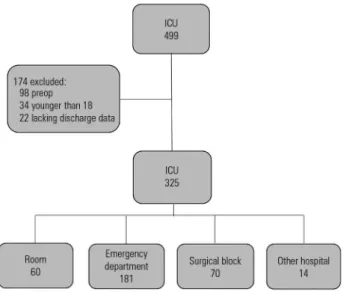
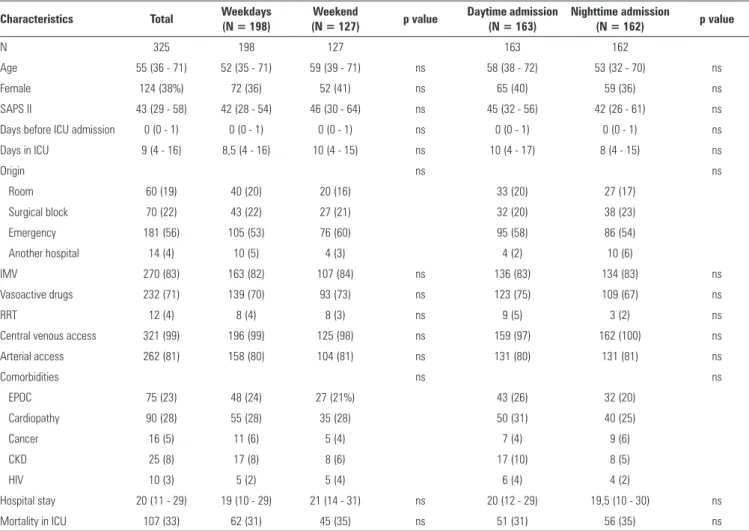
During the study period, 499 admissions to the ICU were recorded. A total of 174 patients were excluded (Figure 1). he 325 patients included in the study were predominantly male (61.8%), with a median age of 55 years (36 - 71) and a SAPS II value of 43 (29 - 58). he average ICU stay was 9 (4 - 16) days. he main comorbidities were heart disease (28%) and chronic obstructive disease (23%). he ICU admissions came mainly from the emergency department (ED; n = 181; 56%). Half of the admissions (163) occurred at night (8:00 PM - 07:59 AM), and 39% (127) occurred during the weekend (Friday 8:00 AM to Monday 7:59 AM). We identiied 23 (7%) patients who were readmitted to the ICU. he remaining characteristics are presented in table 1.
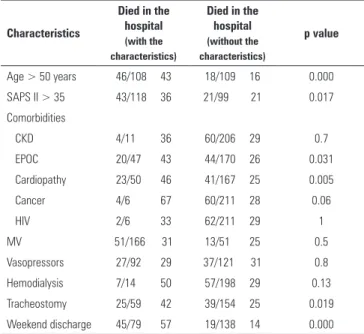
Among the patients discharged from the ICU, factors associated with hospital mortality in the univariate
analysis were SAPS II score > 35 (36% versus 21%; p =
0.017), weekend discharge (57% versus14%, p = 0.000),
the presence of chronic obstructive pulmonary disease
(43% versus 26%, p = 0.031), history of heart disease
(46% versus 25%, p = 0.005), and tracheostomy during
the ICU stay (42% versus 25%, p = 0.019) (Table 3).
Table 3 shows that the bivariable analysis found that age > 50 years was a factor associated with post-ICU mortality (43% versus 16%; p = 0.000).
Using multivariate logistic regression analysis, the factors associated with hospital mortality after discharge from the ICU were discharge during the weekend (odds ratio [OR] 7.7; 95% conidence interval - 95% CI 3.8 - 15.6; p = 0.000) and age > 50 years (OR 2.4, 95% CI 1.1 - 5.4, p = 0.02) (Table 4).
DISCUSSION
he prognostic impact of the time of admission to and discharge from the ICU has been evaluated in diferent studies. he factors that have most often been associated with an increase in mortality for of-hours discharges are diiculty accessing diagnostic or therapeutic procedures, greater severity of patients who arrive on weekends and at night, and a lack of 24-hours access to intensive care doctors.(1-4,14-16)
When we analyzed our population, we did not ind diferences in patient according to the day or time of admission. In this context, there were no diferences in patient mortality linked to the day or time of admission to the ICU. It should be noted that the analyzed hospital has intensive care doctors available in the ICU 24 hours per day every day of the year and similar access to diagnostic techniques at diferent times and days of the week. hese factors may explain the lack of an efect on mortality by the time of ICU admission at this hospital.
he time at which the patient is discharged had a special prognostic implication in our study. Discharges to the loor during the weekend and mainly on Fridays were associated with higher hospital mortality rates. Several European authors have found similar results linked to of-hours discharges.(1,7,9,11,17-21) An evaluation of the causes
associated with this lower survival is beyond the scope of this study, which was not designed for that purpose. Nevertheless, the increase in absenteeism on weekends combined with the treatment changes that result from transfer to the hospital room can explain this increase
Figure 1 - Structure for patient selection. ICU - intensive care unit.
here were no diferences in the population characteristics according to the day or time of admission. Mortality did not difer according to the day or time of
admission (31% weekday admission versus35% weekend
admission; p = ns; 31% daytime admission versus 35%
nighttime admission; p = ns) (Table 1).
Of the patients discharged from the ICU (218), 30% (64) died in the hospital after ICU discharge. he ICU discharges were distributed as follows: 139 patients (64%) left the ICU on weekdays, and 79 (36%) left during the weekend (Figure 2). Patients discharged on the weekend
had a signiicantly higher mortality (57% versus14%; p =
Table 1 - Characteristics of the population and comparisons based on the day and time of admission
Characteristics Total Weekdays (N = 198)
Weekend
(N = 127) p value
Daytime admission (N = 163)
Nighttime admission
(N = 162) p value
N 325 198 127 163 162
Age 55 (36 - 71) 52 (35 - 71) 59 (39 - 71) ns 58 (38 - 72) 53 (32 - 70) ns
Female 124 (38%) 72 (36) 52 (41) ns 65 (40) 59 (36) ns
SAPS II 43 (29 - 58) 42 (28 - 54) 46 (30 - 64) ns 45 (32 - 56) 42 (26 - 61) ns
Days before ICU admission 0 (0 - 1) 0 (0 - 1) 0 (0 - 1) ns 0 (0 - 1) 0 (0 - 1) ns
Days in ICU 9 (4 - 16) 8,5 (4 - 16) 10 (4 - 15) ns 10 (4 - 17) 8 (4 - 15) ns
Origin ns ns
Room 60 (19) 40 (20) 20 (16) 33 (20) 27 (17)
Surgical block 70 (22) 43 (22) 27 (21) 32 (20) 38 (23)
Emergency 181 (56) 105 (53) 76 (60) 95 (58) 86 (54)
Another hospital 14 (4) 10 (5) 4 (3) 4 (2) 10 (6)
IMV 270 (83) 163 (82) 107 (84) ns 136 (83) 134 (83) ns
Vasoactive drugs 232 (71) 139 (70) 93 (73) ns 123 (75) 109 (67) ns
RRT 12 (4) 8 (4) 8 (3) ns 9 (5) 3 (2) ns
Central venous access 321 (99) 196 (99) 125 (98) ns 159 (97) 162 (100) ns
Arterial access 262 (81) 158 (80) 104 (81) ns 131 (80) 131 (81) ns
Comorbidities ns ns
EPOC 75 (23) 48 (24) 27 (21%) 43 (26) 32 (20)
Cardiopathy 90 (28) 55 (28) 35 (28) 50 (31) 40 (25)
Cancer 16 (5) 11 (6) 5 (4) 7 (4) 9 (6)
CKD 25 (8) 17 (8) 8 (6) 17 (10) 8 (5)
HIV 10 (3) 5 (2) 5 (4) 6 (4) 4 (2)
Hospital stay 20 (11 - 29) 19 (10 - 29) 21 (14 - 31) ns 20 (12 - 29) 19,5 (10 - 30) ns
Mortality in ICU 107 (33) 62 (31) 45 (35) ns 51 (31) 56 (35) ns
ns - non-significant; SAPS II - Simplified Acute Physiology Score II; ICU - intensive care unit; IMV - invasive mechanical ventilation; RRT - renal replacement therapy; COPD - chronic obstructive pulmonary disease; CKD - chronic kidney disease; HIV - human immunodeficiency virus; LTE - limitation of therapeutic effort. The results are expressed as number and percentage or median (25% - 75%).
Table 2 - Characteristics and mortality of patients based on the day of discharge from the intensive care unit
Characteristics
Weekday discharge (N = 138)
Weekend discharge (N = 79)
p value
Female 43 (31) 29 (37) ns
SAPS II 37 (26 - 46) 36 (23 - 43) ns
Days in ICU 10 (6 - 18) 10 (5 - 22) ns
Origin ns
Room 22 (16) 15 (19)
Surgical block 33 (24) 20 (25)
Emergency 78 (56) 41 (52)
Another hospital 6 (4) 3 (4)
IMV 103 (75) 61 (79) ns
Vasoactive drugs 63 (46) 30 (39) ns
RRT 8 (6) 6 (8) ns
Central venous access 133 (97) 73 (95) ns
Arterial access 81 (58) 42 (55) ns
Comorbidities ns
EPOC 25 (18) 23 (29)
Cardiopathy 29 (21) 22 (28)
Cancer 2 (1,5) 4 (5)
CKD 7 (5) 4 (5)
HIV 5 (3,5) 1 (1,5)
Tracheostomy 33 (24) 27 (35) ns
Hospital stay 21(12 - 29,5) 16 (9,75 - 29) ns
LTE 7 (5) 5 (6) ns
Died in the hospital 19 (14) 45 (57) 0,000
ns - non-significant; SAPS II - Simplified Acute Physiology Score II; ICU - intensive care unit; IMV - invasive mechanical ventilation; RRT - renal replacement therapy; COPD - chronic obstructive pulmonary disease; CKD - chronic kidney disease; HIV - human immunodeficiency virus; LTE - limitation of therapeutic effort. The results are expressed as percentage or median (25% - 75%).
Table 3 - Bivariate analysis of factors associated with hospital mortality
Characteristics
Died in the hospital
(with the characteristics)
Died in the hospital
(without the characteristics)
p value
Age > 50 years 46/108 43 18/109 16 0.000 SAPS II > 35 43/118 36 21/99 21 0.017 Comorbidities
CKD 4/11 36 60/206 29 0.7
EPOC 20/47 43 44/170 26 0.031
Cardiopathy 23/50 46 41/167 25 0.005 Cancer 4/6 67 60/211 28 0.06
HIV 2/6 33 62/211 29 1
MV 51/166 31 13/51 25 0.5
Vasopressors 27/92 29 37/121 31 0.8 Hemodialysis 7/14 50 57/198 29 0.13 Tracheostomy 25/59 42 39/154 25 0.019 Weekend discharge 45/79 57 19/138 14 0.000
SAPS II - Simplified Acute Physiology Score II; CKD - chronic kidney disease; COPD - chronic obstructive pulmonary disease; HIV - human immunodeficiency virus; MV - mechanical ventilation. The results are expressed as specific value, total and percentage.
Table 4 - Multivariate analysis of factors associated with hospital mortality
OR 95%CI p value
Age > 50 years 2.4 1.1 - 5.4 0.02
SAPS II> 35 points 1.5 0.7 - 3.3 ns
EPOC 1.02 0.4 - 2.5 ns
Cardiopathy 1.6 0.7 - 3.9 ns
Neoplasia 3.3 0.4 - 23.9 ns
Tracheostomy 1.6 0.7 - 3.5 ns
Weekend ICU discharge 7.7 3.8 - 15.6 0.000
OR - odds ratio; CI - confidence interval; SAPS II - Simplified Acute Physiology Score II; COPD - chronic obstructive pulmonary disease; ICU - intensive care unit; ns - not significant.
in mortality.(22,23) When evaluating the mortality rate for
the 3 days of the weekend, we observed that the highest mortality occurred on Friday. Discharges on Sunday were associated with better prognoses. Like the results of the study that Laupland conducted in France, this inding raises the hypothesis that patients who are exposed to greater risk associated with reduced human resources or probable inconsistencies in care face a worse prognosis in the hospital.(12)
he fact that Fridays are associated with a worse prognosis can be explained by the greater amount of time patients admitted on Fridays are exposed to the weekend efect. It is likely that the high mortality of our patients on the hospital loor was the results of a clinical deterioration that went unnoticed during the transition of care on the weekend.
his problem will be challenging to resolve. Not allowing weekend discharges and prolonging patients’ stays does not seem a reasonable solution, nor is increasing the number of beds feasible in the short-term. However, promoting a culture of safety and integrating it into the hospital’s strategy can help resolve this conlict. In this scenario, strategies for improving the perception of risks, the safety of patients outside the ICU and the management of clinical deterioration may have a beneicial efect on mortality.(24-26) Early detection, follow-up at discharge,
active screening for at-risk patients, and the activation of resources when alarming signs and symptoms appear reduces the risk of inadvertent clinical deterioration.(27-29)
or ICU nursing liaison programs has proven to efectively reduce the weekend efect and increase patient safety.(30-33)
his study has limitations that must be considered when interpreting its results. It was conducted in a single center, so it only demonstrates the situation in that center over a speciic period, and its results cannot be generalized to other settings. Additionally, the deinitions of weekend and of-hour admission were arbitrarily established. Diferent studies have used diferent deinitions.(18) Finally,
our study focused on the ICU setting and evaluated data from patients’ stay in the unit; therefore, it lacks detailed data on the aftercare provided in the rooms. Consequently, we can only generate hypotheses regarding the increase in mortality during the weekends.
CONCLUSION
his study shows that factors in addition to those related to the severity of the critical patient are associated with patient prognosis. Both the structure and the process of care impact the inal outcome. In this sense, the time of discharge is independently associated with hospital mortality.
ACKNOWLEDGEMENTS
To Dr. Estrellita Echavarría for her ongoing support
and to members of the Statistics Department of Hospital
Maciel for their support.
Objetivo: Determinar el impacto en la mortalidad del día y horario de admisión y alta de la unidad de cuidados intensivos.
Métodos: Estudio prospectivo observacional, que incluyó pacientes admitidos entre abril y noviembre de 2014 en la uni-dad de cuiuni-dados intensivos del Hospital Maciel de Montevideo.
Resultados: Se analizaron 325 pacientes con una edad de 55 (36 - 71) años y un valor SAPS II de 43 (29 - 58) puntos. No se encontraron diferencias en la mortalidad en unidad de cuidados intensivos de los pacientes al comparar el momento de ingreso (35% el in de semana versus 31% en los días laborales, p = ns) ni el horario de ingreso (nocturnos 35% versus diurnos 31%,
p = ns). El momento de egreso se asoció a mayor mortalidad en el hospital (57% en egresos del in de semana versus 14% en días laborales, p = 0,000). Los factores independientemente asociados a mortalidad hospitalaria luego del alta de unidad de cuidados intensivos fueron la edad mayor de 50 años (OR 2,4; IC95%, 1,1 - 5,4) y el egreso durante el in de semana (OR 7,7; IC95%, 3,8 - 15,6).
Conclusión: Este estudio logró identiicar al momento del alta de la unidad de cuidados intensivos como un factor inde-pendientemente asociado a mortalidad hospitalaria.
RESUMEN
Descriptores: Admisión del paciente; Alta del paciente; Pronostico; Mortalidad; Unidades de cuidados intensivos
REFERENCES
1. Cram P, Hillis SL, Barnett M, Rosenthal GE. Effects of weekend admission and hospital teaching status on in-hospital mortality. Am J Med. 2004;117(3):151-7.
2. Bell CM, Redelmeier DA. Mortality among patients admitted to hospitals on weekends as compared with weekdays. N Engl J Med. 2001;345(9):663-8.
3. Cavallazzi R, Marik PE, Hirani A, Pachinburavan M, Vasu TS, Leiby BE. Association between time of admission to the ICU and mortality: a systematic review and metaanalysis. Chest. 2010;138(1):68-75. 4. Laupland KB, Shahpori R, Kirkpatrick AW, Stelfox HT. Hospital mortality
among adults admitted to and discharged from intensive care on weekends and evenings. J Crit Care. 2008;23(3):317-24.
5. Wallace DA, Angus DC, Barnato AE, Kramer AA, Kahn JM. Nighttime intensivist staffing and mortality among critically ill patients. N Engl J Med. 2012;366(22):2093-101.
6. Taira BR, Meng H, Goodman MS, Singer AJ. Does “off-hours” admission affect burn patient outcome? Burns. 2009;35(8):1092-6.
7. Morales IJ, Peters SG, Afessa B. Hospital mortality rate and length of stay in patients admitted at night to the intensive care unit. Crit Care Med. 2003;31(3):858-63.
8. Kripalani S, Jackson AT, Schnipper JL, Coleman EA. Promoting effective transitions of care at hospital discharge: a review of key issues for hospitalists. J Hosp Med. 2007;2(5):314-23.
9. Gantner D, Farley K, Bailey M, Huckson S, Hicks P, Pilcher D. Mortality related to after-hours discharge from intensive care in Australia and New Zealand, 2005-2012. Intensive Care Med. 2014;40(10):1528-35. 10. Goldfrad C, Rowan K. Consequences of discharges from intensive care at
night. Lancet. 2000;355(9210):1138-42.
11. Uusaro A, Kari A, Ruokonen E. The effects of ICU admission and discharge time on mortality in Finland. Intensive Care Med. 2003;29(12):2144-8. 12. Laupland KB, Misset B, Souweine B, Tabah A, Azoulay E, Goldgran-Toledano
D, et al. Mortality associated with timing of admission to and discharge from ICU: a retrospective cohort study. BMC Health Serv Res. 2011;11:321. 13. Abella A, Hermosa C, Enciso V, Torrejón I, Molina R, Díaz M, et al. Efecto del
14. Bell CM, Redelmeier DA. Waiting for urgent procedures on the weekend among emergently hospitalized patients. Am J Med. 2004;117(3):175-81. 15. Selker HP, Beshansky JR, Pauker SG, Kassirer JP. The epidemiology of
delays in a teaching hospital. The development and use of a tool that detects unnecessary hospital days. Med Care. 1989;27(2):112-29. 16. Kramer AA, Higgins TL, Zimmerman JE. The association between ICU
readmission rate and patient outcomes. Crit Care Med. 2013;41(1):24-33. 17. Obel N, Schierbeck J, Pedersen L, Storgaard M, Pedersen C, Sorensen
HT, et al. Mortality after discharge from the intensive care unit during the early weekend period: a population-based cohort study in Denmark. Acta Anaesthesiol Scand. 2007;51(9):1225-30.
18. Priestap FA, Martin CM. Impact of intensive care unit discharge time on patient outcome. Crit Care Med. 2006;34(12):2946-51.
19. Azevedo LC, de Souza IA, Zygun DA, Stelfox HT, Bagshaw SM. Association between nighttime discharge from the intensive care unit and hospital mortality: a multi-center retrospective cohort study. BMC Health Serv Res. 2015;15:378.
20. Araujo TG, Rieder MM, Kutchak FM, Franco Filho JW. Readmissões e óbitos após a alta da UTI - um desafio da terapia intensiva. Rev Bras Ter Intensiva. 2013;25(1):32-8.
21. Vollam SA, Dutton SJ, Young D, Watkinson PJ. Out-of-hours discharge from intensive care, in-hospital mortality and intensive care readmission rates: a systematic review protocol. Syst Rev. 2015;4:93.
22. Bell CM, Redelmeier DA. Waiting for urgent procedures on the weekend among emergently hospitalized patients. Am J Med. 2004;117(3):175-81. 23. Schilling PL, Campbell DA Jr, Englesbe MJ, Davis MM. A comparison of
in-hospital mortality risk conferred by high hospital occupancy, differences in nurse staffing levels, weekend admission, and seasonal influenza. Med Care. 2010;48(3):224-32.
24. Abella Álvarez A, Torrejón Perez I, Enciso Calderón V, Hermosa Gelbard C, Sicilia Urbán JJ, Ruiz Grispan M, et al. Proyecto UCI sin paredes. Efecto de la detección precoz de los pacientes de riesgo. Med Intensiva. 2013;37(1):12-8.
25. Nates JL, Nunnally M, Kleinpell R, Blosser S, Goldner J, Birriel B, et al. ICU admission, discharge, and triage guidelines: a framework to enhance clinical operations, development of institutional policies, and further research. Crit Care Med. 2016;44(8):1553-602.
26. van Sluisveld N, Hesselink G, van der Hoeven JG, Westert G, Wollersheim H, Zegers M. Improving clinical handover between intensive care unit and general ward professionals at intensive care unit discharge. Intensive Care Med. 2015;41(4):589-604.
27. Laupland KB, Ball CG, Kirkpatrick AW. Hospital mortality among major trauma victims admitted on weekends and evenings: a cohort study. J Trauma Manag Outcomes. 2009;3:8.
28. Abizanda Campos R. Atención especializada al paciente crítico. Una contribución a la perspectiva sobre la especialidad en medicina intensiva. Med Intensiva. 2003;27(8):541-3.
29. Albright KC, Raman R, Ernstrom K, Hallevi H, Martin-Schild S, Meyer BC, et al. Can comprehensive stroke centers erase the “weekend effect”? Cerebrovasc Dis. 2009;27(2):107-13.
30. Niven DJ, Bastos JF, Stelfox HT. Critical care transition programs and the risk of readmission or death after discharge from an ICU: a systematic review and meta-analysis. Crit Care Med. 2014;42(1):179-87.
31. Stelfox HT, Bastos J, Niven DJ, Bagshaw SM, Turin TC, Gao S. Critical care transition programs and the risk of readmission or death after discharge from ICU. Intensive Care Med. 2016;42(3):401-10.
32. Rosa RG, Maccari JG, Cremonese RV, Tonietto TF, Cremonese RV, Teixeira C. The impact of critical care transition programs on outcomes after intensive care unit (ICU) discharge: can we get there from here? J Thorac Dis. 2016;8:(7)1374-6.