Nursing staff in the internal medicine and surgical
units of teaching hospitals: composition and cost
Fernanda Maria Togeiro Fugulin1, Antônio Fernandes Costa Lima1, Valéria Castilho1, Caroline Pereira Guimarães2, Ariane Carvalho3, Raquel Rapone Gaidzinski4
Quadro de profissionais de enfermagem em unidades médico-cirúrgicas de hospitais de ensino: composição e custos
Cuadro de los profesionales de enfermería en las unidades médico-quirúrgicas de los hospitales de enseñanza: composición y costos
1 Associate Professor, Department of Professional Guidance, School of Nursing, University of São Paulo, São Paulo, SP, Brazil.
2 Master’s Student in Sciences, School of Nursing, University of São Paulo, São Paulo, Brazil. 3 Nurse, School of Nursing, University of São Paulo, São Paulo, Brazil.
4 Full Professor, Department of Professional Guidance, School of Nursing, University of São Paulo, São Paulo, SP, Brazil.
Received: 11/30/2014 Approved: 03/05/2015
ORIGINAL ARTICLE DOI: 10.1590/S0080-623420150000800007
ABSTRACT
Objective: Evaluate the mean quantitative and qualitative nursing staf working in the internal medicine and surgical units of three public general teaching hospitals in the city of São Paulo, compared to projected mean staf according to the parameters of Cofen Resolution No. 293/04, as well as measure the mean cost of current and projected nursing staf. Method: Quantitative, descriptive, exploratory study using prospective data collection. Results:In most of the units studied, the number of nursing professionals was adequate. In two of the institutions, the percentage of nurses was lower than that recommended by Cofen. Qualitative and quantitative adjustment of the staf would represent a monthly cost increase of R$141,326 for Hospital A, R$138,989 for Hospital B, and a reduction of R$99,028 for Hospital C. Conclusion: he main contribution of this study was the proposed method for qualitative and quantitative evaluation of nursing staf, in addition to determining the average cost for adjustments.
DESCRIPTORS
Nursing; Hospital nursing staf; Workload; Cost and Cost Analysis.
Correspondence Addressed to:
Fernanda Maria Togeiro Fugulin Av. Dr. Enéas de Carvalho Aguiar, 419 - Cerqueira César
CEP 05403-000 São Paulo, SP, Brazil [email protected]
Nursing staff in the internal medicine and surgical units of teaching hospitals: composition and cost
INTRODUCTION
In recent decades, the social, political and economic landscape has prompted the pursuit of management strat-egies capable of reconciling budget constraints with im-provement of products and services ofered to populations. Health institutions also face the challenge of eicient use of resources while also improving the service provided to their users.
In Brazil, these institutions are experiencing major hardships due to lack of investment in infrastructure and the workforce, combined with the increasing health needs of the population. Problems related to management and training of human resources are considered one of the main factors in deterioration of health care services(1).
he primary measures adopted by managers in this sector in their eforts to tackle rising costs often result in quantitative and qualitative limitations in nursing staf, creating work overloads that hinder the organization and execution of care processes and stand in the way of pro-moting measures to enhance quality of care and the safety of users and care providers(2). he institutions often fail to
meet the minimum nursing staf parameters recommend-ed in Resolution No. 293/04 of the Frecommend-ederal Council of Nursing (COFEN)(3).
Knowledge needs to be generated to assist in the de-cision-making process involving nursing staf adjustments and the costs they would entail, thereby helping to guide human resources policies and transform management pro-cesses in health institutions.
From this perspective, this study sought to evaluate the mean quantitative and qualitative nursing staf working in the internal medicine and surgical units of three public general teaching hospitals in the city of São Paulo, com-pared to the projected mean staf parameters recommend-ed in COFEN Resolution No. 293/04, as well as measure the average cost of the nursing staf, both current and pro-jected, as per this Resolution.
METHOD
A quantitative, descriptive, exploratory study, utilizing prospective data collection, conducted in the internal med-icine and surgical units of three public general teaching hospitals, referred to as Hospital A, Hospital B and Hospi-tal C, in the city of São Paulo. his study was approved by the Research Ethics Committees of the School of Nursing of University of São Paulo (Process No. 1110/2011). Two units were analyzed in Hospital A, three in Hospital B and ive in Hospital C.
Data were collected between August 2012 and July 2013. he study population consisted of nursing professionals (nurses and nursing technicians/aides) and patients hospi-talized in the selected internal medicine and surgical units.
CALCULATIONOFTHEQUANTITATIVEANDQUALITATIVE DAILYMEANSFORPROFESSIONALSINTHEUNITS
he daily mean of nurses and nursing technicians and aides working in the units during each month of the period
from August 2012 to July 2013 was calculated through the following equation:
Where:
Qk=∑d=1Qk(d) d n
Qk = daily mean number of professionals from category
k working in the unit;
∑dnQk(d) = sum of the daily number of professionals from category k working in the units on d = 1, 2, 3....n days of the sample, obtained through the monthly work shift records;
k = professional category being analyzed (nurse, nurs-ing technician or aide).
PROJECTIONOFTHEQUANTITATIVEANDQUALITATIVEDAILY MEANOFPROFESSIONALSNEEDEDFORTHEUNITS
he following calculations were employed:
Identiication of the daily mean number of patients ac-cording to the degree of nursing dependency: he researchers, in partnership with the nursing team providing the care, classiied the patients according to the degree of nursing dependency, using the patient classiication system (PCS) designed by Fugulin(4).
he mean number of patients according to type of care was calculated using the equation:
Where:
nj=TO ×Lj
100
nj = daily mean number of patients according to type of care j (minimum, intermediate, high dependency, semi-intensive and intensive);
TO = mean monthly occupancy rate in the units, from August 2012 to May 2013;
Lj = number of beds, according to type of care j (minimum, intermediate, high dependency, semi-intensive and intensive).
he calculation of the mean recommended daily work-load of nursing professionals, according to COFEN Res-olution No. 293/0411, was obtained through the equation:
Where:
Cj=nj×hj
Cj = mean daily workload according to type of care j
(minimum, intermediate, high dependency, semi-intensive and intensive);
nj = mean daily number of patients according to type of care j (minimum, intermediate, high dependency, semi-in-tensive and insemi-in-tensive);
hj = mean recommended daily hours of care accord-ing to COFEN Resolution No. 293/04(3) (minimum, 3.8
hours; intermediate, 5.6 hours; high dependency and semi-intensive, 9.4 hours; intensive, 17.9 hours).
The calculation of the mean number of profession-als according to category was obtained by applying the following equations:
Where:
Q = mean daily number of nursing professionals required; ∑jn=1Cj = sum of the daily mean workloads according to
n types of care(minimum, intermediate, high-dependency, semi-intensive and intensive);
t = daily working hours.
he number of nurses was calculated using the propor-tion recommended in COFEN Resolupropor-tion No. 293/04(3)
for this professional category. Where:
Qenf=Q×Penf
Qtéc/aux=Q×(1-Penf)
Qenf = mean daily number of nurses;
Q = mean daily number of nursing technicians/aides;
Penf = mean proportion of nurses (minimum and inter-mediate care, 33%, high-dependency and semi-intensive care, 42%, and intensive care 52%);
Qtéc/aux = mean proportion of nursing technicians and aides (minimum and intermediate care, 66%, high-dependency and semi-intensive care, 58%, and inten-sive care 48%).
hese calculations enabled comparison of mean num-ber of current nurses and nursing technicians/ aides with the projected number for the internal medicine and surgi-cal units according to oicial parameters.
Data on nursing staf costs came from the person-nel departments of the hospitals, which sent spread-sheets with the mean payroll costs for nurses and nursing technicians/aides during the study period.
he spreadsheets contained records on the number of professionals, base wages, social security payments, bonuses and beneits, by functional category.
Annual wages were calculated by totaling wages, charges, beneits and bonuses; that was total was divided by the num-ber of professionals, by category, to obtain monthly wages.
To determine the monthly mean hourly costs per category, the monthly mean wage was divided by the number of hours worked, according to the contracts for each hospital.
he variance in the number of projected profession-als (NPP), according to the categories, in relation to the number of current professionals (NCP), as well as the variance in the monthly wage costs for the projected team (MWC-PT) in relation to the monthly wage costs for the current team (MWC-CT) was calculated as follows(5):
Variance=(NPP/NCP-1)×100=%
Variance=(MWC-PT/MWC-CT-1)×100=%
DATAANALYSIS
he data was entered in electronic spreadsheets and presented in igures and charts, using measures of central tendency.
he test of signiicance between means and the Chi-square test were used, at a signiicance level of 5% to compare current staf with projected staf.
Personnel costs were analyzed by descriptive statis-tics, using the monthly wage mean by professional cat-egory in Hospitals A, B and C. he amounts are shown in Brazilian reals.
RESULTS
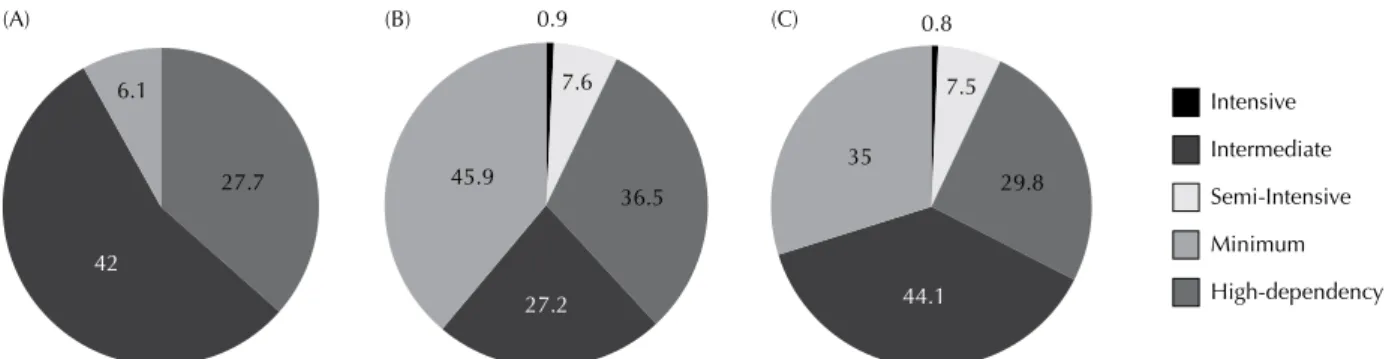
During the period studied, patients in the internal medicine and surgical units of the three teaching hospitals were classiied by the researchers according to the PCS of Fugulin, Gaidzinski e Kurcgant(4). he mean daily number
of patients was: 76 in Hospital A, 118 in B, and 117 in Hospital C. he mean daily distribution of patients ac-cording to the classiication is shown in Figure 1.
Figure 1 - Mean daily number of patients according to the patient classification system from August 2012 to July 2013 - São Paulo, 2014.
Intensive
Intermediate
Semi-Intensive
Minimum
High-dependency 27.7
42
6.1
(A) (B) 0.9 (C)
7.6
36.5
27.2
45.9
0.8
7.5
29.8
44.1
35
Figure 1 shows that in Hospital A there was a pre-dominance of patients classiied as needing intermediate and high-dependency care, with no semi-intensive or in-tensive care patients. In Hospital B, the largest number of patients was in the minimum care category, followed by high-dependency and intermediate care. In Hospital C, the intermediate care category had the largest number of patients, followed by minimum and high-dependency care. Hospitals B and C allocated, on average, one intensive care
patient and seven semi-intensive care patients per day in the units studied.
Figure 2 shows mean current daily nursing staf and projected staf for the same units, in accordance with Cofen Resolution n. 294/04(3).
Nursing staff in the internal medicine and surgical units of teaching hospitals: composition and cost
In Hospital B, there was a signiicant diference in only one unit between projected teams and current teams using the Cofen method, demonstrating a shortage in the current nursing staf. In the other two units this diference was not signiicant, indicating an adequate number of professionals.
In Hospital C, there was a signiicant diference in only two of the ive units studied between projected teams and current teams using the Cofen method, demonstrating that in these units the current numbers of professionals exceed-ed the projectexceed-ed numbers. In the other units, where the diference between projected and current staf was not sig-niicant, the number of professionals was adequate.
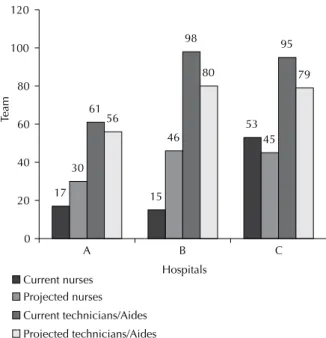
Figure 3 presents the mean daily distribution of pro-fessionals, according to category, currently working in the units of the hospitals studied and the projected percentages established by Cofen, taking into account workload and predominant type of care.
In the two units studied in Hospital A, there was a sig-niicant diference between the projected number of nurses and the current number of nursing, using the Cofen meth-od, indicating that the number of nurses was lower than the proportion recommended by Cofen.
In all the units from Hospital B, there was a signiicant diference between the number of projected number of nurses and the current number of nurses, using the Cofen method,, indicating that the number of nurses was lower than the proportion recommended by Cofen.
In Hospital C, there was a signiicant diference in two units between the projected number nurses and the current number of nurses, using the Cofen method, indicating the number of nurses exceeded the proportion recommend-ed by Cofen. he other units had an adequate number of nursing professionals.
NURSINGSTAFFCOSTSIN HOSPITALS A, B AND C
As shown in Chart 1, the mean total monthly wage costs for current nursing staf was R$755,408 in Hospital A, R$476,506 in Hospital B and R$ 621,791 in Hospital C.
It can be seen that the mean annual hourly cost of the nurse category in Hospital A was 3.24 times that of Hospital C and 1.75 times that of Hospital B. he mean annual hour-ly cost of the nurse category in Hospital B was 1.85 times that of Hospital C. In relation to the nursing technician/aide category, the mean annual hourly cost in Hospital A was 3.83 times that of Hospital C and 1.83 times that of Hospi-tal B. he mean annual hourly cost of this category in Hos-pital B was 2.09 times that of HosHos-pital C.
Monthly working hours (203.36 hours) were higher in Hospital C, followed by Hospitals A and B. Month-ly working hours in Hospital C were 1.41 times that of Hospital A and 1.7 times that of Hospital B. he working hours of Hospital A were 1.2 times that of Hospital B.
he mean hourly and monthly cost for the minimum projected number of nursing professionals according to Cofen Resolution No. 293/04(3) by professional category
and daily working hours are presented in Chart 2, where it can be noted that the mean monthly cost of the projected team would be R$896,734.08 in Hospital A, R$615,494.40 in Hospital B and R$522,762.78 in Hospital C.
In charts 1 and 2, it can be seen that the qualitative and quantitative adjustment of nursing staf, according to the minimum parameters in Cofen Resolution No. 293/04, would represent a monthly increase of R$141,325.92 for Hospital A, by adding 13 nurses and eliminating 5 nursing technicians/aides; an increase of R$138,988.80 for Hos-pital B by adding 31 nurses and eliminating 18 nursing technicians/aides; and a R$99,028 reduction for Hospital C by eliminating 8 nurses and 16 nursing technicians/aides.
DISCUSSION
In most of the units studied, the nursing staf was quan-titatively suicient, according to Cofen parameters. Only one unit in Hospital B had a lower number of professionals than the projected number according to Cofen parameters.
Figure 2 - Mean daily current and projected nursing staff, in the inter-nal medicine and surgical units of the three teaching hospitals, from August 2012 to July 2013 - São Paulo, 2014.
78 113 148 86 126 124 0 20 40 60 80 100 120 140 160
A B C
Hospitals
Team
Current Projected
Figure 3 - Mean daily current and projected nursing staff by profes-sional category from August 2012 to July 2013 - São Paulo, 2014.
17 15 53 30 46 45 61 98 95 56 80 79 0 20 40 60 80 100 120
A B C
In two units of Hospital C, the number of professionals exceeded the projected number according to Cofen, which represents the minimum parameter for determining the size of nursing teams.
However, with respect to the percentage distribution of nursing professionals, it was noted that, except for the units from Hospital C, the number of nurses in the units of Hospitals A and B were lower than that recommended by Cofen. he variance in the number of nurses indicated the need for 76.4% more nurses in Hospital A and 206.6% more in Hospital B. In Hospital C, this variance corre-sponded to a reduction of 15.1% in nurses.
his inding corroborates the results of another study(6)
that showed that the proportion of nurses in most Bra-zilian health institutions was lower than the distribution recommended by Cofen, which represents a standard to be achieved by hospital institutions in Brazil.
Nursing staf adjustments, mainly in terms of ad-justing the proportion of nurses in relation to nursing technicians/aides, represented an 18.7% increase in
per-sonnel costs in Hospital A and 29.1% in Hospital B, and a 15.9% reduction in Hospital C.
he composition of the nursing staf, contractual work-ing hours, and wages were variables examined in order to reconcile costs and human resources in the internal medi-cine and surgical units of Hospitals A, B and C. However, other variables could have an inluence on cost estimates, such as number of beds, care complexity and available technological resources. Knowledge of these variables, combined with costs, could assist in the decision-making process regarding adjustments in current staf in light of care needs and legal requirements.
From this perspective, nurses need to determine quan-titatively and qualitatively determine the number of pro-fessionals needed to achieve the desired standards of care, and analyze the inancial impact of these resources on the outcome of care activities carried out by nursing teams, considering that although economic aspects are important, they should not override technical, human, ethical and so-cial aspects when making decisions(7).
Chart 1 - Distribution of the mean of current number nursing professionals and the mean of annual hourly costs and monthly wage costs, according to professional category and daily working hours - São Paulo, 2014.
Current professional
category - Hospital A Quantity
Mean annual hourly cost
Mean total monthly wage cost
(144 hours) Total
Nurse 17 R$98.06 R$14,120.64 R$240,050.88
Nursing Technician/Aide 61 R$58.67 R$8,448.48 R$15,357.28
Total current team 78 - - R$755,408.16
Current professional
category - Hospital B Quantity
Mean annual hourly cost
Mean total monthly wage cost
(120 hours) Total
Nurse 15 R$55.92 R$6,710.40 R$100,656.00
Nursing Technician/Aide 98 R$31.96 R$3,835.20 R$375,849.60
Total current team 113 - - R$ 476,505.60
Current professional
category - Hospital C Quantity Mean annual hourly cost Mean total monthly wage cost (203.36 hours) Total
Nurse 53 R$30.23 R$6,147.57 R$325,821.21
Nursing Technician/Aide 95 R$15.32 R$3,115.47 R$295,969.65
Total current team 148 - - R$621,790.86
Chart 2 - Distribution of the minimum projected number of nursing professionals and mean hourly and monthly cost, according to professio-nal category and daily working hours - São Paulo, 2014.
Projected professional
category - Hospital A Quantity
Variance in number of professionals
Mean annual hourly cost
Mean total monthly wage
cost (144 hours) Total Wage variance
Nurse 30 + 76.4% R$98.06 R$14,120.64 R$423,619.20 -Nursing Technician/Aide 56 - 8.2 R$58.67 R$8,448.48 R$473,114.88
-Projected total team 86 + 68.2% - - R$896,734.08 +18.7%
Projected professional
category - Hospital B Quantity
Variance in number of professionals
Mean annual hourly cost
Mean total monthly wage
cost (120 hours) Total Wage variance
Nurse 46 + 206.6% R$55.92 R$6,710.40 R$308,678.40
-Nursing Technician/Aide 80 +/- 18.3% R$31.96 R$,835.20 R$306,816.00
-Projected total team 126 + 188.3% - - R$615,494.40 + 29.1%
Projected professional
category - Hospital C Quantity
Variance in number of professionals
Mean annual hourly cost
Mean total monthly wage
cost (203.36 hours) Total Wage variance
Nurse 45 +/- 15.1% R$30.23 R$6,147.57 R$276,640.65
-Nursing Technician/Aide 79 +/- 16.8% R$15.32 R$3,115.47 R$246,122.13
Nursing staff in the internal medicine and surgical units of teaching hospitals: composition and cost
A recent study(8) conducted in nine European
coun-tries to provide information about nursing profession-als in hospitprofession-als found that measures to curb spending that focus quantitatively and qualitatively on nursing professionals can expose users to risk and adversely af-fect patient care outcomes, suggesting that a greater number of nurses providing care could reduce prevent-able hospital deaths.
herefore, nurses also need to seek knowledge, skills and competencies that support negotiations in reference to the nursing staf, demonstrating that while adjusting the number of professionals may result in higher operat-ing costs, it can help reduce expenses arisoperat-ing from negative care outcomes that are due to quantitative and/or qualita-tive insuiciency in professionals(7).
CONCLUSION
The contribution of this study is its proposed method for qualitatively and quantitatively evaluating nursing staffs, as well as determining the mean cost for staff adjustments.
he results merit careful analysis and interpretation so that decisions can be made that will promote eicient supply and distribution of nursing professionals, in quan-titative and qualitative terms, to meet desired quality and safety standards.
The use of this method in other situations and cor-relation of the results with care and management qual-ity indicators could help to scientifically demonstrate the impact of nursing staffs on patient outcomes and health institutions.
RESUMO
Objetivo: Avaliar o quadro quanti-qualitativo médio de proissionais de enfermagem em serviço nas unidades médico-cirúrgicas de três hospitais gerais, públicos e de ensino, do município de São Paulo frente ao quadro médio projetado, segundo parâmetros da Resolução Cofen nº 293/04 e mensurar o custo médio dos quadros em serviço e projetado. Método: Estudo quantitativo, exploratório descritivo, com coleta prospectiva de dados. Resultados:Na maioria das unidades estudadas o quadro de proissionais de enfermagem está quantitativamente adequado. Em duas Instituições a proporção de enfermeiras é inferior ao preconizado pelo Cofen. O ajuste quali-quantitativo do quadro representaria acréscimo mensal de R$ 141.325,92 para o Hospital A; R$ 138.988,80 para o Hospital B e redução de R$ 99.028,00 para o Hospital C.Conclusão: A principal contribuição deste estudo reside na proposição de um método para avaliação quali-quantitativa do quadro de proissionais de enfermagem, bem como para determinação do custo médio de sua adequação.
DESCRITORES
Enfermagem; Recursos Humanos de Enfermagem no Hospital; Carga de Trabalho; Custos e Análise de Custo.
RESUMEN
Objetivo: Evaluar el promedio del cuadro cuantitativo y cualitativo de los profesionales de enfermería que prestan servicio en las unidades médico-quirúrgicas de tres hospitales generales, públicos y de enseñanza, del municipio de São Paulo, frente al cuadro medio proyectado según los parámetros de la Resolución Cofen n° 293/04 y mensurar el promedio de costo de los cuadros en servicio y proyectado Método: estudio cuantitativo, descriptivo, exploratorio, con recolección prospectiva de datos. Resultados: en la mayoría de las unidades estudiadas el cuadro de los profesionales de enfermería está cuantitativamente adecuado. En dos instituciones, la proporción de enfermeras es inferior a la recomendada por el Cofen. El ajuste cualitativo y cuantitativo del cuadro representa un incremento mensual de R$ 141,325.92 para el Hospital A; R$ 138,988.80 al hospital B y la reducción de R$ 99,028.00 al hospital C. Conclusión: la principal contribución de este estudio está en proponer un método de evaluación cualitativa y cuantitativa de los profesionales de enfermería, así como para determinar el promedio de costo de su adecuación.
DESCRIPTORES
Enfermería; Personal de Enfermería en Hospital; Carga de Trabajo; Costos y Análisis de Costos.
REFERENCES
1. Brasil. Ministério da Saúde; Secretaria de Gestão do Trabalho e da Educação na Saúde, Departamento de Gestão e da Regulação do Trabalho em Saúde. Gestão do trabalho e da regulação profissional em saúde: agenda positiva. 3ª ed. Brasília: MS; 2009.
2. Garcia EA, Fugulin FMT. Nurses’ work time distribution at the emergency service. Rev Esc Enferm USP [Internet]. 2010 [cited 2014 Oct 24];44(4): 1032-8. Available from: http://www.scielo.br/pdf/reeusp/v44n4/en_25.pdf
3. Conselho Federal de Enfermagem. Resolução 293/2004. Fixa e estabelece parâmetros para o Dimensionamento do Quadro de Profissionais de Enfermagem nas Unidades Assistenciais das Instituições de Saúde e Assemelhados [Internet]. Brasília: COFEN; 2004 [cited 2014 Jan. 14]. Available from: http://www.cofen.gov.br/resoluo-cofen-2932004_4329.html
4. Fugulin FMT, Gaidzinski RR, Kurcgant P. Sistema de classificação de pacientes: identificação do perfil assistencial dos pacientes unidades de internação do HU-USP. Rev Latino Am Enfermagem [Internet]. 2005[cited 2014 Oct. 24, 2015];13(1):72-8. Available from: http://www.scielo.br/pdf/rlae/v13n1/v13n1a12.pdf
5. Castilho V, Fugulin FMT, Gaidzinski RR. Gerenciamento de custos nos serviços de enfermagem. In: Kurcgant P, coordenadora. Gerenciamento em enfermagem. 2ª ed. Rio de Janeiro: Guanabara Koogan; 2010. p. 121-35.
7. Fugulin FMT, Lima AFC, Castilho V, Bochembuzio L, Costa JA, Castro L. Cost of nursing staffing adequacy in a neonatal unit. Rev Esc Enferm USP [Internet]. 2011 [cited 2014 Oct 23];45(n.spe): 1582-8. Available from: http://www.scielo.br/pdf/reeusp/v45nspe/en_ v45nspea07.pdf