Intra-familial physical violence among
M exican and Egyptian youth
Violência física intra-familiar entre jovens
mexicanos e egípcios
Leonor Rivera-Riveraa, Betania Allena, James F Thrasherb, Ruben Chaveza, Cielo Fernandez-O rtegac, O sman Galalc and Eduardo C Lazcano-Ponced
aDirección de Salud Reproductiva. Centro de Investigaciones en Salud Poblacional. Instituto Nacional
de Salud Pública. Cuernavaca, Morleos, México. bDepartment of Health Behavior. School of Public
Health. University of North Carolina. Chapel Hill, USA. cDepartment of Community Health Sciences.
University of California Los Angeles. Los Angeles, California, USA. dCentro de Investigaciones en
Salud Poblacional. Instituto Nacional de Salud Pública. Cuernavaca, Morelos, México
Funding sources: Consejo Nacional de Ciencia y Tecnología de México (Grant n. 37207-M); Bristol Myers-Squibb Foundation as part of the “ Better Health for Women” Program; Instituto Nacional de Salud Pública; United Nations Fund for Population Activities-Egypt; the Rockefeller Foundation; the Canadian International Development Agency; the Development Cooperation Office of the Government of the Netherlands, Unicef-Egypt; the International Development Research Center of Canada and the Policy Research Division-New York Population Council.
Received on 3/3/2005. Approved on 6/6/2005.
Correspondence: Betania Allen
7a Cerrada de Fray Pedro de Gante #50
Col. Seccion XVI, Del. Tlalpan C.P. 14000 Mexico, DF E-mail: [email protected]
Keywords
Intra-familial violence. Adolescent health. Prevalence. Risk factors. Socio-economic factors. Mexico. Egypt.
D escritores
Violência intra-familiar. Saúde do adolescente. Prevalência. Fatores de risco. Fatores socioeconômicos. México. Egito.
Abstract
Objective
To determine the prevalence of experiencing intra-familial violence among Mexican and Egyptian youth and to describe its associated risk factors.
Methods
Data from questionnaires applied to 12,862 Mexican and 5,662 Egyptian youth, aged 10 to 19, who attended public schools were analyzed. Biviarate and logistic regression analysis were used to determine the relationship between socio-demographics, the experience of intra-familial violence and violence perpetration.
Results
The prevalence of having experienced intra-familial violence was comparable across the Mexican and Egyptian populations (14% and 17%, respectively). In Mexico, young men were more likely to have experienced such violence (OR=2.36) than women, whereas in Egypt, young women were at slightly greater risk than young men (OR=1.25). Older age, male gender and urban residence were independent correlates of experiencing intra-familial violence among Mexican youth. For Egyptian adolescents, in contrast, younger age, female gender and having non-married parents were independent correlates of victimization. Intra-familial violence victims were also more likely than non-victims to perpetrate violence (Mexico: OR=13.13; Egypt: OR=6.58).
Conclusions
Mexican and Egyptian youth experienced intra-familial violence at a relatively low prevalence when compared with youth of other countries. A strong association was found between experiencing intra-familial violence and perpetrating violence.
Resumo
Objetivo
Determinar a prevalência da violência intra-familiar sofrida por jovens mexicanos e egípcios, e descrever os fatores de risco associados.
Métodos
% Rev Saúde Pública 2005;39(5):709-15 www.fsp.usp.br/rsp Intra-familial violence in Mexico and Egypt
Rivera-Rivera L et al
Resultados
A prevalência de violência intra-familiar foi comparável entre as populações mexicana e egípcia (14% e 17%, respectivamente). No México, essa violência foi muito mais provável entre os homens jovens do que entre mulheres (OR=2,36), enquanto que no Egito era mais provável entre as mulheres jovens do que homens (OR=1,25). Idade mais elevada, gênero masculino e residência urbana são fatores associados a violência intra-familiar entre jovens mexicanos. Entre jovens egípcios, a idade mais baixa,o gênero feminino e pais não casados foram fatores associados a essa violência. Foi mais provável a repetição da violência pelos jovens que eram vítimas da violência intra-familiar (México: OR=13,13; Egito: OR=6,58).
Conclusões
A prevalência de experimentar a violência intra-familiar de jovens mexicanos e egípcios foi baixa em comparação com jovens em outros países. Houve forte associação entre vítimas de violência intra-familiar e a repetição da violência.
INTRODUCTION
Physical violence between family members is a sig-nificant public health problem. Even physical pun-ishment of children which is considered “mild” or “ac-ceptable”, such as “hitting” or “smacking,” appears to have long-term negative effects on psychological and even physical health.8,9 Health sequelae associated with a history of physical abuse range from depression and substance abuse to chronic fatigue, sexually transmit-ted infections, and gastrointestinal disorders.4,15,16 In this way, children and young people who witness vio-lence perpetrated by one parent, as well as those who are victims of intra-familial violence, are at increased risk of perpetrating violence.5 The range of effects caused by intra-familial physical violence indicate the public health significance of this issue.
Intra-family physical violence is commonly defined as hitting, slapping, smacking, kicking, burns, shak-ing and other types of physical contact causshak-ing physi-cal harm, which occur between family members.17 Most studies on violence have focused on “high-risk” adolescents (e.g., gang-members, drug users, runaways, homeless youth) or on communities characterized by high levels of violence and other problems, such as drug use.1,22 However, in order to determine the broader public health ramifications of experiencing physical violence, there is a great need to assess the general population prevalence of, and risk factors for, this problem. Increasingly, this has been done in the United States3,7 yet relatively few studies have been carried out in developing countries.10,22,23 Such stud-ies are needed in order to determine the needs, strate-gies, and target populations for public health poli-cies and interventions to address this issue.
In this study, inter-familial violence among Mexi-can and Egyptian youth was examined in order to determine the consistency of and risk factors for this
phenomenon across two diverse and understudied socio-cultural settings. This was done by examining the prevalence of intra-familial physical abuse in representative samples of youth who attend public schools. Also, socio-demographic factors were ex-plored as associated with this type of victimization, as well as the relationship between experiencing and perpetrating violence.
M ETH O D S
Appli-cation of these selection criteria resulted in subsamples of 12,862 Mexican and 5,662 Egyptian youth.
In both Mexico and Egypt, questions assessing experience of intra-familial violence asked whether a family member had ever hit the respondent. Re-spondents were also asked if they had ever hit some-one else, without limiting the target of this act to family members.
Potential socio-demographic correlates of intra-fa-milial violence were also measured, including gen-der, age, and grade. Urban or rural residence was de-rived using census data in both countries. Moreover, an index was constructed to reflect high, middle, and low socio-economic level, using information on hous-ing characteristics, ownership of durable consumer goods, and either family income (Mexico) or occu-pation of head of the household (Egypt). Adolescents (in Mexico) or a responsible adult (in Egypt) an-swered questions about parental level of education and parental marital status.11,13
All statistical analysis were carried out using Stata
(version 7.0) and adjusted for sample weights and design effects in order to generate population-level statistics. First, univariate analyses were used to de-termine the distribution and prevalence of the vari-ables of interest. Then bivariate analyses were per-formed using logistic regression to obtain crude odds ratios (OR) and 95% confidence intervals (95% CI). Finally, multiple logistic regression was used to con-trol for multiple confounding variables and generate adjusted OR and 95% CI.
The Research Ethics Committee of the National In-stitute of Public Health approved the study in Mexico, and the Institutional Review Board of the American University in Cairo approved the Egyptian study.
RESU LTS
The mean ages of the study populations were com-parable across the Mexican and Egyptian samples (mean =13.7 years and 13.2 years, respectively). There were more females in the Mexican (56%) than in the Egyptian sample (48%). Most of the Mexican students were in junior high school (84%) while in Egypt the
Table 1 - Socio-demographic data, prevalence of intra-family victimization* and violence perpetration** among adolescents attending public school in Egypt (n=5,662), 1997, and Mexico (n=12,862), 1998-1999.
M exican students Egyptian students
(N =12,862) (N =5,662)
Variables Cases N on-cases p-val ue Cases N on-cases p-val ue
(13.8 %) (86.2%?) (17.2%) (82.8%?)
N (%) N (%) N (%) N (%)
Age
10-12 415 (23.5) 3,267 (29.5) 543 (55.8) 2,007 (42.8)
13-15 1,005 (56.8) 6,005 (54.1) 329 (33.8) 1,670 (35.6)
16-19 350 (19.8) 1,820 (16.4) 0.00 102 (10.5) 1,011 (21.6) 0.00
Gender
Young w omen 665 (37.6) 6,581 (59.3) 502 (51.5) 2,209 (47.1)
Young men 1,105 (62.4) 4,511 (40.7) 0.00 472 (48.5) 2,479 (52.9) 0.01
School level
El ementary 1,431 (80.9) 9,333 (84.1) 349 (35.8) 1,290 (27.5)
Junior High 318 (18.0) 1,612 (14.5) 173 (17.8) 1,511 (32.2)
High school 21 (1.2) 147 (1.3) 0.01 452 (46.4) 1,887 (40.3) 0.00
Resi dence
U rban 1,180 (66.7) 6,414 (57.8) 433 (44.5) 1,857 (39.6)
Rural 590 (33.3) 4,678 (42.2) 0.00 541 (55.6) 2,831 (60.4) 0.005
Socio-economic level
H i gh 429 (24.2) 2,338 (21.1) 282 (32.1) 1,516 (35.3)
M iddle 1,009 (57.0) 5,792 (52.2) 329 (37.4) 1,540 (35.9)
Low 332 (18.8) 2,962 (26.7) 0.00 268 (30.5) 1,239 (28.9) 0.19
M other’s education
<6 years of school 449 (25.4) 3,029 (27.4) 236 (60.4) 1,080 (57.5)
Completed elementary school 293 (16.6) 1,885 (17.0) 105 (26.9) 513 (27.3)
Completed junior high school 467 (26.4) 2,911 (26.3) 1 (0.3) 17 (0.9)
Completed high school 484 (27.4) 2,768 (25.0) 20 (5.1) 91 (4.8)
U ni versi ty 75 (4.2) 479 (4.3) 0.216 29 (7.4) 179 (9.5) 0.43
Father’s education
<6 years of school 433 (24.7) 2,890 (26.4) 148 (30.8) 736 (30.8)
Completed elementary school 271 (15.5) 1,775 (16.2) 168 (35.0) 717 (30.0)
Completed junior high school 453 (25.9) 2,826 (25.8) 10 (2.1) 57 (2.4)
Completed high school 505 (28.8) 2915 (26.6) 38 (7.9) 206 (8.6)
U ni versi ty 90 (5.1) 531 (4.9) 0.216 116 (24.2) 674 (28.2) 0.20
Parental marital status
M arri ed 1,612 (91.1) 9,973 (89.9) 773 (88.2) 3,863 (90.3)
Other (divorced, separated, widowed))158 (8.9) 1,119 (10.1) 0.129 103 (11.8) 414 (9.7) 0.06
Youth hit someone else
N o 873 (49.3) 10,416 (93.9) 550 (56.6) 4,197 (89.6)
Yes 897 (50.7) 676 (6.1) 0.000 421 (43.4) 487 (10.4) 0.000
% Rev Saúde Pública 2005;39(5):709-15 www.fsp.usp.br/rsp Intra-familial violence in Mexico and Egypt
Rivera-Rivera L et al
population was more evenly distributed across grades, with 29% in elementary school, 30% in junior high, and 41% in high school. Most Mexican and Egyptian students lived in urban areas (59% and 60%, respec-tively) and were from the middle socio-economic level group (53% and 36%, respectively). In both countries, 90% of the students’ parents were married.
The prevalence of intra-familial violence in the study samples was slightly lower in Mexico (14%) than in Egypt (17%). Age was significantly associ-ated with having experienced intra-familial violence; however, the relationship was positive for Mexicans (p<0.001) and inverse for Egyptians (p<0.001) (Ta-ble 1). Similarly, gender was a statistically signifi-cant correlate of victimization, but with a higher prevalence among males than females in Mexico (p<0.001) and a slightly higher prevalence among females than males in Egypt (p=0.01). In both popu-lations, youth who lived in urban areas were more likely to be victimized by a family member than those who lived in rural areas. Socio-economic level was associated with intra-familial violence in Mexico only, and this association was negative (p<0.001). Mexican and Egyptian youth who were victims of intra-family violence were also more likely than non-victims to self-report violence perpetration (p<0.001 in both countries).
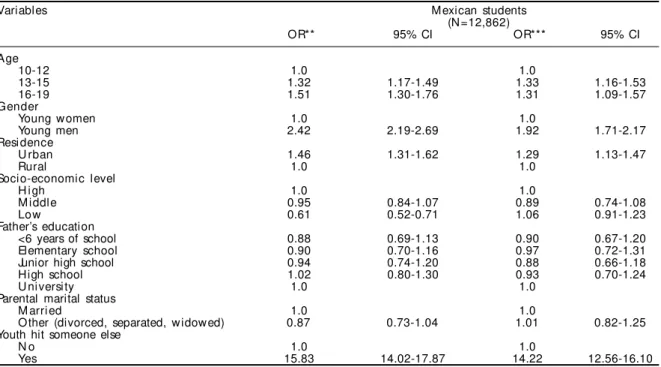
In multivariate models, significant bivariate corre-lations generally remained statistically significant. Table 2 shows the results for the model using the
Mexican data. Older age, male gender and urban resi-dence were independent correlates of experiencing intra-familial violence among Mexican youth. How-ever, the increased risk associated with low socio-economic level became non-significant when con-trolling for these other risk factors.
Results from the model using the Egyptian data are shown in Table 3. In this model, younger age, female gender and having non-married parents were inde-pendent correlates of victimization by a family mem-ber. Finally, the association between experiencing and perpetrating physical violence was strong in both Mexico (OR=13.13, 95% CI: 11.58-14.88) and Egypt (OR=6.58, 95% CI: 5.53-7.80), even after control-ling for other variables.
D ISCU SSIO N
The prevalence of experiencing intra-familial vio-lence among Mexican (14%) and Egyptian (17%) youth who attend public school was relatively low compared to other estimates found for Latin Ameri-can and Arab youth. For instance, a study in Alexan-dria, Egypt, found that 37.5% of elementary and jun-ior high school students had been beaten by their parents.24 Another study among Arab adolescents liv-ing in Israel found that 26% reported beliv-ing slapped, pushed, or kicked by a parent in the previous 12 months.10 A higher prevalence of being hit by parents has also been reported in Santiago, Chile, with higher rates found among youth who attend private (69%)
Table 2 - Correlates of victimization (intra-family violence)* among adolescents attending public school in Mexico, 1998-1999.
Variables M exican students
(N =12,862)
OR** 95% CI OR*** 95% CI
Age
10-12 1.0 1.0
13-15 1.32 1.17-1.49 1.33 1.16-1.53
16-19 1.51 1.30-1.76 1.31 1.09-1.57
Gender
Young w omen 1.0 1.0
Young men 2.42 2.19-2.69 1.92 1.71-2.17
Resi dence
U rban 1.46 1.31-1.62 1.29 1.13-1.47
Rural 1.0 1.0
Socio-economic level
H i gh 1.0 1.0
M iddle 0.95 0.84-1.07 0.89 0.74-1.08
Low 0.61 0.52-0.71 1.06 0.91-1.23
Father’s education
<6 years of school 0.88 0.69-1.13 0.90 0.67-1.20
Elementary school 0.90 0.70-1.16 0.97 0.72-1.31
Junior high school 0.94 0.74-1.20 0.88 0.66-1.18
High school 1.02 0.80-1.30 0.93 0.70-1.24
U ni versi ty 1.0 1.0
Parental marital status
M arri ed 1.0 1.0
Other (divorced, separated, widowed) 0.87 0.73-1.04 1.01 0.82-1.25
Youth hit someone else
N o 1.0 1.0
Yes 15.83 14.02-17.87 14.22 12.56-16.10
*Victims of physical violence by any family member **Crude odds ratio
than public schools (46%).14 Hence, attending pub-lic schools, as all the children in the present sample did, may be protective against victimization. No such studies have been conducted previously in Mexico. However, a nationally representative study on part-ner violence found that 42% of all Mexican women reported having been beaten by their parents during childhood.* The much lower prevalence found in the present study may be due to a cohort effect character-ized by lower levels of physical punishment in more recent generations, or, perhaps, to the study’s inabil-ity to assess the prevalence of victimization among youth dropouts from school and who may be at much higher risk than those who attend school.
The present study also suggested that having ex-perienced intra-familial violence was more than twice as likely among male Mexican youth than among female youth (OR=2.36, 95% CI: 2.08-2.68), while Egyptian females were at slightly greater risk than their male counterparts (OR=1.25, 95% CI: 1.07-1.47). Other studies in these countries have not reported results on such gender differences. However, studies in the US have found higher prevalence of victimiza-tion, repeat victimizavictimiza-tion, and violence perpetration among male youth than among female youth.6,20 Gen-der differences found in the prevalence of victimiza-tion and violence perpetravictimiza-tion may be related to di-vergent gender norms where these events take place. For instance, the aforementioned study among Arab
youth in Israel found that physical abuse of children by fathers was more likely among male youth, and abuse by mothers was more likely among female youth.13 This characteristic of intra-familial violence, as well as others, should be further explored, for ex-ample, through studies that combine qualitative and quantitative methods and that include populations from different cultures.
Finally, in both samples, the study found strong associations between having been hit by a family member and having hit another person. Studies in the US and other developed nations have found simi-lar results.2,19,21 Research based on social learning theory explains this association as a process of ob-serving violent behavior and then replicating the behavior observed.2 There appears to be long-term, inter-generational implications of this learned behav-ior. In the US, experiencing corporal punishment as a child has been associated with physical punishment and abuse of one’s own children,9 an association that appears stronger than other risk factors, such as socio-economic level, gender, alcohol abuse, and witness-ing domestic violence as a child. Experience of cor-poral punishment while young also appears to in-crease the likelihood of spousal abuse.2
The main limitation of the present study concerns its cross-sectional nature and the resulting inability to determine causality. Another limitation concerns the
Table 3 - Correlates of victimization (intra-family violence)* among adolescents attending public school in Egypt, 1997.
Variables Egyptian students
(N =5,662)
O R* * 95% CI O R* * * 95% CI
Age
10-12 2.68 2.14-3.35 2.95 2.30-3.80
13-15 1.95 1.54-2.47 2.07 1.60-2.69
16-19 1.0 1.0
Gender
Young w omen 1.19 1.03-1.37 1.28 1.09-1.49
Young men 1.0 1.0
Resi dence
U rban 1.22 1.06-1.40 1.21 1.03-1.43
Rural 1.0 1.0
Socio-economic condition
H i gh 1.0 1.0
M iddle 1.16 0.97-1.40 1.08 0.87-1.33
Low 1.14 0.96-1.37 1.13 0.93-1.37
Parents’ education
<6 years of school 1.24 1.01-1.53 1.41 1.11-1.80
Elementary school 1.31 1.05-1.63 1.38 1.08-1.78
Junior high/High school 1.09 0.80-1.49 1.13 0.80-1.58
U ni versi ty 1.0 1.0
Parental marital status
M arri ed 1.0 1.0
Other (divorced, separated, widowed) 1.24 0.99-1.56 1.38 1.08-1.78
Youth hit someone else
N o 1.0 1.0
Yes 6.60 5.63-7.72 7.04 5.93-8.36
*Victims of physical violence by any family member **Crude odds ratio
***Odds ratio adjusted by the variables included in the table
% " Rev Saúde Pública 2005;39(5):709-15 www.fsp.usp.br/rsp Intra-familial violence in Mexico and Egypt
Rivera-Rivera L et al
study measure of experiencing intra-familial violence. Since this measure did not specify the violence perpe-trator, the results classified youth as victimized, even though they may have experienced only non-parental physical victimization. Nevertheless, this broad clas-sification may reflect important correlates of violence inflicted by siblings and non-parental kin. These rela-tionships may be more important in societies such as Mexico and Egypt where extended kin relations are more important than in developed nations where nu-clear families are predominant. This study measure also did not take into account more intense experiences of violence. However, since studies have shown that even “hitting” or “smacking” children can have negative consequences,8,9 examination of this type of intra-fa-milial violence is merited.
In addition, the cross-sectional nature of the study did not allow for measuring repeat victimization. Future studies should clarify the source of physical abuse, its intensity, and its frequency. Another limita-tion of this comparison is the present study’s inabil-ity to control for the influence of religion, given that in the Egyptian sample the majority of the respond-ents were Muslims while in the Mexican sample most
of the study participants were Catholics. Finally, the analytic samples used were somewhat different, since the Egyptian sample comprised nationally tive data while the Mexican sample was representa-tive only of one centrally located state. However, these samples were comparable in their inclusion of same age public school students, as well as their use of similar survey instruments.
The obtained results suggest that youth in develop-ing nations, such as Mexico and Egypt, may share with youth populations from more developed nations a general pattern of association between experiencing intra-familial violence and violence perpetration. Fu-ture research should attempt to explain the variation in prevalences of intra-family violence among young men versus young women. Given the multiple nega-tive psychological, behavioral and physical health outcomes linked to the experience of violence during childhood, prevention of interpersonal violence should be a public health priority.12 To design effective inter-ventions, future studies should focus on the dynamics of intra-family violence, as well as social, cultural, and psychological risk factors that should be considered in developing and evaluating such interventions.6,18
REFEREN CES
1. Brook DW, Brook, JS, Rosen Z, De la Rosa M,
Montoya ID, Whiteman M. Early risk factors for violence in Colombian adolescents. Am J Psychiatry 2003;160:1470-8.
2. Carroll J. The intergenerational transmission of family
violence: the long term effects of aggressive behavior. Adv Fam Psychol 1980:2:171-81.
3. Chang JJ, Chen JJ, Brownson RC. The role of repeat
victimization in adolescent delinquent behaviors and
recidivism. J Adolesc Health 2003;32:272-80.
4. Drossman DA, Talley NJ, Leserman J, Olden KW,
Barreiro MA. Sexual and physical abuse and gastrointestinal illness: review and recommendations. Ann Intern Med 1995;123:782-94.
5. DuRant RH, Altman D, Wolfson M, Barkin S, Kreiter
S, Krowchuk D. Exposure to violence and
victimization, depression, substance use, and the use of violence by young adolescents. J Pediatr
2000;137:707-13.
6. DuRant RH, Treiber F, Getts AG, McCloud K, Linder
CW, Woods ER. A comparison of two violence prevention curricula for middle school adolescents. J Adolesc Health 1996;19:111-7.
7. Eamon MK. Antecedents and socioemotional
consequences of physical punishment on children in two-parent families. Child Abuse Negl 2001;6:787-802.
8. Elliman D, Lynch MA. The physical punishment of
children. Arch Dis Child 2000;83:196-8.
9. Graziano AM, Hamblen JL, Plante WA. Subabusive
violence in childrearing in middle-class American
families. Pediatrics 1996;98:345-8.
10. Haj-Yahia MM, Ben-Arieh A. The incidence of Arab adolescents’ exposure to violence in their families of origin and its sociodemographic correlates. Child Abuse Negt 2000;24:1299-315.
11. Ibrahim B, Sallam S, El Tawila S, El Gibaly O, El Sahn F, Lee SM et al. Transitions to adulthood. In: A national survey of Egyptian adolescents. New York: The Population Council; 1999.
12. Kalmuss D. The intergeneracional transmisión of
marital agresión. J Marriage Fam 1984;46:11-19.
14. Lopez Stewart C, Lara MG, Amighetti LD, Wissow LS, Gutierrez MI, Levav I, Maddaleno M. Parenting and physical punishment: primary care interventions in Latin America. Rev Panam Salud Publica 2000;8:257-67.
15. Maman S, Campbell J, Sweat MD, Gielen AC. The intersections of HIV and violence: directions for future research and interventions. Soc Sci Med
2000;50:459-78.
16. McCauley J, Kern DE, Dolonder K, Dill L, Schroeder AF, DeChant HK et al. The battering syndrome: prevalence and clinical characteristics of domestic violence in primary care internal medicine practices. Ann Intern Med 1995;123:734-46.
17. Perry BD, Mann D, Palker-Corell A, Ludy-Dobson C, Schick S. Child physical abuse. In: Levinson D, editor. Encyclopedia of crime and punishment. vol. 1. Thousand Oaks: Sage Publications; 2002. p. 197-202.
18. Powell KE, Dahlberg LL, Friday J, Mercy JA, Thornton T, Crawford S. Prevention of youth violence: rationale and characteristics of 15 evaluation projects. Am J Prev Med 1996;12(Suppl 2):3-12.
19. Rivara FP, Shepherd JP, Farrington DP, Richmond PW, Cannon P. Victim as offender in youth violence. Ann Emerg Med 1995;25:609-14.
20. Roscoe B, Callahan J. Adolescents’ self-report of violence in families and dating relationships. Adolescence 1985;20:545-53.
21. Strauss M. Discipline and deviance: physical
punishment of children and violence and other crimes in adulthood. Soc Probl 1991;38:133-54.
22. Titus JC, Dennis ML, White WL, Scott CK, Funk RR. Gender differences in victimization severity and outcomes among adolescents treated for substance abuse. Child Maltreat 2003;8:19-35.
23. Vizcarra MB, Cortes J, Bustos L, Alarcon M, Muñoz S. Maltrato infantil en la ciudad de Temuco: Estudio de prevalencia y factores asociados. Rev Med Chil 2001;129(12):1425-32.
24. Youssef RM, Attia MS, Kamel MI. Children experiencing violence. II: Prevalence and