Root cause analysis: evaluation of
medication errors at a university hospital
*ANÁLISE DE CAUSA RAIZ: AVALIAÇÃO DE ERROS DE MEDICAÇÃO EM UM HOSPITAL UNIVERSITÁRIO
ANÁLISIS DE CAUSA RAÍZ: EVALUACIÓN DE ERRORES DE MEDICACIÓN EN UN HOSPITAL UNIVERSITARIO
* Part of the thesis, “Análise de causa raiz: avaliação de erros de medicação em uma unidade de clínica médica de um hospital universitário”, University of São Paulo at Ribeirão Preto College of Nursing, 2007. 1 RN. MSc in Fundamental Nursing at University of São Paulo at Ribeirão Preto College of Nursing. Ribeirão
Preto, SP, Brazil. [email protected] RN. Full Professor at General and Specialized Nursing Department, University of São Paulo at Ribeirão Preto
O
RIGINAL
A
R
TICLE
RESUMO
Os objetivos deste estudo foram identifi-car e analisar os tipos de erros de medica-ção observados nas doses de medicamen-tos que foram preparadas e administradas de forma diferente daquelas prescritas. Es-tudo descritivo, utilizando o método de análise de causa raiz, que realizou uma aná-lise secundária de dados de um estudo já existente. No estudo, 74 erros de medica-ção foram identificados, durante o preparo e a administração de medicamentos pela equipe de enfermagem. Erros de dose (24,3%), erros de horário (22,9%) e medi-camentos não autorizados (13,5%) foram os mais frequentes. Assim, a análise de causa raiz foi realizada, identificando múltiplos fatores que contribuíram para a ocorrência dos erros, e estratégias e recomendações foram apresentadas para evitá-los.
DESCRITORES
Sistema de medicação no hospital. Erros de medicação.
Gerenciamento de segurança. Controle de risco.
Enfermagem.
Thalyta Cardoso Alux Teixeira1, Silvia Helena De Bortoli Cassiani2
ABSTRACT
The objectives of this study were to iden-tify and analyze the types of medication errors observed in doses prepared and ad-ministered differently from those pre-scribed. It is a descriptive study using the root cause analysis method, in which a sec-ondary analysis of data from a previously existing investigation was performed. In the study, 74 medication errors were identified during medication preparation and admin-istration by the nursing staff. Dose errors (24.3%), schedule errors (22.9%) and unau-thorized medication administration errors (13.5%) were the most frequent. Hence, medication errors were identified, and root cause analysis was performed, leading to the identification of multiple factors that contributed to error occurrence. Strategies and recommendations were presented for the prevention of errors.
KEY WORDS
Medication systems, hospital. Medication errors.
Safety management. Risk management. Nursing.
RESUMEN
Los objetivos de este estudio consistieron en identificar y analizar los tipos de errores de medicación observados en las dosis de medicamentos que fueron preparadas y administradas de modo diferente respecto del cual fueron prescriptas. El estudio fue de carácter descriptivo, se utilizó el méto-do de análisis de causa raíz, efectuaméto-do en forma secundaria sobre los resultados de un estudio ya existente. En el estudio, 74 errores de medicación fueron identificados durante la preparación y la administración de medicamentos por parte del equipo de Enfermería. Errores de dosis (24,3%), erro-res de horario (22,9%) y medicamentos no autorizados (13,5%) fueron los más fre-cuentes. Así, el análisis de causa raíz fue realizado, identificándose múltiples facto-res que contribuyeron para la ocurrencia de los errores. Fueron presentadas estrategias y recomendaciones para evitarlos.
DESCRIPTORES
Sistema de medicación en hospital. Errores de medicación.
Administración de la seguridad. Control de riesgo.
INTRODUCTION
Patient safety involves, in general, preventing errors in care and eliminating any harms to the patient due to those errors. Error in health care results from an unintentional action caused by some kind of problem or failure when providing patient care(1). That error can be committed by
any health team member and can occur at any time of the health care process, as, for instance, in patient medication.
The culture of punishing the professional when medi-cation errors are discovered remains in practice. Therefore, professionals often face disciplinary actions, humiliations, losing jobs, and legal repercussions when medication er-rors are reported, in addition to the emotional effects they experience, such as feeling guilty and incompetent(2).
Patient safety involves changing this culture to not pun-ishing the professional and, also, adopting measures regard-ing the medication system. This way, errors could be re-ported by the professionals involved and notified so their causes could be investigated.
To help reduce the occurrence of errors, there is a need for health institutions to main-tain a continuous careful analysis of the er-rors that effectively occur(3). Over the last
years, there has been much talk about the investigation of medication errors, as it is es-sential to promote the reliability of the medi-cation system as well as patient safety.
A method that is currently being used to analyze medication errors is root cause analy-sis. This method has been used in
engineer-ing, in the investigation of industrial, nuclear and aviation accidents, and recently in health institutions to improve patient safety(4). It was incorporated, in 1997, by the Joint
Commission on the Accreditation of Healthcare Organiza-tions (JCAHO), a private American organization that pro-vides hospital accreditation.
The root cause analysis method is not simple and con-sists of different technique, which include barrier analysis, change analysis, Ishikawa diagram, Pareto analysis, cause trees, among others, to elaborate the causal chain based on a final unwanted result with the purpose of finding the root cause(4-6). In addition, the proposition of this method
is not limited to simply finding the root causes, but in try-ing to solve the effective fact, with the purpose of prevent-ing and avoidprevent-ing new episodes from happenprevent-ing.
The United StatesVeterans Affairs National Center for Patient Safety – NCPS (2004) has worked extensively to develop the root cause analysis into an effective method to identify problems, analyze critical incidents and gener-ate system improvements(7).
A study was performed to evaluate the frequency, se-verity, root causes and costs of effective adverse events from medication use, after admission, or as the cause for admis-sion in four hospitals. The analysis of adverse events re-lated with patient admission, at the hospital, revealed that 69% of these events were attributed to the patients’ non-adhesion to the treatment and that 19% were attributed to the wrong choice of medication by the physician. The data obtained in the study identified changes in the medi-cation process, such as developing protocols(8).
Therefore, there are several ongoing worldwide in-vestigations, which analyze the incidents in the medica-tion systems of many hospitals. In Brazil, there are not studies in the literature, to this date, that analyze medi-cation errors using the root cause analysis method. Hence, the purpose of the present study is to analyze medication errors, using the root cause analysis method, and propose strategies and recommendations to prevent error recurrence.
OBJECTIVES
The objectives of the present study were to identify and analyze the types of medica-tion errors observed in the medicamedica-tion doses that were prepared and administered differ-ently from what had been prescribed and propose strategies and recommendations to avoid such errors.
METHOD
This is a descriptive study, of cross-sectional design to elicited the complete nature of the phenomena, performed with the objective to observe, describe, and document the aspects of the situation(9).
In this study a secondary analysis was performed on the data obtained in the study Investigação e análise dos erros de medicação em seis hospitais brasileiros(10)
(Investi-gation and analysis of medication errors in six Brazilian hos-pitals) a quantitative, descriptive study, using cross-sectional design that was performed with the purpose to observe, describe, and document the aspects of situations regard-ing the administration of medications. Data collection was performed during 30 days, through direct and non-partici-pant observation of the preparation and administration of the medications. The direct observation technique was used, as it has been described in the literature as the ad-equate method to detect medication errors. Results showed that 821 medication doses were observed at the hospital, the present study location, 70 of which contained 74 medi-cation errors, i.e., some doses involved more than one er-ror in their administration.
To help reduce the occurrence of errors,
there is a need for health institutions to maintain a continuous careful analysis of the errors that effectively
The present study analyzed the medication errors that occurred at an internal medicine unit of a tertiary public university hospital, located in Ribeirão Preto, São Paulo State.
The study universe consists of 70 medication doses that were prepared and administered differently from what had been prescribed, and containing 74 medication errors that were obtained by means of a database used in a previous study(10).
This study was approved by the Research Ethics Com-mittee at the studied hospital and participants provided informed consent.
An instrument was formulated using the root cause analysis method, with the purpose of understanding what had happened and what factors were involved in the iden-tified medication errors.
In the present study, an adaptation of two root cause analysis methods(4,6) was performed to analyze the
medica-tion doses. The first method originated from the Human Performance Enhancement System (HPES), from the energy companies of the United States, and the steps composing this methods are the following: process of problem identi-fication and description, analysis of the task, of the change and of control barriers, outlining the causes and problem factors, identifying the root causes, proposing recommen-dations to avoid the problem from occurring, and imple-menting the systems(4). In the present study, only the first
step of this method was used.
The process of problem identification and description, which comprises the definition and data collection, has the objective to illustrate the identified problem, by de-scribing what happened. Data collection can be performed by reviewing documents, observations and interviews. As soon as the problem was detected, a thorough descrip-tion of what happened should be provided in an orga-nized manner(4).
The second method used was that proposed by SOURCE, developed by the Department of Energy by the Westing-house Savannah River Corporation, in 1991. The referred method defines that root causes are the basic causes that can be identified and manage and supervise the actions needed to correct errors, provide effective recommenda-tions to prevent the recurrence of errors and involve four
steps: data collection and preservation, causal factors chart-ing, identifying the root causes and developing recommen-dations and implementation(6).
The steps used in the present study were: data collec-tion and preservacollec-tion, causal factors charting, and devel-oping recommendations.
The objective of the process of data collection and pres-ervation, as the name defines it, is to collect and preserve error data, as it occurred. With an effective data collection, the error can be illustrated and solved. The data should be obtained as soon as possible, after the error occurred, so as to prevent losses or changes to the data(6).
The causal factors charting is a simple diagram that permits investigators to describe the error from the begin-ning to the end, using a chart. The causal factors charting technique was originally developed by Ludwing Benner and colleagues in US National Transportation Safety Board to use in accident investigations. This technique was designed to help investigators to make a timeline to describe the events and the involved conditions(6).
Before making the recommendations, it is necessary to evaluate if the corrective action will prevent the recur-rence of the event or condition and if it will be achievable according to the institution’s capacity of implementing it. Furthermore, corrective actions should be directed not only to the specific circumstances of the event, but also to the implementation of the system with the objective to reduce the frequency of the problem, reduce the involved staff’s exposition and minimize its consequences(6).
Hence, each medication dose that was prepared and administered differently from what had been prescribed was analyzed. Thus, the table with the frequency of the types of errors was presented in the results section. After performing the analysis of the root of cause analysis using the aforementioned instrument, the causal factors related with the occurrence of medication errors were identified and discussed, and strategies and recommendations were proposed to avoid such errors.
There are several definitions and classifications in the literature about the types of medication errors. Hence, in the present study, the types of medication errors were clas-sified according to the definitions from the literature (10-11),
Chart 1- Categorization and definition of medication errors - Ribeirão Preto, SP - 2007
Medications administered in doses greater or smaller that what had been prescribed
Prescription for 25mg of captopril and a 50mg dose was administered
Medication administered to patient in an time different from that which had been prescribed or predetermined (more or less than a 1 hour difference)
Prescription for vancomycin at 6 pm and administered at 7:20 pm or prescription for enalapril at 10 am and administered at 8 am
Administering medication that has not been prescribed by the physician
Administering amoxicillin instead of amoxacillin combined with clavulanate
Medication incorrectly formulated or manipulated, before administering or using inappropriate proce-dures or techniques to administer a medication
Not measuring doses appropriately, not use the infusion pump for the administration. For instance, to administer iron sulfate after meals or not verify the systemic arterial blood pressure before adminis-tering hypertensive medication
Administering medications using a route different from what had been prescribed
Prescription for intravenous administration and administered orally
Administering and extra dose to what had been pres-cribed or a medication that had been suspended
Administering captopril that later was suspended in the prescription
Incorrect selection of the medication, dosage, pre-sentation, administration route, infusion speed, ina-dequate use instructions by physician and not regis-tering a verbal prescription
Prescribing omeprazole for 8 pm, when it should be administered at 6pm, before dinner
Professional's mistake to not administer the medica-tion to the patient
The professional prepared the aerosol with saline at 0.9% and berotec and did not add the ipratropium bromide that had also been prescribed
Administering the medication to the wrong patient Phenytoin was prescribed to patient A but was
administered to patient B
Administering medication in a way different from what had been prescribed
Furosemide tablets were administered instead of ampoule
Dosage errors
Time errors
Unauthorized
Technique errors
Administration route errors
Extra doses
Prescription errors
Omissions
Wrong patient
Presentation errors
Types of errors Definition Examples
RESULTS AND DISCUSSSION
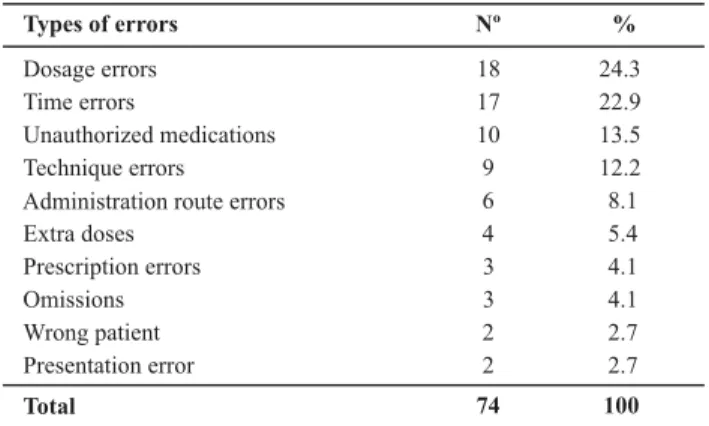
Table 1 presents the distribution of the 74 medication errors, indentified in the 70 medication doses that were prepared and administered differently from what had been prescribed.
Table 1- Types of medication errors identified - Ribeirão Preto, SP - 2007
Types of errors Nº %
Dosage errors 18 24.3
Time errors 17 22.9
Unauthorized medications 10 13.5
Technique errors 9 12.2
Administration route errors 6 8.1
Extra doses 4 5.4
Prescription errors 3 4.1
Omissions 3 4.1
Wrong patient 2 2.7
Presentation error 2 2.7
Total 74 100
In the present study, dosage errors (24.3%), time errors (22.9%) and unauthorized medications (13.5%) were the
errors or wrong quantity (23%) and prescription errors (22%) were the most frequent, reported on the MEDMARX, a database, developed by the United States Pharmacopeia – USP(12) and made accessible on the internet, which
col-lects anonymous data and analyzes medication errors.
In the literature, different studies show different frequen-cies for the identified medication errors. This occurs because each institution has its own medication process, with spe-cific characteristics that need to be identified by the research-ers to help in the error analysis. Therefore, it should be em-phasized that the referred hospital uses a computerized pre-scription system, which is considered a barrier in the medi-cation system, as it avoids error to happen provided it is used correctly, and the medication is stored individually.
Regarding the profession of the health practitioners who were observed preparing and administering medications, 84.3% were nursing aides, 14.3% were nursing technicians and it was not possible to identify the profession of 1.4%. A study performed in Rio Branco, in Acre state, showed that 86.4% of professionals observed while preparing and ad-ministering medications were nursing aides and technicians, while only 13.6% were nurses (13).
profes-often busy with administrative problems, stepping away from the direct supervision of this process. Therefore, the lack of direct supervision in this process results in risk situ-ations for the patient regarding a safe implementation of the drug therapy.
Dosage error
Regarding the 24.3% observed dosage errors, 50% re-ferred to administering twice the prescribed dosage, 27.7% concerned administering half the prescribed dosage and 11.1% referred to administering four times the prescribed dosage. Regarding the presentation of the medications ad-ministered in wrong dosages, most were pills, and metro-prolol was the most frequently involved drug.
In two studies, dosage errors in the administration of medications was among the three most common types of medication errors, corresponding to 12% and 15%(11,14). It is
observed that a factor that contributes with administering wrong medication dosages is storing the medication in dos-ages different from what had been prescribed.
In this institution, medications are stored individually, which demands the nursing team to handle and prepare the medication according to the prescription. Therefore, the unitary dose is a strategy capable of avoiding these medica-tion administramedica-tion errors, and can be adopted by this and other institutions with the purpose of avoiding that similar errors occur again. Among the many advantages of the uni-tary dose, it should be emphasized that it reduces the time necessary for the nursing team to store and prepare medica-tions and thus also improved health care quality(15).
Time errors
In the study, 22.9% regarded time errors, and the most common classes of medications involver were antibiotics, anti-diabetic drugs, anticoagulants, minerals and cardiovas-cular agents. Among these errors, 35.3% were related with the fact that the patient had attended another sector for hemodialysis, to perform and exam or to implant an arte-riovenous fistula.
In fact, many patients receive medications in times differ-ent from what had been prescribed, due to the fact that they go to another sector for some other procedure. Hence, there should be effective communication between nursing and medical teams from the different sectors, to avoid delays, for instance, these medications should be sent along with patients with the objective to increase the safety of its use, especially in cases of antibiotics that can have their altered serum levels, and thus cause harms or illnesses to patients.
A strategy that could help to administer the medication at the prescribed time, when a patient is submitted to some type of procedure or exam, would be the nursing staff control the time of drug administration, thus preventing the moment of performing these procedures, which involves having effective
Unauthorized medications
Of the errors involving unauthorized medication identi-fied in the study (13.5%), most occurred due to the admin-istration of nifedipine instead of nifedipine retard, and amoxacillin instead of amoxacillin combined with clavulanate. Other studies presented a 4% to 13% rate of this type of error(11,16).
It is known that nifedipine and nifedipine retard belong to the same class (calcium channel blockers), but nifedipine is usually used once a day, because it has a prolonged ac-tion, while nifedipine retard is usually prescribed to be used every 12 hours. On the other hand, amoxacillin combined with clavulanate is used to treat infections by amoxacillin-resistant bacteria, as it produces beta-lactamases. Hence, these medication exchanges should not occur.
In the root cause analysis it was questioned whether the medications were correctly stored/dispensed by the pharmacy. Therefore, it was observed that there were mis-takes in dispensing the medication, considering that this step of the medication process is responsible for the selec-tion and separaselec-tion of the medicaselec-tions to be used.
Using bar codes is a way to avoid medication errors, and it is a strategy to intercept those errors, during dis-pensing as well as when administering the medication.
Technique errors
Technique errors involved the steps of medication prepa-ration and administprepa-ration and represented 12.2% of all er-rors. These errors concerned wrong medication infusion time, the lack of equipment in the sector and the inad-equate programming of the infusion volume, per hour, in an infusion pump. They also involved the non-administra-tion of medicanon-administra-tions before and after meals, as recom-mended on the prescriptions, and not using specific mate-rial to measure the dosage correctly, such as when a pro-fessional measured the nistatin dosage at sight.
The orientations prescribed for administering the medi-cations, such as the use of infusion pumps, before/after meals, should be followed by the nursing team, as it could affect the absorption of the medication by the organism or even cause adverse reactions on the patient.
Therefore, it is important for the institution to promote a safe environment for administering medications, which in-cludes having equipment such as a syringe pump and infusion pumps, training and instructing professionals periodically re-garding the techniques to prepare and administer medications, and the presence of protocols and guidelines for administer-ing medications as strategies to avoid those errors.
Administration route errors
orally instead of sublingual, human recombinant erythro-poietin was administered subcutaneously instead of intra-venous, and furosemide was administered intravenously instead of orally. The MEDMARX report stated that one of the most frequent errors that caused harms to patients were rout errors, as they caused significant and immediate harm to the patients’ health condition(12).
Furthermore, vigabatrin, carbamazepine and bromo-pride were administered by inhalation, instead of orally, to the patient by the person accompanying them at the hos-pital (companion). The main factor involved in these events was that the professional handed the medication container to the companion, who administered it to the patient, and did not provide any instructions.
Medications should not be left with patients of their companions to be administered, since it increases the chances of occurring medication errors, especially when patients and their companion do not receive appropriate instructions. It is the nurses’ duty to administer medications, as they have been prepared to perform the task of adminis-tering medications and are, therefore, responsible for this activity in the hospital environment.
To avoid administration route errors, it is recommended that professionals read the medical prescription carefully, identifying the five correct points, which includes the administration route, to guarantee the medication is administered correctly.
Extra doses
In the present study, extra doses (5.4%) occurred due to the administration of medications that had been sus-pended in the medical prescriptions. Medications such as cefepime and enalapril were involved in the errors.
These medications were prescribed, dispensed by the pharmacy, and subsequently suspended by the physician, but the nursing team, which did not check the medical pre-scription, administered the suspended medications never-theless. It was observed that the suspension of the medi-cation was not written in the pharmacy order.
The description of the events and the causal factors charting revealed that the contributing factors were disre-garding the medical prescription and using the pharmacy order for preparing and administering the medications. In another study, the failure to check the medical prescrip-tion resulted in administering extra doses of medicaprescrip-tions such as antibiotics and anticoagulants(17).
The lack of integration and cooperation among multi-professional tem multi-professionals leads to similar situations. According to a study performed at a university hospital, there was a chance that 16.8% of patients hospitalized in the clinics could have received an extra medication (or dose) that had already been suspended by the physician, unless the nursing team had been communicated sooner or checked the medical prescription(18).
The verbal communication between health team mem-bers is essential in patient care and is directly related with medication errors. A study performed at a intensive care unit found evidence that 37% of the reported errors in-volved the verbal communication among professionals(19).
In fact, many times there is no communication between the physician and the nursing team when a change is made to the prescription or a medication is suspended. This in-creases the chance of errors, especially when the prescrip-tion is not used.
In this institution, it is very common for the nursing team to prepare and administer medications consulting the phar-macy order, which does not contain all the information or the changes that were made to the prescription. Therefore, it is recommended that the medical prescription be consulted when preparing and administering medications to avoid such errors, and there should be better cooperation among mem-bers of the multiprofessional team, so that any changes to the prescription be informed to the nursing team.
Prescription errors
All types of prescription errors (4.1%) were intercepted by the nursing team, and were, therefore, considered near-misses. In this study, the errors were related with the inadequate timing of omeprazole, which should be administered be-fore meals, and the verbal prescription of one insulin dose and its non-change in the prescription. A limited number of factors, such as the lack of knowledge or information regarding the treatment, wrong evaluation and use of pa-tient information, prescription and confusing medication nomenclature, wrong dosage calculations and inappropri-ate preparations were the main factors that contributed with the occurrence of prescription errors(20).
Traditionally, physicians decide the medication to be used by the patient, and pharmacists and the nursing staff implement their decisions. The presence of a clinical phar-macist can avoid errors, since they provide more informa-tion and promote optimized medicainforma-tion use, in addiinforma-tion to monitoring the process of prescribing, preparing and ad-ministering the medications, and developing educational programs and medication guidelines(20).
Prescription errors are common and the nursing staff, who have knowledge in this respect, form an important barrier in the medication system for interception, as pre-sented in this study. Furthermore, computerized prescrip-tion systems and the clinical pharmacist are strategies that can avoid this type of error.
Omissions
Mistakes, misses and lack of attention are some of the factors related with human failures that lead to acts or omissions. Behind those human failures, there is always a system failure that contributes with the occurrence of medi-cation errors.
These omission errors could be avoided, especially re-garding the lack of peripheral access and lack of medica-tion at the moment of its administramedica-tion, if nurses super-vised the administration of medications. Nurse supervision could represent one of the defensive barriers in the medi-cation system processes, with the purpose of reducing medication errors. Hence, that supervision performed by nursing aides and technicians provide essential conditions for nursing actions to be developed with quality and with-out causing any harms to patients, besides preventing er-rors in the administration of the medications(3).
Wrong patient
This type of error corresponds to 2.7% of the identified errors. The description of the events and the causal factors charting showed that the nursing professional confirmed the name of patient Y and administered phenytoin and so-dium bicarbonate to that patient in the place of patient X who was in the next bed.
Patient errors are not often reported in the literature, but a case study about one patient error in which the pa-tient was submitted to an electrophysiological procedure in the place of another was presented and by means of root cause analysis, 17 similar errors were found(21).
Identifying the patient at the time of administering the medication, confirming their names, is essential to avoid such errors. Furthermore, using name bracelets and bar codes in the medication administration system are also strategies to avoid this type of error. A study identified that only 6.8% of hospitalized patients used name bracelets, which is alarming, as the bracelet helps to identify the pa-tient, especially when they are unable to communicate(22).
Presentation errors
Presentation errors (2.7%) occurred due to the admin-istration of furosemide ampoule instead of tablets, and bromopride capsules instead of tablets. These errors
im-ply questioning whether there was dispensing error or if there was any storage in the nursing unit.
Dispensing errors could be avoided using a bar code system to clear medications, and the institution should avoid the presence of storages in the nursing units, as it would facilitate separating medications in a presentation different from what had been prescribed.
It was also observed that the separation of furosemide ampoule, instead of tablets, caused the occurrence of an-other error, involving the administration route. Therefore, a presentation error caused a route error, which could harm the patient.
FINAL CONSIDERATIONS
In present study, 70 medication errors were identified, and the most frequent involved dose, time, and unautho-rized medications. In addition, the root cause analysis method was used, which permitted to identify factors that contributed with the occurrence of medication errors. Strat-egies and recommendations to prevent these errors were presented, as it is an important issue, especially consider-ing the high incidence of these problems worldwide.
Institutions should adopt root cause analysis because its proposition is not limited to only finding the root causes, but to actually clarify the fact with the purpose of prevent-ing and avoidprevent-ing new episodes. Hence, the present study contributed with patient safety, presenting medication er-rors, and strategies and recommendations that could be used by other institutions to avoid them.
The difficulty to study and use the root cause analysis method was one of the present study limitations, as there are no publications on this issue in Brazil. Therefore, the root cause analysis methods used in other countries were adapted for developing the present study.
The only medication system steps observed were medi-cation preparation and administration. The other steps, such as prescription or dispensing and distribution were not included in the study due to the complexity of the sys-tem. Therefore, it was impossible to identify other root causes that may have contributed with the occurrence of these errors.
REFERENCES
1. Kohn LT, Corrigan JM, Donaldson MS, editors. To error is human: building a safer health system. Washington: Committee on Quality of Health Care in America, National Academy of Institute of Medicine; 2001.
2. Stump LS. Re-engeneering the medication error-reporting process: removing the blame and improving the system. Am J Health Syst Pharm. 2000;57 Suppl 4:S10-7.
3. CarvalhoVT, Cassiani SHB. Erros na medicação: análise das si-tuações relatadas pelos profissionais de enfermagem. Medici-na (Ribeirão Preto). 2000;33(3):322-30.
5. Vincent CA. Analysis of clinical incidents: a window on the system not a serch for root causes. Qual Safe Health Care. 2004;13(4):242-43.
6. Heuvel LNV, Lorenzo KD, Montgomery RL, Hanson WE, Rooney JR. Root cause analysis handbook: a guide to effective incident investigation. Brookfield: ABS Consulting; 2005.
7. United States Veterans Affairs National Center for Patient Safety. Root cause analysis. NCPS, 2004 [text on the Internet]. [cited 2006 maio 10]. Available from: http:www.patientsafety.gov/ tools
8. Senst BL, Achusin LE, Genest RP, Cosentino LA, Corey C, Little JA, Raybon SJ, Bates DW. Practical approach to determining costs and frequency of adverse drug events in a health care network. Am J Health Syst Pharm. 2001;58(12):1126-32.
9. Polit DF, Beck CT, Hungler BP. Fundamentos de pesquisa em enfermagem: métodos, avaliação e utilização. 5ª ed. Porto Ale-gre: Artmed; 2004.
10. Cassiani SHB, Teixeira TCA, Opitz SP, Silva AEBC, Gimenes FRE, Fakih FT, et al. Identificação e análise dos erros de medicação em seis hospitais brasileiros. Ribeirão Preto: EERP; 2006.
11. Tissot E, Cornette C, Limat S, Mourand JL, Becker M, Etievent JP, et al. Observational study of potencial risk factors of medication administration errors. Pharm World Sci. 2003; 25(6):264-68.
12. Santell JP, Hicks RW, Mcmeekin J, Cousins DD. Medication errors: experience of the United States Pharmacopeia (USP) MEDMARX Reporting System. J Clin Pharmacol. 2003; 43(7):760-7.
13. Opitz SP. Sistema de medicação:análise dos erros nos
pro-cessos de preparo e administração de medicamentos em um hospital de ensino [tese]. Ribeirão Preto: Escola de Enferma-gem de Ribeirão Preto, Universidade de São Paulo; 2006.
14. Prot S, Fontan JE, Alberti C, Bourdon O, Farnoux C, Macher MA, et al. Drug administration error and theis determinants in pediatric in-patients. Int J Qual Health Care. 2005;17(5):381-9.
15. Coimbra JAH, Valsechi E, Carvalho MDB, Pelloso SM. Sistema de distribuição de medicamentos por dose unitária: reflexões para a prática da enfermagem. Rev Lat Am Enferm. 1998;6(4):15-9.
16. Koop BJ, Erstad BL, Allen ME, Theodorou AA, Priestley G. Medication errors and adverse drug events in an intensive care unit: direct observation approach for detection. Crit Care Med. 2006;34(2):415-25.
17. Barker K, Flynn E, Pepper G, Bates DW, Mikeal RL. Medication error observed in 36 health care facilities. Arch Intern Med. 2002;162(16):1897-903.
18. Cassiani SHB, Freire CC, Gimenes FRE. A prescrição médica eletrônica em um hospital universitário: falhas de redação e
opiniões de usuários. Rev Esc Enferm USP.2003;37(1)51-60.
19. Donchin Y, Gopher D, Olin M, Badihi Y, Biesky M, Sprung CL, et al. A look into the nature and causes of human errors in the intensive care unit. Qual Saf Health Care. 2003;12 (2):143-8.
20. Leape LL, Cullen DJ, Clapp MD, Burdick E, Demonaco HJ, Erickson JI, et al. Pharmacist Participation on physician rounds and adverse drug events in the intensive care unit. JAMA. 1999;282(3):267-70.
21. Chassin MR, Becher EC. The wrong patient. Ann Inter Med. 2002;136(11):826-33.
22. Miasso AI, Cassiani SHB. Identificação do paciente como fato minimizador dos erros na administração dos medicamentos. In: Anais do 6º Simpósio de Iniciação Científica da USP; 1998; Ribeirão Preto, BR. Ribeirão Preto: USP; 1998. p. 78.
Funding