Resumo
A escolha alimentar nas sociedades contemporâ-neas passa, inevitavelmente, pelo comércio, pois o alimento constitui-se mercadoria que é consumida, assim como tantos outros bens e serviços. Atual-mente muitas crianças já definem sozinhas suas escolhas alimentares, provocando a atenção tanto de empresas como de organizações preocupadas com sua nutrição. Utilizando o modelo BPM (Behavioral Perpective Model), criado por Foxall (2010), funda-mentado na psicologia do consumidor e estruturado na tríplice contingência de Skinner, analisaram-se os fatores que influenciam crianças em seu com-portamento de compra de alimentos. Tendo como sujeitos 175 alunos com idades compreendidas entre 10 e 12 anos, identificaram-se 35 variáveis que foram classificadas entre estímulos antecedentes (cenário ou histórico de aprendizado) e consequentes (refor-ço utilitário ou informativo) no comportamento de compra. Verificou-se que os estímulos reforçadores (consequentes) têm maior grau de importância para a decisão de compra de alimentos desses sujeitos do que os estímulos antecedentes, sendo que as conse-quências utilitárias são mais influentes do que as informativas. Conclui-se que os atributos dos produ-tos, como sabor e qualidade, têm maior influência na decisão de compra do que os estímulos ambientais, como as promoções e publicidade dos alimentos. Palavras-chave: Consumo de alimentos; Comporta-mento alimentar; Alimentação de crianças.
Alipio Ramos Veiga Neto
Doctor of Behavioral Psychology. Professor in the Master’s Pro-gram in Administration at the Universidade Potiguar (Laureate International Universities).
Address: Av Floriano Peixoto, 295, CEP 59012-500, Natal, RN, Brazil. E-mail: alí[email protected]
Larissa Grace Nogueira Serafim de Melo
Master in Administration from Universidade Potiguar and Nutri-tionist at UFRN. Doctoral studentship in the Public Health Program in UFRN.
Address: Av. Floriano Peixoto, 295, CEP 59012-500, Natal, RN, Brazil. E-mail: [email protected]
Factors influencing children’s food purchasing
behavior
Abstract
Food choice in contemporary societies is, inevitably, a buying decision. Food is a product that is consu-med, like so many other goods and services. Nowa-days many children choose their food themselves, which attracts attention not only from companies that develop products and advertising for that seg-ment, but also organizations concerned with their nutrition. This paper analyzed the factors that in-fluence children’s food purchasing behavior using the Perpective Behavioral Model (BPM) created by Foxall (2010), which in turn is based on consumer psychology and structured on Skinner’s triple con-tingency. The subjects were 175 students between 10 and 12 years old. Thirty-five variables were identified and classified as antecedent stimuli (setting or le-arning history) or purchase reinforcers (utilitarian or informational reinforcement). It was seen that reinforcement stimuli (consequent stimuli) are more important to these children’s decisions than antece-dent stimuli, and that utilitarian consequences are more influential than informational consequences. It was concluded that product attributes such as taste and quality have greater influence on purcha-sing decisions than environmental stimuli such as promotions and food advertising.
Keywords: Food Consumption; Dietary Behavior; Children’s Diet.
Introduction
In choosing a certain food for a meal, an individual should first recognize it, identify it, and classify it as appropriate or not for consumption, according to his or her habits (cultural and nutritional, among others). In this way, far beyond biogenic factors, food choice relates to various socio-environmental factors (McNeal, 2002). In capitalist economies chil-dren have great autonomy as consumers (Oliveira, 2003) and, according to Camargo (2010), consumer behavior should be studied broadly, starting with the consumer’s interactions and seeking to understand his or her relationship with the environment. Chil-dren are positioned in the consumer marketplace, and shop by themselves, especially for school lunch and snacks, making food decisions according to various influences.
For Schor (2009), children have a rich history as actors in the social economy, sometimes playing the role of traders. Children’s buying capacity is grow-ing sharply, accordgrow-ing to studies by McNeal (2002) which show that children between 4 and 12 years of age purchased US$ 23.4 billion of goods in 1997 and US$ 30 billion in 2002. It is notable that the most consumed item is food, responsible for one third of all spending, to the detriment of items such as toys and clothes.
Among the theoretical models which aim to ex-plain consumers’ buying behavior, Foxall’s Behavior Perspective Model (BPM) (1992), stands out; this model is based on studies begun in 1986 which ana-lyzed marketing phenomena and their relationship with areas of the analytical-behavioral literature and the behavioral economy. By making use of this model, our objective was to analyze the factors that influenced children’s food-buying behavior.
Food choice
has physiological and psychosocial components. These characteristics influence food choices, for-ming a dietary model which is the result of a set of choices made by a society. A dietary model is a particular configuration of the social space where consumption habits are present, in which industries that produce and distribute food promote a range of offerings for the customer’s choosing, molding his or her consumption habits based on previous choices (Jomori and Proença, 2008). According to Santos and Andery (2006), eating is a social act, and the development of dietary habits and practices have references in the social dynamic itself. Human food consumption should be analyzed broadly, not only through relationships between agents in the food supply chain such as agricultural producers, industries, vendors and consumers (Oliveira and Thébaud-Mony, 1997).
A child is a socially active individual, capable of making decisions and responding in a specific manner to various social stimuli, such as appeals to consumption (Douglas, 1998). According to McGinnis et al. (2006) the population of children is demanding in their choice of products, and com-panies targeting this segment have sought to offer differentiated products in order to meet the specific needs of this consumer group. Gwozdz and Reisch (2011) relate that in contemporary society, there is a specific social space for children who have client status, behaving like someone who chooses, decides, and purchases, classified as a demanding consumer. In a study commissioned by the Pan-American Health Organization, Hawkes (2006) stressed mar-keting strategies as stimulators of exaggerated and unbalanced consumption from a nutritional point of view. The study recognizes the amplitude
of marketing, but it is tied to only one of the many dimensions which basically define marketing by its publicity, focusing on variables such as television advertisements, marketing in schools, sponsor-ship, merchandising, internet marketing and sales promotions.
Various authors present factors that influence the consumer in his or her purchasing decisions, with emphasis on Sheth et al. (2001), Solomon (2002), Mowen and Minor (2003) and Camargo (2010). From these authors, the existence of other categories in which to group factors that influence the purchasing decision can be seen, such as social, financial, biogenic, and geophysical factors (Chart 1).
Theoretical model (BPM)
Human behavior (including purchasing behavior) is the product of contingencies which the person has previously experienced. A certain environmental stimulus (discriminative) preceding a purchasing action can trigger it (the response of the organism). If the consequence of that determined purchase (res-ponse) makes the organism repeat it when exposed to the same discriminative stimulus again, then this action (response) was reinforced. If the conse-quence of an action does not the make the organism have a similar action when exposed to the same environmental stimulus again, it can mean that the consequence of that action was not reinforced, or was punitive (Santos and Andery, 2006).
Based on the SD-R-SR triple contingency para-digm (Skinner, 2007), in which SD represents dis-criminative stimuli in the environment which can provoke response R (the organism’s action), which in turn leads to reinforcing stimuli, Foxall (2010)
Chart 1 - Variables influencing children’s food purchasing behavior
Dimensions Variables
Publicity and Advertising Television advertising; Internet advertising; Magazine and newspaper advertising; Sponsorship of events; Promotion; Packaging; Point-of-sale merchandising
Social Culture; Social class; Purchasing history; Religion; Social group; Family Financial Income; Price
defined BPM (the behavioral perspective model), in which discriminative stimuli, responses, and reinforcing or punishing consequences make up distinct classes or events forming the fundamental device of motives known as Purchasing Behavior. BPM considers that consumption activity should be systematically related by the contingencies which sustain it.
Discriminative stimuli can be diverse, such as color, brand, scent, slogan, situation, or other memories that come from previous purchases (learn-ing history). The stimuli are capable of mov(learn-ing the consumer to different responses (actions) which will provoke one of four types of consequent stimuli: util-itarian reinforcement, informative reinforcement, utilitarian punishment, and informative punish-ment, noting that the latter two will provoke aversive consequences. Purchasing behavior can be affected by reinforcement contingencies present in the situ-ation where consumption takes place (Lima, 2008; Pohl, 2008; Rosenthal, 2007; Silva, 2007). It is rare for the consumer to not be exposed to the scenario of consumption, so marketing professionals work to influence consumers by means of environmental stimuli (discriminative) which lead to purchase, and positive reinforcements, which foster faithfulness, while at the same time they seek to reduce punitive consequences which lead to future uncertainties in purchasing, or not making similar purchases in the future (Foxall, 2010).
Determining that consumer behavior is influ-enced and can be controlled by scenarios (functional environments) is not a novelty brought by BPM theory, but the fact is that the stimuli present in the scenarios can reinforce an individual’s purchas-ing behavior; in other words, they can define the extent of consumer behavior based on reinforce-ments, which in turn determines a chain reaction of sequenced behaviors. In this way, an individual in a purchasing situation is the result of the current state of deprivation or the effects of deprivation of a certain good or service that he or she wishes to obtain, which determines the reinforcement contingent to the purchase, as well as allows the purchasing situation to occur in the present and in the future (Jannarelli, 2006). Although there are some criticisms of the model, in the sense that the
individuals are not always sequentially reinforced, the model offers an interpretation of the “why” of consumption, and not just the “for what” (Foxall, 1998; Rosenthal, 2007).
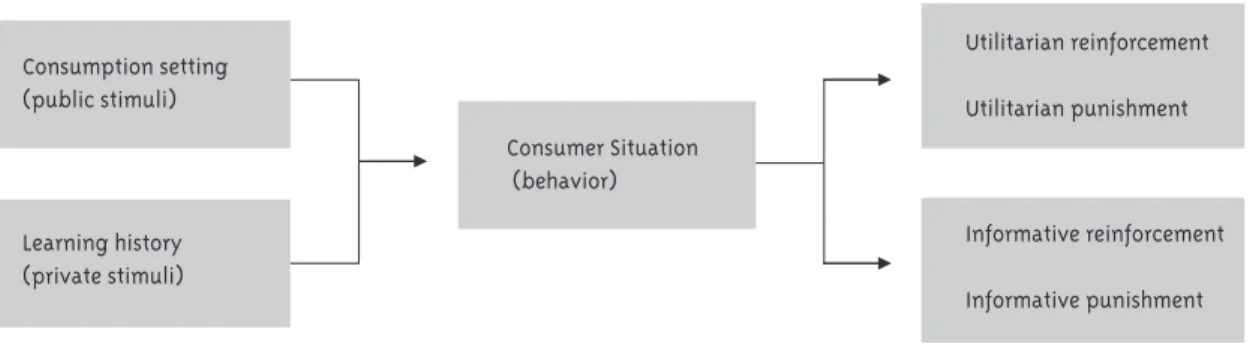
BPM proposes that consumer behavior is ini-tially determined by life history and the scenario of consumption, which precede the purchase (Figure 1). According to the events which take place in the consuming environment, different consequences are indicated. These consequences can be “utilitarian”, when they are associated with the value of the use/ utility of the product, and/or “informative” when they are symbolic or associated with the social response expected by the consumer (Foxall et al., 2006; Foxall, 2010). According to Schiffman and Kanuk (2000), groups influencing the consumer are family, friends, formal social groups, purchasing groups, consumer action groups and work groups. Based on the social relations which are constructed, young consumers can acquire information that might help them in the process of making purchas-ing decisions. Accordpurchas-ing to BPM, the establishment of this feedback of information is characterized as Informative Reinforcement.
Figure 1 - Flowchart representing BPM (Behavioral Perspective Model)
Source: Adapted from Foxall, 2010.
Study variables
The consumption model from a behavioral perspecti-ve (BPM) has serperspecti-ved as a theoretical base for various studies in the area of consumer psychology such as work by Lima (2008), Pohl (2008), Mendes (2008), Ferreira (2007), Porto (2009), Jannarelli (2006), Ro-senthal (2007) and Silva (2007). According to Foxall (2010), the behavioral model allows for amplitude of analysis and adaptation, with no guidance or defini-tion of variables for each construcdefini-tion of the model in the literature. According to Rosenthal (2009), the levels of utilitarian and informative reinforcement are not defined absolutely but relatively, because they reflect the needs of a determined survey. In this way, the variables which determine the consequen-ces of reinforcement or punishment are determined by the researcher, in accordance with the objectives of the study, and with the reality to be surveyed.
In the Consuming Scenario dimension, we clas-sified variables which are stimuli of immediate purchase (impulse buying), or those which could be defined as public stimuli which, according to Baum (2008), are those external to the organisms or which can be observed by other subjects; on the other hand, the private stimuli are those internal to the subject, related to memory or even cognitive processes, and cannot be observed by other people. According to these criteria, in the dimension entitled Learning History, various characteristics of learned stimuli were established; these describe a purchase defined by a consumer’s previous reflection, conducted based on his or her knowledge about a certain prod-uct which is to be acquired (Chart 2).
Consumption setting (public stimuli)
Consumer Situation (behavior)
Learning history (private stimuli)
Utilitarian reinforcement
Utilitarian punishment
Informative reinforcement
Informative punishment
Chart 2 - Variables preceding children’s purchasing behavior
Dimensions Variables
Consumption setting
Promotion Packaging
Point-of-sale merchandising
Culture
Location of point-of-sale
Learning history
TV advertising Internet advertising
Newspaper and magazine advertising Event sponsorship
Purchasing history Personal tastes Emotional state Climate
reinforc-Although the variable “packaging” possessed various characteristics which could place it into multiple dimensions at once, we opted to place it in the Scenario of Consumption dimension, since we consider publicity to be the most important charac-teristic. According to Guadalupe (2000), although food security and ease of logistics continue to be the functions of the packaging, with the variety of products in the consumer marketplace, packaging has also come to promote sales. Faria and Sousa (2008) affirm that packaging is an important item in the marketing equation, one which can awaken the consumer’s desire to buy. Della Lucia et al.(2007) emphasize that the study of food packaging is ex-tremely important, as it represents the consumer’s first contact with the product or food, in this way be-coming a primary object for defining choice and pur-chasing. Garrán (2006) and Giehl (2008) affirm that, in packaging, industries have an efficient channel of communication with the consumer, and can use it to transmit diverse messages about their products. According to Machado (2003), packaging can influ-ence the consumer’s decision through objective and subjective criteria which can be employed, such as appearance, convenience, and the nutritional value of the product. Ishimoto and Nasif (2001) clarified that marketing has exploited food packaging and labeling resources to the maximum in order to pro-vide information to the consumer which might influ-ence their buying decision. Finally, Machado (2006) emphasizes that the process of exchanging values, which is characteristic of marketing, should occur by diffusion of clear, correct, and coherent ideas.
Methodology
In order to respond to the issues of this study, descriptive survey was considered adequate, as our objective was to explain the psychosocial phe-nomenon of children’s consumption, based on the results obtained from applying quantitative and qualitative methods. These primarily included per-sonal interviews with a small sample classified as random, and which were obtained by convenience of access, without selection criteria for confirming the variables obtained in the literature. Afterwards, a questionnaire was given to a statistically
signi-Chart 3 - Consequential variables of children’s buying behavior
Dimensions Variables
Utilitarian reinforcement
Price discount Very low price Hunger State of health Quality Flavor Nutrients Versions
Informative reinforcement
Social class Religion Social group Family Very high price Gender Age Environment
Punishment
Price inaccessible to the consumer High price
Quantity Color Consistency Validity
ficant sample in order to obtain descriptive data (Malhotra, 2006).
Keeping in mind that the project sought to evaluate a total of 35 variables, the sample calcula-tion was made in accordance with Hair et al.(2005) who considered a minimum proportion of at least 5 times the number of respondents per parameter to be evaluated. This meant 175 students between ages 10 and 12, primary school students in a public school in Natal, Rio Grande do Norte. This age group was chosen because of the fact that, according to McNeal (2002), when they reach this age, children are already capable of purchasing in a complete and independent manner. Another issue which contrib-uted to the definition of the age group to be studied was the fact that, according to Coll et al. (2004), only after age 10 can children begin to understand certain social systems such as the economy and the notion of gain, therefore making purchases with greater consciousness of the real value of the product, and are able to distinguish between discounts and pro-motions. The 175 subjects who participated in the survey were individually interviewed by the authors over a period of two months during the second half of 2010, in the school environment, during hours which were previously scheduled with the pedagogical co-ordinators of the school who monitored the process. Initially, the literature was reviewed in order to find a research instrument which could be adapted to the study’s target population. The instruments localized about consumer behavior were conducted with adults, making it difficult to adapt them to the target population of this study. The few studies with young consumers of food published at the time of this project refer, essentially, to the influences of publicity on the purchasing behavior of children. As this study sought to verify other variables of influ-ence, we opted to create our own instrument based on the variable indicated in the literature, especially in Guadalupe (2000) and Hawkes (2006). Seeking better coverage to define the issues which make up the research instrument, interviews were carried out using the focus group technique, based on the reflections expressed orally by the participants. To define the list of questions to be asked in the focus group, the authors got closer to the children’s world, getting to know the characters who pervade
this sphere such as cartoon characters, singers, and actors who were popular with children at the time the research was conducted. The information was collected from the websites, television shows, magazines, and newspapers to which the subjects had access. In these vehicles, the placement of pos-sible food product publicity was observed. After this observation, the authors catalogued the food prod-uct which was the object of the publicity. With this data in hand, visits were made to the supermarkets located in the city where the investigation was con-ducted. The object of these visits was to identify the products observed through mass publicity, on sales displays in the stores which were visited. These data served to guide an informal conversation with the focus group and allowed us to obtain information which indicated some new variables and confirm the variables encountered in the literature (Cruz Neto et al., 2002; Guerra, 2006). The comments expressed in the focus group were analyzed using the content analysis technique (Bardin, 2006). Ten children be-tween the ages of 10 and 12 who were not part of the school’s student body participated in the focus group and were removed from the quantitative sample. Suggestions were obtained about the questions and terms used in order to utilize language appropriate for the population being studied.
Collection and classification of the variables helped to define the issues that composed the research instrument which was created based on Guadalupe (2000) with closed questions on the Likert scale. A pre-test was applied to five children between the ages of ten and twelve; this gave sugges-tions about the quessugges-tions, clarifying the form and language which would permit better comprehension. This information was heeded and used to adapt the instrument. To make the questionnaire more didactic and appropriate for the children, an image of an increasing number of stars was used; in other words, no importance earned zero stars, and four stars marked maximum importance.
analysis was conducted in three stages: first to verify how many factors factorial analysis would extract with all the indicators without forcing extraction; secondly, forced factorial analysis was conducted with only 5 dimensions in order to verify the total of the variance explained by the dimensions of the BPM model; and in the third stage, we conducted a confirmatory factorial analysis to verify the power of the explanation of the variables within the di-mensions of the BPM model. Univariate statistic calculation using the main components was used to extract the factors and analyze the covariance matrix with Varimax rotation.
Results
The variables found in the literature were qua-litatively tested by a convenience sample which confirmed their own adequacy, and also allowed for the grouping of variables in accordance with the model proposed by Foxall (2010). The collected data were submitted to statistical treatment based on factorial analysis in order to obtain their degree of reliability. In an initial solution, a correlation matrix was extracted using Varimax rotation which maintained the factors perpendicular to each other, and minimized the possibility of one variable having high factorial loads for different factors (Bezerra, 2009). For an initial analysis, commonality was be-tween 0.6 and 0.7, which was considered adequate. Later, a descriptive univariate factorial analysis was done in which a correlation matrix was utilized to extract only 5 factors and the Varimax-type rotation was also used; this showed a low commonality index between the variables.
When the KMO test was applied to analyze the variables together, a value of 0.453 was obtained, which according to Bezerra (2009), when this test yields a degree of explanation less than 0.5, means that the factors encountered in the factorial analysis were unable to satisfactorily describe the data varia-tions originally obtained in the survey. However, as the objective of the research was to analyze the factors and not necessarily detect them, this result served as a warning, but did not impede the under-standing of the overall results, or the continuity of the factorial analysis.
In the first attempt at factorial analysis with free grouping of the variables, 16 factors were obtained with 65.6% of variation explained. In a second factorial analysis, which limited the factors to 5 to correspond with the number of constructs (dimensions) of BPM, only 25.9% of variation was explained; however, according to Bezerra (2009), some results can be better explained by varied criteria depending on the theoretical knowledge with respect to the variables as well as the type of survey. This information corroborates what has already been explained by Hair et al. (2005), when they explained that conceptual questions as well as empirical questions can affect the researcher’s decision regarding the method to be used in defin-ing the number of factors that determine the set of original variables in a study.
Finally, a confirmatory factorial analysis was conducted with variables from each construct in order to analyze the power of explanation of the variables together with each dimension of BPM. The results showed low values for the selected survey subjects, as can be seen in Chart4. The KMO tests to verify the adequacy of the sample showed results close to 0.5, between 0.447 and 0.514, showing a par-tially adequate sample. All the dimensions showed a matrix with low correlation between variables, and commonalities below 0.5 or, in other words, greater commonality the closer to 1 the results were. Variance was not satisfactorily explained in any of the dimensions, with explanation scores of 16% and 24%. From these results, it was verified that the dimensions of the BPM model, for the subjects researched, presented a low power of explanation for the set of variables which made up each dimension.
According to the literature, it is not always pos-sible to establish explicative relationships between the variables; accordingly, the researchers’ inference based on pre-established groupings can be consid-ered adequate, despite not having confirmation for the variation suggested by the factorial analysis (Hair et al., 2005; Bezerra, 2009).
important for these children were, in first place, quality, with 153 subjects (in a sample composed of 175 participants); in other words, 87.4% of the children considered quality to be very important in their choice of food products. Along with quality, other variables deserve mention in the survey re-sults, such as the product’s expiration date (78.3%), nutritional value (72%), flavor (70.9%), healthiness (64.6%), and quantity (49.7%), all variables related to the utilitarian values of the product.
In contrast, in evaluating the degree of importance to the subjects, variables related to reference groups as well as publicity efforts were observed. For these individuals, the least important variable was “newspaper and magazine advertise-ment”, reaching an average degree of importance of 1.98 in a range which varied from 1 to 5, as can be seen in Table 1. The other variables which were con-sidered to be of little importance for these subjects were “social group”, “internet propaganda”, “emo-tional state”, “location of POS”, “culture”, “religion”, and “social class”, which received an average degree of importance between 2.07 and 2.40, respectively. These results contrast with the literature on consumer behavior, which emphasizes that social groups made up of family or friends strongly influ-ence purchasing decisions. However, the results showed that the most important utilitarian rein-forcement for the children interviewed was related to product quality. The quality of a food product can have varied meanings for each of the subjects interviewed, as these can be associated with various different characteristics which were emphasized in the statements in the focus group.
Along with the same tendency of general analysis of the variables, it was verified that, when grouped into the dimensions of the BPM model, the average result places “utilitarian reinforcement” into first
Chart4 - Results of the confirmatory factorial analysis of the factors (dimensions) of BPM
KMO Test Correlation matrix Commonality Variation explained
Consumption setting 0.499 min. 0.016 - max. 0.162 min. 0.018 - max 0.478 24% Learning history 0.447 min. 0.018 - max 0.160 min. 0.001 - max 0.431 16% Utilitarian reinforcement 0.490 min. 0.011 - max.0.195 min. 0.006 - max 0.461 17% Informative reinforcement 0.514 min. 0.005 - max.0.154 min. 0.067 - max 0.302 16% Punishment 0.494 min. 0.004 - max. 0.132 min. 0.036 - max 0.539 21%
Table 1 - Average degree attributed by the subjects to the variables, in order of importance
Variable Average Standard deviation
Quality 4.75 0.72
Expiration date 4.59 0.88 Nutrients 4.49 0.98
Flavor 4.46 1.02
Healthiness 4.23 1.15 Quantity 4.03 1.20 Purchasing history 3.99 1.07 Discount 3.98 1.12
Family 3.89 1.24
Consistency 3.89 1.22 Preserving the environment 3.87 1.06
Having light and diet versions 3.86 1.23 Promotion 3.63 1.36 Packaging 3.49 1.13 Low price 3.47 1.25 Appropriate price 3.45 1.37 Price I can afford 3.33 1.46 Appropriate to the climate 3.17 1.29 Personal taste 3.11 1.22 Appropriate to sex 2.90 1.16 Perceived hunger 2.79 1.28 High price 2.58 1.30 Appropriate color 2.53 1.20 TV advertisement 2.50 1.24 Appropriate to age 2.43 1.31
Point of sales merchandising 2.43 1.19 Event sponsorship 2.41 1.57 Social class 2.40 1.30 Religion 2.38 1.38
Culture 2.38 1.31
POS location 2.30 1.50 Emotional state 2.11 1.19 Internet advertising 2.08 1.42 Social group 2.07 1.37 Newspaper and magazine
advertisement
of 4.0 in a range varying from 1.20 to 4.88 in all di-mensions (Table 2); in other words, for the children interviewed, it was most important to choose a purchase by the utilitarian attributes of the product.
The second highest average was equated with the “punishment” dimension (average of 3.64), denoting that, for the public participating in the study, a food product which is below the expected standard will provoke distancing from the product. Therefore, if the product does not correspond to the young consumer’s expected standard of quality, punishment avoidance behavior will probably oc-cur, consequently the product will not be acquired again. The result for the “informative reinforce-ment” dimension stood out (average of 2.81) showing that, for the interview subjects, the social response which may come from purchasing a food product is less important in the purchasing decision than the utilitarian value of the product, although, accord-ing to Schiffman and Kanuk (2000), social groups
Table 2 - Descriptive analysis of the constructs of the BPM model
Minimum Maximum Average Standard deviation
Consumption setting 1.20 4.40 2.85 .628
Learning history 1.50 3.75 2.67 .431
Utilitarian reinforcement 2.88 4.88 4.00 .432 Informative reinforcement 1.50 4.13 2.81 .496
Punishment 2.17 4.67 3.64 .555
Table 3 - Descriptive analysis of stimuli before and after purchase
Minimum Maximum Average Standard deviation
Prior stimuli 1.71 4.08 2.76 .389
Consequent stimuli 2.56 4.19 3.41 .316
can be a large influence in consumers’ purchasing decisions, especially children.
According to Hawkes (2006), marketing, espe-cially with regards to aspects of publicity and adver-tising, significantly affects choices and affects chil-dren’s dietary habits. Nevertheless, for the group of children who participated in the study, the variables associated with marketing, which were distributed in the BPM model among the dimensions prior to purchase, are less important than the post-purchase variables, which refer to product attributes.
Conclusion
The act of purchasing food has been shown to be a complex behavior and cannot be considered an isolated act, since it may involve a set of various factors and have distinct particularities for each person, adult or child, as can be seen in the results. These indicate that, for the interviewed public, the-re athe-re various factors which influence the decision making process in purchasing food, many of which differ from what the theory indicates.
The general objective, to analyze the factors that influence children in their food purchasing behav-ior, was understood to have been attained. Through the literature as well as through the interview with the focal group, factors were identified and later confirmed in the qualitative research. With the defi-nition of variables in the literature, and its confirma-tion in the focus group, it was possible to assure the analysis of the factors which lead children to choose foods. It was noted that among the variables found, those related to notions of publicity and the influ-ence of social groups were not as significant as the literature has indicated, especially with reference to work by Hawkes (2006, 2010) and Camargo (2010). In the group studied, product attributes such as flavor and quality, which are understood to be utilitarian reinforcers, were shown to be more important than advertising appeals. Based on the quantitative analysis of the data collected in the field research, a greater degree and order of importance of the factors following purchase behavior (utilitarian and informative reinforcement, and punishment avoidance) was perceived.
Based on the results of the research, it was verified that the quality variable can be related to satisfaction in the surveyed consumers, according
to Gronroos (2007), who attributes consumer sat-isfaction to full satsat-isfaction of their expectations from the purchase. In this way, based on the survey results, it is understood that strategies towards promoting improvement in food products, which can bring benefits to young consumers, can contribute to faithfulness in young consumers, especially with relation to quality, expiration date, nutrients, and flavor, variables which are strongly considered in the purchasing decision to the detriment of variables related to advertising.
Although the KMO test has indicated low sample adequacy for the utilization of factorial analysis, it was possible to apply confirmatory factorial analy-sis, which showed low explanation of the variables of the BPM dimensions; however, as stated by Hair et al. (2005), analysis based on conceptual questions have been shown adequate, to the extent that they enable the classification of the variables studied in their constructs. The combination of the dimensions related to punishment, whether informative or utili-tarian, was shown to be adequate since, with relation to the results, punishment always brings about avoidance of the purchase, because the consumer seeks to avoid punishment, considering punish-ment to be everything that (in the food product) is below the consumer’s expected standards. Viability of the use of classification of added product value presented by Gronroos (2007) and Pelham (2010) stands out, as do variables of the reinforcing stimuli and in the punishment category those variables which remove value from the product. We recom-mend further studies utilizing this same process of classification of the variables of the BPM model in order to confirm efficacy.
consumers. It is also suggested that larger studies be conducted in order to confirm or refute the idea that advertising has a large influence on children’s food purchasing decisions.
References
BARDIN, L. Análise de conteúdo. Lisboa: Edições 70, 2006.
BAUM, W. M. Compreender o behaviorismo: comportamento, cultura e evolução. Porto Alegre: Artmed, 2008.
BEZERRA, F. A. Análise fatorial. In: CORRAR, L. J.; PAULO, E.; DIAS FILHO, J. M. (Coord.). Análise multivariada para os cursos de administração,
ciências contábeis e economia. São Paulo: Atlas,
2009. p. 73-130.
CAMARGO, P. Comportamento do consumidor: a biologia, anatomia e fisiologia do consumo. São Paulo: Novo Conceito, 2010.
COLL, C.; MARCHESI, A.; PALACIOS, J.
Desenvolvimento psicológico e educação. Porto
Alegre: Artmed, 2004.
CORRAR, L. J.; PAULO, E.; DIAS FILHO, J.
M. Análise multivariada para os cursos de
Administração, Ciências Contábeis e Economia.
São Paulo: Atlas, 2009.
CRUZ NETO, O.; MOREIRA, M. R.; SUCENA, L .F. M. Grupos focais e pesquisa social qualitativa: o debate orientado como técnica de investigação. In: ENCONTRO DA ASSOCIAÇÃO BRASILEIRA DE ESTUDOS POPULACIONAIS, 13., 2002, Ouro Preto.
Anais... Ouro Preto: ABEP, 2002.
DELLA LUCIA, S. M. et. al. Fatores da embalagem de café orgânico torrado e moído na intenção de compra do consumidor. Ciência e Tecnologia dos
Alimentos, Campinas, v. 27, n. 3, p. 485-491, 2007
DOUGLAS, L. Children’s food choice. Nutrition
and Food Science, Kansas City, v. 98, n. 1, p. 14-18,
1998.
FARIA, M. A.; SOUSA, C. V. Influência da embalagem no composto de marketing. In: CONGRESSO NACIONAL DE EXCELÊNCIA EM GESTÃO, 4., 2008, Niterói. Anais... Rio de Janeiro:
FERREIRA, D. C. S. Efeitos da música ambiente
sobre o comportamento do consumidor: análise
comportamental do cenário de consumo. 2007. Tese (Doutorado em Ciências do Comportamento) - Instituto de Psicologia da Universidade de Brasília, Brasília, DF, 2007.
FOXALL, G. R. The Behavioral Perspective Model of purchase and consumption: from consumer theory to marketing practice. Journal of the
Academy of Marketing Science, Ruston, v. 20, n. 2,
p. 189-198, 1992.
FOXALL, G. R. Radical behaviorist interpretation: generating and evaluating an account of
consumer. The Behavior Analyst, Portage, v. 21, n. 2, p. 321-354, 1998.
FOXALL, G. R. Interpreting consumer choice: the Behavioral Perspective Model. New York: Routledge, 2010.
FOXALL, G. R. et. al. Consumer behavior analysis and social marketing: the case of environmental conservation. Behavioral and Social Issues, Cambridge, v. 15, n. 1, p. 101-124, 2006.
GARRÁN, V. G. A influência dos aspectos visuais da embalagem na formação das atitudes do
consumidor: um estudo no setor de alimentos.
2006. Dissertação (Mestrado em Administração) - Faculdade de Administração da Pontifícia Universidade Católica de São Paulo, São Paulo, 2006.
GIEHL, R. B. T. A importância das informações nutricionais nos rótulos de alimentos na intenção
de compra do consumidor. 2008. Dissertação
(Mestrado em Administração) - Faculdade de Administração e Negócios da Pontifícia Universidade Católica de São Paulo, São Paulo, 2008.
GRO NROOS, C. Service management and
marketing: customer management in service
competition. Chichester: Wiley, 2007.
GUADALUPE, E. A. S. Influência da embalagem no processo de decisão de compra de produtos
alimentícios: estudo de caso: biscoitos “cookies”.
GUERRA, I. C. Pesquisa qualitativa e análise
de conteúdo: sentidos e formas de uso. Estoril:
Princípia, 2006.
GWOZDZ, W.; REISCH, L. A. Instruments for analyzing the influence of advertising on children’s food choices. International Journal
of Obesity, New York, v. 35, p. S137-S143, 2011.
Supplement 1.
HAIR JR, J. F. et al. Análise multivariada de dados. Porto Alegre: Bookman, 2005.
HAWKES, C. Marketing de alimentos para
crianças: o cenário global das regulamentações.
Brasília, DF: OPAS: Anvisa, 2006.
HAWKES, C. Food packaging: the medium is the message. Public Health Nutrition, Cambridge, v. 2, n. 13, p. 297-299, 2010.
ISHIMOTO, E. Y.; NACIF, M. A. L. Propaganda e marketing na informação nutricional. Revista
Brasileira de Alimentos, São Paulo, v. 2, n. 11, p.
28-33, 2001.
JANNARELLI, E. P. A relação entre o dizer e o fazer para o comportamento de escolhas de marcas.
2006. Dissertação (Mestrado em Psicologia Experimental) - Faculdade de Psicologia da Pontifícia Universidade Católica de São Paulo, São Paulo, 2006.
JOMORI, M. M.; PROENÇA, R. P. C.; CALVO, M. C. M. Determinantes da escolha alimentar. Revista
de Nutrição, Campinas, v. 21, n. 1, p. 63-73, 2008.
LIMA, K. D. V. Efeito de variáveis sociais do cenário de consumo no comportamento e relato
de descarte de lixo. 2008. Dissertação (Mestrado
em Ciências do Comportamento) - Instituto de Psicologia da Universidade de Brasília, Brasília, DF, 2008.
LOVELOCK, C.; WRIGHT, L. Serviços, marketing e
gestão. São Paulo: Saraiva, 2001.
MACHADO, F. M. S. Estratégias de concorrência da indústria alimentícia e seus desdobramentos na
dimensão nutricional. 2003. Tese (Doutorado em
Nutrição) - Faculdade de Nutrição da Universidade de São Paulo, São Paulo, 2003.
MACHADO, F. M. S. O consumerismo na indústria alimentícia: uma análise da dimensão nutricional.
Revista de Comunicação e Inovação, São Caetano
do Sul, v. 7, n. 12, p. 25-38, 2006.
MALHOTRA, N. Pesquisa de marketing: uma orientação aplicada. Porto Alegre: Bookman, 2006.
McGINNIS, J. M.; GOOTMAN, J. A.; KRAAK, V. I.
Food marketing to children and youth: threat
or opportunity? Washington, DC: National Academies Press, 2006.
McNEAL, J. U. Children as consumers of
commercial and social products. Washington, DC:
Pan American Health Organization, 2002.
MENDES, A. M. Comportamento precorrente à
compra em shopping center: efeitos de cartaz
promocional em vitrinas sobre taxas de conversão e faturamento. 2008. Dissertação (Mestrado em Ciências do Comportamento) - Instituto de Psicologia da Universidade de Brasília, Brasília, DF, 2008.
MENDES, M. E. P. A Criança brasileira como um fenômeno de consumo: perspectivas no mercado de iogurtes a partir da análise de grupos motivacionais. In: ENCONTRO ANUAL DA ANPAD, 22., 1998, Foz do Iguaçu. Anais... Foz do Iguaçu: Anpad, 1998. p. 1-17.
MOWEN, J. C.; MINOR, M. S. Comportamento do
consumidor. São Paulo: Prentice Hall, 2003.
OLIVEIRA, M. D. O. R. Consumidores de palmo e
meio: a criança e a família perante o consumo.
2003. Dissertação (Mestrado em Sociologia da Infância) - Universidade do Minho, Braga, 2003.
OLIVEIRA, S. P.; THÉBAUD-MONY, A. Estudo do consumo alimentar: em busca de uma abordagem multidisciplinar. Revista de Saúde Pública, São Paulo, v. 31, n. 2, p. 201-208, 1997.
PELHAM, A. M. The impact of salesperson perception of firm market orientation on
behaviors and consulting effectiveness. Journal of
Business-to-Business Marketing, New York, v. 17,
POHL, R. H. B. F. Comportamentos precorrentes
à compra no supermercado: efeitos do tipo de
produto e do tráfego sobre taxas de conversão. 2008. Tese (Doutorado em Ciências do
Comportamento) - Instituto de Psicologia da Universidade de Brasília, Brasília, DF, 2008.
PORTO, R. B. Correspondência dizer-fazer em
escolha de marcas: influência das estratégias de
marketing no ponto-de-venda e das experiências anteriores dos consumidores. 2009. Tese (Doutorado em Ciências do Comportamento) - Instituto de Psicologia da Universidade de Brasília, Brasília, DF, 2009.
POULAIN, J. P.; PROENÇA, R. P. C. O espaço social alimentar: um instrumento para o estudo dos modelos alimentares. Revista de Nutrição, Campinas, v. 16, n. 3, p. 245-256, 2003.
QUAIOTI, T. C. B.; ALMEIDA, S. S. Determinantes psicológicos do comportamento alimentar: uma ênfase em fatores ambientais que contribuem para a obesidade. Revista de Psicologia USP, São Paulo, v. 17, n. 4, p. 193-211, 2006.
ROSENTHAL, B. Comportamento de consumo: uma análise dos fatores que controlam a escolha de bebidas com base no modelo na perspectiva comportamental, de Foxall. 2007. Dissertação (Mestrado em Psicologia Experimental) - Faculdade de Psicologia da Pontifícia
Universidade Católica de São Paulo, São Paulo, 2007.
ROSENTHAL, B. Comportamento de consumo: uma análise dos fatores que controlam a escolha de bebidas. SEMINÁRIOS EM ADMINISTRAÇÃO - SEMEAD, 12., 2009, São Paulo. Anais eletrônicos... São Paulo: Departamento de Administração da FEA-USP, 2009. Disponível em: <http://www. ead.fea.usp.br/semead/12semead/resultado/ trabalhosPDF/697.pdf>. Acesso em: 22 maio 2013.
SANTOS, L. E.; ANDERY, M. A. P. A. O
estabelecimento de função discriminativa ou condicional de respostas e sua participação em classe de estímulos equivalentes. Interação em
Psicologia, Curitiba, v. 10, n. 2, p. 253-265, 2006.
SCHIFFMAN, L. G.; KANUK, L. L. Comportamento
do consumidor. Rio de Janeiro: LTC, 2000.
SCHOR, J. B. Nascidos para comprar:uma leitura essencial para orientarmos nossas crianças na era do consumismo. São Paulo: Gente, 2009.
SHETH, J. N.; MITTAL, B.; NEWMAN, B. I.
Comportamento do cliente: indo além do
comportamento do consumidor. São Paulo: Atlas, 2001.
SILVA, M. S. V. Análise do comportamento do
consumidor: valor de equivalência e avaliação
de qualidade e conhecimento de marcas de café. 2007. Dissertação (Mestrado em Psicologia) - Faculdade de Psicologia da Universidade Católica de Goiás, Goiânia, 2007.
SKINNER, B. F. Seleção por conseqüências.
Revista Brasileira de Terapia Comportamental e
Cognitiva, São Paulo, v. 9, n. 1, p. 129-137, 2007.
SOLOMON, M. R. O comportamento do
consumidor: comprando, possuindo e sendo. Porto
Alegre: Bookman, 2002.
VIANA, V. Psicologia, saúde e nutrição: contribuindo para o estudo do comportamento alimentar. Análise Psicológica, Lisboa, v. 4, n. 20, p. 611-624, 2002.