Financing of Pharmaceutical Services
in the municipal management of the
Brazilian Unified Health System
Daniel Resende FaleirosI, Francisco de Assis AcurcioII, Juliana ÁlvaresII, Renata Cristina Rezende Macedo do NascimentoI, Ediná Alves CostaIII, Ione Aquemi GuibuIV, Orlando Mario SoeiroV, Silvana Nair LeiteVI, Margô Gomes de Oliveira KarnikowskiVII, Karen Sarmento CostaVIII, Augusto Afonso Guerra JuniorI
I Programa de Pós-Graduação em Medicamentos e Assistência Farmacêutica. Faculdade de Farmácia.
Universidade Federal de Minas Gerais. Belo Horizonte, MG, Brasil
II Departamento de Farmácia Social. Faculdade de Farmácia. Universidade Federal de Minas Gerais. Belo Horizonte,
MG, Brasil
III Instituto de Saúde Coletiva. Universidade Federal da Bahia. Salvador, BA, Brasil
IV Departamento de Saúde Coletiva. Faculdade de Ciências Médicas. Santa Casa de São Paulo. São Paulo, SP, Brasil V Faculdade de Ciências Farmacêuticas.Pontifícia Universidade Católica de Campinas. Campinas, SP, Brasil VI Departamento de Ciências Farmacêuticas. Universidade Federal de Santa Catarina. Florianópolis, SC, Brasil VII Faculdade de Ceilândia. Universidade de Brasília. Brasília, DF, Brasil
VIII Núcleo de Estudos de Políticas Públicas. Universidade Estadual de Campinas. Campinas, SP, Brasil
ABSTRACT
OBJECTIVE: To discuss factors related to the inancing of the Basic Component of Pharmaceutical Services within the municipal management of the Brazilian Uniied Health System.
METHODS: The Pesquisa Nacional sobre Acesso, Utilização e Promoção do Uso Racional de Medicamentos no Brasil – Serviços (PNAUM – National Survey on Access, Use and Promotion of Rational Use of Medicines – Services) is a cross-sectional, exploratory, and evaluative study that performed an information survey in a representative sample, stratiied by Brazilian regions It considered diferent study populations in the sampling plan, which represent primary health care services in the cities. Data were collected in 2015 by two methods: in person, by applying direct observation scripts and interviews with users, physicians, and professionals responsible for the dispensing of medicines in primary care services; by telephone interviews with municipal health managers and municipal professionals responsible for Pharmaceutical Services. he results were extracted from the questionnaires applied by telephone.
RESULTS: Of the sample of 600 eligible cities, we collected 369 interviews (61.5%) with secretaries and 507 (84.5%) with pharmaceutical services managers. 70.8% of the cities have a computerized management system; and 11.9% have qualiication/training of professionals. More than half (51.3%) of the cities received funds for the structuring of pharmaceutical services, and almost 60% of these cities performed this type of spending. In 35.4% of cases, municipal secretaries of health said that they use resources of medicines from the Componente Básico da Assistência Farmacêutica (CBAF – Basic Component of Pharmaceutical Services) to cover demands of other medicines, but only 9.7% believed that these funds were suicient to cover the demands. he existence of a permanent bidding committee exclusively for acquiring medicines was reported in 40.0% of the cities.
CONCLUSIONS: We found serious deiciencies in the public inancing of medicines, as well as little concern about the formality in the use of public resources, expenses that meet individual demands to the detriment of the community, insuicient resources allocated to the Basic Component of Pharmaceutical Services, and exhaustion of the inancing model.
DESCRIPTORS: Pharmaceutical Services, economics. Healthcare Financing. Primary Health Care. Health Services Research. Uniied Health System.
Correspondence: Daniel Resende Faleiros PPGMAF – Faculdade de Farmácia Universidade Federal de Minas Gerais Avenida Presidente Antônio Carlos, 6627 Pampulha 31.270-901 Belo Horizonte, MG, Brasil E-mail: [email protected]
Received: Mar 30, 2016 Approved: Feb 7, 2017
How to cite: Faleiros DR, Acurcio FA, Álvares J, Nascimento RCRM, Costa EA, Guibu IA, et al. Financing of Pharmaceutical Services in the municipal management of the Brazilian Unified Health System. Rev Saude Publica. 2017;51 Suppl 2:14s.
Copyright: This is an open-access article distributed under the terms of the Creative Commons Attribution License, which permits unrestricted use, distribution, and reproduction in any medium, provided that the original author and source are credited.
he inancing of health systems has become a major challenge before the growing demand for health actions and services. he pharmaceutical spending has been settling as a real threat to the sustainability of public systems16. hese expenses can be quite signiicant because of
the high unit value of some medicines or by the large volume of items needed to meet the needs of the population.
One way or another, these values are expressive before the set of total spending on health care, either on the account of citizens or Government. In 1996, medicines accounted for 37% of the total spending of Brazilian families with health, becoming 47% in 200810. On the
other hand, the spending forecast of the Brazilian Uniied Health System (SUS) for the promotion and organization of Pharmaceutical Services (PS); maintenance and operation of the Popular Pharmacy Program ( free and co-payment); production of pharmaceuticals, medicines, and herbal medicines; acquisition and distribution of medicines of PS Components and for the treatment of HIV/AIDS and other sexually transmitted diseases totaled R$ 13.2 million for 2017, representing more than 11% of the total expenditures set out for the Brazilian Ministry of Health7.
The Pesquisa Nacional Sobre Acesso, Utilização e Promoção do Uso Racional de
Medicamentos– Serviços (PNAUM – National Survey on Access, Use and Promotion of Rational Use of Medicines – Services)11 aimed to characterize the organization of PS in SUS
primary health care, focusing the promotion of access and rational use of medicines, as well as the identiication and discussion of factors that compromise the consolidation of the PS in the cities. his study is part of PNAUM – Services and aimed to discuss factors related to the inancing of the Componente Básico da Assistência Farmacêutica (CBAF – Basic Component of Pharmaceutical Services) in Brazilian cities.
METHODS
PNAUM – Services is a cross-sectional, exploratory, and evaluative study, consisting of a information survey in a representative sample of primary health care services in cities. he sample was stratiied by the Brazilian regions, considering the diferent study populations in the sampling plan1.
Data were collected from July 2014 to May 2015, by face-to-face and telephone interviews. In person, data were collected by applying direct observation scripts, interviews with patients, physicians, and professionals responsible for the dispensing of medicines in SUS primary health care services. By phone, data were collected using semi-structured questionnaires for municipal health managers and professionals responsible for PS in the cities, applied by interviews conducted by trained researchers, with computer-assisted telephone interview technology. All interviews, in-person or by telephone, were preceded by the signing of the informed consent form1.
he instruments aimed to know the organization of PS, including their inancing and the local conduct on the use of inancial resources destined to the CBAF. he results relevant to inance-related factors were extracted of the questionnaires applied to municipal secretaries of health and those responsible for the PS of the cities, listed in the following groups of variables: management of inancial resources, use of computerized systems, professional training and qualiication, ways of acquiring medicines and structuring PS.
Statistical analysis included estimates of absolute and relative frequencies (with 95% conidence intervals). Group comparison was held by Pearson’s Chi-square test. Data analysis was performed with SPSS®
software, version 22, using the plan of complex samples1.
RESULTS
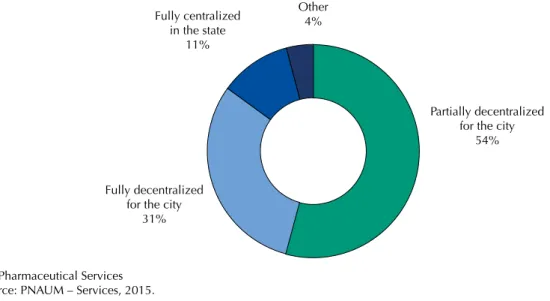
Of the calculated sample of 600 cities eligible for the study, 369 interviews were conducted (61.5%) with municipal secretaries of health and 507 (84.5%) with those responsible for PS. According to the secretaries, 54% of Brazilian cities have adopted the partial decentralization regime agreeing with the implementation of CBAF resources, followed by 30.8% who have adopted the fully decentralized regime (Figure 1). he PS coordination had full autonomy of management of the inancial resources deined for PS in 22.7% of the cities, and partial in 45.6%. Of the cities evaluated, 67.3% made expenses intended for the structuring of PS in the year preceding the research. CBAF resources were used to cover demands for medicines not belonging to this component by 35.4% of the cities. 9.7% of municipal secretaries of health stated that the resources intended for CBAF were suicient to meet the demands of the population. From the perspective of those responsible for PS, the PS coordination had full autonomy for managing inancial resources in 19.7% of the cities, and partial autonomy in 38.2%. hey reported that 70.8% of Brazilian cities had a computerized system for PS management, especially in the South region (88.8%). Activities for qualiication and/or professional training for workers of PS occurred in 11.9% of the cities (Table 1).
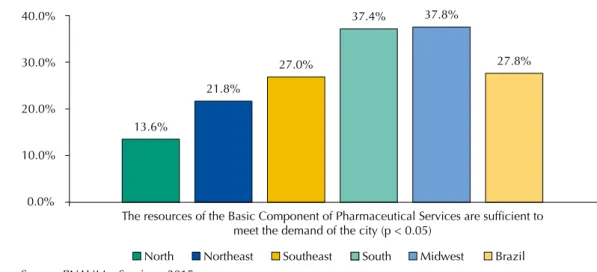
More than half of the cities received, in the year preceding the survey, resources from the states or federal government aimed at the structuring of PS. Just over 50% of the cities made some expense with PS structuring. As stated by the interviewees, 86.4% of cities applied, in the year before the survey, the total value agreed of the corresponding credit of CBAF, compared with 72.7% of states (Table 1). When asked about the suiciency of the CBAF’s inancial resources to meet the demand of the city, about 37% of those responsible for PS in the South and Midwest regions evaluated it positively, while in the North and Northeast regions these percentages were only 13.6% and 21.8%, respectively (Figure 2).
he existence of a Comissão Permanente de Licitação (CPL – Permanent Bidding Committee) – exclusive for the purchase of medicines in the city –, was reported in 37.7% of cities, especially in the Midwest region, with 49%. When asked whether the Programa Farmácia Popular do Brasil
(PFPB – Brazilian Popular Pharmacy Program) inluenced the purchase of medicines carried out by the cities, 50.9% of them have registered airmative responses. he North region presented the lowest index of interference (33.2%) and the Southeast, the largest one (61.7%). 66.6% of cities have purchased medicines to meet judicial demands in the year preceding the research. he Midwest region stood out with the highest index (75.3%) and the North region with the lowest (47.5%) (Table 1).
Fully centralized in the state
11%
Fully decentralized for the city
31%
Partially decentralized for the city
54% Other
4%
PS: Pharmaceutical Services Source: PNAUM – Services, 2015.
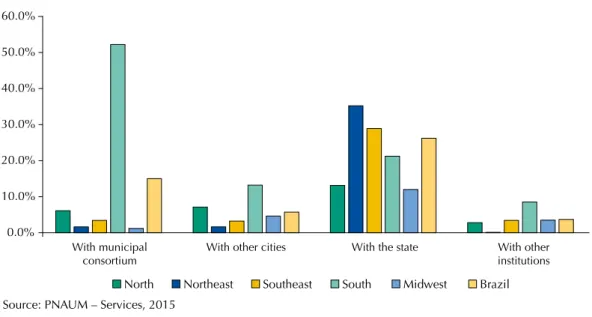
medicines (26.2%), followed by consortium between cities (15.0%). he South region has adopted the strategy of consortia in 52.2% of the cities (Figure 3). Purchase of medicines carried out in local pharmacies/drugstores was registered in 58.3% of cities, with emphasis for the cities of the North, which had the highest percentage (73.4%) (Figure 4).
Table 1. Data reported by those responsible for municipal Pharmaceutical Services, according to Brazilian regions. National Survey on Access, Use and Promotion of Rational Use of Medicines – Services, 2015.
Variable Midwest North Northeast South Southeast Brazil
na % (95%CI) na % (95%CI) na % (95%CI) na % (95%CI) na % (95%CI) na % (95%CI)
The coordination of PS has autonomy in financial management
Yes, fully 17 19.5 (12.4–29.2) 10 10.8 (5.6–19.6) 16 15.3 (8.7–25.3) 24 24.3 (16.7–33.9) 20 22.8 (15–33) 87 19.7 (15.7–24.4) Yes, partially 30 30.9 (22.2–41.3) 22 25 (16.7–35.6) 35 38.4 (28–49.9) 43 42.3 (32.8–52.5) 38 39.8 (29.9–50.7) 168 38.2 (33–43.6) Existence of a computerized system for the management of PSb
Yes 54 53.5 (43.5–63.3) 41 40.1 (30.5–50.5) 60 61.2 (50–71.4) 95 88.8 (80.9–93.7) 81 78.7 (69.2–85.8) 331 70.8 (66–75.1) Existence, in the city, of some type of qualification and/or training for PS professionals
Yes 11 14.8 (8.4–24.9) 9 10.4 (5.3–19.2) 8 11.6 (5.6–22.4) 11 9.5 (4.8–17.8) 11 13.5 (7.6–22.8) 50 11.9 (8.6–16.2) The city received resources (from the State or Federal governments) intended for structuring PS in the past year
Yes 23 43.2 (30.4–57) 23 35.8 (24.6–48.7) 37 60.6 (47.2–72.5) 27 42.1 (30.5–54.7) 35 53.9 (41.4–65.9) 145 51.3 (44.8–57.7) The city spent with the structuring of PS in the past year
Yes 44 58.5 (47–69.1) 35 44 (32.9–55.8) 50 62.5 (50.5–73.2) 56 59.1 (48.4–69) 35 44.3 (33–56.2) 220 54.8 (49.1–60.5) The city applied, in the past year, the total value agreed of the corresponding credit of the Basic Component of Pharmaceutical Services
Yes 37 85.3 (70.8–93.3) 41 73.7 (59.8–84.1) 46 80.5 (67–89.4) 59 92.7 (83–97) 63 90.2 (79.8–95.5) 246 86.4 (81.1–90.4) The state applied, in the past year, the total value agreed on the corresponding entry of the Basic Component of Pharmaceutical Servicesb
Yes 25 77 (59.4–88.4) 22 57.2 (40.7–72.3) 27 49.9 (35.1–64.8) 47 86.8 (74.7–93.7) 54 84.2 (72.4–91.6) 175 72.7 (65.7–78.6) Existence of a permanent bidding committee exclusively for the purchase of medicines in the city
Yes 43 49 (38.6–59.5) 34 41.4 (31.2–52.4) 26 33.6 (23.5–45.6) 40 36.9 (27.8–46.9) 39 38.1 (28.5–48.7) 182 37.7 (32.6–43) The Popular Pharmacy Program influences the purchase of medicines by the cityb
Yes 54 56.1 (45.8–65.9) 32 33.2 (24.2–43.7) 29 35.9 (25.7–47.5) 61 58.4 (48.6–67.7) 60 61.7 (51.4–71.1) 236 50.9 (45.8–56) The city purchased medicines to meet judicial demands in the past yearb
Yes 71 75.3 (65.3–83.2) 43 47.6 (36.7–58.6) 52 59 (46.3–70.6) 73 69.2 (59.1–77.7) 74 72.4 (62.3–80.7) 313 66.6 (61.3–71.5) PS: pharmaceutical services
a N value non-weighted b p < 0.05
Source: PNAUM - Services, 2015.
13.6%
21.8%
27.0%
37.4% 37.8%
27.8%
0.0% 10.0% 20.0% 30.0% 40.0%
The resources of the Basic Component of Pharmaceutical Services are sufficient to meet the demand of the city (p < 0.05)
North Northeast Southeast South Midwest Brazil
Source: PNAUM – Services, 2015.
DISCUSSION
Medicines are a vital input in health care22, as well as in the process of sustainability of health
systems before the volume of inancial resources to acquire these items16. In a scenario of
inite resources and ininite demands, the need for proper management of the resources employed in PS is imperative. In this sense, the results achieved by PNAUM – Services help overcoming this challenge, since they allow one to know and to discuss the factors related to the management of inancial resources within the CBAF.
CBAF12 is intended for the purchase of medicines and supplies, as speciied in Annex I and Annex IV of the Relação Nacional de Medicamentos Essenciais (Rename – National List of Essential Medicines),
including those related to the diseases and health programs of primary health care, dedicated to meet the individual and collective basic needs of the population9. Other items are also part of
CBAF: herbal medicines, homeopathic matrices and mother tinctures of Brazilian Homeopathic Pharmacopoeia, and the medicines listed in Group 3 of the PS Specialized Component.
0.0% 10.0% 20.0% 30.0% 40.0% 50.0% 60.0%
With municipal consortium
With other cities With the state With other institutions
North Northeast Southeast South Midwest Brazil
Source: PNAUM – Services, 2015
Figure 3. Partners that the cities have established for the purchase of medicines, according to the representatives of municipal Pharmaceutical Services, by regions and Brazil. National Survey on Access, Use and Promotion of Rational Use of Medicines – Services, 2015.
0.0% 10.0% 20.0% 30.0% 40.0% 50.0% 60.0% 70.0% 80.0%
Always/repeatedly Sometimes Rarely/never
North Northeast Southeast South Midwest Brazil
Source: PNAUM – Services, 2015
secretariats of health determine, in their respective Comissões Intergestores Bipartite
(CIB – Bipartite Intermanagement Committees), the form of agreement for using the CBAF resources. According to data collected with secretaries of health, 11% of cities agreed to use CBAF resources centrally by the state manager, who took responsibility for acquisition, logistics, and supplies in the cities. Other 31% agreed on the completely decentralized form in municipal management and became responsible for the direct acquisition of the items. However, more than half (54%) chose the partially decentralized mode, which means that the state management of SUS maintained some responsibility for the medicines purchase, even allowing the cities to adhere to their Price Registration Proceedings6.
We observed that the PS inancial resource management was held autonomously by those responsible for PS in only 19.7% of cities, although most cities (70.8%) have a computerized system for PS management , which allows monitoring and control by the secretariat of health. Regarding purchases made by cities, 26.2% of them took place in partnership with the state secretariats of health, with emphasis on the Northeast (35.2%) and Southeast (28.9%) regions. We highlight the possibility of states in these regions establishing partnerships with the major public laboratories. he form of the acquisition accomplished by public consortia was adopted by 15% of the cities, especially in the South, where more than 50% of its cities adopted this form of purchase. he Consórcio Paranáa
contributed heavily to this result, and the vast majority of cities of this state is associated with it. he North region was the one that reported the lowest rate of partnerships for medicines purchases.
Regardless of the scope of SUS management, all purchases of supplies and medicines should be carried out in agreement with the rules that control purchases, biddings, and contracts of the Public Administration3. Almost half of PS managers reported they always, repeatedly,
or sometimes purchased medicines in local pharmacies or drugstores. Probably, this practice, which had the biggest instances recorded in the Midwest and South, was in disaccord with current standards.
It is also the managers’ responsibility to register all inancial resources related to PS in the Health Plan, in the Annual Schedule, and in the Annual Management Report, as well as to promote the monitoring of these resources, ensure the balance between responsibility and participation in the inancing, and provide analyses with information on prices, quantities purchased, and number of patients met12.
Still regarding the purchase of medicines, we highlight the practice declared by 35.4% of secretaries: using CBAF resources to situations other than those reported in the agreements. Also, the fact that more than 66% of the cities have bought medicines intended to meet judicial demands is noteworthy. In fact, health litigation has the positive efect of ensuring access to medicines in shortage situations, even illing the lack of care or enabling the incorporation of new health technology. However, it represents a great challenge for SUS, as it puts at risk the achievement of the constitutional principles of the system and causes diiculties for PS management, which may compromise the quality of the use of medicines17.
It is believed that this phenomenon is aggravated by the lack of trained human resources, which causes weaknesses in the management of the demands of the population, hindering the appropriate guidance to patients in the dispensing units, which ultimately start to operate to a limited extent, as a simple place to deliver medicines18. he fact that only 12% of
the cities have registered investments in the training of professionals in PS can corroborate such understanding.
A signiicant consequence of litigation is the disorganization of the health systemb, especially
in the processes of acquisition, since judicial decisions are issued on the basis of urgency, forcing managers to often perform direct acquisitions in pharmacies or drugstores. Certainly, these acquisitions occur at an unfavorable price compared to other forms, which tends to
a Consórcio Intergestores Paraná
Saúde (Health Intermanagement
Consortium of Parana), founded in 1999, constituted in the form of a public consortium, with legal personality under private law, not-for-profit. It gathers 394 cities of the 399 of Paraná and carries out the acquisition of the medicines listed in the Basic Pharmaceutical Services of the state.
b Barroso LR. Da falta de
aggravate one of the consequences of this phenomenon: the use of inancial resources for the care of individual needs rather than collective needs19,b.
Still concerning the disorganization of the supplies and medicines purchase, our results showed the interference of PFPB in the acquisition of CBAF medicines. he PFPB was created with the purpose of broadening citizens’ access to essential medicines for the treatment of the most common diseases, by the accreditation of private drugstores, promoting the dispensing of medicines free of charge and/or in co-payment system4. he inancing of these
medicines takes place by the transfer of resources from the Brazilian Ministry of Health to the accredited establishments13. In this context, and given a scenario of insuicient resources,
municipal secretariats of health may choose not to purchase the list of products ofered by the PFPB. It must be considered that the acquisition by cities can be impaired depending on the ability of manufacturers to meet both public and private networks, either by the limitation of production or by the practicality in the process of selling with prices without the discounts conditioned to the sales for the Government. Still, apart from the aspect of organization of processes, the economic aspect must be considered. Recent real world evidence registered that the direct production of PS by the public sector, carried out by a network of its own, is economically more favorable given the outsourcing of PFPB services8.
he results related to the funding for structuring and maintaining PS are worrisome. Little more than half of the cities (54.3%) spent in this area, even with the record that 51.3% of cities received some type of inancial incentive from the federal or state government. Even lower rates were veriied for the investment in qualiication and/or professional training for PS workers. his scenario shows a progressive dismantling of the services rendered, in contrast with the fact that, since 2010, it is possible to use up to 15% of the state and municipal resources to inance PS improvements, namely: adjustment of the infrastructure of SUS pharmacies, acquisition of equipment and furniture to support PS actions, and promotion of activities linked to the continuing education and qualiication of human resources14.
As a way of supporting the national qualiication of PS, the Brazilian Ministry of Health instituted, in 2012, the Programa Nacional de Qualiicação da Assistência Farmacêutica no
Âmbito do SUS (QUALIFAR-SUS – National Program for Qualiication of Pharmaceutical Services of SUS), prioritizing cities of up to 100,000 inhabitants classiied in the range of extreme poverty. he program was organized into four areas: infrastructure, education, information, and care. he funding takes place by the transfer of federal resources destined to acquisition of furniture and equipment required for the structuring of public Centrais de Abastecimento Farmacêutico (CAF – Pharmaceutical Supply Centers) and Pharmacies in primary health care, in addition to the maintenance of pharmaceutical services. Until 2016, resources were destined to 1,582 cities, totaling 28% of the Brazilian cities. he investment resource, delivered in a single installment, varies, by population, between R$11.2 thousand and R$24 thousand. he total resource cost is R$ 24 thousand/year, delivered in quarterly form. Although it is an important and necessary program, it shows small impact, either as a source of PS inancing or by the number of cities covered – mainly by the low population coverage achieved.
he PS in SUS are funded with municipal, state, and federal budgets, according to the peculiarities of their components: basic, specialized, or strategic. he CBAF is inanced with resources from the three levels of government and has application of minimum values, per inhabitant/year, based on the population of each city12. he resources are transferred monthly
National Policy of Integral Health Care for Persons Deprived of Liberty in the Prison System). Between 1999 and 2016, a 390% increase was registered in the minimum value per capita/year of tripartite inancing of CBAF14. Similarly, between 2005 and 2009, there was a 61% increase in
the total amount spent for purchase of medicines by the three spheres of SUS management21.
According to our results, 72.7% of the states and 86.4% of the cities applied the total value agreed to inance the CBAF. However, only 9.7% of secretaries of health consider the inancial resources intended for the CBAF suicient to meet the population’s needs. What actually happens is that the values for the CBAF are outdated, especially by the SUS federal manager, responsible for over 50% of the funding. he inancial gap, in detriment to the possibility of states and cities having increased values in agreements in the respective CIB, exceeds 50%, when applied to the Broad Consumer Price Index, and becomes even greater if we consider the estimated population growth in the period, more than 12 million peoplec
. he discrepancies were exacerbated in 2013, when some medicines of other components migrated to the CBAF, without their respective inancial contribution15. In this sense, the cities increased their own
resources for public health actions and services (ASPS) and for per capita expenses with medicines. Between 2010 and 2016, the average percentage of expenses with ASPS jumped from 20.37 to 23.27%d, above the 15% recommended by the Federal Constitution. Between 2010 and
2015, the median medicines per capita expenses of the cities jumped from R$ 15.71 to R$ 21.04d.
Despite the freezing of PS resources, the complete exhaustion of the current model of PS inancing takes place, derived from the model of SUS inancing. he indings of this research base this understanding as well as the law 141/20125, which regulated, to the inancing of
the system, the mandatory use of apportionment criteria for the resources of the federal and state governments transferred to other entities, aiming at the progressive reduction of regional disparities. he apportionment of resources linked to ASPS, included there the inancing of all primary health care, must consider the health needs of the population, the epidemiological, demographic, socio-economic, and spatial dimensions, as well as the ability to ofer health actions and services, and also the combination of the criteria governed by the Law2. Additionally, it must employ a method of calculation that considers a general
index, built upon the health needs, health care networks, and technical performance of ASPS execution for each of the management levels20. As established in law, this is a funding
model agreed and standardized for PS, as well as for the SUS, since 2012.
he application of the questionnaire by telephone is a limitation of this research, because it could not allow the respondent access or query to auxiliary material. Also, this is a cross-sectional study, which relects only the moment of the survey, not enabling the establishment of temporal relationships between the results found.
Finally, the results observed in this study show serious deiciencies in the inancing and management of the CBAF inancial resources. Among these, we highlight: little concern with the formality in the execution of public resources, either by evidence of acquisition or destination of resources outside of the regulatory standards or by the non-application by the states and cities of their respective corresponding credits; expenses incurred for meeting individual demands to the detriment of collective ones, and; statement of most managers that the resources intended for the CBAF are insuicient to cover needs and demands of the population. he fact that the main inancial incentive of PS is below by more than 50% in its value since 2010 corroborates this understanding, as well as the inding, depending on the results obtained and due to legal regulations, of the exhaustion of the current model of PS inancing.
In the context of the CBAF, major challenges have not yet been overcome. Considering the multiplicity of responsibilities between the management levels of the SUS to ensure the population’s access to medicines in primary health care, addressing these challenges requires revising the PS inancing model, the Política Nacional de Medicamentos (PNM – National Drug Policy), and the Política Nacional de Assistência Farmacêutica (PNAF – National Policy of Pharmaceutical Services).
c Brazilian Institute of Geography
and Statistics. The total population, men and women 2000-2030. Rio de Janeiro: IBGE; 2013 [cited December 11, 2016]. Available from: http://www.ibge.gov.br/home/ estatistica/populacao/projecao_ da_populacao/2013/.
d Ministry of Health (BR).
REFERENCES
1. Álvares J, Alves MCGP, Escuder MML, Almeida AM, Izidoro JB, Guerra Junior AA, et al. Pesquisa Nacional sobre Acesso, Utilização e Promoção do Uso Racional de Medicamentos: métodos.
Rev Saude Publica. 2017;51 Supl 2:4s. https://doi.org/10.11606/S1518-8787.2017051007027
2. Brasil. Lei nº 8.080, de 19 de setembro de 1990. Dispõe sobre as condições para a promoção, proteção e recuperação da saúde, a organização e o funcionamento dos serviços correspondentes e dá outras providências. Diario Oficial Uniao. 20 set 1990. [cited 2017 Jan 10]. Available from: http://www.planalto.gov.br/ccivil_03/leis/L8080.htm
3. Brasil. Lei nº 8.666, de 21 de junho de 1993. Regulamenta o art. 37, inciso XXI, da Constituição Federal, institui normas para licitações e contratos da Administração Pública e dá outras
providências. Diario Oficial Uniao. 22 jun 1993; Seção 1:8269. Publicação retificada em 6 de
julho de 1994.
4. Brasil. Decreto nº 5.090, de 20 de maio de 2004. Regulamenta a Lei nº 10.858, de 13 de abril
de 2004, e institui o programa “Farmácia Popular do Brasil”, e dá outras providências. Diario
Oficial Uniao. 21 maio 2004 [cited 2017 Jan 10]; Seção 1:6. Available from: http://www. planalto.gov.br/ccivil_03/_ato2004-2006/2004/decreto/d5090.htm
5. Brasil. Lei Complementar nº 141, de 13 de janeiro de 2012. Regulamenta o § 3o do art. 198 da Constituição Federal para dispor sobre os valores mínimos a serem aplicados anualmente pela União, Estados, Distrito Federal e Municípios em ações e serviços públicos de saúde; estabelece os critérios de rateio dos recursos de transferências para a saúde e as normas de fiscalização, avaliação e controle das despesas com saúde nas 3 (três) esferas de governo; revoga dispositivos das Leis nos 8.080, de 19 de setembro de 1990, e 8.689, de 27 de julho de 1993; e dá outras
providências. Diario Oficial Uniao. 16 jan 2012 [cited 2017 Jan 10]. Available from: http://www.
planalto.gov.br/ccivil_03/leis/LCP/Lcp141.htm
6. Brasil. Decreto nº 7.892, de 23 de janeiro de 2013. Regulamenta o Sistema de Registro de Preços previsto no art. 15 da Lei nº 8.666, de 21 de junho de 1993. Diario Oficial Uniao. 24 jan 2013 [cited 2017 Jan 3]; Seção 1:2. Available from: http://www.planalto.gov.br/ ccivil_03/_ ato2011-2014/2013/Decreto/D7892.htm
7. Brasil. Lei nº 13.414, de 10 de janeiro de 2017. Estima a receita e fixa a despesa da União para
o exercício financeiro de 2017 [Lei Orçamentária Anual]. Diario Oficial Uniao. 11 jan 2017
[cited 2016 Jan 3]; Seção 1:70. Available from: http://www.planalto.gov.br/ccivil_03/_ato2015-2018/2017/lei/L13414.htm
8. Garcia MM, Guerra Junior AA, Acúrcio FA. Economic evaluation of the Programs Rede Farmácia de Minas do SUS versus Farmácia Popular do Brasil. Cienc Saude Coletiva. 2017;22(1):221-33. https://doi.org/10.1590/1413-81232017221.15912015
9. Giovanella L, Mendonça MHM. Atenção primária à saúde. In: Giovanella L, Escorel S, Lobato LVC, Noronha JC, Carvalho AI, organizadores. Políticas e sistemas de saúde no Brasil. 2.ed. rev ampl. Rio de Janeiro: Editora Fiocruz; 2012. p.493-545.
10. Helfer AP, Camargo AL, Tavares NUL, Kanavos P, Bertoldi AD. Capacidade aquisitiva e
disponibilidade de medicamentos para doenças crônicas no setor público. Rev Panam Salud
Publica. 2012:31(3):225-32. https://doi.org/10.1590/S1020-49892012000300007
11. Ministério da Saúde (BR). Portaria nº 2.077 de 17 de setembro de 2012. Institui a Pesquisa Nacional sobre Acesso, Utilização e Promoção do Uso Racional de Medicamentos no Brasil
(PNAUM). Diario Oficial Uniao. 19 set 2012 [cited 2017 Feb 12]; Seção 1:26. Available from:
http://bvsms.saude.gov.br/bvs/saudelegis/gm/2012/prt2077_17_09_2012.html 12. Ministério da Saúde (BR). Portaria nº 1.555, de 30 de julho de 2013. Dispõe sobre
as normas de financiamento e de execução do Componente Básico da Assistência
Farmacêutica no âmbito do Sistema Único de Saúde (SUS). Diario Oficial Uniao. 31 jul
2013 [cited 2017 Jan 3]; Seção 1. Available from: http://portalarquivos.saude.gov.br/images/ pdf/2014/outubro/17/FAQ—-Portaria-CBAF.pdf
13. Ministério da Saúde (BR). Portaria nº 111, de 28 de janeiro de 2016. Dispõe sobre o Programa
Farmácia Popular do Brasil (PFPB). Diario Oficial Uniao. 29 jan 2016; Seção 1:104. Available
from: http://bvsms.saude.gov.br/bvs/saudelegis/gm/2016/prt0111_28_01_2016.html 14. Ministério da Saúde (BR). Portaria nº 4.217 de 28 de dezembro de 2010. Aprova as
normas de financiamento e execução do Componente Básico da Assistência Farmacêutica.
Diario Oficial Uniao. 30 dez 2010. Revogada pela PRT nº 1.555/GM/MS de 30.07.2013, que
as regras de financiamento e execução do Componente Especializado da Assistência
Farmacêutica no âmbito do Sistema Único de Saúde (SUS). Diario Oficial Uniao.
31 jul 2013 [cited 2017 Jan 10]; Seção 1:69. Available from: http://bvsms.saude.gov.br/bvs/ saudelegis/gm/2013/prt1554_30_07_2013.html
16. Mota DM, Silva MGC, Sudo EC, Ortún V. Uso racional de medicamentos: uma abordagem
econômica para tomada de decisões. Cienc Saude Coletiva. 2008;13 Supl:589-601.
https://doi.org/10.1590/S1413-81232008000700008
17. Pepe VLE, Acurcio FA. Assistência farmacêutica e demandas judiciais de medicamentos no Sistema Único de Saúde. In: Osorio-de-Castro CGS; Luíza VL, Castilho SR, Oliveira MA, Jaramillo NM, organizadores. Assistência farmacêutica: gestão e prática para profissionais de saúde. Rio de Janeiro: Editora Fiocruz; 2014. v.1, p.325-39.
18. Pinto CDBS, Osorio-de-Castro CGS. Gestão da Assistência Farmacêutica e demandas judiciais
em pequenos municípios brasileiros: um estudo em Mato Grosso do Sul. Saude Debate.
2015;39 Nº Espec:171-83. https://doi.org/10.5935/0103-1104.2015S005152 19. Sant’Ana JMB, Pepe VLE, Osorio-de-Castro CGS, Ventura M. Essencialidade
e assistência farmacêutica: considerações sobre o acesso a medicamentos
mediante ações judiciais no Brasil. Rev Panam Salud Publica. 2011:29(2):138-44.
https://doi.org/10.1590/S1020-49892011000200010
20. Santos L, Mendes A. Notas técnico-jurídicas sobre critérios e metodologia de rateio dos recursos
federais para os Estados e Municípios no SUS. BDM Bol Direito Munic. 2014;30(9):647-64.
21. Vieira FS, Zucchi P. Financiamento da Assistência Farmacêutica no Sistema Único de Saúde.
Saude Soc. 2013;22(1):73-84. https://doi.org/10.1590/S0104-12902013000100008
22. Vieira FS, Mendes ACR. Evolução dos gastos com medicamentos: crescimento que preocupa. In: Anais do VIII Encontro da Associação Brasileira de Economia da Saúde; 7-9 nov 2007; São Paulo (SP). Rio de Janeiro: ABES; 2007 [cited 2017 Jan 3]. Available from: http://abresbrasil.org. br/ sites/default/files/mesa_07_-_fabiola_gastos_medicamentos.pdf
Funding: Department for Pharmaceutical Services and Strategic Health Supplies and Department of Science and Technology of the Secretariat of Science, Technology, and Strategic Supplies of the Brazilian Ministry of Health (SCTIE/MS – Process 25000.111834/2), Decentralization of FNS Resources.
Authors’ Contribution: Data analysis and interpretation: DRF, RCRMN, IAG, OMS, SNL, MGOK. Writing of the manuscript: DRF, RCRMN. Critical review of the manuscript: EAC, KSC, FAA, JA, AAG Jr. All authors declare to be responsible for all aspects of the study, ensuring its accuracy and completeness.