High pressure studies on bis(
L
-histidinate)nickel(II) monohydrate
J.R. Maia
a, J.A. Lima Jr
b,⁎
, P.T.C. Freire
b, F.E.A. Melo
b, A.S. de Menezes
c, C.M.R. Remédios
d, L.P. Cardoso
e aFaculdade de Filosofia Dom Aureliano Mattos, Universidade Estadual do Ceará, CEP 63.900-000 Limoeiro do Norte, CE, BrazilbDepartamento de Física, Universidade Federal do Ceará, C.P. 6030, Campus do Pici, 60440-970 Fortaleza, CE, Brazil cDepartamento de Física, CCET, Universidade Federal do Maranhão, Centro Tecnológico, CEP 65085-580 São Luís, MA, Brazil dInstituto de Ciencias Exatas e Naturais, Universidade Federal do Pará, CEP66075-110 Belém, PA, Brazil
eInstituto de Física Gleb Wataghin, Universidade Estadual de Campinas, CEP 13083-859 Campinas, SP, Brazil
a b s t r a c t
a r t i c l e
i n f o
Article history:
Received 22 May 2017
Received in revised form 10 August 2017 Accepted 13 August 2017
Available online 14 August 2017
Raman spectra of bis(L-histidinate)nickel(II) monohydrate crystal were obtained for pressures up to 9.5 GPa. Our results show the disappearance of some of the Raman modes and the appearance of other modes. These modifi-cations evidence that the sample undergoes phase transitions at around 0.8 and 3.2 GPa. The role played by the Ni ions and hydrogen bonds in the dynamics of the phase transitions is discussed. Under decompression, down to atmospheric pressure, the original Raman spectra are recovered, showing that both phase transitions are fully reversible.
© 2017 Elsevier B.V. All rights reserved.
Keywords:
Raman spectroscopy High pressure Phase transition
Bis(L-histidinato)nickel(II) monohydrate Metal organic complex
1. Introduction
Metal ions are present in a huge variety of biological systems and play essential roles in the composition and activity of enzymes and pro-teins[1]. The biological functions of compounds containing metal ions are closely related to the basic chemical properties of the metals and also with the conformation of the ligand[2].
High pressure has been widely used as a useful tool for investigating the physical and chemical properties of materials and, especially, of co-ordination compounds. These complexes exhibit many interesting properties such as changes in the coordination number[3], spin-crossover[4], piezochromism[5], negative linear compressibility[6], magnetism[7], and phase transitions[8,9].
Coordination compounds of metallic ions and organic molecules have been synthetized for a long time[10–13]and the number of papers dealing with their structural, vibrational, thermal and magnetic proper-ties is increasing[14–23]. However, studies reporting the behavior of these materials under pressure are scarce[24,25], especially in the case where the ligand is an amino acid molecule[3,26].
Gould et al.[26]performed an X-ray diffraction experiment under pressure on a nickel aspartate compound (Ni(L-Aspartate)(H2O)2. In that work, a phase transition was observed between 0.58 and 1.26 GPa. It was also noted that both the ambient and the high pressure
phase are orthorhombic (both belonging to P212121space group) and that during the phase transition the Ni(II) octahedral rotates causing a drastic shift in the position of the axial bonds and a rearrangement in the hydrogen bonds of the solvent water molecule.
Under pressure, the Cu2(OH)(citrate)(guanidine)2complex pre-sents two single-crystal-to-single-crystal phase transitions[25]. Partic-ularly, in the first phase transition, occurring at 2.9 GPa, it was observed the increase in the coordination number of the Cu center due to the conversion of long intermolecular interactions into covalent bonds [25]. For the FeNb compound, [FeII (pyrazole)4]2[Nb-IV(CN)8]·4H2O, which was investigated under pressure [4], new
Raman bands observed in the CN stretching region were associated with the spin crossover at the FeIIsite, since the CN unit links the Fe and Nb ions. The same complex also exhibited piezochromism under compression. Its color changes from dark pink at ambient pressure, through purple, blue and dark blue at 2.0 GPa. It is important to mention that the analogue complex MnNb, [MnII(pyrazole)4]2[NbIV(CN)8]· 4H2O, was also studied. However, neither spin crossover, nor piezochroism have been observed by compressing these systems[4].
So far, no pressure-dependent study of the vibrational properties of metal-organic complexes with amino acid ligands has been published. In this work, we present a detailed pressure-dependent Raman spectra study of bis(L-histidinate)nickel(II) monohydrate up to 9.5 GPa. No change in the color of the crystal was observed, but modifications in the Raman modes suggest that the crystal undergoes two phase transi-tions in this pressure range.
⁎ Corresponding author.
E-mail address:alves@fisica.ufc.br(J.A. Lima).
http://dx.doi.org/10.1016/j.saa.2017.08.040 1386-1425/© 2017 Elsevier B.V. All rights reserved.
Contents lists available atScienceDirect
Spectrochimica Acta Part A: Molecular and Biomolecular
Spectroscopy
2. Experimental
Needle-like violet crystals of bis(L-histidinate)nickel(II) monohydrate (hereafterL-histidinate) were obtained by slow evapora-tion, as reported in Ref.[27]. Typical crystal dimensions were of 6 mm ([100] direction) × 3 mm × 2 mm. Raman spectra were recorded by
using a triple-grating spectrometer (Jobin-Yvon T64000) equipped with a N2-cooled charge-coupled device (CCD) detection system. The 514.5 nm line of an argon ion laser was used for excitation. An Olympus microscope lens with a focal distance fD= 20.5 mm and numerical ap-erture NA = 0.35 was used to focus the laser beam on the sample sur-face. The spectrometer slits were set for a resolution of 2 cm−1. In the high pressure experiment we studied the sample between ambient pressure and 9.5 GPa using a membrane diamond anvil cell (MDAC) [28]. We used diamonds anvils with a culet of 400μm in diameter. A 150 μm-diameter hole in a stainless-steel (200 μm of thickness
preindented to 40μm) was loaded with nujol. The pressure was
moni-tored using the rubyfluorescence lines[29]. Two sets of experiments were performed. In thefirst we compressed the sample up to 9.5 GPa, then we released the pressure and acquired some spectra down to 0.2 GPa. After we recovered the initial spectrum we performed another round of pressure measurements on the same sample. In this second round, only few spectra were recorded, but the acquisition time and the number of acquisitions were greater than those of thefirst set in order to obtain a better signal to noise ratio.
3. Results
The sample was characterized by X-ray powder diffraction and Rietveld refinement method. Our results show that theL-histidinate crystallizes in a monocyclic structure and space group P21(C22), with four molecules (Z = 4) per unit cell, with a volume equal to 1534.9 Å3 and lattice parameters a = 29.406(4) Å, b = 8.2675(9) Å, c = 6.3136(6) Å andβ= 90.01(1) in accordance with reference[27]. The Ni atom presents octahedral coordination binding by two histidine mol-ecules (binding by two Nitrogen and one Oxigen atoms) and a water molecule. The octahedron is slightly deformed and the molecule of L-histidinate forms six hydrogen bonds.Fig. 1shows a representation of theL-histidinate molecule.
Fig. 2shows the Raman spectra of theL-histidinate crystal obtained in the spectral range 50–350 cm−1
from ambient pressure up to 9.5 GPa. In this paper, we will follow the Raman mode assignment Fig. 1.(a) Bis(L-histidinate)nickel(II) monohydrate molecule with enumeration of atoms.
(b) Projection of the structure in the ca plane. Nitrogen in blue, carbon in grey, nickel in green and oxygen in red.
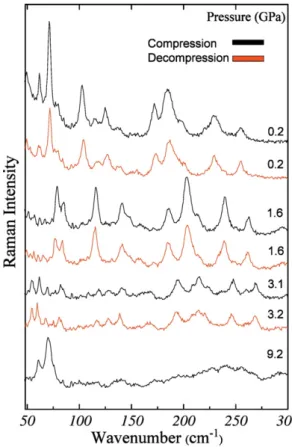
Fig. 2.Raman spectra of the bis(L-histidinate)nickel(II) monohydrate crystal for selected pressures (in GPa) in the spectral range 50–350 cm−1, in experiment 1 in (a) and in experiment 2
previously reported by Maia et al.[30]. In this region, the Raman modes with wavenumbers lower than 185 cm−1have contributions from the skeleton modes but can be classified as lattice modes. Thefirst change in the Raman spectra of this region is the disappearance of two modes at 0.8 GPa. These modes are centered at 61 and 115 cm−1respectively (marked by arrows). Also, a mode represented byδappears at 0.8 GPa
and becomes more intense as the pressure increases. Upon further com-pression, all modes in this region lose intensity, while three new modes (α,β, andγ) appear at around 50–75 cm−1for the Raman spectrum re-corded at 3.2 GPa. Among these three new modes only one, the modeβ,
gains intensity. Between 100 and 350 cm−1
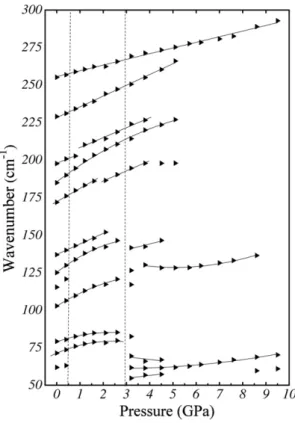
all modes remain with low intensities up to 9.5 GPa. The wavenumber vs pressure plot for the modes in the 50–300 cm−1region is shown inFig.3. It can be seen, the slope of the curves shows discontinuities at 0.8 and 3.2 GPa. All this modifications observed on external modes are evidence that this material has undergone two phase transitions on increasing pressure.
Fig. 4(a) shows the spectral region ranging from 350 to 700 cm−1. Thefirst two modes of this region, centered at 365 and 432 cm−1
, re-spectively, lose intensity with increasing pressure and are no longer ob-served in the Raman spectrum at 9.5 GPa. The third mode (centered at 471 cm−1
) was classified as a torsion of the NCC unit from the imidazole ring,τ(HNCC). Between 0.4 and 0.8 GPa, this mode splits into two peaks which remain visible until 3.8 GPa. In the spectrum recorded at 4.1 GPa only one mode is seen and, even with low intensity, it is observed up to 9.5 GPa. The behavior of this mode corroborates our hypotheses that this compound has undergone two phase transitions. The next two modes (centered at 486 and 556 cm−1) have low intensity even at am-bient pressure. For this reason, we will not assume that their disappear-ance is a result of the phase transitions. The last two modes of this region were observed at 632 and 657 cm−1in the spectrum recorded at ambient pressure, being classified as torsional modes of the imidazole ring. With increasing pressure no modification was observed at 0.8 GPa but further compression causes a splitting of both modes at 3.2 GPa. This splitting also reinforces our assumption that a phase transition takes place. InFig. 4(b) all these modifications are better observed.Fig. 5 pre-sents the wavenumber versus pressure plot for the modes observed in this spectral region.
The last spectral region, between 3100 and 3350 cm−1, is shown in Fig. 6. It is characterized by the presence of bands associated with both the stretching of CH and the stretching of the water molecule. Thefirst two modes centered at 3145 and 3155 cm−1
, respectively, were assigned as CH stretching modesν(CH) and maintain their intensity up to 2.6 GPa. Further compression up to 3.2 GPa causes a reduction in Fig. 3.Wavenumber versus pressure plot of Raman modes of bis(L-histidinate)nickel(II)
monohydrate crystal in the spectral range 40–350 cm−1.
Fig. 4.Raman spectra of the bis(L-histidinate)nickel(II) monohydrate crystal for selected pressures (in GPa) in the spectral range 350–700 cm−1, in experiment 1 in (a) and in experiment 2
the intensity of thefirst mode and the appearance of a new mode marked by an asterisk. At this pressure, these two modes also change their relative intensities. For pressures higher than 3.8 GPa the mode marked with an asterisk is no longer observed and gradually the re-maining modes lose intensity. The mode centered at 3180 cm−1 (marked with a grey square) has low intensity in all spectra recorded below 3.2 GPa. For pressures higher than 3.2 GPa it gains intensity.
The two modes appearing at frequencies higher than 3250 cm−1are classified as the stretching vibrations of the water molecule. Thefirst one (3280 cm−1at 0.1 GPa) has low intensity until 2.6 GPa; between 3.2 and 3.8 GPa it becomes more intense and for pressures higher than 5.1 it loses intensity and become broader, becoming practically im-perceptible. The last studied Raman mode (at 3306 cm−1for 0.1 GPa) becomes wider and loses intensity more drastically for pressures higher than 2.6 GPa. It is worth mentioning that all modes in this region pres-ent a discontinuity in the plot of the wavenumber versus pressure at 3.2 GPa (seeFig. 7). This fact, additionally, reinforces our hypotheses that a phase transition takes place between 2.6 and 3.2 GPa. It is also re-markable that the frequency of many of the Raman modes present a quadratic behavior as a function of pressure. The coefficients obtained in the adjustment of the wavenumber versus pressure plot are present-ed inTable 1.
The last aspect of interest is related with the reversibility of the phase transitions. For this purpose, Raman spectra were recorded by de-creasing pressure from 9.5 GPa down to 0.2 GPa. As shown inFig. 8, we observed that the Raman spectra were fully recovered after decompres-sion. This shows us that both phase transitions are reversible. No crack-ing or changcrack-ing in the color was observed in the range of pressure investigated.
4. Discussion
Phase transitions associated with modifications on internal and ex-ternal modes have been reported for some amino acid crystals in
previous works[31–38]. In the present study, changes in both the low-wavenumber and the internal modes, discontinuities in the wave-number vs. pressure plot and changes in the relative intensity of several bands allow us to suggest that bis(L-histidinate)nickel(II) monohydrate undergoes two phase transitions in the pressure range from 0 to 9.5 GPa. Now we discuss more about these phase transitions and will also try to compare our results with other studies performed on metallic complexes and amino acid crystals.
According to DFT calculations,[30]the lattice modes observed at 103, 115 and 125 cm−1can be associated with vibrations of the Nickel atom. This is important because as these modes change with increasing pressure we realize that the Ni atom participates considerably in the structural stability of the crystal. The Ni ion seems to play an important role in the second phase transition. Also, the analysis of the stretching of water molecules shows that the hydrogen bond plays a substantial role in the phase transition at 3.2 GPa. In a nickel aspartate dihydrated com-plex (Ni(L-aspartate)(H2O)2)[26]the Ni octahedral rotates during a phase transition observed between 0.58 and 1.26 GPa. Up to 1.26 GPa, no significant change in the Ni\\O bond lengths occurs, but all bonds in-crease and the tilting of the octahedral presents a considerable enlarge-ment. From 0.58 to 1.26 GPa the torsion angle Ni\\O\\C\\O increases from 23.9° to 52.7°. On increasing pressure up to 1.26 GPa, the unit cell presents an anisotropy that was associated with changes in the structure of the Ni(L-aspartate)(H2O)2molecule. Other phase transition that has contribution from the metal atom was observed in the Cu(L-aspartate)(H2O)2complex[3]. Pressurization of this material from 0.3 to 0.9 GPa results in a sudden compression of the distorted Jahn– Teller Cu\\O contact from 2.926 to 2.883 Å (corresponding to 37% of the total compression obtained in the experiment). On increasing pres-sure to 6.8 GPa, the most compressible Cu–L bond occurs in the Jahn– Teller axial Cu\\O bond, Cu1–O6, which decreases by 0.055 Å, while the long Cu1–O4 contact decreases by 0.278 Å. On increasing pressure up to 7.9 the distorted Cu1–O4 bond compress significantly again. This Fig. 5.Wavenumber versus pressure plot of Raman modes of bis(L-histidinate)nickel(II)
monohydrate crystal in the spectral range 350–700 cm−1.
unusual compressibility behavior observed in the Jahn–Teller Cu\\O bonds on increasing pressure above 6.8 GPa coincides with the discon-tinuity in the compression behavior in the unit cell dimensions, which implies that the compression of the axial Cu\\O bonds are the driving force for this transition in which the long Cu\\O interaction has been converted into a primary coordination bond, increasing the coordina-tion number from 5 to 6[3].
It is worthy to compare this result with those observed inL-histidine hydrochloride monohydrated (LHHM)[39]. Modifications in the Raman profile and changes in the slope of the wavenumber vs. pressure curves have indicated that this crystal undergoes a phase transition between 2.7 and 3.1 GPa. On comparing the crystalline structure of both crystals one canfigure out why LHHM resists almost 2.0 GPa more than L-histidinate before showing structural modifications. In the L-histidinate the molecules are more distorted than in the LHHM crystal. The torsional angle C1–C2–C3, and C2–C3–C4 in LHHM are 112.84° and 115.18°[40]while inL-histidinate these angles in one of the mole-cule are 109.52° and 112.99°[27]. InL-histidinate the molecule forms seven hydrogen bonds and in LHHM it forms more bonds (nine hydro-gen bonds). Generally, these bonds are longer (for instance, the average bond length formed by water molecule in LHHM is 2.910 Å and in L-histidinate is 2.876 Å). So, we believe that the less distorted molecules, the greater number of hydrogen bonds and longer bonds makes the LHHM structure more resistant to the stress caused by the pressure and only forPN2.6 GPa some modifications are induced.
Modifications in the modes classified as torsions of imidazole ring are additional support indicating that the Ni interferes in the phase tran-sition since one of the Nitrogen atom of imidazole ring is bonded to the Ni atom. The splitting of modes centered at 471, 632, 657, and 3155 cm−1are relevant modi
fications that support our hypothesis. As each Ni atom bonds two histidine molecules we can interpret this Fig. 7.Wavenumber versus pressure plot of Raman modes of bis(L-histidinate)nickel(II)
monohydrate crystal in the spectral range 3100–3400 cm−1.
Table 1
Raman shift and pressure coefficients of some modes of bis(L-histidinate)nickel(II) at am-bient pressure (ωexp) and parameters obtained from the linearfitting (ω=ω0+αP) and from the parabolicfitting (ω=ω0+αP +βP2) to the experimental points. Assignment of
the modes. Pressure (P) values are in GPa·ωexpandω0values are in cm−1.
ωexp Assignment (ref.[30]) 0.8 GPa≤P≤3.2 GPa 3.2≤P≤9.5 GPa
ω0 α β ω0 α β
48.9 1.9 62.6 −1.1 0.2 74.3 −1.8
71 Lattice 71.4 6.6 −1.4
79 Lattice 78.9 5.3 −1.1
102 Lattice 102.7 9.7 −1.1 146.1 −6.9 0.7
125 Lattice 125.22 12.1 −1.6 128.8 3.85
137 Lattice 137.2 7.0
185 ν(Ni1N2) +ν(Ni1N5) 185.4 11.7 −0.7 229 δ(C3C4C6) +
δ(Ni1N5C11)
228.3 7.2 228.3 7.2
255 τ(C1C2C3C4) +
τ(C7C8C9C10)
255.7 3.8 255.7 3.8
365 δ(O2C7C8) +δ(N4C8C7) 366.1 9.2 390.9 0.4 432 δ(O1C1C2) +δ(C2C3C4) 432.4 8.9
471 τ(H16N3C6C4) +
τ(H15N6C12C10)
470.8 8.0 419.1 21.4 −1.0
558 τ(H2N1C2C3) +
τ(H9N4C8C9)
558.6 3.2
627.0 1.6 631 τ(H16N3C6C4) +
τ(H15N6C12C10) +
τ(C6N3C5N2)
631.8 3.0 642.9 1.1
657 τ(H2N1C2C3) +
τ(H9N4C8C9)
657.4 2.0 668.2 −3.2 −0.3
664.7 1.6 3145 ν(C11H13) +ν(C12H14) 3145 4.4 3166.7 −7.1 0.7 3180 νs(N1H2) 3181.9 −8.1 2.7 3146.3 11.2 3278 νs(H2O) 3278.4 −3.74 3.7 3215.0 23.1 −1.1
3306 νa(H2O) 3305.9 0.7 3274.4 13.9 −0.5
Nomenclature:τ= torsion;δ= deformation in plane;ν= stretching; a = asymmetric; s = symmetric.
Fig. 8.Comparison of the Raman spectra of bis(L-histidinate)nickel(II) monohydrate
crystal in the spectral range 50–300 cm−1for selected values of pressure registered
splitting as conformational modifications in these molecules that drives them to occupy nonequivalent sites and this causes slight modifications in the frequency of some modes.
Water molecules are equally important for the stabilization of the crystalline structure.Fig. 7shows the wavenumber of the two stretching water modes moving to higher wavenumber values for pressures higher than 3.0 GPa. These discontinuities reflect some instability in the hydro-gen bonds of water molecules with the histidinate molecules. This relat-ed to the fact that when the wavenumber of the stretching water modes shifts to higher values, certainly the Owater-H distance shortens and the distance from the hydrogen to the linking atom in the histidinate mole-cule increases, weakening the hydrogen bond. In the Ni(L-aspartate)(H2O)2crystal[26]the increasing pressure causes a substan-tial hydrogen bond rearrangement since water molecules rotate to form new hydrogen bonds interacting with the carboxyl oxygen atom. Re-markable modifications in the water molecules across a phase transition were also observed in theL-asparagine monohydrated crystal[41]. Upon compression the stretching modes of water shifted their wavenumbers to the low wavenumber region and showed regimes with linear and quadratic dependence of the wavenumber as a function of pressure[41].
In LHHM the stretching modes of water molecule present a differ-ent behavior from that observed in theL-histidinate. Under compres-sion the wavenumber of these modes present a linear dependence of pressure and decrease up to the highest pressure obtained indicating an increasing of the intensity of the hydrogen bond[39]. In the L-histidinate, for pressures lower than 3.2 GPa, one mode practically did not change its wavenumber and the other exhibits a quadratic pressure dependence decreasing its wavenumber between 0.1 and 0.4 GPa. Thefirst phase transition does not change the behavior of these modes and after the second phase transition (pressures higher than 3.2 GPa) both modes present a quadratic increase of their wave-number values, indicating a reduction in the bond length of the water molecule.
One last comparison can be made with other Ni complexes to indi-cate the importance of the metal ions in the structure of such a com-pound. For instance, Bruce-Smith et al. [42] studied the Nickel Dimethylgloxime (Ni(dmg)2) under pressure and reported a reversible phase transition at 7.4 GPa. It was also observed a strong color change of the crystal at 2.0 GPa. The changes in the cell volume and in the cell pa-rameters as function of pressure were continuous and monotonic and the major compression was observed along thec-direction (direction perpendicular to planar layers of Ni(dmg)2) thus corresponding to the shortest contact between nickel ions.
For authors of ref.[42]the Ni\\Ni interactions appear to account for the compressibility of the structure along the chains (c-axis). The inter-actions are also responsible for the color changes observed on compres-sion since the Ni orbitals could overlap. DFT calculations were performed in this compound[43]and the distance between Ni atoms was observed to decrease from 3.231A (at ambient pressure) to 2.894 A (at 5.1 GPa). However, the Ni\\Ni interactions producing the color change of the sample do not have any influence on structural stability of crystal at 2.0 GPa.
In the case ofL-histidinate no overlapping occurs since de Ni ion has already six bonds and it ion is 6.31 Å far from the next Ni ion in the c di-rection, and 8.26 A in thebdirection, so no color change of the crystal would be expected. Taking a look in Fig. 01(b) we see that L-histidinate structure is formed by chains along theaaxis. By increasing pressure these chains will approach each other and probably the dis-tance between the N atom of one molecule and the O atom of other mol-ecule will decrease too (at ambient pressure this distance is 3.16 Å). As these N and O atoms are bonded to Ni ion modifications in the other bonds of the Ni ion will occur. For all the points discussed above we be-lieve Ni ions play a fundamental role in the phase transitions corrobo-rated by the observed modifications in both the lattice modes and the internal modes.
As discussed previously, the Raman spectra profiles were recovered after decompression, indicating the reversibility of the observed phase transitions. The reversibility of phase transitions on amino acids crystals is quite common and was reported previously for some crystals[32,44].
5. Conclusion
Raman spectroscopy was used to study the vibrational properties of bis(L-histidinate)nickel(II) monohydrate crystal for pressures up to 9.5 GPa. Strong modifications in bands associated with lattice and inter-nal modes indicate that the material undergoes two phase transitions in this range. Thefirst occurs between 0.4 and 0.8 GPa and the second oc-curs between 2.6 and 3.2 GPa. The Ni ion seems to play an important role in the second phase transition while the hydrogen bond is determi-nant for the phase transition at 3.2 GPa. Finally, the decompression ex-periment revealed that both phase transitions are reversible. No change of color or cracking of the sample were observed during the decompres-sion process.
Acknowledgments
Authors acknowledge CNPq (Universal 454941/2014-5), and FUNCAP (Pronem 01/2016) forfinancial support.
References
[1] J.J.R. Frausto da Silva, R.J.P. Williams, The Biological Chemistry of the Elements: The Inorganic Chemistry of Life, Clarendon Press, Oxford, 1991.
[2] M.M. Harding, M.W. Nowicki, M.D. Walkinshaw, Crystallogr. Ver. 16 (2010) 247–302.
[3] J.A. Gould, M.J. Rosseinskya, S.A. Moggach, Dalton. T. 41 (2012) 5464–5467. [4] D. Pinkowicz, M. Rams, M. Misek, K.V. Kamenev, H. Tomkowiak, A. Katrusiak, B.
Sieklucka, J. Am. Chem. Soc. 137 (2015) 8795–8802.
[5] P.J. Byrne, P.J. Richardson, J. Chang, A.F. Kusmartseva, D.R. Allan, A.C. Jones, K.V. Kamenev, P.A. Tasker, S. Parsons, Chem. Eur. J. 18 (2012) 7738–7748.
[6] A.B. Cairns, J. Catafesta, C. Levelut, J. Rouquette, A. van der Lee, L. Peters, A.L. Thompson, V. Dmitriev, J. Haines, A.L. Goodwin, Nat. Mater. 12 (2013) 212–216.
[7] G.A. Craig, C.H. Woodall, S.C. McKellar, M.R. Probert, K.V. Kamenev, S.A. Moggach, E.K. Brechin, S. Parsons, M. Murrie, Dalton. T. 44 (2015) 18324–18328.
[8] M. Zhou, K. Wang, Z.W. Men, C.L. Sun, Z.L. Li, B.B. Liu, G.T. Zou, B. Zou, CrystEngComm 16 (2014) 4084–4087.
[9] E.C. Spencer, R.J. Angel, N.L. Ross, B.E. Hanson, J.A.K. Howard, J. Am. Chem. Soc. 131 (2009) 4022–4026.
[10] F. Gao, R.Y. Wang, T.Z. Jin, G.X. Xu, Z.Y. Zhou, X.G. Zhou, Polyhedron 16 (1997) 1357–1360.
[11] Y. Chen, Z.J. Guo, S. Parsons, P.J. Sadler, Chem. Eur. J. 4 (1998) 672–676.
[12] S.G. Teoh, B.T. Chan, H.K. Fun, M.E. Kamwaya, Z. Kristallogr. 181 (1987) 199–204.
[13] A. Karipides, B. Thomas, Acta. Crystallogr. C. 42 (1986) 1705–1707.
[14] R. Mrozek, Z. Rzaczynska, M. Sikorska-Iwan, M. Jaroniec, T. Glowiak, Polyhedron 18 (1999) 2321–2326.
[15] R. Mrozek, Z. Rzaczynska, M. Sikorska-Iwan, J. Therm. Anal. Calorim. 63 (2001) 839–846.
[16] R. Wysokinski, B. Morzyk-Ociepa, T. Glowiak, D. Michalska, J. Mol. Struct. 606 (2002) 241–251.
[17] K. Helios, M. Duczmal, A. Pietraszko, D. Michalska, Polyhedron 49 (2013) 259–268.
[18] A. Wojciechowska, A. Gagor, R. Wysokinski, A. Trusz-Zdybek, Synthesis, J. Inorg. Biochem. 117 (2012) 93–102.
[19] A. Wojciechowska, A. Gagor, M. Duczmal, Z. Staszak, A. Ozarowski, Inorg. Chem. 52 (2013) 4360–4371.
[20] M. Malik, R. Wysokinski, W. Zierkiewicz, K. Helios, D. Michalska, J. of Phys. Chem. A. 118 (2014) 6922–6934.
[21]F. Baniasadi, M.M. Tehranchi, M.B. Fathi, S.M. Hamidi, N. Safari, V. Amani, Mater. Chem. Phys. 168 (2015) 35–41.
[22] K. Helios, A. Pietraszko, R. Wysokinski, D.P. Strommen, D. Michalska, Vib. Spectrosc. 52 (2010) 1–9.
[23]S. Andotra, S. Kumar, M. Kour, Vikas, Chayawan, V. Sharma, S. Jaglan, S.K. Pandey, Spectrochim. Act. A. 180 (2017) 127–137.
[24] F.P.A. Fabbiani, G. Buth, B. Dittrich, H. Sowa, CrystEngComm 12 (2010) 2541–2550.
[25] S.A. Moggach, K.W. Galloway, A.R. Lennie, P. Parois, N. Rowantree, E.K. Brechin, J.E. Warren, M. Murrie, S. Parsons, CrystEngComm 11 (2009) 2601–2604.
[26] J.A. Gould, M.J. Rosseinsky, J.E. Warren, S.A. Moggach, Z. Kristallogr. 229 (2014) 123–128.
[27] T. Sakurai, H. Iwasaki, T. Katano, Y. Nakahashi, Acta. Crystallogr. B. 34 (1978) 660–662.
[28] J.C. Chervin, B. Canny, J.M. Besson, P. Pruzan, Rev. Sci. Instrum. 66 (1995) 2595–2598.
[30] J.R. Maia, J.A. Lima Jr., P.T.C. Freire, J. Mendes Filho, C.E.S. Nogueira, A.M.R. Teixeira, A.S. de Menezes, C.M.R. Remédios, L.P. Cardoso, J. Mol. Struct. 1054-1055 (2013) 143–149.
[31]J.H. da Silva, V. Lemos, P.T.C. Freire, F.E.A. Melo, J. Mendes Filho, J.A. Lima Jr., P.S. Pizani, Phys. Status Solidi B 246 (2009) 553–557.
[32]J.O. Carvalho, G.M. Moura, A.O. Dos Santos, R.J.C. Lima, P.T.C. Freire, P.F. Façanha Filho, Spectrochim. Acta A 161 (2016) 109–114.
[33] S.A. Moggach, D.R. Allan, S.J. Clark, M.J. Gutmann, S. Parsons, C.R. Pulham, L. Sawyer, Acta. Crystallogr. B. 62 (2006) 296–309.
[34]P.T.C. Freire, Pressure-induced phase transitions in crystalline amino acids, Raman Spectroscopy and X-ray Diffraction. In High-Pressure Crystallography 2010, pp. 559–572 Springer, Dordrecht.
[35] S.A. Moggach, S. Parsons, P.A. Wood, Crystallogr. Rev. 14 (2008) 143–184.
[36] E.V. Boldyreva, Phase Transit. 82 (2015) 303–321.
[37] C.H. Görbotz, Crystallogr. Rev. 21 (2015) 1–53.
[38] E.V. Boldyreva, Z. Kristallogr. 229 (2014) 236–245.
[39] G.P. De Sousa, P.T.C. Freire, J.A. Lima, J. Mendes, F.E.A. Melo, Vib. Spectrosc. 57 (2011) 102–107.
[40] J. Donohue, L.R. Lavine, J.S. Rollett, Acta Crystallogr. 9 (1956) 655–662.
[41]J.A.F. Silva, P.T.C. Freire, J.A. Lima Jr., J. Mendes Filho, F.E.A. Melo, A.J.D. Moreno, A. Polian, Vib. Spectrosc. 77 (2015) 35–39.
[42] I.F. Bruce-Smith, B.A. Zakharov, J. Stare, E.V. Boldyreva, C.R. Pulham, J. Phys. Chem. C 118 (2014) 24705–24713.
[43]Shanti G. Patra, Nilangshu Mandal, Ayan Datta, Dipankar Datta, Comput. Theor. Chem. 1114 (2017) 118–124.