A new experimental model for inducing interstitial cystitis by
oxidative stress using intravesical instillation of a nitric oxide
donor gel
Novo modelo experimental de indução de cistite intersticial por estresse oxidativo utilizando
instilação intravesical de gel doador de óxido nítrico
Thais Figueiredo Palma1, Márcia Lanzoni de Alvarenga2, Amedea Barozzi Seabra3,
Marcelo Ganzarolli de Oliveira4, Cássio Luis Zanettini Riccetto5
ABSTRACT
Objective: The aim of this study was to develop an experimental model of inducing interstitial cystitis through intravesical instillation of a polymeric solution containing the NO donor S-nitrousglutathione (GSNO) and to compare it to the experimental interstitial cystitis induced by vesical instillation of protamine and potassium chloride.
Methods: A total of 40 female Wistar rats were used and divided into four groups: 1 – ten rats treated with saline solution + GSNO; 2 – ten rats treated with saline solution + polymeric solution (without GNSO); 3 – ten rats treated with protamine sulphate + KCl; 4 – ten rats treated with protamine sulphate + GSNO. The rats received one application (five animals in each group) or three applications (five animals in each group) of the corresponding substance through intravesical instillation, and after six days (five animals in each group) or nine days (five animals in each group) they were euthanized and their bladders were removed for macroscopic evaluation and histological study. Results: In the macroscopic evaluation edema and hyperemia of the mucosa were observed in 2 (22%) animals in Group 1, in no (0%) animal in Group 2, in 10 (100%) animals in Group 3, and in 5 (50%) animals in Group 4. In the protamine + KCl group and in saline + GSNO, similar effects were observed in the bladder wall. The animals in Group 2 (saline + polymeric solution) showed significantly less vascular congestion compared to the other groups after 9 days of the instillation (p = 0.0035). Significant fibrosis was observed in Groups 3 and 4, 6 days (p = 0.3781) and 9 days (p = 0.0459) after instillations, when compared to controls (Group 2). All groups presented neutrophilic infiltrate of variable intensity, 6 days after instillations (p = 0.7277). After 9 days, there was a regression of the infiltrate, with no evidence of accentuated neutrophilic reaction in all the groups (p = 0.2301). Conclusions: The inflammatory response to
bladder instillation with an aqueous solution of S-nitrousglutathione was very similar to that induced by bladder instillation of protamine and KCl. Instillation of an aqueous solution of S-nitrousglutathione can be considered a new model for experimental induction of interstitial cystitis.
Keywords: Disease models, animal; Cystitis, interstitial/chemically induced; Protamines/adverse effects; Potassium chloride/adverse effects; Rats, Wistar
RESUMO
Objetivo: O objetivo deste estudo foi o desenvolvimento de um modelo experimental para a indução de cistite intersticial, por meio da instilação vesical de uma solução polimérica de gel doador de óxido nítrico S-nitrosoglutationa (GSNO), e compará-lo ao modelo experimental para a indução da cistite intersticial por instilação vesical de protamina e cloreto de potássio. Métodos: Foram utilizadas 40 ratas Wistar, divididas em quatro grupos: 1 – dez ratas tratadas com solução salina + GSNO; 2 – dez ratas tratadas com solução salina + solução de polímeros (sem GNSO); 3 – dez ratas tratadas com sulfato de protamina + KCl; 4 – dez ratas tratadas com sulfato de protamina + GSNO. As ratas receberam uma aplicação (cinco animais em cada grupo) ou três aplicações (cinco animais em cada grupo) da substância correspondente através de instilação vesical, e após seis dias (cinco animais em cada grupo) ou nove dias (cinco animais em cada grupo) foram sacrificadas, e a bexiga foi removida para exame macroscópico e estudo histológico.
Resultados: Na avaliação macroscópica observou-se edema e hiperemia da mucosa em 2 animais (22%) do Grupo 1, em nenhum
Study carried out at Universidade Estadual de Campinas – UNICAMP, Campinas (SP), Brazil.
1 Master’s degree at Universidade Estadual de Campinas – UNICAMP, Campinas (SP), Brazil. 2 PhD, Universidade de Taubaté – UNITAU, Taubaté (SP), Brazil.
animal (0%) do Grupo 2, em 10 animais (100%) do Grupo 3, e em 5 animais (50%) do Grupo 4. No grupo protamina + KCl e no grupo solução salina + GSNO, observamos efeitos semelhantes sobre a parede da bexiga. Os animais do Grupo 2 (salina + polímeros) apresentaram significantemente menos congestão vascular que os dos outros grupos após 9 dias de instilação (p = 0,0035). Observou-se fibroObservou-se significante nos Grupos 3 e 4, 6 dias (p = 0,3781) e 9 dias (p = 0,0459) após as instilações, quando comparados com o grupo controle (Grupo 2). Todos os grupos apresentaram infiltrados neutrofílicos de intensidade variável, 6 dias após as instilações (p = 0,7277). Após 9 dias, observou-se regressão do infiltrado, sem evidência de acentuada reação neutrofílica em todos os grupos (p = 0,2301). Conclusões: A resposta inflamatória à instilação da bexiga com uma solução aquosa de S-nitroglutationa foi muito semelhante àquela induzida pela instilação de protamina e KCl. A instilação de uma solução aquosa de S-nitroglutationa pode ser considerada um novo modelo experimental para a indução da cistite intersticial.
Descritores: Modelos animais de doenças; Cistite intersticial/ induzido quimicamente; Protaminas/efeitos adversos; Cloreto de Potássio/efeitos adversos; Ratos Wistar
INTRODUCTION
Interstitial cystitis (IC) is a condition characterized by bladder pain, urinary urgency, polyuria and nocturia. The International Continence Society (ICS) prefers the term “painful bladder syndrome”, defined as the supra-pubic pain related to the bladder filling, and associated with other symptoms, such as increased urinary frequency (during the day and at night) in the absence of urinary tract infection or of some other
obvious disease(1). It is known that IC affects both
men and women, but it is predominant in women
(approximately 90% of all patients)(2). The main
problem for the patients is the impact of the disease on their quality of life(3).
Histological analysis of bladder wall biopsy is an important step to confirm the final diagnosis of IC. In general, there is an inflammatory reaction in the submucosa and muscular layers, composed predominantly of lymphocytes and plasma cells, and also of macrophages, neutrophils, mast cells and eosinophils.
The regulation of the nitric oxide synthase enzyme (NOS) in the urine was suggested as an important factor in the immune response of IC. Other theories include a possible infectious origin, neurogenic inflammation and histamine-induced generalized visceral hypersensitivity caused by abnormalities in the
immune or neuroendocrine systems(4).
Because IC is an idiopathic disease, a new experimental model using oxidative stress would be a major advance for understanding this condition. Besides, it would allow the experimental evaluation of new treatments for IC. The probable relation between nitric oxide (NO) and the IC inflammatory process lead
us to an attempt of producing an experimental model that is closer to reality and more reliable, with a NO donor gel to induce the inflammatory process.
OBJECTIVE
The objective of this study was to present a new experimental model of IC induction by oxidative stress using a nitric oxide donor gel.
METHODS
The effects of a polymeric aqueous solution of the copolymer poly(ethylene poly(propilene oxide)-poly(ethylene oxide) (PEO-PPO-PEO) Pluronic F127, containing S-nitrousglutathione (GSNO) as a NO donor over the bladder wall of the rats were studied. GSNO is an endogenous S-nitrousthiol that acts as a carrier and donor of NO, increasing its half life.
This project was developed at our institution, after approval by the Research Ethics Committee, protocol number 1296-1. The rats were accommodated in cages containing five animals each, under ideal feeding, temperature, humidity and light conditions.
A pilot study including 20 Wistar rats was made as a training process for bladder catheterization in the animals. The sample size included 40 female Wistar rats aged three months.
The NO donor chosen for this experiment was GSNO, produced and donated by the Chemistry Institute of the Universidade Estadual de Campinas – Campinas, São Paulo, Brazil.
GSNO was synthesized by reacting equimolar amounts of glutathione with sodium nitrite in aqueous hydrochloric acid (HCl 0.5 M), under stirring in an ice bath for 40 minutes. The final solution was precipitated with acetone, filtered and washed with cold water and acetone. The precipitate formed was dried for 24 hours. The GSNO obtained was stored in the freezer (-20°C) and protected from light.
Preparation of the solution containing NO gel Pluronic F-127 (25% wt) in water containing GSNO (100 µM) was prepared as described previously. Solid Pluronic F-127 was added to cold water (5°C). This solution was left at 5°C for 12 hours to reach equilibrium dissolution of the polymer. Appropriate volume of aqueous solution of GSNO (0.35 mM) was added to the solution of Pluronic F-127 by stirring in an ice bath to complete the homogenization of the solution.
Figure 1. (A) The rats undergo tricotomy and assepsy; (B) the urethra is shown with tweezers; (C) insertion of the catheter carefully; (D) instillation of the liquid according to each group
*in T = 6, five animals were euthanized; GSNO: S-nitrousglutathione.
Saline solution + GSNO
Time T = 1 T = 2 T = 3 T = 6 T = 9
Day 1 2 3 6 9
Instillation Saline Solution Saline Solution GSNO GSNO GSNO
Table 1. Time schedule for Group 1
*in T = 6, five animals were euthanized.
Saline solution + polymeric solution
Time T = 1 T = 2 T = 3 T = 6 T = 9
Day 1 2 3 6 9
Instillation Saline
Solution
Saline Solution
Polymeric Solution
Polymeric Solution
Polymeric Solution
Table 2. Time schedule for Group 2
Saline solution + protamine and KCl
Time T = 1 T = 2 T = 3 T = 6 T = 9
Day 1 2 3 6 9
Instillation Saline
Solution
Saline Solution
Protamine Protamine Protamine
Table 3. Time schedule for Group 3
*in T = 6, five animals were euthanized.
Protamine and KCl + GSNO
Time T = 1 T = 2 T = 3 T = 6 T = 9
Day 1 2 3 6 9
Instillation Protamine Protamine GSNO GSNO GSNO
Table 4. Time schedule for Group 4
*in T = 6, five animals were euthanized; GSNO: S-nitrousglutathione.
Group Treatment
1 Saline solution + GSNO
2 Saline solution + Excipient
3 Protamine + Excipient
4 Protamine + GSNO
GSNO: S-nitrousglutathione.
Table 5. Treatment groups
The animals were divided into four groups, as shown in tables 1 to 4.
until bladder overflow was achieved, and then they were injected with GSNO solution in three doses, two days between each dose, and after that they were euthanized.
Group 2 – Ten rats underwent two sessions
of intravesical instillation with a 24-hour interval between them of saline solution 0.9% at 0.04 ml/ min until bladder overflow was achieved, and then they were injected with excipient solution (only the polymeric solution, without the GSNO) in three doses, two days between each dose, and after that they were euthanized.
Group 3 – Ten rats underwent two sessions of of intravesical instillation with a 24-hour interval between them using protamine solution (30 mg/ml) and potassium chloride (KCl) 300 mM, 0.04 ml/min, until bladder overflow (when the maximum vesical capacity is obtained), and then they were injected with excipient solution (only polymeric solution, without GSNO) in three doses, two days between each dose, and after that they were euthanized.
Group 4 – Ten rats underwent two sessions of of intravesical instillation with a 24 hours interval between them using protamine solution (30 mg/ml) and KCl 300 mM, 0.04 ml/min, until bladder overflow (when the maximum vesical capacity is obtained), and then they were injected with GSNO solution in 3 doses, 2 days between each dose, and after that they were euthanized.
The groups were divided according to table 5.
Group 1 – Ten rats underwent two sessions of intravesical instillation with a 24-hour interval between them of saline solution 0.9% at 0.04 ml/min
In all groups the substances were infused inside the bladder until overflow was achieved (mean of 1 ml). The substances were kept into the bladder until the next micturition of the animals.
Euthanasia
Analysis
The bladders were fixed in formaldehyde for 24 hours and then in ethylic alcohol 70%. The histological slides were made with 3-4-mm slices and HE stained. The pathological study was based on the classification shown in table 6.
in Group 3, and in 5 (50%) animals in Group 4. In the protamine + KCl and in saline + GSNO groups, similar effects on the bladder wall were observed.
The microscopic evaluation was performed by a pathologist, following the parameters cited in table 6.
In the microscopic evaluation there was no significant difference between the groups regarding vascular congestion in the animals in T = 6 days (p = 0.6329). After 9 days, vascular congestion was significantly smaller in Group 2 (saline solution + excipient) than in Groups 1, 3 and 4 (p = 0.0035), as described in table 7. The vascular congestion can be observed in figures 3 and 4.
Figure 2. (A) Skin cut; (B) muscle layer cut; (C) opening of the abdominal wall; (D) identification and removal of the bladder; (e) opening the bladder; (f) the bladder is put on a stick to be fixated in formol
Parameters Severity
Acute Moderate Mild Not present
Neutrophils -3 -2 -1 0
Edema -3 -2 -1 0
Vascular congestion -3 -2 -1 0
Monomorphonuclear 3 2 1 0
Granulation tissue 3 2 1 0
Fibrosis 3 2 1 0
Table 6. Classification of histological findings (HE)
The analysis of the histological slides was performed by a pathologist, who received them identified only by numbers, with no indication of groups. All parameters described in table 6 were analyzed, and the data were analyzed statistically. Statistical analysis was performed with assistance of the Department of Statistics of the Research Board of the Faculdade de Ciências Médicas of Universidade Estadual de Campinas. Descriptive analysis was conducted using frequency tables for categorical variables. For comparison of proportions, the Fisher exact test was used and the level of significance was 5%.
RESULTS
In the macroscopic evaluation, edema and hiperemia of the mucosa were observed in 2 (22%) animals in Group 1, in no (0%) animals in Group 2, in 10 (100%) animals
Figure 3. Vascular congestion in animal of Group 4. Section of the bladder wall showing vascular congestion and interstitial overflow of red blood cells. Discrete inflammatory infiltrate (HE, 20 times)
Figure 4. Vascular congestion in animal of Group 4. Vascular congestion in interstitial venule (HE, 40 times)
T = 6
Group n Acute Moderate Mild Not Present
Saline + GSNO 3 0 80 20 0
Saline + Excipient 4 0 0 0 100
Protamine 4 33.3 66.67 0 0
Protamine + GSNO 5 40 60 0 0
T = 9
Group n Acute Moderate Mild Not Present
Saline + GSNO 5 0 80 20 0
Saline + Excipient 5 0 0 0 100
Protamine 3 33.3 66.67 0 0
Protamine + GSNO 5 40 60 0 0
Table 7. Descriptive analysis and comparison of vascular congestion among groups (%)
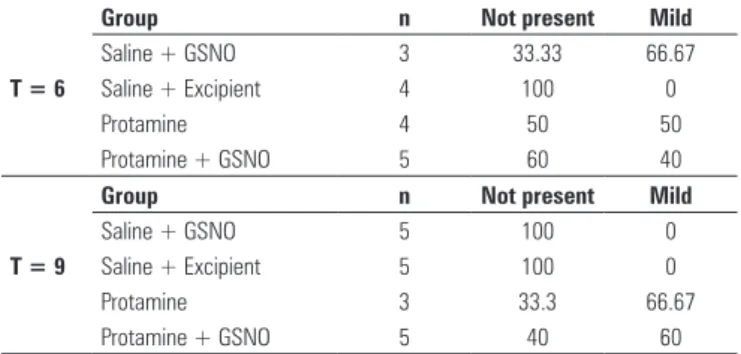
There was no difference between the groups regarding fibrosis in T = 6 (p = 0.3781). After 9 days, fibrosis was significantly higher in Group 4 (protamine + GSNO) when compared to Groups 1 and 2 (p = 0.0035), according to table 8.
The animals euthanized in T = 6 did not present any significant differences regarding linfomonocitary infiltrate (p = 0.7253). In T = 9, there was a significant difference between the groups (p = 0,0459). In the group treated with GSNO + saline solution, the infiltrate was larger than in the others. The presence of mast cells in the infiltrate was not observed in a way that allowed its quantification and comparison among groups.
DISCUSSION
Interstitial cystitis is a condition that deserves our attention for many reasons, including lack of reliable criteria for diagnosis. Usually, a clinical diagnosis is made, but cystoscopy and histology are also important tools for the investigator. There are a few classifications available in the literature, but further analyses must
be developed at molecular level. For that reason, in
vivo and in vitro experimental models are needed, in
that the ones previously described do not reproduce the inflammation properly, because its cause is often
unknown(5). Previous studies found higher levels of NO
in patients with IC, demonstrating the need of further
studies about its role in the inflammatory process(6).
Besides the already known difficulties, it is important to create an experimental model to study the IC, since it is so hard to perform a clinical trial. In one of the few trials with patients(7), besides the small sample, it was difficult to collect material from them. Because it causes great discomfort, the patients chosen for the clinical trial were those who would already referred to surgery for some other bladder disorder. In this case, 25 ml of air were introduced via catheter in the patient bladder and after 5 minutes the air was analyzed and the level of NO was compared to that in room air. The study found significant differences, proving that patients with cystitis
presented more NO than healthy individuals(8).
There are few experimental models of IC described in the literature, and many attempts have failed. The first projects of development of IC in animals used
T = 6
Group n Not present Mild
Saline + GSNO 3 33.33 66.67
Saline + Excipient 4 100 0
Protamine 4 50 50
Protamine + GSNO 5 60 40
T = 9
Group n Not present Mild
Saline + GSNO 5 100 0
Saline + Excipient 5 100 0
Protamine 3 33.3 66.67
Protamine + GSNO 5 40 60
Table 8. Descriptive analysis and comparison of fibrosis among groups (%)
GSNO: S-nitrousglutathione.
In all groups, neutrophilic infiltrate of variable intensity was observed after six days. After nine days, a tendency towards regression was observed, with no significant differences between groups (p = 0.7277, T = 6; p = 0.2301, T = 9).
The tendency of regression was also observed in the edema, in all groups, with no significant differences (T = 6, p = 0.8096; T = 9, p = 0.2478). Edema can be observed in figures 5 to 7.
Figure 5. Mild submucosal and interstitial edema. (HE, 10 times)
Figure 6. Moderate submucosal and interstitial edema (HE, 10 times)
acetic acid, cyclophosphamide, lipopolysaccharides, protamine sulfate and agonist of vanilloid receptors. These substances did not produce the expected effects, either because they excessively damaged the bladder, or for not being reliable.
It was proposed that impaired barrier function of bladder epithelium and subsequent infiltration of urine contents be important initial events in the pathophysiology of IC. Therefore, Fraser et al. tried to develop a model that would reliably mimic the acute phase of this debilitating disease. To this end, they combined protamine sulfate (PS) treatment, thought to breakdown urothelial umbrella cell barrier function, and physiologic concentrations of KCl in an open cystometrogram animal model. Female Sprague-Dawley rats were anesthetized and transurethral continuous cystometry was performed with normal saline, and 100 or 500 mmol/l of KCl as control. Either 10 or 30 mg/ml of PS was then added to the control solution for a 30-minute period (for mild and severe urothelial barrier breakdown, respectively), after which the control solution was continued for one to two hours. Bladder contraction amplitudes, durations, frequency, and intercontractile intervals were recorded and analyzed. There were no differences between the saline, 100 or 500 mmol/l of KCl control periods, indicating that barrier function in these animals was not affected by the physical preparation. Of the treatments tested, 100 mmol/l of KCl with 30 mg/ml of PS and 500 mmol/l of KCl (the physiologic concentration of rat urine) with either 10 or 30 mg/ml of PS produced reliable irritation, which continued up to 2 hours after cessation of PS administration. These results indicate that the historic use of normal saline, instead of the more physiologic 500 mmol/l of KCl, for cystometry greatly biases our understanding of the function of the lower urinary tract in animal models of IC; and slight, non-cytotoxic insults to urothelial barrier function can result in dramatic irritating responses, given the proper physiological conditions(9).
In 2007, an experimental model of IC was
described with intraperitoneal administration
of cyclophosphamide, an anti-tumor agent that is metabolized into acrolein in the kidney and accumulates in the bladder to produce toxic effects, ultimately resulting in visceral pain. This substance produces histological damage only in the urothelium. Cyclophosphamide was dissolved in 0.9% saline solution and administered intraperitoneally (IP). Vehicle or CP was administered (200 – 400 mg/kg, IP), and spontaneous and evoked pain behaviors were
evaluated simultaneously in the same mice(10).
Another experimental study was performed in cats that already presented idiopathic IC. In some cats
there was naturally an idiopathic form of IC with all the characteristics of human IC, including its symptoms. The animals had history of polakiuria, hematuria and micturition in inadequate locations. After the study of NO levels in both control and IC bladders, it was observed
that the NO levels in the IC bladders were higher(11).
Rudick et al. studied a variety of attenuated pseudorabies virus (PRV) (Bartha), a homologous of herpes virus that is taken up by neurons and undergoes retrograde transport and viral replication within the central nervous system (CNS). PRV was originally shown to cause cystitis in rats when injected into the tailbase posterior abductor muscle and taken up by motor neurons. PRV-induced cystitis is a neurally mediated event triggered by viral action in the CNS, and cystitis is associated with bladder mast cell activation, even though Bartha PRV is incapable of descending sensory nerves to the bladder. In mice, PRV causes urothelial expression of RANTES (Re-Activated in Normal, T cell-Expressed, Secreted), a chemokine known to promote mast cell trafficking. Thus, the pathophysiology of murine PRV cystitis is consistent with human IC, in which the presence of urothelial lesions in patient biopsies correlates with IC symptoms, and many IC patients are very sensitive to instillation of nerve-depolarizing concentrations of KCl into the bladder, a
finding that suggests a loss of barrier function(12).
In the literature we can also find IC induction with substance P and lipopolysaccharides (LPS). Substance P was instilled in the bladders of rats 24 hours after
exposure to LPS. In vitro studies determined that LPS
and substance P induced the release of histamine and cytokine by the bladder. LPS was absorbed by the urothelial cells and systemically distributed. Twenty-four hours after the instillation, bladder inflammation was characterized by edema and leukocyte infiltration on its wall(8).
The probable relation between NO and the IC inflammatory process led to an attempt to produce an experimental model that is closer to reality and also more reliable, with a NO donor gel to start up the inflammatory process.
The findings in the histology of the bladders of the rats, indicating inflammation, show that it is possible to continue these tests so that the IC studies can be developed even further.
CONCLUSIONS
REFERENCES
1. Oktem G, Altay B, Turna B, Aktug H, Yavasoglu A, Yilmaz O, et al. Determination of nitric oxide synthase activity and apoptosis of germ cells in different obstruction models. Acta Histochem. 2000;111(2):119-26.
2. Abrams P, Cardozo L, Fall M, Griffiths D, Rosier P, Ulmsteinn U, Van Kerrebroeck P, Victor A, Wein A; Standardisation Sub-Committee of the International Continence Society. The standardisation of terminology in lower urinary tract function: report from the standardisation sub-committee of the International Continence Society. Urology. 2003;61(1):37-49.
3. Birder LA, Kanai AJ, de Groat WC. DMSO: effect on bladder afferent neurons and nitric oxide release. J Urol. 1997;158(5):1989-95.
4. Jones CA, Nyberg L. Epidemiology of interstitial cystitis. Urology. 1997;49(5A Suppl):2-9.
5. Cartledge JJ, Davies AM, Eardley I. A randomized double-blind placebo-controlled crossover trial of the efficacy of L-arginine in the treatment of interstitial cystitis. BJU Int. 2000;85(4):421-6.
6. Erickson DR. Urine markers of interstitial cystitis. Urology. 2001;57(6 Suppl 1):15-21.
7. Koskela LR, Thiel T, Ehrén I, De Verdier PJ, Wiklund NP. Localization and expression of inducible nitric oxide synthase in biopsies from patients with interstitial cystitis. J Urol. 2008;180(2):737-41.
8. Saban MR, Saban R, Hammond TG, Haak-Frendscho M, Steinberg H, Tengowski MW, et al. LPS-sensory peptide communication in experimental cystitis. Am J Physiol Renal Physiol. 2002;282(2):F202-10.
9. Fraser MO, Chuang YC, Lavelle JP, Yoshimura N, de Groat WC, Chancellor MB. A reliable, nondestructive animal model for interstitial cystitis: intravesical low-dose protamine sulfate combined with physiological concentrations of potassium chloride. Urology. 2001;57(6 Suppl 1):112.
10. Wantuch C, Piesla M, Leventhal L. Pharmacological validation of a model of cystitis pain in the mouse. Neurosci Lett. 2007;421(3):250-2.
11. Birder LA, Wolf-Johnston A, Buffington CA, Roppolo JR, de Groat WC, Kanai AJ. Altered inducible nitric oxide synthase expression and nitric oxide production in the bladder of cats with feline interstitial cystitis. J Urol. 2005;173(2):625-9.